How To Close High Ticket Sales: A 2026 Playbook
High-ticket deals are not small deals with bigger numbers. Here is the discovery, proof, and close sequence that actually moves $25k+ contracts across the line in 2026.
TL;DR
- High-ticket closing is won in discovery, not in the close. If you cannot name the buyer's cost of inaction in dollars, you do not have a deal — you have a conversation.
- Expect 6-10 stakeholders on a $25k+ B2B purchase. Your job is to arm an internal champion, not to out-talk a committee.
- Price late, anchor early. Give a range in call one, a fixed number only after you have quantified the problem.
- Most "lost to no decision" deals die from missing contacts, not missing features. Map and reach the whole buying group before you build the proposal.
- The close itself should be boring. If the signature moment feels like a fight, something upstream broke.
What counts as a high ticket sale?#
There is no universal dollar line, but in B2B the practical threshold is where the purchase stops being an expense and starts being a project. That usually begins around $10,000 annual contract value and gets serious past $25,000.
Three things change at that price point:
- Buying committee replaces the buyer. Gartner's widely cited research puts the typical B2B buying group at six to ten decision makers, each arriving with independent research. One enthusiastic user is no longer enough.
- Procurement and legal enter the room. Security reviews, MSAs, and vendor onboarding add weeks. These are not obstacles to overcome; they are stages to plan for.
- The cost of being wrong becomes personal. Someone's judgment is on the line. Risk reduction outsells feature superiority.
That last point is the one most reps miss. At $500/mo, the buyer asks "is this good?" At $50,000/yr, the buyer asks "will this make me look stupid in six months?" Your entire process should answer the second question.
How is closing high ticket different from closing SMB deals?#
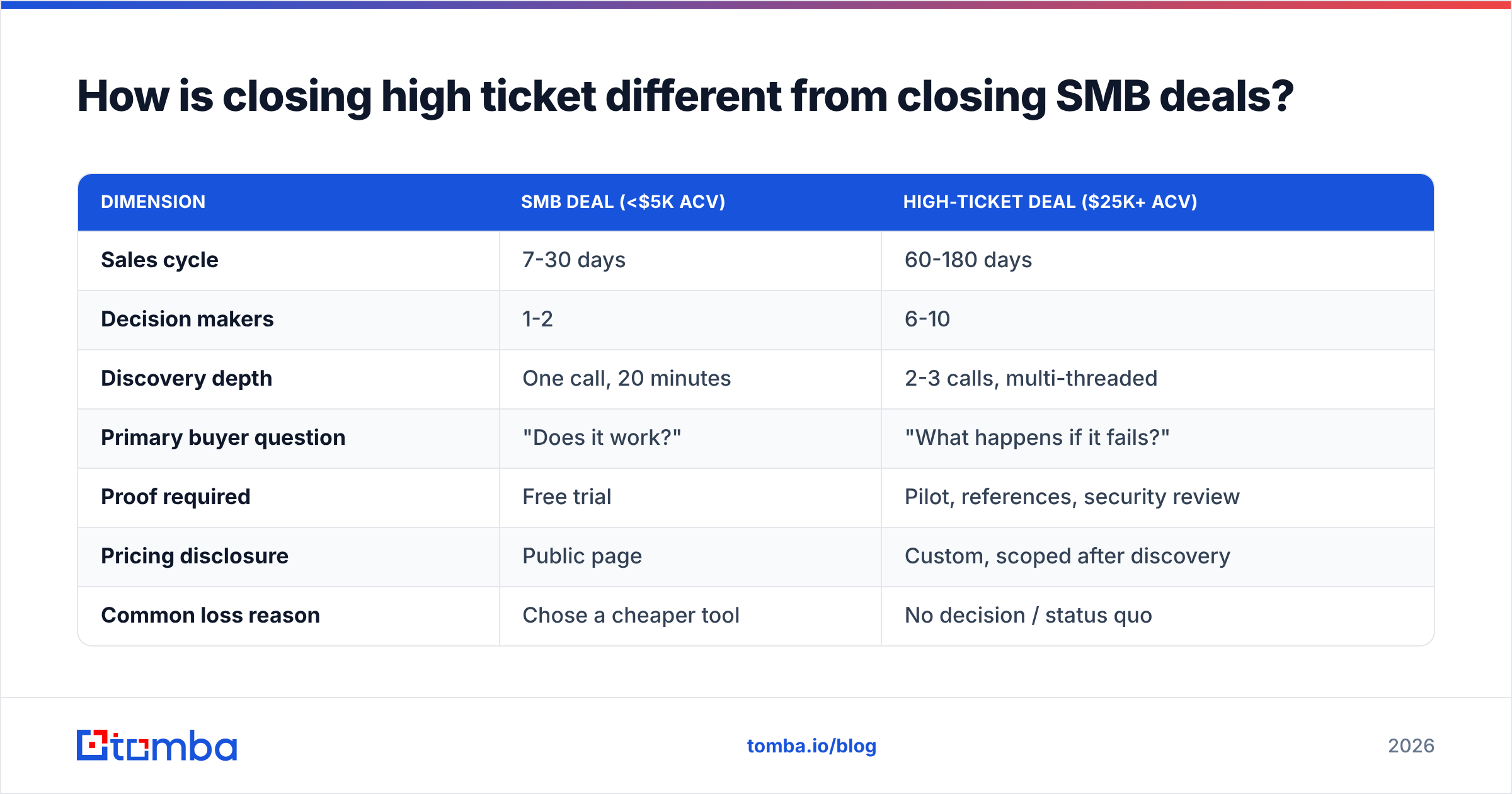
The mechanics diverge more than most playbooks admit. Running an SMB motion on an enterprise deal produces the classic failure pattern: great first call, strong demo, then silence.
| Dimension | SMB deal (<$5k ACV) | High-ticket deal ($25k+ ACV) |
|---|---|---|
| Sales cycle | 7-30 days | 60-180 days |
| Decision makers | 1-2 | 6-10 |
| Discovery depth | One call, 20 minutes | 2-3 calls, multi-threaded |
| Primary buyer question | "Does it work?" | "What happens if it fails?" |
| Proof required | Free trial | Pilot, references, security review |
| Pricing disclosure | Public page | Custom, scoped after discovery |
| Common loss reason | Chose a cheaper tool | No decision / status quo |
| Close mechanic | Trial-to-paid conversion | Mutual action plan + signature |
| Post-close risk | Low | Onboarding failure kills renewal |
Notice the loss reason row. In small deals you lose to competitors. In large deals you lose to inertia. That reframes the whole job: you are not beating a rival vendor, you are beating "let's revisit next quarter."
What does discovery look like for a high ticket deal?#
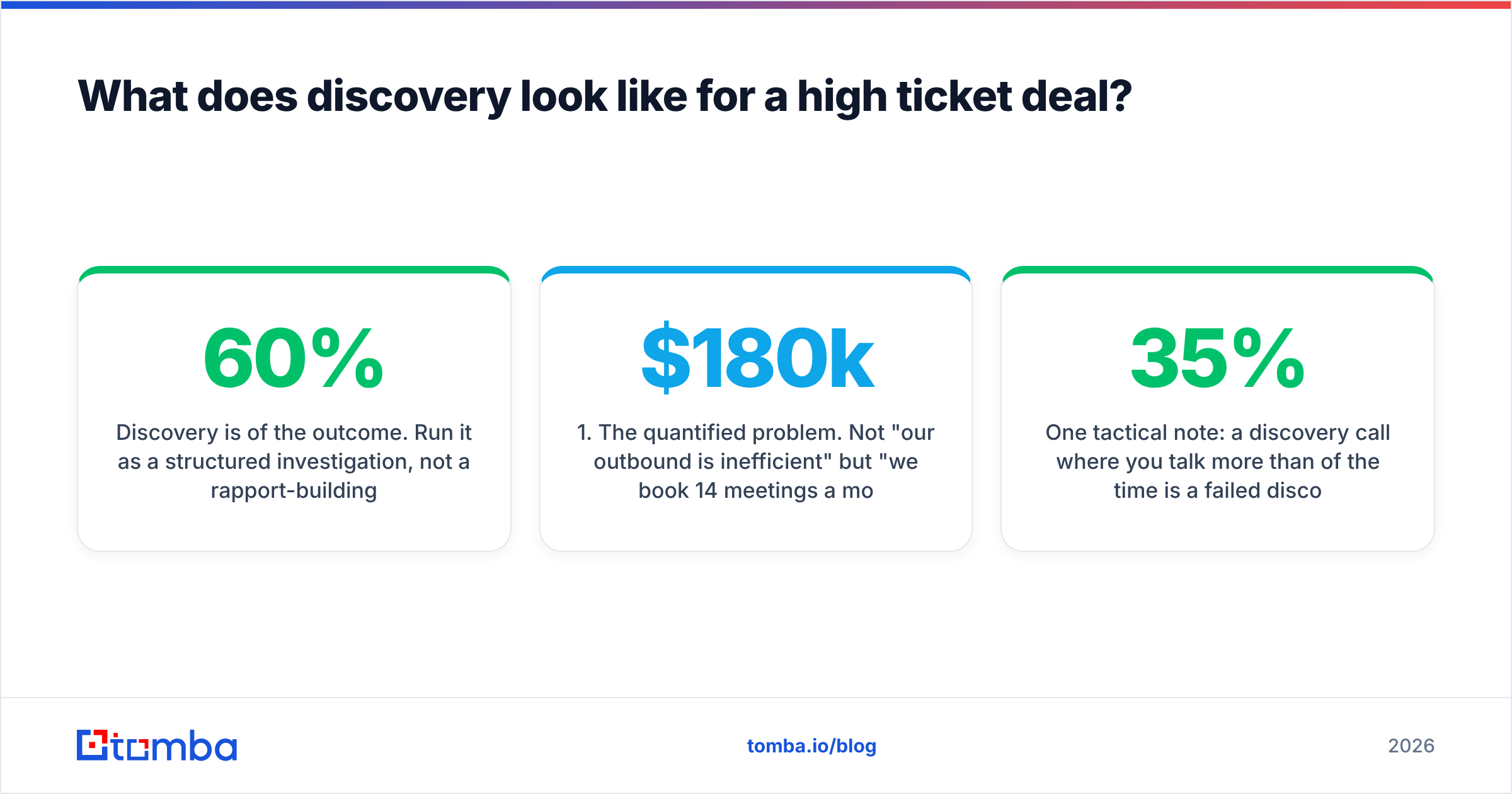
Discovery is 60% of the outcome. Run it as a structured investigation, not a rapport-building chat.
The five things you must leave discovery knowing:
- The quantified problem. Not "our outbound is inefficient" but "we book 14 meetings a month against a target of 40, and each missed month costs roughly $180k in pipeline." If the buyer cannot produce the number, help them build it on the call.
- The trigger event. Why now, and not last year? A new VP, a funding round, a churned enterprise logo, a compliance deadline. No trigger usually means no urgency, which means no close.
- The decision process, in writing. Who signs. Who can veto. What the approval steps are. What the last comparable purchase looked like and how long it took.
- The competing alternatives. Including the internal build option and doing nothing. Ask directly: "If you don't solve this, what happens?"
- The success criteria. What specific metric, measured how, by when, proves this was the right call.
Ask for the numbers explicitly. "Walk me through how you'd calculate what this is costing you" gets better data than "what's your budget?" — and budget conversations become far easier once the cost of inaction is on the table.
One tactical note: a discovery call where you talk more than 35% of the time is a failed discovery call. Record it and check.
How do you reach every stakeholder in the buying group?#
This is where deals quietly die. You have a champion in RevOps, but the VP of Sales, the CFO, and the IT security lead have never heard your name. Then the deal goes to committee and you are represented by a slide deck your champion built at 11pm.
Multi-threading is the fix, and it is a data problem before it is a sales problem. You need verified contact details for people who never filled out your form.
A practical multi-threading sequence:
- Map the org. From the champion's answers plus LinkedIn, list every person who touches the decision. Include the skeptic — especially the skeptic.
- Find verified contacts. Use a domain search to pull the company's email pattern and known contacts, then confirm each address with an email verifier before sending. Bouncing an email to a CFO is a bad first impression you cannot undo.
- Ask permission, then act. "I'd like to send Priya a short note covering the security questions directly — mind if I copy you?" Champions almost always say yes and it protects the relationship.
- Tailor by role. The CFO wants payback period. IT wants SOC 2 and SSO. The end user wants to know their workflow does not break. Same deal, three different one-pagers.
- Add a phone channel for the executive. Senior buyers answer calls more than they answer cold email. Sourcing direct dials through a phone finder gives you a second path when email goes quiet.
Research from vendors across the category consistently shows multi-threaded deals close at meaningfully higher rates than single-threaded ones. The mechanism is simple: single-threaded deals have one point of failure, and that point of failure changes jobs, goes on leave, or gets overruled.
If you are building this list at scale across many accounts, the bulk email finder workflow is faster than looking people up one at a time — feed in the company domains and roles, get back verified contacts for the whole target list.
How should you handle pricing on a high ticket sale?#
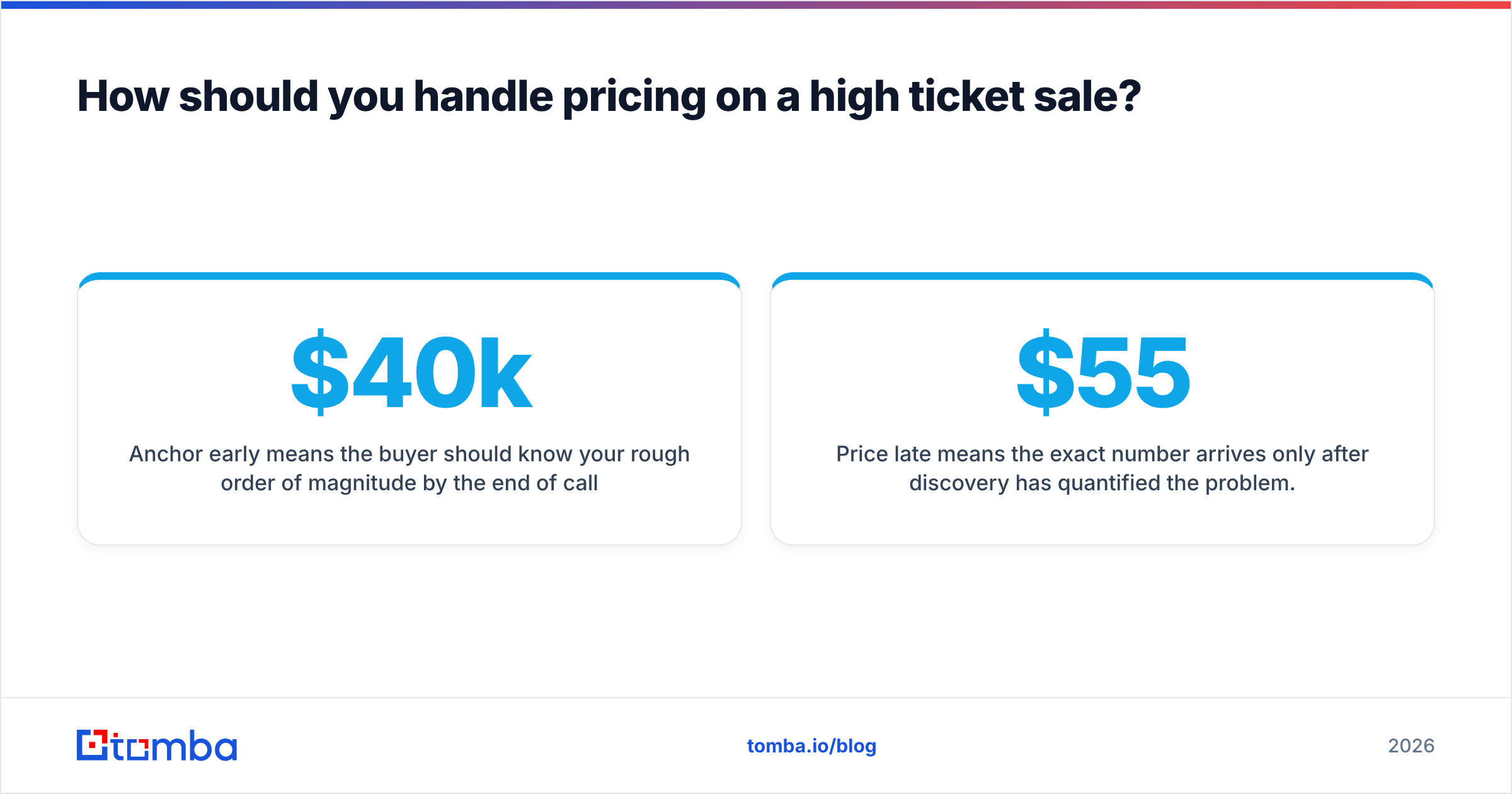
Price late, anchor early. Those are not contradictory.
Anchor early means the buyer should know your rough order of magnitude by the end of call one. "Engagements like this typically land between $40k and $70k a year depending on seat count and data volume." This disqualifies the wrong prospects before you spend six weeks on them, and it prevents the sticker shock that kills deals at proposal stage.
Price late means the exact number arrives only after discovery has quantified the problem. A $55,000 price is absurd in a vacuum and obvious next to a $400,000 annual loss.
Three pricing moves that work at this level:
- Present three options, not one. A scoped-down version, the recommended package, and an expanded version. The buyer's question shifts from "yes or no" to "which one," and the middle option gets chosen most of the time.
- Show the payback math yourself. Do not make the CFO build the model. Put months-to-payback in the proposal, using the buyer's own numbers from discovery.
- Never discount without a trade. Discounting for nothing tells the buyer your original number was fiction. Trade for a longer term, a case study, a faster start date, or annual prepay.
What objections actually stall high ticket deals?#
The objections you hear are rarely the objections that matter. "It's too expensive" almost always translates to "I don't believe the return" or "I don't have the political capital to push this through."
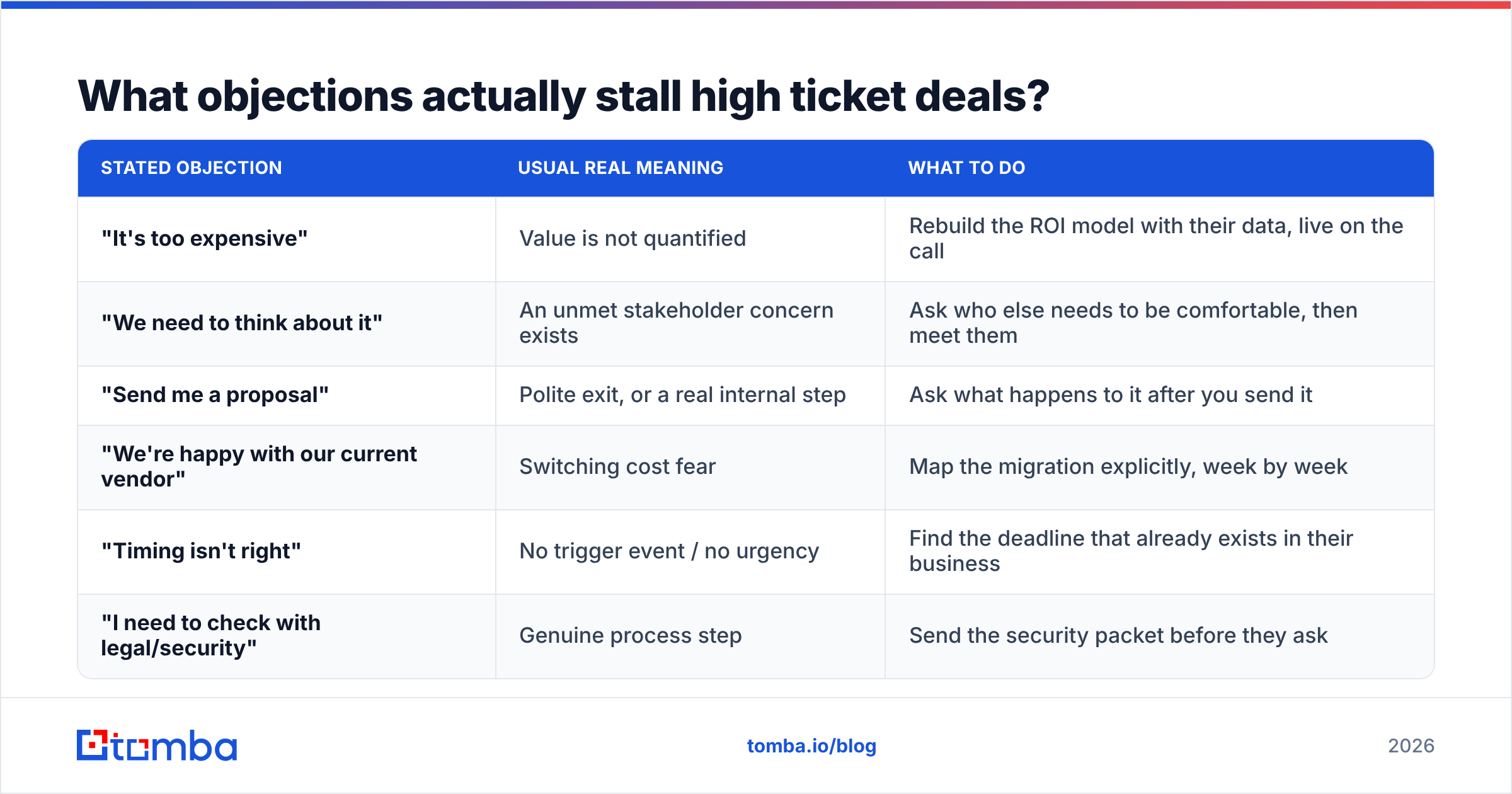
| Stated objection | Usual real meaning | What to do |
|---|---|---|
| "It's too expensive" | Value is not quantified | Rebuild the ROI model with their data, live on the call |
| "We need to think about it" | An unmet stakeholder concern exists | Ask who else needs to be comfortable, then meet them |
| "Send me a proposal" | Polite exit, or a real internal step | Ask what happens to it after you send it |
| "We're happy with our current vendor" | Switching cost fear | Map the migration explicitly, week by week |
| "Timing isn't right" | No trigger event / no urgency | Find the deadline that already exists in their business |
| "I need to check with legal/security" | Genuine process step | Send the security packet before they ask |
The technique that resolves most of these is the same: get specific. "Too expensive compared to what?" "What would need to be true for the timing to be right?" Vague objections stay unresolved; specific ones become work items.
And when the answer really is no, take it early. A fast no is worth more than a slow maybe, because forecast accuracy is a real asset when you are managing a long-cycle pipeline. Track your win rate by stage to see where deals actually die versus where you think they die.
What does the actual close look like?#
If you have done discovery, multi-threading, and pricing properly, the close is administrative. That is the goal.
The mutual action plan. Somewhere around the mid-point of the cycle, build a shared document with the buyer listing every step to go live: security review, legal redlines, procurement submission, kickoff date, first value milestone. Put names and dates on each row. Send it to the champion for edits.
This does three things. It exposes hidden steps before they surprise you. It creates a natural reason to check in that is not "just following up." And it shifts the frame from "will you buy" to "here is how we go live," which is a far easier conversation.
The close sequence itself:
- Confirm the decision criteria are met. Walk through the success criteria from discovery and show how each is addressed. Get explicit agreement on each one.
- Surface remaining risk. "What's the biggest reason this wouldn't work?" Ask it directly. Unspoken risk is what turns into a stalled deal.
- Set the signature path. Who signs, in what order, on what platform, by when. Ambiguity here costs weeks.
- Make the ask plainly. "Everything we discussed is reflected in the agreement. Can we get it signed by Friday so onboarding starts on the 15th?" No theatrics, no manufactured scarcity.
Skip the pressure tactics. Deadline-driven discounts and artificial scarcity work on impulse purchases and actively damage trust with a committee that has been evaluating you for three months. HubSpot's sales research and Salesforce's State of Sales reporting both point the same direction: buyers at this level value transparency and responsiveness over urgency theater.
How do you keep the pipeline full while long deals cook?#
The structural risk of high-ticket selling is that a 120-day cycle makes you neglect prospecting for 120 days. Then Q3 closes strong and Q4 is empty.
Two habits fix this:
- Fixed prospecting blocks. Protect time weekly regardless of how hot your live deals are. Sourcing new accounts and contacts should be a calendar item, not a mood.
- Systematize contact sourcing. The slowest part of prospecting is finding verified contact data, not writing the message. Automating that through an email finder API or a spreadsheet workflow removes the friction that makes reps skip prospecting entirely.
It also helps to widen your definition of a lead source. Website visitor identification, LinkedIn engagement, and account expansion inside existing customers all produce warmer high-ticket opportunities than pure cold outbound. Compare tooling honestly when you build this stack — peers like BookYourData approach the data problem from a prepaid list angle that suits some teams better than a subscription model, and G2's category listings are a reasonable neutral starting point for comparing options.
What metrics tell you your high ticket process is working?#
Do not judge a long-cycle motion on closed-won alone — the feedback loop is too slow to correct anything.
Track these instead:
- Stakeholders engaged per deal. Target three or more with a real two-way interaction. This is the single strongest leading indicator in most enterprise pipelines.
- Discovery-to-proposal conversion. If it is above 80%, you are not disqualifying hard enough and your proposals are going to unqualified buyers.
- Average stage age. Where do deals sit longest? That stage has a missing artifact — usually a security packet, a reference call, or an ROI model.
- No-decision rate. Rising no-decision means discovery is producing weak business cases, not that your closers are weak.
- Contact data accuracy. If a meaningful share of your outreach bounces, your multi-threading is failing silently. Verified contacts are cheaper than lost quarters.
Review these monthly with the whole team. Long cycles hide problems; explicit metrics surface them while there is still time to act.
Where should you start?#
Pick your three largest open opportunities and audit them against this list: Do you have a quantified cost of inaction? Do you have three or more engaged stakeholders? Do you have a mutual action plan with dates? Do you know exactly who signs?
Most reps find at least one gap in every deal. Close those gaps before you build another proposal.
If the gap is contacts — and it usually is — start there. Tomba's Email Finder gives you verified professional email addresses for every stakeholder in the buying committee, so you can multi-thread a $50k deal instead of hoping one champion carries it. The free tier includes 25 searches a month to test it on a live deal; paid plans start at $49/mo on Starter, with Growth at $99/mo for teams running volume. Full Tomba pricing is public — no scoping call required.
Related guides#
// get started
Find, verify and enrich your first contacts today
Start on the free plan with 25 searches a month, then scale when your team is ready.
Free plan · No credit card required · GDPR & CCPA
// about the author