How to Coach a Sales Team: A Practical 2026 Framework
Most sales coaching fails because managers inspect deals instead of building skills. Here is a repeatable weekly system — cadence, call reviews, scorecards, and metrics — that actually moves win rates.
TL;DR
- Sales coaching is skill development. Pipeline review is deal inspection. Most managers do the second, call it the first, and wonder why nothing changes.
- A working system needs four parts: a fixed weekly cadence, a call-review scorecard, one skill focus per rep per month, and a metric that proves the skill moved.
- Coach one behavior at a time. Reps who get five pieces of feedback in a 30-minute 1:1 apply zero of them.
- Ramp coaching, mid-performer coaching, and top-performer coaching are three different jobs — do not run the same template on all three.
- Bad data breaks coaching before it starts. If a rep's connect rate is low because half their contacts bounce, no amount of talk-track work fixes it.
Managers get promoted for closing deals and then get handed a job nobody trained them for. The default fallback is to run pipeline reviews harder — more deals inspected, more forecast pressure, more "what's the next step?" What follows is the alternative: a system for building rep capability that you can run in about three hours a week per five reps.
What is sales coaching, actually?#
Sales coaching is the repeatable process of observing a rep's behavior, isolating one gap, giving targeted feedback, and verifying the behavior changed on the next attempt. That last clause is the one everyone skips.
Think of it like a golf swing lesson. A coach does not stand behind you and ask what your score was — that is the scoreboard, and you both already know it. The coach watches your grip, changes one thing, and makes you hit twenty more balls to see if the change stuck. Pipeline review is the scoreboard. Coaching is the grip.
The distinction matters because the two activities compete for the same calendar slot and the same 1:1. Here is how they split:
- Deal inspection asks "what happens next on the Acme deal?" It moves one opportunity forward and teaches nothing transferable.
- Pipeline review asks "is there enough coverage to hit the number?" It is a management and forecasting function, not a development one.
- Skill coaching asks "why did you not ask about budget authority on that call?" It transfers to every future call.
- Career coaching asks "where do you want to be in eighteen months?" It drives retention, which quietly drives quota attainment more than any tactic on this list.
- Process coaching asks "why is your CRM stage data wrong?" It sounds administrative but it protects the accuracy of every other signal you use.
Blend all five into one 30-minute meeting and you have accomplished none of them. Separate them by calendar slot.
How often should you coach a sales team?#
Weekly, thirty minutes, per rep, protected. That is the floor. Research consistently ties consistent coaching cadence to quota attainment — Gartner's sales research and Salesforce's State of Sales both put development time near the top of what separates high-performing sales orgs from average ones. What kills coaching is not disagreement about its value; it is that the slot is the first thing cancelled when a deal catches fire.
Protect it by making the coaching 1:1 a different meeting from the forecast call. If they share a slot, the forecast always wins — urgency beats importance every time.
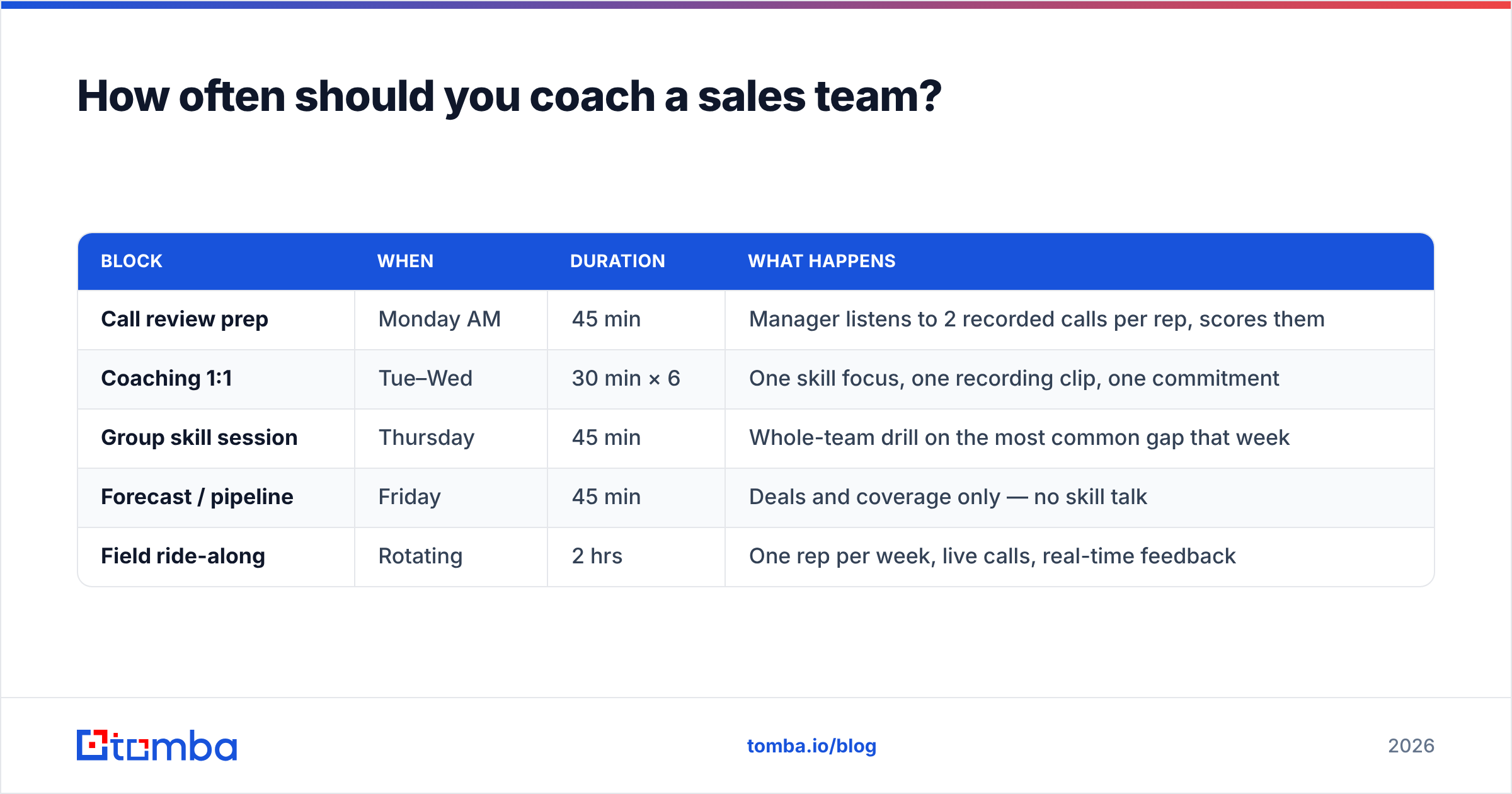
A workable weekly rhythm for a manager with six reps:
| Block | When | Duration | What happens |
|---|---|---|---|
| Call review prep | Monday AM | 45 min | Manager listens to 2 recorded calls per rep, scores them |
| Coaching 1:1 | Tue–Wed | 30 min × 6 | One skill focus, one recording clip, one commitment |
| Group skill session | Thursday | 45 min | Whole-team drill on the most common gap that week |
| Forecast / pipeline | Friday | 45 min | Deals and coverage only — no skill talk |
| Field ride-along | Rotating | 2 hrs | One rep per week, live calls, real-time feedback |
Total: roughly five hours. If you cannot find five hours a week to develop the people who carry your number, the problem is your calendar, not the framework.
What should you actually review — calls or CRM?#
Calls. CRM data tells you what happened; recordings tell you why. A rep with a 12% demo-to-proposal rate has a problem you can see in the CRM, but you can only diagnose it by listening to four demos back to back.
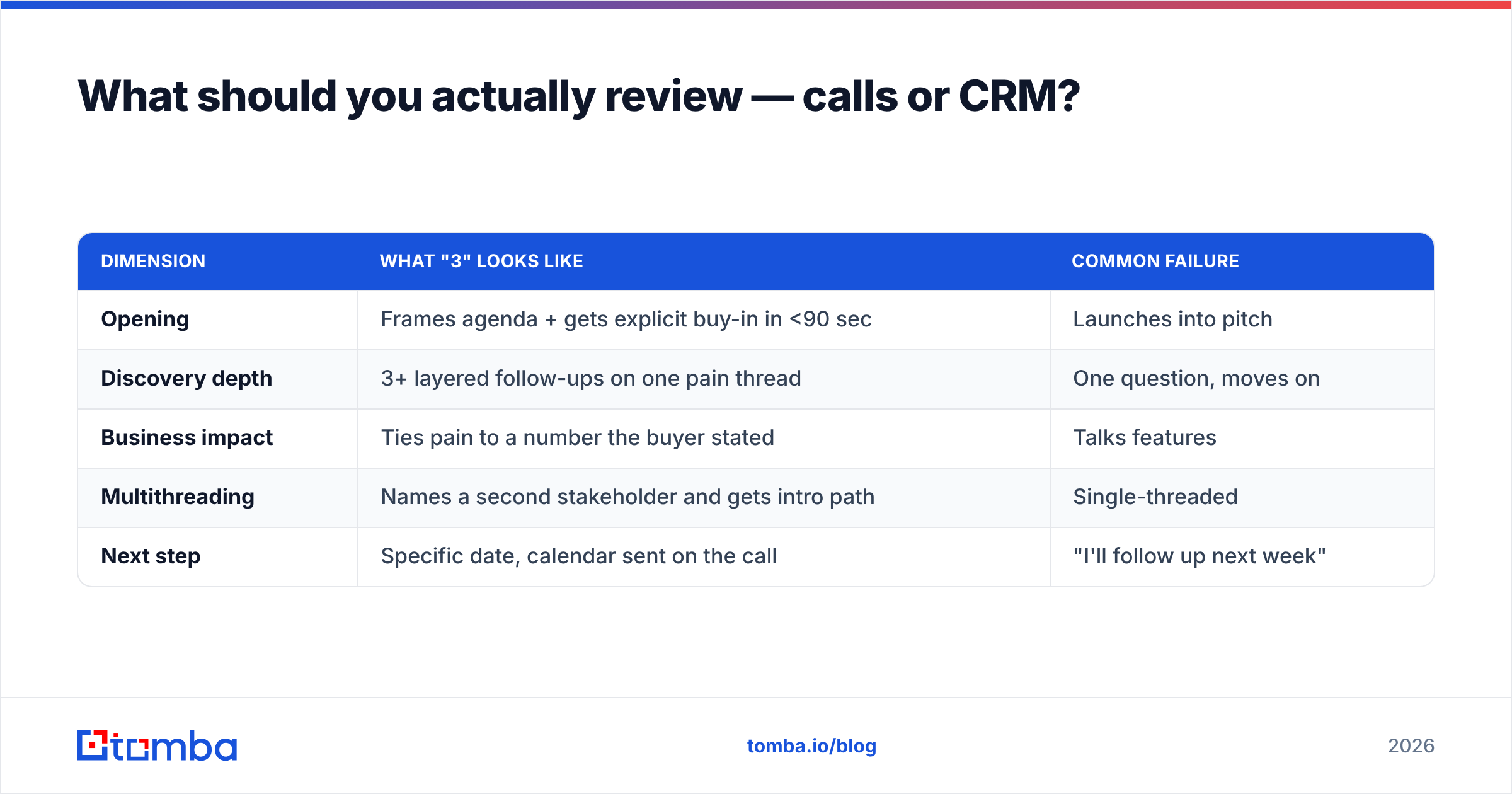
Score calls against a fixed rubric so feedback stops being about your taste and starts being about the standard. A workable five-dimension scorecard:
| Dimension | What "3" looks like | Common failure |
|---|---|---|
| Opening | Frames agenda + gets explicit buy-in in <90 sec | Launches into pitch |
| Discovery depth | 3+ layered follow-ups on one pain thread | One question, moves on |
| Business impact | Ties pain to a number the buyer stated | Talks features |
| Multithreading | Names a second stakeholder and gets intro path | Single-threaded |
| Next step | Specific date, calendar sent on the call | "I'll follow up next week" |
Score 1–3 on each. Anything under 10/15 gets a coaching focus. Do not send the scorecard by email and call it coaching — the score is the conversation starter, not the conversation.
Recording tools make this tractable. Conversation intelligence platforms surface talk-ratio, monologue length, and question count automatically, which means your 45 minutes of prep goes to judgment rather than transcription. If your team already evaluated one and passed, the market is broad enough that a Gong alternative usually covers the same review workflow at a different price point.
[Suggested visual: screenshot of a conversation-intelligence call review timeline showing talk-ratio bars and flagged discovery questions]
How do you run a coaching 1:1 that changes behavior?#
Use a fixed structure. Improvisation produces pleasant conversations and no measurable change.
The 30-minute structure:
- Rep self-assessment (5 min). "Play me the moment in that call you'd redo." Reps identify their own gap correctly about 60% of the time, and self-identified gaps get fixed faster than assigned ones.
- Clip review (8 min). Play one 90-second segment. Not the whole call. The clip is evidence, and evidence ends debate.
- One diagnosis (5 min). Name a single behavior. "You asked about budget, they deflected, and you moved on" — not "your discovery needs work."
- Role-play the replacement (8 min). This is the part everyone cuts and it is the part that works. Have them say the better version out loud, twice, until it sounds like them and not like you.
- Written commitment (4 min). One sentence in a shared doc: what they will do, on which calls, before next Tuesday.
Next week, you open by reviewing that commitment. If you skip that step, reps learn the commitments are theater and stop preparing.
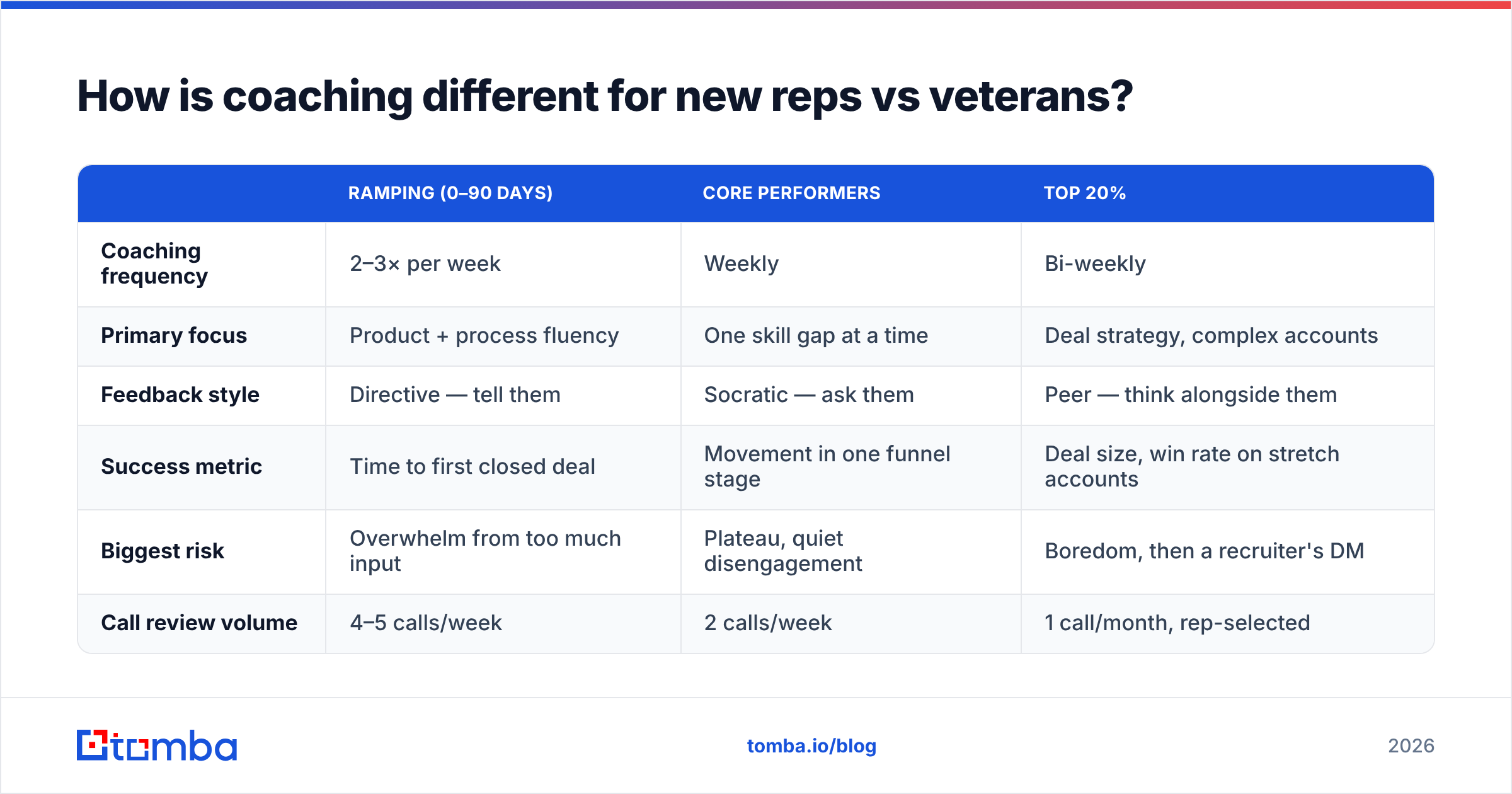
How is coaching different for new reps vs veterans?#
Radically. Running the same playbook across a mixed-tenure team is the most common structural mistake in sales management.
| Ramping (0–90 days) | Core performers | Top 20% | |
|---|---|---|---|
| Coaching frequency | 2–3× per week | Weekly | Bi-weekly |
| Primary focus | Product + process fluency | One skill gap at a time | Deal strategy, complex accounts |
| Feedback style | Directive — tell them | Socratic — ask them | Peer — think alongside them |
| Success metric | Time to first closed deal | Movement in one funnel stage | Deal size, win rate on stretch accounts |
| Biggest risk | Overwhelm from too much input | Plateau, quiet disengagement | Boredom, then a recruiter's DM |
| Call review volume | 4–5 calls/week | 2 calls/week | 1 call/month, rep-selected |
The top-performer column deserves attention. Managers under-coach their best reps because those reps are hitting quota, then are surprised when they leave. High performers do not want less coaching — they want harder coaching. Bring them a deal you cannot figure out and think it through together.
What metrics prove your coaching is working?#
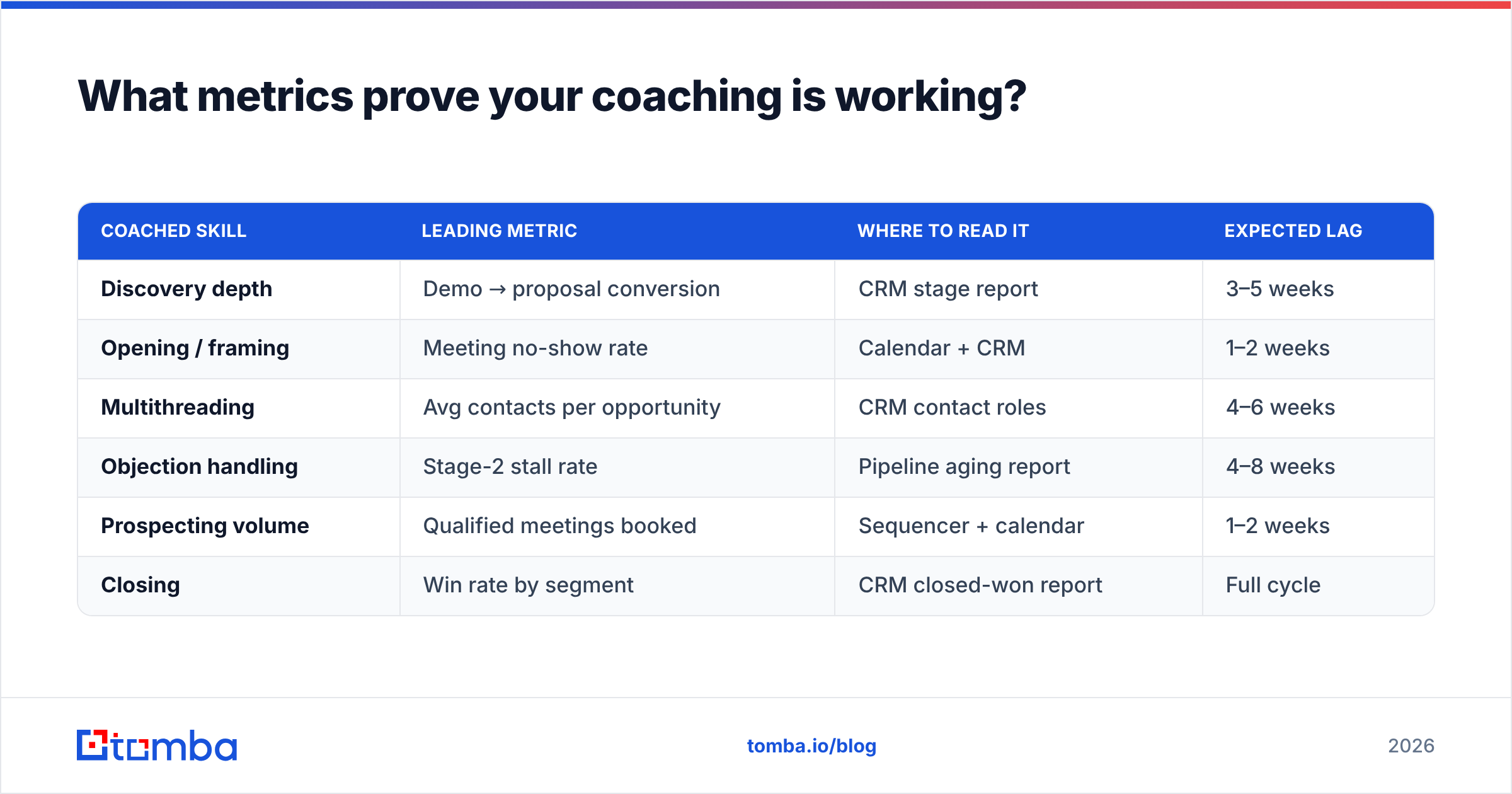
Quota attainment is a lagging indicator with a sales-cycle-length delay, which makes it useless for steering. Track leading indicators tied to the specific skill you coached.
| Coached skill | Leading metric | Where to read it | Expected lag |
|---|---|---|---|
| Discovery depth | Demo → proposal conversion | CRM stage report | 3–5 weeks |
| Opening / framing | Meeting no-show rate | Calendar + CRM | 1–2 weeks |
| Multithreading | Avg contacts per opportunity | CRM contact roles | 4–6 weeks |
| Objection handling | Stage-2 stall rate | Pipeline aging report | 4–8 weeks |
| Prospecting volume | Qualified meetings booked | Sequencer + calendar | 1–2 weeks |
| Closing | Win rate by segment | CRM closed-won report | Full cycle |
Pick one metric per rep per month. If it has not moved in two cycles, your diagnosis was wrong — change the diagnosis, not the rep.
A caution on measurement: leading metrics are only trustworthy if the underlying data is clean. Stage definitions must be written down and enforced, or "demo → proposal conversion" measures reporting habits rather than skill.
Why do coaching programs fail?#
Five failure modes account for most of it.
- The cancelled slot. Coaching gets moved for a customer escalation once, then twice, then permanently. Fix: coaching happens even when it is 15 minutes in a car.
- Feedback flooding. Five notes in one session, none applied. Fix: one behavior, one commitment, verified next week.
- No standard. Every manager coaches to personal preference, so reps get contradictory input across managers. Fix: a shared scorecard the whole front line uses.
- Coaching the number. "You need three more meetings" is a target, not coaching. Fix: coach the behavior that produces the meeting.
- Broken inputs. You coach a rep on call openings when their real problem is that 30% of their dials go to disconnected numbers or bounced addresses.
That last one is worth expanding, because it is the one managers most often mistake for a skill problem.
How does data quality affect coaching?#
Coaching sits on top of a data layer, and a bad data layer makes every diagnosis wrong.
Consider a rep whose connect rate is half the team average. You could coach cadence, timing, and voicemail scripts for six weeks. But if their list came from a stale export and a third of the emails hard-bounce, you have been coaching a symptom while the sender reputation quietly degrades for the whole domain.
Before you diagnose a prospecting skill gap, verify three things:
- Contact validity. Run the rep's list through an email verifier and check the bounce rate. Above 3% and the list is the problem, not the rep.
- Contact completeness. Are they working from a name and a company, or a name, verified email, direct dial, and role context? Reps with thin records burn selling time on research. Contact enrichment closes that gap faster than any pep talk.
- Territory coverage. Two reps with wildly different connect rates may simply have different account quality. Check before you coach.
The rule: separate input problems from execution problems before every coaching conversation. A rep working a bad list who gets coached on effort will disengage, and they will be right to.
[Suggested visual: screenshot of a CRM contact record showing verified email status, direct dial, and last-enriched date side by side with an unverified record]
What tools support a coaching program?#
You do not need a stack to start — a recording tool and a shared doc covers the first 90 days. As the team grows, the categories that matter:
| Category | What it does for coaching | Watch out for |
|---|---|---|
| Conversation intelligence | Auto-transcribes and scores calls, clips moments | Managers watch dashboards instead of calls |
| CRM reporting | Supplies the leading metrics above | Garbage stage hygiene = garbage signal |
| Enablement / LMS | Houses playbooks, certification, onboarding paths | Content rots; assign an owner |
| Data + email finder | Ensures reps work verified, complete contact records | Free scrapers produce bounce-heavy lists |
| Sequencer | Shows cadence adherence and reply rates per rep | Volume metrics mistaken for skill metrics |
Review categories on G2 before committing, and be honest about whether a tool solves a problem you actually have. Most coaching failures are calendar failures, and no software fixes a calendar.
What does a 90-day rollout look like?#
Days 1–30 — Establish the baseline. Set the scorecard. Score three calls per rep without giving feedback yet. Publish the rubric so reps know what "good" means. Fix data inputs: verify lists, audit CRM stage definitions.
Days 31–60 — Run the cadence. Weekly 1:1s begin. One skill focus per rep. Start the group session on the most common gap. Track one leading metric per rep. Expect resistance from veterans — frame it as "I want your read on this deal," not remediation.
Days 61–90 — Measure and adjust. Compare scorecard averages to day 1. Look for movement in leading metrics. Retire the focus areas that closed, pick new ones. Have each rep coach a peer on the skill they just fixed — teaching is the fastest way to lock in a behavior.
By day 90 you should be able to answer, per rep, three questions: what skill did they improve, what metric moved, and what is next. If you cannot, the program was activity without a system.
Start with clean inputs#
Coaching only compounds when the underlying pipeline is real. If your reps are burning their week chasing contacts that bounce or dialing numbers that ring nowhere, the coaching conversation will keep landing on effort when the problem is data.
Fix the input layer first: use Tomba Email Finder to build verified contact lists by domain, name, or company, so every call your reps make is a call worth coaching. The free tier includes 25 searches a month to test list quality against your current source; paid plans start at $49/mo, with full Tomba pricing covering bulk workflows and API access when you scale it across the team. Clean data, then coach the behavior — in that order.
Related guides#
Ready to find emails that actually work?
Join 150,000+ professionals who stopped guessing and started sending. Free credits on signup — no credit card required.
Get the Tomba newsletter
Practical outbound tactics and product updates — once every two weeks.
About the author