How to Coach Salespeople: A Practical 2026 Manager Playbook
Most sales coaching is just deal inspection wearing a friendlier name. Here is a weekly cadence, a call-scoring rubric, and a metric set that proves coaching actually moved win rates.
TL;DR
- Coaching is not deal inspection. If your 1:1 agenda is "walk me through your pipeline," you are forecasting, not coaching.
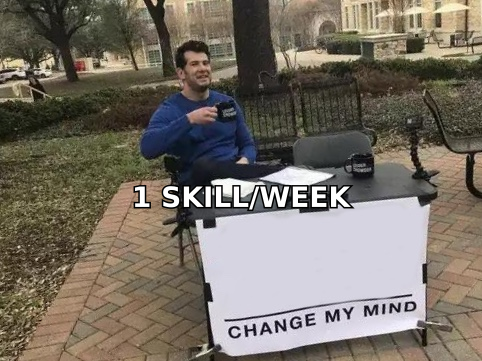
- Coach one skill per rep per week. Reps who get three feedback points at once change zero behaviors.
- Score calls against a written rubric, not a vibe. A 6-line rubric beats a 40-line one because managers actually fill it in.
- Ramping reps need mechanics (talk tracks, objection handling). Veterans need deal strategy and territory design. Same cadence, different content.
- Measure coaching by leading indicators — meetings booked per 100 contacts, first-call-to-second-call conversion — not by quarterly quota attainment, which lags too far behind to correct anything.
What does it actually mean to coach salespeople?#
Coaching means changing what a rep does on their next call. That is the whole test. If the conversation you just had will not visibly alter behavior in the next 72 hours, it was a status update.
Three activities get mislabeled as coaching, and separating them is the first real move a sales manager makes:
- Deal inspection — "What's the next step on Acme?" This protects the forecast. It teaches nothing, because you are solving the rep's problem for them instead of building their ability to solve it.
- Performance management — "You're at 62% of quota, here's the plan." Necessary, documented, HR-adjacent. It is not coaching and should not share a meeting slot with coaching, because the rep will spend the whole hour defending themselves.
- Coaching — "Let's listen to minute 14 of the Northwind call, where the prospect said 'we already have something.' What did you do next, and what else could you have done?"
Only the third one builds capability. HubSpot's sales research has consistently found that reps forget most of what they learn in onboarding within weeks unless it is reinforced in the field — which is a polite way of saying that training without coaching is a sunk cost.
The practical implication: separate the calendar. Deal inspection belongs in a pipeline review with the whole team. Coaching belongs in a protected 1:1 where nobody's compensation is on the table.
Why do most sales coaching programs fail?#
They fail for four reasons, and none of them is "the manager didn't care."
The cadence collapses under quarter-end pressure. Coaching 1:1s are the first meeting cancelled when the number is at risk — which is precisely when reps need them. Managers who protect the slot in week 12 of the quarter get compounding returns; managers who don't restart from zero every quarter.
Feedback is too broad to act on. "Be more consultative" is not coachable. "In the first four minutes, you asked two questions and made nine statements — flip that ratio next call" is coachable, because the rep can count it themselves.
Too much feedback at once. A manager listens to a 40-minute call, finds eleven things, and delivers all eleven. The rep changes nothing, because working memory during a live call holds about one new behavior. Pick the highest-leverage one and let the other ten wait.
No shared standard. Without a rubric, two managers on the same team coach in opposite directions, and reps learn to optimize for whoever reviews their calls that month. Gartner's sales research repeatedly points at inconsistent frontline management as the drag on enablement ROI — the content is fine, the delivery varies by manager.
How do you build a weekly coaching cadence?#
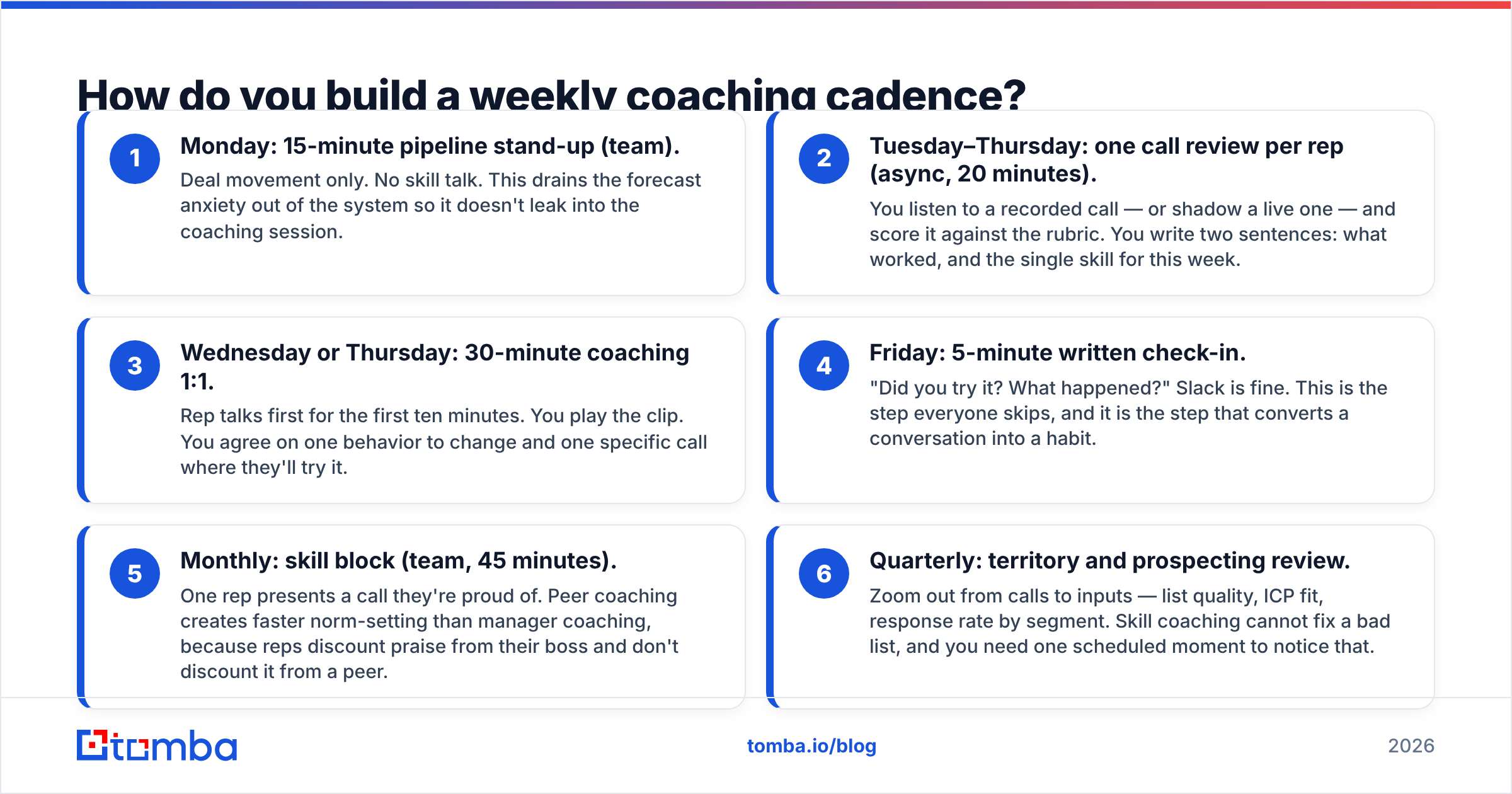
Here is the structure that survives a bad quarter. Six components, roughly 90 minutes of manager time per rep per week including prep.
- Monday: 15-minute pipeline stand-up (team). Deal movement only. No skill talk. This drains the forecast anxiety out of the system so it doesn't leak into the coaching session.
- Tuesday–Thursday: one call review per rep (async, 20 minutes). You listen to a recorded call — or shadow a live one — and score it against the rubric. You write two sentences: what worked, and the single skill for this week.
- Wednesday or Thursday: 30-minute coaching 1:1. Rep talks first for the first ten minutes. You play the clip. You agree on one behavior to change and one specific call where they'll try it.
- Friday: 5-minute written check-in. "Did you try it? What happened?" Slack is fine. This is the step everyone skips, and it is the step that converts a conversation into a habit.
- Monthly: skill block (team, 45 minutes). One rep presents a call they're proud of. Peer coaching creates faster norm-setting than manager coaching, because reps discount praise from their boss and don't discount it from a peer.
- Quarterly: territory and prospecting review. Zoom out from calls to inputs — list quality, ICP fit, response rate by segment. Skill coaching cannot fix a bad list, and you need one scheduled moment to notice that.
The unlock is the Friday check-in. Managers who run steps 1–3 and drop steps 4–6 report that coaching "doesn't stick," which is accurate: nothing reinforced the behavior between Wednesday and the following Wednesday.
What should you coach: skills, deals, or pipeline?#
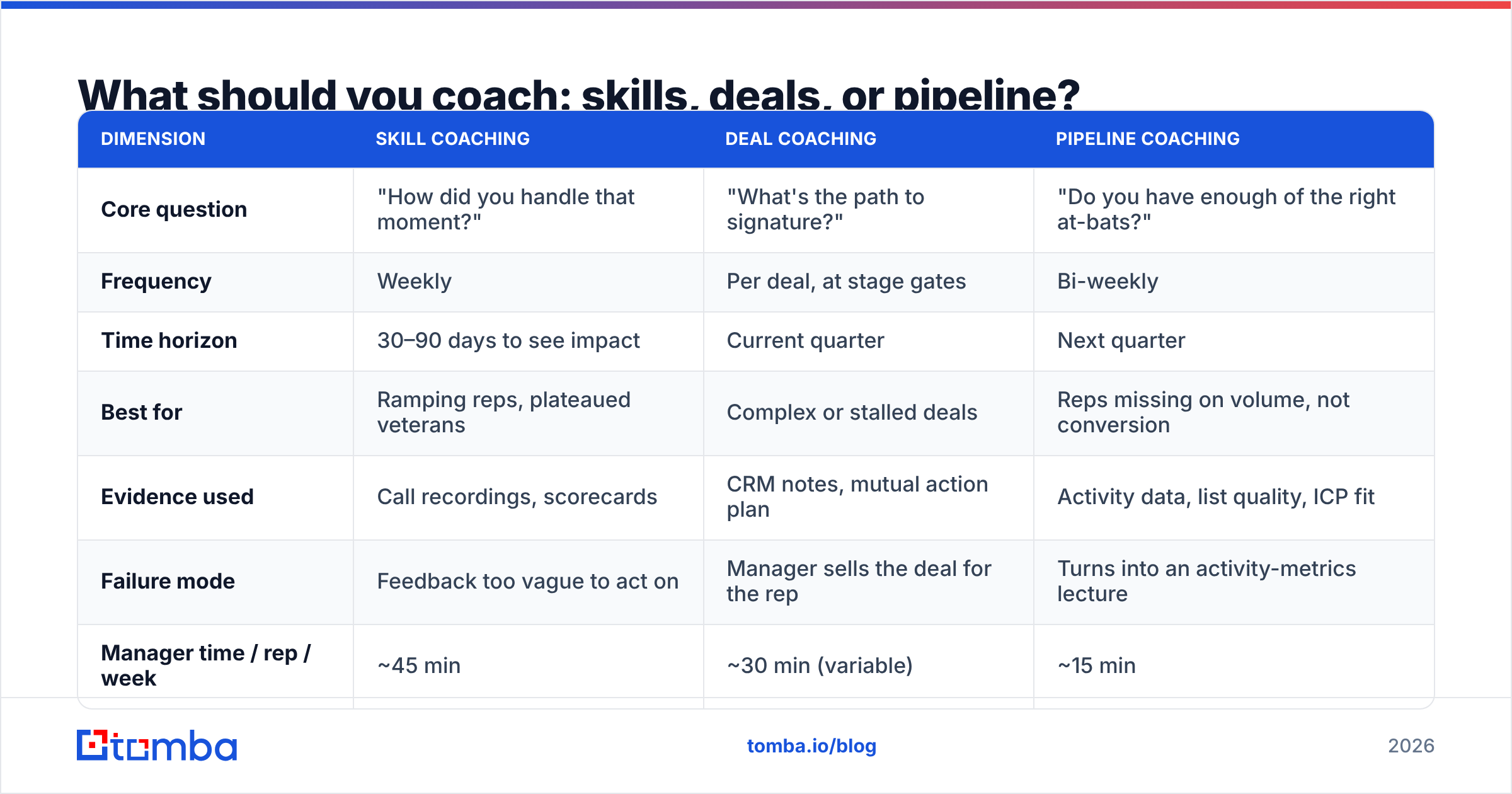
All three, but not in the same session and not at the same frequency. Here is how the three modes compare:
| Dimension | Skill coaching | Deal coaching | Pipeline coaching |
|---|---|---|---|
| Core question | "How did you handle that moment?" | "What's the path to signature?" | "Do you have enough of the right at-bats?" |
| Frequency | Weekly | Per deal, at stage gates | Bi-weekly |
| Time horizon | 30–90 days to see impact | Current quarter | Next quarter |
| Best for | Ramping reps, plateaued veterans | Complex or stalled deals | Reps missing on volume, not conversion |
| Evidence used | Call recordings, scorecards | CRM notes, mutual action plan | Activity data, list quality, ICP fit |
| Failure mode | Feedback too vague to act on | Manager sells the deal for the rep | Turns into an activity-metrics lecture |
| Manager time / rep / week | ~45 min | ~30 min (variable) | ~15 min |
A rep missing quota because they can't handle pricing pushback needs skill coaching. A rep missing quota because they only have nine opportunities needs pipeline coaching — and probably a better prospecting list, not a better objection-handling script. Diagnosing the wrong one wastes a quarter.
How do you run a call review that changes behavior?#
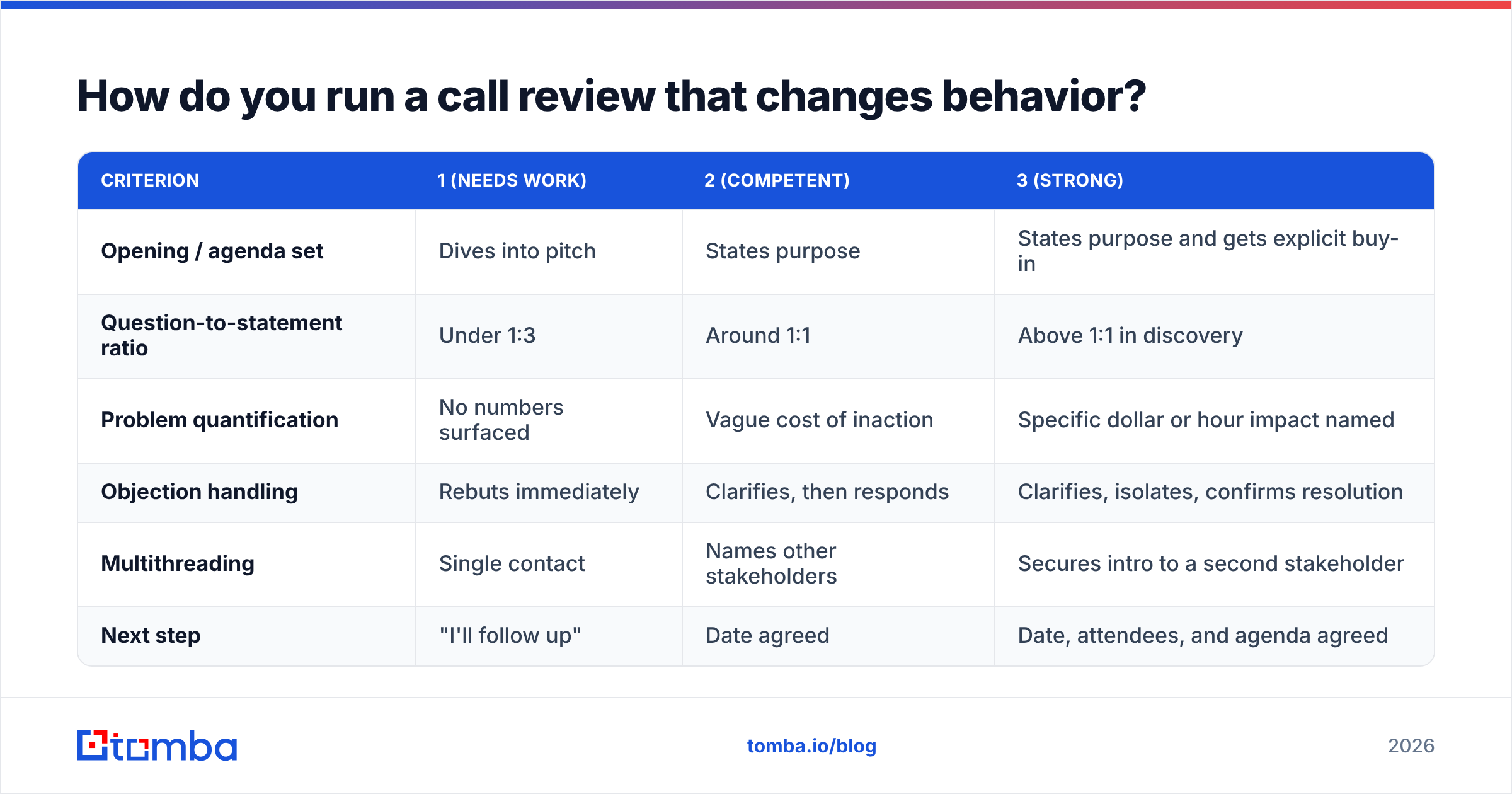
Use a short rubric, score it before the meeting, and let the rep self-assess first.
A workable six-criterion rubric, each scored 1–3:
| Criterion | 1 (needs work) | 2 (competent) | 3 (strong) |
|---|---|---|---|
| Opening / agenda set | Dives into pitch | States purpose | States purpose and gets explicit buy-in |
| Question-to-statement ratio | Under 1:3 | Around 1:1 | Above 1:1 in discovery |
| Problem quantification | No numbers surfaced | Vague cost of inaction | Specific dollar or hour impact named |
| Objection handling | Rebuts immediately | Clarifies, then responds | Clarifies, isolates, confirms resolution |
| Multithreading | Single contact | Names other stakeholders | Secures intro to a second stakeholder |
| Next step | "I'll follow up" | Date agreed | Date, attendees, and agenda agreed |
Two rules make this work. First, the rep scores themselves before you share your scores — the gap between their self-score and yours is the most useful diagnostic you'll get, and a rep who scores themselves a 3 on discovery when you scored a 1 has an awareness problem, not a technique problem. Second, you only discuss the two lowest criteria. Everything else waits.
Timestamped clips beat summaries. "At 12:40 you said X" gives the rep something concrete to relive. Paraphrasing gives them something to argue with.
How do you coach new reps versus veterans?#
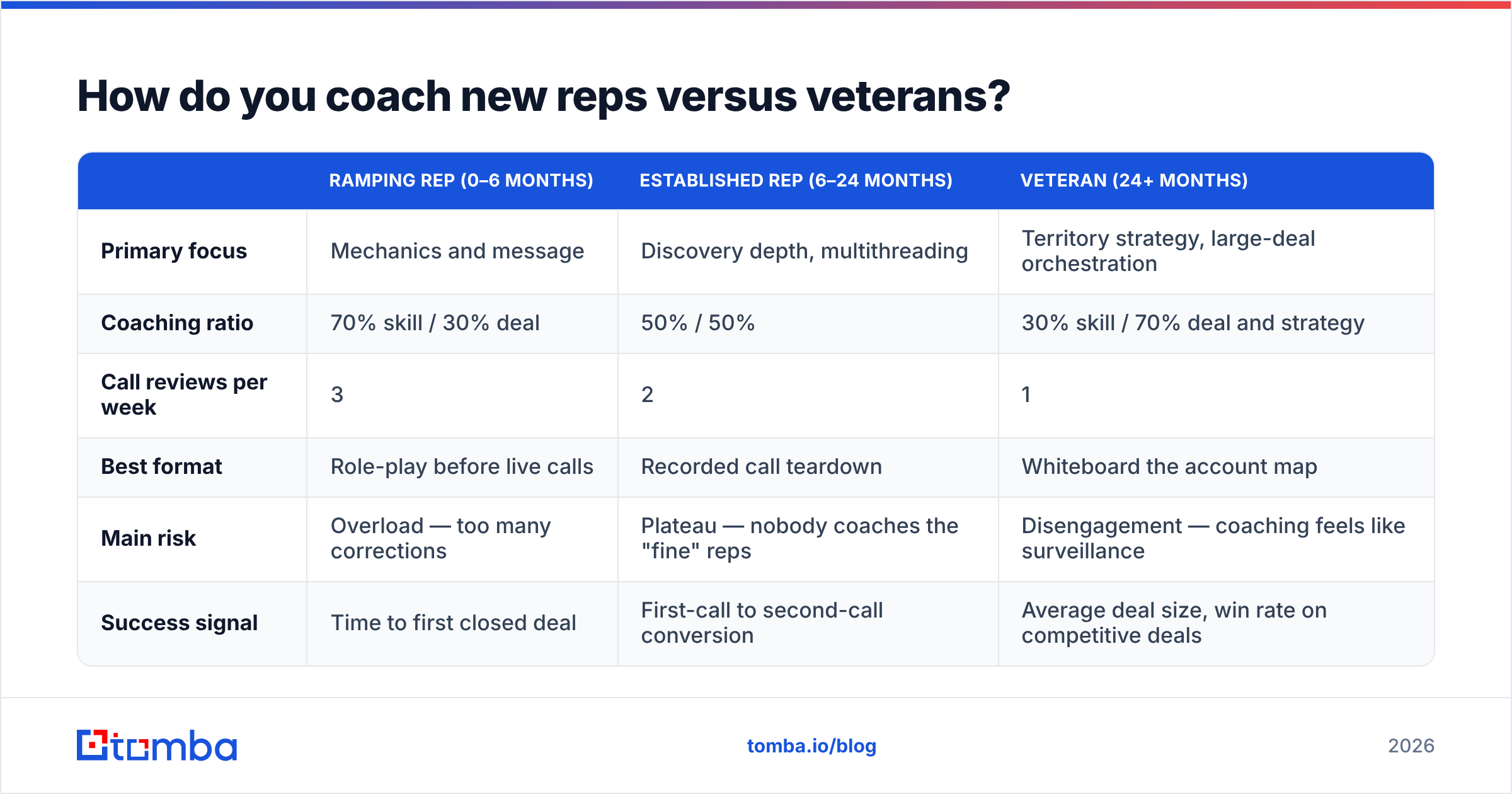
The cadence stays identical. The content inverts.
| Ramping rep (0–6 months) | Established rep (6–24 months) | Veteran (24+ months) | |
|---|---|---|---|
| Primary focus | Mechanics and message | Discovery depth, multithreading | Territory strategy, large-deal orchestration |
| Coaching ratio | 70% skill / 30% deal | 50% / 50% | 30% skill / 70% deal and strategy |
| Call reviews per week | 3 | 2 | 1 |
| Best format | Role-play before live calls | Recorded call teardown | Whiteboard the account map |
| Main risk | Overload — too many corrections | Plateau — nobody coaches the "fine" reps | Disengagement — coaching feels like surveillance |
| Success signal | Time to first closed deal | First-call to second-call conversion | Average deal size, win rate on competitive deals |
The middle column is where most teams lose money. Reps at 95–105% of quota get almost no coaching attention because they aren't on fire, and they aren't president's club either. Moving ten "fine" reps from 100% to 115% is worth more than dragging one struggling rep from 50% to 70%, and it's usually easier.
Veterans need a different frame entirely. Do not review their call openings — they know. Review their account strategy: who they haven't met at the target company, which competitor is embedded, what the renewal timeline looks like. Ask them to coach you on the account, and correct at the edges.
What metrics prove coaching is actually working?#
Quota attainment is a lagging indicator with a 90-day delay and a dozen confounders. Use it for compensation, not for coaching feedback loops.
Track these instead, per rep, monthly:
- Meetings booked per 100 qualified contacts. Isolates prospecting effectiveness from list volume. If this drops while activity holds steady, your data or your messaging degraded — not your reps.
- Discovery-to-proposal conversion. The clearest read on discovery quality. Coaching discovery skills should move this within 6–8 weeks.
- Average number of stakeholders per closed-won deal. Multithreading is the single most coachable behavior with a direct line to win rate, and it is trivially countable in the CRM.
- Slipped-deal rate. Deals pushed to the next quarter more than once usually trace back to a weak next-step discipline — criterion six on the rubric above.
- Rubric score trend. Average score across your six criteria, per rep, over eight weeks. If scores rise and conversion doesn't, your rubric is measuring the wrong things. Fix the rubric.
Set a floor, not a target, on activity metrics. Targets on calls-per-day produce reps who make 61 bad calls. Floors catch genuine disengagement without incentivizing theater. Peer-review sites like G2's sales coaching category are useful for seeing which platforms actually surface these leading indicators versus which just record calls.
How do you coach prospecting when the data is the problem?#
You can't coach your way out of a bad contact list, and a surprising share of "this rep can't prospect" diagnoses are really "this rep is emailing addresses that bounce."
Run this check before you spend another 1:1 on cold email technique:
- Bounce rate above 4%? That's a data problem. Verify the list before you rewrite the copy — sending to dead addresses damages sender reputation, which then suppresses the deliverability of the good addresses too.
- Reply rate under 1% with clean deliverability? Now it's a messaging problem, and it is coachable. Review five sent emails line by line in the 1:1.
- Replies but no meetings? That's a call-to-action and qualification problem, not a targeting problem.
- Meetings but no second calls? Discovery. Back to the rubric.
The sequence matters. Teams that skip the data check spend six weeks coaching copywriting on a list that was never reachable. Giving reps verified contact data — through a bulk email finder run against your ICP list, or an email verifier pass before every send — removes the excuse and makes the coaching conversation honest. When the inputs are clean, the remaining gap is genuinely skill, and skill is what you're qualified to coach.
One caveat worth stating plainly: enrichment tools do not create pipeline. They remove a category of failure so that coaching addresses the real one. A rep with perfect data and weak discovery still loses.
Where should you start next Monday?#
Pick one rep. Write the six-criterion rubric on a single page. Review one of their calls, score it, ask them to score it, and agree on one behavior for the week. Check in on Friday. Repeat for four weeks before you judge whether it works.
Do not roll out a coaching program to twelve reps in week one. The rubric will be wrong, the cadence will slip, and you'll conclude coaching doesn't work when what didn't work was the rollout.
And before you coach a single prospecting call, look at the list. If your reps are working addresses nobody verified, fix that first — Tomba's Email Finder will find and verify professional addresses by domain, name, or company so your team's at-bats are real ones. The free tier covers 25 searches a month if you just want to spot-check a rep's current list; paid plans start at $49/mo, with full Tomba pricing laid out per tier. Clean inputs, one skill a week, a protected 30 minutes. That's the whole system.
Related guides#
// get started
Find, verify and enrich your first contacts today
Start on the free plan with 25 searches a month, then scale when your team is ready.
Free plan · No credit card required · GDPR & CCPA
// about the author