How to Cold Call in 2026: A Rep's Step-by-Step Playbook
Cold calling still books meetings in 2026 — if your list is clean and your first 12 seconds earn the next 30. Here is the exact opener, structure, and objection framework top reps use.
TL;DR
- Cold calling is not dead, but connect rates now hinge on data quality more than script quality — a wrong number kills the call before you speak.
- The first 12 seconds decide everything: name, permission, reason. Skip the "how are you today?" — it flags you as a rep instantly.
- Use a four-part call structure: opener, problem hypothesis, one qualifying question, specific ask for a calendar slot.
- Objections are patterns, not surprises. There are roughly six you will hear all week; write the responses once and drill them.
- Blended sequences (call + email + LinkedIn on the same contact) outperform call-only cadences by a wide margin, so pair your dialer with a verified email finder.
What is cold calling, and does it still work in 2026?#
Cold calling is placing an unscheduled phone call to a prospect who has not requested contact, with the goal of booking a next step — usually a discovery meeting, not a sale.
It still works. It just works differently than it did in 2015. Mobile penetration in B2B means you are often calling a personal cell rather than a switchboard, spam-labeling on carrier networks punishes high-volume dialing from unregistered numbers, and buyers screen aggressively. What has not changed: a live human conversation compresses a three-week email thread into four minutes.
The honest framing is that cold calling is now a high-effort, high-yield channel. Connect rates of 3-8% on quality mobile data are normal. Of those connects, 10-20% converting to a meeting is a healthy benchmark for a competent rep. That means roughly 100-150 dials to land two or three meetings. If your numbers are far below that, the problem is almost always one of three things: bad data, a weak opener, or calling at the wrong hour.
What do you need before you pick up the phone?#
Preparation is where most cold calling fails, silently. You cannot fix a bad list with enthusiasm.
- A verified direct number. Switchboard numbers route you to a gatekeeper who has been trained to block you. Direct dials and mobiles are what move the needle. Pull them through a phone finder and run them through a phone validator so you are not burning dials on disconnected lines.
- A trigger you can name in one sentence. New funding round, a job posting for a role your product supports, a leadership change, a tech-stack switch. "I saw you're hiring three SDRs" is a reason to call. "I wanted to introduce myself" is not.
- A problem hypothesis, not a product pitch. Write down the single operational pain you believe this account has. You will test it out loud in the first 30 seconds.
- The email address, ready to send. Every call ends in a follow-up email — connected or not. Have it queued before you dial.
- A quiet room and a headset. Background noise reads as call center, and call center reads as hang up.
- A block of at least 60 uninterrupted minutes. Cold calling in five-minute gaps between meetings produces the worst version of you.
That fourth point deserves emphasis. Reps who treat calls and email as separate motions leave most of the value on the table. If you are already enriching accounts, run a domain search on each target company so you have the email pattern and adjacent contacts before you dial — when the VP doesn't pick up, you can reach the director who does.
What does a good cold call opener sound like?#
Your opener has one job: buy the next 30 seconds. It does not sell, qualify, or explain.
The structure that consistently survives contact with real prospects:
Name → honest frame → permission → reason.
"Hi Marcus, it's Dana from Tomba. I know I'm an interruption — can I take 30 seconds to tell you why I called, and you can tell me to get lost?"
Then, on the almost-always "go ahead":
"I saw you posted two SDR roles last week. Most teams doing that are trying to fix pipeline with headcount because the list they're working is 40% stale. That's usually the actual problem. Is that anywhere near reality for you?"
Three things are happening. You acknowledged the interruption, which disarms the reflex to hang up. You gave a reason tied to observable evidence. And you ended on a question that invites a correction rather than a yes/no.
Openers to retire:
- "How are you doing today?" — signals a script within two words.
- "Did I catch you at a bad time?" — invites the easiest possible exit.
- "I'm calling from [Company], we're a leading provider of…" — the prospect stops listening at "leading provider."
- Any opener longer than 15 seconds before your first question mark.
The permission-based opener works because it inverts the power dynamic. You are not asking for their business; you are asking for half a minute and offering an easy out. Most people take the 30 seconds.
How should you structure the rest of the call?#
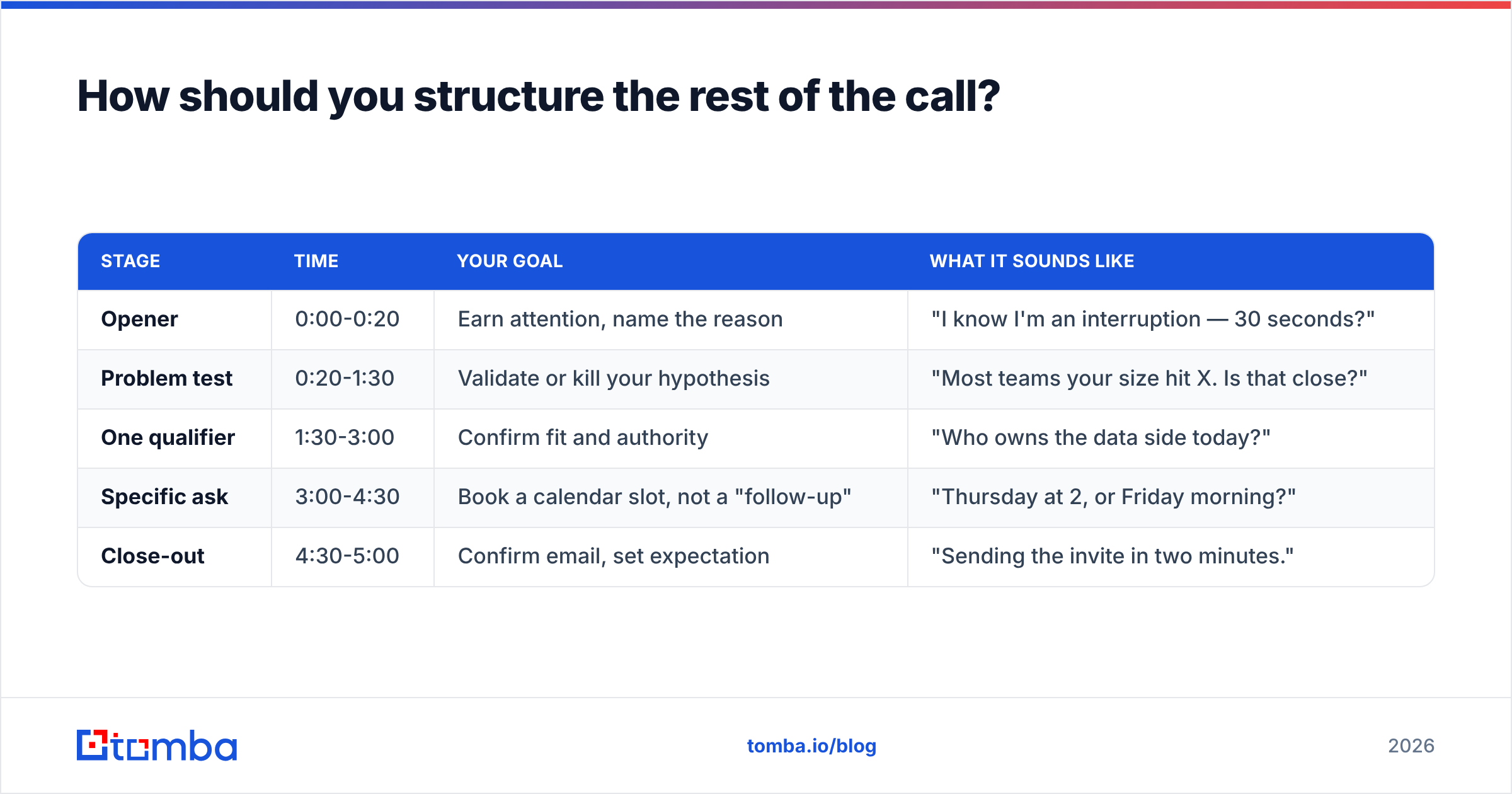
Once you have permission, run a four-part arc. Total target length: four to six minutes.
| Stage | Time | Your goal | What it sounds like |
|---|---|---|---|
| Opener | 0:00-0:20 | Earn attention, name the reason | "I know I'm an interruption — 30 seconds?" |
| Problem test | 0:20-1:30 | Validate or kill your hypothesis | "Most teams your size hit X. Is that close?" |
| One qualifier | 1:30-3:00 | Confirm fit and authority | "Who owns the data side today?" |
| Specific ask | 3:00-4:30 | Book a calendar slot, not a "follow-up" | "Thursday at 2, or Friday morning?" |
| Close-out | 4:30-5:00 | Confirm email, set expectation | "Sending the invite in two minutes." |
Notice what is missing: a demo, a feature list, and pricing. Cold calls that pitch features convert worse than cold calls that diagnose problems, because the prospect has no frame yet for why a feature matters. You are earning a meeting, not closing a deal.
One qualifier, not five. The temptation is to run full BANT on the phone. Resist it. Every additional question raises the odds the prospect decides this is a survey and bails. Ask the single question that determines whether the meeting is worth booking, then book it.
Ask for a specific time. "Would you be open to a chat sometime next week?" produces a vague yes that never lands on a calendar. "I've got Thursday at 2 or Friday at 10 — which is easier?" produces a meeting.
How do you handle the six objections you will actually hear?#
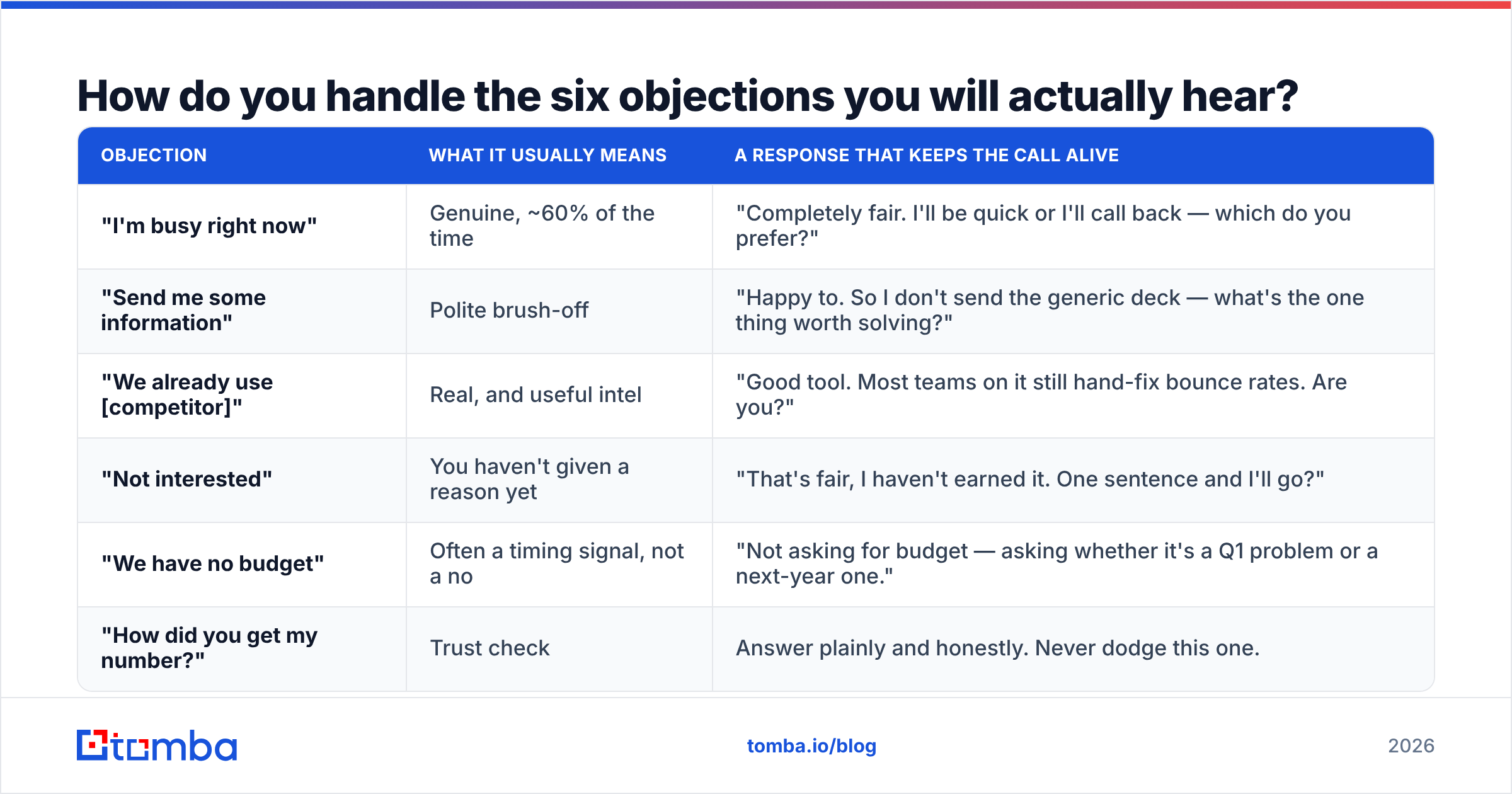
Objections in cold calling are not creative. Across thousands of dials, the same six come back. Write your responses, say them out loud until they sound unrehearsed, and stop improvising.
| Objection | What it usually means | A response that keeps the call alive |
|---|---|---|
| "I'm busy right now" | Genuine, ~60% of the time | "Completely fair. I'll be quick or I'll call back — which do you prefer?" |
| "Send me some information" | Polite brush-off | "Happy to. So I don't send the generic deck — what's the one thing worth solving?" |
| "We already use [competitor]" | Real, and useful intel | "Good tool. Most teams on it still hand-fix bounce rates. Are you?" |
| "Not interested" | You haven't given a reason yet | "That's fair, I haven't earned it. One sentence and I'll go?" |
| "We have no budget" | Often a timing signal, not a no | "Not asking for budget — asking whether it's a Q1 problem or a next-year one." |
| "How did you get my number?" | Trust check | Answer plainly and honestly. Never dodge this one. |
That last row matters more than it looks. Prospects increasingly ask where their data came from, and a vague or evasive answer ends the call and can damage your brand. Know your data sources and be able to say in one sentence that the contact is business-contact information sourced from public and licensed records. Confidence here converts skeptics; hedging does not.
For a broader view of how buyers respond to outbound in general, HubSpot's sales research is a reasonable neutral baseline, and G2's category reviews are useful for sanity-checking vendor claims about connect rates.
When should you call, and how many dials is enough?#
Timing moves connect rates more than almost any script change.
Best windows (prospect's local time):
- 8:00-9:30 a.m. — before the calendar fills, gatekeepers often not in yet
- 4:00-5:30 p.m. — meetings done, guard down
- Tuesday through Thursday outperform Monday and Friday, consistently
Worst windows: Monday before 10 a.m., Friday after 3 p.m., and the hour directly after lunch in the prospect's timezone.
On volume: aim for 60-80 quality dials per focused day rather than 200 sloppy ones. A dial is only "quality" if the number is verified, the contact is in your ICP, and you have a trigger. Padding your dial count with unverified numbers inflates activity metrics and depresses your actual response rate.
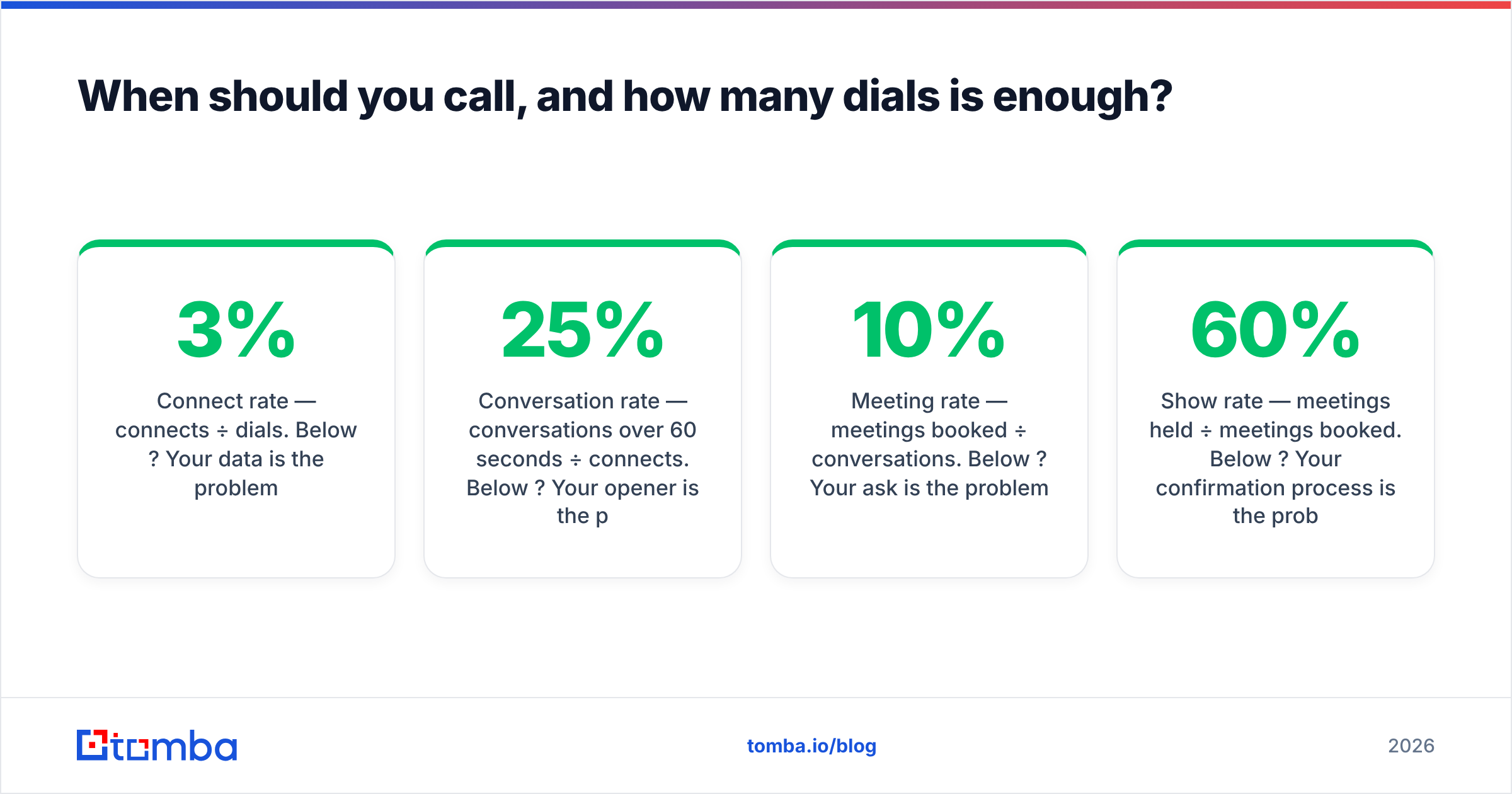
Track these four numbers weekly:
- Connect rate — connects ÷ dials. Below 3%? Your data is the problem.
- Conversation rate — conversations over 60 seconds ÷ connects. Below 25%? Your opener is the problem.
- Meeting rate — meetings booked ÷ conversations. Below 10%? Your ask is the problem.
- Show rate — meetings held ÷ meetings booked. Below 60%? Your confirmation process is the problem.
Each metric points at a different fix. Reps who only track "dials" cannot diagnose anything.
How does cold calling compare to cold email and LinkedIn?#
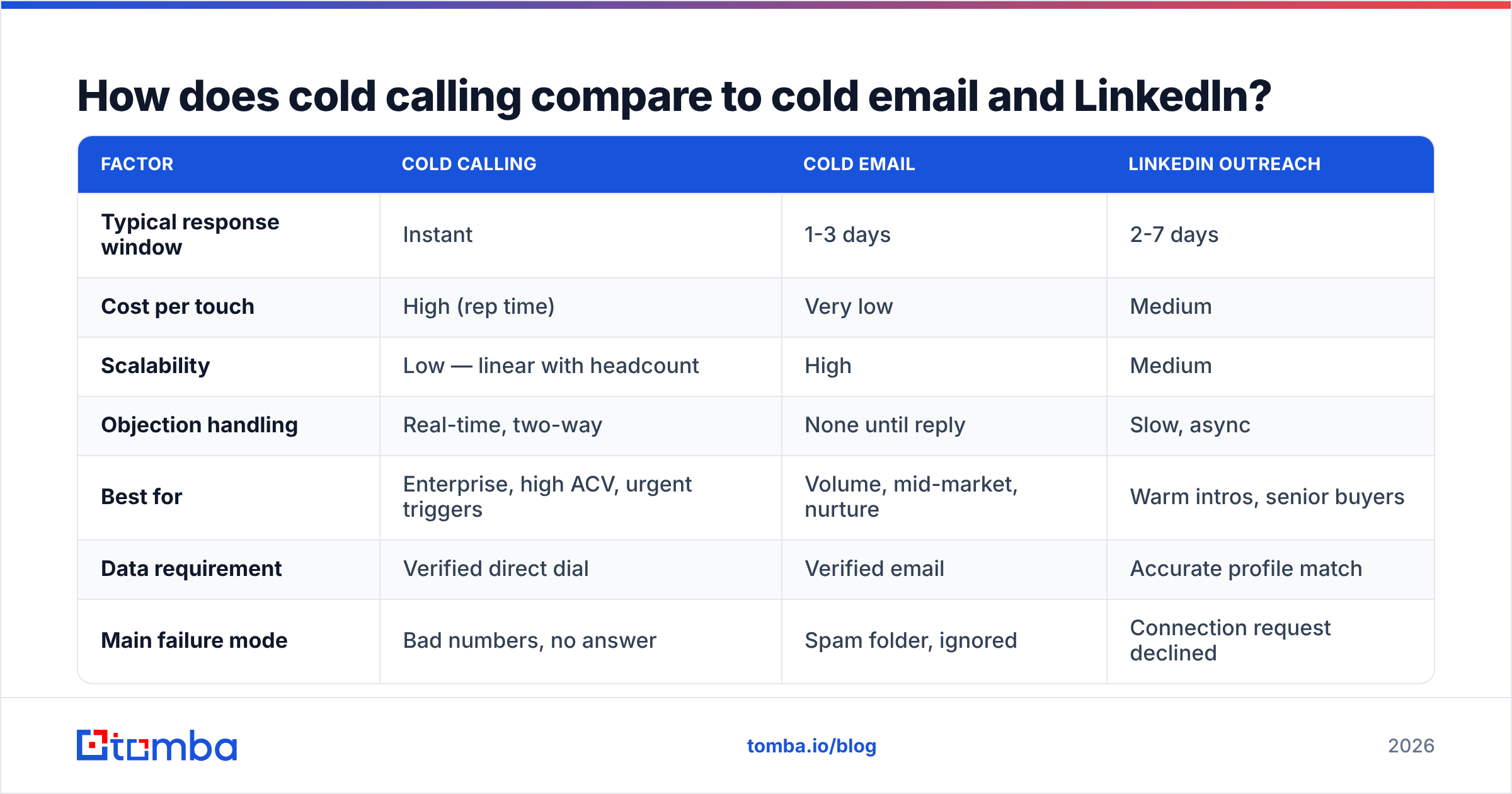
Neither channel wins alone. The comparison matters because it tells you where to spend the hour you have.
| Factor | Cold calling | Cold email | LinkedIn outreach |
|---|---|---|---|
| Typical response window | Instant | 1-3 days | 2-7 days |
| Cost per touch | High (rep time) | Very low | Medium |
| Scalability | Low — linear with headcount | High | Medium |
| Objection handling | Real-time, two-way | None until reply | Slow, async |
| Best for | Enterprise, high ACV, urgent triggers | Volume, mid-market, nurture | Warm intros, senior buyers |
| Data requirement | Verified direct dial | Verified email | Accurate profile match |
| Main failure mode | Bad numbers, no answer | Spam folder, ignored | Connection request declined |
The practical conclusion: run them together on the same contact. A common high-performing pattern is email on day one, call on day two, LinkedIn view and connect on day three, call again on day five, break-up email on day nine. Each channel warms the next — a prospect who has seen your name in their inbox is measurably more likely to take the call.
That only works if your contact record is complete. Missing the email means the sequence collapses to call-only. Tools like a LinkedIn finder and data enrichment close those gaps so every contact in your cadence has all three channels available. For enterprise teams standardizing this, Salesforce's outbound guidance covers the CRM-side hygiene that keeps multi-channel sequences from double-touching the same buyer.
What separates reps who book meetings from reps who don't?#
After the script and the timing, the differences are behavioral.
- They record and review their own calls. Not their manager's review — their own. Listening to yourself is uncomfortable and it is the fastest improvement loop available.
- They talk less. Top performers hold roughly a 45/55 talk-to-listen ratio on cold calls. Weak performers run 80/20 and mistake it for enthusiasm.
- They pause after the ask. Silence after "Thursday at 2 or Friday at 10?" is your closest ally. Fill it and you talk yourself out of the meeting.
- They confirm in writing within two minutes. Calendar invite plus a two-line email referencing something specific the prospect said. This alone lifts show rates substantially.
- They keep a clean list. They delete bad numbers instead of re-dialing them for three weeks to keep activity counts up.
- They call again. Most meetings come on dial three through six, not dial one. Reps who quit after two attempts never see the yield curve.
That last habit compounds only if your list stays accurate. Contact data decays roughly 25-30% per year as people change jobs, so a list you built in January is meaningfully wrong by autumn. Re-enrich quarterly, or you are drilling a great opener into numbers nobody answers.
Where should you start this week?#
Pick 50 accounts inside your ICP. For each one, get a verified direct number, a verified email, and one observable trigger you can say in a sentence. Write a single opener and run it 50 times without changing it — you cannot learn anything from a script you rewrite every ten dials. Track connect rate, conversation rate, and meeting rate. Change exactly one variable next week.
The prep is the part that scales. If you are building those 50 records by hand, you will spend more time researching than dialing, and the research is not where the meetings come from.
Start with the contact layer. Tomba's Email Finder pulls verified professional email addresses by name, company, or domain, and the surrounding toolkit — email verifier, phone finder, and bulk email finder — gives you the complete, dial-ready record before you pick up the phone. The free tier includes 25 searches a month, and paid plans start at $49/mo on Starter, $99/mo on Growth, and $249/mo on Pro; full Tomba pricing is public. Build the clean list first, then let the script do its job.
Related guides#
// get started
Find, verify and enrich your first contacts today
Start on the free plan with 25 searches a month, then scale when your team is ready.
Free plan · No credit card required · GDPR & CCPA
// about the author