How To Cold Call As A Financial Advisor: 2026 Playbook
Cold calling still books meetings for financial advisors who follow compliance rules, dial the right list, and open with a reason to call. Here is the full 2026 playbook, scripts included.
TL;DR
- Cold calling still works for financial advisors, but only on a narrow, well-researched list — 200 qualified numbers beat 5,000 scraped ones.
- Compliance comes first: check the National Do Not Call Registry, your firm's policy, state rules, and FINRA/SEC advertising guidance before a single dial.
- The opener decides everything. Twenty seconds, a permission question, a specific reason for calling this person, and no product pitch.
- Expect roughly 60–100 dials per booked meeting when your list is clean. That ratio collapses if your phone numbers are wrong or outdated.
- Pair calls with email and LinkedIn. Advisors who touch a prospect three ways convert meaningfully better than dial-only reps.
Does cold calling still work for financial advisors in 2026?#
Yes — for a smaller slice of advisors than in 2005, and only with better inputs.
Here is the honest picture. Answer rates on unknown numbers have fallen for a decade. Carrier spam labeling flags high-volume dialers within days. Regulators have tightened the rules around unsolicited contact. And the prospect you want — a business owner with a liquidity event coming, a 55-year-old engineer with $1.2M in a 401(k), a physician group with no retirement plan — gets called by three other advisors this month.
But the calls that connect still convert better than almost any other channel. A live conversation with a qualified prospect is worth twenty emails. The advisors who quit cold calling did not quit because it stopped working; they quit because the version they were running — buy a list, dial 400 numbers, read a script about "reviewing your portfolio" — stopped working. That version deserved to die.
What replaced it is narrower and slower per contact. You call fewer people, you know more about each one, and you have a specific reason to call today rather than a generic offer to help.
Screenshot placeholder: Dialer dashboard showing connect rate, talk time, and meetings booked by day — the three metrics that actually tell you whether your calling program is healthy.
What compliance rules apply before you dial?#
This section is not optional and it is not legal advice — run your process past your firm's compliance officer before you start.
The baseline stack for a U.S.-based advisor:
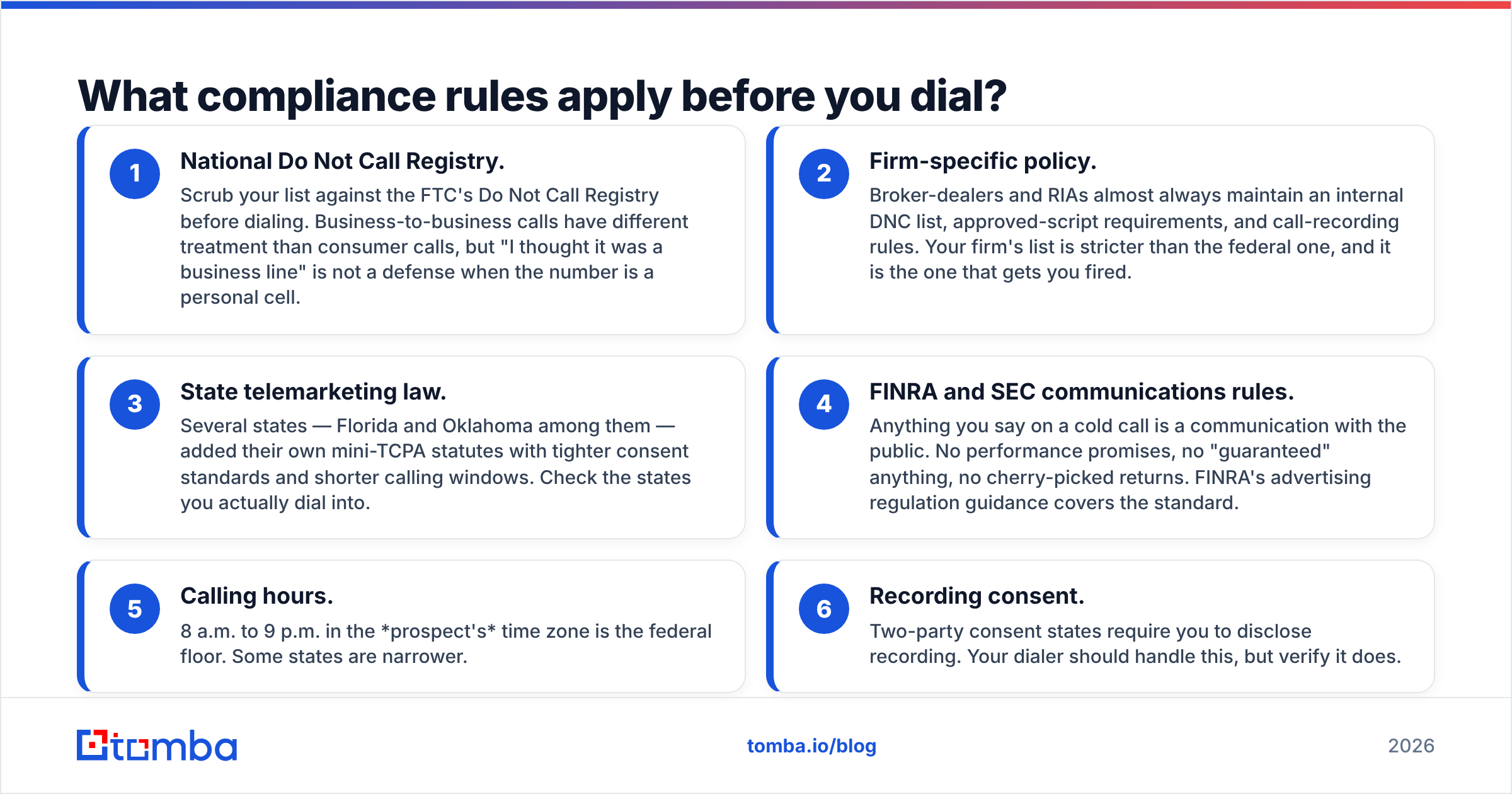
- National Do Not Call Registry. Scrub your list against the FTC's Do Not Call Registry before dialing. Business-to-business calls have different treatment than consumer calls, but "I thought it was a business line" is not a defense when the number is a personal cell.
- Firm-specific policy. Broker-dealers and RIAs almost always maintain an internal DNC list, approved-script requirements, and call-recording rules. Your firm's list is stricter than the federal one, and it is the one that gets you fired.
- State telemarketing law. Several states — Florida and Oklahoma among them — added their own mini-TCPA statutes with tighter consent standards and shorter calling windows. Check the states you actually dial into.
- FINRA and SEC communications rules. Anything you say on a cold call is a communication with the public. No performance promises, no "guaranteed" anything, no cherry-picked returns. FINRA's advertising regulation guidance covers the standard.
- Calling hours. 8 a.m. to 9 p.m. in the prospect's time zone is the federal floor. Some states are narrower.
- Recording consent. Two-party consent states require you to disclose recording. Your dialer should handle this, but verify it does.
The practical effect: you cannot buy a consumer list and start dialing. You build a business-contact list, you scrub it, and you document the scrub.
How do you build a call list that is worth dialing?#
Your list is the single biggest lever on your results, and most advisors underinvest here by an order of magnitude.
Start from a niche, not from a geography. "Business owners in Dallas" is not a list — it is a phone book. "Owners of $3–15M revenue HVAC and plumbing companies in DFW who have been in business 15+ years" is a list, because you can say something true and specific to every person on it.
Then build the contact record. For each prospect you want, at minimum:
- Name and exact title — so you are not asking the gatekeeper "who handles finances?"
- Direct dial or mobile — a main switchboard number cuts your connect rate roughly in half
- Verified work email — for the pre-call and post-call touches
- A trigger or hook — an acquisition, a hiring surge, a new location, a milestone anniversary, a published article
- LinkedIn profile — for the follow-up sequence and for context on the call
Getting direct dials and verified emails at scale is where most advisors stall out. Manual research runs about 8–12 minutes per contact. Tools compress that. A phone finder returns B2B numbers from a name and company, an email finder fills in the address, and a bulk email finder processes a CSV of company names in one pass instead of one at a time.
One rule: verify before you dial. Bad numbers do not just waste time — repeated calls to disconnected or reassigned numbers are exactly what triggers carrier spam labeling on your outbound line. Run numbers through a phone validator and emails through an email verifier first.
What should your cold call opener actually say?#
You have about twenty seconds before the prospect decides whether this is a sales call to end or a conversation to have.
The structure that survives contact with real prospects:
1. Name yourself and your firm, plainly. "Hi Dana, this is Marcus Webb with Cardinal Ridge Advisors."
2. Ask permission with an honest frame. Not "did I catch you at a bad time?" (invites a yes). Try: "I know I'm calling you out of the blue — can I have thirty seconds to tell you why, and then you can tell me to go away?" It works because it is true and because it hands them control.
3. Give the specific reason you called this person. This is the whole call. "I work with owners of trade businesses in North Texas, and I noticed you've been running Ridgeline for eighteen years. Most owners I talk to at that stage have most of their net worth locked inside the business and no real plan for getting it out."
4. Ask one open question and stop talking. "Is that roughly where you are, or have you already sorted that out?"
5. Book a specific time, not a vague follow-up. "How about Thursday at 8:15, before your day gets away from you? Fifteen minutes."
Notice what is absent: no products, no performance numbers, no "comprehensive financial review," no asking about their current advisor in the first ninety seconds. You are trying to earn a fifteen-minute calendar slot, not close an account.
How do you handle the four objections you will hear every day?#
| Objection | Weak response | Response that keeps the call alive |
|---|---|---|
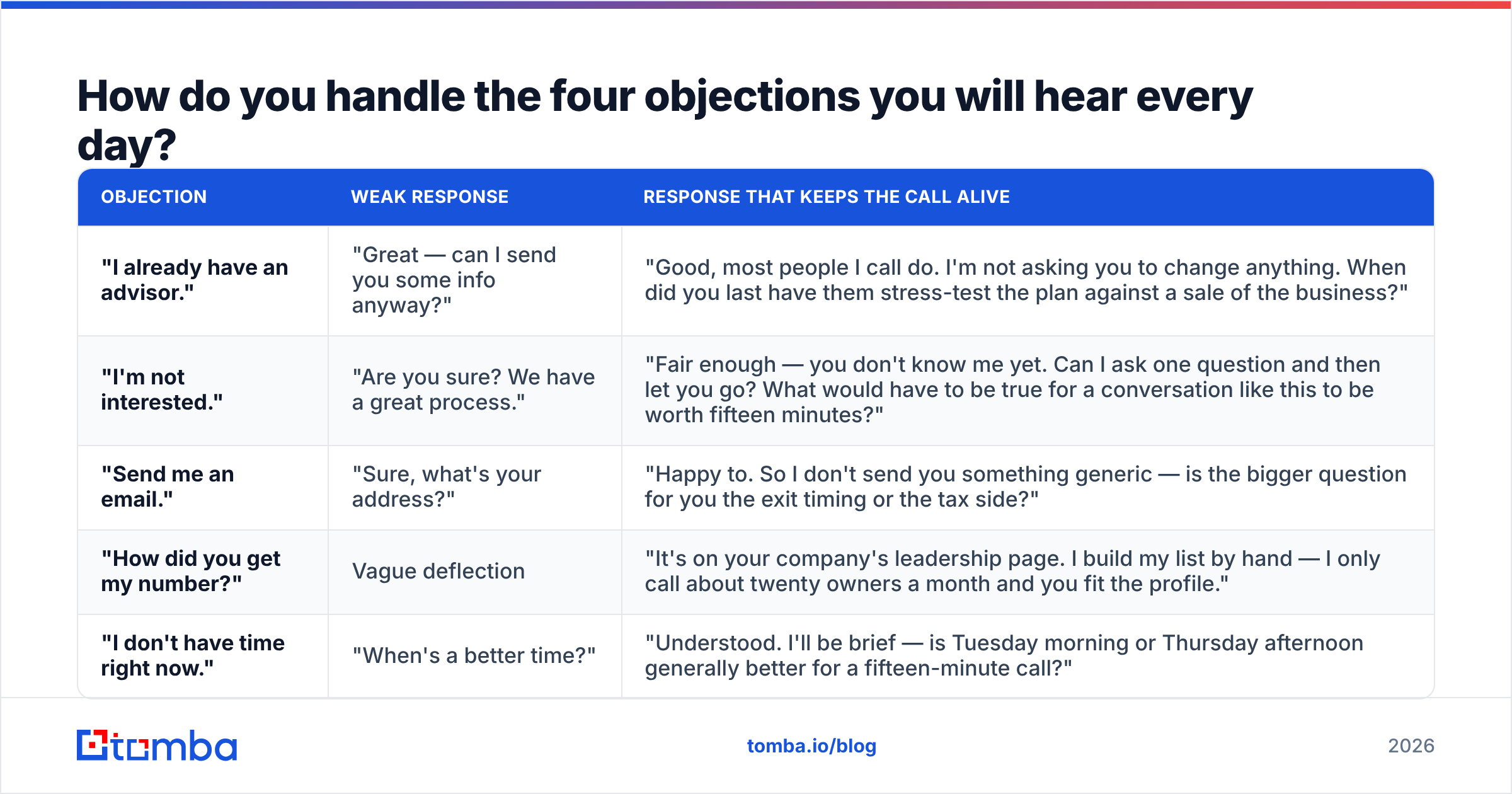
| "I already have an advisor." | "Great — can I send you some info anyway?" | "Good, most people I call do. I'm not asking you to change anything. When did you last have them stress-test the plan against a sale of the business?" |
| "I'm not interested." | "Are you sure? We have a great process." | "Fair enough — you don't know me yet. Can I ask one question and then let you go? What would have to be true for a conversation like this to be worth fifteen minutes?" |
| "Send me an email." | "Sure, what's your address?" | "Happy to. So I don't send you something generic — is the bigger question for you the exit timing or the tax side?" |
| "How did you get my number?" | Vague deflection | "It's on your company's leadership page. I build my list by hand — I only call about twenty owners a month and you fit the profile." |
| "I don't have time right now." | "When's a better time?" | "Understood. I'll be brief — is Tuesday morning or Thursday afternoon generally better for a fifteen-minute call?" |
Two principles run through the right-hand column. First, agree before you redirect — arguing with an objection confirms you are a telemarketer. Second, always end your turn with a question, because the person asking questions controls the call.
What numbers should you expect from a calling program?#
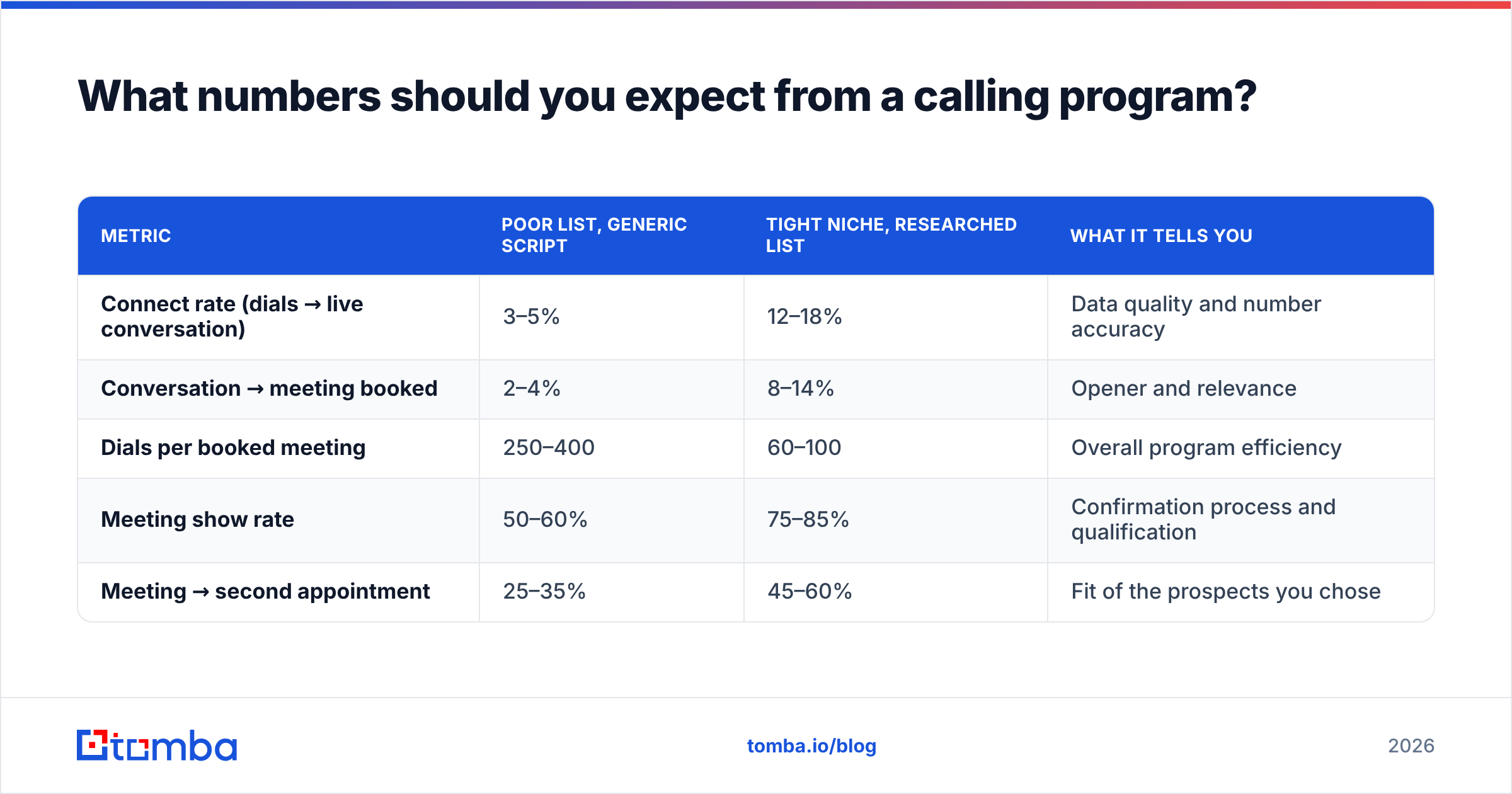
Track these five, weekly. If you only track meetings booked, you cannot diagnose what is broken.
| Metric | Poor list, generic script | Tight niche, researched list | What it tells you |
|---|---|---|---|
| Connect rate (dials → live conversation) | 3–5% | 12–18% | Data quality and number accuracy |
| Conversation → meeting booked | 2–4% | 8–14% | Opener and relevance |
| Dials per booked meeting | 250–400 | 60–100 | Overall program efficiency |
| Meeting show rate | 50–60% | 75–85% | Confirmation process and qualification |
| Meeting → second appointment | 25–35% | 45–60% | Fit of the prospects you chose |
The gap between the two columns is almost never talent. It is inputs. An advisor with a mediocre script and a surgical list outperforms a gifted talker working a scraped spreadsheet, every time.
Set a floor you can sustain: 40 dials in a two-hour morning block, four days a week. That is 640 dials a month, which at a healthy ratio is six to ten new meetings. Ten meetings a month is a practice-changing number for most advisors.
Screenshot placeholder: CRM activity view with call dispositions, next-step tasks, and a follow-up sequence attached to each dial — what a disciplined post-call workflow looks like in practice.
How should you combine calls with email and LinkedIn?#
Dial-only is the least efficient version of this. Prospects who have seen your name before answer at noticeably higher rates.
A workable 14-day sequence for a single prospect:
- Day 1 — Connection request on LinkedIn, no pitch, no note beyond a line about their business.
- Day 2 — Short email. Four sentences: who you are, the specific observation about their situation, one question, no attachment. Use a subject line generator if you are stuck, but keep it plain — "Question about Ridgeline's next chapter" beats anything clever.
- Day 4 — First call. Now you are a name they half-recognize.
- Day 6 — Voicemail plus a same-minute email referencing the voicemail. This pairing lifts reply rates more than either does alone.
- Day 9 — Second call at a different hour. If you tried 9 a.m., try 4:30 p.m.
- Day 14 — Breakup email. "I'll stop reaching out — if the timing changes, here's my direct line." A surprising share of replies come here.
Then stop, and re-enter the prospect in six months with a new trigger. Persistence past a clear no is how advisors end up on internal DNC lists.
For deliverability on the email side, get the fundamentals right before you scale: authenticate your domain, check your SPF record, and keep bounce rates under 2% by verifying addresses before send. Poor email deliverability quietly kills the multi-channel advantage.
Which tools are worth paying for?#
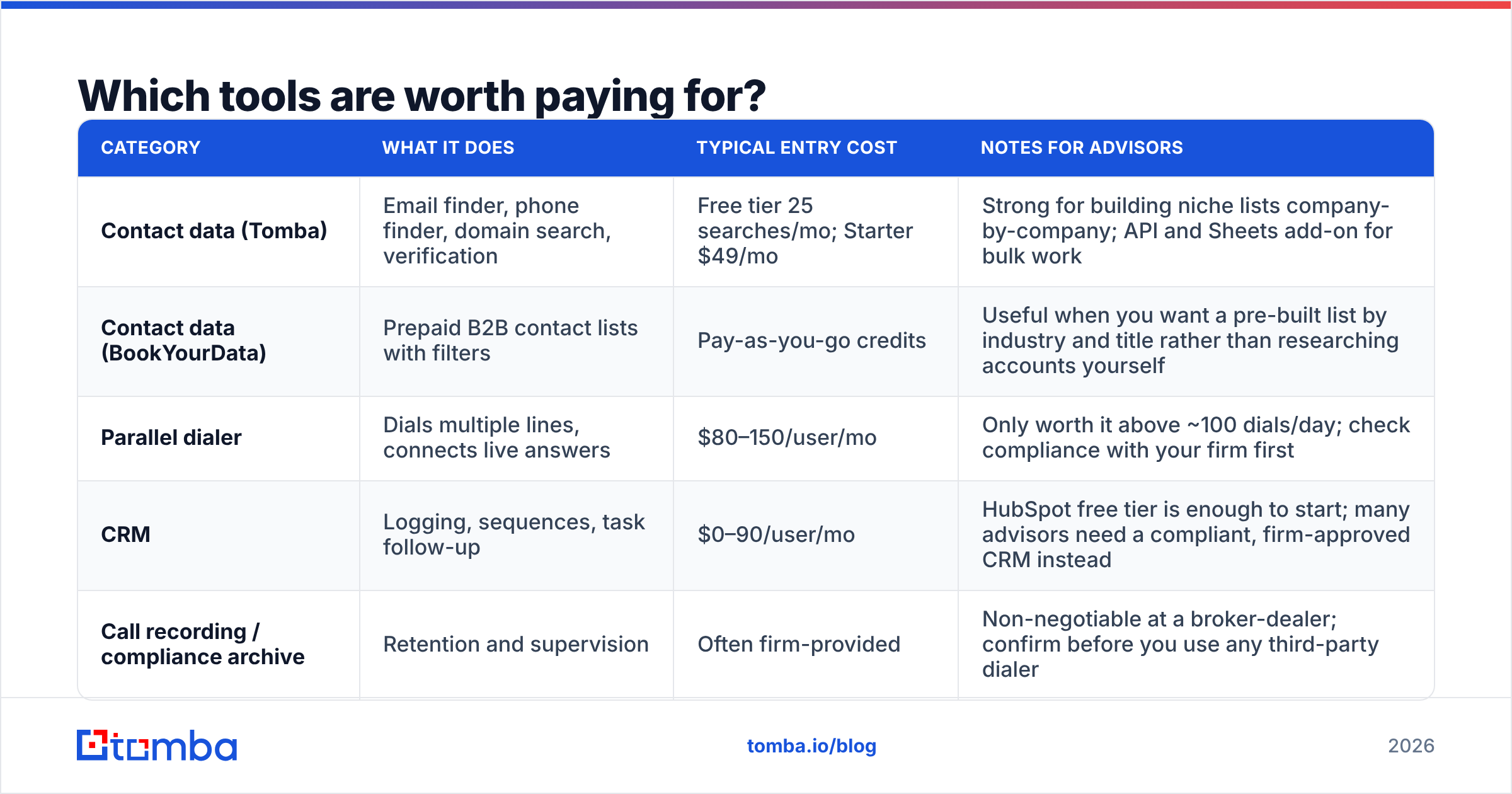
You need three things: a list source, a way to enrich and verify contacts, and a dialer. Most advisors overbuy on the third and underbuy on the second.
| Category | What it does | Typical entry cost | Notes for advisors |
|---|---|---|---|
| Contact data (Tomba) | Email finder, phone finder, domain search, verification | Free tier 25 searches/mo; Starter $49/mo | Strong for building niche lists company-by-company; API and Sheets add-on for bulk work |
| Contact data (BookYourData) | Prepaid B2B contact lists with filters | Pay-as-you-go credits | Useful when you want a pre-built list by industry and title rather than researching accounts yourself |
| Parallel dialer | Dials multiple lines, connects live answers | $80–150/user/mo | Only worth it above ~100 dials/day; check compliance with your firm first |
| CRM | Logging, sequences, task follow-up | $0–90/user/mo | HubSpot free tier is enough to start; many advisors need a compliant, firm-approved CRM instead |
| Call recording / compliance archive | Retention and supervision | Often firm-provided | Non-negotiable at a broker-dealer; confirm before you use any third-party dialer |
Tomba's Tomba pricing runs Free (25 searches/mo), Starter $49/mo, Growth $99/mo, Pro $249/mo, and Enterprise custom. For a solo advisor building 200–400 researched contacts a month, Starter or Growth covers it. If you are researching accounts one at a time while browsing company sites, the Tomba Chrome extension is faster than tab-switching into a dashboard.
For independent reviews of any of these categories before you commit, G2 is the least biased starting point — filter reviews by company size so you are reading solo-practice feedback rather than enterprise deployments.
What kills a financial advisor's cold calling program?#
Five failure modes, in rough order of how often they show up:
- Calling too broad a list. If your opener could be read to any of your prospects unchanged, your list is too wide.
- Pitching in the first ninety seconds. Nobody buys financial advice on a first call. Sell the meeting.
- Inconsistency. Two hundred dials in one heroic week, then nothing for a month. The compounding effect of calling is entirely in the consistency.
- Skipping the follow-up. Most booked meetings come from the second, third, or fourth touch — not the first dial.
- Dirty data. Wrong numbers, dead emails, and stale titles waste your time and damage your sending and calling reputation simultaneously.
Fix the fifth one first. It is the only one you can solve with a process change rather than a habit change, and it makes the other four easier.
Where do you start this week?#
Pick one niche you can describe in a sentence. Build 100 contacts inside it with a direct dial, a verified email, a title, and one specific observation per person. Scrub against DNC and your firm's list. Write one opener and one voicemail. Block two hours, four mornings, for three weeks. Then look at your five metrics and change exactly one thing.
That is the whole program. It is not complicated — it is just narrower and more disciplined than what most advisors are willing to do.
Build the list before you build the script. Tomba's Tomba Email Finder turns a name and company domain into a verified professional email in seconds, and pairs with the phone finder and verifier so every record on your call sheet is real before you dial it. Start on the free tier at 25 searches a month, and move to Starter at $49/mo when your niche list outgrows it.
Related guides#
// get started
Find, verify and enrich your first contacts today
Start on the free plan with 25 searches a month, then scale when your team is ready.
Free plan · No credit card required · GDPR & CCPA
Get the Tomba newsletter
Product and data updates
// about the author