How to Cold Call B2B Prospects in 2026: A Rep's Playbook
Cold calling still books meetings in 2026 — but only if your list, opener, and objection handling are right. Here is the full B2B cold call playbook, with scripts, benchmarks, and the tools that actually move connect rates.
TL;DR
- Cold calling B2B works in 2026, but the math is brutal: expect roughly 1 meeting per 60–100 dials on a cold list, and 1 per 25–40 on a researched, verified list.
- Your list quality decides more than your script. Wrong number, wrong title, wrong company size — no opener saves that.
- Use a permission-based opener ("I know I'm interrupting — can I take 30 seconds?"), then a one-sentence reason for the call tied to their role.
- Treat objections as reflexes, not decisions. The first "not interested" arrives before the prospect has processed anything you said.
- Block calls in 90-minute windows, 2–3 times a day, and measure connect rate, conversation rate, and meeting rate separately.
Why does cold calling still work in B2B in 2026?#
Because almost nobody does it well anymore. Everyone piled into email and LinkedIn, inboxes got saturated, and the phone quietly became a less contested channel for the reps willing to pick it up.
The catch: the phone got harder mechanically. Mobile carriers flag high-volume numbers as spam. Office lines are dead in hybrid companies. Gatekeepers are now voicemail systems and Slack. So the reps who succeed on the phone in 2026 are not the ones who dial more — they are the ones who dial correct numbers with a reason to call.
Think of cold calling like fishing. You can improve your casting technique forever, but if you're casting into a parking lot, nothing happens. The list is the water. The script is the cast.
Wait — that's the wrong direction. Here's the meme that fits:
What do you need before your first dial?#
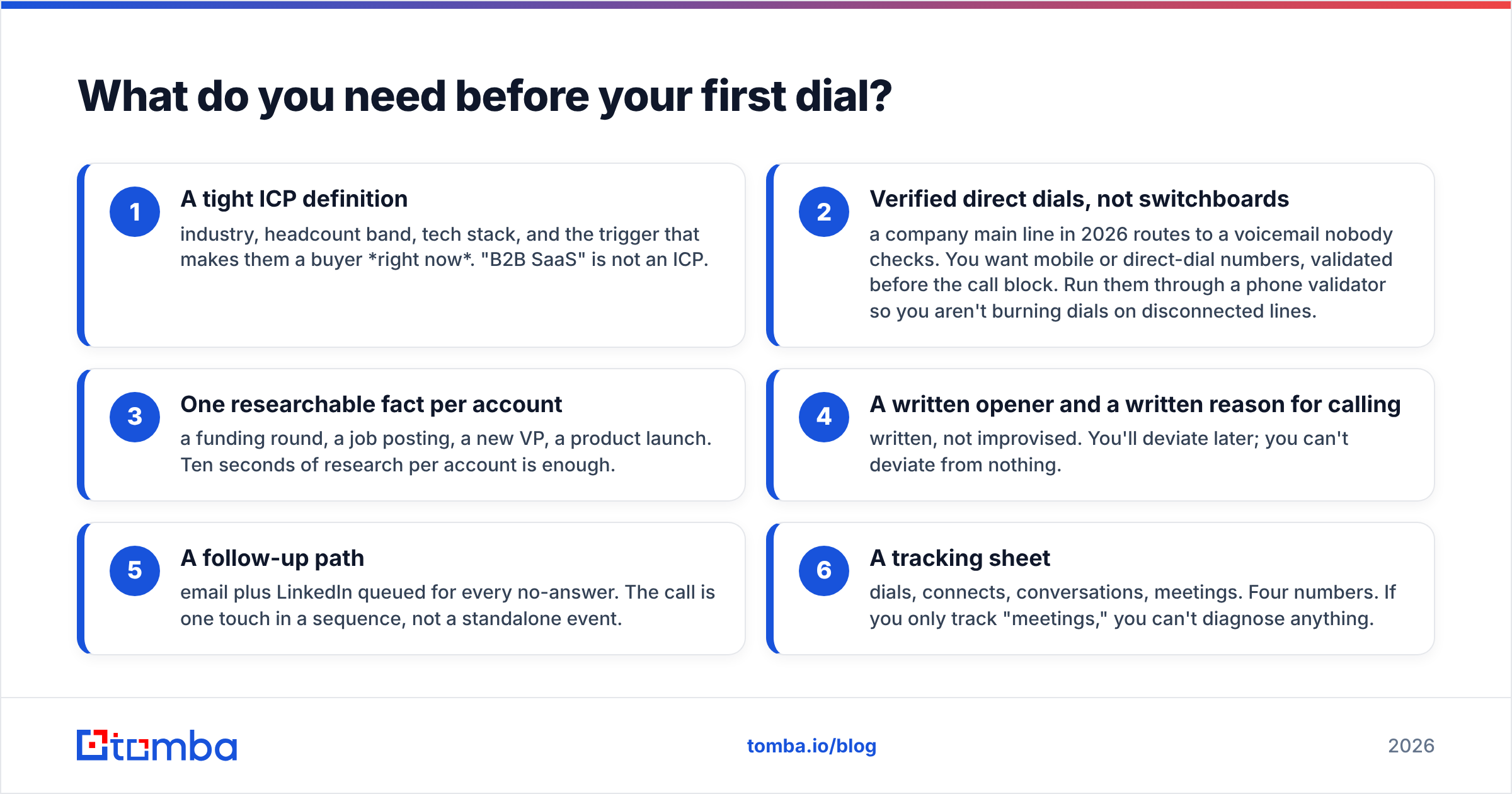
Do not open the dialer until these five things exist. Every one of them multiplies the value of the calls you're about to make.
- A tight ICP definition — industry, headcount band, tech stack, and the trigger that makes them a buyer right now. "B2B SaaS" is not an ICP.
- Verified direct dials, not switchboards — a company main line in 2026 routes to a voicemail nobody checks. You want mobile or direct-dial numbers, validated before the call block. Run them through a phone validator so you aren't burning dials on disconnected lines.
- One researchable fact per account — a funding round, a job posting, a new VP, a product launch. Ten seconds of research per account is enough.
- A written opener and a written reason for calling — written, not improvised. You'll deviate later; you can't deviate from nothing.
- A follow-up path — email plus LinkedIn queued for every no-answer. The call is one touch in a sequence, not a standalone event.
- A tracking sheet — dials, connects, conversations, meetings. Four numbers. If you only track "meetings," you can't diagnose anything.
The second item is where most teams quietly lose. Bought contact lists rot at roughly 25–30% per year as people change jobs, and phone data decays faster than email data. If you're sourcing contacts yourself, pair an email finder with a phone finder so each account has two reachable channels rather than one guess.
How do you structure a B2B cold call?#
Five beats, roughly 4–7 minutes if it goes well. Most calls die in beat two, which is why beat two gets the most rehearsal.
Beat 1 — The pattern interrupt (5 seconds). "Hi Sarah, it's Mark from Tomba. I know you weren't expecting my call — can I have 30 seconds to tell you why I rang, and then you can tell me to get lost?"
That works because it names the awkwardness out loud instead of pretending you're an old friend. Fake familiarity ("Hey Sarah, how've you been?") gets hung up on faster than honest interruption.
Beat 2 — The reason (15 seconds). One sentence. Role-specific problem, not product features. "I'm calling because I noticed you're hiring three SDRs this quarter. Most of the RevOps leads I talk to at that stage are trying to figure out how to feed those reps a list that doesn't bounce."
Beat 3 — The permission question. "Is that anywhere near a real problem for you, or am I way off?" Give them a clean exit. Counterintuitively, offering the exit raises the number of people who stay.
Beat 4 — Two discovery questions, maximum. Not a discovery call. Two questions to confirm fit: how they do it today, and what breaks.
Beat 5 — The specific ask. "Worth 20 minutes Thursday at 2, or Friday morning?" Never "does sometime next week work?"
What are the highest-leverage cold call openers?#
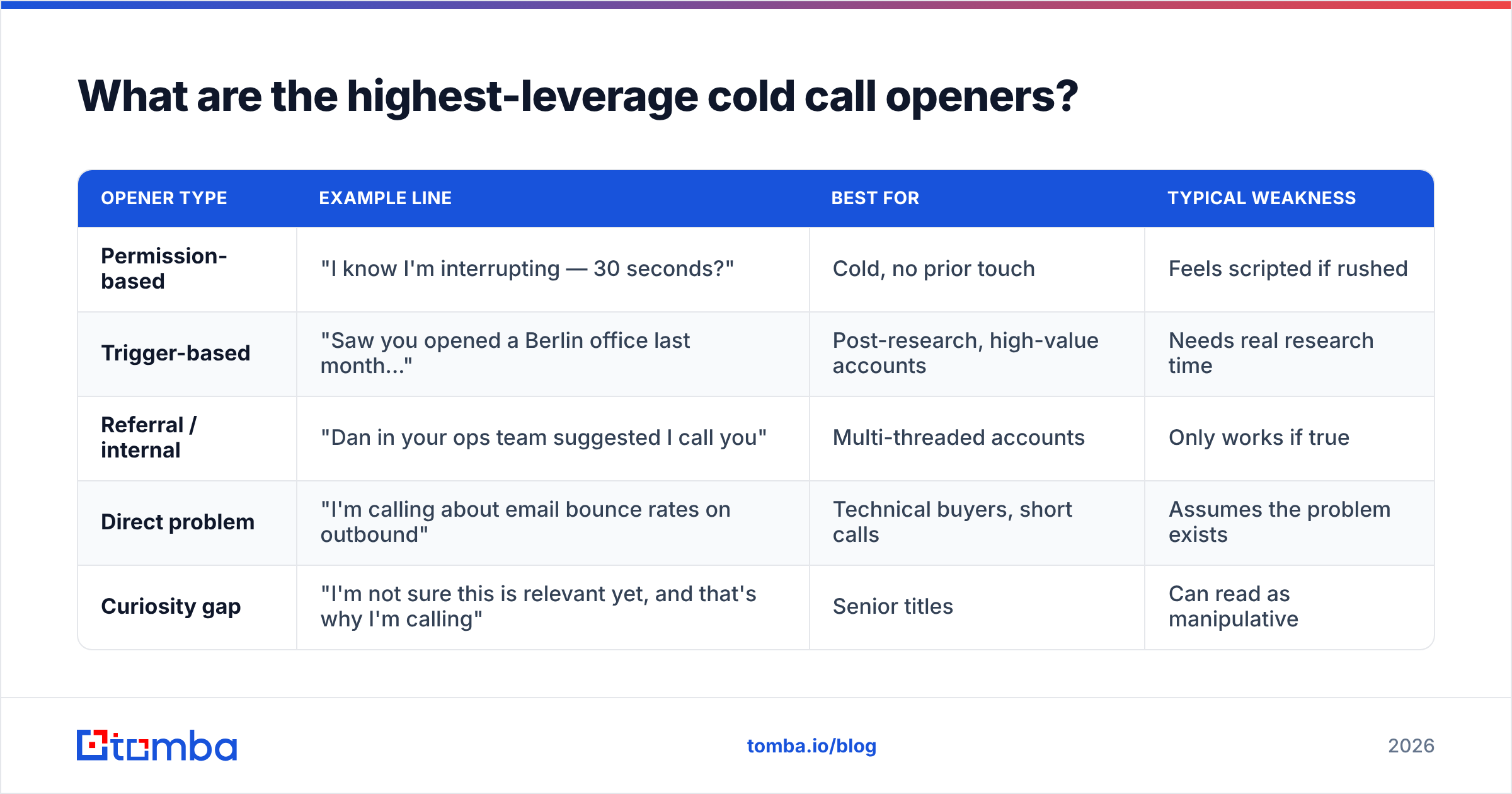
Different openers suit different call types. Here's how the common ones compare in practice.
| Opener type | Example line | Best for | Typical weakness |
|---|---|---|---|
| Permission-based | "I know I'm interrupting — 30 seconds?" | Cold, no prior touch | Feels scripted if rushed |
| Trigger-based | "Saw you opened a Berlin office last month..." | Post-research, high-value accounts | Needs real research time |
| Referral / internal | "Dan in your ops team suggested I call you" | Multi-threaded accounts | Only works if true |
| Direct problem | "I'm calling about email bounce rates on outbound" | Technical buyers, short calls | Assumes the problem exists |
| Curiosity gap | "I'm not sure this is relevant yet, and that's why I'm calling" | Senior titles | Can read as manipulative |
The permission-based opener is the safest default because it works without research. The trigger-based opener converts best but caps your volume — you can only research 30–40 accounts a day properly.
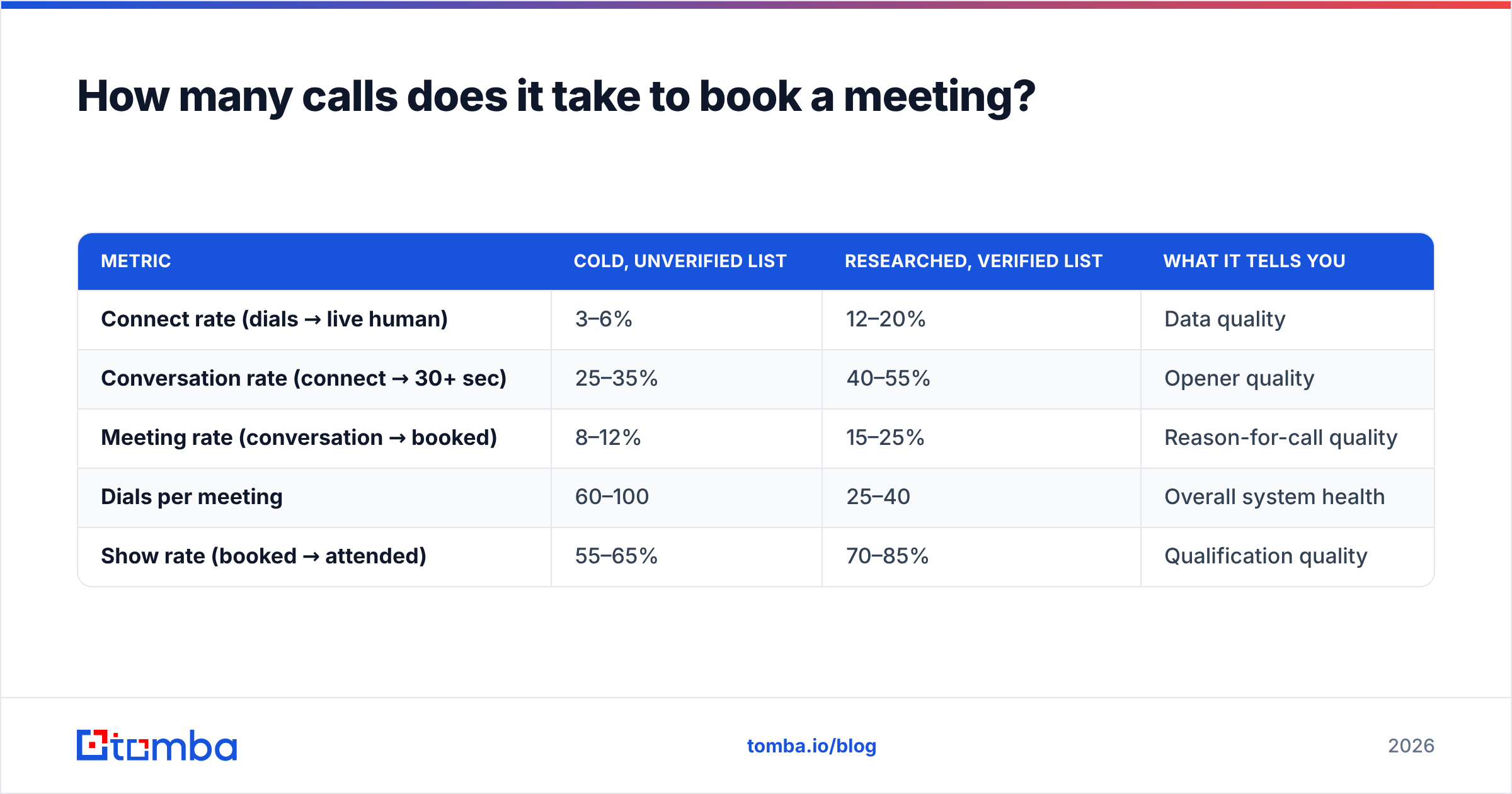
How many calls does it take to book a meeting?#
Set expectations with real numbers before your first block, or you'll quit on day three.
| Metric | Cold, unverified list | Researched, verified list | What it tells you |
|---|---|---|---|
| Connect rate (dials → live human) | 3–6% | 12–20% | Data quality |
| Conversation rate (connect → 30+ sec) | 25–35% | 40–55% | Opener quality |
| Meeting rate (conversation → booked) | 8–12% | 15–25% | Reason-for-call quality |
| Dials per meeting | 60–100 | 25–40 | Overall system health |
| Show rate (booked → attended) | 55–65% | 70–85% | Qualification quality |
Read this diagnostically. Low connect rate is a data problem — go fix your list, not your script. Low conversation rate is an opener problem. Low meeting rate means your reason for calling isn't landing with that persona. Low show rate means you're booking people who agreed just to end the call.
Industry benchmark reporting from sources like Gartner's sales research and buyer surveys published on G2 consistently show B2B buyers now engage multiple channels before responding — which is why your calls should never be the only touch on an account.
How do you handle the four objections you'll actually hear?#
Ninety percent of cold call objections are one of four reflexes. Write a response to each, say it out loud fifty times, and stop improvising.
"I'm not interested." Arrives before they've processed anything. Don't argue with it — reframe. "Totally fair, you don't know what I do yet. Thirty seconds and then I'll go — the reason I called specifically was [trigger]. If that's not relevant, I'll delete your number."
"Send me an email." Usually a polite hang-up. Convert it into information. "Happy to. So I don't send you something useless — is the bigger issue right now [problem A] or [problem B]?" Then send the email and reference the call in the subject line.
"We already use [competitor]." Never attack the incumbent. Peers like BookYourData or your prospect's existing vendor may be serving them well, and rubbishing a tool they chose makes you look uninformed. "Good tool. Most teams I talk to who use it are happy with the coverage and just supplement on [specific gap]. Is that your experience or is coverage fine for you?"
"Now's not a good time." Take it literally once. "Understood. Is it a bad five minutes or a bad quarter? If it's the five minutes, when's better — I'll call back then."
How should you structure your calling day?#
Volume without structure produces exhausted reps and no meetings. Structure it like a gym program: heavy blocks, real recovery, measured progression.
- Two or three 90-minute blocks, ideally 8:00–9:30, 11:30–1:00, and 4:00–5:30 local time to the prospect. Decision-makers answer before assistants arrive and after meetings end.
- Research the night before, not during the block. Context-switching between research and dialing halves your dial count.
- Stand up. Genuinely — posture changes vocal energy, and the difference is audible.
- Record and review two calls a day. Not ten. Two, listened to properly, with one specific change identified.
- Never leave a call block without queuing follow-up. Every no-answer gets an email and a LinkedIn touch the same day. LinkedIn outreach plus a voicemail plus an email on the same day reads as persistence; the call alone reads as noise.
On voicemail: leave one, under 20 seconds, and only on the first and third attempts. "Sarah, Mark from Tomba, calling about the SDR hiring push — I'll try you Thursday, or my number's [X]." No pitch. The voicemail exists to make your name familiar for the next dial.
How do you get the right phone numbers and emails?#
This is the unglamorous half of cold calling that determines everything else.
Start from the account, not the person. Identify target companies from your ICP, then use domain search to map who works there and what the company email pattern looks like. From there, verify each contact before it enters your dialer — an email verifier pass keeps your follow-up sequence out of spam folders, and validating phone numbers keeps your connect rate honest.
A workable weekly rhythm:
- Monday — build the list. 150–200 accounts matching ICP and trigger criteria.
- Monday PM — enrich and verify. Emails, direct dials, LinkedIn URLs. Drop anything unverifiable rather than dialing it.
- Tuesday–Thursday — call blocks, with same-day email and LinkedIn follow-up.
- Friday — review recordings, update objection responses, refresh the list for next week.
If you're running this for a team rather than solo, a bulk email finder turns the Monday build into a batch job instead of a day of manual lookups. For pricing on volume, Tomba plans start free at 25 searches a month, with Starter at $49/mo and Growth at $99/mo covering most single-team outbound motions.
What mistakes kill B2B cold calls fastest?#
- Pitching in the first 20 seconds. You haven't earned the right. Reason for calling ≠ pitch.
- Talking more than 40% of the call. Record yourself and time it; most reps are shocked.
- Asking "how are you today?" It signals "salesperson" in under two seconds.
- Dialing switchboards. In hybrid-work companies, main lines route nowhere useful.
- Not calling back. Most booked meetings come from attempts 3–6, not attempt 1. Research from HubSpot's sales data has long shown the majority of reps stop after one or two attempts, which is exactly why persistence still works.
- Booking meetings with anyone who says yes. A 55% show rate usually means you're booking people who wanted the call to end.
- Reading the script. Learn the beats, not the sentences. Prospects hear reading instantly.
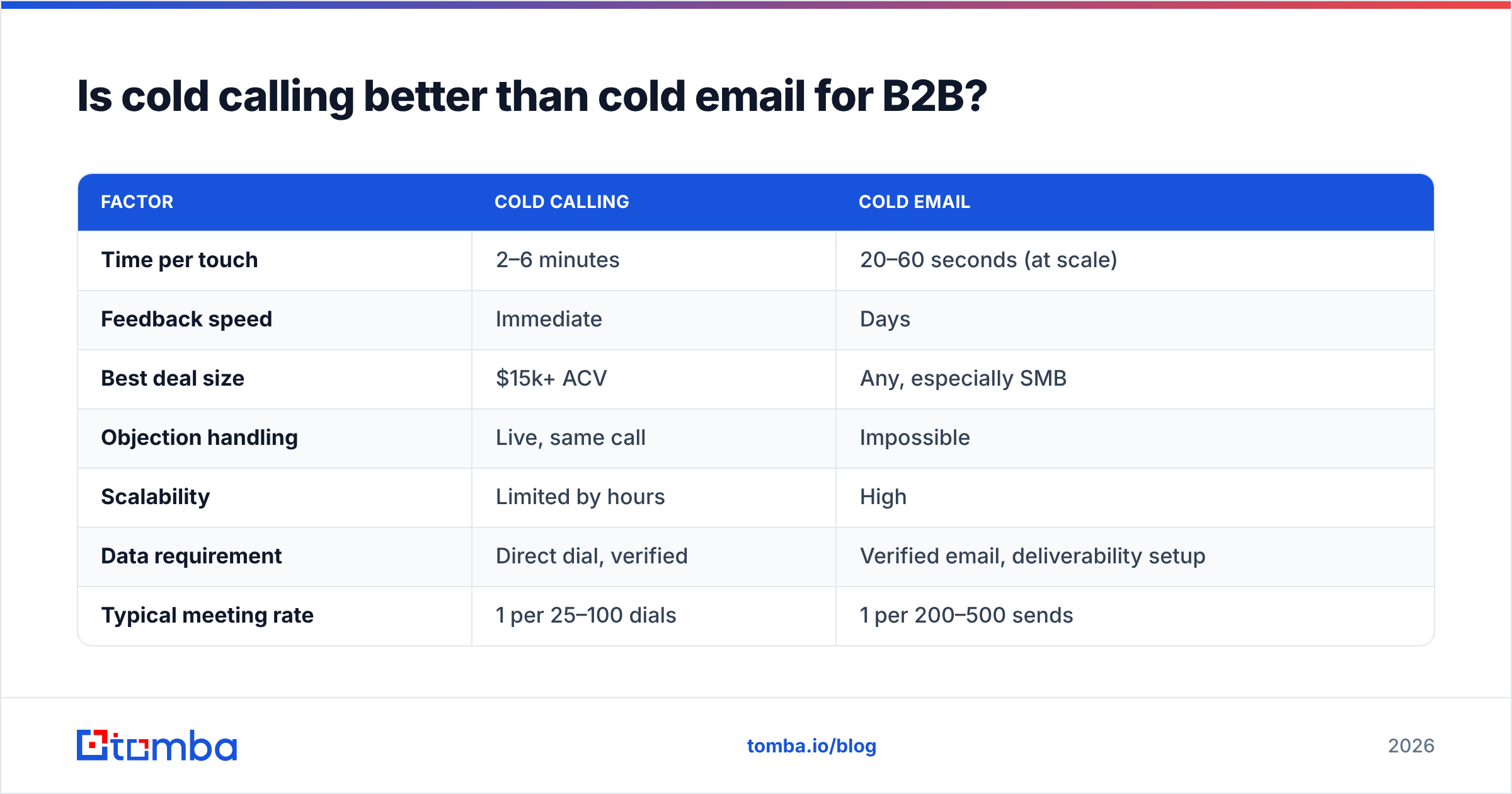
Is cold calling better than cold email for B2B?#
Neither wins alone — they do different jobs, and the answer depends on your deal size and buyer.
| Factor | Cold calling | Cold email |
|---|---|---|
| Time per touch | 2–6 minutes | 20–60 seconds (at scale) |
| Feedback speed | Immediate | Days |
| Best deal size | $15k+ ACV | Any, especially SMB |
| Objection handling | Live, same call | Impossible |
| Scalability | Limited by hours | High |
| Data requirement | Direct dial, verified | Verified email, deliverability setup |
| Typical meeting rate | 1 per 25–100 dials | 1 per 200–500 sends |
The honest read: calling wins on conversion per touch, email wins on volume and cost. Run both against the same account list, sequence them together, and let the channel that gets the response carry the deal. Reps who only email plateau; reps who only call burn out.
Where should you start this week?#
Pick 50 accounts that match your ICP and have a live trigger. Find and verify a direct dial and an email for each. Write your opener down. Book two 90-minute blocks. Track four numbers.
Fifty accounts done properly will teach you more than 500 done sloppily — and the data you gather in week one is what makes week four's calls convert.
If the bottleneck is contact data rather than technique, that's the fixable part. The Tomba Email Finder gives you verified professional emails by name or domain, with direct-dial phone lookup and enrichment alongside it, so your call block starts from numbers that actually ring and emails that actually land. Start on the free tier with 25 searches a month, test it against your current list, and see how much of your low connect rate was never a script problem at all.
Related guides#
// get started
Find, verify and enrich your first contacts today
Start on the free plan with 25 searches a month, then scale when your team is ready.
Free plan · No credit card required · GDPR & CCPA
Get the Tomba newsletter
Product and data updates
// about the author