How to Cold Call for Insurance Leads: A 2026 Playbook
Cold calling still books insurance appointments in 2026 — if your list, timing, and first 12 seconds are right. Here is the exact script, cadence, and data workflow agents use to hit 6-9% contact-to-appointment rates.
TL;DR
- Cold calling insurance leads still works in 2026, but the win rate lives in the list, not the script. Bad numbers cap you at 2-3% contact rates no matter how good your opener is.
- Use a 12-second opener: name, reason, permission question. Do not pitch coverage on the first breath.
- Plan 8 touches per lead across 12 business days, mixing calls, voicemail, and email. Most agents quit at touch 3.
- Call between 8:00-10:00 a.m. and 4:00-6:00 p.m. local time. Midday dials to business owners are close to wasted.
- Pair dialing with verified contact data — a verified email plus a validated direct line roughly doubles your reachable universe per 100 records.
Why does cold calling still work for insurance in 2026?#
Because insurance is a trust-and-timing product, and the phone compresses both.
Most B2B categories have been flooded with automated outbound. Insurance is different in one important way: the buying trigger is usually an event — a renewal date, a new hire, a new vehicle, a lease signing, a compliance letter from a carrier. Events are time-boxed. Email sits in an inbox for three days. A phone call lands inside the window.
The catch is that the phone has gotten harder. Carrier-level spam labeling (STIR/SHAKEN attestation, branded caller ID, analytics scoring from Hiya and First Orion) means an unregistered number dialing 300 times a day gets flagged "Scam Likely" within about a week. That is the single biggest change from five years ago. If you skip caller ID registration, you are not doing outbound — you are doing charity.
So "how to cold call for insurance leads" in 2026 is really three problems stacked:
- Reachability — is the number correct, and does it ring through un-flagged?
- Relevance — do you have a reason to call this person this week?
- Response — does your first 12 seconds earn 30 more?
Most training material only covers #3. That is why most agents plateau.
What does a good insurance cold call list actually look like?#
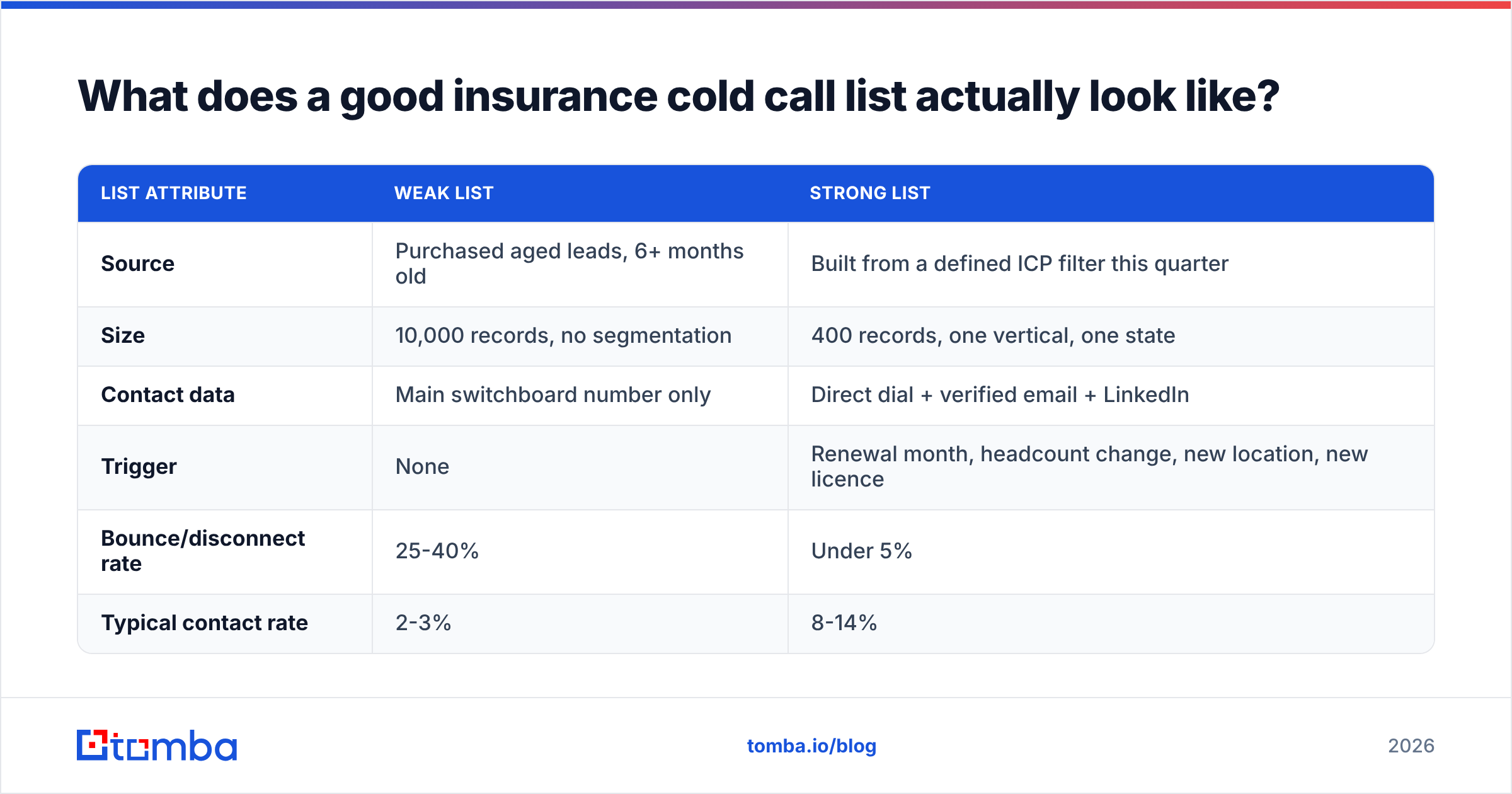
A good list is narrow, event-triggered, and verified. Here is the difference in practice.
| List attribute | Weak list | Strong list |
|---|---|---|
| Source | Purchased aged leads, 6+ months old | Built from a defined ICP filter this quarter |
| Size | 10,000 records, no segmentation | 400 records, one vertical, one state |
| Contact data | Main switchboard number only | Direct dial + verified email + LinkedIn |
| Trigger | None | Renewal month, headcount change, new location, new licence |
| Bounce/disconnect rate | 25-40% | Under 5% |
| Typical contact rate | 2-3% | 8-14% |
For commercial lines, build the list around a vertical you can speak to fluently — trucking fleets, dental practices, contractors, restaurant groups. Vertical specificity is what makes your opener credible. "I work with 40 HVAC contractors in Arizona" beats "I help businesses save on insurance" every time.
For personal lines, the trigger set is different: new homeowners, recent movers, new vehicle registrations where public, and referral-adjacent networks (realtors, mortgage brokers, auto dealers).
Building the list is where most agents burn hours. A practical workflow:
- Define the filter — industry code, employee band, geography, and one trigger.
- Pull the company set — from a B2B data provider, a chamber directory, a licensing board, or an association member list.
- Find the decision maker — owner, CFO, office manager, or HR lead depending on line of business.
- Enrich contact points — use a domain search to map a company's email pattern, then a phone finder for direct lines rather than reception.
- Verify before dialing — run the emails through an email verifier so your follow-up sequence does not bounce and torch your sending domain.
- Load into the dialer with the trigger noted in a custom field so it appears on screen during the call.
That sixth step matters more than it sounds. If the trigger is not visible while the phone is ringing, you will default to a generic pitch.
What should you say in the first 12 seconds?#
Name, reason, permission. In that order, in under 12 seconds.
The structure that consistently outperforms in insurance outbound:
"Hi [Name], this is [Your Name] with [Agency]. I'll be straight with you — this is a cold call. I work with [vertical] in [region] and I noticed [trigger]. Can I take 30 seconds to tell you why I called, and you can tell me to go away?"
Four things are doing work there:
- The upfront admission. Naming the cold call defuses the pattern-interrupt reflex. Prospects relax when you stop pretending.
- The vertical anchor. It proves you did not dial randomly.
- The trigger. It answers "why now."
- The permission ask with an escape hatch. "Tell me to go away" gives control back, and control is what people actually want on an unexpected call.
What to avoid in the opener:
- "How are you today?" — signals a script instantly.
- "Are you the person who handles insurance?" — a gatekeeper question that gets you a gatekeeper answer.
- Any mention of price, savings, or quotes before permission is granted. Leading with savings frames you as a commodity broker.
Once you have permission, your next 30 seconds should be one specific, verifiable observation plus one question. Example for commercial auto: "Most fleets your size in [state] are seeing 14-18% renewal increases this cycle because of the litigation environment. When does your policy renew?" The renewal date is the only qualifying data you need on call one.
For the objection layer, prepare exactly three responses and stop there:
- "I already have an agent." → "Good — most people I talk to do. I'm not asking you to switch. I'm asking for 10 minutes 60 days before your renewal so you have a second number to compare. Fair?"
- "Send me something." → "Happy to. So I don't send you the generic packet — are you more concerned about premium or coverage gaps right now?"
- "Not interested." → "Understood. Before I let you go — is that a 'never' or a 'not this quarter'?" Then log the answer and set the callback.
Research from HubSpot's sales data has long shown that persistence past the first "no" is where most conversion sits. In insurance specifically, a "not this quarter" logged with a renewal date is worth more than a lukewarm "sure, send info."
How many calls does it take, and when should you dial?#
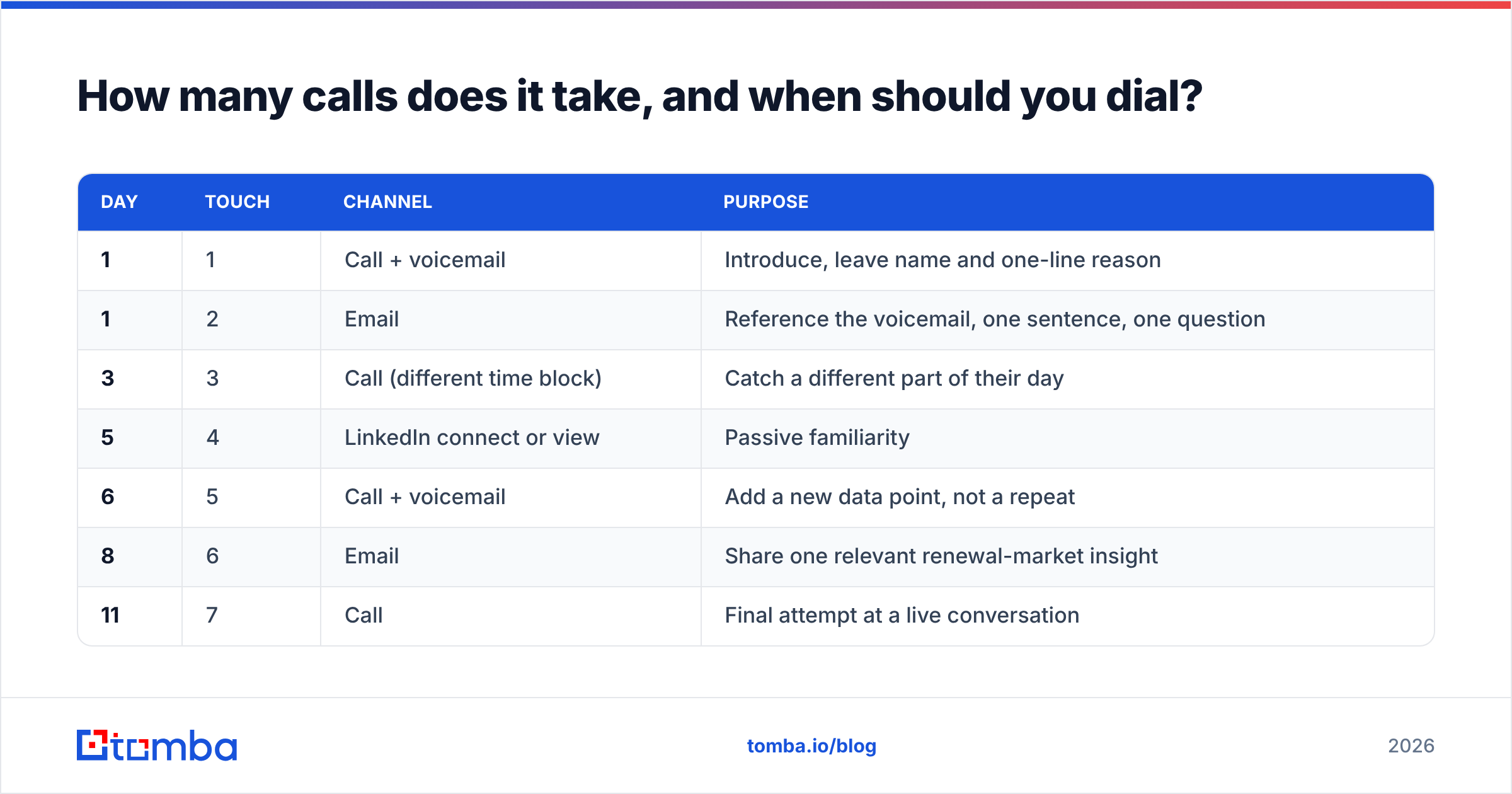
Plan for 8 touches over 12 business days. Here is the cadence that balances persistence against annoyance.
| Day | Touch | Channel | Purpose |
|---|---|---|---|
| 1 | 1 | Call + voicemail | Introduce, leave name and one-line reason |
| 1 | 2 | Reference the voicemail, one sentence, one question | |
| 3 | 3 | Call (different time block) | Catch a different part of their day |
| 5 | 4 | LinkedIn connect or view | Passive familiarity |
| 6 | 5 | Call + voicemail | Add a new data point, not a repeat |
| 8 | 6 | Share one relevant renewal-market insight | |
| 11 | 7 | Call | Final attempt at a live conversation |
| 12 | 8 | Breakup email | "Closing your file" — historically high reply rate |
Timing rules that hold up across most agencies:
- Best windows: 8:00-10:00 a.m. and 4:00-6:00 p.m. local time. Owners are at their desk before staff arrive and after the day's fires are out.
- Worst window: 11:30 a.m.-1:30 p.m. Lunch, deliveries, shift changes.
- Best days: Tuesday, Wednesday, Thursday. Monday is triage; Friday is checkout.
- Never dial the same time twice. If 9 a.m. Tuesday failed, try 4:30 p.m. Thursday. Rotating time blocks alone can lift contact rate several points.
Track dials, contacts, conversations, and appointments as four separate numbers. Most agents only track dials and appointments, which hides the real bottleneck. If your contact rate is under 5%, fix the list. If contacts are fine but conversations die, fix the opener. If conversations are good but appointments do not book, fix the close.
How does cold calling compare to other insurance lead channels?#
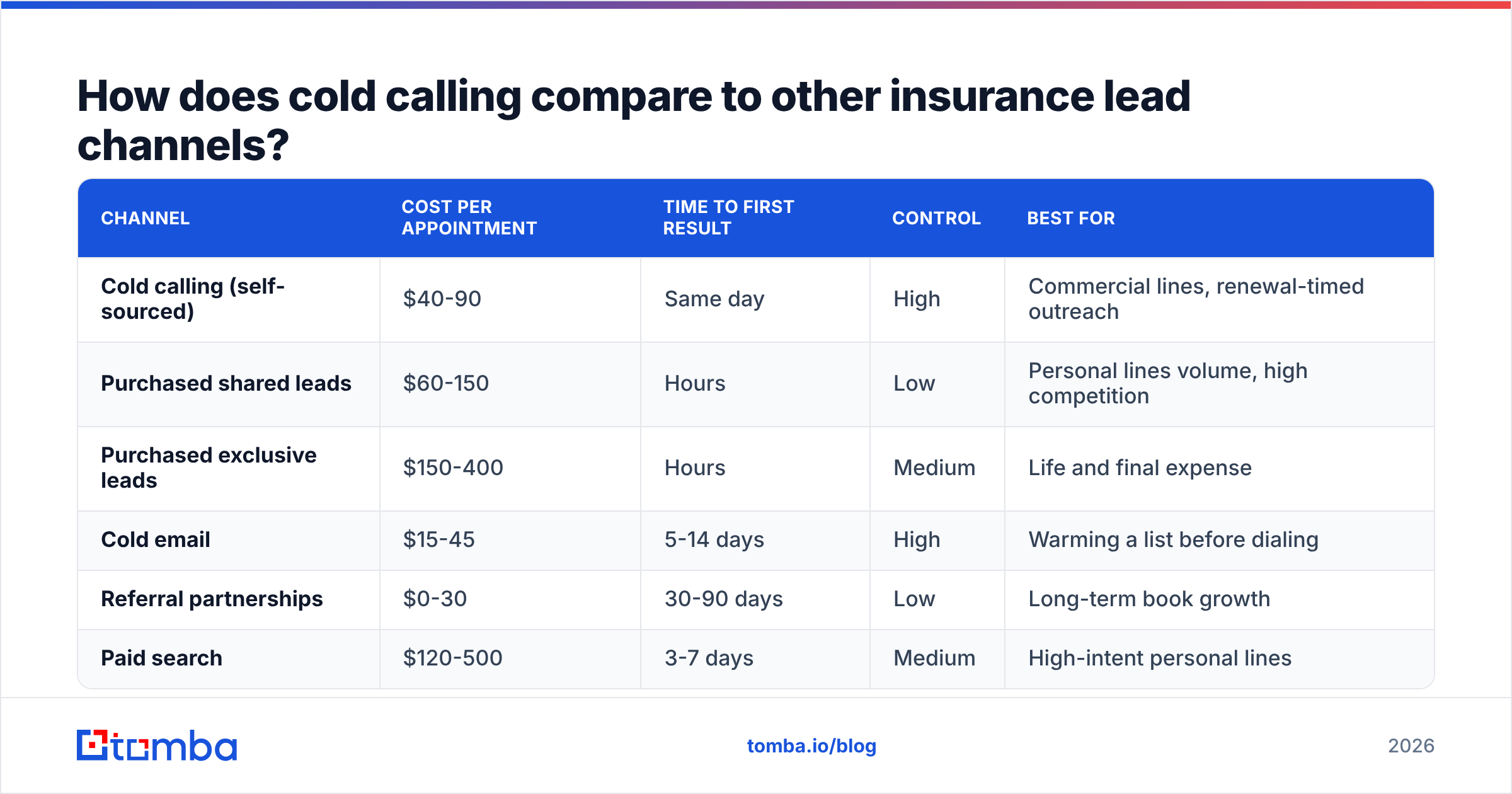
Cold calling is not the cheapest channel — it is the fastest to control. Here is how it stacks against the usual alternatives.
| Channel | Cost per appointment | Time to first result | Control | Best for |
|---|---|---|---|---|
| Cold calling (self-sourced) | $40-90 | Same day | High | Commercial lines, renewal-timed outreach |
| Purchased shared leads | $60-150 | Hours | Low | Personal lines volume, high competition |
| Purchased exclusive leads | $150-400 | Hours | Medium | Life and final expense |
| Cold email | $15-45 | 5-14 days | High | Warming a list before dialing |
| Referral partnerships | $0-30 | 30-90 days | Low | Long-term book growth |
| Paid search | $120-500 | 3-7 days | Medium | High-intent personal lines |
The practical answer for most agencies is not "pick one." It is: use cold email to warm a verified list, then dial the openers. A prospect who has seen your name in the inbox twice answers the phone at a noticeably higher rate than a pure cold dial — and that only works if the emails actually delivered, which is a data-quality problem, not a copywriting one.
That is also why email deliverability belongs in a cold-calling article. Bounced pre-call emails do double damage: they fail to warm the prospect and they degrade your sending domain for every future campaign.
What tools and compliance rules do you actually need?#
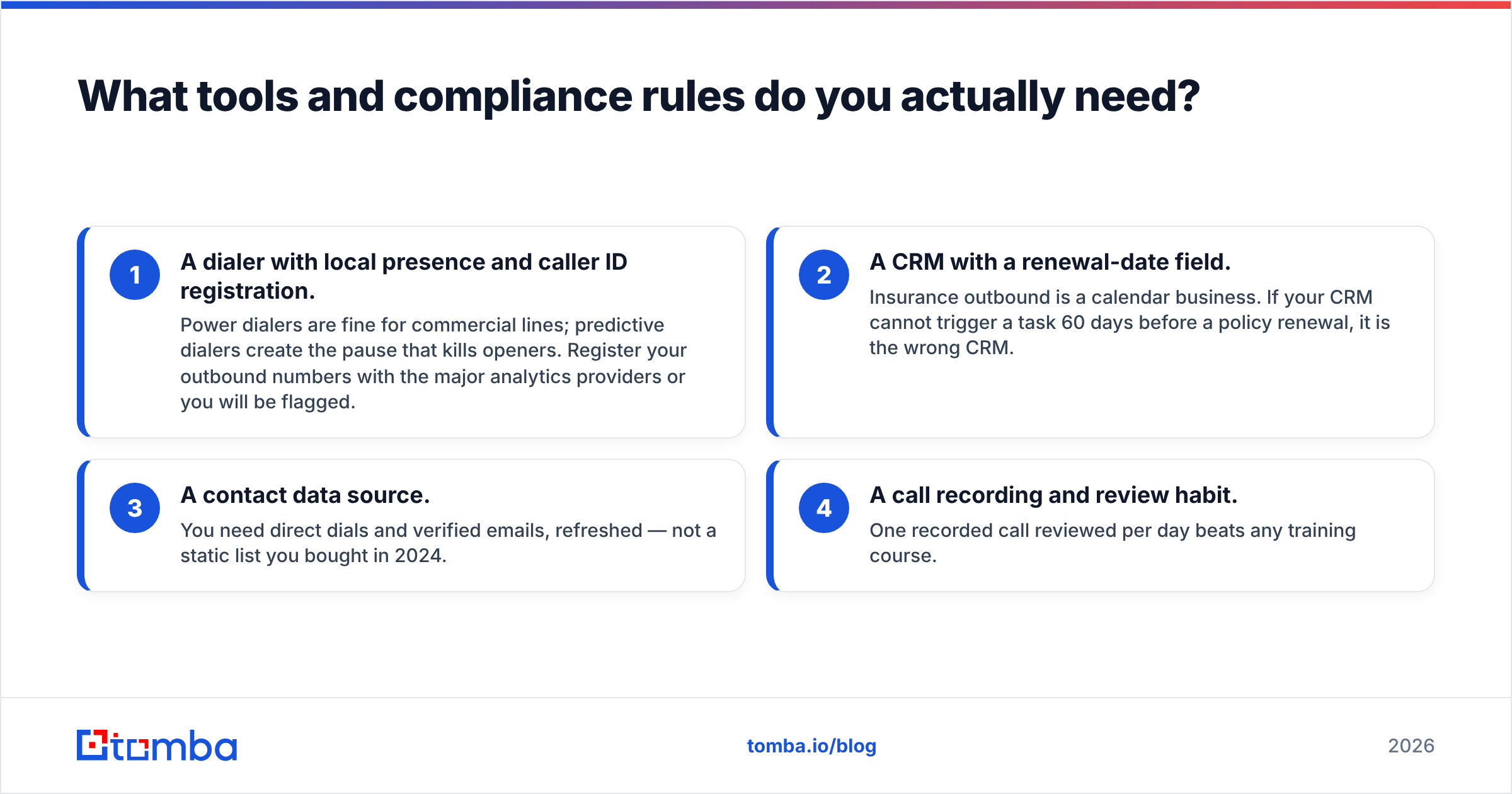
Keep the stack small. Four categories cover it.
- A dialer with local presence and caller ID registration. Power dialers are fine for commercial lines; predictive dialers create the pause that kills openers. Register your outbound numbers with the major analytics providers or you will be flagged.
- A CRM with a renewal-date field. Insurance outbound is a calendar business. If your CRM cannot trigger a task 60 days before a policy renewal, it is the wrong CRM.
- A contact data source. You need direct dials and verified emails, refreshed — not a static list you bought in 2024.
- A call recording and review habit. One recorded call reviewed per day beats any training course.
Compliance is non-negotiable and varies by jurisdiction:
- Do Not Call. Scrub against the national registry and any state registries before every campaign. In the US, check the FTC's National Do Not Call Registry requirements for sellers.
- TCPA and autodialers. Manual-dial requirements and consent rules apply differently to mobile numbers. Get counsel; do not rely on a vendor's marketing page.
- State insurance regulations. Licensing disclosure, recorded-call notification, and permissible solicitation language vary. Know your state's rules before you build the script.
- B2B vs B2C. Business lines have more latitude than personal lines in many jurisdictions, but "more latitude" is not "no rules."
Write your compliance constraints into the script itself so reps cannot forget them under pressure.
How do you keep the list fresh without burning hours?#
Automate the refresh, not the conversation.
The highest-leverage habit is treating your call list like perishable inventory. Direct dials go stale as people change roles; company emails break when domains change or employees leave. A quarterly refresh cycle looks like this:
- Re-verify every email in the active pipeline. Anything that flips to invalid gets re-enriched or archived.
- Re-check job titles on your top 100 accounts. A new office manager is a new opening.
- Re-pull the trigger data — renewal months, headcount changes, new locations.
- Deduplicate before loading into the dialer so two reps never call the same owner in a week.
If you are working from spreadsheets, a Google Sheets workflow can handle enrichment and verification in place without exporting to yet another tool. For higher volume, bulk email finder runs handle a few thousand records at a time, and the Tomba API plugs enrichment straight into your CRM so records refresh on write.
One honest caveat on data providers: no vendor has perfect coverage for every vertical. Contractors and independent trades are consistently harder to source than SaaS or professional services. Compare providers on your actual target list, not on their homepage claims — G2 category reviews are a reasonable starting point, but a 100-record test against a vertical you know is better evidence than any review score. Tools like BookYourData, Apollo, and Tomba all have different strengths by geography and industry; test before you commit budget.
What does a realistic 30-day ramp look like?#
Week by week, here is a plan you can actually execute alongside a book of business.
- Week 1 — Build. Define one vertical and one geography. Build 400 records. Enrich and verify. Register caller ID. Write the opener and three objection responses.
- Week 2 — Dial and record. 60 dials per day, two time blocks. Record every call. Do not change the script mid-week — you need a clean baseline.
- Week 3 — Diagnose. Pull your four metrics. Fix the weakest one only. Most agents find the list is the problem, not the script.
- Week 4 — Scale the winner. Double down on the segment with the highest contact-to-conversation rate. Kill the rest. Add the email touches to the cadence.
Expect roughly 300 dials to produce 25-40 contacts, 12-20 real conversations, and 3-6 appointments in a well-built commercial list. If you are far below that, the diagnosis is almost always the data.
Get your dial list right before your next block#
Cold calling for insurance leads rewards preparation far more than charisma. The agents booking consistently are not better talkers — they are dialing correct numbers, at the right hour, with a reason on screen.
If the bottleneck in your outbound is finding the right people to call, start there. Tomba Email Finder locates verified professional email addresses by name, company, or domain so you can warm your list before you dial and follow up after you hang up. The free tier includes 25 searches per month, and paid plans start at $49/mo on the Starter tier — check current Tomba pricing for Growth and Pro limits. Build 400 clean records this week, and let your dials do what they are supposed to do: reach someone.
Related guides#
// get started
Find, verify and enrich your first contacts today
Start on the free plan with 25 searches a month, then scale when your team is ready.
Free plan · No credit card required · GDPR & CCPA
// about the author