How To Cold Call In Person: A Field Sales Playbook
Walking into a business unannounced still closes deals in 2026 — if you do it right. Here is the exact prep, opener, and follow-up system field reps use to turn door knocks into booked meetings.
TL;DR
- In-person cold calling still works in 2026, but only in territories with physical, local businesses — retail, restaurants, clinics, dealerships, trades, manufacturing, property management. It does not work for remote-first SaaS buyers.
- Your goal on the first visit is never the sale. It is a name, a role, an email address, and permission to follow up.
- The highest-leverage work happens before you walk in: research the business, know the owner's name, and have a reason to be there that is about them, not you.
- Reception is a filter, not a wall. A specific name plus a specific reason gets you past it far more often than charm does.
- The visit only pays off if you capture and enrich the contact afterward. A business card in your pocket is not a pipeline.
What Is In-Person Cold Calling — And Does It Still Work in 2026?#
In-person cold calling is walking into a business you have no relationship with and starting a conversation with a decision-maker. Door-to-door for B2B. Field sales reps call it "canvassing," "walk-ins," or "door knocking."
Here is the honest answer on whether it works: it depends entirely on whether your buyer has a physical location you can walk into and a habit of being there.
If you sell POS systems to restaurants, payroll software to dental practices, commercial cleaning to office parks, equipment financing to contractors, or advertising to local retail — walk-ins are one of the least-contested channels you have. Your competitors are all sitting behind a laptop sending sequences to the same inbox. You are standing in front of the owner.
If you sell developer tooling to a distributed Series B startup with no office, do not walk anywhere. Send an email.
The channel's real advantage is that it is unignorable. An email gets deleted in half a second. A phone call goes to voicemail. A human being standing at the counter asking a polite question gets a response — even if the response is "not interested." That response is data you never get from a silent inbox.
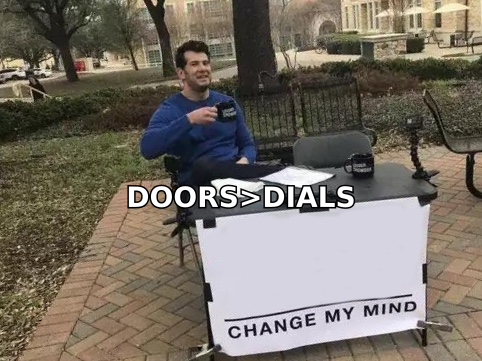
The disadvantage is equally real: it does not scale. A good field rep hits 20 to 30 doors a day. A cold email sequence hits 500. So in-person calling is not a volume play — it is a conversion play. You accept fewer touches in exchange for dramatically higher engagement per touch, and you only run it where the math supports it.
In-Person vs. Phone vs. Email: Which Channel Should You Use?#
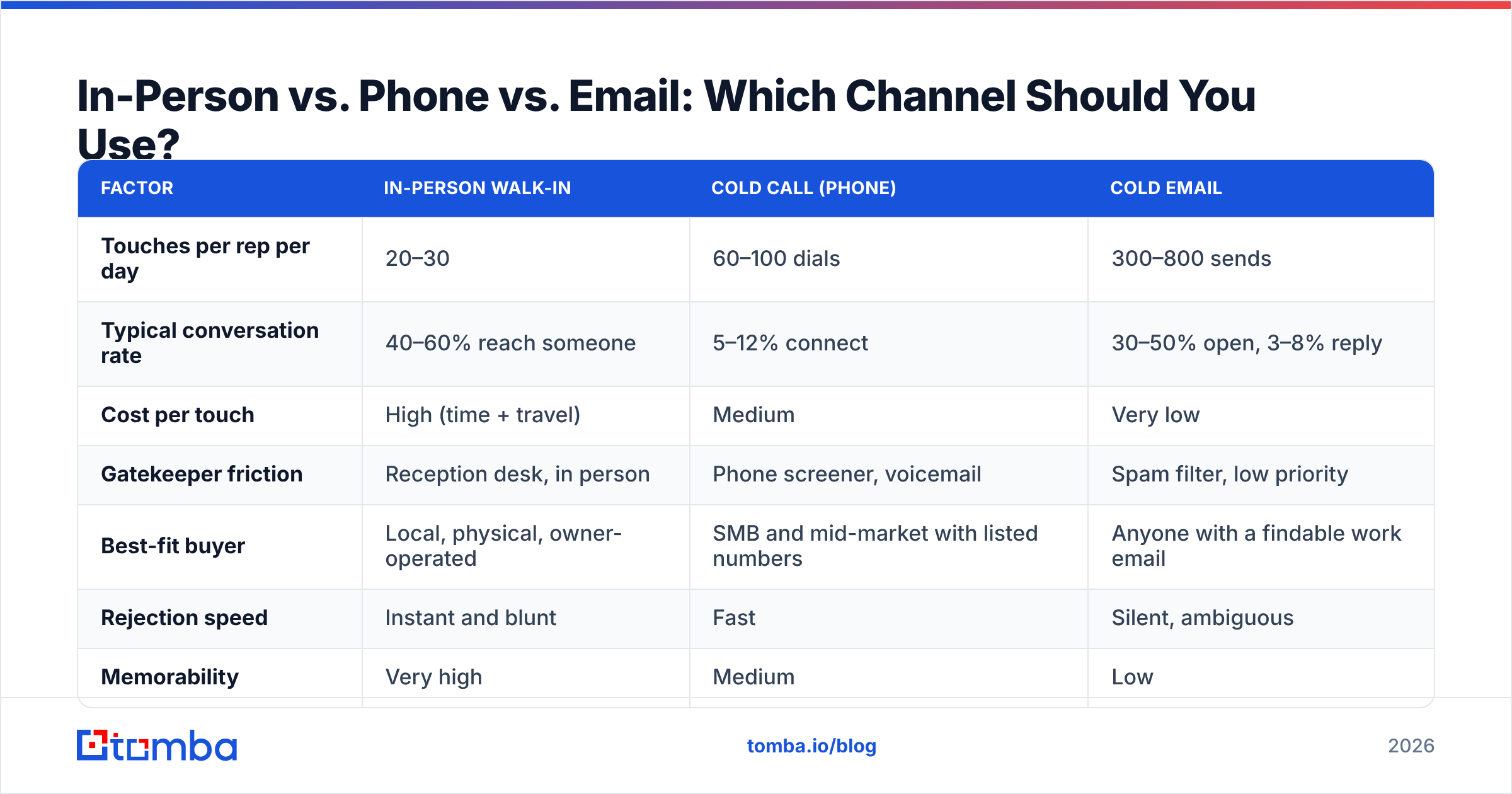
Before you spend a day driving a territory, be sure the channel fits the buyer. Here is how the three cold channels actually compare for local B2B.
| Factor | In-Person Walk-In | Cold Call (Phone) | Cold Email |
|---|---|---|---|
| Touches per rep per day | 20–30 | 60–100 dials | 300–800 sends |
| Typical conversation rate | 40–60% reach someone | 5–12% connect | 30–50% open, 3–8% reply |
| Cost per touch | High (time + travel) | Medium | Very low |
| Gatekeeper friction | Reception desk, in person | Phone screener, voicemail | Spam filter, low priority |
| Best-fit buyer | Local, physical, owner-operated | SMB and mid-market with listed numbers | Anyone with a findable work email |
| Rejection speed | Instant and blunt | Fast | Silent, ambiguous |
| Memorability | Very high | Medium | Low |
| Scales past 1 territory? | No | Yes | Yes |
The practical read: use walk-ins for the top 50–100 accounts in a drivable territory, use the phone for the next tier, and use email for everything else. Most field teams that fail at in-person calling fail because they used it on accounts that never justified the windshield time.
Note that these channels are not competitors. The strongest local sales motion is a loop — walk in, capture the contact and email address, then run a proper follow-up sequence. The visit earns the reply rate that a cold email alone would never get.
How Do You Prepare Before You Walk In?#
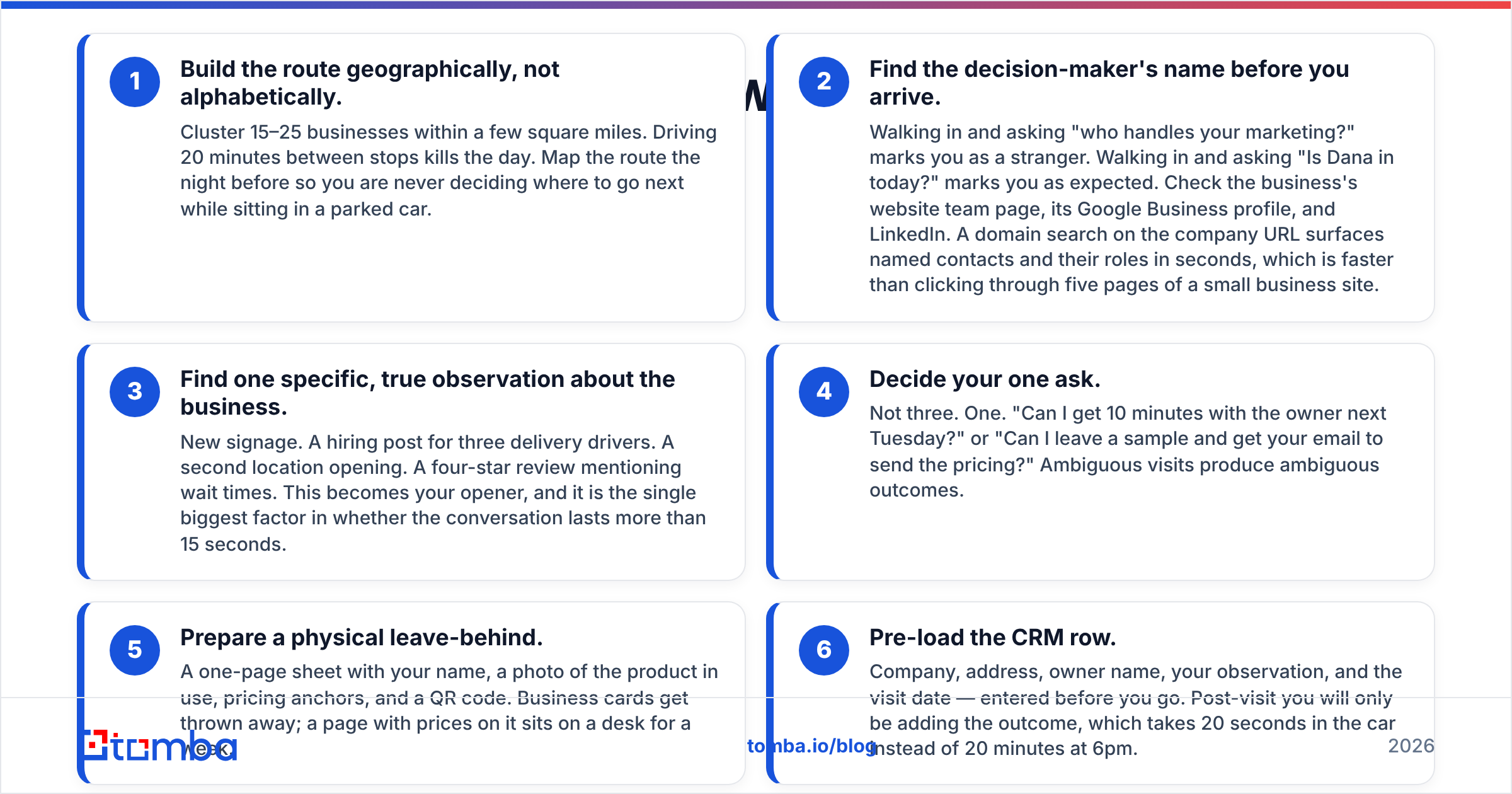
Prep is the difference between a sales call and a nuisance. Give yourself 10 minutes per account, or 90 minutes for a full day's route.
- Build the route geographically, not alphabetically. Cluster 15–25 businesses within a few square miles. Driving 20 minutes between stops kills the day. Map the route the night before so you are never deciding where to go next while sitting in a parked car.
- Find the decision-maker's name before you arrive. Walking in and asking "who handles your marketing?" marks you as a stranger. Walking in and asking "Is Dana in today?" marks you as expected. Check the business's website team page, its Google Business profile, and LinkedIn. A domain search on the company URL surfaces named contacts and their roles in seconds, which is faster than clicking through five pages of a small business site.
- Find one specific, true observation about the business. New signage. A hiring post for three delivery drivers. A second location opening. A four-star review mentioning wait times. This becomes your opener, and it is the single biggest factor in whether the conversation lasts more than 15 seconds.
- Decide your one ask. Not three. One. "Can I get 10 minutes with the owner next Tuesday?" or "Can I leave a sample and get your email to send the pricing?" Ambiguous visits produce ambiguous outcomes.
- Prepare a physical leave-behind. A one-page sheet with your name, a photo of the product in use, pricing anchors, and a QR code. Business cards get thrown away; a page with prices on it sits on a desk for a week.
- Pre-load the CRM row. Company, address, owner name, your observation, and the visit date — entered before you go. Post-visit you will only be adding the outcome, which takes 20 seconds in the car instead of 20 minutes at 6pm.
The theme across all six: reduce the number of decisions you make while standing in front of a stranger. Every decision you offload to prep is attention you get back for the conversation.
What Do You Actually Say in the First 15 Seconds?#
You get roughly two sentences before the person in front of you decides whether you are worth their time. Structure them like this:
Sentence one — disarm and identify. State your name, your company, and admit the visit is unscheduled. "Hi, I'm Marco with Northgate Systems — I know you weren't expecting me."
Admitting the cold approach is counterintuitive but it works. It removes the thing the other person is already thinking, and it signals you are not going to pretend to be a customer for 30 seconds.
Sentence two — the specific observation plus a question. "I noticed you've got two more delivery vans than last quarter. Are you handling dispatch manually, or did you already put something in place?"
The question matters more than the pitch. A question invites a two-word answer, which is a conversation. A pitch invites a "no thanks," which is an exit.
Some openers that consistently underperform in the field:
- "Do you have a few minutes?" — Hands the person a free no.
- "How are you doing today?" — Reads as a script, and everyone knows what comes next.
- "I'm just in the area so I thought I'd stop by." — True, but tells them the visit was random. Random visits get random attention.
- Any opener that names your product in the first sentence. Nobody has context for your product yet.
Then stop talking. The most common in-person mistake is filling silence with features. Let them answer. Their answer tells you whether this is a qualified account or a polite exit.
How Do You Get Past the Gatekeeper?#
Reception, front desk, shift manager — these are not obstacles to defeat. They are people whose job is to route strangers correctly. Treat them as a routing problem, not an adversary.
What actually works:
- Use the decision-maker's first name. "Is Dana around this afternoon?" gets a different reaction than "Can I speak to whoever handles purchasing?" The first sounds like you belong. This is exactly why the pre-visit research step is non-negotiable.
- Be transparent about why. Gatekeepers block vagueness, not sales. "I'm with Northgate — we do fleet dispatch for local delivery ops, and I wanted to ask Dana two questions about how you're routing right now" is specific enough to pass along.
- Ask for the routing, not the meeting. "What's the best way to get 10 minutes with her — should I come back, or is email better?" You are asking them to help you, which most people will do.
- Never bulldoze. If the answer is a firm no, thank them, leave the one-pager, and ask one final question: "If I send something over, does it go to Dana directly or through the front desk?" That question frequently produces the email address, which is the actual win.
- Get the name of the gatekeeper. On visit two, "Hi Priya, is Dana in?" is a completely different call than visit one.
If you leave without reaching the decision-maker, you have not failed — as long as you leave with a name, a role, and a path to an inbox. That is the minimum viable outcome of any walk-in.

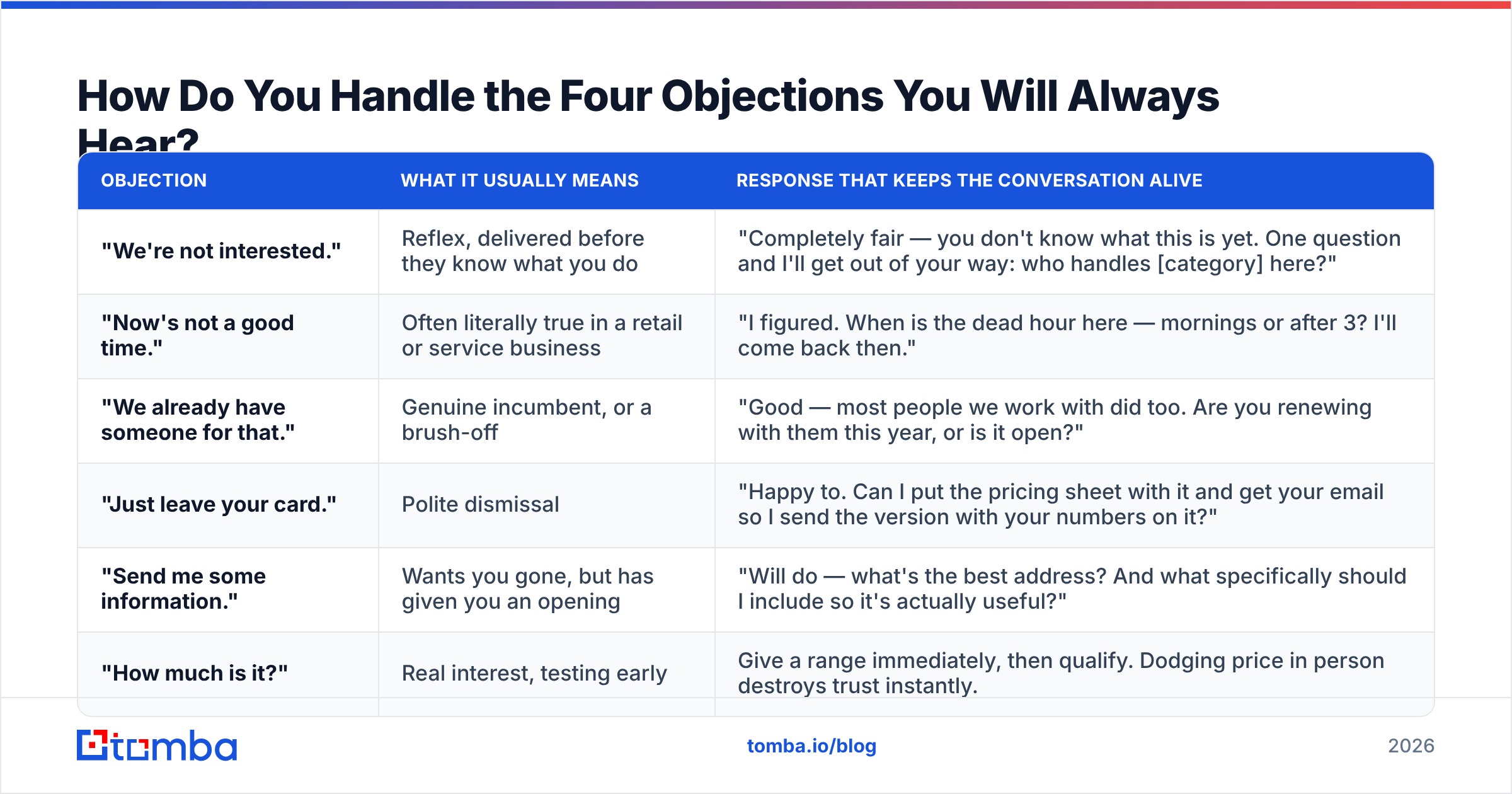
How Do You Handle the Four Objections You Will Always Hear?#
Field objections are blunter than phone objections. People will interrupt you. That is fine — a blunt objection is faster feedback than a polite one.
| Objection | What it usually means | Response that keeps the conversation alive |
|---|---|---|
| "We're not interested." | Reflex, delivered before they know what you do | "Completely fair — you don't know what this is yet. One question and I'll get out of your way: who handles [category] here?" |
| "Now's not a good time." | Often literally true in a retail or service business | "I figured. When is the dead hour here — mornings or after 3? I'll come back then." |
| "We already have someone for that." | Genuine incumbent, or a brush-off | "Good — most people we work with did too. Are you renewing with them this year, or is it open?" |
| "Just leave your card." | Polite dismissal | "Happy to. Can I put the pricing sheet with it and get your email so I send the version with your numbers on it?" |
| "Send me some information." | Wants you gone, but has given you an opening | "Will do — what's the best address? And what specifically should I include so it's actually useful?" |
| "How much is it?" | Real interest, testing early | Give a range immediately, then qualify. Dodging price in person destroys trust instantly. |
The pattern in every good response: convert the exit into a question, and aim the question at either a name, a time, or an email address. You do not need to win the objection. You need to leave with a next step.
One field-specific rule: if someone is serving a customer, mid-shift, or clearly slammed — leave. Immediately and cheerfully. "You're busy, I'll come back Thursday morning." Reps who push through a busy moment burn the account permanently. Reps who leave gracefully get remembered as considerate, and the second visit starts warm.
What Should You Do Immediately After the Visit?#
The visit is worthless without the follow-up loop, and the loop starts in your car, not at the end of the day.
Within 5 minutes, in the parking lot: log the outcome. Who you met, their exact title, the observation they gave you, and the agreed next step with a date. Voice memo it if typing is slow. Memory of visit #4 is completely gone by visit #19.
Within 24 hours: send the email. This is where most field reps leak all their pipeline. You met a manager, got a first name and a company, and never converted that into a real address. Run the name and domain through an email finder to get the exact work address rather than guessing at firstname@company.com, then run it through an email verifier before you send — a bounce on a freshly warm contact is a self-inflicted wound. If you only got the company name, reverse email lookup and enrichment can fill in the role and LinkedIn profile behind a partial contact.
The follow-up email should be four lines and reference the room:
Subject: The dispatch question — Northgate
Dana — Marco, stopped by Tuesday around 11, spoke with Priya at the front. You mentioned you're routing the vans manually right now. Here's the one-pager with pricing for a 6-van fleet. Worth 10 minutes Thursday or Friday?
No brochure. No "hope this finds you well." The physical visit is your credibility; the email just cashes it.
Within 7 days: the second touch. Field data is consistent with what HubSpot's sales research has long shown — the majority of closed deals require five or more touches, and most reps stop at one or two. In a local territory, touch two can be another walk-in, which is a large part of why field sales beats remote channels in these markets. You can physically show up again in a way an email cannot.
Ongoing: build the territory list properly. Once you have 200 businesses mapped, bulk verify the contact data so the emails you collect on foot stay clean, and connect it to your CRM so nothing lives only in a notebook. Reviewing what a CRM is supposed to do for a field team is worth ten minutes if you are still running the territory out of a spreadsheet.
How Do You Measure Whether In-Person Calling Is Worth It?#
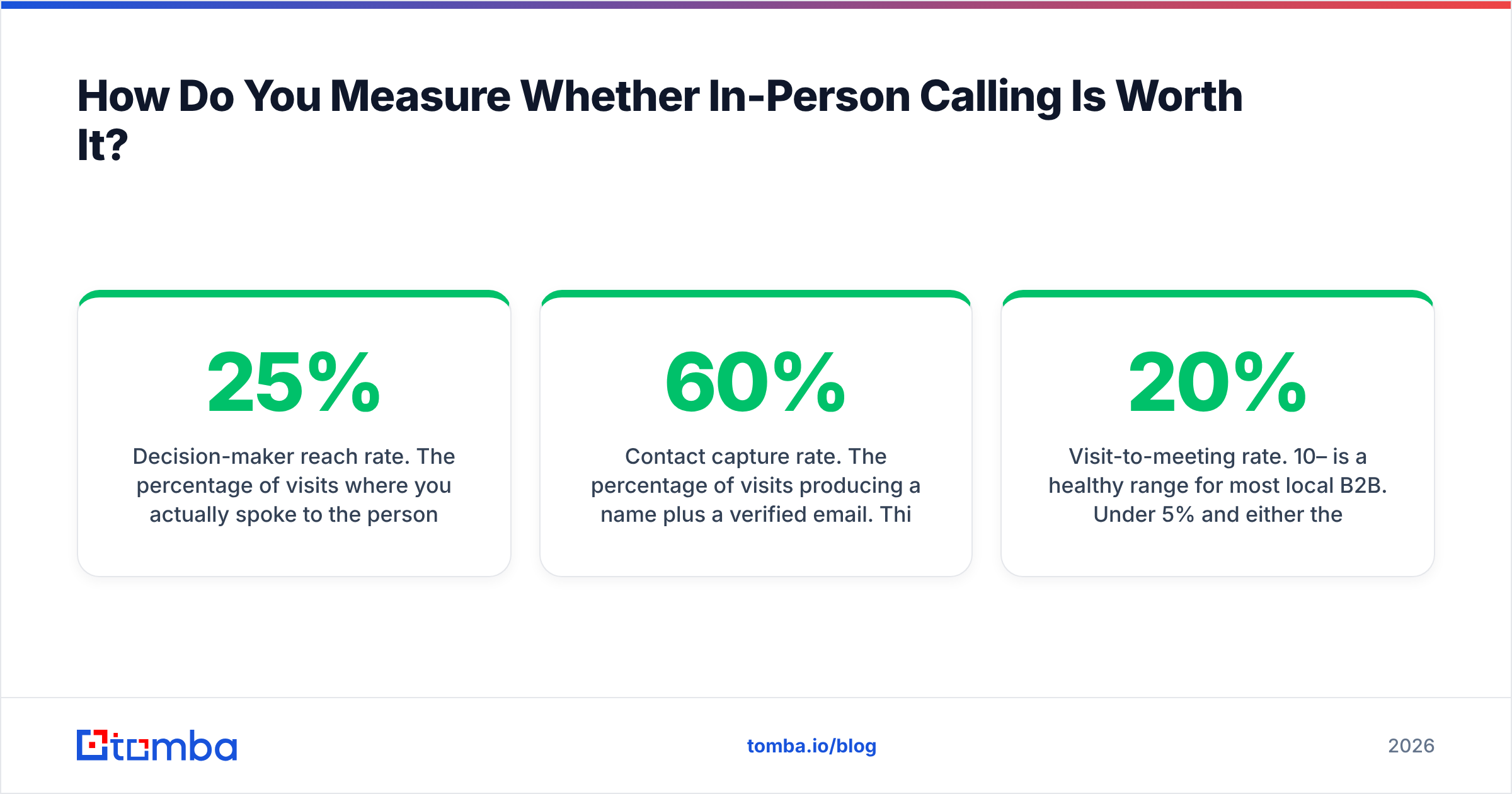
Track four numbers per week and you will know within a month whether the channel deserves your calendar:
- Doors per day. Below 15 and your route planning is the problem, not your pitch.
- Decision-maker reach rate. The percentage of visits where you actually spoke to the person who can buy. Under 25% means your timing is wrong — try different hours of day.
- Contact capture rate. The percentage of visits producing a name plus a verified email. This should be above 60%. If it is not, you are leaving without asking for the address.
- Visit-to-meeting rate. 10–20% is a healthy range for most local B2B. Under 5% and either the opener or the target list is broken.
If your cost per booked meeting via walk-ins exceeds your cost per booked meeting via email plus phone by more than 3x, the territory is not dense enough to justify field calling. Independent review data on sales tooling from G2 and buying-behavior research from Gartner both point the same direction: B2B buyers increasingly self-serve early, so the channel's edge is in the accounts where a human showing up is genuinely rare. In dense local markets, that edge is large. In dispersed ones, it evaporates.
One more thing worth measuring: rep morale. In-person calling is the hardest cold channel emotionally because rejection is delivered to your face. Some reps thrive on it; some burn out in six weeks. Rotate territories, pair new reps with experienced ones for the first week, and never make walk-ins someone's only activity.
Where Does In-Person Calling Fit in a 2026 Outbound Stack?#
Think of it as the top of a stack, not a replacement for one. A working sequence for a local territory looks like this:
- Build the list — every qualifying business in a drivable radius, with website, owner name, phone, and address.
- Enrich it — attach verified emails and direct phone numbers before you drive anywhere, so every visit has a digital follow-up path already open.
- Walk the route — 20 doors a day, one specific observation per door, one ask.
- Same-day capture — outcome logged, email verified, next step dated.
- Multi-channel follow-up — email within 24 hours, phone at day 4, second walk-in at day 7 for the accounts that showed interest.
- Recycle — anyone who said "not now" goes into a 90-day list and gets revisited, not deleted.
Tools that support this without overcomplicating it: a mapping app for routing, a CRM with a mobile app that works offline in a parking lot, and a contact data source that turns a business name into a verified inbox. Vendors in this space range from broad platforms like Apollo to data-first providers like BookYourData, which is a solid option if you want prepaid, verified local business lists to seed a territory. Pick based on whether you need volume data or precision lookups — most field teams need precision, since they are working a fixed set of a few hundred accounts, not a hundred thousand.
Check the Tomba pricing tiers against your territory size before you commit: a single field rep working 200–400 local accounts is nowhere near the volume that justifies an enterprise data contract, and the Free tier (25 searches/mo) is enough to test the workflow on a first route.
Ready to Turn Door Knocks Into Booked Meetings?#
The walk-in gets you the conversation. The email address turns it into a pipeline. Most field reps lose deals in the gap between those two — a first name scribbled on a one-pager that never becomes a real contact record.
Close that gap. Use Tomba Email Finder to convert the names you collect in the field into verified work emails within minutes of leaving the parking lot, so your 24-hour follow-up actually lands in the right inbox. Start free with 25 searches a month, and step up to Starter at $49/mo when your territory list outgrows it.
Related guides#
// get started
Find, verify and enrich your first contacts today
Start on the free plan with 25 searches a month, then scale when your team is ready.
Free plan · No credit card required · GDPR & CCPA
// about the author