How to Cold Call Investors: A Founder's Playbook for 2026
Most founders butcher the investor cold call in the first 15 seconds. Here's the research, list-building, and script framework that actually books the second meeting.
TL;DR
- Cold calling investors works, but only after you have narrowed the list to funds whose thesis, check size, and stage genuinely match your round — a 40-name qualified list beats a 400-name scrape every time.
- The first 15 seconds decide everything. Name the fund's own portfolio pattern, state your traction number, and ask for 20 minutes. Nothing else.
- Associates pick up. Partners rarely do. Treat the associate as the real buyer, not a gatekeeper to route around.
- You need direct dials and verified emails to run this at all. Partner mobile numbers are rarely public, and the fund's
info@inbox is where pitches go to die. - Expect 3-8% conversion from dial to first meeting when the list is tight. If you are under 1%, your targeting is wrong, not your script.
Does cold calling investors actually work in 2026?#
Yes — with a narrow definition of "works." Cold calling will not replace a warm introduction from a portfolio founder. What it will do is get you in front of the 10-20% of funds that are actively deploying into your stage and sector but have no path to hear about you otherwise.
The math is simple. A seed round typically needs 60-100 meaningful investor conversations to close. Warm intros from your existing network might produce 15-25 of those. Cold outreach — phone, email, or both — has to cover the gap. Founders who refuse to do it either raise slower or accept worse terms from the first fund that says yes.
The reason cold calling has a bad reputation among founders is that most of it is done badly: a scraped list of every VC in a directory, a generic voicemail, no follow-up sequence, no research. That is not cold calling. That is noise.
Done properly, an investor cold call is a research-heavy, low-volume, high-precision motion. You are not running a 300-dials-a-day SDR play. You are making 15-25 well-prepared calls a week during an active raise.
What do you need before you dial a single investor?#
Do not touch the phone until these five assets exist. Skipping any one of them turns a promising call into a wasted first impression you cannot repeat.
- A one-line thesis match. You must be able to say, in a single sentence, why this fund specifically should care. "You led the Series A in [portfolio company], and we're solving the same buyer's problem one layer down in the stack." If you cannot write that sentence, remove the fund from the list.
- One traction number that is not vanity. ARR, paying logos, net revenue retention, or week-over-week growth. Not "users," not "signups," not "waitlist." Investors mentally discount soft metrics to zero within two seconds.
- A verified direct line. Fund switchboards route to reception or to a shared voicemail nobody checks. You need the partner's or associate's direct dial and a verified work email as the fallback channel.
- A two-page deck teaser. Not the full deck. Problem, traction chart, team, round size. This is what you send within four minutes of hanging up, while you are still in short-term memory.
- A CRM row per fund. Stage, check size, thesis notes, last contact, next action. A spreadsheet is fine. No memory-based tracking — you will be running 60+ threads simultaneously and you will drop the ones that mattered.
The third item is where most founders stall. Investor contact data decays faster than almost any other B2B segment because partners move funds, spin out, and rebrand constantly. This is why a live lookup tool matters more than a static list — you can use a domain search against the fund's website to pull the current team's addresses and formats, then verify each one before it enters your sequence.

How do you build a target investor list that is actually callable?#
Start with signal, not volume. There are roughly 3,000 active institutional funds globally and maybe 60 that are a genuine fit for any given company at any given stage. Your job is to find those 60.
Work through these filters in order:
- Stage fit. A fund with a $400M vehicle will not write your $500K pre-seed check. Check their last 10 deals on Crunchbase, not their website copy.
- Check size. Median check per round, from public announcements. If your round is $2M and their median is $8M, you are a rounding error to them.
- Thesis and sector. Read the last three partner blog posts or podcast appearances. Investors telegraph what they want to fund months before they fund it.
- Recency. Has the fund deployed in the last 90 days? Funds between vehicles take meetings and never write checks. That is the single biggest time sink in fundraising.
- Conflict check. If they already back a direct competitor, skip. You will leak strategy for nothing.
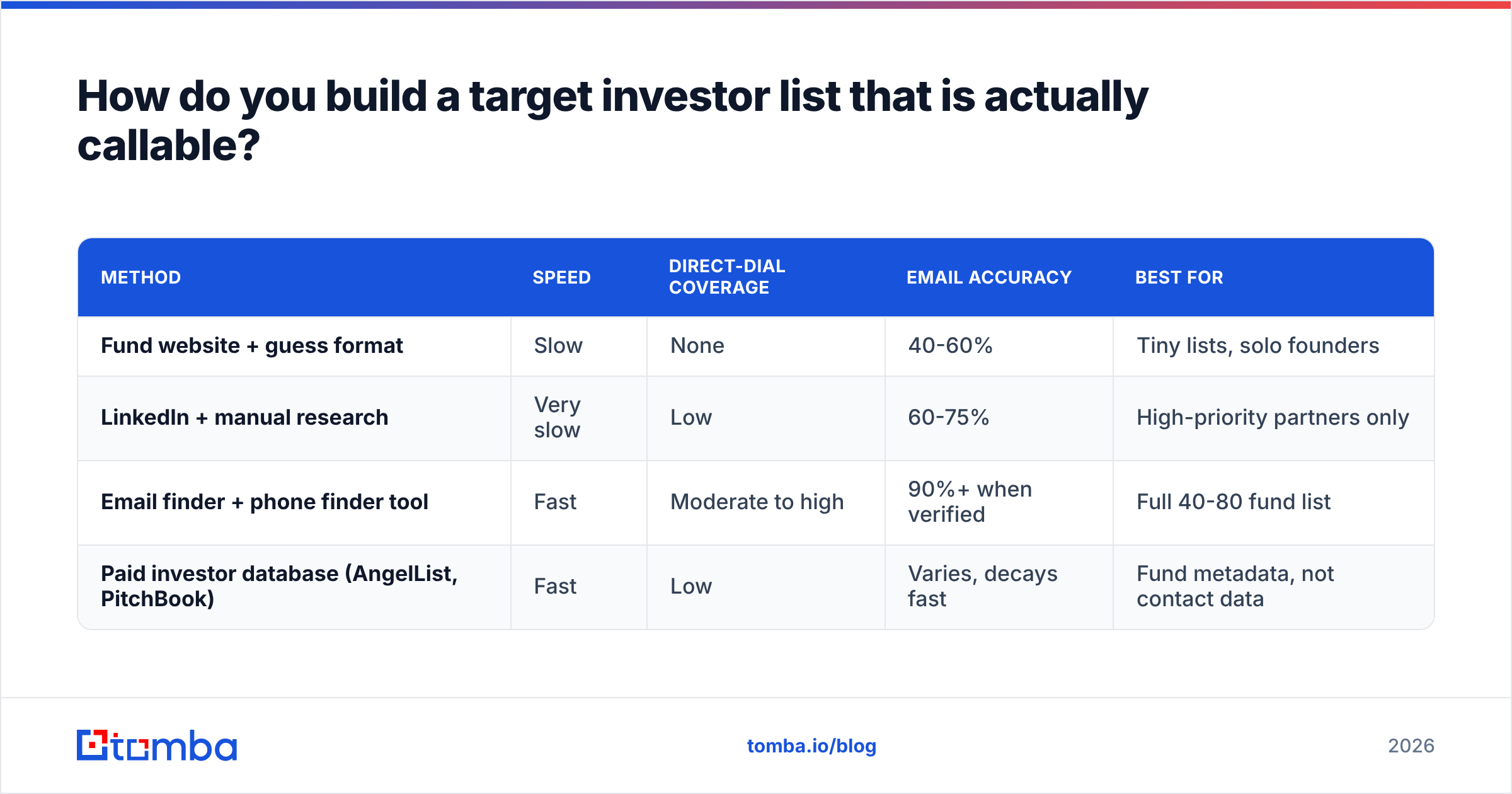
Once the list is set, you need contacts. Fund websites list partners by name but almost never publish direct emails or mobile numbers. Three practical routes:
| Method | Speed | Direct-dial coverage | Email accuracy | Best for |
|---|---|---|---|---|
| Fund website + guess format | Slow | None | 40-60% | Tiny lists, solo founders |
| LinkedIn + manual research | Very slow | Low | 60-75% | High-priority partners only |
| Email finder + phone finder tool | Fast | Moderate to high | 90%+ when verified | Full 40-80 fund list |
| Paid investor database (AngelList, PitchBook) | Fast | Low | Varies, decays fast | Fund metadata, not contact data |
The pragmatic stack is a database for fund metadata plus a live finder for contact data. Use PitchBook or Crunchbase to decide who to call, then use an email finder and phone finder to work out how to reach them. Databases are good at history and terrible at current contact details; finders are the reverse.
One more thing: run every address through an email verifier before you send anything. Investor domains are frequently catch-all configured, which means a naive tool will mark a wrong guess as valid. A bounce on a fund domain during an active raise is a self-inflicted wound.
What should you actually say in the first 15 seconds?#
Assume the person answered by accident and is deciding right now whether to hang up. Your opener has three jobs: prove you are not a random vendor, establish relevance, and make a small ask.
Here is a structure that survives contact with real partners:
"Hi [Name], this is [Your Name], founder of [Company]. I know this is a cold call — 30 seconds and I'll let you decide. You led [Portfolio Co]'s Series A, and we're doing [one-line thesis match]. We're at [traction number] growing [rate], raising a [round size] round. Worth 20 minutes next week?"
Break down why each piece is there:
- Naming the call as cold. Removes the pretence. Investors respect it and it buys you the 30 seconds.
- The portfolio reference. Proves research in four words. Never use "I love what you're doing" — it signals zero preparation.
- The traction number, early. Investors triage on numbers. Withholding it to "build to the reveal" gets you hung up on.
- The 20-minute ask. Small, specific, and easy to say yes to. Never ask for "a chat" or "to pick your brain."
What to cut: your origin story, the market size, the TAM slide, the founding team's pedigree, and anything resembling "we're the Uber for X." All of it belongs in the meeting, not the call.
Keep the whole opener under 25 seconds. Time yourself. Most founders run 50+ seconds on the first attempt and lose the listener at second 20.
How do you handle the four objections you will always hear?#
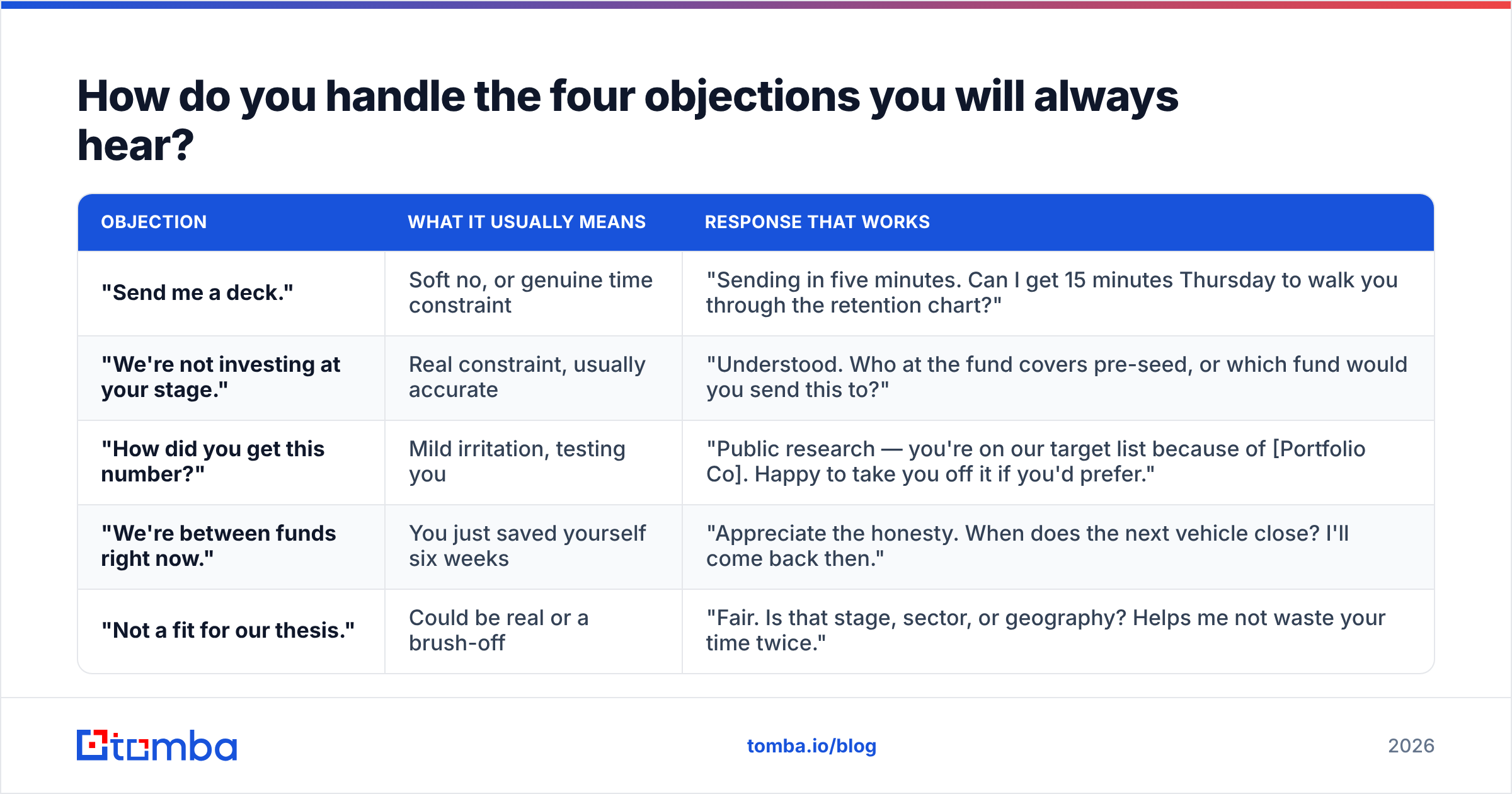
You will hear the same four responses in nearly every investor cold call. Prepare exact language for each — improvising here is how good leads die.
| Objection | What it usually means | Response that works |
|---|---|---|
| "Send me a deck." | Soft no, or genuine time constraint | "Sending in five minutes. Can I get 15 minutes Thursday to walk you through the retention chart?" |
| "We're not investing at your stage." | Real constraint, usually accurate | "Understood. Who at the fund covers pre-seed, or which fund would you send this to?" |
| "How did you get this number?" | Mild irritation, testing you | "Public research — you're on our target list because of [Portfolio Co]. Happy to take you off it if you'd prefer." |
| "We're between funds right now." | You just saved yourself six weeks | "Appreciate the honesty. When does the next vehicle close? I'll come back then." |
| "Not a fit for our thesis." | Could be real or a brush-off | "Fair. Is that stage, sector, or geography? Helps me not waste your time twice." |
Two rules that matter more than the scripts. First, never argue with a no — investors talk to each other and a reputation for being difficult travels fast in a small ecosystem. Second, always ask for a referral on the way out. "Who else should be looking at this?" converts roughly one in five rejections into a warm intro, which is a far better return than pushing a dead lead.
The "send me a deck" response deserves special attention because it is the most common. Treat it as a real yes only if you attach a time to it. A deck sent into silence has a single-digit response rate. A deck sent with a specific calendar proposal converts several times better.
When should you call, and how many times?#
Timing is not superstition here — investor calendars have real structure.
- Tuesday to Thursday. Monday is partner meeting day at most funds; the partner is either in it or preparing for it. Friday is dead after 2pm.
- 8:00-9:30am or 4:30-6:00pm local. Before the assistant is screening and after the meeting block ends. Mid-day calls hit voicemail almost every time.
- Avoid the last two weeks of the quarter. Portfolio work and LP reporting eat everything.
On cadence, six to eight touches across three weeks is the working range, mixing channels:
- Day 1 — Call. If voicemail, leave 20 seconds max with your name, company, one number, and that an email is coming.
- Day 1 (+10 min) — Email referencing the call attempt. Two-page teaser attached.
- Day 4 — Call at a different time of day.
- Day 7 — Email with a new data point, not a "just following up."
- Day 12 — LinkedIn message, short, referencing the same thesis match.
- Day 18 — Final call plus a genuine breakup email.
The breakup email is the highest-response message in most founder sequences. "Assuming the timing isn't right — I'll stop here and update you when we hit [milestone]" gets replies precisely because it removes pressure. If you want help structuring the written half of the sequence, the cold email templates library is a reasonable starting point to adapt rather than copy.

How do you measure whether your investor cold calling is working?#
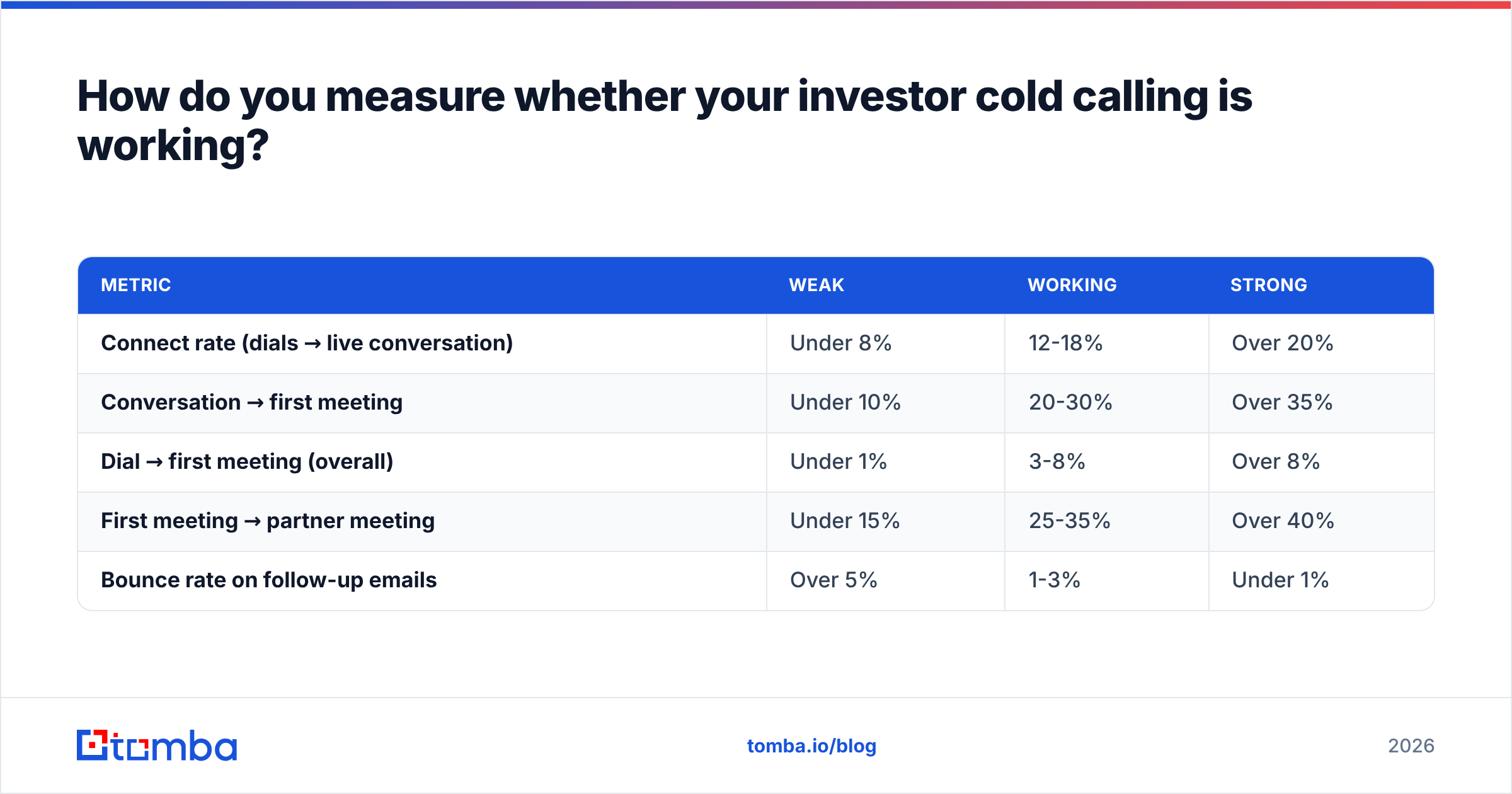
Track five numbers weekly. If you are not measuring, you are guessing about the most time-expensive activity in your raise.
| Metric | Weak | Working | Strong |
|---|---|---|---|
| Connect rate (dials → live conversation) | Under 8% | 12-18% | Over 20% |
| Conversation → first meeting | Under 10% | 20-30% | Over 35% |
| Dial → first meeting (overall) | Under 1% | 3-8% | Over 8% |
| First meeting → partner meeting | Under 15% | 25-35% | Over 40% |
| Bounce rate on follow-up emails | Over 5% | 1-3% | Under 1% |
Diagnose by where the number breaks:
- Low connect rate means your contact data is wrong. You are calling switchboards or stale numbers. Fix the list before you touch the script.
- Low conversation-to-meeting means the opener or the thesis match is weak. Record your calls (with consent where required) and listen to the first 20 seconds.
- Low meeting-to-partner-meeting means you have a pitch problem, not an outreach problem. Different fix entirely.
- High bounce rate means unverified emails are entering the sequence, which also drags down your sender reputation for every other thread you are running.
For benchmarks on how phone outreach compares to other channels, HubSpot's sales statistics research is a reasonable neutral reference, though note that most published cold-call data comes from B2B SaaS sales rather than fundraising specifically. Investor calls typically show higher connect rates and lower volumes than standard SDR benchmarks.
What are the legal and etiquette limits?#
Three things to get right.
Do-not-call registries. In the US, business-to-business calls are largely exempt from the National Do Not Call Registry, but state-level rules vary and calling a personal mobile with an autodialer is a different legal category entirely. Dial manually. Never use automated dialers for investor outreach — it is both legally riskier and immediately obvious to the person answering.
GDPR and EU investors. Legitimate interest can cover B2B outreach to a professional at their work contact details, but you need to be able to state your source, honour deletion requests immediately, and avoid calling personal numbers. If a European partner asks how you got their number, answer honestly and offer removal on the spot.
Ecosystem etiquette. The venture world is small and reputational. Do not call a partner's personal mobile at 9pm. Do not call three people at the same fund in the same week. Do not claim a mutual connection you do not have — it gets checked, and it ends the relationship permanently.
The safest posture: professional contact channels only, manual dialing, honest sourcing, immediate opt-out. That keeps you compliant and keeps your name clean.
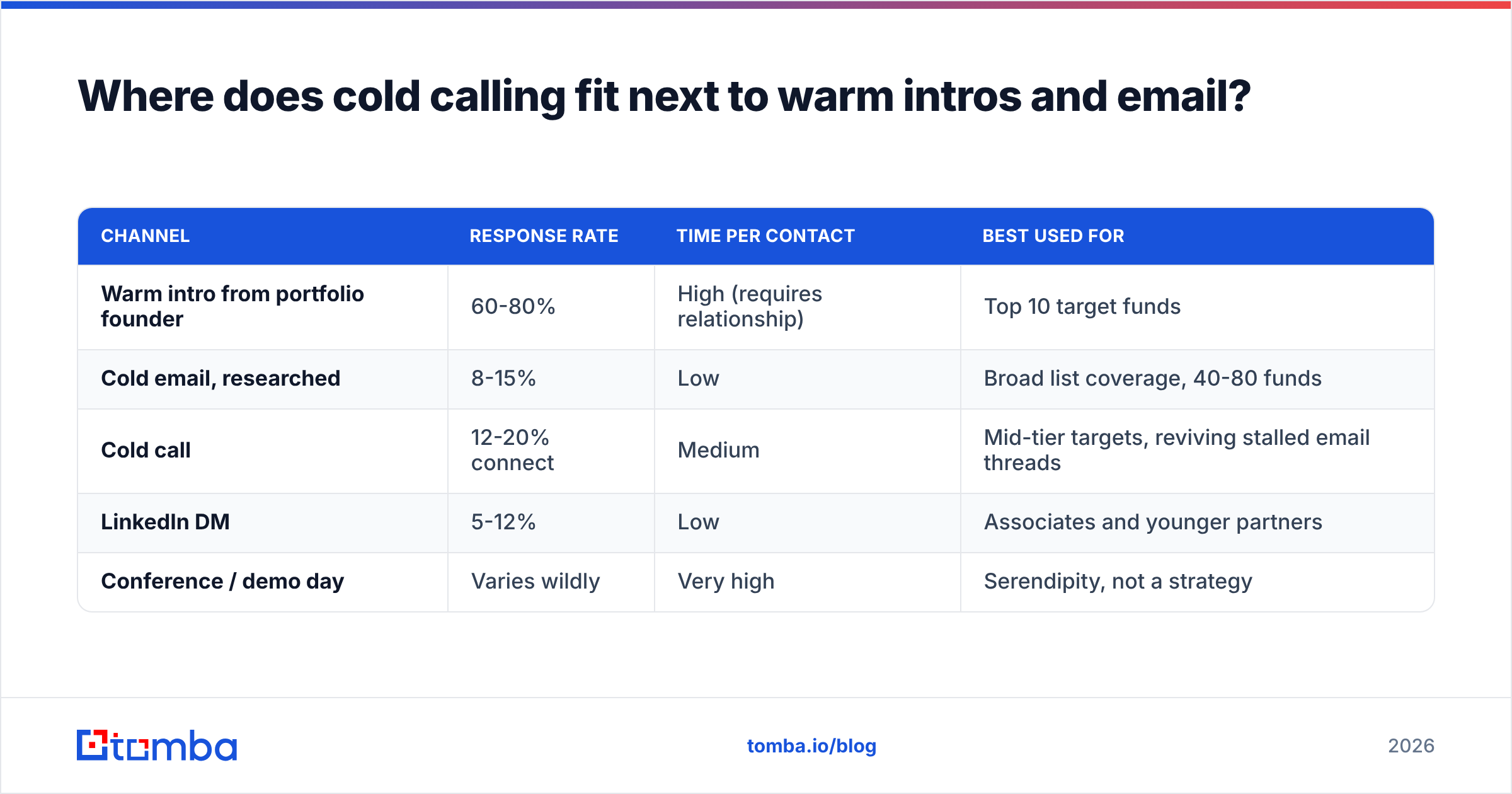
Where does cold calling fit next to warm intros and email?#
Cold calling is one lane in a three-lane road, and it is rarely the fastest one.
| Channel | Response rate | Time per contact | Best used for |
|---|---|---|---|
| Warm intro from portfolio founder | 60-80% | High (requires relationship) | Top 10 target funds |
| Cold email, researched | 8-15% | Low | Broad list coverage, 40-80 funds |
| Cold call | 12-20% connect | Medium | Mid-tier targets, reviving stalled email threads |
| LinkedIn DM | 5-12% | Low | Associates and younger partners |
| Conference / demo day | Varies wildly | Very high | Serendipity, not a strategy |
The strongest sequence uses all of them together: cold email for coverage, cold call to break through on the funds that matter most, LinkedIn as a third touch, and warm intros reserved for the handful of funds you genuinely want to lead the round. Founders who run only one channel raise more slowly than founders who layer them.
Note also that a cold call following a cold email performs far better than a cold call alone. The name is already familiar, even faintly, and familiarity is most of what a cold opener is fighting for. Build the B2B database of target funds first, run the email sequence, then call the non-responders who scored highest on thesis fit.
Ready to build the list you'll actually call?#
The scripts in this post are worth nothing against a bad list. Every metric that matters — connect rate, meeting rate, bounce rate — is downstream of whether you have current, verified contact details for the right 60 people.
Start with Tomba Email Finder to pull verified addresses for partners and associates at your target funds, then layer in phone data for the funds at the top of your list. The free tier gives you 25 searches a month to test your first batch; paid plans start at $49/mo on Starter and $99/mo on Growth if you are running a full raise. Full Tomba pricing is public, and the API works if you'd rather script the whole list-build against your CRM.
Get the list right, and the phone gets a lot easier to pick up.
Related guides#
// get started
Find, verify and enrich your first contacts today
Start on the free plan with 25 searches a month, then scale when your team is ready.
Free plan · No credit card required · GDPR & CCPA
Get the Tomba newsletter
Product and data updates
// about the author