How to Cold Call Real Estate Leads: A 2026 Playbook
Cold calling still books listing appointments in 2026 — but only if your list, timing, and first 12 seconds are right. Here's the exact script, dial cadence, and compliance checklist agents use.
TL;DR
- Cold calling real estate still works in 2026, but the win rate lives in the list, not the script. Bad numbers burn 60-70% of your dial time before you say a word.
- Expect roughly 1 listing appointment per 100-150 connected conversations on cold lists, and 1 per 20-40 on expireds and FSBOs.
- Your first 12 seconds must do three things: name yourself, name the reason, and ask permission. Skip any one and the hang-up rate spikes.
- Compliance is not optional — federal DNC scrubbing, state-level rules, and consent records are the difference between a business and a fine.
- Pair a dialer with verified contact data. A phone finder and phone validator pass cuts dead dials before they cost you an hour.
Real estate is one of the last industries where a cold phone call reliably outperforms a cold email. Homeowners don't read unsolicited email from agents. They do answer a call about their own property — especially if the listing just expired, if they're trying to sell it themselves, or if three houses on their street just closed above asking.
The problem is that most agents treat cold calling as a volume game and quit at week three. This guide breaks down the parts that actually move the needle: which lists convert, what to say in the first 12 seconds, how to structure a week of dialing, and where the legal landmines sit.
Does cold calling still work in real estate in 2026?#
Yes — with a narrower definition of "works" than 2015.
Pick-up rates on unknown numbers have collapsed. Carrier-level spam labeling, STIR/SHAKEN attestation, and iOS call screening mean a meaningful share of your dials never ring at all. The FCC's robocall rules push carriers to flag high-volume, low-answer numbers, and a mismanaged dialer will get your line labeled "Spam Likely" inside two weeks.
What survives is targeted calling. When you call 200 random homeowners, you're a nuisance. When you call 40 people whose listing expired last Tuesday, you're the first person offering a plan. Same activity, different economics.
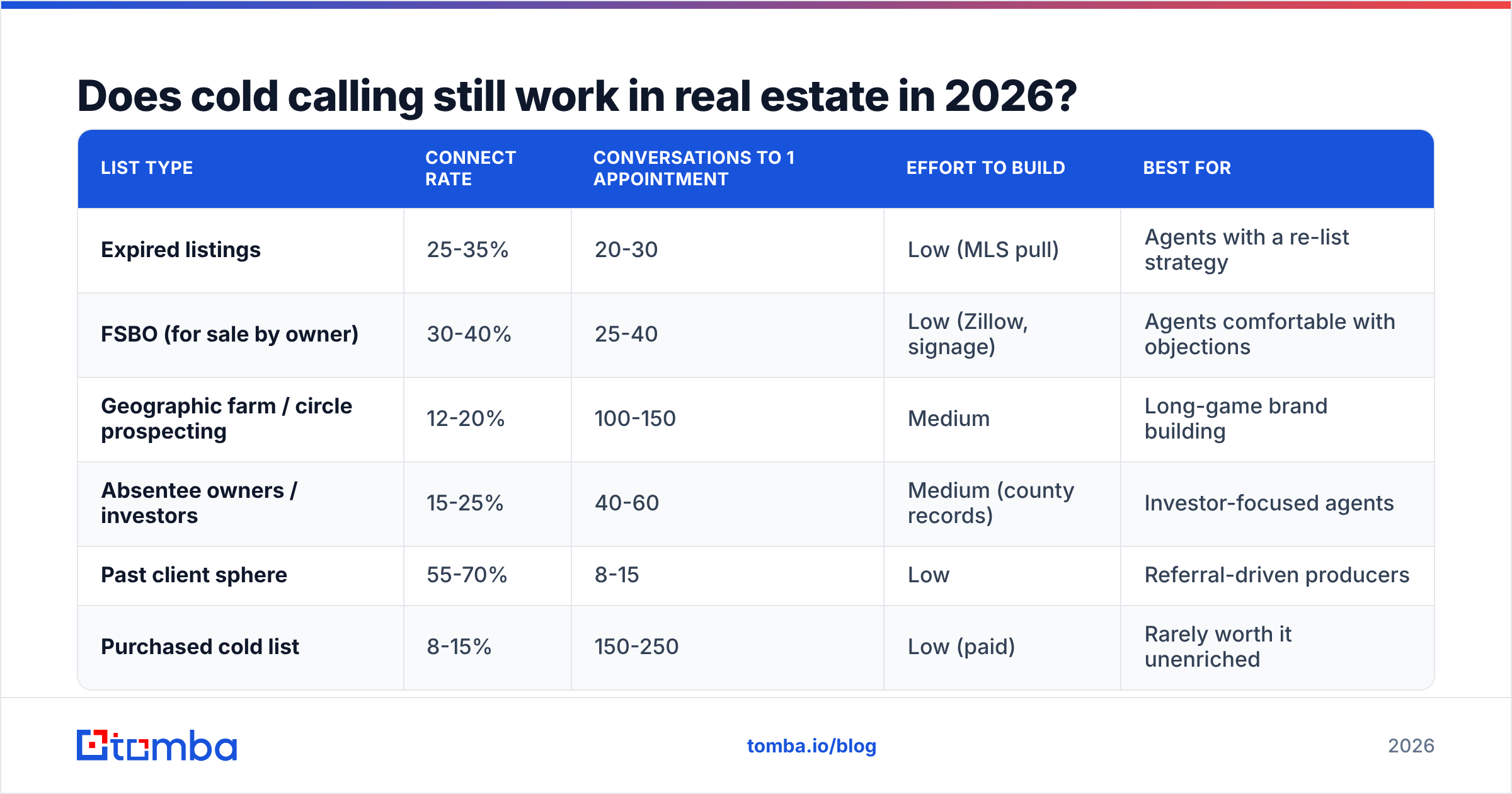
Here's what the funnel realistically looks like across list types:
| List type | Connect rate | Conversations to 1 appointment | Effort to build | Best for |
|---|---|---|---|---|
| Expired listings | 25-35% | 20-30 | Low (MLS pull) | Agents with a re-list strategy |
| FSBO (for sale by owner) | 30-40% | 25-40 | Low (Zillow, signage) | Agents comfortable with objections |
| Geographic farm / circle prospecting | 12-20% | 100-150 | Medium | Long-game brand building |
| Absentee owners / investors | 15-25% | 40-60 | Medium (county records) | Investor-focused agents |
| Past client sphere | 55-70% | 8-15 | Low | Referral-driven producers |
| Purchased cold list | 8-15% | 150-250 | Low (paid) | Rarely worth it unenriched |
The pattern is obvious: the more the person's situation gives you a reason to call, the fewer dials you need. Buying a bigger list is the wrong lever. Buying a more relevant list, then verifying the numbers on it, is the right one.
How do you build a real estate cold call list that connects?#
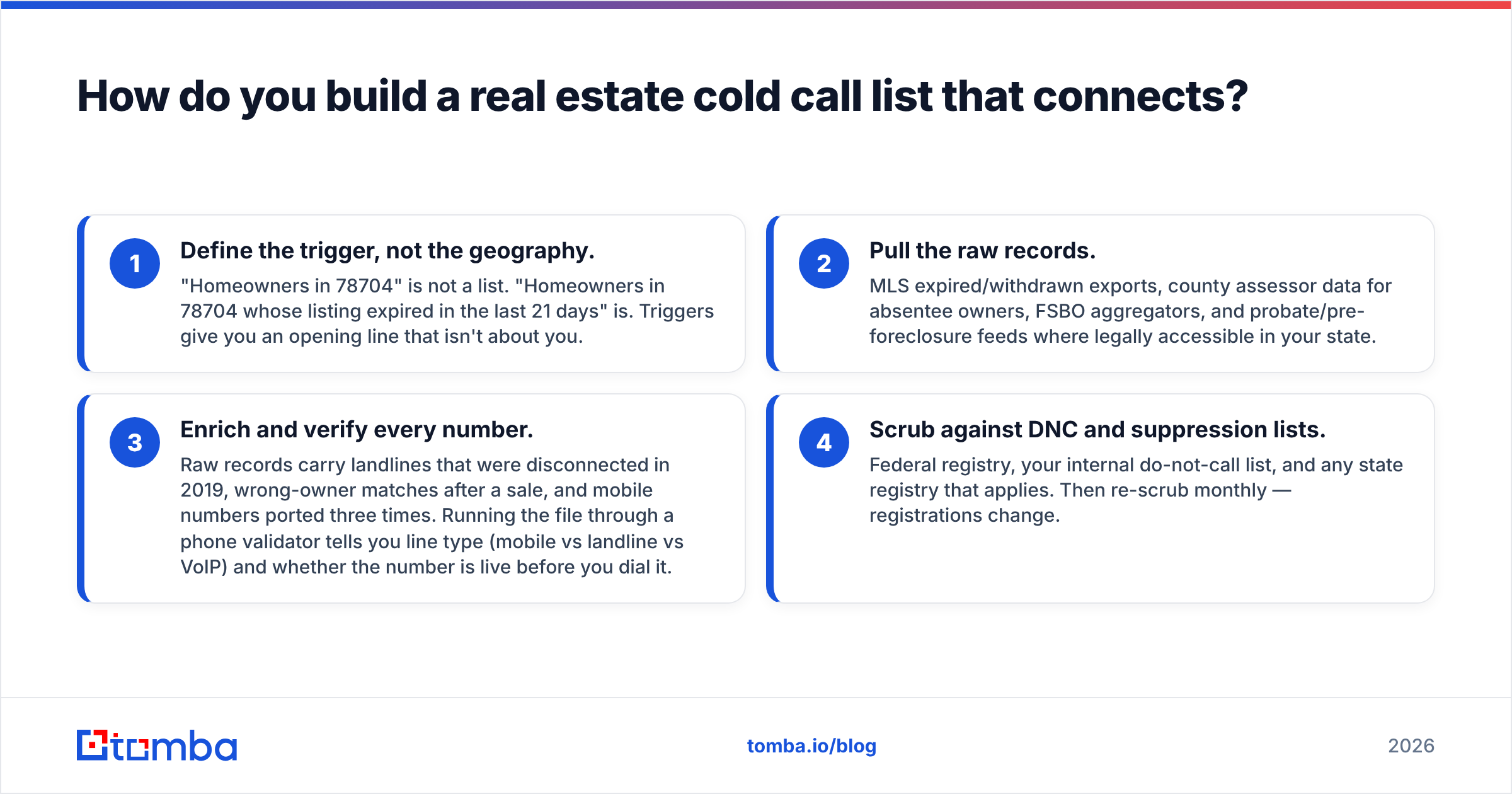
Four steps, in order. Skip step three and you'll spend your morning listening to disconnect tones.
- Define the trigger, not the geography. "Homeowners in 78704" is not a list. "Homeowners in 78704 whose listing expired in the last 21 days" is. Triggers give you an opening line that isn't about you.
- Pull the raw records. MLS expired/withdrawn exports, county assessor data for absentee owners, FSBO aggregators, and probate/pre-foreclosure feeds where legally accessible in your state.
- Enrich and verify every number. Raw records carry landlines that were disconnected in 2019, wrong-owner matches after a sale, and mobile numbers ported three times. Running the file through a phone validator tells you line type (mobile vs landline vs VoIP) and whether the number is live before you dial it.
- Scrub against DNC and suppression lists. Federal registry, your internal do-not-call list, and any state registry that applies. Then re-scrub monthly — registrations change.
For the enrichment step specifically, the ROI math is simple. If 35% of your raw numbers are dead and you dial 120 numbers a day at ~90 seconds each including wrap-up, you're burning about 63 minutes daily on numbers that were never going to ring. Filtering those out before the session costs pennies per record and returns an hour.
If you're also building an email follow-up track for the same contacts — which you should be — a bulk email finder run on the same file gives you a second channel for the 65% who don't pick up.
What should you say in the first 12 seconds?#
Three components, in this order, in under 12 seconds:
- Name + company — "Hi, this is Maria Chen with Ridgeline Realty."
- Reason tied to them — "I'm calling because your listing on Ash Street came off the market Tuesday."
- Permission ask — "Do you have thirty seconds, or did I catch you mid-something?"
The permission ask is the piece most agents drop, and it's the highest-leverage word count on the call. It converts an interruption into a negotiated conversation. When someone says "go ahead," they've made a micro-commitment and the hang-up probability drops sharply.
What to avoid in the opener:
- "How are you today?" — signals a script instantly and invites "not interested."
- Long credential dumps — nobody cares about your production volume in second four.
- Leading with a question about their plans — "Are you thinking of selling?" is answerable with "no" and ends the call.
- Apologizing — "Sorry to bother you" tells them you're a bother.
An expired-listing script that holds up#
"Hi, is this David? — This is Maria Chen with Ridgeline Realty. I'm calling because I saw your home on Ash Street came off the market this week. Do you have thirty seconds, or did I catch you at a bad time?
(permission granted)
Thanks. I'm not going to pitch you on the phone. I do want to ask one thing: when it was listed, do you feel like the issue was the price, the photos and exposure, or just bad timing in the market?
(listen — genuinely listen)
That tracks with what I've seen on that street. I've got a two-page breakdown of what the three homes that did sell within a half-mile did differently. Can I email it over, and if it's useful we talk Thursday?"
Notice the ask isn't for an appointment. It's for permission to send something. The appointment ask comes after the email lands.
An FSBO script#
"Hi, this is Maria Chen with Ridgeline Realty — I'm calling about the home you have for sale on Ash Street. I'm not calling to ask you to list with me. Quick question: are you open to working with a buyer who has an agent, if that agent's commission is covered by the buyer?
(almost always yes)
Perfect, that's all I needed. I've got two buyers in that price band. Can I put your property in front of them and send you the showing feedback either way?"
You're offering value with no ask attached. Roughly a third of FSBOs list with an agent eventually, and the agent who sent honest showing feedback for six weeks is the one they call.
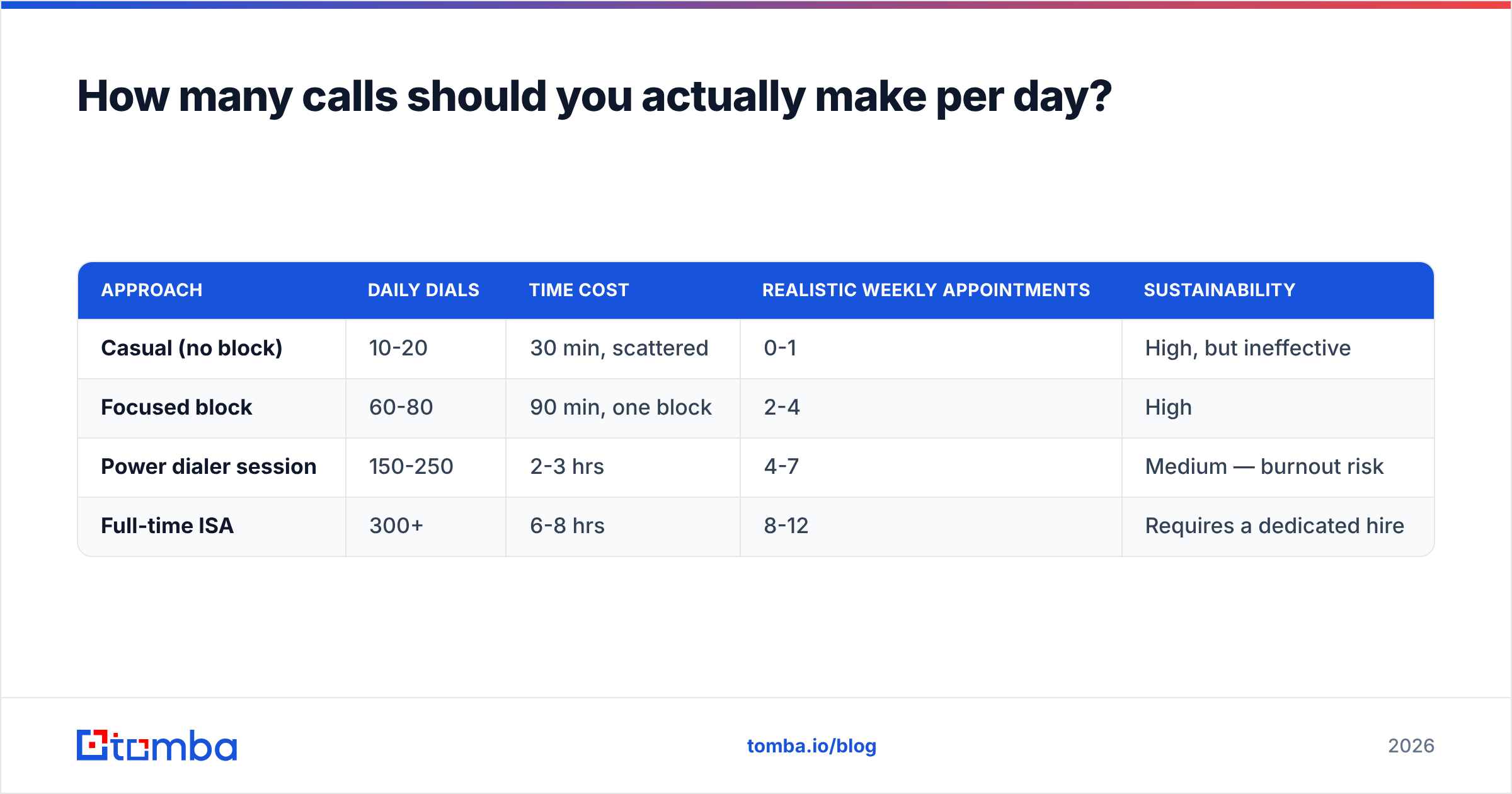
How many calls should you actually make per day?#
Fewer than the gurus say, more consistently than you currently do.
| Approach | Daily dials | Time cost | Realistic weekly appointments | Sustainability |
|---|---|---|---|---|
| Casual (no block) | 10-20 | 30 min, scattered | 0-1 | High, but ineffective |
| Focused block | 60-80 | 90 min, one block | 2-4 | High |
| Power dialer session | 150-250 | 2-3 hrs | 4-7 | Medium — burnout risk |
| Full-time ISA | 300+ | 6-8 hrs | 8-12 | Requires a dedicated hire |
The focused-block model is where most solo agents should land: one 90-minute block, same time daily, 60-80 dials on a pre-verified list. Two hours of unfocused dialing on a bad list produces less than 90 focused minutes on a good one.
On timing: mid-morning (10-11:30 a.m. local) and early evening (5-7 p.m. local) consistently out-answer the midday dead zone. Avoid Monday before 10 a.m. and Friday after 3 p.m. Test your own market — answer-rate patterns vary more by metro than most coaching admits.
Track four numbers and nothing else at first:
- Dials — raw attempts.
- Connects — a human said hello. This is your list-quality metric.
- Conversations — you got past the opener. This is your script metric.
- Appointments set — the only number that pays.
If connects are low, fix the data. If conversations are low, fix the opener. If appointments are low, fix the offer. Diagnosing the wrong stage is why agents rewrite scripts that were never the problem.
How do you handle the four objections you'll actually hear?#
You'll hear the same four all week. Prepare these and you've prepared for 80% of calls.
"I'm not interested." Don't fight it. "Totally fair — most people aren't when I call out of nowhere. Can I ask one thing before I let you go: is the plan to relist, or are you staying put for now?" You've reframed from pitch to curiosity, and half the time you get a real answer.
"I'm already working with an agent." "Good — I'd rather you have someone than not. Is your agreement still active, or did it lapse when the listing expired?" Expired listings frequently mean the agreement lapsed too. If it's active, thank them and log a follow-up for the expiry date. Never poach an active agreement.
"How did you get my number?" Answer honestly and immediately. "Public MLS records — your listing information is published when a home goes on the market." Hesitation here sounds like you're hiding something. Honesty ends the objection in one sentence.
"Just email me something." This is often a soft brush-off, but treat it as a real request. "Absolutely — what's the best address?" Then send something genuinely useful within the hour. If you don't have their address, an email finder will resolve it from the name and property record so the follow-up doesn't stall.
What are the compliance rules you can't ignore?#
This section is not legal advice, and rules shift. Verify with your broker and your state association before you dial.
The non-negotiables as they stand:
- Federal DNC Registry. Scrub your list before every campaign. The National Do Not Call Registry provides access for sellers; violations run into five figures per call.
- Established Business Relationship exemption. Past clients and inbound inquiries have carve-outs, but they expire — generally 18 months after a transaction, 3 months after an inquiry. Don't assume a 2021 client is still callable.
- FSBO and expired listings are not automatically callable. A public listing does not override a DNC registration in most interpretations. Scrub anyway.
- Calling hours. 8 a.m. to 9 p.m. in the recipient's time zone, federally. Several states are stricter.
- Internal do-not-call list. You must maintain one, honor requests immediately, and keep records for five years.
- Call recording consent. Two-party consent states require disclosure. Know which side your state and the recipient's state fall on.
- State registries and mini-TCPA laws. Florida, Oklahoma, and several others have added stricter consent requirements that go beyond federal rules.
The practical version: maintain one master suppression file, scrub monthly, log every opt-out within 24 hours, and keep your dialer's answer rate healthy so carriers don't flag your number. The NAR publishes member guidance worth reading annually.
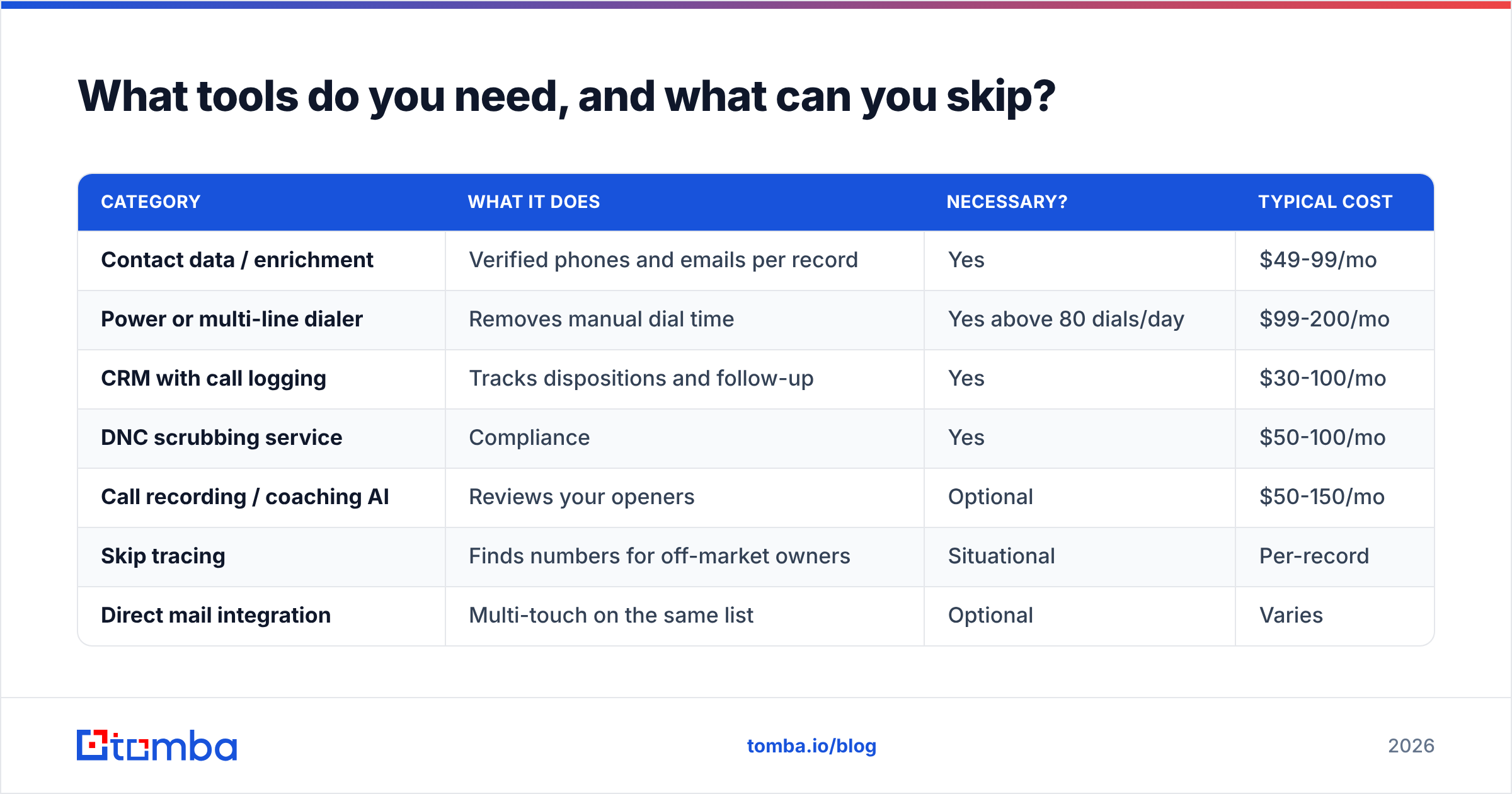
What tools do you need, and what can you skip?#
| Category | What it does | Necessary? | Typical cost |
|---|---|---|---|
| Contact data / enrichment | Verified phones and emails per record | Yes | $49-99/mo |
| Power or multi-line dialer | Removes manual dial time | Yes above 80 dials/day | $99-200/mo |
| CRM with call logging | Tracks dispositions and follow-up | Yes | $30-100/mo |
| DNC scrubbing service | Compliance | Yes | $50-100/mo |
| Call recording / coaching AI | Reviews your openers | Optional | $50-150/mo |
| Skip tracing | Finds numbers for off-market owners | Situational | Per-record |
| Direct mail integration | Multi-touch on the same list | Optional | Varies |
Two things to notice. First, data quality is the only line item where cheaping out reliably costs more than it saves — a dialer running through bad numbers just wastes time faster. Second, you don't need the coaching AI in month one. Record yourself on your phone and listen back; that's 90% of the value for free.
For the data layer, Tomba pricing starts free with 25 searches a month to test list quality before committing, then $49/mo on Starter and $99/mo on Growth for higher-volume enrichment. If you're pulling records at scale, the Tomba API lets you enrich a full MLS export in a single job rather than record by record. Peers like BookYourData take a database-first approach that suits agents who'd rather buy a pre-built list than assemble one — worth evaluating alongside enrichment tools depending on whether you already have raw records.
What does a full week of real estate cold calling look like?#
- Monday: Pull the weekend's expireds and new FSBOs. Enrich, verify, scrub. Dial 10-11:30 a.m. Log everything.
- Tuesday: Dial the same block. Second attempt on Monday's no-answers — different time of day.
- Wednesday: Circle-prospect around any new listing or closing in your farm. "Your neighbor's house just sold for X" is the strongest cold opener that exists.
- Thursday: Third attempt on the week's no-answers, plus follow-up calls to anyone who accepted an email. This is your highest-appointment day.
- Friday: Morning block only. Afternoon: update your CRM, scrub new opt-outs, build next week's list.
Three attempts across different days and times before you retire a number. Most agents quit after one. The second and third attempts routinely out-connect the first because you're catching a different part of the person's day.
Where to start this week#
Pick one list type — expireds is the easiest to start with — pull 100 records, enrich and verify them, scrub against DNC, and block 90 minutes a day for two weeks. Track dials, connects, conversations, and appointments. At the end of two weeks you'll have real numbers for your market instead of someone else's benchmarks.
The enrichment step is where most of the wasted effort disappears. Run your list through the Tomba Email Finder and its phone lookup to get verified contact points before you spend a single minute dialing — start on the free tier with 25 searches to see how much of your current list is actually reachable, then scale up when the connect rate proves it out.
Related guides#
// get started
Find, verify and enrich your first contacts today
Start on the free plan with 25 searches a month, then scale when your team is ready.
Free plan · No credit card required · GDPR & CCPA
Get the Tomba newsletter
Product and data updates
// about the author