How to Cold Call Restaurants: A 2026 Playbook That Books Meetings
Restaurants answer the phone between 2pm and 4pm — and almost never during service. Here is the timing, list-building, and script framework that actually books meetings with owners and GMs.
TL;DR
- Restaurants are the hardest vertical to reach by phone for one reason: you keep calling during service. The only reliable windows are roughly 2:00–4:00 pm and 9:30–11:00 am local time.
- The person answering is almost never the buyer. Your first goal on call one is the owner's or GM's name and direct line — not a pitch.
- Build the list before you dial. A gatekeeper-proof list (owner name + direct email + mobile) triples connect rates versus dialing the number on Google Maps.
- Your opener has about 8 seconds. Lead with a local, specific observation ("saw you just added a second location in Fort Greene"), not with your company name.
- Phone alone underperforms. Restaurant owners reply to a call + text + email triangle within a 48-hour window far more than to repeat dials.
Cold calling restaurants breaks most B2B playbooks. There is no receptionist queue, no LinkedIn-savvy decision maker sitting at a desk, and no calendar with open slots. There is a line cook who picked up because the host is seating a four-top, an owner who is physically in the building 60 hours a week, and a hard rule that nobody talks to a vendor while food is going out.
This guide covers what actually works: when to dial, how to build a list that skips the front-of-house entirely, what to say in the first eight seconds, and how to stack channels so the phone stops being your only shot.
Why is cold calling restaurants different from normal B2B?#
Three structural things make restaurants their own category.
- The buyer is operational, not administrative. A restaurant owner is expediting, doing inventory, or covering a shift. They are not at a desk. Voicemail-to-callback rates are brutally low because they never check voicemail.
- The phone is a revenue line. That number on Google is for reservations and takeout orders. Every second you occupy it is a second a paying customer can't get through — which is why staff are trained to end vendor calls fast.
- Service windows are non-negotiable. From roughly 11:30 am to 2:00 pm and 5:00 pm onward, nobody will talk to you. That leaves a genuinely narrow band of callable hours.
- Trust is hyper-local. Restaurant owners buy from people who mention the neighborhood, a competitor down the street, or a specific menu item. Generic corporate framing gets dismissed instantly.
Once you accept those four constraints, the tactics write themselves. You dial in the gap, you skip the main line where possible, and you sound like someone who has actually eaten there.
When should you actually call a restaurant?#
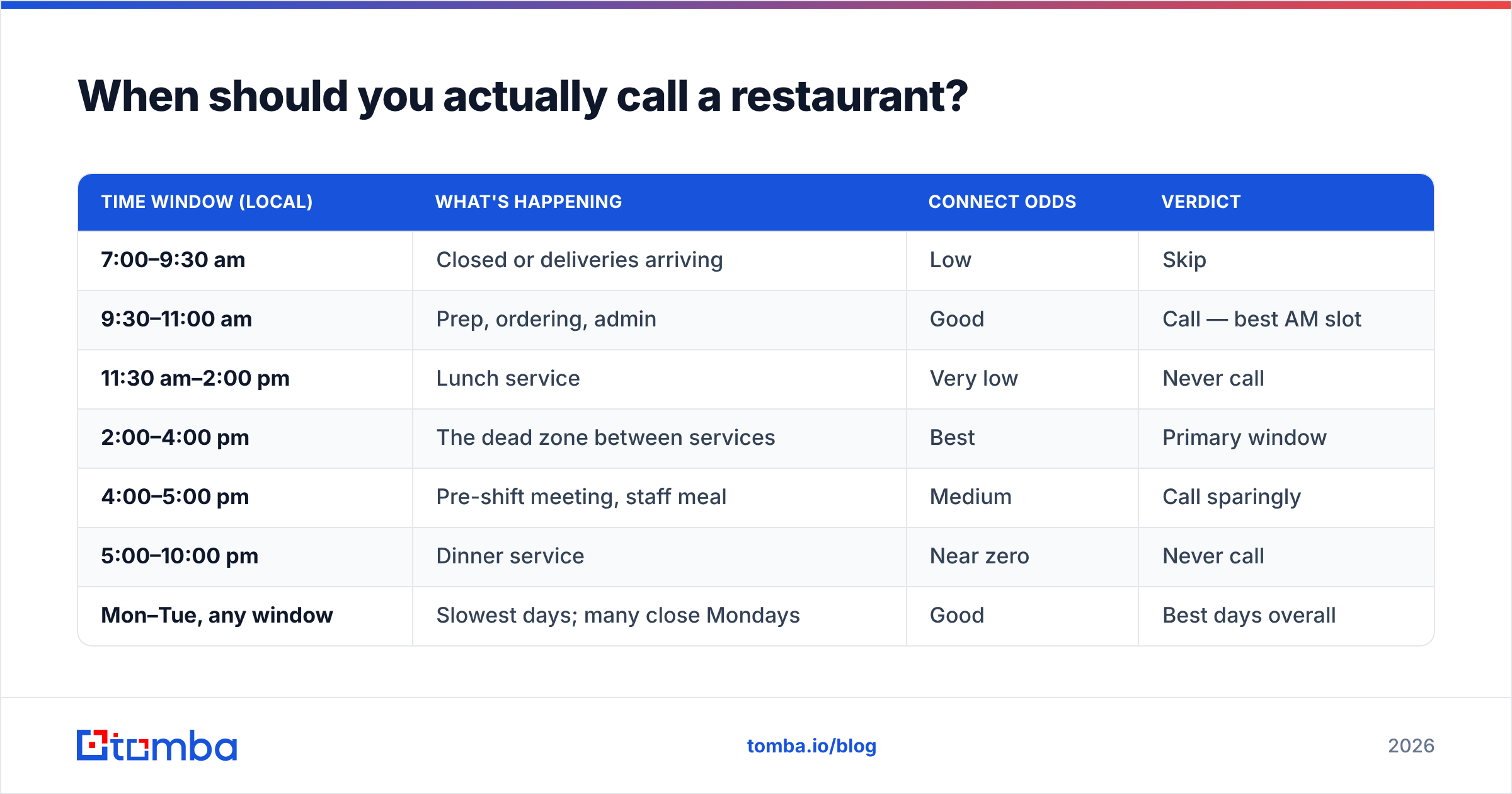
Timing is the single highest-leverage variable — bigger than script, bigger than list quality, bigger than tooling. Here is how the day breaks down for a typical full-service restaurant.
| Time window (local) | What's happening | Connect odds | Verdict |
|---|---|---|---|
| 7:00–9:30 am | Closed or deliveries arriving | Low | Skip |
| 9:30–11:00 am | Prep, ordering, admin | Good | Call — best AM slot |
| 11:30 am–2:00 pm | Lunch service | Very low | Never call |
| 2:00–4:00 pm | The dead zone between services | Best | Primary window |
| 4:00–5:00 pm | Pre-shift meeting, staff meal | Medium | Call sparingly |
| 5:00–10:00 pm | Dinner service | Near zero | Never call |
| Mon–Tue, any window | Slowest days; many close Mondays | Good | Best days overall |
The 2:00–4:00 pm block is where the meeting gets booked. If you only have two hours a day for restaurant dialing, use those two. Mondays and Tuesdays outperform Thursdays and Fridays by a wide margin because weekend prep hasn't started.
One caveat: this map assumes full-service dining. Quick-service and fast-casual run different curves — QSR is busiest 11:00 am–1:00 pm and 5:00–7:00 pm, with a genuine lull around 3:00 pm. Coffee shops flip entirely; call them after 1:00 pm, never before 10:00 am.
How do you build a restaurant call list that skips the gatekeeper?#
The main line is the worst number in your dataset. It routes to whoever is closest to the host stand, and that person is trained to say "email us." What you want instead:
- Owner or GM full name — pulled from the restaurant's about page, local press, or the liquor license record.
- Direct email — usually a first-name pattern at the restaurant domain (chef@, owner@, firstname@).
- Corporate or back-office line — for groups with 3+ locations, there's almost always a separate admin number.
- Mobile number — the highest-value field for independents, where the owner's cell often is the business line.
- LinkedIn profile — thin coverage in this vertical, but multi-unit operators and hospitality groups are usually on it.
For the email and pattern work, an email finder that resolves owner-name-plus-domain into a verified address does the heavy lifting. When you're working a whole restaurant group, domain search returns every published address on the domain at once, which is how you find the accounting@ or events@ inbox that actually gets read. For the numbers themselves, a phone finder pass over the same list fills in mobiles you won't get from a Google Business listing.
Two practical rules on list hygiene. First, restaurants churn — the National Restaurant Association tracks turnover rates that make a six-month-old list dangerously stale. Re-verify before every campaign. Second, run the emails through an email verifier before you send anything, because restaurant domains are heavily populated with abandoned addresses from previous ownership.
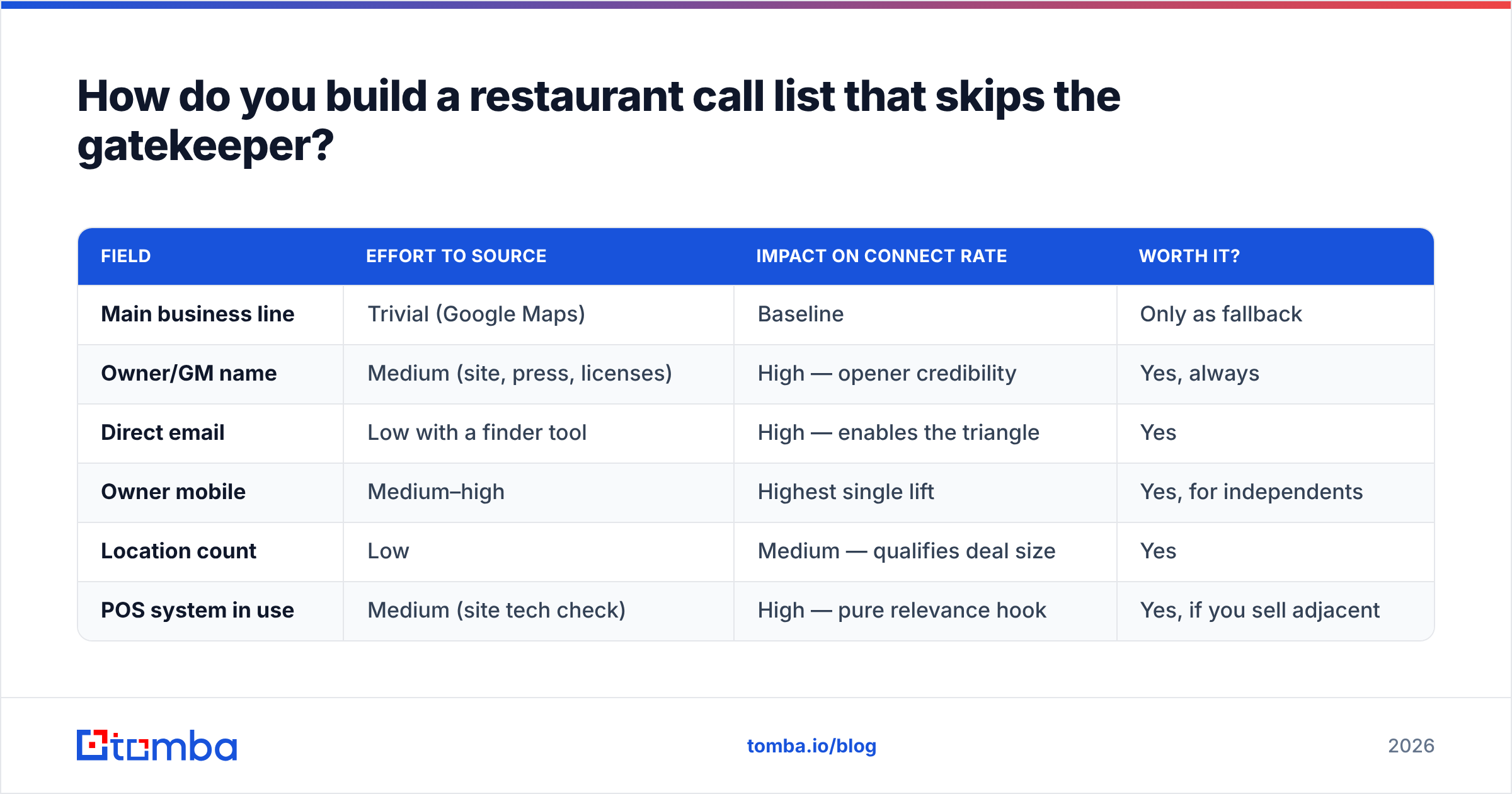
What data fields actually move connect rate?#
| Field | Effort to source | Impact on connect rate | Worth it? |
|---|---|---|---|
| Main business line | Trivial (Google Maps) | Baseline | Only as fallback |
| Owner/GM name | Medium (site, press, licenses) | High — opener credibility | Yes, always |
| Direct email | Low with a finder tool | High — enables the triangle | Yes |
| Owner mobile | Medium–high | Highest single lift | Yes, for independents |
| Location count | Low | Medium — qualifies deal size | Yes |
| POS system in use | Medium (site tech check) | High — pure relevance hook | Yes, if you sell adjacent |
That last row is underrated. Knowing whether a prospect runs Toast, Square, or Clover lets you open with a sentence that no generic caller can produce. A website tech stack check surfaces the online-ordering and reservation widgets a restaurant runs, which tells you most of what you need.
What should you say in the first eight seconds?#
Assume the person who picks up is busy, standing, and holding something. Your opener has to do three things fast: identify who you want, prove you're not a mass dialer, and ask permission.
The structure that works:
- Name the person, not the business. "Hi — is Marco around?" outperforms "Hi, is the owner available?" by a mile. Using the name signals you belong.
- Give a five-word reason. "It's about your online ordering." Not your company, not your category — the outcome area.
- Ask for permission with an exit. "Do you have ninety seconds, or should I try back at three?" The escape hatch dramatically reduces hang-ups.
- Land one specific, local observation. "I saw you're doing pickup through your own site instead of the third-party apps — that's unusual around Carroll Gardens."
- Close for a small next step. Not a demo. A five-minute call at a stated time, or permission to text them a link.
Here is that framework as an actual script:
"Hi, is Marco around? … Marco, hey — Dana with Northline. Quick one about your online ordering. Do you have ninety seconds, or is three o'clock better? … Appreciate it. I noticed you're taking pickup orders through your own site rather than the delivery apps, which most places on Court Street aren't doing. We help spots like yours keep that direct-order share when the apps get aggressive on promos. Worth five minutes Thursday at 2:15, or is that in your prep?"
What to avoid: "How are you today?" (instant vendor tell), long company introductions, "I'll be quick" without saying how quick, and anything that sounds like a script being read. If you get a hard no, ask for one thing before you hang up — the best email to send a one-pager to. That's a win, not a loss.
How do you handle the four objections you'll hear every day?#
| Objection | What it actually means | Response that keeps the call alive |
|---|---|---|
| "We're not interested." | Reflex, said before hearing anything | "Totally fair — I hadn't said anything yet. One sentence and you can hang up on me." |
| "Send me an email." | Soft brush-off, but a real address | "Will do. Is that the info@ or do you have one that actually gets read?" |
| "The owner isn't here." | Often true; also a screen | "No problem — when's she usually in? I'd rather catch her than keep bugging you." |
| "We're in the middle of service." | You called at the wrong time | "My fault entirely. Two o'clock tomorrow better?" Then hang up immediately. |
| "We already use [competitor]." | Qualified prospect, wrong timing | "Good product. Most people we talk to switched over the renewal — when's yours up?" |
The rule underneath all five: never argue, never push past a second no, and always leave with either a time or an email. Restaurant owners have long memories about pushy vendors in a small local market, and word travels between operators faster than in almost any other industry.
Should you use a multichannel sequence instead of just dialing?#
Yes — and the data on single-channel outbound has been pointing this way for years. HubSpot's sales research consistently shows multi-touch, multi-channel sequences outperforming phone-only cadences, and restaurants amplify the effect because the buyer is mobile-first and rarely at a computer.
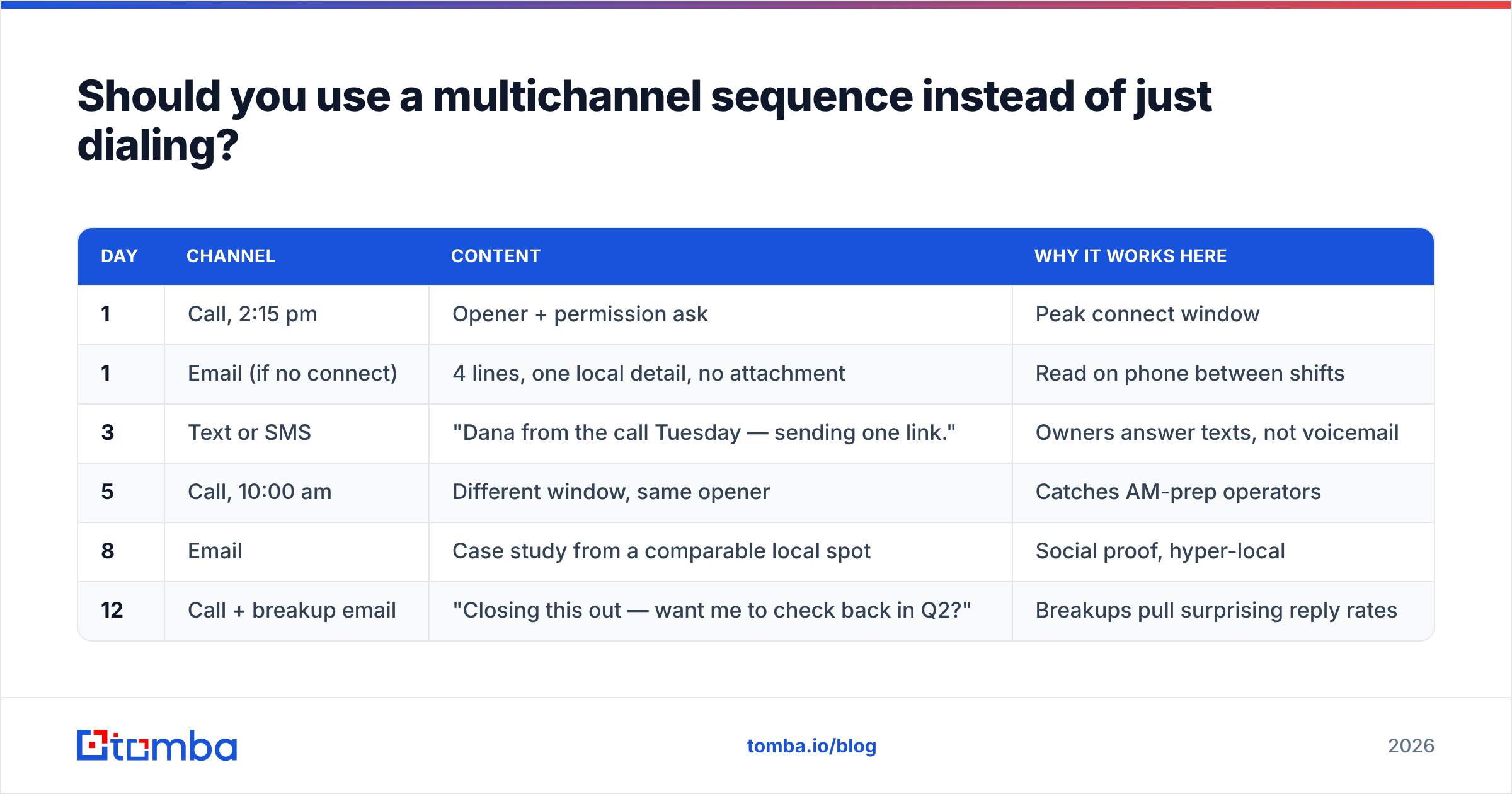
A cadence that respects how restaurant owners actually work:
| Day | Channel | Content | Why it works here |
|---|---|---|---|
| 1 | Call, 2:15 pm | Opener + permission ask | Peak connect window |
| 1 | Email (if no connect) | 4 lines, one local detail, no attachment | Read on phone between shifts |
| 3 | Text or SMS | "Dana from the call Tuesday — sending one link." | Owners answer texts, not voicemail |
| 5 | Call, 10:00 am | Different window, same opener | Catches AM-prep operators |
| 8 | Case study from a comparable local spot | Social proof, hyper-local | |
| 12 | Call + breakup email | "Closing this out — want me to check back in Q2?" | Breakups pull surprising reply rates |
Two things make this work. First, the email has to be short enough to read on a phone standing in a walk-in — four lines maximum. Second, every touch references the previous one, so it reads as one person following up, not three systems firing.
If you're running this at volume, a bulk email finder pass on your target list before the sequence starts means you're not scrambling for addresses mid-cadence. And because email deliverability collapses fast when you email stale restaurant domains, verify first — bounce rates above 3% on a small local list will cost you the whole sending domain.
What tools do you actually need for restaurant cold calling?#
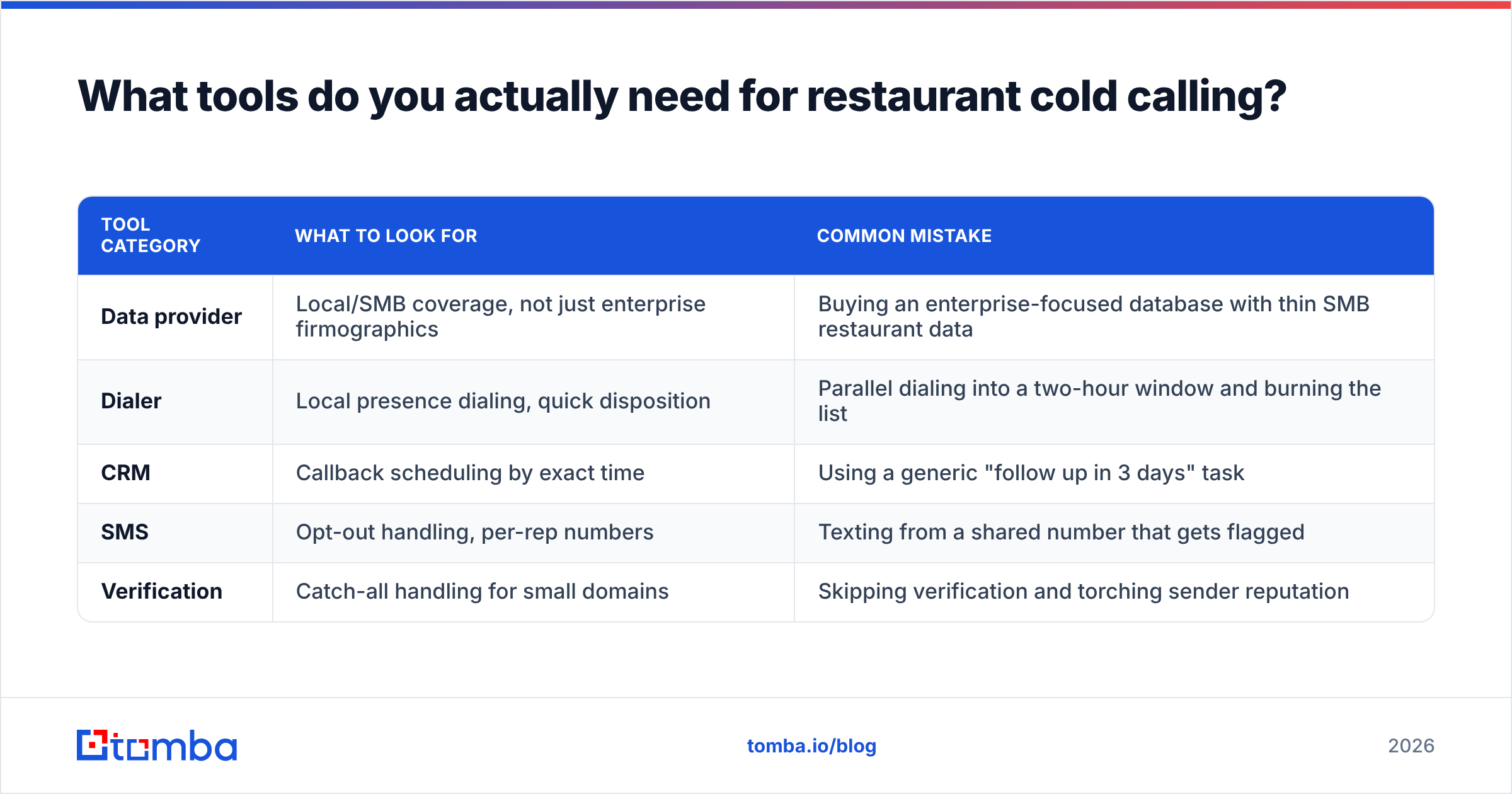
You need less than most stacks suggest. Four categories:
- Contact data — owner names, verified emails, mobile numbers. This is where the leverage is.
- A dialer — parallel dialers help less here than in other verticals, because your callable window is narrow and each conversation is short. A power dialer is enough.
- A CRM with a callback field — restaurant selling lives or dies on "call me back Tuesday at 3." If your system can't schedule that precisely, you'll lose deals to forgetfulness.
- A texting channel — compliant business SMS, since text is the channel restaurant owners actually answer.
| Tool category | What to look for | Common mistake |
|---|---|---|
| Data provider | Local/SMB coverage, not just enterprise firmographics | Buying an enterprise-focused database with thin SMB restaurant data |
| Dialer | Local presence dialing, quick disposition | Parallel dialing into a two-hour window and burning the list |
| CRM | Callback scheduling by exact time | Using a generic "follow up in 3 days" task |
| SMS | Opt-out handling, per-rep numbers | Texting from a shared number that gets flagged |
| Verification | Catch-all handling for small domains | Skipping verification and torching sender reputation |
On the data side, Tomba covers the finding and verification layer: a free email checker for one-off checks, data enrichment to fill in company details on a list you already have, and a Tomba API if you're wiring this into your own dialer or CRM workflow. Tomba pricing starts with a free tier at 25 searches a month, then $49/mo Starter, $99/mo Growth, and $249/mo Pro — which matters when you're testing a new vertical before committing budget.
For pre-built SMB contact lists where you'd rather buy than build, BookYourData is a solid option in the local-business space and worth comparing against a find-and-verify workflow depending on whether your target list is defined by geography or by named accounts. Check current user reviews on G2 before you commit to any data vendor — coverage claims and actual SMB density diverge more in this category than in enterprise data.
How do you measure whether restaurant cold calling is working?#
Standard SDR benchmarks will mislead you. Restaurant dialing produces fewer connects per hour but higher conversion per connect, because the person who picks up is frequently the actual decision maker — no procurement, no committee, no six-month cycle.
Track these instead of raw dial counts:
- Connects per callable hour — normalize against your 2–4 pm window, not an 8-hour day. Anything above 8 is healthy.
- Decision-maker reach rate — what share of connects reached the owner or GM. If this is under 30%, your list is the problem, not your script.
- Callback-honored rate — how often a scheduled "call me Tuesday at 3" actually converts. Under 50% means you're not confirming by text.
- Meeting-to-close velocity — restaurants decide fast or never. If a deal is open past 45 days, it's dead.
- Cost per booked meeting by data source — compare your build-it-yourself list against any purchased list. The gap here justifies or kills your tooling spend.
One more measurement note: track by day of week. Monday and Tuesday dialing will show materially better numbers, and the temptation is to spread effort evenly across the week. Don't. Concentrate volume where the odds are.
What's the fastest way to start this week?#
Pick 100 restaurants inside one geography — one neighborhood, one metro corridor, one cuisine category. Narrow beats broad, because a local reference in your opener only works if you have several nearby customers to name.
Then, in order: pull owner names from each site's about page and local press, resolve those names to verified emails, add mobile numbers where you can, and load the whole thing into your CRM with the callable-window field pre-set. Block 2:00–4:00 pm Monday through Wednesday. Dial 40 a day. Send the follow-up email the same afternoon while the call is still fresh.
That's the whole system. There isn't a clever hack underneath it — restaurant cold calling rewards timing discipline and list quality far more than script polish.
If the bottleneck is the list, that's the part worth fixing first. The Tomba Email Finder turns an owner's name plus a restaurant domain into a verified, deliverable address in seconds, so your 2:00 pm block goes to conversations instead of to hunting for contact details. Start on the free tier at 25 searches a month, test it against one neighborhood's worth of prospects, and scale from there once the connect numbers prove out.
Related guides#
// get started
Find, verify and enrich your first contacts today
Start on the free plan with 25 searches a month, then scale when your team is ready.
Free plan · No credit card required · GDPR & CCPA
// about the author