How to Cold Call Successfully: A 2026 Playbook That Books Meetings
Cold calling still books meetings in 2026 — but only if your list, timing, and first 12 seconds are right. Here is the exact framework, script, and math behind a 5%+ connect-to-meeting rate.
TL;DR
- Cold calling works in 2026, but the win rate lives in the list, not the script. Bad phone data caps your connect rate before you say a word.
- Your first 12 seconds decide the call. Use a permission-based opener, name the reason you called, and stop talking.
- Expect 60-90 dials per booked meeting at a 4-8% connect-to-meeting rate. Anything better usually means a tighter list or warmer intent signals.
- Objections are patterns, not surprises. Six responses cover roughly 80% of what you'll hear.
- Pair calls with email. Multi-touch sequences beat call-only or email-only outreach by a wide margin in most B2B teams.
Why does cold calling still work in 2026?#
Because decision-makers still answer phones, and almost nobody calls them well.
Buyers are drowning in AI-written email. Their inboxes have three layers of filtering, a Gmail promotions tab, and a spam threshold that punishes anyone sending 400 near-identical messages a day. Meanwhile their mobile rings maybe twice a week from a stranger. Scarcity is on your side.
The catch: cold calling has never been more punishing for the unprepared. Mobile carriers now flag high-volume numbers as "Scam Likely" within days. Gatekeepers route unknown numbers to voicemail by default. And a prospect who picks up gives you seconds — not minutes — to earn attention.
So the question isn't whether cold calling works. It's what separates a rep booking eight meetings a week from one booking zero on the same dial volume.
Three things, in this order: data quality, call structure, and follow-through.
What actually determines cold call success?#
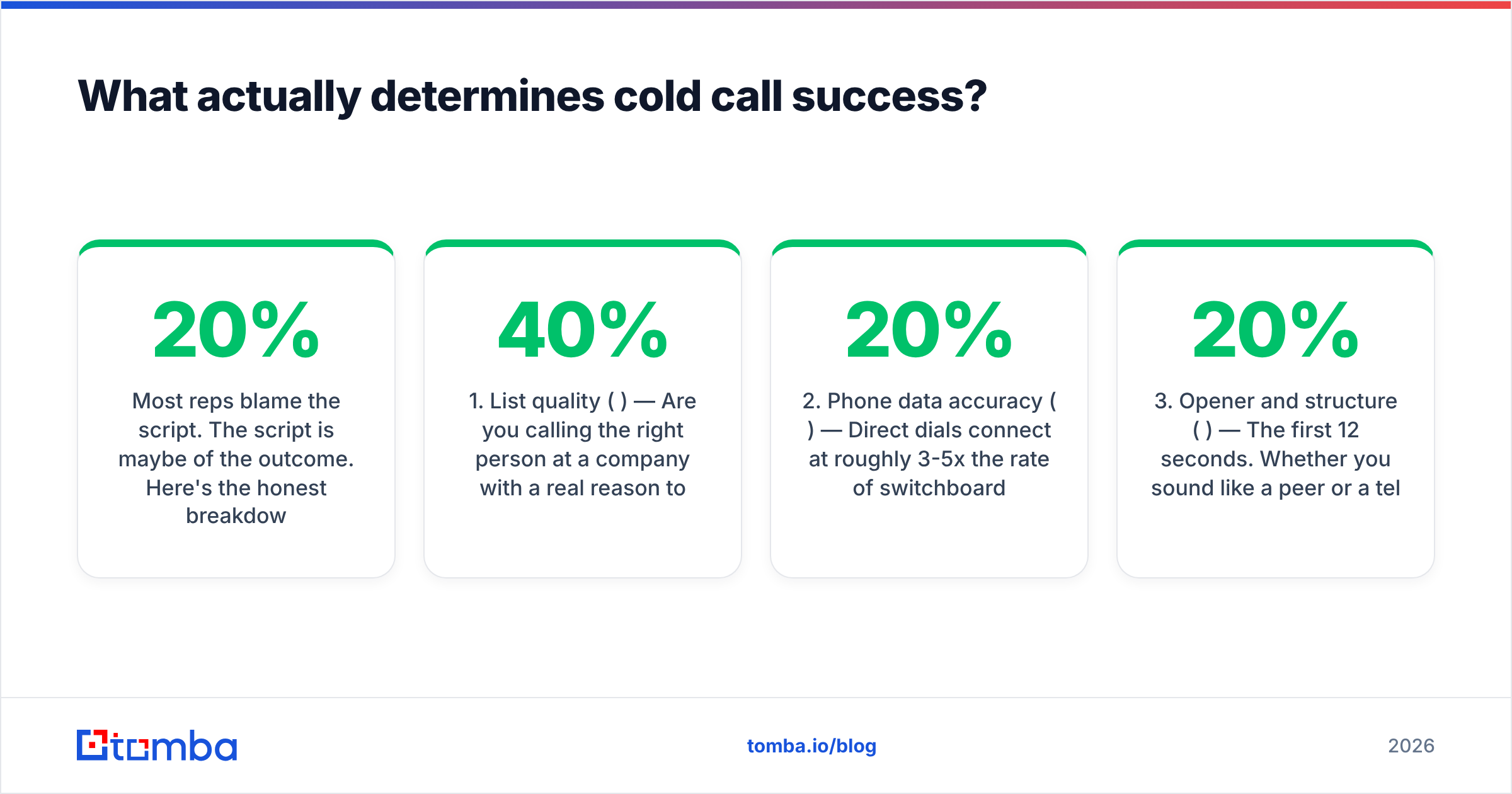
Most reps blame the script. The script is maybe 20% of the outcome. Here's the honest breakdown of where results come from:
- List quality (40%) — Are you calling the right person at a company with a real reason to buy right now? A perfect script to a wrong-fit prospect books nothing.
- Phone data accuracy (20%) — Direct dials connect at roughly 3-5x the rate of switchboard numbers. If half your numbers are stale, you've halved your ceiling before dialing.
- Opener and structure (20%) — The first 12 seconds. Whether you sound like a peer or a telemarketer.
- Objection handling (10%) — Everyone hits "not interested." The difference is whether you have a second sentence ready.
- Follow-through (10%) — The meeting confirmation, the email recap, the second call. Most booked meetings that no-show were never really confirmed.
Notice the top two are both data problems, not talent problems. That's the part reps consistently under-invest in.
Before you touch a script, audit your list. Pull 50 records and check: is the title current? Is the company still in your ICP? Does the direct dial actually reach the person? If more than a third fails, fix the list first. A B2B phone numbers source with verified direct dials is worth more than any coaching session.
How do you build a cold call list that connects?#
Start narrow. The instinct is to build a 5,000-record list so you never run out of dials. That's backwards — a 300-record list of tightly qualified accounts will outperform it, because you can research each one in 90 seconds and reference something real.
Your list build sequence:
- Define the trigger, not just the persona. "VP Sales at 50-200 person SaaS" is a persona. "VP Sales at 50-200 person SaaS who posted a hiring req for 3 SDRs in the last 30 days" is a trigger. Triggers double connect-to-conversation rates because you have a reason to call today.
- Find the humans. Pull decision-makers and their one-level-down reports. The manager often takes the call the VP won't.
- Get the contact data. Direct dial first, mobile second, switchboard as a fallback. Layer in email so you can run a multi-channel sequence — the email finder and phone finder fill the same row.
- Validate before dialing. Run numbers through a phone validator to strip disconnected lines and landlines that are really fax numbers. Ten minutes of cleanup saves an hour of dead dials.
- Enrich for context. Headcount, funding stage, tech stack. Contact enrichment turns a name into a talking point.
- Segment into daily blocks. 40-60 records per calling block, grouped by persona so you're not context-switching between CFOs and IT directors.
How do the main phone-data sources compare?#
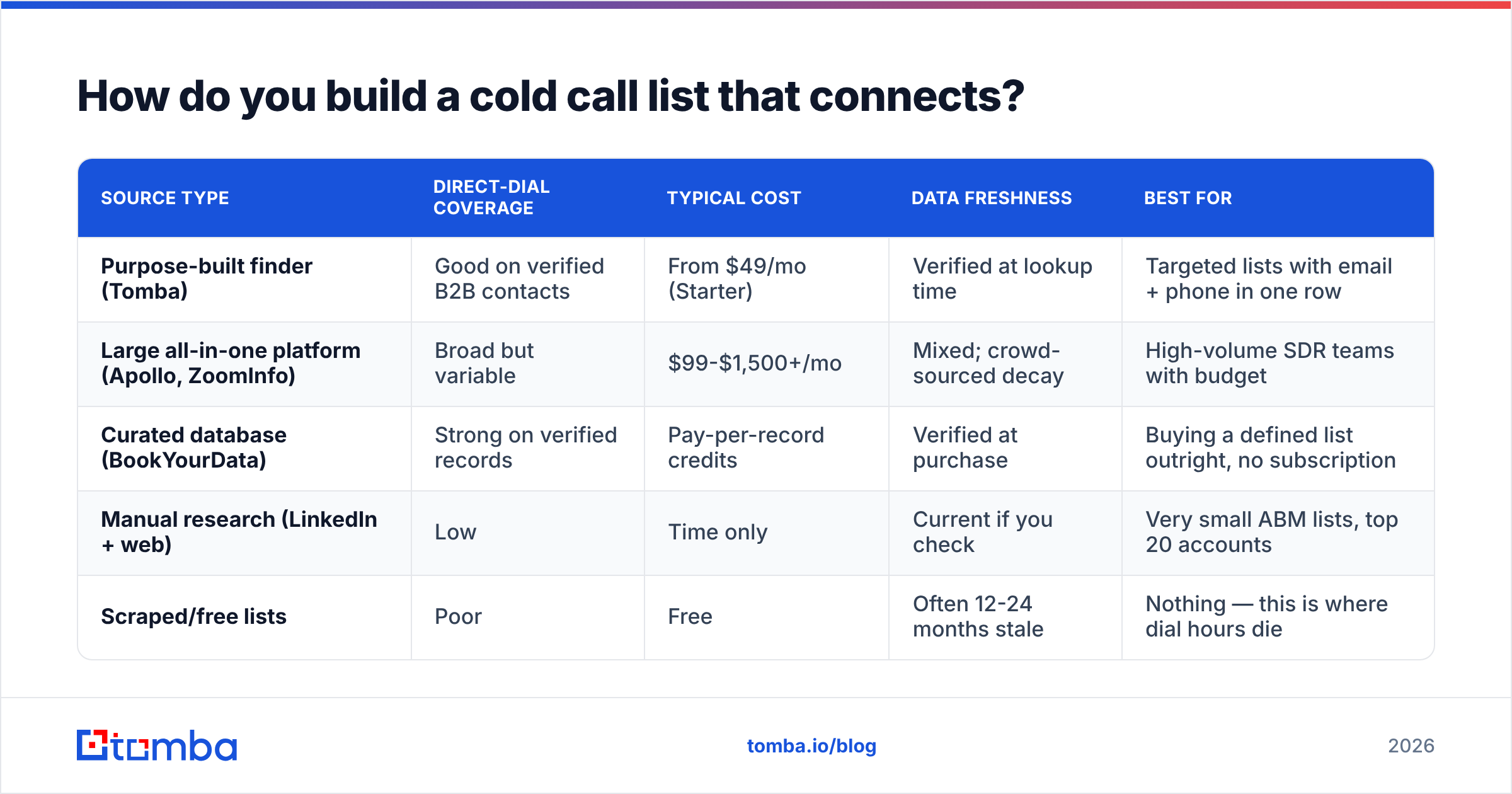
| Source type | Direct-dial coverage | Typical cost | Data freshness | Best for |
|---|---|---|---|---|
| Purpose-built finder (Tomba) | Good on verified B2B contacts | From $49/mo (Starter) | Verified at lookup time | Targeted lists with email + phone in one row |
| Large all-in-one platform (Apollo, ZoomInfo) | Broad but variable | $99-$1,500+/mo | Mixed; crowd-sourced decay | High-volume SDR teams with budget |
| Curated database (BookYourData) | Strong on verified records | Pay-per-record credits | Verified at purchase | Buying a defined list outright, no subscription |
| Manual research (LinkedIn + web) | Low | Time only | Current if you check | Very small ABM lists, top 20 accounts |
| Scraped/free lists | Poor | Free | Often 12-24 months stale | Nothing — this is where dial hours die |
The pattern: you're trading money for time or accuracy for volume. A team dialing 100x/day needs a platform. A founder calling 15 named accounts needs precision, and a free email checker plus a few targeted lookups will get there without a contract.
What should you say in the first 12 seconds?#
Name yourself, name the reason, ask permission, stop.
The structure that survives testing across most B2B teams:
"Hi [Name], it's [You] from [Company]. I know I'm an interruption — can I take 30 seconds to tell you why I called, and you can tell me if it's worth continuing?"
Then the reason, tied to their world:
"We work with VP Sales at Series B SaaS companies who are scaling SDR teams past ten reps. The pattern we keep hearing is that ramp time doubles once the team crosses that line. Is that anywhere close to what you're seeing?"
Why this works:
- "I know I'm an interruption" disarms the reflex. You've said the thing they were about to think.
- Asking for 30 seconds is a small commitment. Most people grant it.
- Naming a specific pattern proves you called them, not a list.
- Ending on a question hands them the floor before they hang up.
What to avoid: "How are you today?" (transparently fake), "Did I catch you at a bad time?" (invites a yes), and any sentence containing "solution," "synergy," or "just touching base."
Keep the whole opener under 25 seconds of speaking. Then be quiet. The silence after your question is uncomfortable for you and normal for them. Don't fill it.
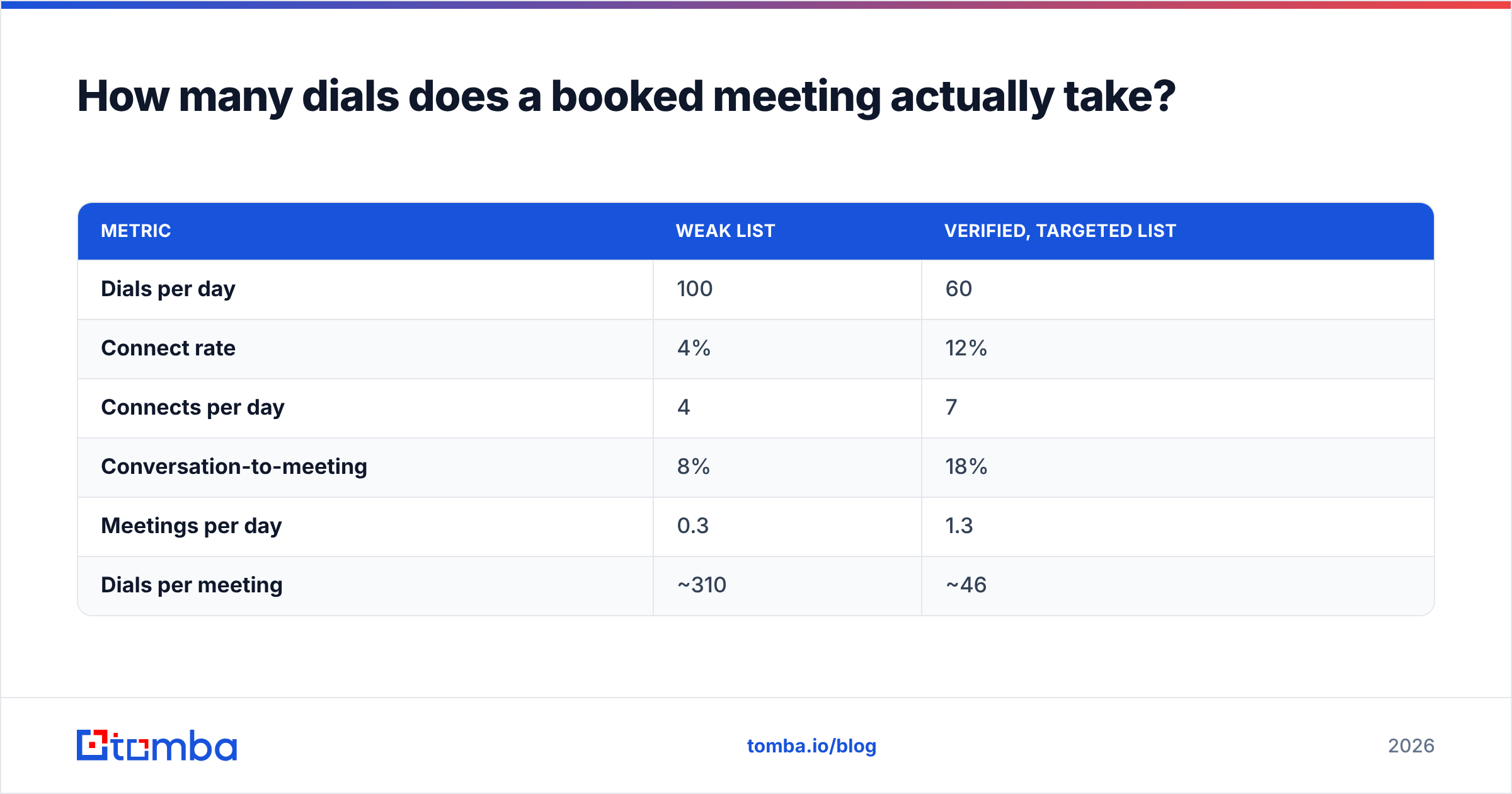
How many dials does a booked meeting actually take?#
Here's the math most managers won't put on a slide.
| Metric | Weak list | Verified, targeted list |
|---|---|---|
| Dials per day | 100 | 60 |
| Connect rate | 4% | 12% |
| Connects per day | 4 | 7 |
| Conversation-to-meeting | 8% | 18% |
| Meetings per day | 0.3 | 1.3 |
| Dials per meeting | ~310 | ~46 |
Same rep. Same script. The only variable is data quality and targeting. That gap — 310 dials versus 46 — is why "just dial more" is bad coaching advice for a team with a broken list.
Set your own baseline over two weeks before you optimize anything. Track four numbers: dials, connects, conversations over 60 seconds, and meetings booked. If your connect rate is under 5%, the problem is the list. If connects are fine but conversations are short, the problem is the opener. If conversations are long but meetings don't book, the problem is your ask.
What are the six objections you'll hear most?#
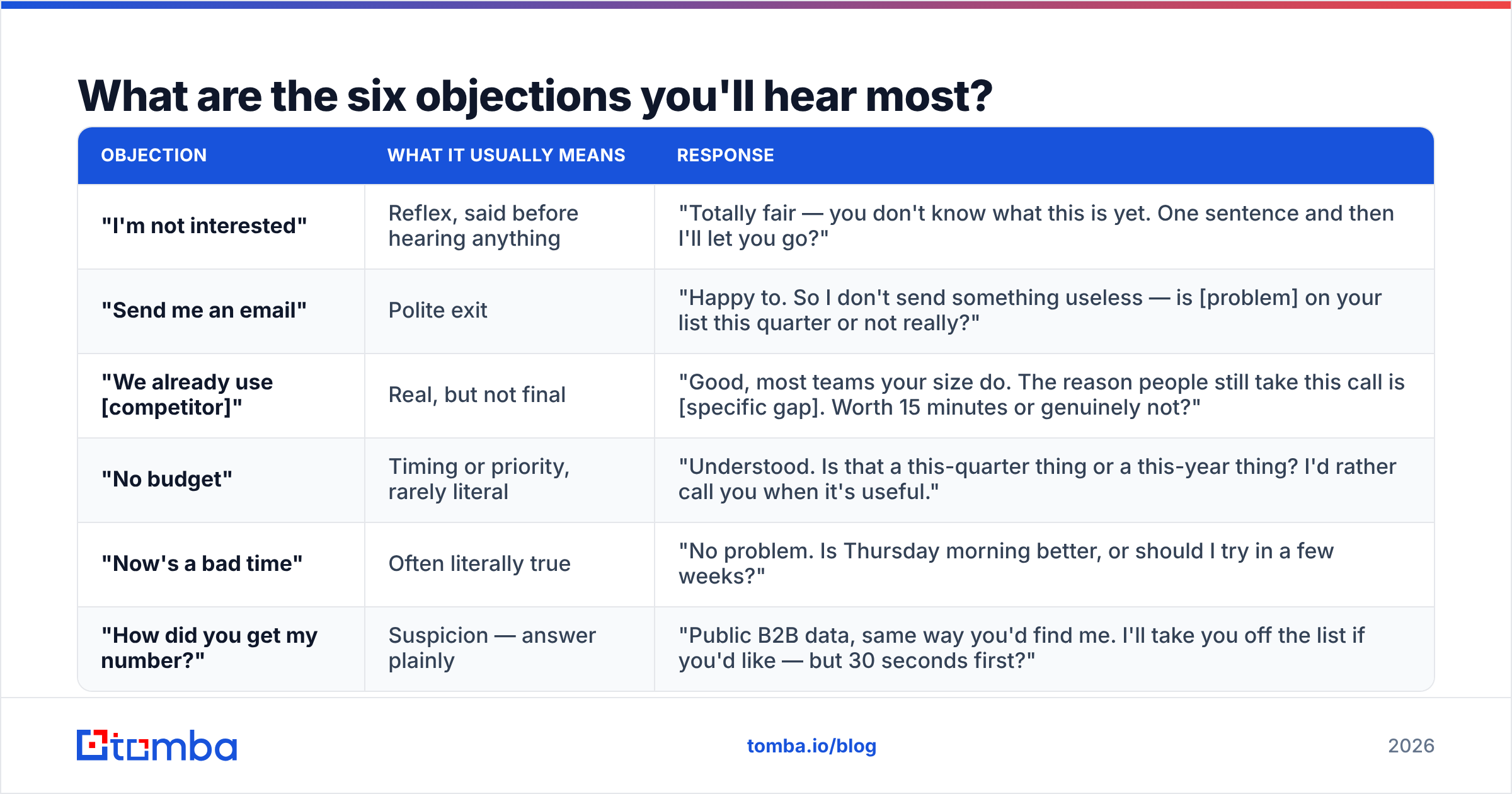
Objections are predictable. Script the second sentence, not the whole conversation.
| Objection | What it usually means | Response |
|---|---|---|
| "I'm not interested" | Reflex, said before hearing anything | "Totally fair — you don't know what this is yet. One sentence and then I'll let you go?" |
| "Send me an email" | Polite exit | "Happy to. So I don't send something useless — is [problem] on your list this quarter or not really?" |
| "We already use [competitor]" | Real, but not final | "Good, most teams your size do. The reason people still take this call is [specific gap]. Worth 15 minutes or genuinely not?" |
| "No budget" | Timing or priority, rarely literal | "Understood. Is that a this-quarter thing or a this-year thing? I'd rather call you when it's useful." |
| "Now's a bad time" | Often literally true | "No problem. Is Thursday morning better, or should I try in a few weeks?" |
| "How did you get my number?" | Suspicion — answer plainly | "Public B2B data, same way you'd find me. I'll take you off the list if you'd like — but 30 seconds first?" |
Two rules that matter more than any specific wording. First, agree before you redirect: "Fair," "Understood," "Good." Arguing with a stranger who owes you nothing ends the call. Second, give them a real exit. "Tell me to go away and I will" makes people more likely to stay, not less — it signals you're a person, not a script.
How do you combine cold calls with email?#
Call-only outreach leaves meetings on the table. So does email-only. The teams booking consistently run both against the same list, in a fixed rhythm.
A workable 12-day sequence:
- Day 1 — Call. No voicemail on the first attempt.
- Day 1 — Email, 60 words, same angle you would have used on the phone.
- Day 3 — Call, different time of day. Leave a 15-second voicemail referencing the email.
- Day 5 — LinkedIn connect, no pitch in the note.
- Day 7 — Call. Second voicemail, new angle.
- Day 10 — Email reply-to-thread with one specific piece of value.
- Day 12 — Breakup call plus a two-line email closing the loop.
The email side only works if your addresses are clean. Bounces above 3% start dragging your sender reputation down, and a burned domain kills the channel that was supposed to support your calls. Run every address through an email verifier before the sequence starts, not after.
Time your dials. Across most published B2B benchmarks and internal data teams share on G2 and HubSpot's sales research, mid-morning and late afternoon in the prospect's local time beat lunch and Monday mornings. Tuesday through Thursday outperform Monday and Friday. Test it yourself — your market may differ — but don't burn your best list on a Friday at 4pm.
What separates the top 10% of cold callers?#
Four habits, none of them charisma.
They research in 90 seconds, not 20 minutes. One relevant fact — a funding round, a job posting, a product launch — is enough. Anything more is procrastination dressed as preparation.
They talk less than half the time. Record your calls. If you're speaking more than 45% of a discovery conversation, you're pitching, not qualifying.
They disqualify fast. A booked meeting with someone who'll never buy is worse than a no, because it eats a calendar slot and inflates your pipeline. Ask "is this a priority this quarter?" early and believe the answer.
They call in blocks. Two 90-minute blocks beat eight hours of scattered dialing. Momentum is real — your fifth call sounds better than your first, and your fortieth sounds better than your fifth.
One more, less obvious: they keep their own data clean. Top performers spend 20-30 minutes a week pruning their list — removing bounced contacts, updating titles, adding new triggers. It's unglamorous and it compounds. Tools that plug into your existing stack make this cheap; a HubSpot integration or a Google Sheets workflow means enrichment happens where you already work instead of in a separate tab you'll forget about.
What should you do in your first week?#
If you're starting from zero, run this order:
- Days 1-2 — Build a 200-record list with a real trigger. Verify phones and emails.
- Day 3 — Write one opener and one ask. Say them out loud 20 times before dialing.
- Days 4-5 — Dial 60 per day in two blocks. Record everything. Track four metrics.
- End of week — Listen to your three worst calls and your one best. Adjust one thing, not five.
Then repeat for three more weeks before you judge the channel. Cold calling has enough variance that a single bad week means nothing. Four weeks of data means something.
Where to get the contact data#
Every part of this playbook depends on reaching the right person on the first attempt. That's a data problem before it's a sales problem.
Tomba Email Finder gives you verified professional emails by domain, name, or company, with direct-dial phone lookup, catch-all detection, and enrichment sitting alongside it — so one workflow produces a row that's ready to call and ready to email. The free tier includes 25 searches a month if you want to test accuracy on your own accounts before committing, and paid plans start at $49/mo. Full Tomba pricing is public, no demo required.
Build the list right, and the dialing takes care of itself.
Related guides#
// get started
Find, verify and enrich your first contacts today
Start on the free plan with 25 searches a month, then scale when your team is ready.
Free plan · No credit card required · GDPR & CCPA
// about the author