How to Cold Call Without Sounding Like a Salesman in 2026
Buyers hang up on the pitch, not the call. Here are seven concrete openers, scripts, and research habits that make a cold call sound like a peer conversation instead of a telemarketing read.
TL;DR
- Buyers don't hate cold calls — they hate being processed. The tell is pattern, not medium: fake enthusiasm, a permission-begging opener, and a script read at 190 words per minute.
- The fastest fix is structural: say why you called in the first eight seconds, in plain language, without asking "how are you today?"
- Research beats charisma. Two verified facts about the account do more for your tone than any tonality course.
- Talk-to-listen ratio under 45% on discovery calls correlates with materially better outcomes in published conversation-intelligence data. Silence is a technique, not a failure.
- Bad data creates salesman-voice indirectly: when you don't trust your list, you rush, hedge, and over-qualify. Clean contact data before you fix your script.
Why do buyers instantly know you're a salesman?#
Because you sound like every other cold call they've taken this quarter.
Think of it like hearing a robocall's first half-second. You don't parse the words — you recognize the shape. Slight audio delay, upward-inflected greeting, first name said twice. Your brain files it under "extract me from this" before the sentence finishes. Cold calls trip the same pattern detector.
The specific tells are boring and consistent:
- The permission opener. "Did I catch you at a bad time?" or "Do you have 30 seconds?" Both hand the prospect a scripted exit and signal that you expect to be a burden.
- Manufactured warmth. "Hey John! How's your Tuesday going?" — from a stranger, at 9:14am, with call-center ambience behind you.
- Feature vomit. Three product capabilities in one breath, because you're afraid of the pause.
- Pace. Nervous reps speak 30–40% faster than they do in normal conversation. Speed reads as "reading."
- Company-first framing. "I'm calling from Acme, we're a leading provider of…" No buyer has ever wanted the second half of that sentence.
None of those are moral failures. They're compression artifacts — what happens when you try to fit a value proposition into a window you assume is closing. The cure isn't a better pitch. It's removing the assumption that you're about to be thrown out.
What actually makes a call sound like a peer conversation?#
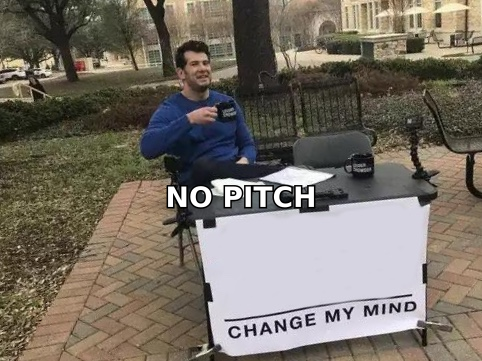
Four variables, ranked by how much they move the needle:
| Variable | Salesman version | Peer version | Difficulty to change |
|---|---|---|---|
| Opener | "How are you today?" | "This is a cold call — want the 20-second version?" | Easy, one day |
| Framing | "We help companies like yours…" | "I saw you posted three SDR roles in Berlin." | Medium, needs research |
| Pace | ~185 wpm, no pauses | ~140 wpm, 2-second gaps | Medium, needs recordings |
| Talk ratio | 70–80% you | 40–45% you | Hard, needs discipline |
| Close | "Can I book 30 minutes?" | "Worth a look, or is this not a priority?" | Easy, one day |
The single highest-leverage change is the permission-to-be-honest opener. Naming the call for what it is — "this is a cold call" — breaks the pattern match immediately. The prospect's script for handling salespeople doesn't have a branch for a salesperson who admits it. You get three or four extra seconds of genuine attention, which is all you need.
The second-highest is pace. Record ten of your own calls and listen at 1x. Most reps are shocked at how fast they sound. Slowing down 20% makes the exact same words read as considered rather than rehearsed. Gong's public research on conversation data has consistently found that successful discovery calls skew toward the rep listening more than talking — the specific thresholds vary by segment, but the direction never does.
How do you open a cold call without the salesman tell?#
Here are five openers that work, with the mechanism behind each.
1. The transparent cold call.
"Hi Sarah, this is Marcus — I'll be honest, this is a cold call. Do you want to hang up, or can I take 30 seconds to tell you why I picked you?"
Mechanism: honesty is unexpected. The offered exit is real, which makes the request feel non-manipulative. Roughly half of prospects who would have hung up on a normal opener will give you the 30 seconds.
2. The specific observation.
"Hi Sarah — I noticed your team shipped the self-serve tier last month and you're now hiring two demand-gen people. I called about the second thing."
Mechanism: proves you're not on a dialer list. Requires actual research, which is why most reps skip it.
3. The referral-adjacent.
"Hi Sarah — I spoke with Tom on your RevOps team last week about pipeline attribution. He suggested you'd have the stronger opinion."
Mechanism: borrowed trust. Only use if true. A fabricated referral is the fastest way to lose an account permanently.
4. The negative reverse.
"Hi Sarah — this is probably a bad time and it might not be relevant at all. Can I give you one sentence and you tell me to go away?"
Mechanism: removes pressure by pre-agreeing with the objection. Works well with senior buyers who are allergic to enthusiasm.
5. The problem-first.
"Hi Sarah — quick question. When your reps pull a list from your CRM, how often are the emails already dead?"
Mechanism: skips the introduction entirely and opens on a problem the prospect recognizes. Best when you have strong signal that the problem exists.
Notice what's missing from all five: no company name in the first sentence, no "how are you," no adjectives about your product. The company introduction can wait until sentence three, once you've earned it.
Does research really change how you sound?#
Yes, and this is the part most tonality advice misses.
Your voice betrays confidence level. When you're calling a name from a list you don't trust, with a job title that might be two years stale, you hedge. You say "I think you might be the person who…" You over-explain. You rush, because on some level you know you're guessing, and you're trying to get past the guessing part.
When you know three verifiable things about the account — they just raised a Series B, they posted two SDR roles, their careers page runs on a stack you integrate with — you stop hedging. The tone change is automatic. You don't have to perform confidence; you just have it.
That's a data problem, not a delivery problem. The prep loop that actually works:
- Confirm the human still works there. Titles and employers churn hard. A reverse email lookup or LinkedIn cross-check takes 20 seconds and prevents the worst opener of all: calling someone by a job they left.
- Get the direct line, not the switchboard. Gatekeeper routing wastes the energy you need for the actual conversation. A phone finder pass across your call list beats dialing main numbers.
- Find one company-specific fact. Recent funding, a product launch, a hiring pattern, a public job posting. One is enough. Three is showing off.
- Find one person-specific fact. A conference talk, a podcast appearance, a post they wrote. Skip if nothing exists — inventing one is worse than having none.
- Write your one-sentence reason for calling. If you can't fit it in one sentence, you don't have a reason yet.
- Validate the number before you dial. Nothing sounds less professional than three failed connection attempts in a row. A phone validator pass on the list removes disconnected and misrouted numbers.
Twelve minutes of prep for a list of ten accounts. Reps who skip it aren't saving time — they're moving it to the call, where it costs more.
What should you say after the opener?#
The middle of the call is where most reps revert to salesman mode. They got past the opener, felt relief, and immediately started pitching.
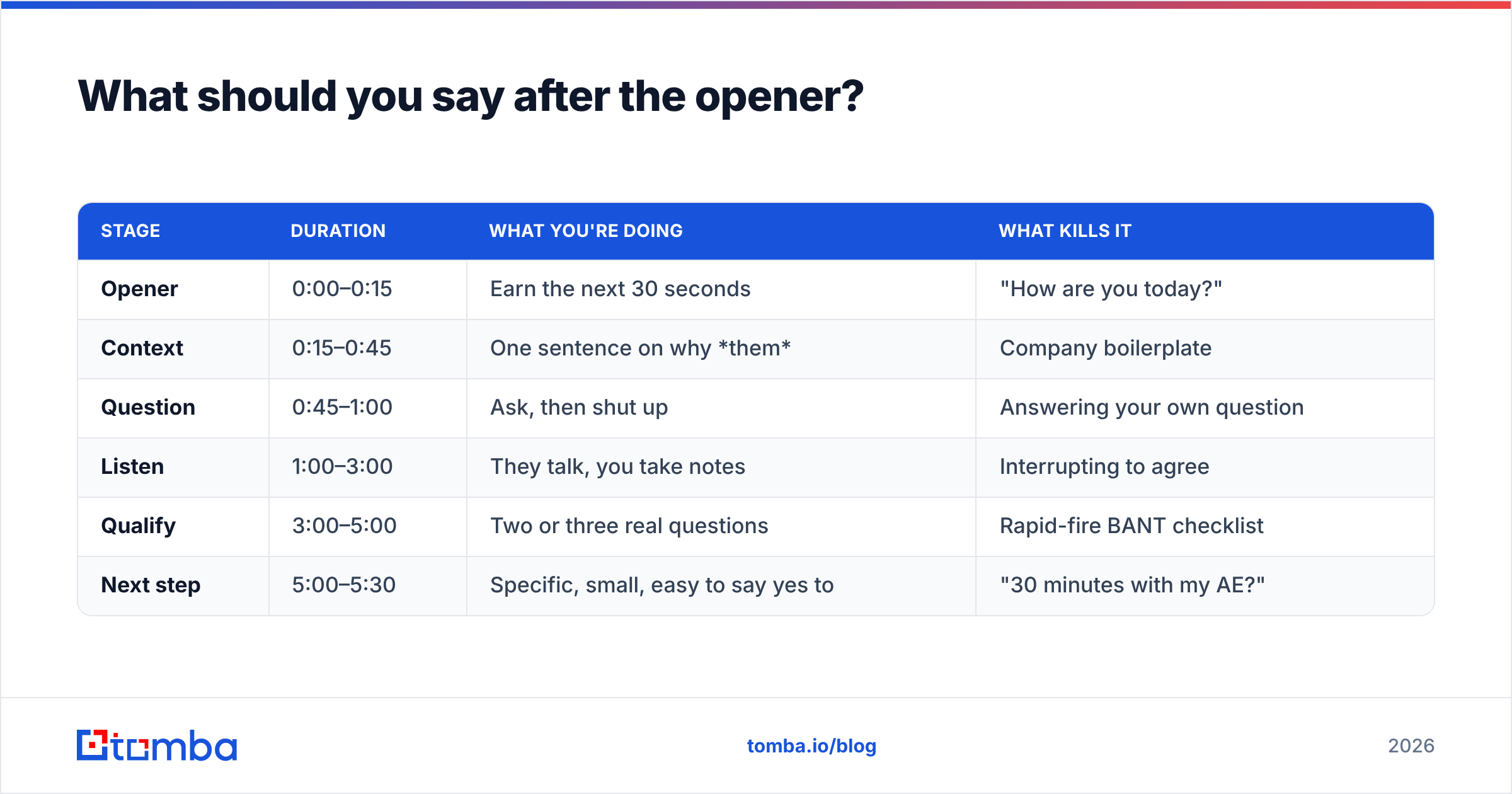
Resist. The structure that works:
| Stage | Duration | What you're doing | What kills it |
|---|---|---|---|
| Opener | 0:00–0:15 | Earn the next 30 seconds | "How are you today?" |
| Context | 0:15–0:45 | One sentence on why them | Company boilerplate |
| Question | 0:45–1:00 | Ask, then shut up | Answering your own question |
| Listen | 1:00–3:00 | They talk, you take notes | Interrupting to agree |
| Qualify | 3:00–5:00 | Two or three real questions | Rapid-fire BANT checklist |
| Next step | 5:00–5:30 | Specific, small, easy to say yes to | "30 minutes with my AE?" |
The listening block is the hard part. After you ask your question, count two full seconds of silence before you say anything. It feels endless. It's the single most common difference between reps who book meetings and reps who don't — a pattern that shows up repeatedly in published sales-methodology work from firms like HubSpot and in the training literature more broadly.
On qualification: the salesman version fires questions like a form. "What's your budget? Who's the decision maker? What's your timeline?" The peer version asks one question and follows the answer. If they say "we tried a tool like this last year," that's your next three minutes — what happened, what broke, who championed it. You'll learn more from that thread than from any framework checklist. Track how this changes your response rate across a full quarter, not a week.

How do you handle the "not interested" reflex?#
"Not interested" said in the first ten seconds isn't an objection. It's a reflex — the verbal equivalent of closing a cookie banner. The prospect hasn't heard anything to be uninterested in yet.
Three responses, ranked:
Acknowledge and redirect (best).
"Totally fair — you don't know what this is yet. One sentence and then I'll let you go: [reason]. Still nothing?"
Ask what they assumed (good).
"Fair enough. Out of curiosity, what did you think I was calling about? I want to make sure I'm not wasting the next person's time either."
Agree and exit gracefully (when it's real).
"Understood. I'll leave you alone. If it's ever relevant, I'm at [email] — no follow-up sequence, I promise."
That third one matters more than reps think. A clean exit preserves the account. A rep who argues past a genuine no gets flagged internally, and the next three reps from your company get blocked before they dial.
The one thing not to do: "I understand, but if I could just take 30 more seconds…" The word "but" invalidates everything before it, and the prospect hears the script resuming.
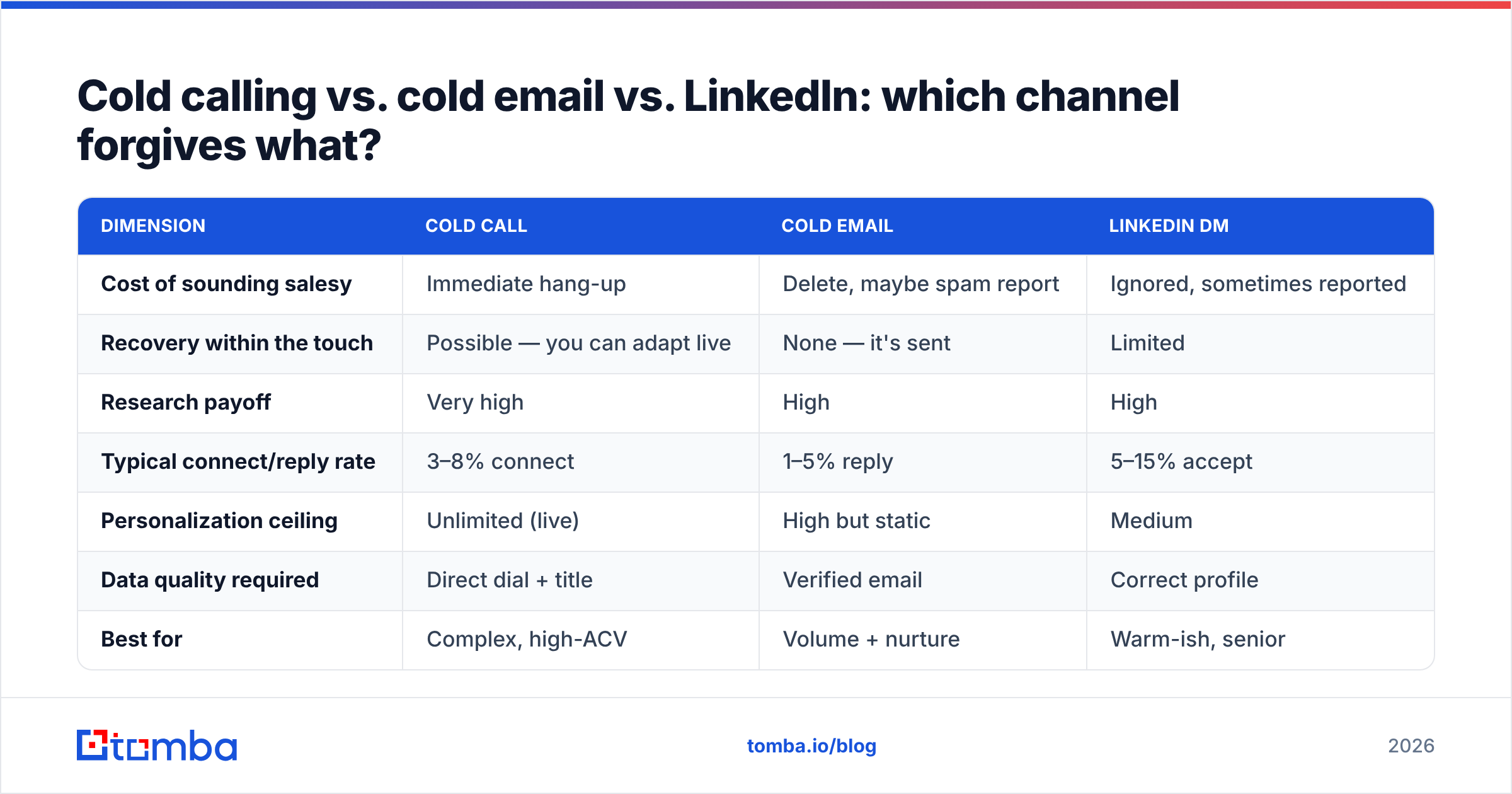
Cold calling vs. cold email vs. LinkedIn: which channel forgives what?#
Different channels punish salesman-voice differently. Understanding that helps you pick your sequencing.
| Dimension | Cold call | Cold email | LinkedIn DM |
|---|---|---|---|
| Cost of sounding salesy | Immediate hang-up | Delete, maybe spam report | Ignored, sometimes reported |
| Recovery within the touch | Possible — you can adapt live | None — it's sent | Limited |
| Research payoff | Very high | High | High |
| Typical connect/reply rate | 3–8% connect | 1–5% reply | 5–15% accept |
| Personalization ceiling | Unlimited (live) | High but static | Medium |
| Data quality required | Direct dial + title | Verified email | Correct profile |
| Best for | Complex, high-ACV | Volume + nurture | Warm-ish, senior |
The practical takeaway: cold calling is the only channel where you can course-correct mid-touch. That's an advantage, and reps waste it by reading a script that can't adapt. If you're going to script anything, script the first two sentences and the exit — leave the middle free.
For a multichannel sequence, most teams run email first to create familiarity, then call. That only works if the emails actually land, which depends on email deliverability hygiene and verified addresses. A call that opens with "I sent you a note last week" is worthless if the note bounced.
What does a clean cold call actually sound like?#
Full transcript, roughly 90 seconds:
Rep: Hi Sarah, this is Marcus. I'll be straight with you — this is a cold call. Want to hang up, or can I have 30 seconds?
Sarah: …go ahead.
Rep: Thanks. I saw you're hiring two SDRs in Berlin and you just opened a self-serve tier. Usually when both happen at once, the outbound list quality becomes somebody's problem fast. Is that landing anywhere near reality for you?
Sarah: I mean, kind of. We're pulling from an old database, yeah.
Rep: (pause) How old?
Sarah: Honestly? Two years. We've been meaning to clean it.
Rep: That's the normal answer. What happens when your new reps hit it — bounces, or just nobody home?
Sarah: Bounces mostly. Our domain got flagged in March.
Rep: Okay, that's the expensive version. Two options — I can send you a one-page breakdown of what typically causes that, no meeting required, or we do 20 minutes next week and I show you the specific state of your list. Which is less annoying?
Sarah: Send the page first.
Rep: Done. Best email?
Count the differences from a standard call: no company name until asked, one question at a time, an actual pause, a next step with two options where both are small, and no attempt to force the meeting. Marcus never once said "solution," "leverage," or "circle back."
Also count what he knew before dialing: hiring activity, product launch, and a working direct line. That's it. Twelve minutes of prep bought a conversation.
How do you practice this without burning real accounts?#
- Record everything. If your dialer doesn't record, use a separate recorder. Listen to five calls a week at 1x, not 1.5x.
- Count your talk ratio manually on three calls. Stopwatch. It's more humbling than any dashboard.
- Run the first 15 seconds only. Practice openers on a colleague until you can say them at conversational pace without reading.
- Call your worst-fit accounts first on Monday. Burn the rust on prospects you don't need.
- Kill one filler phrase per week. "Just checking in," "quick question," "reaching out," "does that make sense?" Pick one, eliminate it, move to the next.
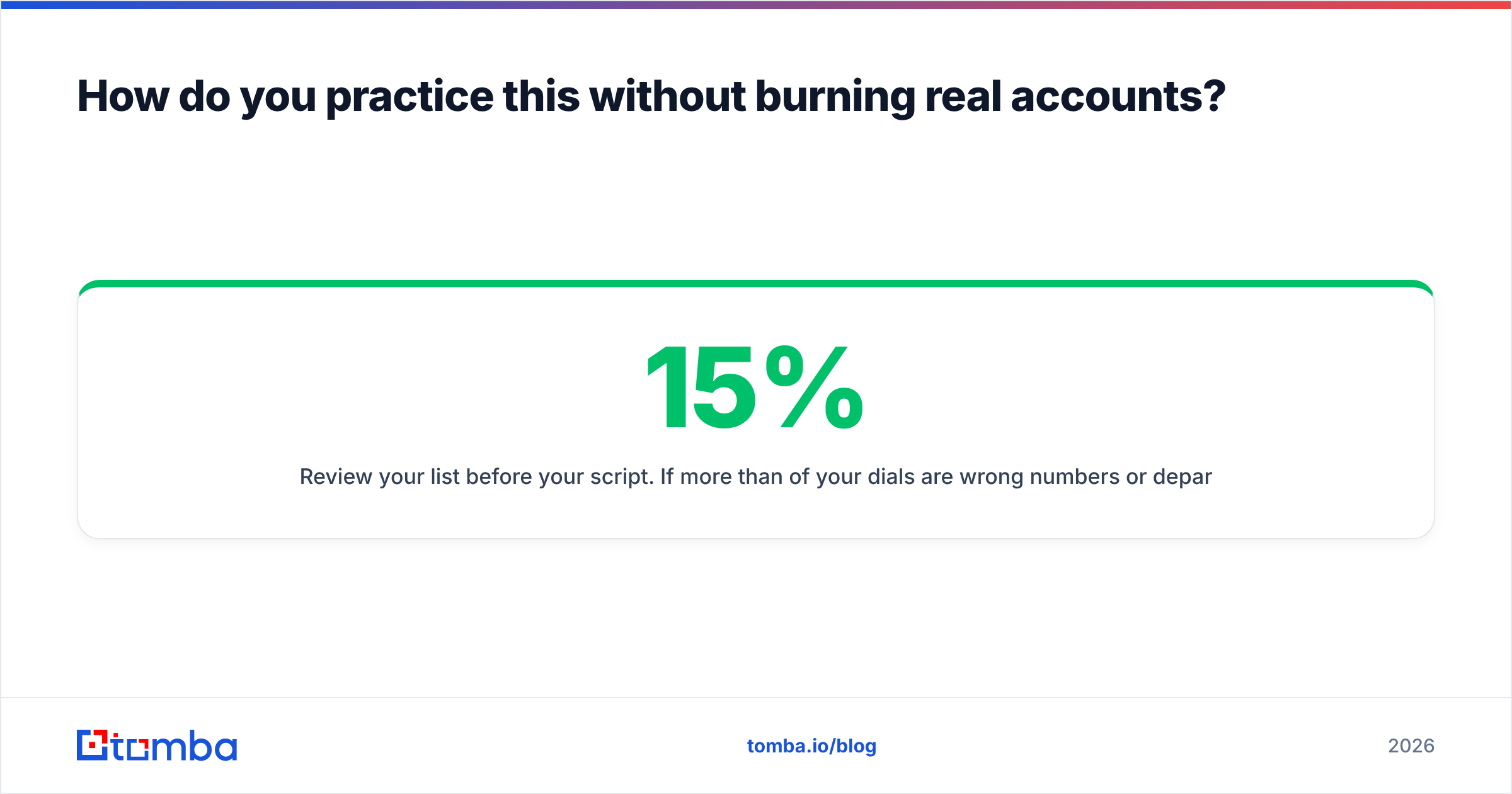
- Review your list before your script. If more than 15% of your dials are wrong numbers or departed employees, fix data first. No tonality work survives a bad list.
That last point is where most teams stall. Reps who spend their morning fighting disconnected numbers and stale titles arrive at the good conversations already defensive. Peer tone is downstream of data confidence.
The bottom line#
Sounding like a salesman is a symptom of three things: a script you're reading instead of a reason you're calling, a pace driven by anxiety, and a list you don't trust. Fix them in that order.
The transparent opener costs nothing and works tomorrow. Slowing down 20% costs nothing and works this week. Fixing your data costs a little and fixes the other two permanently.
If your call list is the weak link — stale titles, switchboard numbers, contacts who left 18 months ago — start there. Tomba's Email Finder gives you verified professional contacts by name and domain so your pre-call research starts from something real, and the free tier covers 25 searches a month if you want to test it against your current list before committing. Paid plans start at $49/mo; see Tomba pricing for the full breakdown. Clean the data, then go have a conversation instead of a pitch.
Related guides#
// get started
Find, verify and enrich your first contacts today
Start on the free plan with 25 searches a month, then scale when your team is ready.
Free plan · No credit card required · GDPR & CCPA
Get the Tomba newsletter
Product and data updates
// about the author