How To Cold Email Investors: A 2026 Playbook That Works
Most founder cold emails to VCs die in the first two lines. Here is the research, structure, and sending routine that actually gets a reply from investors in 2026.
TL;DR
- Cold emailing investors works, but only at small volume with real research. A 40-investor list you actually studied beats a 500-name blast every time.
- The winning structure is five lines: why them, one-line company, traction proof, the ask, the deck link. Anything longer gets skimmed and archived.
- Get the right address.
info@andhello@inboxes at VC firms are triage queues; partner and principal addresses are where decisions start. Use a verified email finder rather than guessing formats. - Traction is the subject line. "3 → $47K MRR in 5 months, B2B fintech" outperforms "Investment opportunity" by a wide margin.
- Two follow-ups, spaced 5 and 12 days out, with new information each time. After that, move on and re-engage at your next milestone.
Does cold emailing investors actually work?#
Yes — but not the way most founders do it.
The version that works looks like targeted business development: 30 to 60 investors, each researched, each email referencing something specific about their thesis or portfolio. The version that fails looks like a mail merge to every partner scraped from a VC list, with {{first_name}} in the greeting and a 400-word company history underneath.
Investors read cold email. Many partners publicly say they source deals from it — it is one of the few channels where a founder with no network can reach the same person a warm intro would reach. What they do not read is the fifth generic pitch of the morning. Your job is to be recognizably not that.
Two things separate the pile that gets replies from the pile that gets archived: relevance (you clearly understand what this specific investor funds) and evidence (there is a number in the email that makes them curious). Everything below is in service of those two.
Wait — that renders wrong. Here it is properly:

What do investors actually want to see in a cold email?#
Investors are pattern-matchers under time pressure. A partner at a seed fund might see 100+ inbound items a week and take first calls with three of them. They are scanning for a fast answer to four questions:
- Is this in my box? Stage, sector, geography, check size. If you are pre-seed consumer hardware in Lisbon and they do Series B enterprise SaaS in the US, nothing else in the email matters.
- Is something working? Revenue, users, retention, a signed LOI, a waitlist that converted. One credible number beats three paragraphs of vision.
- Why is this team the one? A single clause of founder-market fit. Not a résumé.
- What are they asking me to do? A clear, low-friction next step.
Notice what is not on that list: your market-size slide, your competitive moat essay, your five-year roadmap. Those belong in the deck. The email exists to earn the deck open.
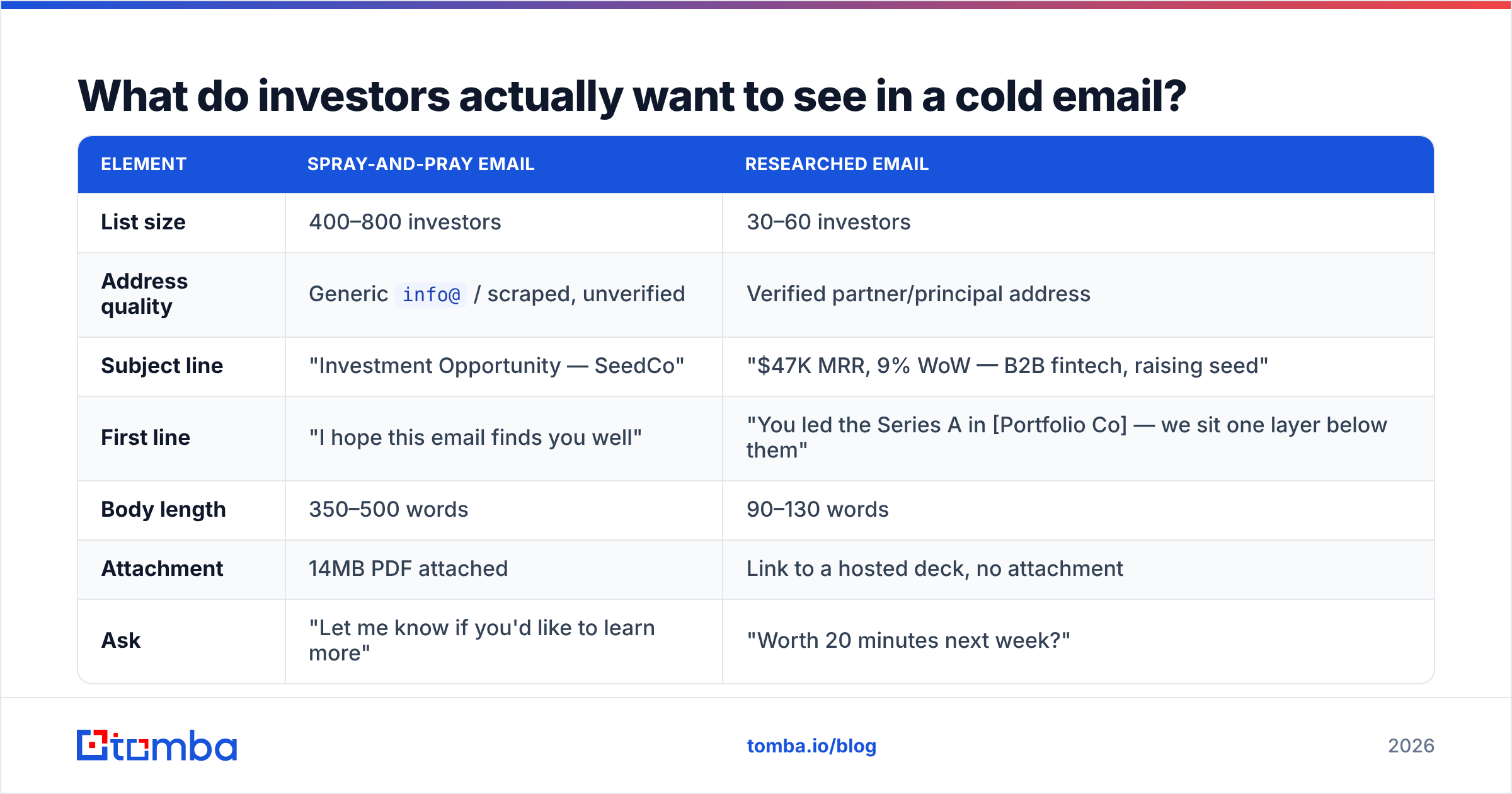
Here is how the two approaches compare in practice:
| Element | Spray-and-pray email | Researched email |
|---|---|---|
| List size | 400–800 investors | 30–60 investors |
| Address quality | Generic info@ / scraped, unverified |
Verified partner/principal address |
| Subject line | "Investment Opportunity — SeedCo" | "$47K MRR, 9% WoW — B2B fintech, raising seed" |
| First line | "I hope this email finds you well" | "You led the Series A in [Portfolio Co] — we sit one layer below them" |
| Body length | 350–500 words | 90–130 words |
| Attachment | 14MB PDF attached | Link to a hosted deck, no attachment |
| Ask | "Let me know if you'd like to learn more" | "Worth 20 minutes next week?" |
| Realistic reply rate | Under 1% | 8–20% at small volume |
| Bounce risk | High — unverified list hurts sender reputation | Low — pre-verified addresses |
The right-hand column is not more work per email than you think. It is roughly ten extra minutes of research per investor, and it is the entire difference.
How do you build the investor list?#
Start with portfolio archaeology, not investor directories.
Pick five to ten companies that are adjacent to yours — same buyer, same stage a year or two ahead, or a complementary product. Look up who funded them. Those firms have already spent money proving they believe your thesis. Then narrow by:
- Stage fit. A fund writing $5M checks will not do your $600K pre-seed, no matter how good the note.
- Check size and ownership targets. Public on most fund websites and on Crunchbase.
- Recency. A partner who invested in your space three months ago is warm to the category. One who did it in 2019 may have moved on.
- The individual, not the firm. Funds do not have theses; partners do. Find the specific person who champions your category — usually visible from their published posts, podcast appearances, and board seats.
- Conflicts. If they funded your direct competitor, skip them. Sending anyway costs you credibility and risks your data.
Aim for a tiered list: Tier 1 (perfect fit, 10–15 names), Tier 2 (good fit, 20–30), Tier 3 (plausible, the rest). Send to Tier 2 first. Use those replies to fix your messaging, then hit Tier 1 with the sharpened version.
How do you find an investor's actual email address?#
This is where most founder outreach quietly dies. You write a good email and send it to an address that either bounces or lands in a shared inbox nobody reads.
VC firms typically use predictable patterns — first@fund.com is extremely common at smaller funds, first.last@fund.com at larger ones — but "typically" is not good enough when a bounce costs you both the contact and a hit to your sender reputation.
A practical sequence:
- Check the obvious public sources first. Many partners list their email in their X/Twitter bio, on a personal site, or at the bottom of their Substack. Free and unambiguous.
- Run a domain search on the fund. A domain search returns the addresses and the dominant format for that domain, so you know whether the firm uses
jane@orjane.doe@before you guess. - Find the individual by name. With the firm domain plus the partner's name, an email finder returns the specific address with a confidence score and the sources it was found in.
- Verify before sending. Always. An email verifier checks the mailbox exists at the SMTP layer, which keeps your bounce rate under the 2% threshold where inbox providers start throttling you.
- Handle catch-all domains carefully. Many funds run catch-all servers that accept anything, so standard verification returns "unknown." A catch-all verifier applies pattern confidence and historical signal to give you a usable risk rating instead of a shrug.
If you found the partner through an article or a portfolio announcement they wrote, an author finder resolves the byline straight to a contact.
Do not attach the deck as a file. Host it — DocSend, Notion, or a plain link — so you get open analytics and your email stays light enough to avoid attachment filters.
What does a cold email to an investor look like?#
Short. Five components, in this order.
1. Subject line — traction plus category.
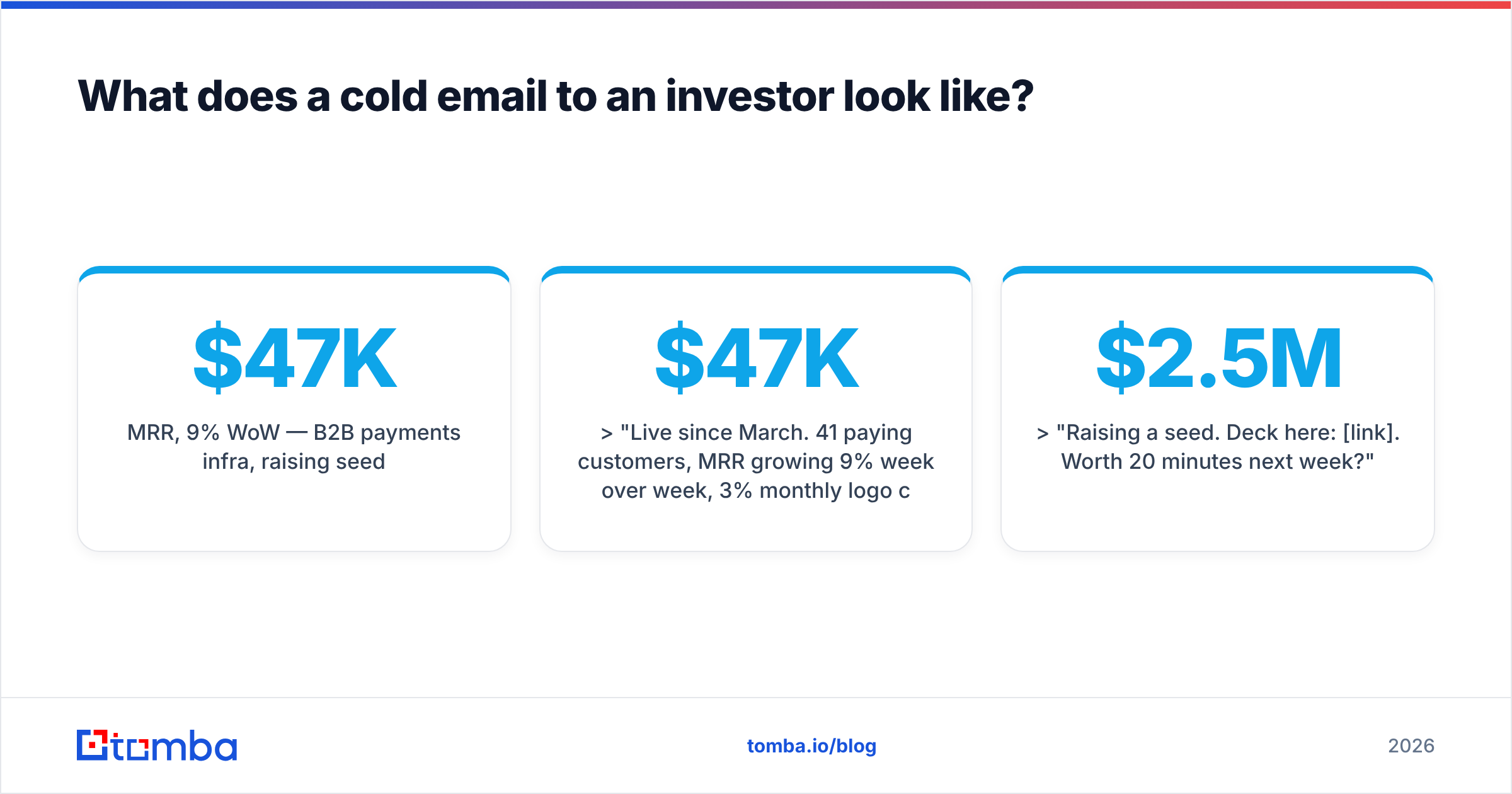
$47K MRR, 9% WoW — B2B payments infra, raising seedNo "Investment Opportunity." No "Quick question." Put the most impressive true fact in the subject.
2. Why them, specifically (one sentence).
"You wrote about the reconciliation layer being the real bottleneck in fintech infra — that's exactly the wedge we took."
This line is doing the heaviest lifting in the email. It has to be something you could only write about them.
3. What you do (one sentence, plain language).
"Rivet is an API that reconciles payment ledgers across processors — think Plaid for back-office finance ops."
No jargon, no "revolutionary," no "AI-powered platform that leverages."
4. Proof (two or three numbers).
"Live since March. 41 paying customers, $47K MRR growing 9% week over week, 3% monthly logo churn. Two of them switched off Stripe Revenue Recognition."
If you have no revenue, use whatever is real: pilot LOIs, waitlist conversion, retention on a free product, a technical benchmark. Zeroes stated honestly are better than vague adjectives.
5. The ask (one line) and the link.
"Raising a $2.5M seed. Deck here: [link]. Worth 20 minutes next week?"
Total: under 130 words. Signature with your name, company, and one link. No banner images, no tracking-heavy HTML, no "Sent from my iPhone" fake-casual trick.
How many should you send, and how often should you follow up?#
Volume is your enemy here, and this is the part founders get wrong most often after they discover automation tools.
Sending 500 investor emails a week from a domain that has never sent bulk mail is the fastest way to land in spam and burn the domain you also use for customer contracts. Investor outreach should look like human email, because it is.
Practical guardrails:
- 20–40 sends per day maximum, per mailbox, ramping up over two weeks if the domain is new to outbound.
- Send from a subdomain (
founders.yourco.com) if you are running any volume, so a reputation problem never touches your primary domain. - Check your SPF, DKIM, and DMARC records before the first send. A missing SPF record is a silent deliverability tax. Google's sender guidelines spell out the current requirements for bulk senders.
- No link tracking pixels on investor outreach. They add nothing at this volume and they trip filters.
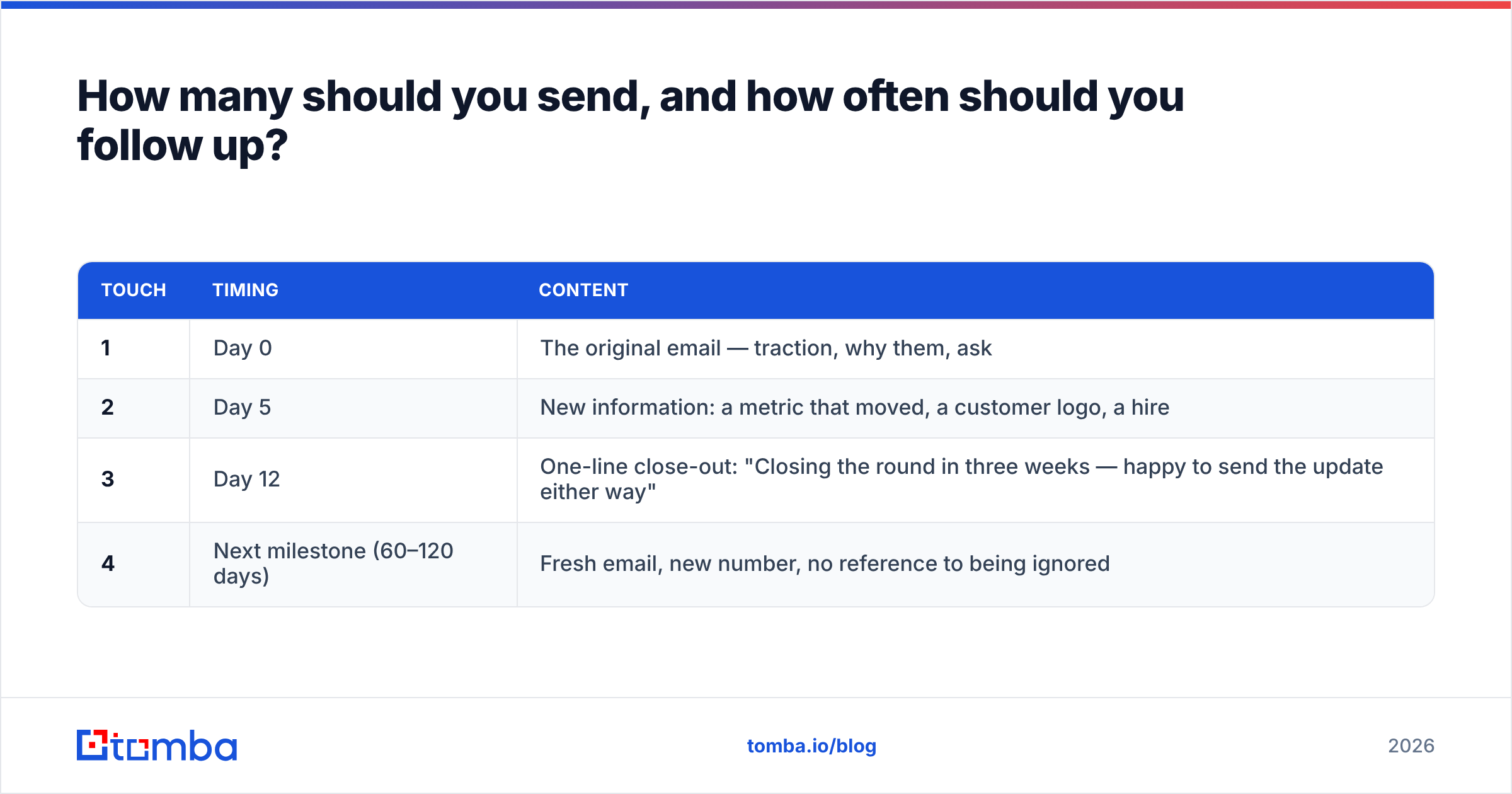
The follow-up cadence that works:
| Touch | Timing | Content |
|---|---|---|
| 1 | Day 0 | The original email — traction, why them, ask |
| 2 | Day 5 | New information: a metric that moved, a customer logo, a hire |
| 3 | Day 12 | One-line close-out: "Closing the round in three weeks — happy to send the update either way" |
| 4 | Next milestone (60–120 days) | Fresh email, new number, no reference to being ignored |
Three touches, then stop. The fourth is a new conversation at a new milestone, and it converts surprisingly well — investors who passed on your seed frequently take the Series A call because they watched you execute.
Never follow up with "just bumping this to the top of your inbox." Add information or say nothing.
What mistakes kill investor cold emails?#
- Sending to
info@. These addresses at most firms route to an associate triage queue or nowhere at all. Get the partner. - NDAs. Asking an investor to sign one before a first call marks you as unfamiliar with how the industry works. Nobody signs.
- Attaching a 12MB deck. Filters hate it, phones hate it, and you lose the open data.
- Hedged asks. "Let me know if you might possibly be interested in potentially chatting" gets no reply. "Worth 20 minutes next week?" gets a yes or a no, and a no is useful.
- Inflated numbers. Investors talk to each other and to your customers. One exaggerated metric ends the relationship permanently.
- Mass BCC. Visible or detectable multi-send is an instant pass at most firms.
- Ignoring stage fit. The single most common reason for silence is that you emailed someone who structurally cannot invest in you.
- No deadline or forcing function. A round with a lead, a closing date, or a hard allocation number creates a reason to reply this week rather than someday.
For a broader sanity check on your sequences and copy, the cold email templates library is a reasonable place to pressure-test structure before you send.
How do you track and improve the campaign?#
Treat it like a funnel with four numbers: delivered, opened (if you measure it at all), replied, and meetings booked. At 40 sends you will not get statistical significance, so read directionally.
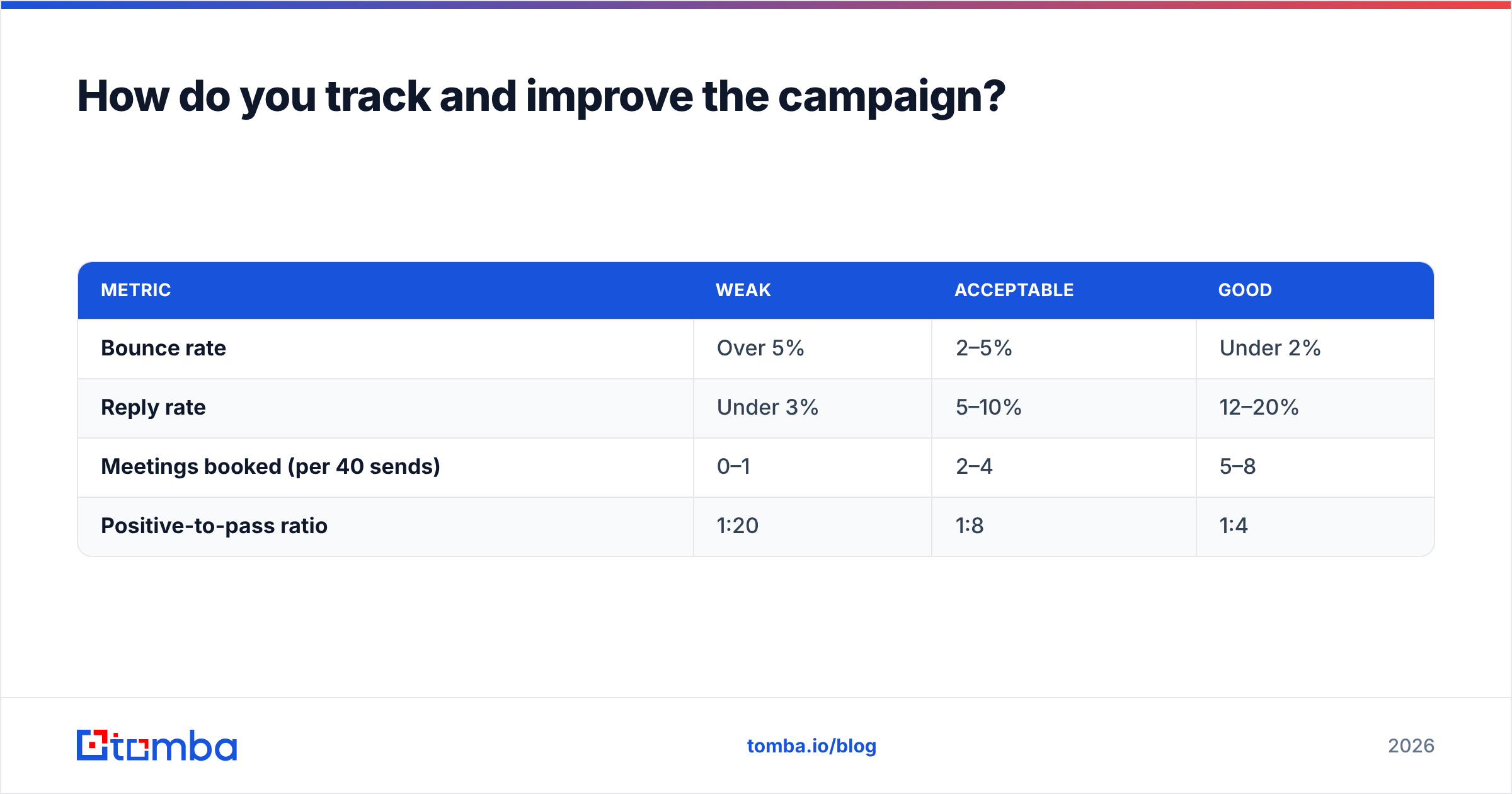
Benchmarks worth aiming for on a well-researched list:
| Metric | Weak | Acceptable | Good |
|---|---|---|---|
| Bounce rate | Over 5% | 2–5% | Under 2% |
| Reply rate | Under 3% | 5–10% | 12–20% |
| Meetings booked (per 40 sends) | 0–1 | 2–4 | 5–8 |
| Positive-to-pass ratio | 1:20 | 1:8 | 1:4 |
If your bounce rate is high, the list is the problem — verify before the next batch. If opens are fine but replies are not, the body and the ask are the problem. If nobody opens, the subject line is generic or the address quality is poor.
Track everything in a spreadsheet or your CRM with columns for firm, partner, thesis note used, send date, and outcome. When you raise again in 18 months, that file is worth more than the round.
Log the reasons for passes too. Three investors saying "too early" is noise; three saying "I don't believe the retention story" is a product roadmap.
Should you use automation for investor outreach?#
Partially. Automate the mechanical work, keep the writing human.
Automate: finding and verifying addresses, enriching records with fund and role data, deduplicating your list, scheduling send times, logging outcomes. A bulk email finder run over a list of fund domains and partner names turns two days of manual lookup into a coffee break.
Do not automate: the "why them" line, the traction framing, or the follow-ups. Sequencing tools that inject a generic paragraph and merge a first name produce exactly the email investors have learned to ignore. If a template variable is doing the personalization, it is not personalization.
A reasonable stack for a founder raising a seed: a research pass in a browser, an email finder extension to pull addresses as you go, verification in bulk before the send, and then plain Gmail or Outlook to actually send — one at a time, from your own account. At 40 emails, manual sending is genuinely fine and it keeps you honest about quality.
If you are running this repeatedly (an accelerator, a fundraising advisor, a venture studio), the Tomba API handles find-and-verify inside your own tooling, and the Google Sheets add-on covers the case where your list already lives in a spreadsheet.
What should you do next?#
Build the list before you write a word. Ten Tier-1 names you genuinely understand will teach you more in a week than 400 addresses ever will. Then write one email you would be happy to receive, verify every address on the list, and send in batches of 20 with two follow-ups each.
The mechanics are the easy part to fix. Get the addresses right, keep the email under 130 words, put a real number in the subject line, and follow up with new information rather than a bump.
When you are ready to build that list, the Tomba Email Finder resolves partner-level addresses from a fund domain and a name, with confidence scores and source citations so you know what you are sending to before you send it. The free tier covers 25 searches a month — enough to test the workflow on your Tier 1 list — and paid plans start at $49/month if you need volume. Full Tomba pricing is public.
Related guides#
// get started
Find, verify and enrich your first contacts today
Start on the free plan with 25 searches a month, then scale when your team is ready.
Free plan · No credit card required · GDPR & CCPA
// about the author