How to Collect Intent Data: A Practical 2026 Playbook
Intent data only works if you can act on it. Here is how to collect first-party, second-party, and third-party intent signals, score them, and turn them into contacts your reps can actually email.
TL;DR
- Intent data is any observable behavior that suggests an account is researching a problem you solve. It comes in three flavors: first-party (your own properties), second-party (review sites and publishers), and third-party (co-op networks and bidstream).
- Start with first-party. It is free, it is the most accurate, and most teams have never instrumented it properly.
- Third-party intent from Bombora, 6sense, or G2 costs $25K–$120K/year and gets you account-level signals — not people. You still need contact data to act.
- A signal without a name and an email is a dead end. Budget for resolution and enrichment, not just the signal feed.
- Score signals by recency, depth, and fit. A pricing-page visit from an ICP-fit account beats 400 anonymous topic surges every time.
What is intent data, really?#
Intent data is behavioral exhaust. Somebody at a company reads three articles about "SOC 2 automation," downloads a compliance checklist, compares two vendors on G2, and visits your pricing page twice in a week. None of those actions is a purchase. Together they describe an account that has moved from "unaware" to "actively shopping."
The useful mental model: intent data is a smoke detector, not a fire alarm. It tells you where to look. It does not tell you that someone is ready to sign.
Three categories matter, and they are not interchangeable:
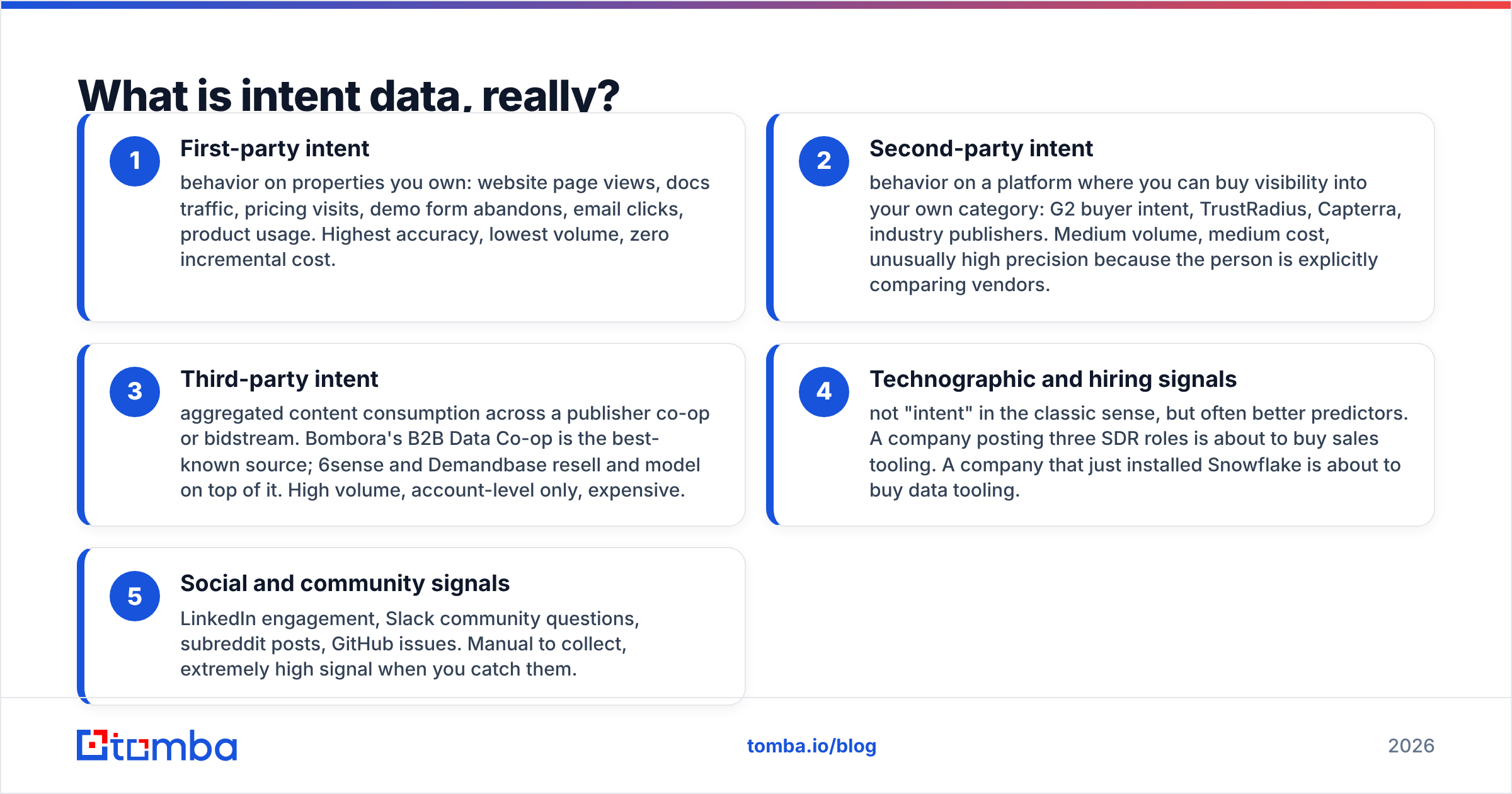
- First-party intent — behavior on properties you own: website page views, docs traffic, pricing visits, demo form abandons, email clicks, product usage. Highest accuracy, lowest volume, zero incremental cost.
- Second-party intent — behavior on a platform where you can buy visibility into your own category: G2 buyer intent, TrustRadius, Capterra, industry publishers. Medium volume, medium cost, unusually high precision because the person is explicitly comparing vendors.
- Third-party intent — aggregated content consumption across a publisher co-op or bidstream. Bombora's B2B Data Co-op is the best-known source; 6sense and Demandbase resell and model on top of it. High volume, account-level only, expensive.
- Technographic and hiring signals — not "intent" in the classic sense, but often better predictors. A company posting three SDR roles is about to buy sales tooling. A company that just installed Snowflake is about to buy data tooling.
- Social and community signals — LinkedIn engagement, Slack community questions, subreddit posts, GitHub issues. Manual to collect, extremely high signal when you catch them.
How do you collect first-party intent data?#
Start here. Every team I have audited has under-instrumented their own site while paying five figures for third-party topic surges.
Step 1 — Instrument the pages that indicate buying, not browsing. Blog traffic is not intent. Pricing, comparison pages, docs, integrations, security/compliance pages, and careers pages are. Tag them explicitly in your analytics layer with an intent_weight property so downstream scoring is trivial.
Step 2 — De-anonymize the traffic. Roughly 97% of B2B site visitors never fill out a form. Reverse-IP and identity-graph tools resolve a share of that traffic to a company. Tomba's website visitor reveal does account-level identification; so do Albacross, Leadfeeder, and RB2B. Match rates vary wildly by geography — expect 30–50% in North America, far less in the EU where residential and VPN traffic dominates.
Step 3 — Capture form-fill and email engagement. Every demo request, newsletter signup, and webinar registration is explicit intent. Pipe them into the same scoring table as the anonymous signals so one account's history is unified.
Step 4 — Add product-led signals if you have a free tier. Trial signup, feature activation, invite-a-teammate, hitting a usage limit. These outperform every purchased dataset.
Step 5 — Set a decay window. A pricing-page visit is worth a lot on day one and nearly nothing on day 30. Most teams use a 14–30 day half-life. Without decay you accumulate a permanently "hot" list that reps learn to ignore.
What does each intent source actually cost?#
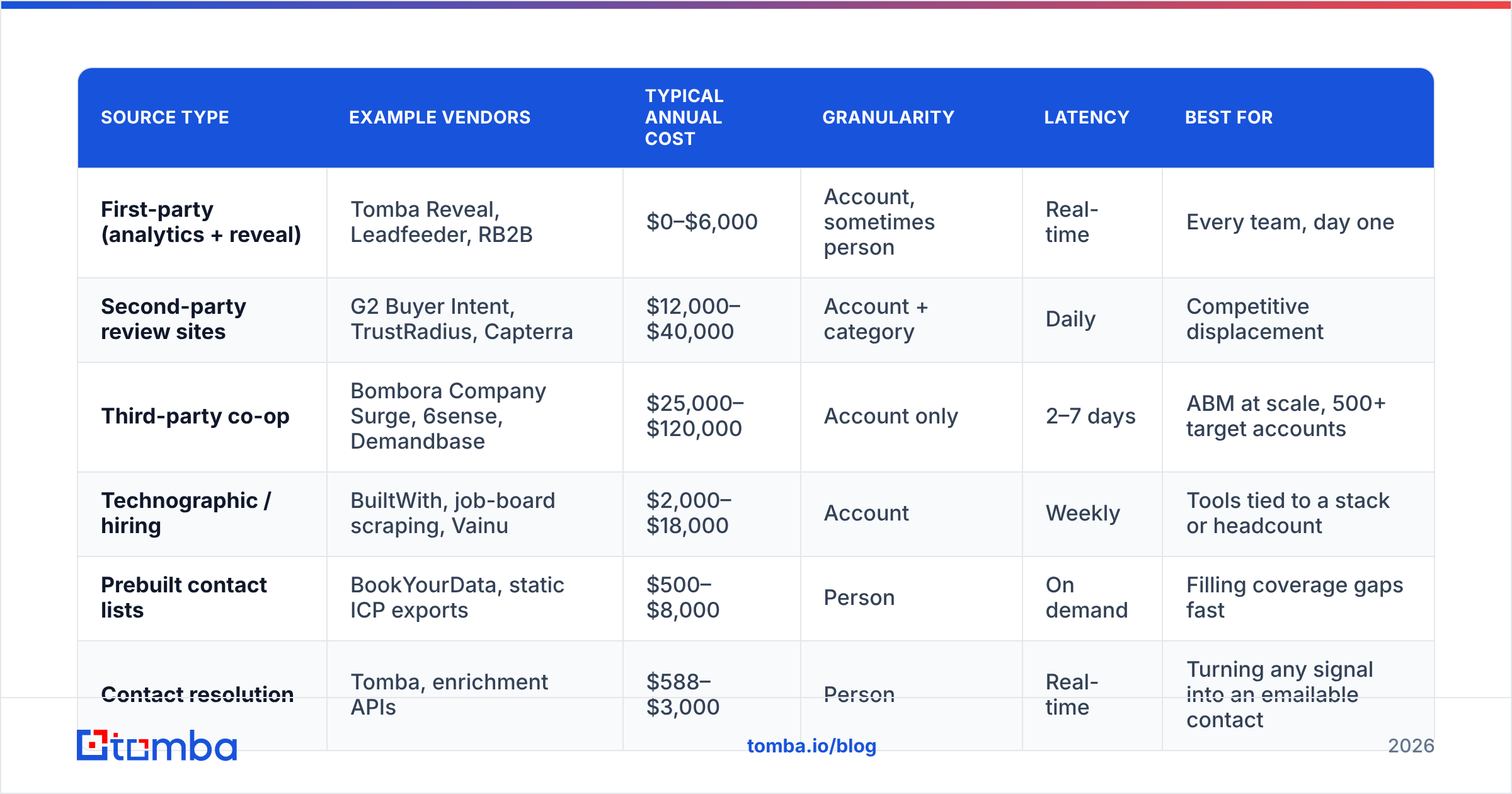
Here is the honest comparison. Prices are 2026 list ranges for a mid-market team; everything is negotiable and most vendors discount hard in Q4.
| Source type | Example vendors | Typical annual cost | Granularity | Latency | Best for |
|---|---|---|---|---|---|
| First-party (analytics + reveal) | Tomba Reveal, Leadfeeder, RB2B | $0–$6,000 | Account, sometimes person | Real-time | Every team, day one |
| Second-party review sites | G2 Buyer Intent, TrustRadius, Capterra | $12,000–$40,000 | Account + category | Daily | Competitive displacement |
| Third-party co-op | Bombora Company Surge, 6sense, Demandbase | $25,000–$120,000 | Account only | 2–7 days | ABM at scale, 500+ target accounts |
| Technographic / hiring | BuiltWith, job-board scraping, Vainu | $2,000–$18,000 | Account | Weekly | Tools tied to a stack or headcount |
| Prebuilt contact lists | BookYourData, static ICP exports | $500–$8,000 | Person | On demand | Filling coverage gaps fast |
| Contact resolution | Tomba, enrichment APIs | $588–$3,000 | Person | Real-time | Turning any signal into an emailable contact |
Two things jump out. First, the expensive tiers give you the least granular data — third-party co-op signals are account-level by design, because publisher co-ops anonymize at the individual level for privacy compliance. Second, the cheapest line item on the table is the one that makes every other line item usable.
Why does account-level intent fail without contact data?#
Because "Acme Corp is surging on 'email deliverability'" is not something a rep can act on. Acme has 1,400 employees. Which of them?
This is the gap that kills most intent programs. You buy the feed, you get 300 surging accounts a week, and your SDRs spend their mornings in LinkedIn Sales Navigator guessing at job titles instead of sending emails. Intent data has a last-mile problem, and the last mile is contact resolution.
The fix is a mechanical pipeline:
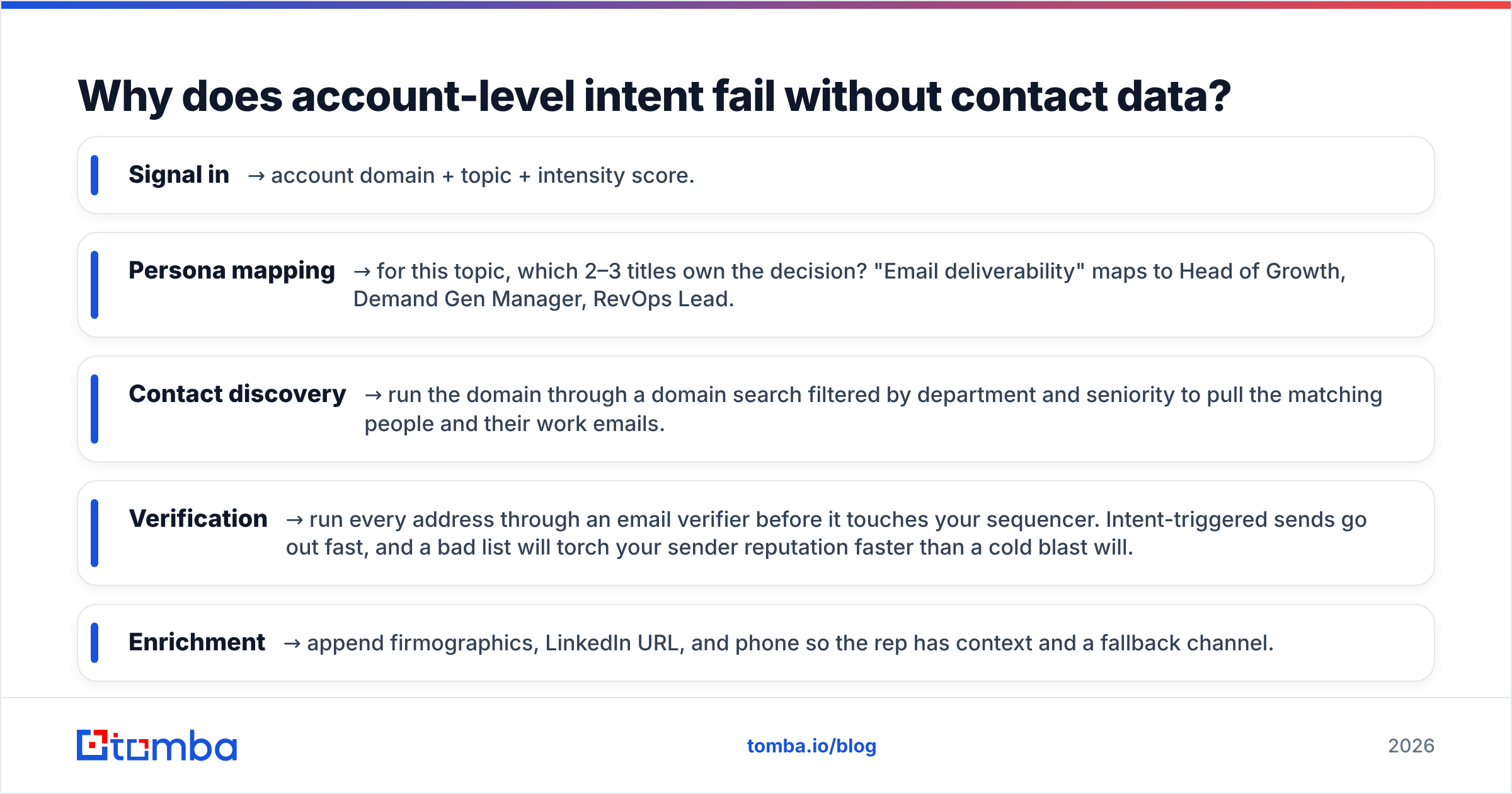
- Signal in → account domain + topic + intensity score.
- Persona mapping → for this topic, which 2–3 titles own the decision? "Email deliverability" maps to Head of Growth, Demand Gen Manager, RevOps Lead.
- Contact discovery → run the domain through a domain search filtered by department and seniority to pull the matching people and their work emails.
- Verification → run every address through an email verifier before it touches your sequencer. Intent-triggered sends go out fast, and a bad list will torch your sender reputation faster than a cold blast will.
- Enrichment → append firmographics, LinkedIn URL, and phone so the rep has context and a fallback channel.
Teams that automate this via the Tomba API go from signal to sequenced contact in under a minute. Teams that do it manually average two to four days — by which point the surge has decayed and a competitor has already replied.
How do you score intent signals so reps trust them?#
A scoring model that nobody trusts is worse than no model, because it trains the team to ignore your alerts. Three dimensions, weighted:
Fit (0–40 points). Does the account match your ICP on size, industry, geography, and stack? An account with perfect intent and zero fit is noise. Kill it before scoring anything else.
Depth (0–35 points). How committed is the behavior? Ranked roughly: pricing page (35) > docs or integrations page (28) > comparison/alternatives page (25) > G2 category browse (20) > third-party topic surge (12) > blog post read (4).
Recency (0–25 points, decaying). Full points inside 72 hours, half at 14 days, zero past 30. Apply the decay nightly.
Anything over 70 is a same-day task. 50–70 goes into a nurture sequence. Under 50 stays in the database and waits for a second signal. Publish the formula to the sales team — the moment it is a black box, reps stop believing it.
One warning about third-party surge data specifically: vendors report relative lift against an account's own baseline, not absolute volume. A tiny company reading two articles can show a bigger "surge" than an enterprise reading two hundred. Always cross-reference surge with fit before routing.
Is third-party intent data worth buying in 2026?#
It depends entirely on your target account count.
Under 200 target accounts: no. You can monitor those accounts manually — set up alerts on their hiring pages, job posts, funding news, and LinkedIn activity, and combine with first-party reveal. Spending $40K on Bombora to watch 150 accounts is a poor trade.
200–2,000 accounts: maybe. This is where second-party review-site intent shines, because the intent is explicit rather than modeled. If you sell in a category with a mature G2 or Capterra presence, buy that before you buy co-op data.
Over 2,000 accounts, or running true ABM with a marketing team that can act on account-level signals: yes. Third-party co-op data at that scale is the only way to prioritize, and platforms like 6sense earn their price by modeling rather than just reporting.
The other consideration is privacy. Bidstream-derived intent has come under sustained regulatory pressure in the EU, and several vendors have quietly narrowed their EU coverage. If your ICP is European, assume third-party volume will be a fraction of what the sales deck implies, and weight your first-party collection accordingly. Forrester and Gartner have both flagged intent-data accuracy claims as an area where buyers should demand validation data before signing.
How do you build the collection stack step by step?#
A 30-day rollout that does not require a data engineer:
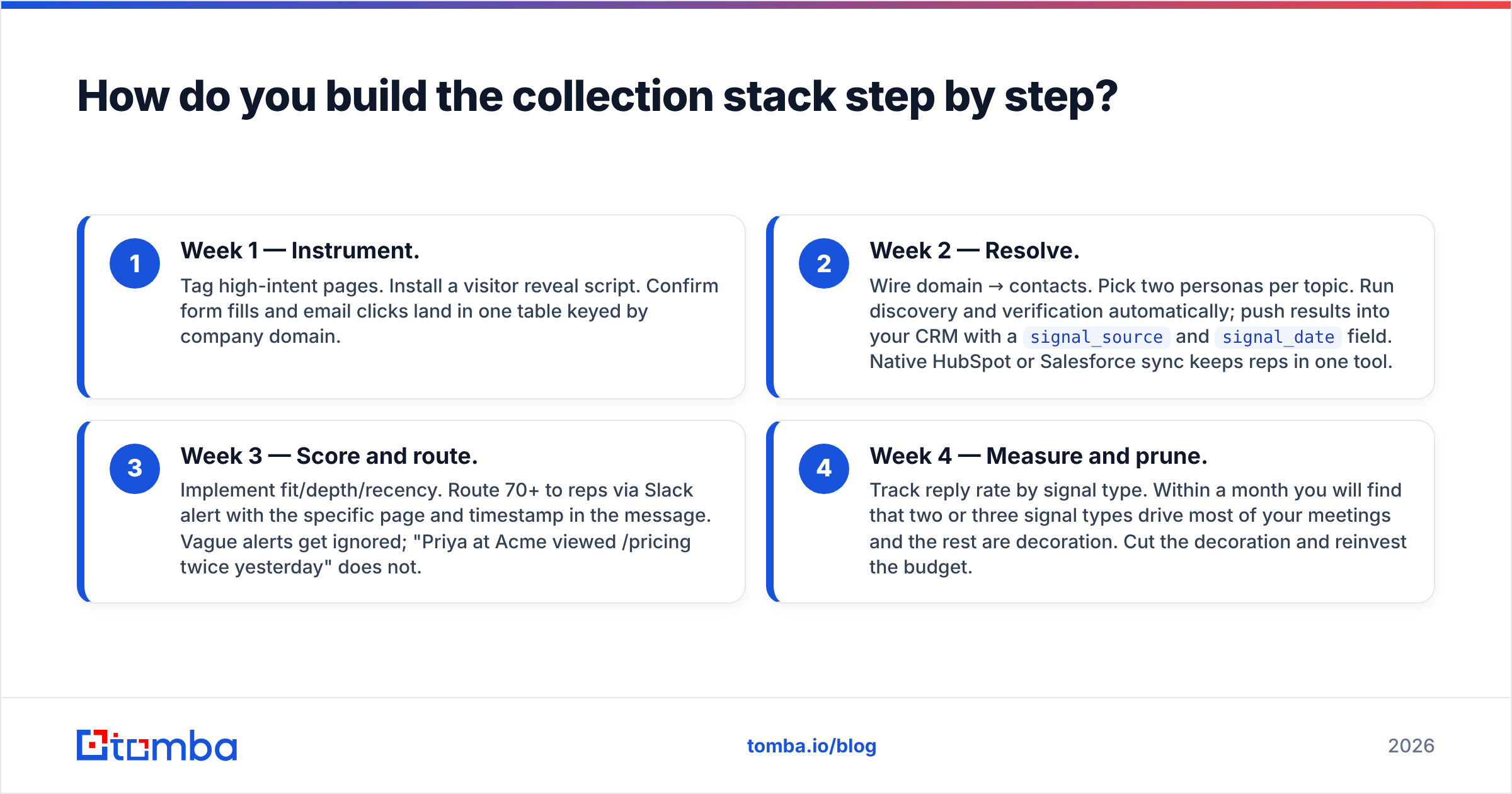
- Week 1 — Instrument. Tag high-intent pages. Install a visitor reveal script. Confirm form fills and email clicks land in one table keyed by company domain.
- Week 2 — Resolve. Wire domain → contacts. Pick two personas per topic. Run discovery and verification automatically; push results into your CRM with a
signal_sourceandsignal_datefield. Native HubSpot or Salesforce sync keeps reps in one tool. - Week 3 — Score and route. Implement fit/depth/recency. Route 70+ to reps via Slack alert with the specific page and timestamp in the message. Vague alerts get ignored; "Priya at Acme viewed /pricing twice yesterday" does not.
- Week 4 — Measure and prune. Track reply rate by signal type. Within a month you will find that two or three signal types drive most of your meetings and the rest are decoration. Cut the decoration and reinvest the budget.
The measurement step is the one everyone skips. Tag every sequenced contact with the signal that triggered it, then compare reply rates 60 days later. Most teams discover their expensive third-party feed underperforms a free pricing-page trigger by a factor of three or four.
What are the most common intent-data mistakes?#
Treating volume as validation. A vendor promising 40,000 surging accounts per month is promising you noise. Precision beats recall in outbound, always.
Skipping verification. Intent-triggered outreach is by definition fast and high-volume. Sending to unverified addresses at speed is the single fastest way to damage email deliverability. Verify every address, and check catch-all domains specifically with a catch-all verifier rather than guessing.
Referencing the signal in the email. Do not write "I saw you were researching data warehouses." It reads as surveillance and kills trust. Use the signal to decide who and when, then write about the problem, not the tracking.
Ignoring the negative signal. An account that visited your pricing page and then went quiet for six weeks is a different problem than one that never visited. Route them differently.
Buying before instrumenting. If you cannot answer "which pages did our last 10 closed-won accounts visit before they converted," you are not ready to buy third-party data. That answer is free and it is sitting in your analytics right now.
Turn intent signals into contacts you can email#
Every intent source in this post produces the same output: a company domain and a reason to reach out. The bottleneck is always the same — turning that domain into a named person with a verified work email before the signal decays.
That is what Tomba Email Finder does. Feed it the surging domain plus the persona you want, get back verified professional emails with confidence scores, and push them straight into your sequencer through the API or a native CRM integration. The free tier gives you 25 searches a month to test it against your existing signal feed; Starter is $49/mo and Growth is $99/mo, which is less than most teams spend on a single month of a third-party intent contract.
Instrument first, resolve second, buy third. In that order, intent data becomes a pipeline engine instead of a dashboard nobody opens.
Related guides#
// get started
Find, verify and enrich your first contacts today
Start on the free plan with 25 searches a month, then scale when your team is ready.
Free plan · No credit card required · GDPR & CCPA
// about the author