How to Conduct a Discovery Call That Actually Qualifies Buyers
Most discovery calls turn into demos in under six minutes. Here's a repeatable 30-minute framework, the question set that surfaces real pain, and the disqualification rules that protect your pipeline.
TL;DR
- A discovery call is a qualification conversation, not a mini-demo. The moment you share your screen in the first ten minutes, you have stopped learning and started pitching.
- Budget 30 minutes and split it roughly 5 / 20 / 5: frame the call, ask questions, agree on next steps. Talk-to-listen ratio should sit near 30/70.
- Your question set needs four layers — situation, problem, impact, and buying process. Skipping impact is why deals stall at "we decided to hold off."
- Disqualifying fast is a feature. A rep who runs 12 discovery calls and kills 7 outperforms one who advances all 12 into a bloated forecast.
- Pre-call research is the multiplier. Accurate contact data, verified titles, and a read on the company's tech stack let you skip the questions a five-minute web search should have answered.
What is a discovery call, exactly?#
A discovery call is the first substantive conversation between a seller and a prospect where the goal is to determine whether a real, funded, urgent problem exists — and whether your product is a credible fix for it.
Think of it like a doctor's intake appointment. A good doctor does not hand you a prescription 90 seconds after you sit down. They ask what hurts, how long it has hurt, what you have already tried, and what happens if it keeps hurting. Only then do they suggest treatment. Sellers who open with "let me walk you through our platform" are the equivalent of a doctor prescribing before the patient finishes their first sentence.
Three things separate discovery from every other call in your sales process:
- The output is a decision, not a demo. You leave with either a qualified next step or a clean disqualification. "They seemed interested" is not an output.
- You are diagnosing, not persuading. Persuasion happens later, once you know what actually matters to them.
- You are mapping the buying committee. Gartner's research on B2B buying groups has consistently found that a typical enterprise purchase involves six to ten decision makers. If you finish discovery knowing only one name, you have not finished discovery.
Why do most discovery calls fail?#
They fail for boring, fixable reasons. In call reviews across most B2B teams, the same five patterns show up again and again.
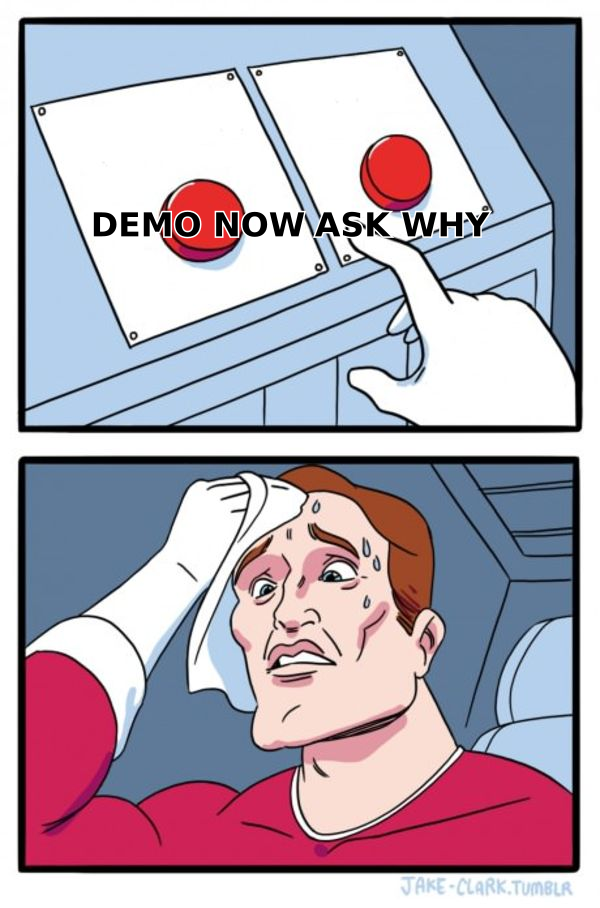
Failure mode 1 — the premature demo. The prospect asks "so what does it do?" at minute four, and the rep gratefully shares their screen. The call becomes a feature tour. The prospect leaves with product knowledge; the rep leaves with nothing.
Failure mode 2 — the interrogation. Twenty questions fired in sequence with no reaction, no summarizing, no follow-up. Prospects can tell when they are filling out a CRM form out loud.
Failure mode 3 — no impact layer. The rep learns what is broken but never quantifies what broken costs. Without a dollar figure or a job-risk figure, there is nothing to justify a budget request internally.
Failure mode 4 — happy ears. Any positive signal gets logged as buying intent. "This is interesting" becomes a stage-two opportunity.
Failure mode 5 — bad prep. The rep burns eight of thirty minutes asking what the company does, how many employees it has, and who the prospect reports to. All of that is public information.
How do you prepare for a discovery call?#
Preparation is where the call is won. Give yourself 10-15 minutes per call and collect five things:
- Company basics — headcount, funding stage, recent announcements, and any hiring signals. A company posting three SDR roles has a very different problem than one that just cut its marketing team.
- The person — verified title, tenure, prior companies, and what they post about publicly. Tenure under six months usually means they were hired to change something; ask what.
- Tech stack — what they already run tells you the integration questions and the likely incumbent you are displacing. A quick website tech stack check takes seconds.
- Contact accuracy — confirm the email and phone you have actually belong to that person at that company. Nothing kills momentum like a calendar invite bouncing.
- A working hypothesis — one sentence: "I think they are struggling with X because of Y." You will test it in the first five minutes and abandon it if wrong.
The contact-data layer matters more than reps admit. If your invite lands in a dead inbox, or you address the prospect by the wrong title, the call starts at a deficit. Running names through an email verifier before you book, and using data enrichment to fill in title, seniority, and department, removes a whole category of avoidable friction.
What should the discovery call structure look like?#
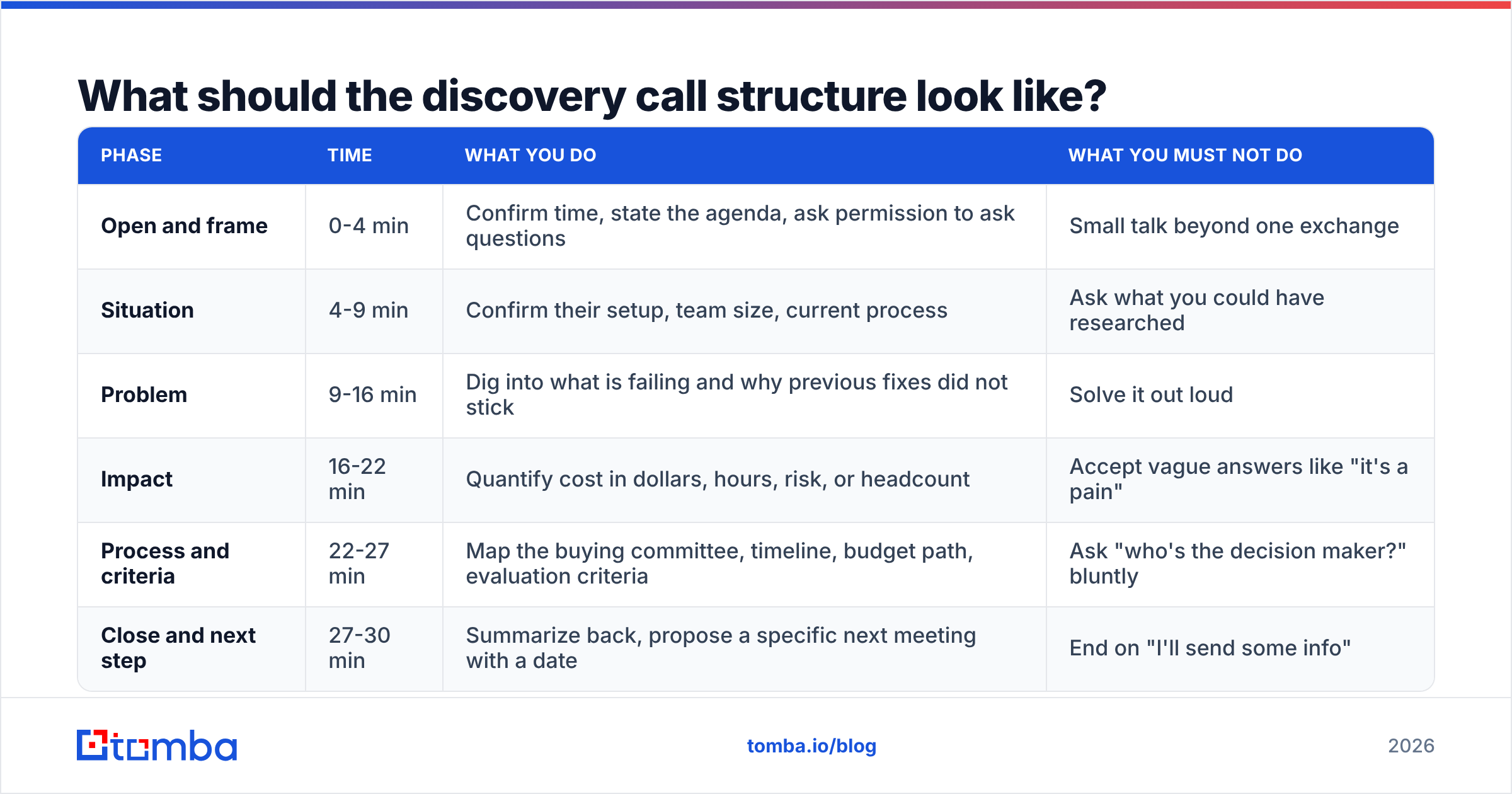
Here is a 30-minute structure that works across most B2B segments. Adjust the minute counts, not the sequence.
| Phase | Time | What you do | What you must NOT do |
|---|---|---|---|
| Open and frame | 0-4 min | Confirm time, state the agenda, ask permission to ask questions | Small talk beyond one exchange |
| Situation | 4-9 min | Confirm their setup, team size, current process | Ask what you could have researched |
| Problem | 9-16 min | Dig into what is failing and why previous fixes did not stick | Solve it out loud |
| Impact | 16-22 min | Quantify cost in dollars, hours, risk, or headcount | Accept vague answers like "it's a pain" |
| Process and criteria | 22-27 min | Map the buying committee, timeline, budget path, evaluation criteria | Ask "who's the decision maker?" bluntly |
| Close and next step | 27-30 min | Summarize back, propose a specific next meeting with a date | End on "I'll send some info" |
The framing step is underrated. Say something like: "I've got 30 minutes. My plan is to spend most of it understanding how your team handles [X] today, and if it looks like we can help, I'll show you exactly the part that's relevant — not a generic tour. Does that work?" You have just bought yourself permission to ask questions for twenty straight minutes and pre-empted the premature demo request.
What questions should you ask on a discovery call?#
Organize your questions by layer, not by topic. Each layer earns you the right to the next one.
Layer 1 — Situation (confirm, don't excavate). You researched this; you are validating.
- "I saw you're running [tool]. Is that handling the whole workflow or just part of it?"
- "How many people touch this process day to day?"
Layer 2 — Problem (where it breaks).
- "Walk me through the last time this went wrong. What happened?"
- "What have you already tried to fix it? Why didn't that stick?"
- "If nothing changes in the next two quarters, what does that look like?"
Layer 3 — Impact (make it numeric).
- "Roughly how many hours a week does that cost the team?"
- "What's the revenue attached to the deals that slip because of this?"
- "Who else feels it when this breaks — does it reach your VP?"
Layer 4 — Process (how a purchase actually happens here).
- "The last time your team bought something in this category, what did the process look like?"
- "Besides you, who would need to be comfortable with this before it moves?"
- "Is there budget already allocated, or would this need to be requested?"
Two techniques multiply the value of every question above. The first is the double-click: whatever answer you get, ask "what do you mean by that?" or "tell me more about that part" exactly once. The surface answer is almost never the real one. The second is the summarize-back: at minute 20, say "let me make sure I have this right" and replay their situation in your own words. If you get it wrong, they will correct you — and the correction is usually the most valuable thing said on the call.
For a fuller list of framing patterns you can reuse in follow-up emails, HubSpot maintains a solid public library of discovery call questions worth stealing from.
How do you know when to disqualify?#
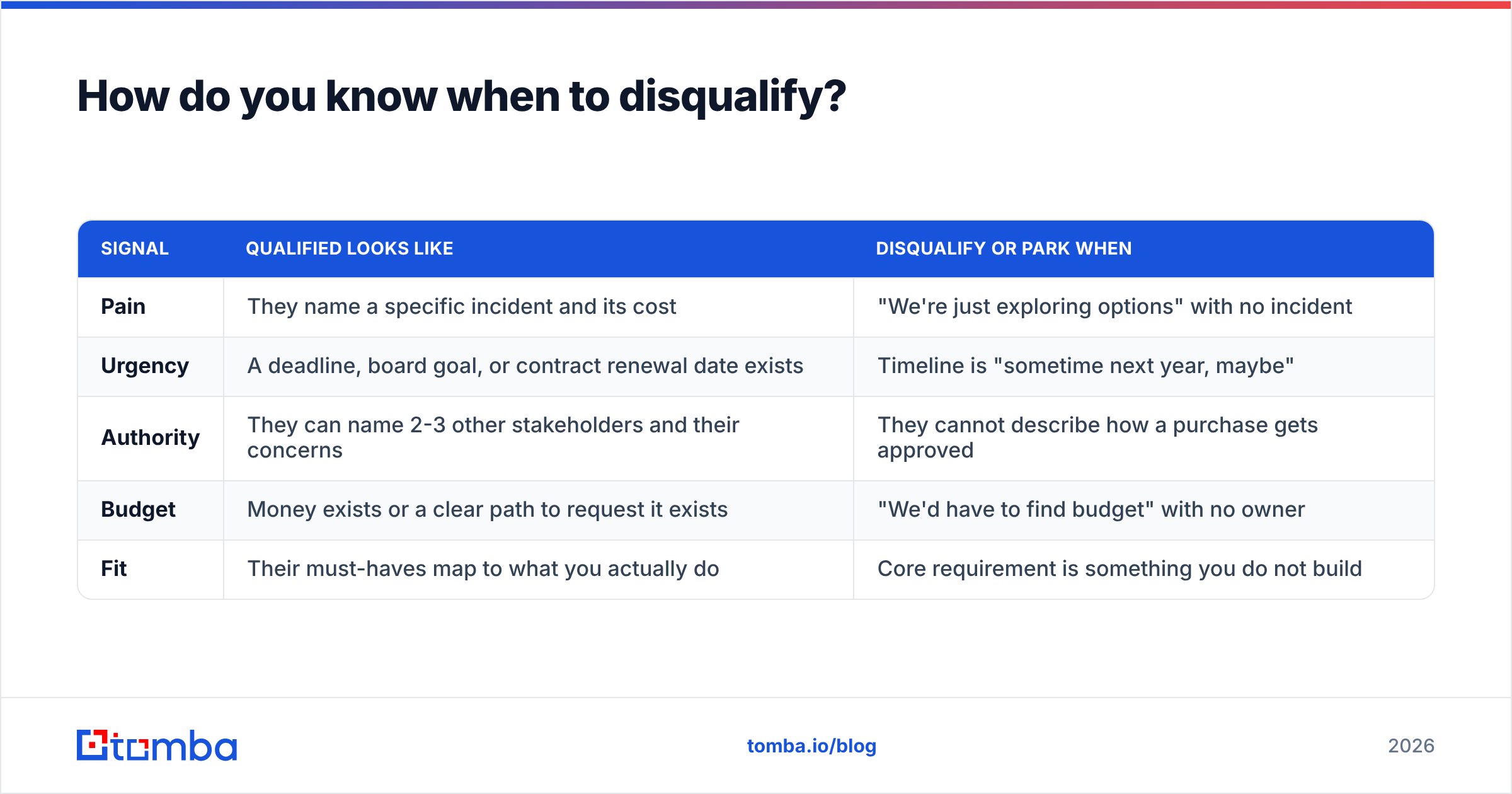
Fast disqualification is the highest-leverage habit in discovery. Every opportunity you advance without real pain consumes forecast credibility, SE hours, and your own attention.
| Signal | Qualified looks like | Disqualify or park when |
|---|---|---|
| Pain | They name a specific incident and its cost | "We're just exploring options" with no incident |
| Urgency | A deadline, board goal, or contract renewal date exists | Timeline is "sometime next year, maybe" |
| Authority | They can name 2-3 other stakeholders and their concerns | They cannot describe how a purchase gets approved |
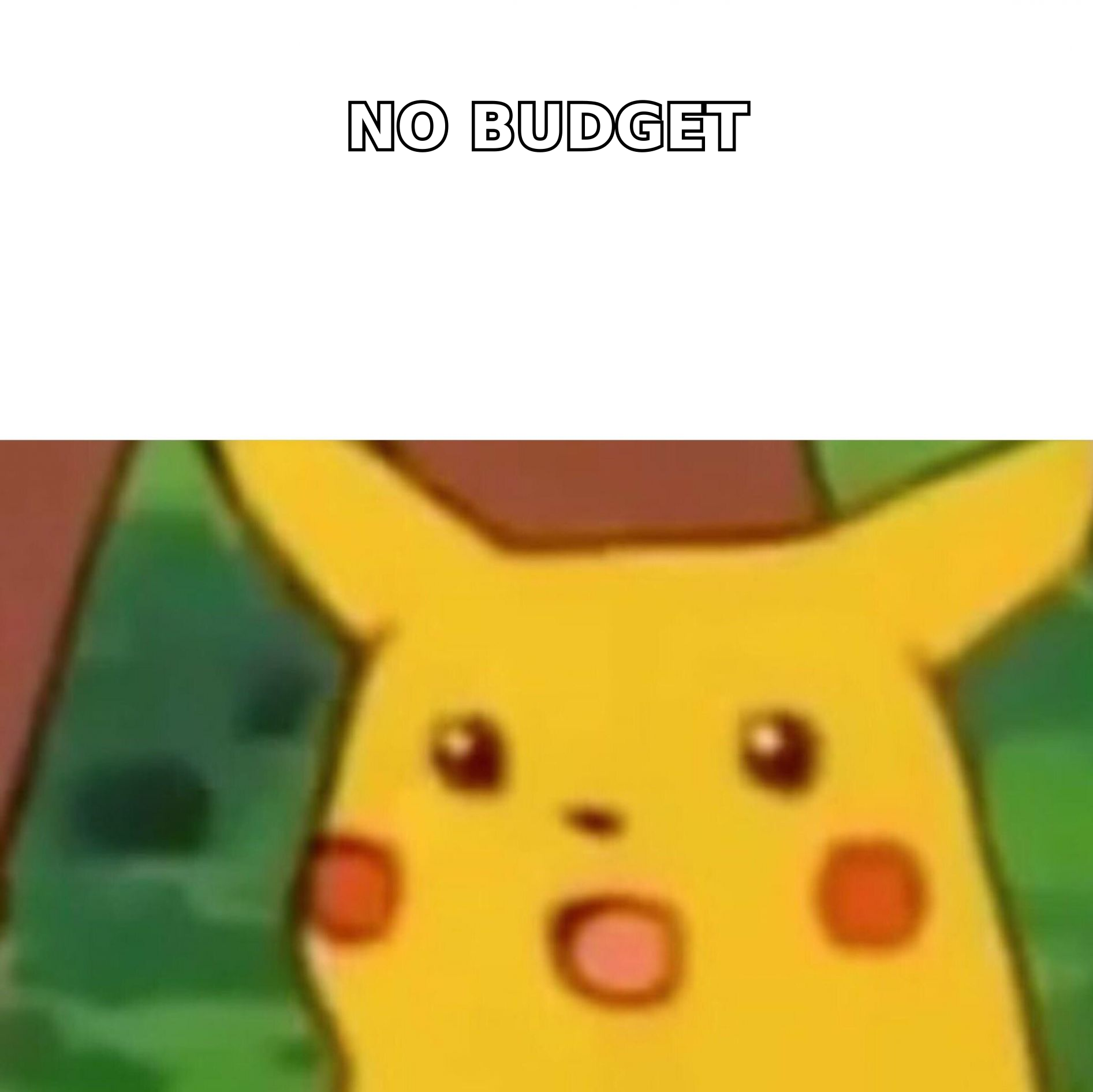
| Budget | Money exists or a clear path to request it exists | "We'd have to find budget" with no owner |
| Fit | Their must-haves map to what you actually do | Core requirement is something you do not build |
You do not need all five to advance — you need pain plus at least a path on the other four. Two clean misses is a park; three is a disqualification. Say it out loud on the call: "Based on what you've described, I don't think we're the right fit right now — here's what I'd do instead." Prospects remember the reps who told them the truth, and a surprising share of them come back.
What are the biggest discovery call mistakes to avoid?#
- Talking more than 40% of the time. Conversation-intelligence vendors like Gong have published call-analysis research repeatedly showing that top performers talk substantially less than average performers on discovery calls. Record your calls and check the ratio; the number is usually worse than you think.
- Asking "who is the decision maker?" It flatters no one and often gets a defensive answer. Ask about process instead — "how did the last purchase like this get approved?" — and the org chart falls out naturally.
- Accepting the first pain they name. The first answer is the rehearsed one. The third answer, after two double-clicks, is the real one.
- Pitching features during discovery. If you must address a direct product question, answer in one sentence and return to questions: "Yes, we do that — I'll show you exactly how at the end. Before that, tell me more about..."
- Ending without a calendared next step. "I'll follow up next week" is where deals go to die. Book the next meeting before you hang up, with named attendees.
- Not writing it down within ten minutes. Notes taken an hour later are reconstructions. Capture verbatim quotes, especially anything with a number in it — those quotes become your business case later.
How do you follow up after a discovery call?#
Send the recap within four hours, while the conversation is still fresh for both of you. A good recap has four parts and fits on one screen:
- What I heard — three bullets in their words, including the numbers they gave you.
- What I did not cover — one open question you still need answered. This creates a natural reason to reply.
- What happens next — the agreed date, the attendees, and what you will show.
- One artifact — a case study, a benchmark, or a short doc that matches their exact problem. Not a general brochure.
If the call surfaced additional stakeholders, this is the moment to find them. You will usually get a first name and a title and nothing else. A domain search on their company plus a quick verification pass turns "Priya on the RevOps side" into a real, deliverable address you can copy into the recap thread — which is far more effective than asking your champion to forward things and hoping they do.
Track the recap's fate honestly in your CRM. If the champion does not reply within three business days after a call they described as urgent, the urgency was not real. That is data, and it should change your forecast.
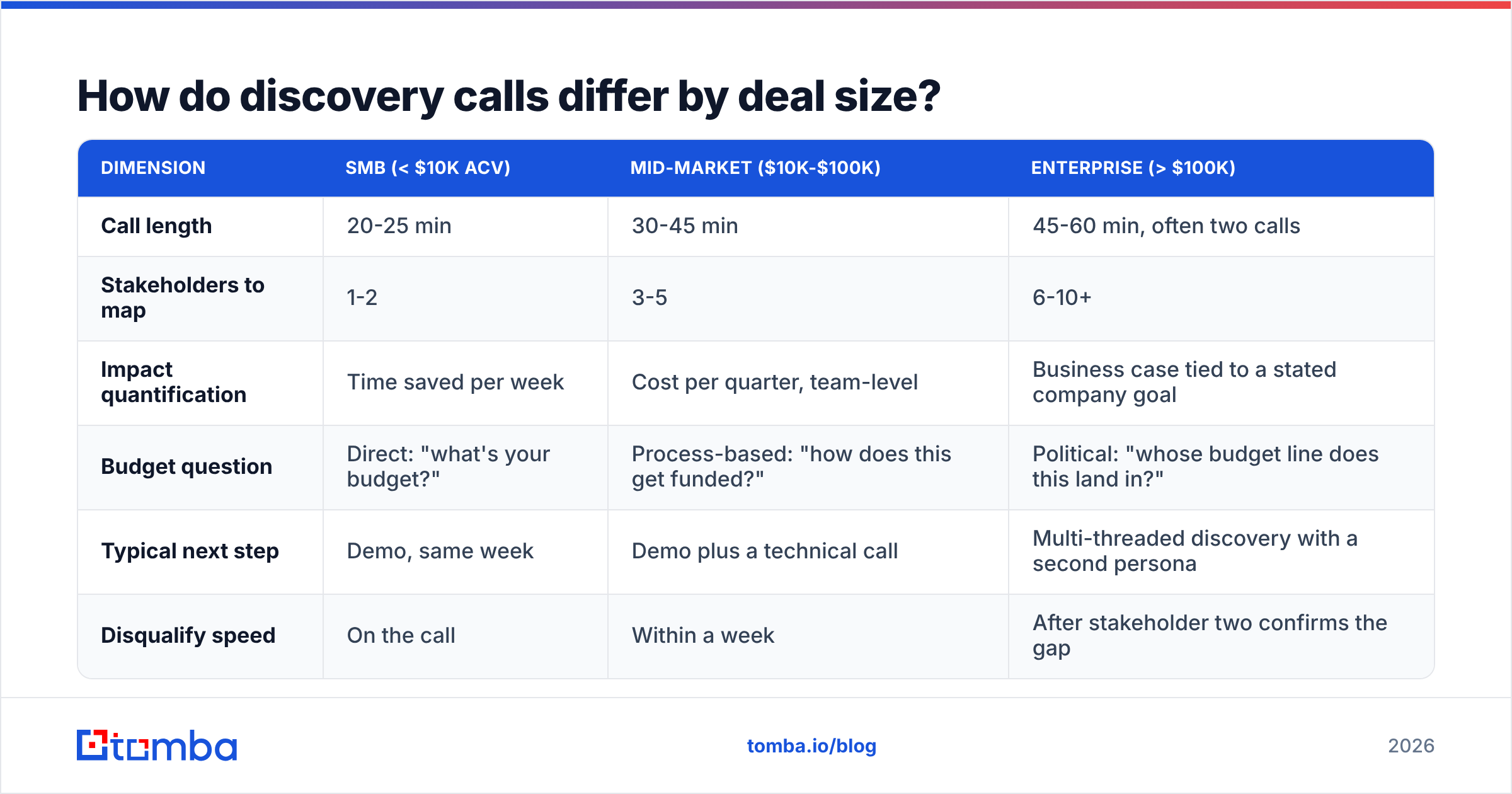
How do discovery calls differ by deal size?#
The framework holds, but the emphasis shifts.
| Dimension | SMB (< $10k ACV) | Mid-market ($10k-$100k) | Enterprise (> $100k) |
|---|---|---|---|
| Call length | 20-25 min | 30-45 min | 45-60 min, often two calls |
| Stakeholders to map | 1-2 | 3-5 | 6-10+ |
| Impact quantification | Time saved per week | Cost per quarter, team-level | Business case tied to a stated company goal |
| Budget question | Direct: "what's your budget?" | Process-based: "how does this get funded?" | Political: "whose budget line does this land in?" |
| Typical next step | Demo, same week | Demo plus a technical call | Multi-threaded discovery with a second persona |
| Disqualify speed | On the call | Within a week | After stakeholder two confirms the gap |
The most common mistake is running an SMB discovery call on an enterprise deal — one call, one contact, one demo booked — and then wondering why procurement appeared out of nowhere in month four.
What should you do next?#
Discovery is a skill you improve by review, not by reading. Pick three recorded calls from last month, count your talk time, and mark the exact minute you started pitching. Then rerun the same call structure on your next five conversations and compare.
The other half of the equation is who you get on the call in the first place. A perfect discovery framework applied to the wrong contact at the wrong company is still a wasted 30 minutes. Build your call list from verified, enriched contact data so that every conversation starts with the right person, at the right company, reachable at a working address.
Tomba's Email Finder does exactly that: find and verify professional email addresses by name, domain, or company, so the stakeholders you uncover during discovery become contactable the same afternoon. Start free with 25 searches a month, or move to the Starter plan at $49/mo when your pipeline outgrows it — full Tomba pricing is public, with Growth at $99/mo and Pro at $249/mo.
Related guides#
// get started
Find, verify and enrich your first contacts today
Start on the free plan with 25 searches a month, then scale when your team is ready.
Free plan · No credit card required · GDPR & CCPA
Get the Tomba newsletter
Product and data updates
// about the author