How To Convert Leads Into Customers: A 2026 Playbook
Most leads die between the form fill and the first real conversation. Here is the exact routing, scoring, and follow-up sequence that turns raw leads into closed-won revenue in 2026.
TL;DR
- Conversion is a routing and timing problem before it is a persuasion problem. Most leads are lost in the gap between form fill and first human contact.
- Respond in under five minutes. Contact rates fall off a cliff after the first hour, and by day two you are effectively cold-emailing your own inbound.
- Score leads on fit and behavior. Fit-only scoring floods your reps with ICP-matched tire-kickers; behavior-only scoring floods them with students and competitors.
- Six to eight touches across email, phone, and LinkedIn beats one perfect email. Most reps stop at two.
- Bad contact data silently caps everything. If 22% of your emails bounce and half your direct dials are wrong, no amount of messaging skill saves the funnel.
Why do most leads never become customers?#
Because nobody talks to them fast enough, and when someone does, the data is wrong.
Think of your funnel like a restaurant kitchen. Orders come in (leads), and every minute a ticket sits on the rail, the food gets colder. You can have the best chef in the city — if the ticket sits for six hours, the customer has left. Most conversion problems that get diagnosed as "our messaging isn't resonating" are actually tickets sitting on the rail.
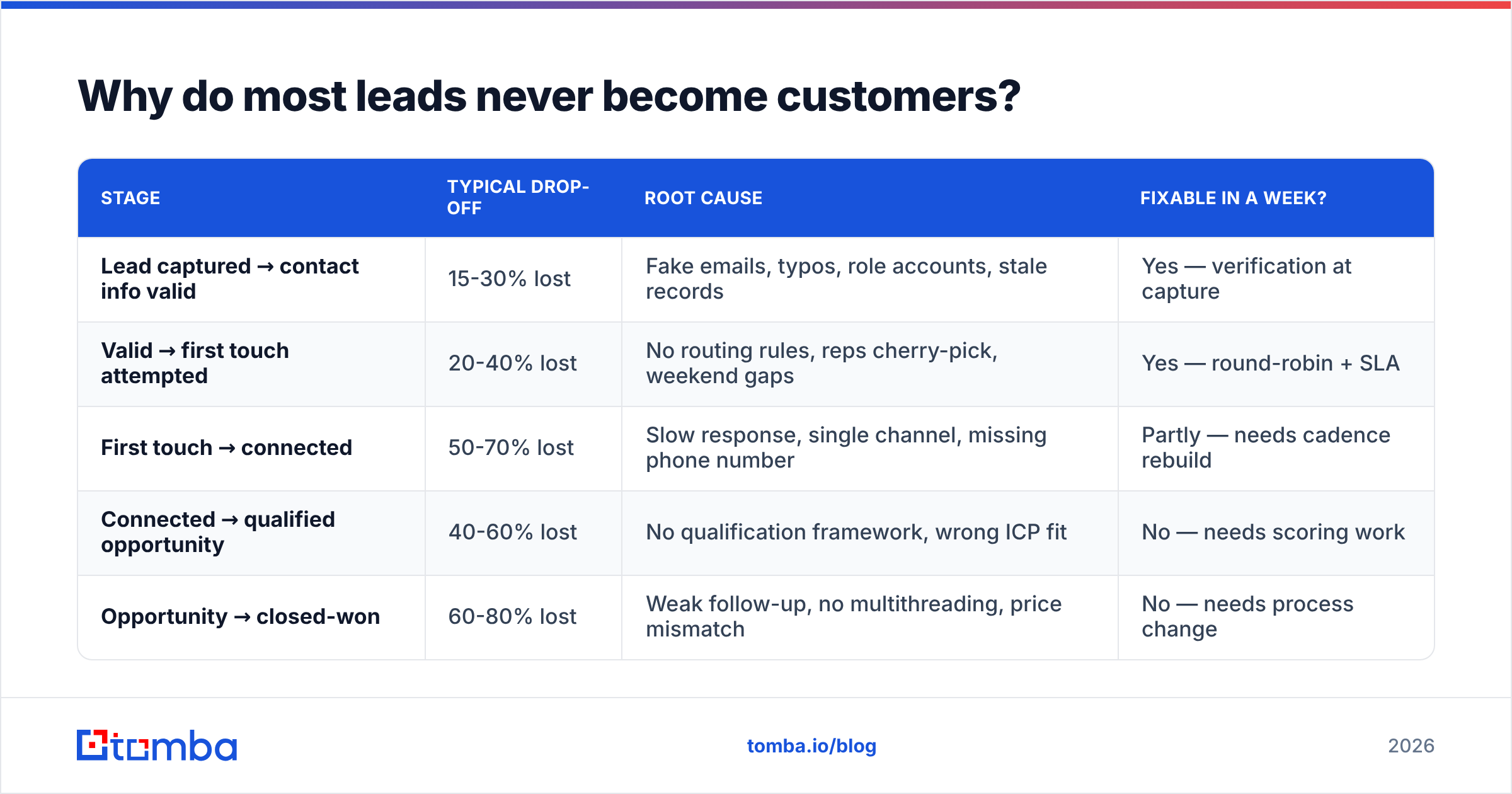
Here is the honest anatomy of the leak, from raw lead to closed-won:
| Stage | Typical drop-off | Root cause | Fixable in a week? |
|---|---|---|---|
| Lead captured → contact info valid | 15-30% lost | Fake emails, typos, role accounts, stale records | Yes — verification at capture |
| Valid → first touch attempted | 20-40% lost | No routing rules, reps cherry-pick, weekend gaps | Yes — round-robin + SLA |
| First touch → connected | 50-70% lost | Slow response, single channel, missing phone number | Partly — needs cadence rebuild |
| Connected → qualified opportunity | 40-60% lost | No qualification framework, wrong ICP fit | No — needs scoring work |
| Opportunity → closed-won | 60-80% lost | Weak follow-up, no multithreading, price mismatch | No — needs process change |
Multiply those out and a 1,000-lead month produces somewhere between 8 and 40 customers. The spread between those two numbers is not talent. It is operational hygiene.
What is lead conversion, exactly?#
Lead conversion is the process of moving a contact from "expressed some interest" to "signed a contract," measured as the percentage of leads that reach closed-won within a defined window.
Two clarifications that save arguments in pipeline meetings:
- Conversion rate needs a denominator you actually control. "Lead-to-customer" across all sources hides everything. A demo request converts at 20-30%; a whitepaper download converts at 1-3%. Averaging them produces a number that tells you nothing.
- Conversion rate needs a time window. If your sales cycle is 90 days, measuring this month's leads against this month's closed deals compares two unrelated cohorts. Use cohort-based measurement: leads created in March, closed by June.
Once you fix the measurement, the levers become obvious. There are exactly five, and they compound:
- Speed — how fast the first human touch happens after the trigger event.
- Data quality — whether the email lands and the phone rings the right person.
- Routing and scoring — whether the right rep gets the right lead with the right priority.
- Cadence depth — how many touches, across how many channels, over how many days.
- Qualification discipline — how fast you disqualify so you stop burning cycles.
How fast do you actually need to respond?#
Under five minutes for high-intent leads. Under one hour for everything else.
The research here is old but stubbornly consistent. The Harvard Business Review study on lead response found firms that contacted a prospect within an hour were roughly seven times more likely to qualify that lead than firms that waited even two hours — and sixty times more likely than firms that waited 24 hours or more. Nothing about buyer behavior since then has made people more patient.
What "speed to lead" actually requires operationally:
- A routing rule that never sleeps. Round-robin assignment with an on-call fallback. If a lead lands at 9pm Friday, it should be in someone's queue by Monday 8:01am at the latest, not Tuesday afternoon.
- An SLA with a visible timer. Reps respond to what is measured. Put a "minutes since assignment" column on the queue view.
- A phone number attached to the record. Email-only first touch cuts your connect rate roughly in half. If you're not enriching inbound leads with a direct dial, you're leaving your fastest channel unused. A phone finder run at the moment of capture solves this without adding a manual step.
- A pre-written first-touch template so the rep isn't composing from scratch at minute four.
The counterintuitive part: speed matters more for low-intent leads than high-intent ones. A demo request will tolerate a two-hour delay because their intent is durable. A content download's intent evaporates within the hour — they were curious, and curiosity has a short half-life.
How should you score and route leads?#
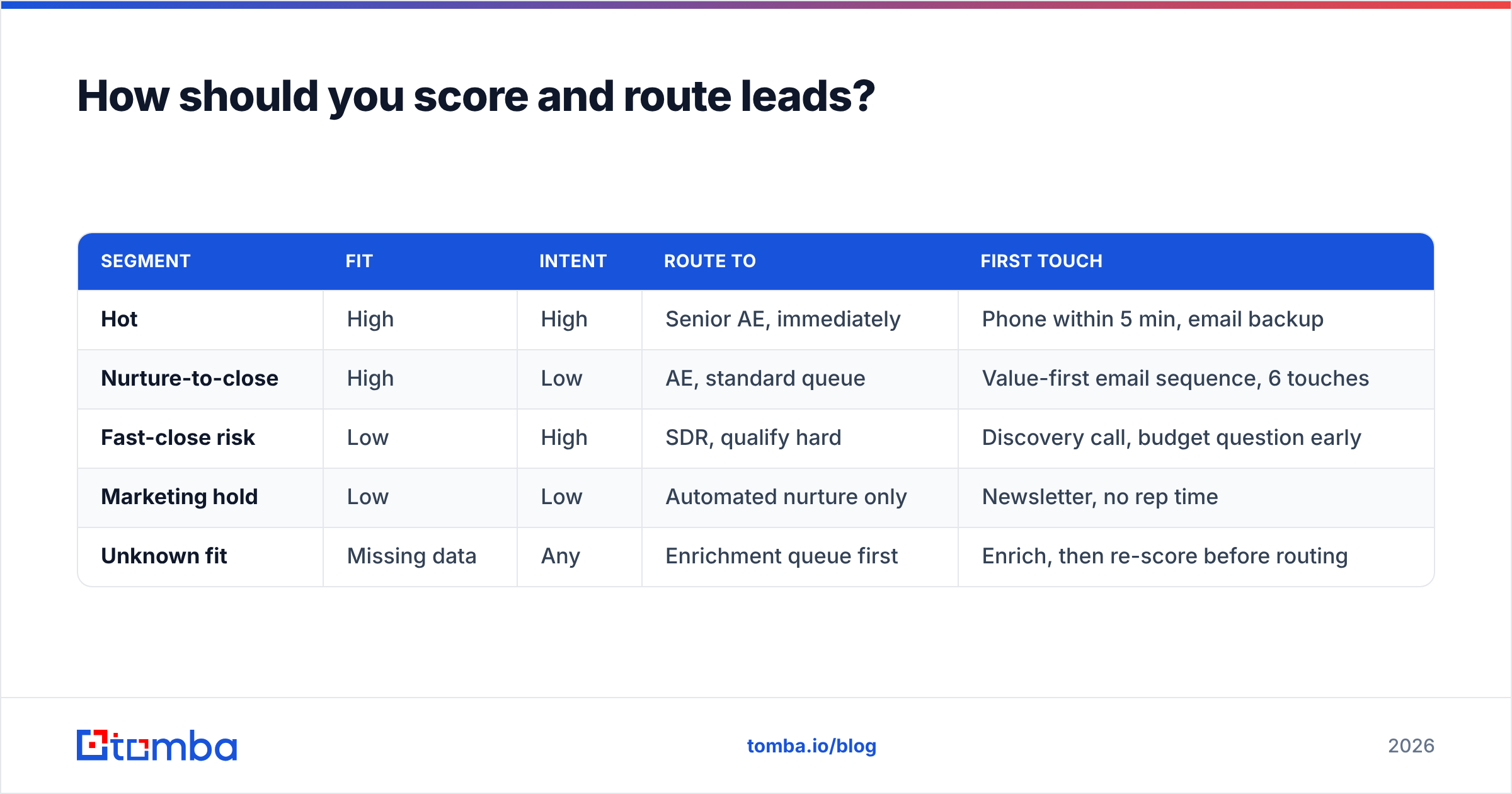
Score on two independent axes — fit and intent — and route on the combination, not on a single blended number.
Blended scores ("this lead is an 82") destroy information. A CTO at a perfect-fit company who downloaded one PDF and a student at a 5-person shop who visited pricing twelve times can both score 82. They need completely different treatment.
| Segment | Fit | Intent | Route to | First touch |
|---|---|---|---|---|
| Hot | High | High | Senior AE, immediately | Phone within 5 min, email backup |
| Nurture-to-close | High | Low | AE, standard queue | Value-first email sequence, 6 touches |
| Fast-close risk | Low | High | SDR, qualify hard | Discovery call, budget question early |
| Marketing hold | Low | Low | Automated nurture only | Newsletter, no rep time |
| Unknown fit | Missing data | Any | Enrichment queue first | Enrich, then re-score before routing |
That last row matters more than teams expect. A meaningful share of inbound leads arrive with a personal Gmail address, no company field, and a first name only. Routing those to a rep wastes the rep's time; discarding them wastes real demand. The correct move is enrichment: take what you have — an email, a domain, a LinkedIn URL — and resolve it into company, headcount, and role before scoring. A reverse email lookup on a personal address frequently surfaces the work identity behind it.
For the scoring model itself, keep it embarrassingly simple at first. Five fit attributes and five intent signals, each worth one point, thresholds at 3. Complex models built before you have conversion data are just formalized guesses. HubSpot's lead scoring documentation is a reasonable starting reference for the mechanics, but the attribute selection has to come from your own closed-won analysis. Pull your last 50 wins, find what they had in common, score for that.
Does your contact data quality actually change conversion?#
Yes, and it's the least glamorous lever with the largest multiplier.
Run the arithmetic. Say you have 1,000 leads a month and a 22% bounce rate on outbound emails — which is roughly what unverified B2B lists produce. That's 220 leads you never reached. If your downstream lead-to-customer rate is 4%, you just lost nine customers to bad strings of text. Fixing the bounce rate to 2% recovers eight of them, and costs less than one rep-day of effort.
Worse, bounces compound. Mailbox providers read a high bounce rate as a signal that you're sending to a purchased list, and your sender reputation degrades. Then the emails that were valid start landing in spam. One bad import can suppress conversion on clean records for weeks.
The hygiene checklist, in order of impact:
- Verify at capture, not at send. A real-time email verifier call on form submit catches typos while the prospect is still on the page and can be asked to correct them.
- Re-verify anything older than 90 days. B2B contact data decays at roughly 2-3% per month through job changes alone. A year-old list is a quarter wrong.
- Handle catch-all domains explicitly. Catch-all servers accept everything, so standard verification returns "unknown." Treat unknowns as a separate segment with their own send policy rather than dumping them into the main list.
- Deduplicate before routing. Two reps working the same account is how you lose deals you were winning.
- Enrich missing firmographics. You cannot score fit on fields you don't have.
If you're building the list rather than receiving it, this is where an email finder earns its keep — resolving a name plus a company domain into a verified, deliverable address rather than a guessed permutation that bounces.
What does a follow-up cadence that converts look like?#
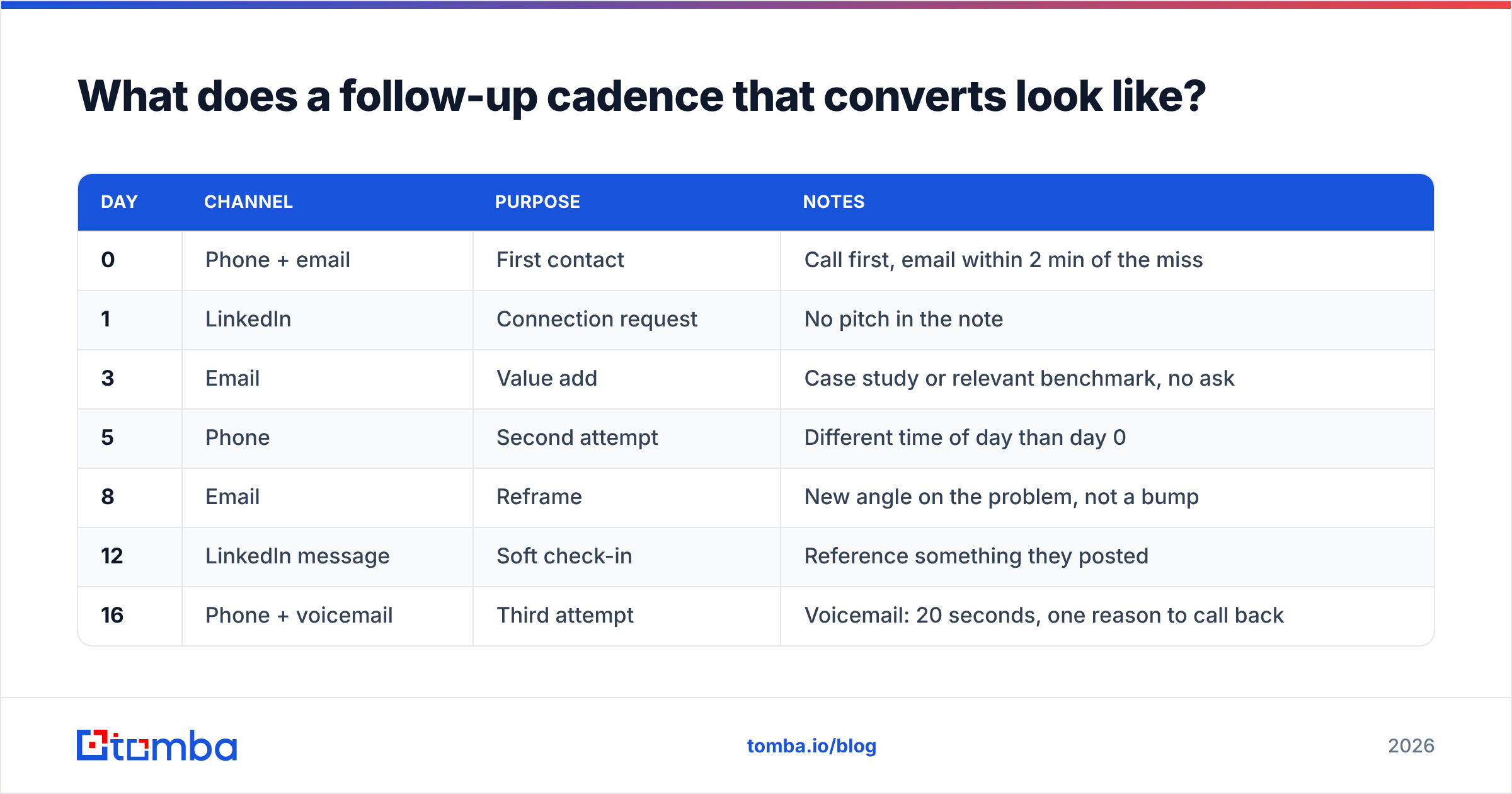
Six to eight touches across at least three channels, spread over 14-21 days, with the phone doing more work than most teams allow.
The single most common failure in B2B follow-up is stopping at touch two. Reply rates in most sequences peak somewhere between touches three and five — meaning the average rep quits immediately before the payoff. This is not a case for spamming; it is a case for finishing what you started.
A cadence that holds up across most B2B motions:
| Day | Channel | Purpose | Notes |
|---|---|---|---|
| 0 | Phone + email | First contact | Call first, email within 2 min of the miss |
| 1 | Connection request | No pitch in the note | |
| 3 | Value add | Case study or relevant benchmark, no ask | |
| 5 | Phone | Second attempt | Different time of day than day 0 |
| 8 | Reframe | New angle on the problem, not a bump | |
| 12 | LinkedIn message | Soft check-in | Reference something they posted |
| 16 | Phone + voicemail | Third attempt | Voicemail: 20 seconds, one reason to call back |
| 21 | Breakup | Explicit close-the-loop; often the best performer |
Three rules that matter more than the schedule:
- Vary the time of day. Calling at 10am four times proves only that they're busy at 10am.
- Every touch must carry new information. "Just bumping this to the top of your inbox" is not information. It is a request for free attention.
- Multithread by touch four. If the primary contact has gone dark, find a peer or their manager. Deals with three or more engaged contacts close at meaningfully higher rates than single-threaded ones. A domain search on the account surfaces the rest of the buying committee without waiting for an introduction that may never come.

How do you qualify without killing momentum?#
Disqualify fast, qualify slowly.
The instinct in most teams is the reverse: they qualify hard on the first call (budget, authority, need, timeline, all in twelve minutes) and then hang on to anything that survives. That produces a pipeline full of deals that pass a checklist but never close.
Invert it. On the first conversation, hunt for reasons to exit: no budget cycle within the horizon, a hard technical blocker, an incumbent contract with 20 months left. Those are cheap to find and expensive to ignore. Everything else stays in, and qualification deepens across subsequent conversations as you learn the account.
Practical version:
- Disqualify on the call — hard blockers only. Say so plainly and part on good terms; a "no, because X" from a real buyer is worth more than a vague maybe.
- Qualify on the second call — problem depth, current workaround cost, who else feels the pain.
- Qualify the process on the third — how they buy, who signs, what has to be true by when.
- Re-qualify at every stage change — a deal that stops moving is telling you something about qualification you missed earlier.
The metric to watch is not win rate in isolation. It's win rate combined with time-to-disqualify. A team with a 25% win rate that kills bad deals in eight days is outperforming a team with a 30% win rate that takes sixty.
Which tools actually move conversion?#
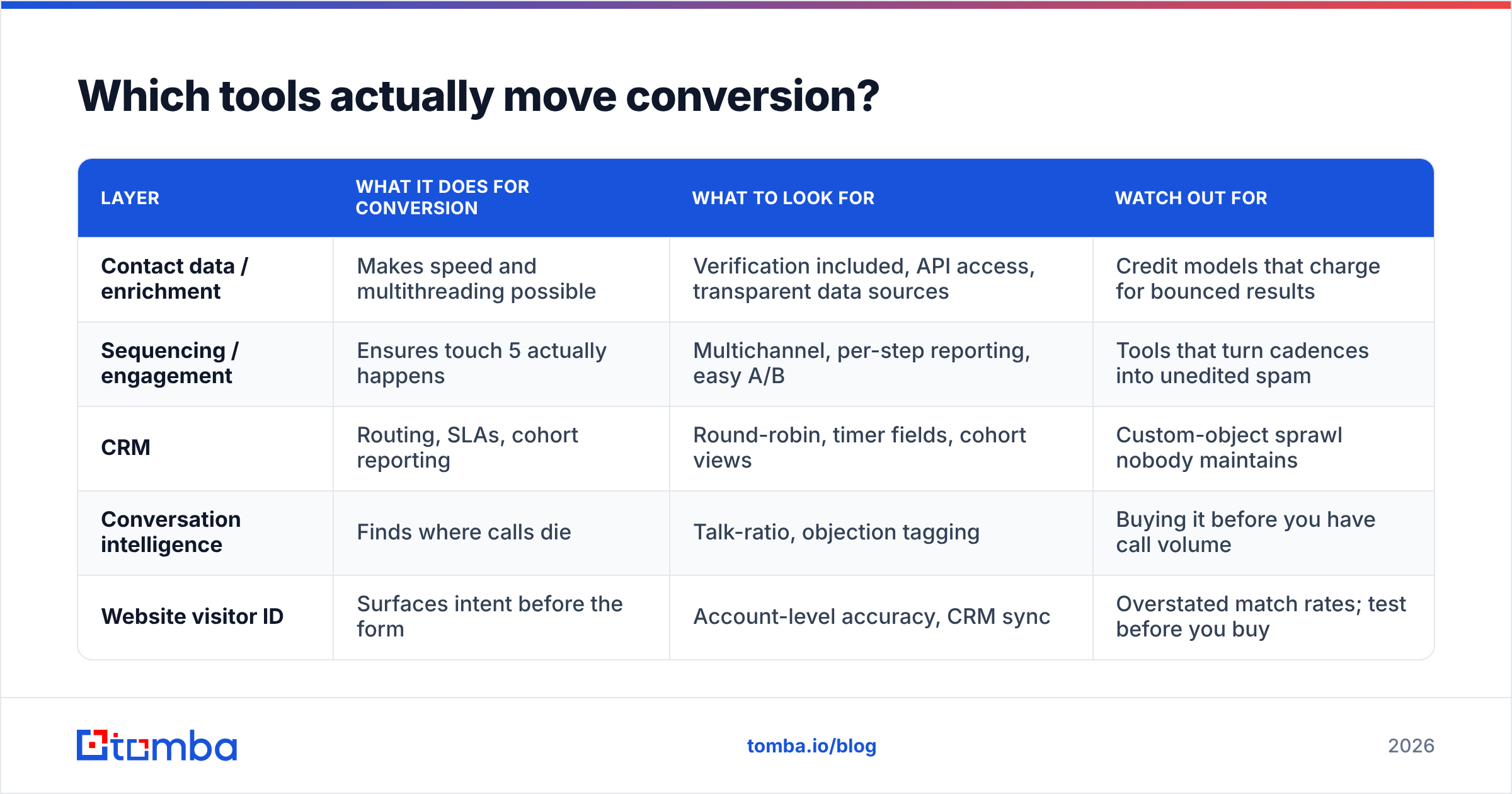
Fewer than the vendor landscape suggests. Three categories do the heavy lifting: contact data, sequencing, and CRM discipline.
| Layer | What it does for conversion | What to look for | Watch out for |
|---|---|---|---|
| Contact data / enrichment | Makes speed and multithreading possible | Verification included, API access, transparent data sources | Credit models that charge for bounced results |
| Sequencing / engagement | Ensures touch 5 actually happens | Multichannel, per-step reporting, easy A/B | Tools that turn cadences into unedited spam |
| CRM | Routing, SLAs, cohort reporting | Round-robin, timer fields, cohort views | Custom-object sprawl nobody maintains |
| Conversation intelligence | Finds where calls die | Talk-ratio, objection tagging | Buying it before you have call volume |
| Website visitor ID | Surfaces intent before the form | Account-level accuracy, CRM sync | Overstated match rates; test before you buy |
On the data layer specifically, the market splits between database-first vendors — BookYourData and similar prebuilt-list providers, which are strong when you want volume in a known segment — and search-and-verify tools like Tomba, which resolve specific people at specific companies on demand. Both are legitimate; they solve different problems. If you know the account list, search-and-verify wins on precision and cost. If you're building a segment from scratch, a curated database gets you moving faster. Plenty of teams run both, and G2's category listings are a reasonable place to sanity-check current user reviews before committing.
What doesn't move conversion, despite the pitch: another dashboard, an AI SDR replacing your follow-up entirely, or a lead-scoring model with 40 variables built before you have 100 closed-won deals to train it on.
What should you measure weekly?#
Six numbers. If you can't recite them, you can't improve conversion.
- Median speed-to-first-touch — in minutes, not hours, and use median rather than mean so one weekend outlier doesn't hide the pattern.
- Contact rate — percentage of assigned leads reached by a human. Below 30% means a data or cadence problem, not a messaging one.
- Touches per lead before disposition — if the average is under four, your reps are quitting early.
- Bounce rate on outbound — above 5% and you have a data hygiene emergency, not a nuisance.
- Lead-to-opportunity rate, by source — never blended.
- Cohort lead-to-customer rate — leads created in month N, closed by month N+cycle-length.
Review them by source and by rep. Conversion problems are almost never uniform; they cluster in one channel or one person's queue, and the blended number hides exactly the thing you need to see.
Where should you start this week?#
Pick the leak with the shortest fix time, not the biggest number. In practice that ordering is nearly always:
- Day 1 — Measure current speed-to-lead. Most teams are shocked; the number is usually measured in hours.
- Day 2 — Verify your existing lead database. Bounce rate tells you how much of your "pipeline" is fictional.
- Day 3 — Set a routing rule and an SLA timer. No new software required in most CRMs.
- Days 4-5 — Rebuild one cadence from two touches to seven, and enrich the segment with phone numbers.
- Week 2 — Rebuild scoring on the fit/intent grid, using your last 50 closed-won deals as the training set.
None of this is clever. It is the unglamorous operational work that separates funnels converting at 2% from funnels converting at 12% on identical traffic.
Start with the data layer, because everything else depends on it. If your leads arrive with missing emails, no phone numbers, and half-filled company fields, no cadence or scoring model will rescue them. Tomba's Email Finder resolves names and domains into verified, deliverable addresses — with verification built in so bounces get caught before they hit your sender reputation. The free tier gives you 25 searches a month to test against your own list; paid plans start at $49/mo, and full Tomba pricing scales to Growth at $99/mo and Pro at $249/mo when you're ready to run it across the whole funnel. Test it on your last 100 unconverted leads and see how many were simply never reachable.
Related guides#
Ready to find emails that actually work?
Join 150,000+ professionals who stopped guessing and started sending. Free credits on signup — no credit card required.
Get the Tomba newsletter
Practical outbound tactics and product updates — once every two weeks.
About the author