How to Convert Prospects Into Customers: A 2026 Playbook
Most prospects don't say no — they go quiet. Here's the step-by-step system for turning cold contacts into paying customers, with the qualification, timing, and follow-up rules that actually move deals.
TL;DR
- Conversion is not a closing problem. It's a qualification, data quality, and timing problem that shows up at the close.
- The average B2B deal needs 5-8 touches, but 44% of reps stop after one. Your follow-up cadence is probably your biggest single lever.
- Bad contact data kills conversion before the pitch starts. A 25% bounce rate means a quarter of your pipeline never existed.
- Score prospects on fit and intent before you invest rep time — a small qualified list beats a big cold one every time.
- The seven-step system below (research → verify → qualify → open → diagnose → prove → close) is what separates a 2% reply rate from a 12% one.
What Does "Converting a Prospect" Actually Mean?#
A prospect is a lead that has passed a fit check. A customer is a prospect who has said yes and paid. Everything between those two states is the conversion process — and most teams treat it as a single leap instead of a sequence of small yeses.
Think of it like a restaurant reservation. A lead is someone who walked past your window. A prospect is someone who read the menu. A customer is someone who sat down and ordered. You don't convert the window-walker directly into a diner — you get them to read the menu first, then ask if they'd like a table.
That framing matters because it changes what you measure. If your close rate is bad, the fix is rarely "better closing lines." It's usually further upstream: you were talking to the wrong person, at the wrong company, at the wrong moment, with an email address that didn't resolve.
Here's the stage model most B2B teams should be running:
- Raw lead — a name, a company, maybe a domain. No fit assessment yet.
- Verified contact — you have a deliverable email and confirmed role. This step alone protects your sender reputation.
- Qualified prospect — the company matches your ICP on size, industry, and tech stack, and the person can influence a purchase.
- Engaged prospect — they replied, booked a call, or clicked something meaningful. You now have a two-way conversation.
- Opportunity — a named problem, a rough budget, and a timeline exist.
- Customer — signed and paid.
Most "conversion problems" are actually a leak between stages 2 and 3. Teams push raw leads straight into sequences and then blame the copy.
Why Do Most Prospects Never Convert?#
Four causes account for the majority of lost deals, and only one of them is about salesmanship.
Bad data. If 20-30% of your list bounces, you're not just losing those contacts — you're damaging deliverability for the good ones. Mailbox providers treat high bounce rates as a spam signal, and once your domain reputation drops, even your perfectly-written emails to real prospects land in spam. Running every list through an email verifier before send is the cheapest conversion fix available.
No qualification. Reps spend equal effort on a 12-person startup with no budget and a 400-person company actively evaluating vendors. HubSpot's research on sales qualification frameworks consistently shows that time reallocation — not more activity — drives the biggest win-rate gains.
Premature pitching. The first email asks for 30 minutes. The prospect has no idea what problem you solve for someone like them. Ask for the meeting on touch four, not touch one.
Giving up too early. This is the big one. Most reps send one or two emails and mark the prospect dead. Deals that close often do so on the fifth, sixth, or eighth touch — long after the average rep has moved on.
How Do You Qualify Prospects Before You Spend Rep Time?#
Qualification is a filter, not a form. The goal is to spend 80% of your selling time on the 20% of prospects who can actually buy.
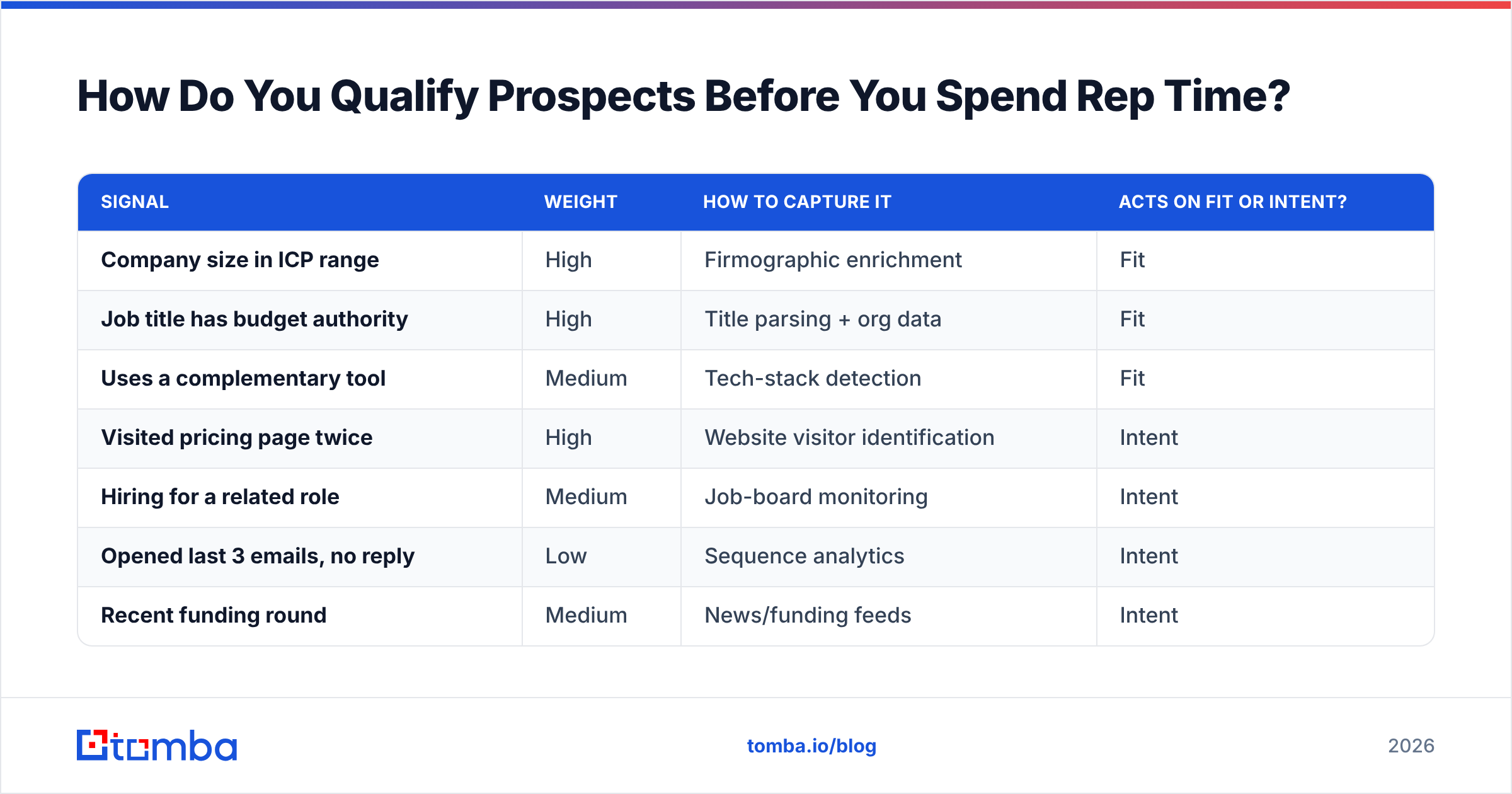
Use a two-axis score: fit (do they look like your best customers?) and intent (are they showing buying behavior right now?).
| Signal | Weight | How to capture it | Acts on fit or intent? |
|---|---|---|---|
| Company size in ICP range | High | Firmographic enrichment | Fit |
| Job title has budget authority | High | Title parsing + org data | Fit |
| Uses a complementary tool | Medium | Tech-stack detection | Fit |
| Visited pricing page twice | High | Website visitor identification | Intent |
| Hiring for a related role | Medium | Job-board monitoring | Intent |
| Opened last 3 emails, no reply | Low | Sequence analytics | Intent |
| Recent funding round | Medium | News/funding feeds | Intent |
Score each prospect 0-10 on both axes. High fit + high intent goes to a rep today. High fit + low intent goes into a nurture track. Low fit gets removed — not "saved for later," removed. Keeping dead weight in your CRM inflates your pipeline and destroys your forecast accuracy.
For the enrichment side of this, contact enrichment fills in firmographics and role data automatically so your score isn't built on guesses. For intent, website visitor reveal tells you which companies are already researching you — those are the warmest prospects you will ever get, and most teams never look at them.
What Is the 7-Step System to Convert Prospects Into Customers?#
This is the operational sequence. Each step has an exit condition — don't advance until it's met.
Step 1 — Build the list from a definition, not a hunch. Write down your ICP in one sentence with hard numbers: "SaaS companies, 50-500 employees, US/EU, using HubSpot, with a named RevOps role." Then source contacts against it. A domain search across your target account list gives you every discoverable contact at those companies with role and department attached, which is faster than scraping LinkedIn one profile at a time.
Step 2 — Verify every address before it enters a sequence. Aim for a bounce rate under 2%. Anything above 5% and you're actively burning your domain. Catch-all domains need special handling — a standard verifier returns "unknown," so use a catch-all verifier to separate the genuinely risky from the safely mailable.
Step 3 — Score and segment. Apply the fit/intent matrix above. Split into three tracks: rep-led (high/high), sequence-led (high fit, low intent), and nurture (everything else worth keeping).
Step 4 — Open with relevance, not with your product. The first email's only job is to earn a reply. Reference something specific and verifiable: a job posting, a recent launch, a tool in their stack. Two sentences of context, one question, no attachment, no calendar link. Your email response rate will tell you within 200 sends whether the angle works.
Step 5 — Diagnose before you prescribe. On the first call, spend 70% of the time asking. What's the current process? What does it cost them in hours or dollars? What have they already tried? A prospect who articulates their own problem out loud converts at a dramatically higher rate than one who is told what their problem is.
Step 6 — Prove it with their numbers, not yours. Generic case studies convert poorly. Take the numbers they gave you in step 5 and build a one-slide before/after. "You said 12 hours a week on list building. Here's that at 90 minutes." That's a proof point they can defend internally.
Step 7 — Close with a decision, not a discount. Ask for a specific next action with a date attached. If the answer is no, get the reason — that reason is the most valuable data in your funnel, because it tells you which upstream step is leaking.
Which Follow-Up Cadence Actually Converts?#
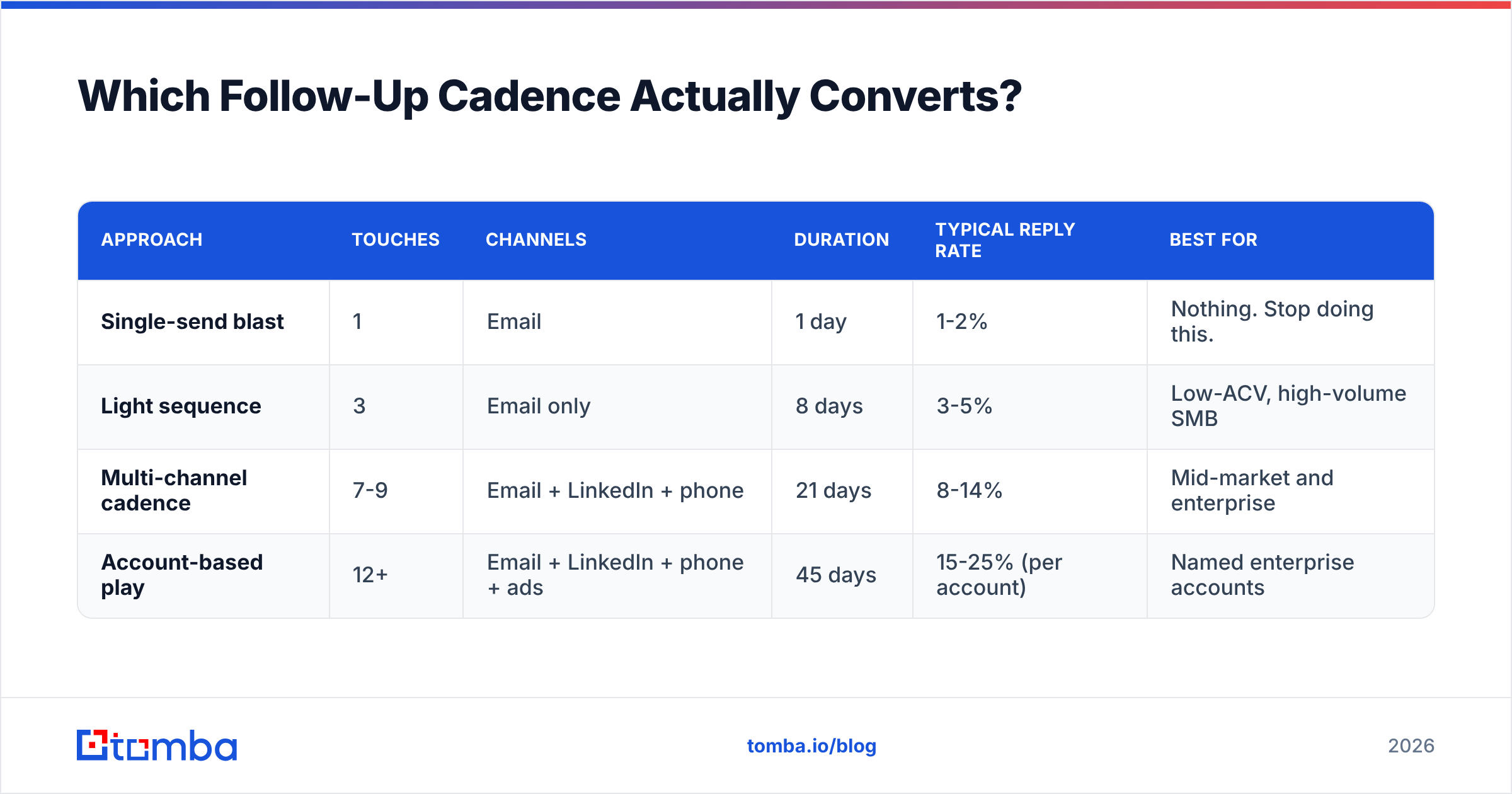
Cadence is where most of the money is. Below is a comparison of three common approaches and what they realistically produce on a clean, verified 500-contact list.
| Approach | Touches | Channels | Duration | Typical reply rate | Best for |
|---|---|---|---|---|---|
| Single-send blast | 1 | 1 day | 1-2% | Nothing. Stop doing this. | |
| Light sequence | 3 | Email only | 8 days | 3-5% | Low-ACV, high-volume SMB |
| Multi-channel cadence | 7-9 | Email + LinkedIn + phone | 21 days | 8-14% | Mid-market and enterprise |
| Account-based play | 12+ | Email + LinkedIn + phone + ads | 45 days | 15-25% (per account) | Named enterprise accounts |
The multi-channel cadence is the sweet spot for most B2B teams. A workable 21-day shape:
- Day 1 — Email 1: relevance opener, one question
- Day 3 — LinkedIn connect, no pitch in the note
- Day 5 — Email 2: short case reference, still no calendar link
- Day 8 — Phone call, voicemail if no answer
- Day 11 — Email 3: the ask, with a specific time proposal
- Day 15 — LinkedIn message referencing the email thread
- Day 21 — Break-up email: "closing the loop, should I check back in Q3?"
The break-up email routinely outperforms every other message in the sequence. It removes pressure and triggers a response from people who were interested but busy.
For the phone leg, you need numbers that connect. A phone finder paired with validation stops reps from burning an afternoon on disconnected lines.
How Do You Know Which Step Is Leaking?#
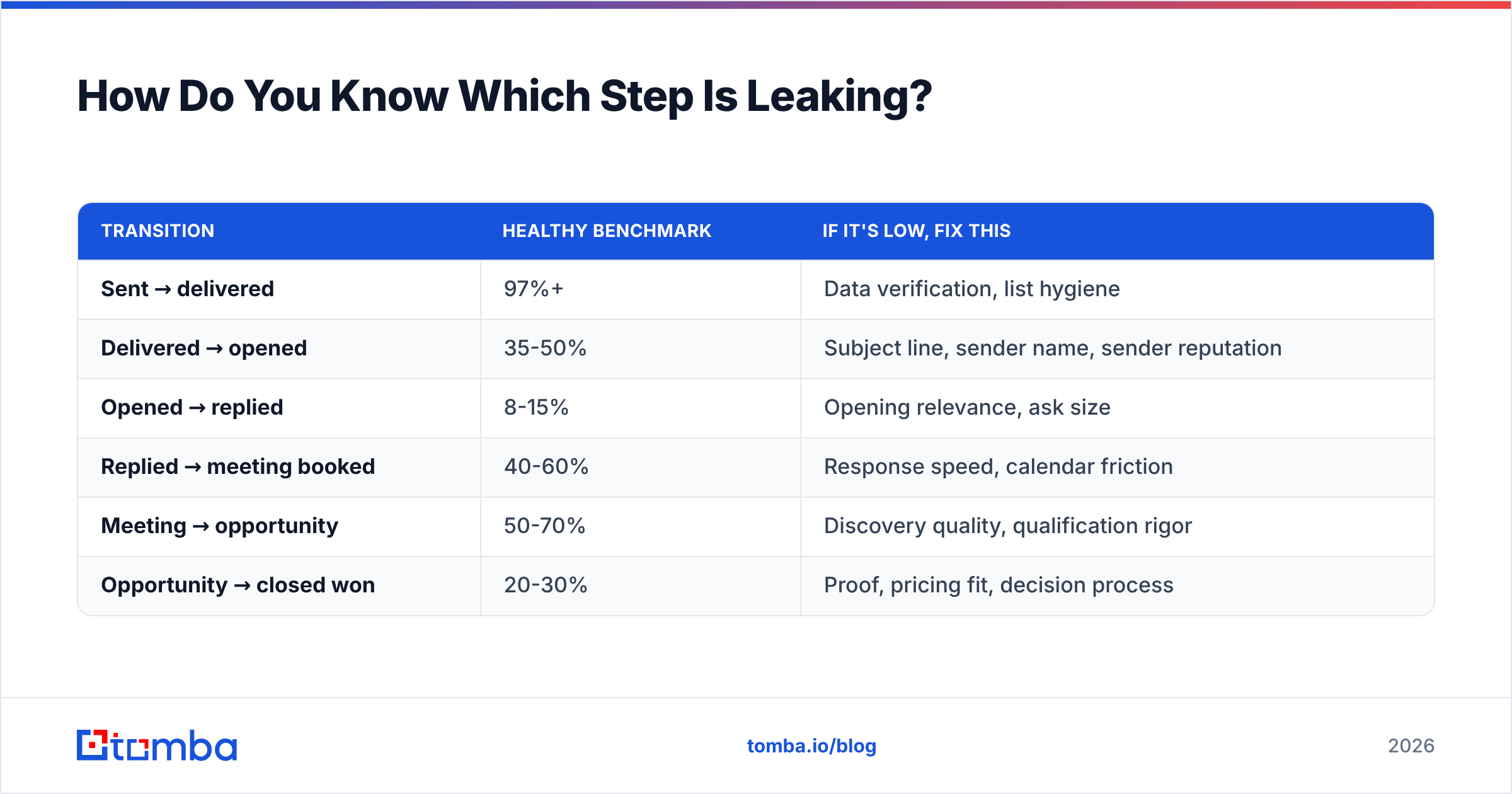
Instrument each transition and look at the ratio, not the absolute number.
| Transition | Healthy benchmark | If it's low, fix this |
|---|---|---|
| Sent → delivered | 97%+ | Data verification, list hygiene |
| Delivered → opened | 35-50% | Subject line, sender name, sender reputation |
| Opened → replied | 8-15% | Opening relevance, ask size |
| Replied → meeting booked | 40-60% | Response speed, calendar friction |
| Meeting → opportunity | 50-70% | Discovery quality, qualification rigor |
| Opportunity → closed won | 20-30% | Proof, pricing fit, decision process |
Diagnose from the top down. There's no point optimizing your discovery call script if 30% of your emails never arrive. Deliverability sits upstream of everything, and email deliverability problems disguise themselves as messaging problems all the time.
One practical rule: if opened-to-replied is under 5% but delivered-to-opened is healthy, your targeting is fine and your copy is the problem. If delivered-to-opened is under 25%, your data or your sender reputation is the problem and no amount of rewriting will save you.
What Tools Do You Need for Each Stage?#
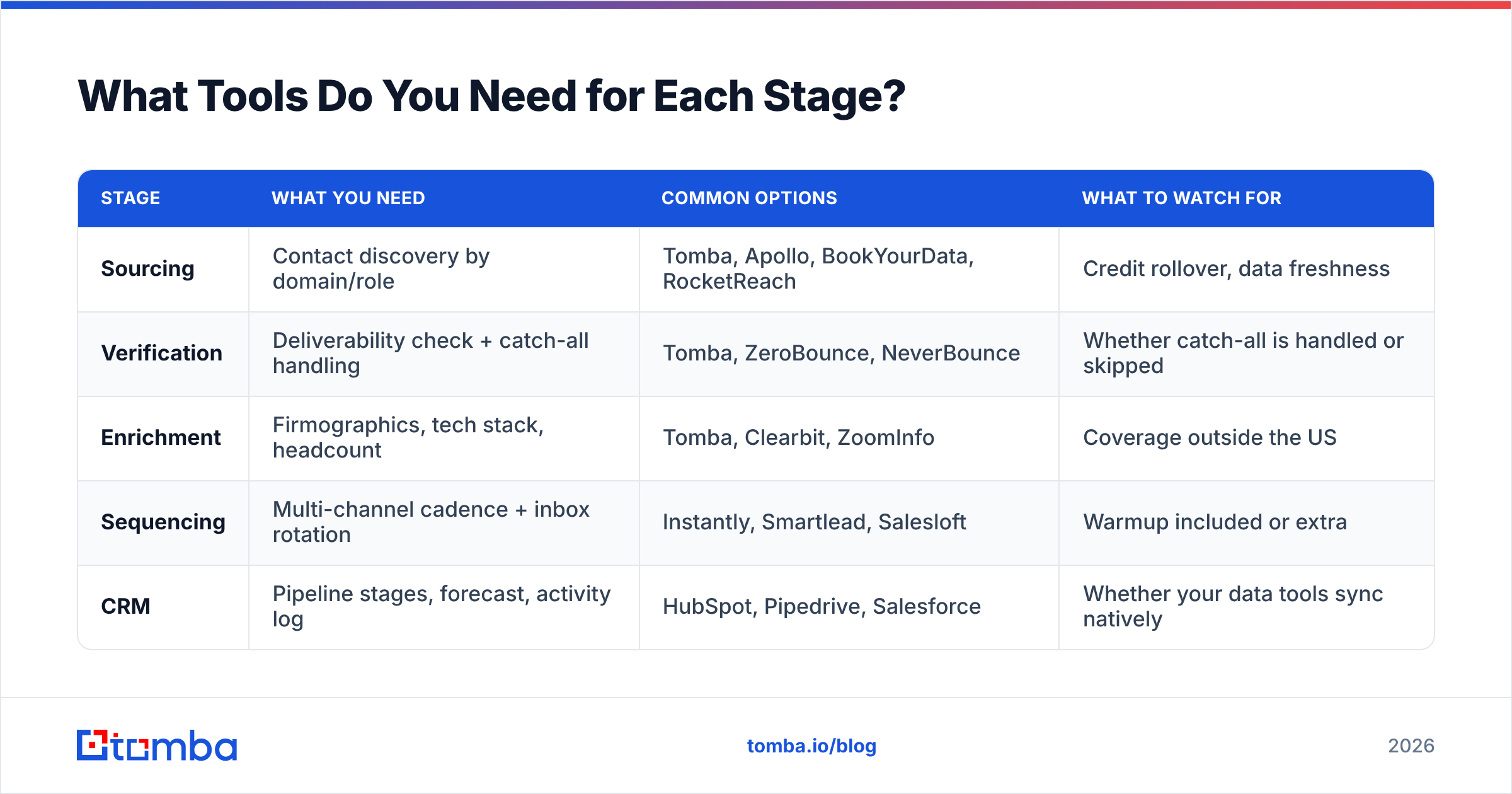
You don't need a 12-tool stack. You need one reliable source of contact data, one sequencer, and one CRM. Everything else is optional.
| Stage | What you need | Common options | What to watch for |
|---|---|---|---|
| Sourcing | Contact discovery by domain/role | Tomba, Apollo, BookYourData, RocketReach | Credit rollover, data freshness |
| Verification | Deliverability check + catch-all handling | Tomba, ZeroBounce, NeverBounce | Whether catch-all is handled or skipped |
| Enrichment | Firmographics, tech stack, headcount | Tomba, Clearbit, ZoomInfo | Coverage outside the US |
| Sequencing | Multi-channel cadence + inbox rotation | Instantly, Smartlead, Salesloft | Warmup included or extra |
| CRM | Pipeline stages, forecast, activity log | HubSpot, Pipedrive, Salesforce | Whether your data tools sync natively |
On cost: Tomba pricing starts with a free tier at 25 searches per month, then Starter at $49/mo, Growth at $99/mo, and Pro at $249/mo, with Enterprise custom. That covers finding, verifying, and enriching from one place, which removes the reconciliation work of stitching three vendors together. BookYourData takes a different route with prepaid, pay-as-you-go list purchases — genuinely useful if you want a one-time list without a subscription, and a fair comparison point depending on whether your buying pattern is recurring or episodic. Check independent review data on G2 before committing to any annual contract.
If your team already lives in a CRM, wire the data layer in directly — a HubSpot integration or Salesforce integration means enriched, verified contacts land in the right record automatically instead of arriving as a CSV nobody imports.
How Long Should Conversion Actually Take?#
Set expectations by deal size, or you'll kill good deals by rushing and waste quarters on bad ones by waiting.
- Under $2k ACV — 7 to 21 days. Self-serve or a single call. If it's dragging past a month, it's not real.
- $2k-$20k ACV — 30 to 60 days. Two to four calls, one or two stakeholders, a security or procurement checkpoint.
- $20k-$100k ACV — 60 to 120 days. Multi-threading is mandatory; single-threaded deals at this size die when your champion changes jobs.
- $100k+ ACV — 6 to 12 months. Formal evaluation, legal review, board-level budget. Track it in an account plan, not an email sequence.
The most common forecasting error is treating a stalled deal as an active one. If there's been no inbound activity from the prospect in 30 days — no replies, no calls, no page visits — it's not a late-stage opportunity anymore. Move it back to nurture and stop counting it. Gartner's research on B2B buying behavior has consistently found that buyers spend the majority of their evaluation time outside contact with any vendor, which means silence isn't always rejection — but it isn't commitment either.
What Should You Do This Week?#
Pick the leak with the worst ratio and fix only that. In order of typical impact:
- Verify your existing list. If bounce rate is above 5%, everything downstream is measured wrong. Do this before anything else.
- Extend your cadence from 3 touches to 7. Add a phone leg and a break-up email. This is a one-hour change to a sequence template.
- Cut your list in half. Remove everyone below your fit threshold. Your reply rate will go up because the denominator got honest.
- Add one intent signal. Pricing-page visitors or funding announcements. Route those to a rep same-day.
- Rewrite email 1 to remove the ask. No calendar link before touch four. Measure reply rate over the next 200 sends.
Each of these is a single afternoon of work. None require new headcount.
Start With Clean, Verified Contact Data#
Every step in this playbook depends on reaching a real person at a real company. That's the foundation, and it's the step teams most often skip.
The Tomba Email Finder finds professional email addresses by domain, name, or company, with verification built into the same workflow — so the contacts entering your sequence are ones that actually deliver. Start on the free tier at 25 searches a month, run your current target account list through it, and compare the bounce rate against whatever you're using now. If the difference is meaningful, you've just found your cheapest conversion improvement of the quarter.
Related guides#
// get started
Find, verify and enrich your first contacts today
Start on the free plan with 25 searches a month, then scale when your team is ready.
Free plan · No credit card required · GDPR & CCPA
// about the author