How to Convince a Prospect: A 2026 Framework That Closes
Convincing a prospect is not about better adjectives. It is about evidence, risk removal, and giving your champion something they can defend internally. Here is the framework, the scripts, and the stall-breakers that work in 2026.
TL;DR
- You do not convince a prospect. You give a prospect enough evidence, and enough cover, to convince the four other people who will actually decide.
- Persuasion fails on three predictable things: no quantified problem, no defensible proof, and no path to a low-risk first step. Fix those and objections shrink.
- The highest-leverage move is not a better pitch deck. It is arriving with something the prospect did not know about their own business.
- Stalls ("send me pricing", "circle back next quarter") are almost always missing-stakeholder or missing-risk problems in disguise, not price problems.
- Persuasion starts before the first email: if you are pitching the wrong contact at a bad address, no framework saves you.
What does it actually mean to convince a prospect?#
Convincing a prospect means moving them from "this is interesting" to "I am willing to spend political capital on this." Those are wildly different states, and most reps conflate them.
Interest is cheap. A prospect can be interested and still do nothing for eighteen months, because doing nothing has a cost of zero and doing something has a cost of their credibility. The moment your champion forwards your deck to a VP, they are attaching their name to your claims. If your claims are soft, they will not forward it.
So the real job is not persuasion in the theatrical sense. It is evidence transfer. You are equipping one person to run an internal argument you will never be in the room for. Gartner's research on the B2B buying journey has been making this point for years: buying groups have grown, buyers spend the majority of their cycle without any vendor present, and the deals that stall are usually the ones where the internal case was never portable.
Think of it like handing someone a case file rather than a sales pitch. A pitch works only while you are talking. A case file keeps working in a meeting you were not invited to.
Why do most attempts to convince a prospect fail?#
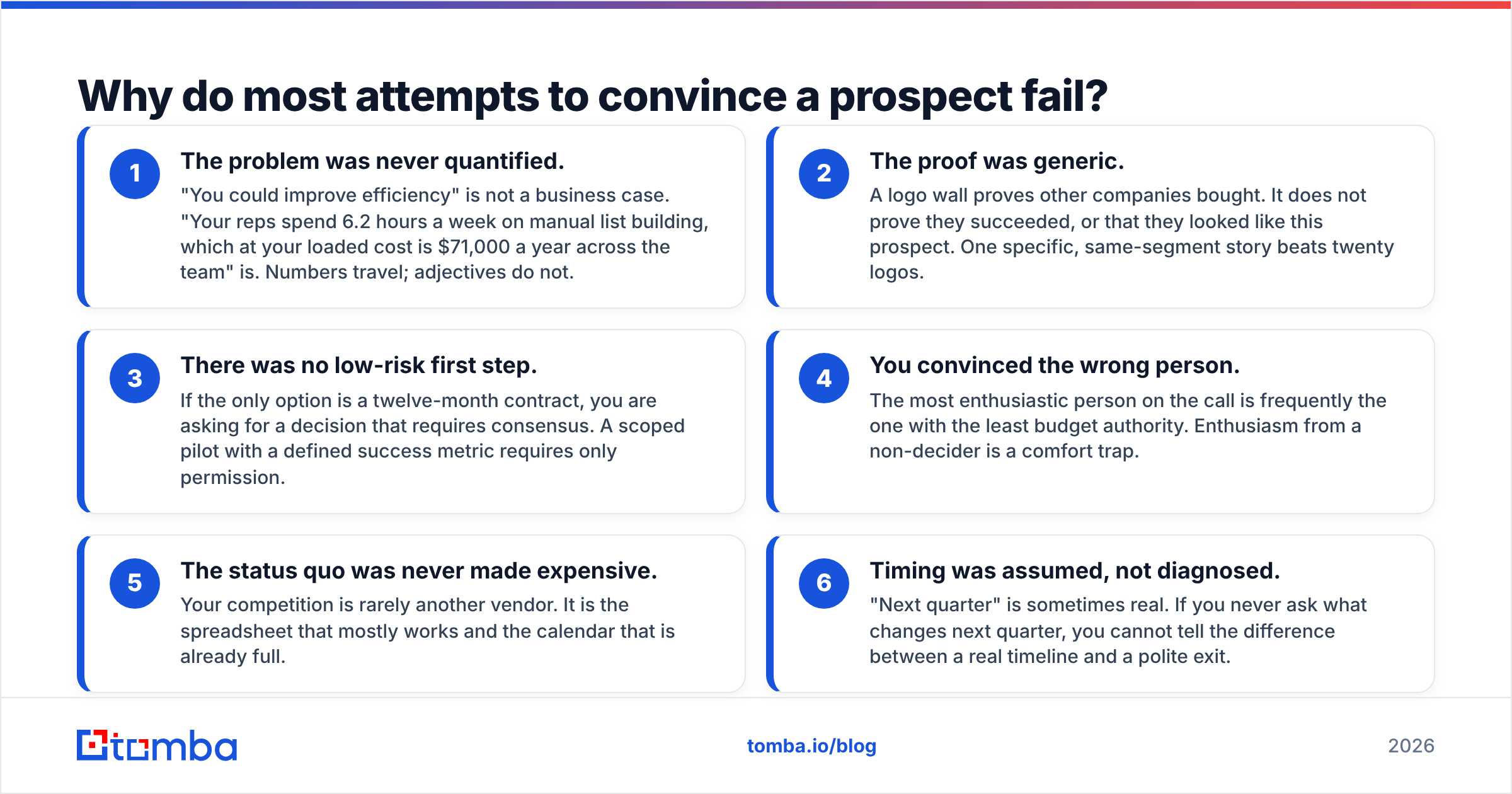
Four failure modes account for the overwhelming majority of lost deals. They are all fixable and none of them are about charisma.
- The problem was never quantified. "You could improve efficiency" is not a business case. "Your reps spend 6.2 hours a week on manual list building, which at your loaded cost is $71,000 a year across the team" is. Numbers travel; adjectives do not.
- The proof was generic. A logo wall proves other companies bought. It does not prove they succeeded, or that they looked like this prospect. One specific, same-segment story beats twenty logos.
- There was no low-risk first step. If the only option is a twelve-month contract, you are asking for a decision that requires consensus. A scoped pilot with a defined success metric requires only permission.
- You convinced the wrong person. The most enthusiastic person on the call is frequently the one with the least budget authority. Enthusiasm from a non-decider is a comfort trap.
- The status quo was never made expensive. Your competition is rarely another vendor. It is the spreadsheet that mostly works and the calendar that is already full.
- Timing was assumed, not diagnosed. "Next quarter" is sometimes real. If you never ask what changes next quarter, you cannot tell the difference between a real timeline and a polite exit.
Which persuasion framework should you actually use?#
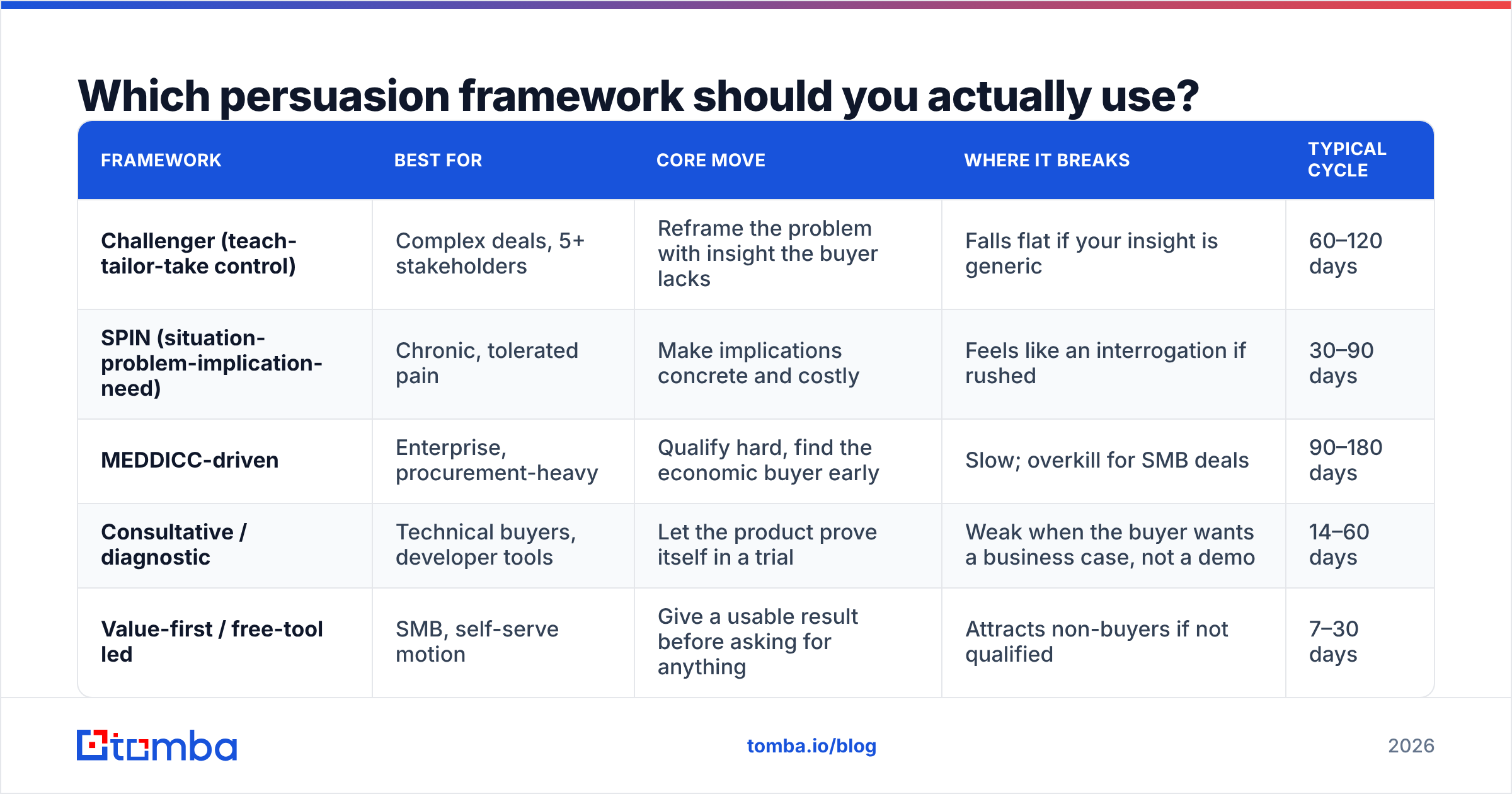
There is no single winner. The framework should match the deal's shape — how technical the buyer is, how many stakeholders exist, and whether the pain is acute or chronic.
| Framework | Best for | Core move | Where it breaks | Typical cycle |
|---|---|---|---|---|
| Challenger (teach-tailor-take control) | Complex deals, 5+ stakeholders | Reframe the problem with insight the buyer lacks | Falls flat if your insight is generic | 60–120 days |
| SPIN (situation-problem-implication-need) | Chronic, tolerated pain | Make implications concrete and costly | Feels like an interrogation if rushed | 30–90 days |
| MEDDICC-driven | Enterprise, procurement-heavy | Qualify hard, find the economic buyer early | Slow; overkill for SMB deals | 90–180 days |
| Consultative / diagnostic | Technical buyers, developer tools | Let the product prove itself in a trial | Weak when the buyer wants a business case, not a demo | 14–60 days |
| Value-first / free-tool led | SMB, self-serve motion | Give a usable result before asking for anything | Attracts non-buyers if not qualified | 7–30 days |
Pick one and run it properly. The failure I see most often is a rep who half-uses three frameworks and ends up with a discovery call that is neither diagnostic nor challenging — just a list of questions the buyer has answered on four other calls this month.
How do you build a case the prospect can defend internally?#
Your champion needs four things, and they need them in a format they can paste into an email without editing.
The trigger. Why now, in one sentence. "Our SDR team is missing quota and the bottleneck is list quality, not activity." If your champion cannot state the trigger in one line, the VP will not read line two.
The quantified cost of inaction. Use the prospect's own numbers, gathered in discovery, not your benchmark deck. If they told you 28% of their outbound bounces, do the arithmetic in front of them: bounce rate, wasted sends, domain reputation risk, and the deliverability cleanup cost that follows. Bounce damage compounds — a burned sending domain is a two-month recovery, not a two-day one, and it drags email deliverability down for every campaign running on it.
Proof from a lookalike. Same size, same industry, same problem shape. Include the messy part — what took longer than expected. Buyers trust case studies with friction far more than case studies without it. Public review sites like G2 are useful here precisely because the three-star reviews are where the real objections live; read them before your prospect does.
A first step that is smaller than the decision. A two-week pilot on 500 records with a pre-agreed success threshold. You are not asking for a purchase. You are asking for a test with a defined outcome, which is a decision a single manager can usually make alone.
Write these four into a one-page document and send it after the call. Not a deck. A document, because documents get forwarded and decks get downloaded and forgotten.
What do you say when the prospect stalls?#
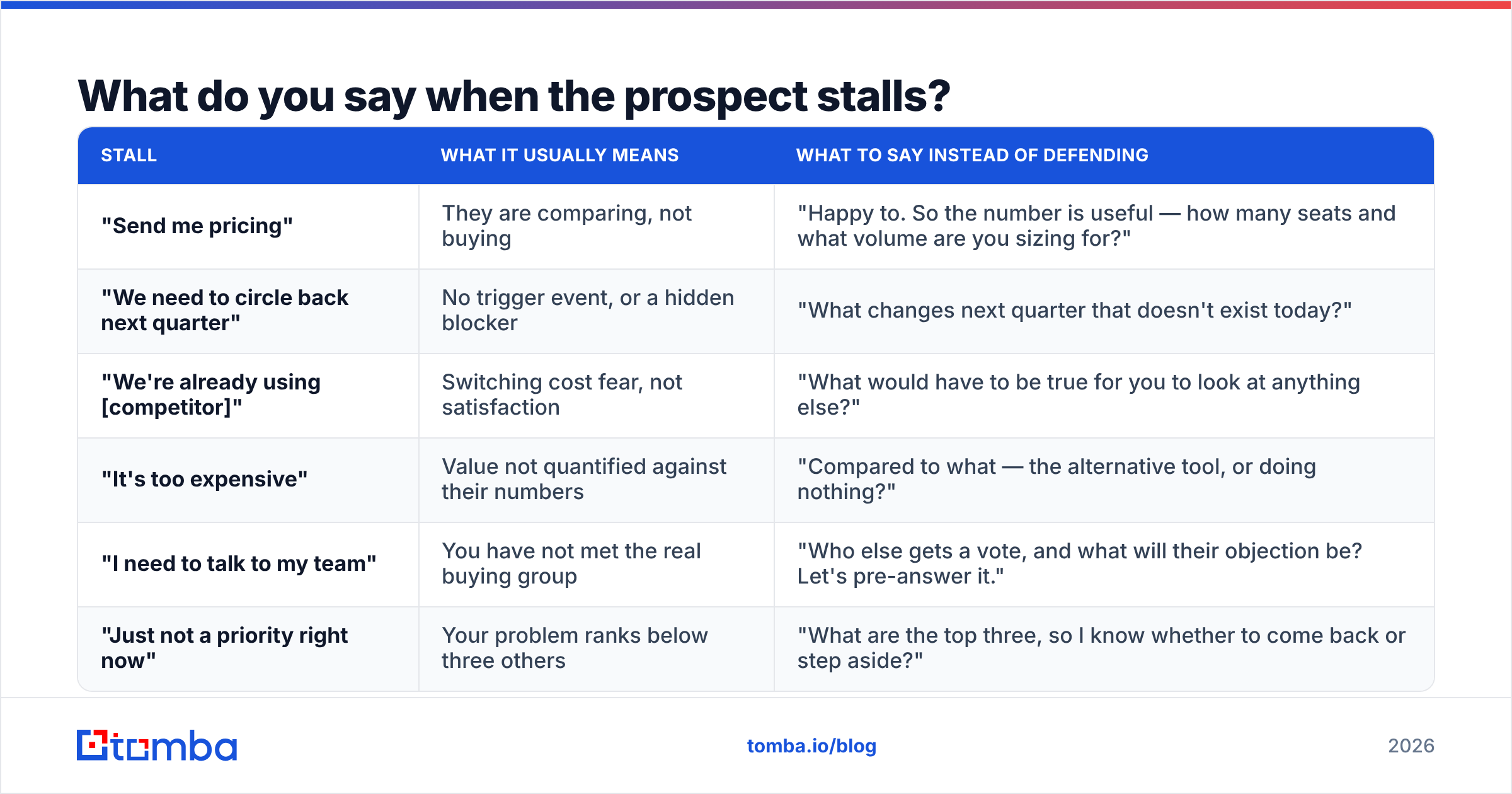
Stalls are diagnostic information. Each common one maps to a specific missing element, and the right response is a question, not a counter-argument.
| Stall | What it usually means | What to say instead of defending |
|---|---|---|
| "Send me pricing" | They are comparing, not buying | "Happy to. So the number is useful — how many seats and what volume are you sizing for?" |
| "We need to circle back next quarter" | No trigger event, or a hidden blocker | "What changes next quarter that doesn't exist today?" |
| "We're already using [competitor]" | Switching cost fear, not satisfaction | "What would have to be true for you to look at anything else?" |
| "It's too expensive" | Value not quantified against their numbers | "Compared to what — the alternative tool, or doing nothing?" |
| "I need to talk to my team" | You have not met the real buying group | "Who else gets a vote, and what will their objection be? Let's pre-answer it." |
| "Just not a priority right now" | Your problem ranks below three others | "What are the top three, so I know whether to come back or step aside?" |
Note the pattern: none of these responses argue. Arguing with an objection makes the prospect defend it, which cements it. Questions make the prospect examine it.
The strongest single line in the table is the last one. Offering to step aside is unusual enough that it frequently produces the real answer, and a real "no" is worth more than a fake maybe you will chase for six weeks.
How do you convince a prospect without discounting?#
Discounting is the fastest way to convert a value problem into a price problem permanently. Once you cut, every future conversation starts from the cut. Use these levers first.
- Shorten the commitment, not the price. A quarterly term at full rate is easier to approve than an annual term at 20% off, and it protects your price integrity.
- Reduce scope, keep rate. Fewer seats, fewer modules, same per-unit price. The buyer gets a smaller number without you devaluing the product.
- Attach a success metric. "If we don't hit 92% deliverable rate on the first 1,000 records, we part ways at day 30." You have converted risk into a condition rather than a discount.
- Front-load onboarding. Time and expertise cost you less than margin and are often what the buyer actually wants.
- Trade, never give. Any concession buys something: a case study, a reference call, a faster signature, a multi-team rollout.
HubSpot's ongoing sales research consistently shows that deals closed on discount churn at higher rates than deals closed on demonstrated value — the customer who bought on price bought the price, not the outcome.
How does data quality change your odds of convincing anyone?#
This is the unglamorous part that decides everything upstream of your framework. You cannot convince someone you never reach, and you cannot build credibility with a person who is not the buyer.
Three concrete failure points:
- Wrong person. You spent four calls persuading a manager whose director already standardized on something else. Enrichment that returns seniority, department, and reporting context prevents this. Contact enrichment at the list-building stage costs minutes; discovering it in week six costs the quarter.
- Wrong address. A bounced email does not just fail to land — it degrades the domain you will use for every future prospect. Verifying before send is not hygiene, it is protection of your entire outbound channel.
- No context to open with. The "insight" a Challenger-style approach depends on has to come from somewhere. Firmographic and technographic signals give you an opening line that is not "I saw you're hiring SDRs."
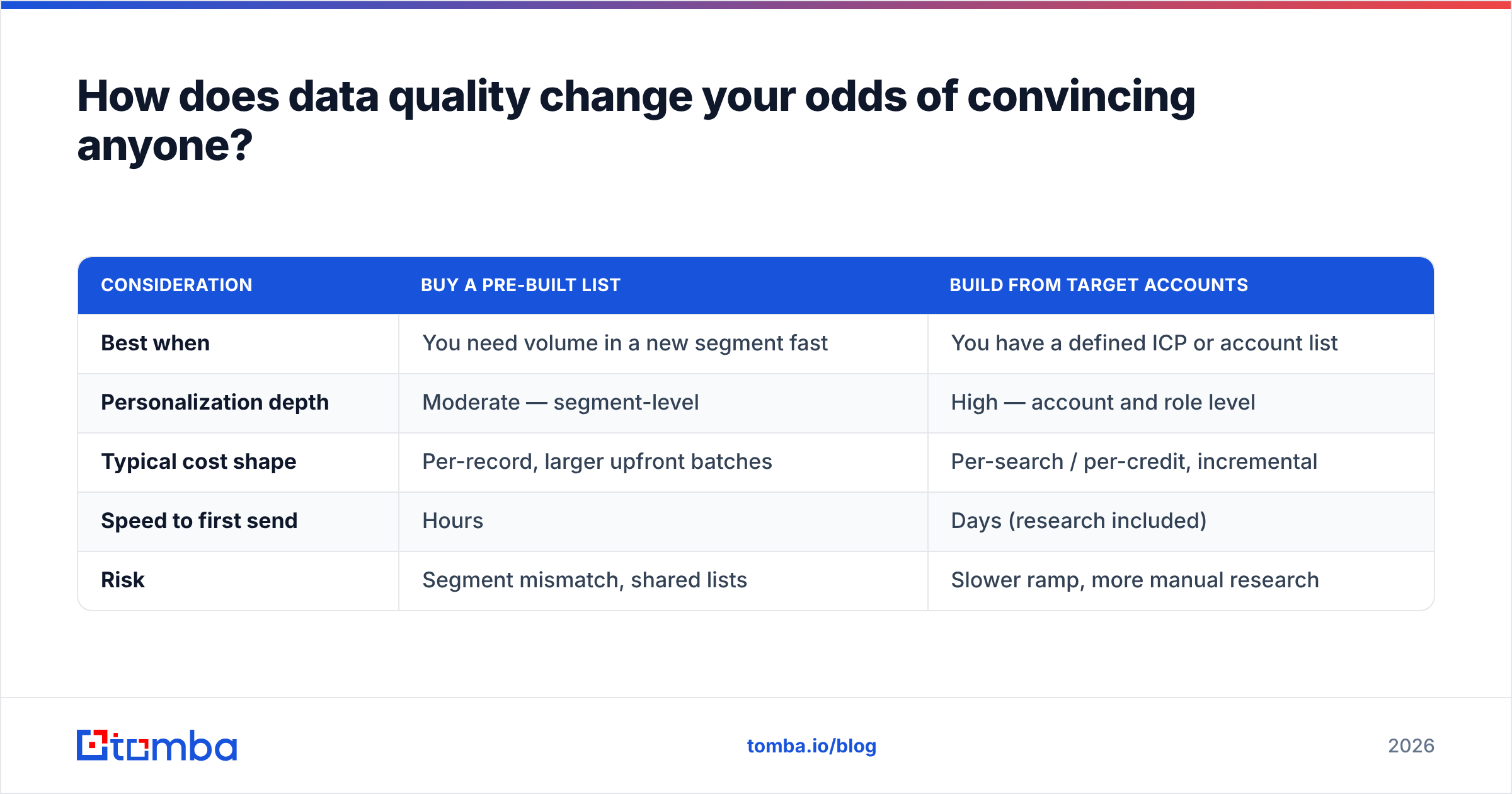
If you are building lists by hand, your response rate ceiling is set before you write a single word of copy. Tooling here is genuinely competitive — BookYourData is strong if you want pre-built, ready-to-download B2B lists with human-verified contacts, and it suits teams that would rather buy a segment than assemble one. Tomba fits the opposite motion: you already know the accounts, and you need accurate addresses and enrichment for those specific companies, via domain search or the API. Pick based on whether your bottleneck is which accounts or how to reach the ones you picked.
| Consideration | Buy a pre-built list | Build from target accounts |
|---|---|---|
| Best when | You need volume in a new segment fast | You have a defined ICP or account list |
| Personalization depth | Moderate — segment-level | High — account and role level |
| Typical cost shape | Per-record, larger upfront batches | Per-search / per-credit, incremental |
| Speed to first send | Hours | Days (research included) |
| Risk | Segment mismatch, shared lists | Slower ramp, more manual research |
Tomba's own pricing follows the incremental model: a free tier at 25 searches per month, Starter at $49/mo, Growth at $99/mo, Pro at $249/mo, and custom Enterprise terms. Full details are on the Tomba pricing page.
What does a convincing sequence look like week by week?#
Persuasion is cumulative. A single brilliant email rarely moves anyone; four coherent touches that each add something usually do.
- Week 1 — Insight. Open with something specific about their business they have not seen. No ask beyond a reply.
- Week 1–2 — Diagnostic call. Quantify the problem in their numbers. Do not demo. Ending a first call without demoing is itself persuasive; it signals you are diagnosing, not selling.
- Week 2 — The one-pager. Trigger, cost of inaction, lookalike proof, proposed first step. Sent as a document, written for the person who was not on the call.
- Week 3 — Multi-threading. Ask your champion to loop in the person who will object. Meet the objection while you can still answer it.
- Week 3–4 — Scoped pilot. Defined data set, defined success threshold, defined end date.
- Week 5+ — Decision on evidence. The pilot either hit the number or it did not. You are now discussing a result, not a promise.
Deals that follow this shape lose less often to "no decision," which remains the largest single competitor in B2B. If you also log each stage properly in your CRM, you get something more valuable than any one deal: a record of which stall killed which opportunity, which is the only reliable way to improve the framework next quarter.
Where should you start this week?#
Pick one open opportunity that has gone quiet. Write the four-part one-pager for it — trigger, quantified cost, lookalike proof, small first step — and send it to your champion with a single question: "Who else needs to see this, and what will they push back on?"
That one message does more than another follow-up asking if they had a chance to review the deck.
And if the honest answer is that your pipeline is too thin for framework work to matter yet, fix the input first. Start with the Tomba Email Finder to build a verified list of the exact people who can say yes — free tier included, 25 searches a month, no card. Convincing the right prospect is a solvable problem. Convincing the wrong one never was.
Related guides#
// get started
Find, verify and enrich your first contacts today
Start on the free plan with 25 searches a month, then scale when your team is ready.
Free plan · No credit card required · GDPR & CCPA
// about the author