How to Create a B2B Sales Funnel That Converts in 2026
A step-by-step build guide for a B2B sales funnel that actually closes: stage definitions, exit criteria, data sourcing, and the conversion math that tells you where deals really leak.
TL;DR
- A B2B sales funnel is a set of stages with written exit criteria, not a picture of a cone. If a rep can't say why a deal moved from Stage 2 to Stage 3, you don't have a funnel — you have a list.
- Build it backwards from closed-won: decide your revenue target, work back through stage conversion rates, and only then decide how many contacts you need at the top.
- Five stages is enough for most teams: Awareness → Engaged → Qualified → Evaluation → Closed. More stages means more forecast noise, not more precision.
- Bad contact data is the single most common leak. A 30% bounce rate at the top of the funnel silently doubles your cost per opportunity before a rep ever talks to anyone.
- Measure stage-to-stage conversion and time in stage. The second number finds stuck deals that conversion rate alone hides.
What is a B2B sales funnel, and how is it different from a pipeline?#
A B2B sales funnel is the model of how a stranger becomes a customer, broken into stages you can count. A pipeline is the subset of that funnel where a named salesperson owns a named deal with a dollar value attached.
The analogy: the funnel is the whole airport — arrivals, security, gates, boarding. The pipeline is only the passengers who already have a boarding pass. Marketing usually owns the terminal doors; sales owns the gate. Most funnel dysfunction happens at the handoff between the two, where nobody agreed what "ready to board" means.
The practical difference matters because the two get measured differently. Funnel metrics answer "are enough of the right people entering?" Pipeline metrics answer "are the deals we have going to close this quarter?" You need both, and you need them to reconcile — if marketing reports 400 MQLs and sales says it received 60 real opportunities, someone's definition is broken.
How do you create a B2B sales funnel step by step?#
Seven steps. Do them in order — skipping to tactics before you've defined the ICP is why most funnel rebuilds fail twice.
- Define the ICP narrowly enough to disqualify. "Mid-market SaaS" is not an ICP. "Series B–C B2B SaaS companies, 80–400 employees, US/UK, with an existing outbound team of 3+ SDRs" is. The test: can a new rep look at a company and say no in ten seconds? If not, your top of funnel will fill with noise.
- Write the stages and their exit criteria. Each stage needs one observable, binary condition to leave it. Not "prospect is interested" — that's a feeling. Use "prospect booked a meeting with a calendar invite accepted."
- Source the contact data. Build target account lists first, then find the specific humans at those accounts. Account-first, contact-second — the reverse gives you enthusiastic conversations with people who can't sign.
- Verify before you send. Every unverified address is a deliverability tax on the whole domain. Run lists through an email verifier before the first send, not after the first bounce report.
- Design the entry motions. Outbound sequences, inbound content, partner referrals, product-led signups — each is a distinct entry path with its own conversion math. Track them separately from day one or you'll never know which one to fund.
- Instrument the stages in your CRM. Required fields at each transition. If moving to "Qualified" doesn't force a rep to fill in budget authority and timeline, the stage means nothing 60 days later.
- Set the review cadence. Weekly for stage movement, monthly for conversion rates, quarterly for the stage definitions themselves. Definitions drift; audit them.
What stages should a B2B sales funnel have?#
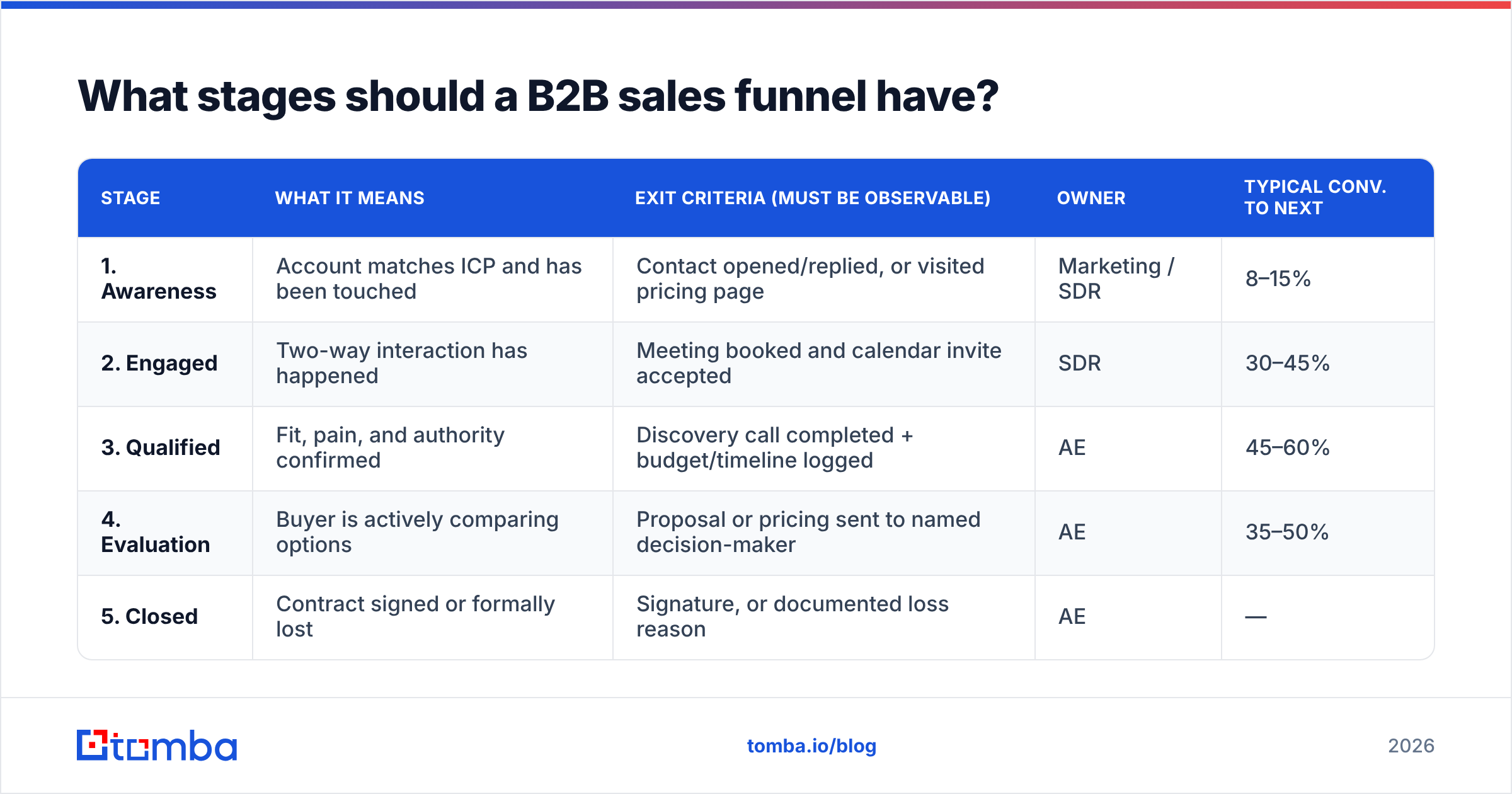
Five, for most teams. Here's the structure with the exit criteria that make each one enforceable.
| Stage | What it means | Exit criteria (must be observable) | Owner | Typical conv. to next |
|---|---|---|---|---|
| 1. Awareness | Account matches ICP and has been touched | Contact opened/replied, or visited pricing page | Marketing / SDR | 8–15% |
| 2. Engaged | Two-way interaction has happened | Meeting booked and calendar invite accepted | SDR | 30–45% |
| 3. Qualified | Fit, pain, and authority confirmed | Discovery call completed + budget/timeline logged | AE | 45–60% |
| 4. Evaluation | Buyer is actively comparing options | Proposal or pricing sent to named decision-maker | AE | 35–50% |
| 5. Closed | Contract signed or formally lost | Signature, or documented loss reason | AE | — |
The numbers in that last column are ranges, not promises. Your own baseline beats any benchmark — measure for one full sales cycle, then use your real numbers. Public benchmark sets from G2 and vendor research from HubSpot are useful for sanity-checking whether you're wildly off, not for target-setting.
Two rules keep the stage model honest:
- A deal can skip forward but never sit still silently. If something's been in Evaluation for 90 days on a 45-day average cycle, it isn't in Evaluation. It's lost and nobody has said so.
- Only one stage can be "in progress" per account. Multi-threading is good; multiple parallel opportunity records for the same deal is forecast pollution.
How many leads do you need at the top of the funnel?#
Work backwards. This is arithmetic, not strategy, and it takes five minutes.
Say you need $500,000 in new bookings this quarter and your average contract value is $20,000. That's 25 closed-won deals. Apply the conversion rates from your own funnel — using the mid-points from the table above:
- 25 closed-won ÷ 0.42 (Evaluation→Closed) = 60 evaluations
- 60 ÷ 0.52 (Qualified→Evaluation) = 115 qualified
- 115 ÷ 0.37 (Engaged→Qualified) = 311 engaged
- 311 ÷ 0.11 (Awareness→Engaged) = 2,827 contacts touched
Now the uncomfortable part: that 2,827 assumes every contact is reachable. At a 25% bounce-and-bad-data rate — which is unremarkable for a scraped or aging list — you actually need to source closer to 3,770 contacts to touch 2,827. That gap is why data quality is a funnel input, not an ops chore.
Sanity-check the top number against reality. If 2,827 contacts is more than your entire addressable market for the quarter, the problem isn't your funnel — it's your ACV or your ICP width, and no amount of sequence tuning fixes it.
Where do B2B sales funnels leak the most?#
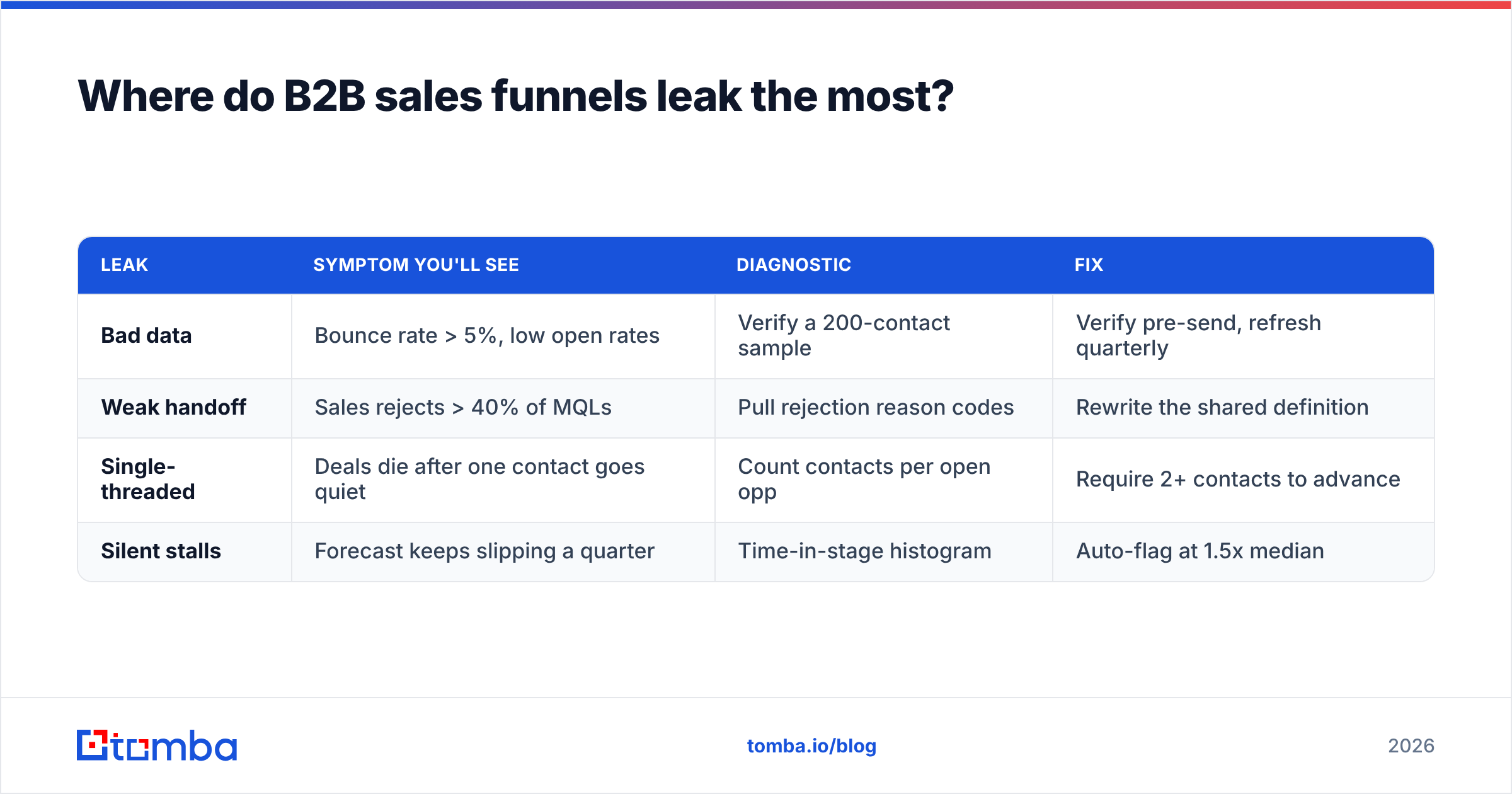
Four places, ranked by how much money they cost and how cheap they are to fix.
1. Invalid contact data at entry. The cheapest leak to fix and the most ignored. Bounces don't just waste a send — they damage sender reputation, which suppresses inbox placement for the valid contacts on the same list. One bad list can depress a quarter of outbound.
2. The MQL-to-SQL handoff. Marketing counts a whitepaper download as a lead; sales calls it a tire-kicker. Fix: one shared definition, written down, with a rejection loop. Sales must be able to bounce a lead back with a reason code, and marketing must see the reason codes weekly.
3. Single-threaded deals. A deal with one contact at the account has a single point of failure. When that champion changes jobs — and roughly one in five B2B contacts changes role each year — the deal dies. Fix: require two named contacts before a deal can enter Evaluation.
4. Silent stalls. Deals that neither advance nor get marked lost. They inflate pipeline and destroy forecast accuracy. Fix: an automatic aging rule. Past 1.5x your average time-in-stage, the deal moves to a "Stalled" flag and forces a rep decision.
| Leak | Symptom you'll see | Diagnostic | Fix |
|---|---|---|---|
| Bad data | Bounce rate > 5%, low open rates | Verify a 200-contact sample | Verify pre-send, refresh quarterly |
| Weak handoff | Sales rejects > 40% of MQLs | Pull rejection reason codes | Rewrite the shared definition |
| Single-threaded | Deals die after one contact goes quiet | Count contacts per open opp | Require 2+ contacts to advance |
| Silent stalls | Forecast keeps slipping a quarter | Time-in-stage histogram | Auto-flag at 1.5x median |
How do you fill the top of the funnel with accurate contacts?#
Three sourcing motions, and you almost certainly need more than one.
Account-first outbound. Build a target account list from firmographic filters, then find the buying committee at each account. A domain search returns the contacts and email patterns for a company in one query, which is far faster than guessing formats one person at a time. This is the highest-control motion — you decide exactly who enters.
Signal-triggered outbound. Same as above, but timed to a trigger: new funding, a relevant hire, a technology change, a visit to your pricing page. Conversion rates on triggered outreach typically run several multiples above untriggered, because you're catching a buying window instead of interrupting one at random.
Inbound capture and enrichment. A form fill gives you a work email and nothing else. Data enrichment turns that into a company, headcount, role, and tech stack so routing and scoring can happen automatically instead of a rep manually researching every submission.
Whichever mix you run, the sequence is the same: source → verify → enrich → route. Skipping verify is the expensive shortcut.
What tools do you actually need to run the funnel?#
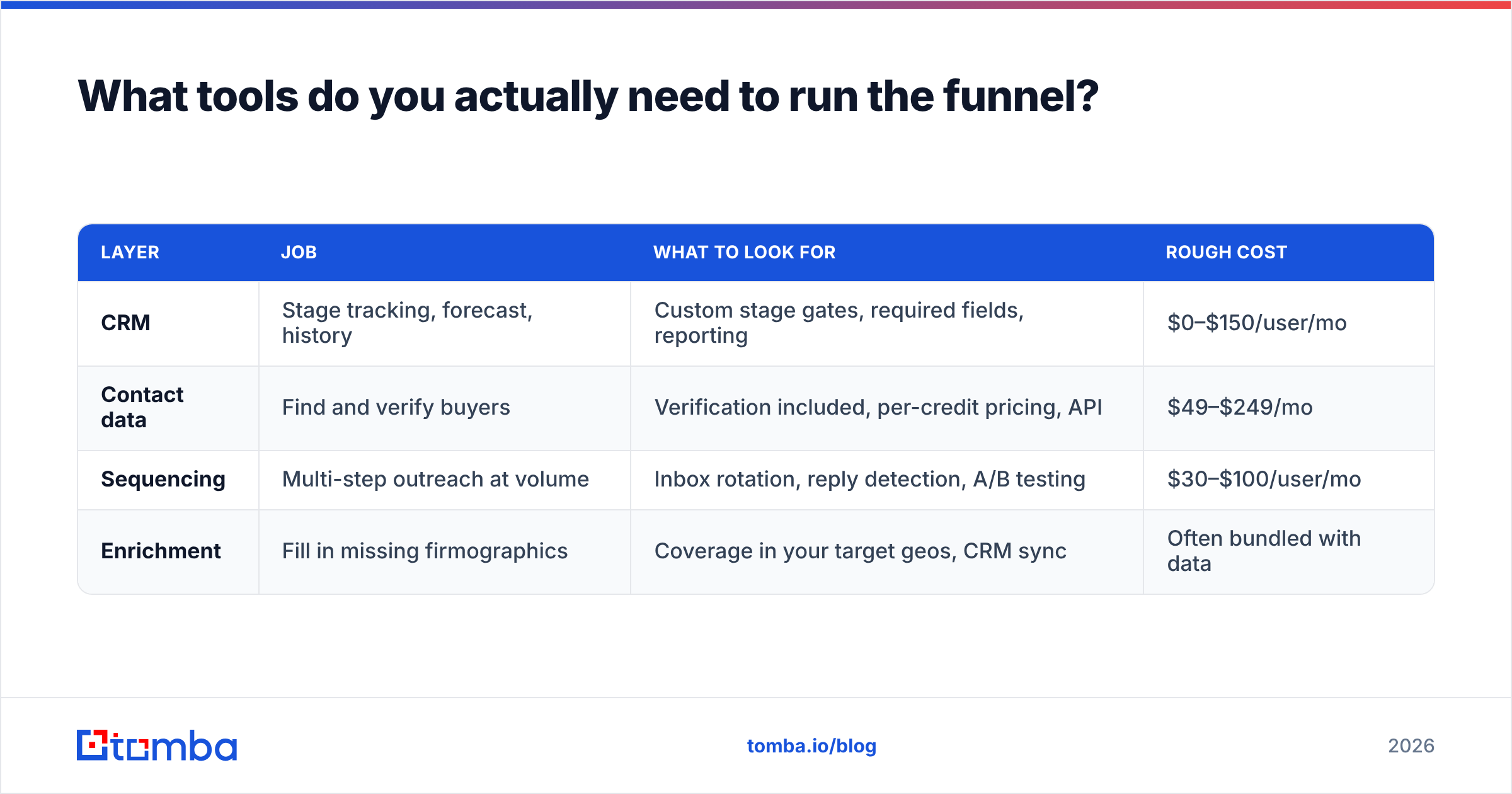
Fewer than the vendor landscape suggests. Four categories cover the whole build.
| Layer | Job | What to look for | Rough cost |
|---|---|---|---|
| CRM | Stage tracking, forecast, history | Custom stage gates, required fields, reporting | $0–$150/user/mo |
| Contact data | Find and verify buyers | Verification included, per-credit pricing, API | $49–$249/mo |
| Sequencing | Multi-step outreach at volume | Inbox rotation, reply detection, A/B testing | $30–$100/user/mo |
| Enrichment | Fill in missing firmographics | Coverage in your target geos, CRM sync | Often bundled with data |
On the contact-data layer specifically, the two questions worth asking a vendor are: what does a verified result actually mean, and do I pay for results you couldn't find? Credit-burn on failed lookups is the hidden cost that makes a cheap tool expensive.
For reference on pricing structures across this category: Tomba runs a free tier at 25 searches/month, Starter at $49/mo, Growth at $99/mo, and Pro at $249/mo, with verification bundled rather than sold as a separate SKU — full Tomba pricing is public. BookYourData takes a different and equally valid approach with pay-as-you-go credits and no subscription commitment, which suits teams running occasional list builds rather than continuous outbound. Neither model is universally better; the deciding factor is whether your sourcing is steady-state or bursty.
Resist the urge to buy an all-in-one platform before you know your stage conversion rates. Tools amplify a working funnel and accelerate a broken one.
How do you measure and improve the funnel over time?#
Track four numbers per stage, reviewed on a fixed cadence.
- Stage-to-stage conversion rate. The obvious one. Trend it monthly, not weekly — weekly data is too noisy at typical B2B volumes to mean anything.
- Median time in stage. The metric that finds stalls. Track the median, not the mean; one 400-day zombie deal wrecks an average.
- Volume entering the stage. Conversion rate improvements are worthless if entry volume halved at the same time. Always read the two together.
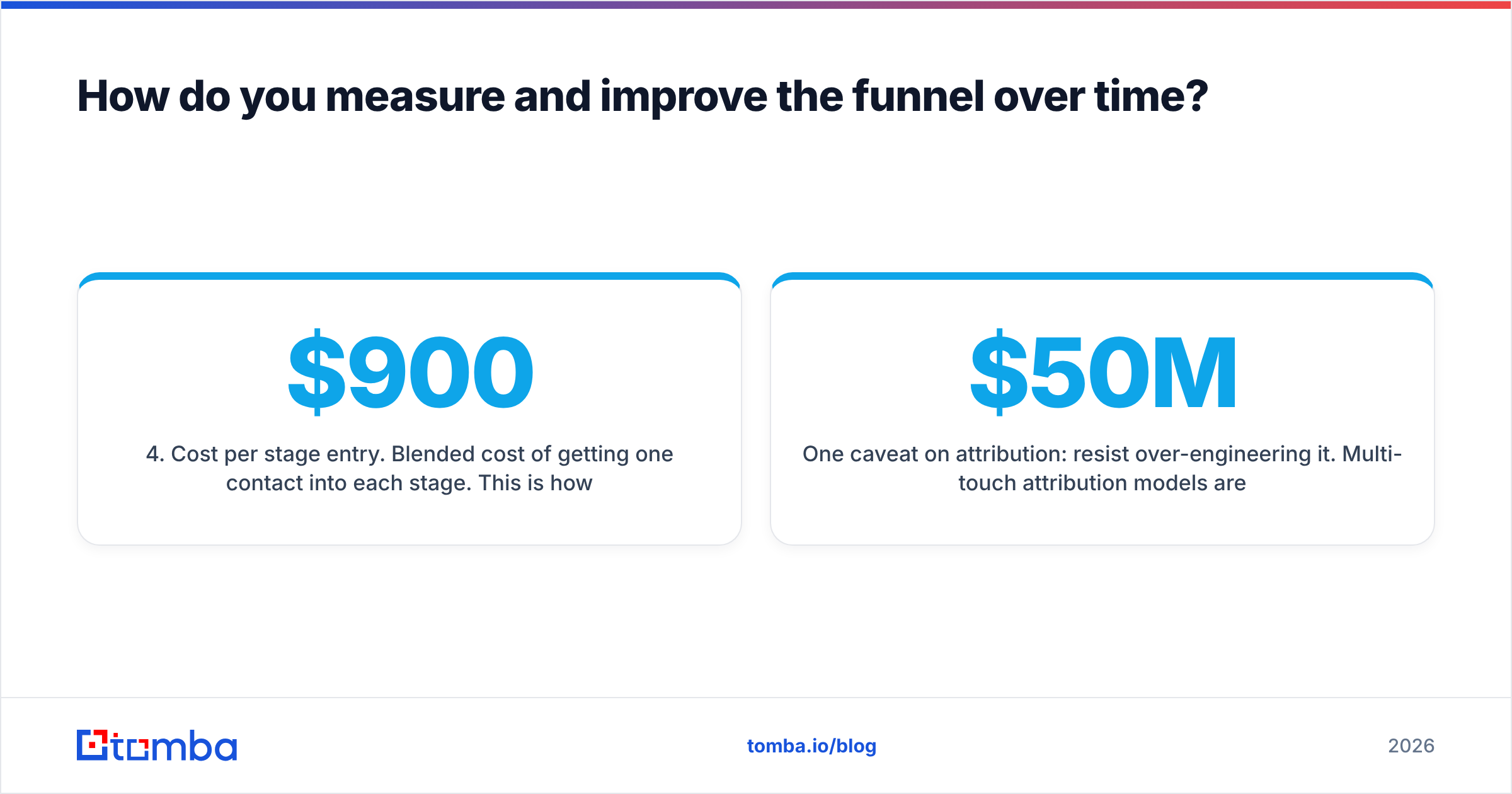
- Cost per stage entry. Blended cost of getting one contact into each stage. This is how you decide whether to fix the top or the middle of the funnel — if a qualified opportunity costs you $900 and closes at $20,000 ACV, you have room; if it costs $6,000, you have a business model problem.
The improvement loop is deliberately boring: pick the single stage with the worst conversion relative to your own trailing six-month average, form one hypothesis about why, change one thing, wait a full sales cycle, measure. Changing three things at once means you learn nothing, and in B2B — where cycles run 30 to 120 days — you only get a handful of learning cycles per year. Spend them carefully.
One caveat on attribution: resist over-engineering it. Multi-touch attribution models are seductive and, at sub-$50M revenue, usually produce decisions you'd have made anyway from a simple first-touch/last-touch split. Spend the effort on data quality instead — it compounds; attribution modeling doesn't.
Frequently asked questions#
How long does it take to build a B2B sales funnel? Two to three weeks to define stages, instrument the CRM, and source the first list. Then one full sales cycle — 30 to 120 days — before the conversion data means anything.
Should the funnel be different for inbound and outbound? Same stages, separate reporting. Inbound converts faster at the top and often slower in Evaluation; blending them hides both patterns.
How often should the contact database be refreshed? Quarterly at minimum. B2B contact data decays at roughly 2–3% per month through job changes alone, which compounds to about a third of a list going stale in a year.
Do small teams need all five stages? Yes, but the AE and SDR owner columns collapse into one person. The stages exist to force decisions, not to justify headcount.
Build the top of your funnel on data that doesn't bounce#
Everything downstream of contact sourcing — your sequences, your discovery calls, your forecast — inherits the quality of the list you started with. Get that layer right and the rest of the funnel work compounds.
The Tomba Email Finder finds verified professional email addresses by name, company, or domain, with verification built into the same workflow rather than bolted on afterwards. Start on the free tier at 25 searches a month to test coverage against your own target account list, then scale to Starter at $49/mo when the funnel math says it's worth it. Run your next 100 target accounts through it and compare the bounce rate against whatever you're using now — that single test tells you more than any vendor comparison chart.
Related guides#
// get started
Find, verify and enrich your first contacts today
Start on the free plan with 25 searches a month, then scale when your team is ready.
Free plan · No credit card required · GDPR & CCPA
// about the author