How to Create a Buyer Persona That Actually Drives Pipeline
Most buyer personas are fiction with a stock photo attached. Here is a 7-step research process that turns interviews, CRM data, and firmographics into a persona your reps will actually use.
TL;DR
- A buyer persona is only useful if it changes what you say in an email or on a call. If it doesn't, it's a poster.
- Build it from three inputs: 8-12 customer interviews, your closed-won/closed-lost CRM data, and firmographic patterns from your best accounts.
- Skip the invented details (hobbies, favorite coffee). Keep the buying-relevant fields: trigger events, evaluation criteria, objections, and the exact words they use.
- Personas expire. Re-validate every two quarters, or after any major pricing, product, or ICP change.
- Turn the finished persona into a targeting filter — job titles, company size, tech stack — then use a tool like Tomba Email Finder to build the list that matches it.
What is a buyer persona, and how is it different from an ICP?#
A buyer persona is a research-based profile of a specific human who influences or makes a purchase decision. An ICP (ideal customer profile) describes the company you want to sell to. You need both, and confusing them is the most common reason persona projects fail.
Think of it like fishing. The ICP tells you which lake to fish in — company size, industry, region, funding stage. The persona tells you what bait works — what the fish is hungry for, what spooks it, and when it feeds.
Concretely:
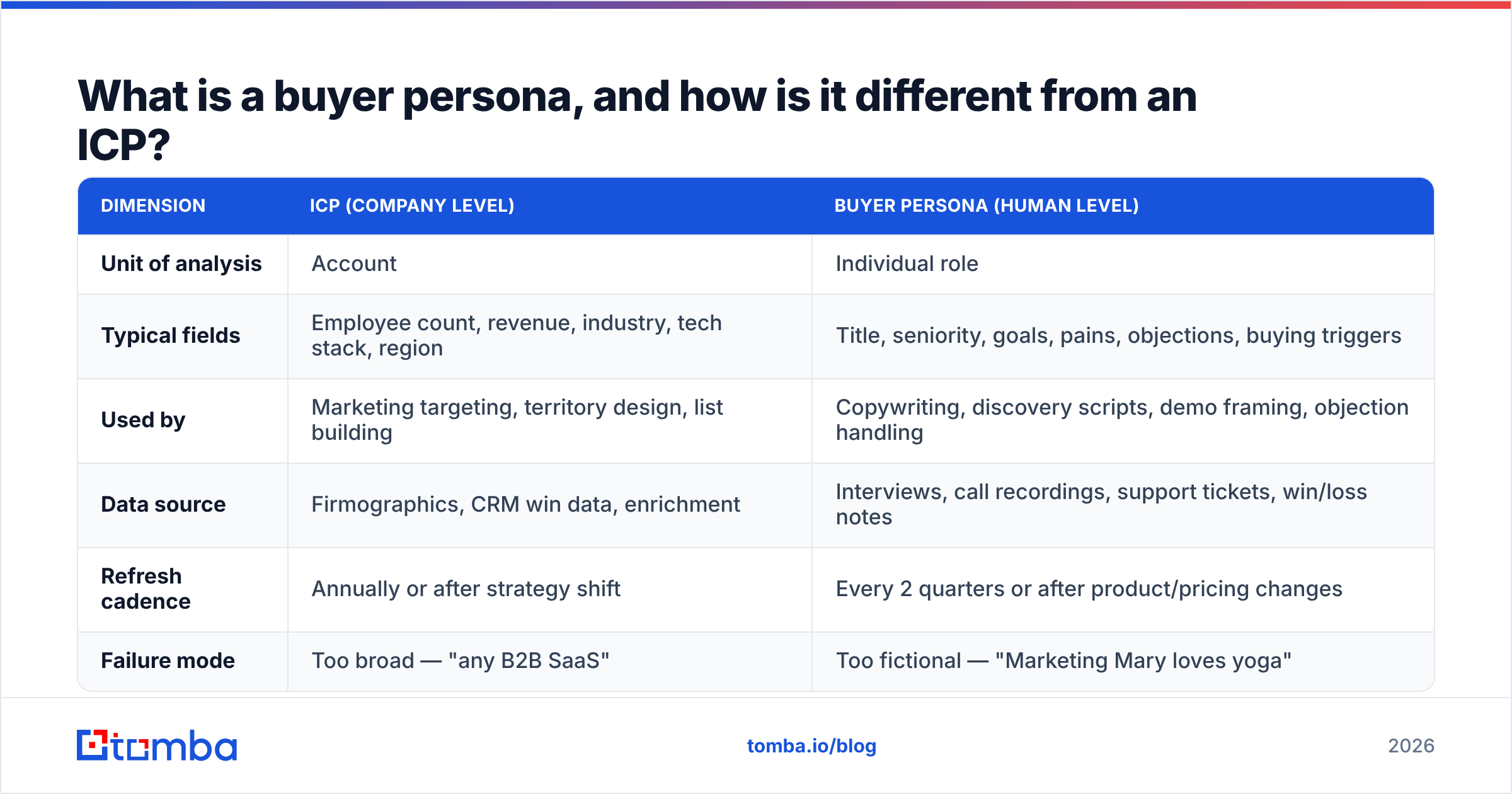
| Dimension | ICP (company level) | Buyer persona (human level) |
|---|---|---|
| Unit of analysis | Account | Individual role |
| Typical fields | Employee count, revenue, industry, tech stack, region | Title, seniority, goals, pains, objections, buying triggers |
| Used by | Marketing targeting, territory design, list building | Copywriting, discovery scripts, demo framing, objection handling |
| Data source | Firmographics, CRM win data, enrichment | Interviews, call recordings, support tickets, win/loss notes |
| Refresh cadence | Annually or after strategy shift | Every 2 quarters or after product/pricing changes |
| Failure mode | Too broad — "any B2B SaaS" | Too fictional — "Marketing Mary loves yoga" |
If you only build one, build the ICP first. A perfect persona pointed at the wrong company segment still wastes your quarter.
Why do most buyer personas get ignored by sales?#
Because they were written by someone who never talked to a customer, and they contain nothing a rep can use in the next 30 seconds of a conversation.
The failure pattern is consistent. A team runs a two-week workshop, produces a one-page PDF with a stock photo named "Operations Olivia," lists her goals as "efficiency" and "growth," and pins it to Confluence. No rep ever opens it again — because "efficiency" doesn't tell you what to write in a subject line.
A persona earns its keep when it answers questions a rep has during the sale:
- What event makes this person start looking? ("Our RevOps lead quit and nobody owns the data model.")
- What do they type into Google first? The literal query, not your category name.
- Who else has to say yes? Names of the roles in the buying committee and what each one fears.
- What kills the deal at the finish line? Security review, procurement, an incumbent contract renewal date.
- What phrasing makes them nod? The exact vocabulary they use for the problem, which is almost never your marketing vocabulary.
Answer those five and you have something usable. Everything else is decoration.

How do you create a buyer persona in 7 steps?#
Here's the process end to end. Budget about two weeks of part-time work for your first persona and three or four days for each additional one.
Step 1: Pull the quantitative baseline from your CRM#
Before you talk to anyone, look at what already closed. Export your last 12-24 months of closed-won deals and segment by:
- Job title of the primary champion
- Job title of the economic buyer (often different)
- Company size band and industry
- Deal cycle length and ACV
- Lead source
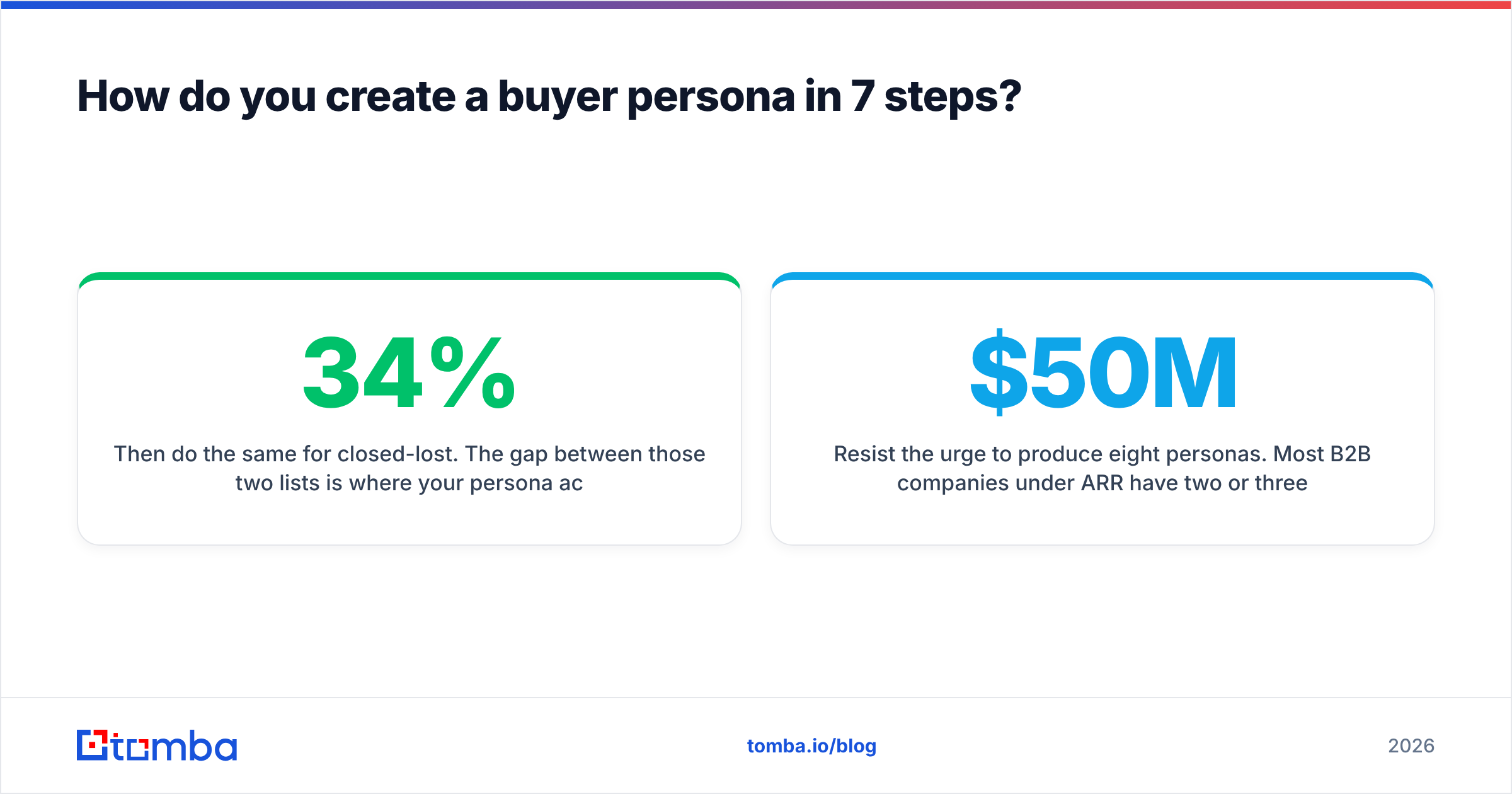
Then do the same for closed-lost. The gap between those two lists is where your persona actually lives. If VP Marketing champions close at 34% and Marketing Managers close at 9%, your persona is the VP — regardless of who fills out the most demo forms.
Step 2: Recruit 8-12 interviewees#
You want a mix: five recent closed-won champions, three closed-lost prospects, and two or three customers who churned. Churned customers are the highest-signal group and the hardest to get on the phone — offer a gift card and be explicit that you're not selling.
Eight interviews is roughly where themes start repeating. Past twelve you're mostly confirming what you already heard. This mirrors what qualitative researchers call saturation, and it holds up well in B2B.
Step 3: Run the interviews with a fixed script#
Don't freestyle. Use the same open questions every time so you can compare answers across transcripts:
- Walk me through the day you decided to look for a solution. What happened?
- What did you try first, before you evaluated tools?
- Who else was involved, and what did each of them care about?
- What almost stopped you from buying?
- If you had to explain what we do to a peer, what would you say?
Record everything (with permission) and keep verbatim quotes. Quotes are the deliverable — paraphrases lose the vocabulary you came for.
Step 4: Layer in firmographic and technographic enrichment#
Interviews tell you why. Data tells you how many and where. Take the account list from Step 1, run it through a data enrichment pass, and look for patterns your reps can filter on: headcount growth rate, funding events, specific tools in the stack, number of offices, department size.
This is what turns a persona from a narrative into a targeting query. "Director of Demand Gen at a 200-800 person B2B SaaS company that runs HubSpot and hired two SDRs in the last quarter" is something you can actually build a list against.
Step 5: Cluster the findings into 2-4 personas — no more#
Resist the urge to produce eight personas. Most B2B companies under $50M ARR have two or three that matter: the champion, the economic buyer, and sometimes a technical blocker.
Cluster on buying behavior, not demographics. Two people with the same title who buy for completely different reasons are two personas. Two people with different titles who buy for the same reason and evaluate the same way are one persona.
Step 6: Write the persona document#
Keep it to one page per persona. Required fields:
- Role and reporting line — who they report to, who reports to them, budget authority in dollars
- Trigger events — the three to five situations that start a search, in their words
- Success metrics — the number their boss grades them on this quarter
- Objection stack — ranked list of what they push back on, with the response that has worked
- Evaluation behavior — where they research, who they ask, how long they take, which review sites they check (G2 and Capterra still dominate B2B software research)
- Verbatim quotes — five to eight direct quotes, unedited
Notice what's absent: age, hobbies, a photo, a cute alliterative name. None of those change a single word of your outreach.
Step 7: Wire it into the workflow#
A persona that lives in a doc is dead. Put it where work happens:
- Add a persona field to your CRM contact records and make it required on opportunity creation
- Build a sequence per persona rather than one generic sequence
- Add the objection stack to your battle cards
- Score inbound leads against persona fit, not just engagement
HubSpot's own research team publishes a reasonable persona framework if you want a second structural reference before you commit to a template.
What should a buyer persona template actually include?#
Here's a side-by-side of what to keep and what to cut. The right column is where most templates go wrong.
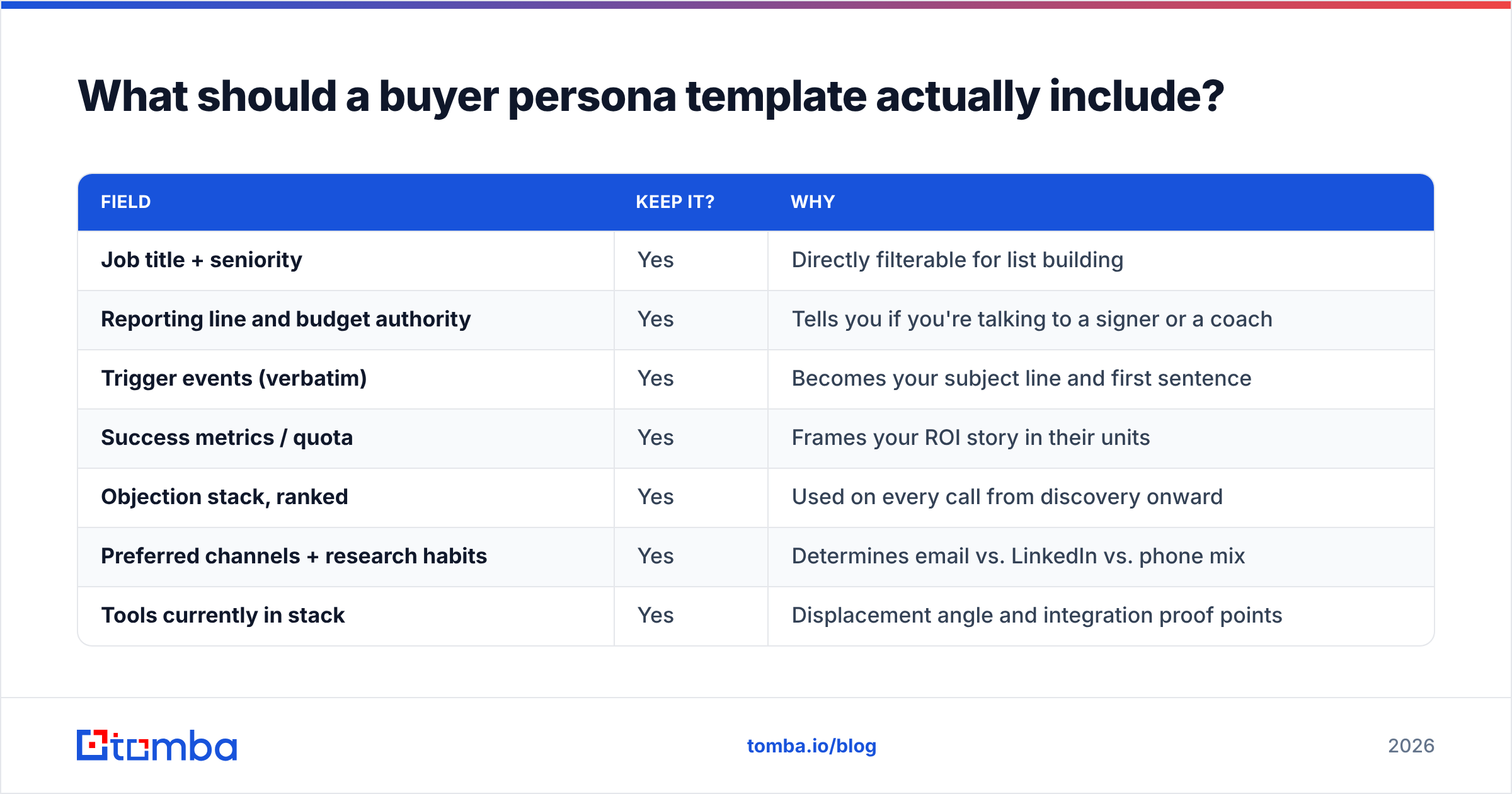
| Field | Keep it? | Why |
|---|---|---|
| Job title + seniority | Yes | Directly filterable for list building |
| Reporting line and budget authority | Yes | Tells you if you're talking to a signer or a coach |
| Trigger events (verbatim) | Yes | Becomes your subject line and first sentence |
| Success metrics / quota | Yes | Frames your ROI story in their units |
| Objection stack, ranked | Yes | Used on every call from discovery onward |
| Preferred channels + research habits | Yes | Determines email vs. LinkedIn vs. phone mix |
| Tools currently in stack | Yes | Displacement angle and integration proof points |
| Age range, gender, photo | No | Never changes messaging; adds bias risk |
| Hobbies and personal life | No | Invented in 95% of templates; reps ignore it |
| Cute alliterative name | No | Signals the persona is fiction, kills credibility |
| Generic goals ("grow revenue") | No | True of everyone; not actionable |
| Personality type / DISC label | Rarely | Useful in enterprise, noise in SMB velocity motions |
A one-page persona with the eight "yes" fields beats a six-page persona with all of them.
Where do you get the data without a research budget?#
You have more raw material than you think, and most of it is free.
Sources ranked by signal-to-effort:
- Call recordings — Gong, Chorus, or even Zoom transcripts. Search for the phrase "the reason we started looking" across 50 calls and you have your trigger events without booking a single interview.
- Closed-lost notes — Filter your CRM for lost reasons over the last four quarters. Cluster them. That's your objection stack, pre-ranked by frequency.
- Support tickets and onboarding calls — Where the promise met reality. Excellent for the "success metrics" field.
- Review sites — Read G2 reviews of your competitors, not yourself. The "what problem were you solving" field on those reviews is free qualitative research at scale.
- Community and subreddit threads — Search for your category name plus "recommendations." You'll get unfiltered vocabulary.
- Your own inbox — Replies to cold email, including the rude ones, tell you exactly which framing lands and which insults their intelligence.
For the outbound side, once you know the titles and company profiles that match, the mechanical work is list building. A domain search across your target account list surfaces the people holding those titles, and a bulk email finder run turns the shortlist into contactable records without manual lookup.
How do you validate a persona before you bet a quarter on it?#
Run a controlled test. Personas are hypotheses, and hypotheses get tested.
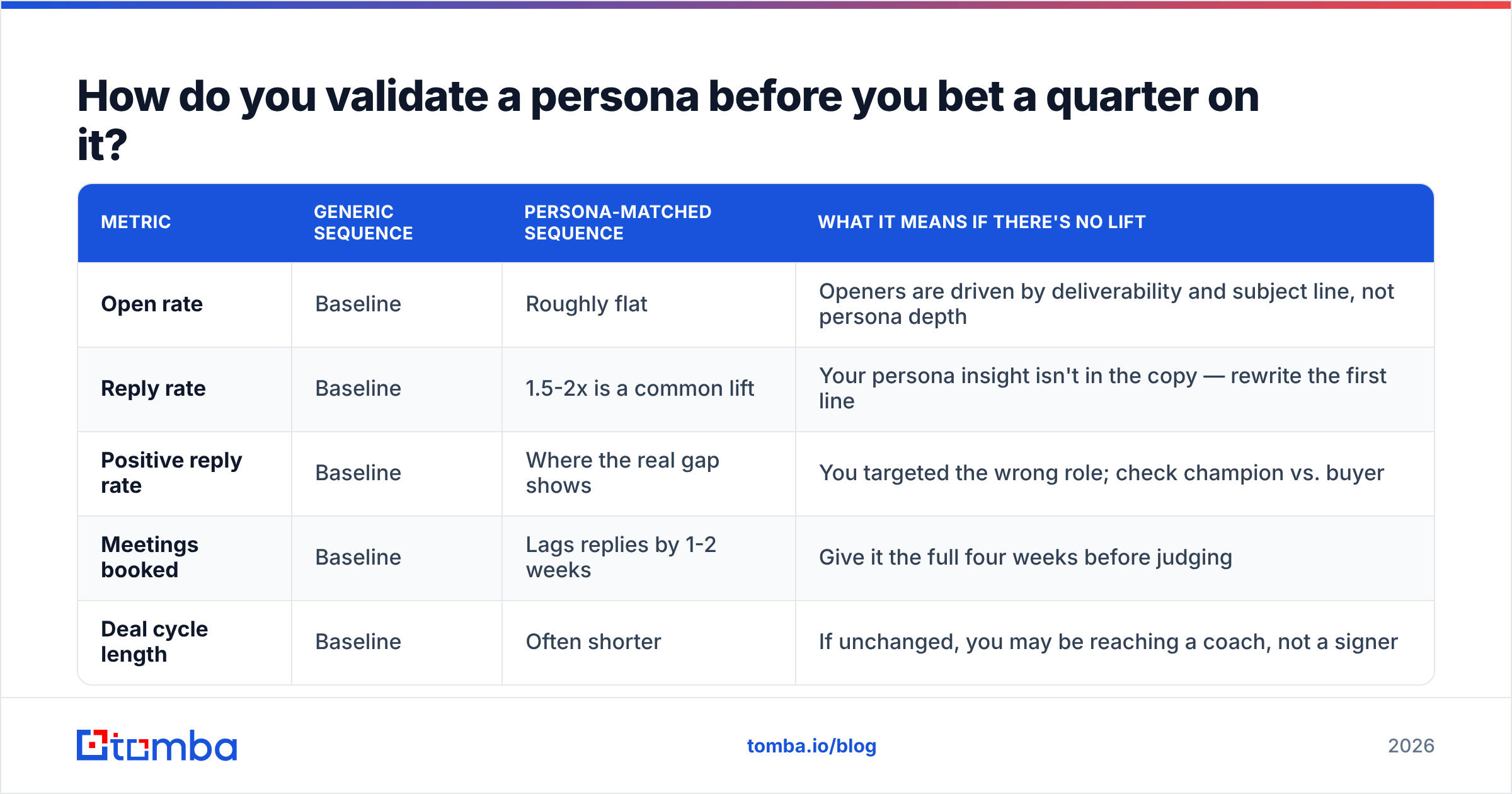
Pick one persona, build a 150-contact segment that matches it exactly, and run a sequence written specifically for that persona's trigger event and vocabulary. Run a control segment of 150 contacts from your generic list with your existing generic sequence. Compare reply rate, positive reply rate, and meetings booked over four weeks.
Reasonable expectations:
| Metric | Generic sequence | Persona-matched sequence | What it means if there's no lift |
|---|---|---|---|
| Open rate | Baseline | Roughly flat | Openers are driven by deliverability and subject line, not persona depth |
| Reply rate | Baseline | 1.5-2x is a common lift | Your persona insight isn't in the copy — rewrite the first line |
| Positive reply rate | Baseline | Where the real gap shows | You targeted the wrong role; check champion vs. buyer |
| Meetings booked | Baseline | Lags replies by 1-2 weeks | Give it the full four weeks before judging |
| Deal cycle length | Baseline | Often shorter | If unchanged, you may be reaching a coach, not a signer |
If the persona-matched segment doesn't beat the control on positive reply rate, the persona is wrong or the copy didn't use it. Both are fixable, and both are worth knowing before you rebuild your whole sequence library.
One caveat that ruins a lot of these tests: bad data. If 22% of your persona-matched segment bounces, you're measuring list hygiene, not messaging. Run the segment through an email verifier first so the comparison is fair. Bounce noise has killed more persona experiments than bad copy has.
How often should you rebuild your buyer personas?#
Every two quarters for a light refresh, annually for a full rebuild. Trigger an immediate review when any of these happen:
- You change pricing. New price points attract a different buyer with different approval thresholds.
- You ship a major product line. New capability, new job title that cares about it.
- Your win rate drops in a segment. Often the first sign the persona drifted, not that the reps got worse.
- A category competitor repositions. The evaluation criteria your buyer uses shift with the market narrative.
- Your ACV moves up or down 30%+. Above roughly $50K ACV you're selling to a committee; below $15K you're often selling to a single practitioner. Those are different personas entirely.
The light refresh is cheap: three interviews, a fresh CRM pull, and an hour updating the objection stack. Do it on a calendar, not when someone remembers.
What are the most common buyer persona mistakes?#
- Building personas from internal opinion. If nobody on the project talked to a customer, you documented your assumptions and gave them a name.
- Confusing the user with the buyer. The person who uses the product daily often has zero budget authority. Both matter; treat them as separate personas with separate messaging.
- Ignoring the blocker. Security, legal, and procurement kill more late-stage deals than competitors do. If your enterprise motion has no security-reviewer persona, you'll keep losing at week nine.
- Over-segmenting. Eight personas means no persona gets maintained. Three, maintained well, will outperform.
- Never testing it. A persona nobody validated against real reply data is a belief, not a finding.
- Letting it go stale silently. Personas decay quietly. Nothing breaks; win rates just erode a point at a time.
Turn the persona into a real contact list#
A finished persona is a targeting spec: these titles, at these company profiles, with these tools in their stack. The next step is turning that spec into a list of real, reachable people — which is where most persona work stalls.
That's the gap Tomba Email Finder closes. Feed it the domains from your ICP and the titles from your persona, and it returns verified professional email addresses with confidence scores, so the segment you test is the segment you defined. Start on the free tier (25 searches a month, no card) to validate one persona; the Starter plan at $49/mo covers a typical two-persona outbound test, and Growth at $99/mo handles ongoing list building for a full SDR team. Full Tomba pricing is public if you want to size it against your volume first.
Build the persona from evidence. Then go find the people who match it.
Related guides#
// get started
Find, verify and enrich your first contacts today
Start on the free plan with 25 searches a month, then scale when your team is ready.
Free plan · No credit card required · GDPR & CCPA
// about the author