How to Create a Cold Call Script That Actually Books Meetings
Most cold call scripts fail in the first eight seconds. Here is a seven-part framework, a line-by-line build, and the objection handling that keeps reps on the phone long enough to book the meeting.
TL;DR
- A cold call script is not a word-for-word reading — it is a decision tree with fixed openers, flexible middles, and one hard ask.
- The first 8 seconds decide the call. Use a permission-based opener that names the reason you dialed, not a "how are you today?"
- Build the script in seven parts: opener, reason for the call, problem hypothesis, qualifying questions, objection branches, the ask, and the fallback.
- Scripts fail more often from bad data than bad wording. If the phone number belongs to the wrong person, no line saves the call.
- Test one variable per week — opener, hypothesis, or ask — and track connect-to-meeting rate, not dials.
What is a cold call script, and what is it not?#
A cold call script is a written decision tree for a conversation you have not had yet. It fixes the parts that must be consistent (the first two sentences, the ask) and leaves the rest as branches you choose based on what the prospect says.
Think of it like a pilot's checklist. Nobody claims a checklist makes you a pilot. It stops a competent pilot from forgetting the landing gear when they are tired at 4pm on their fortieth call. That is the same job a script does for a rep on dial 40.
What a script is not: a monologue. If you can read your script aloud end-to-end without pausing for a human to respond, you wrote a voicemail, not a script. Prospects hear read-aloud copy immediately — the cadence is wrong, the breathing is wrong, and the pitch drops at the end of every sentence.
Two failure modes kill most first drafts:
- Too rigid. The rep hits an unscripted response and freezes, then restarts the pitch from the top.
- Too loose. "Just have a conversation" produces forty different pitches from forty reps, and you cannot tell what is working.
The fix is structure with named branches. You write the openers and objection responses verbatim, and you write the middle as questions rather than statements.
What are the seven parts of a cold call script?#
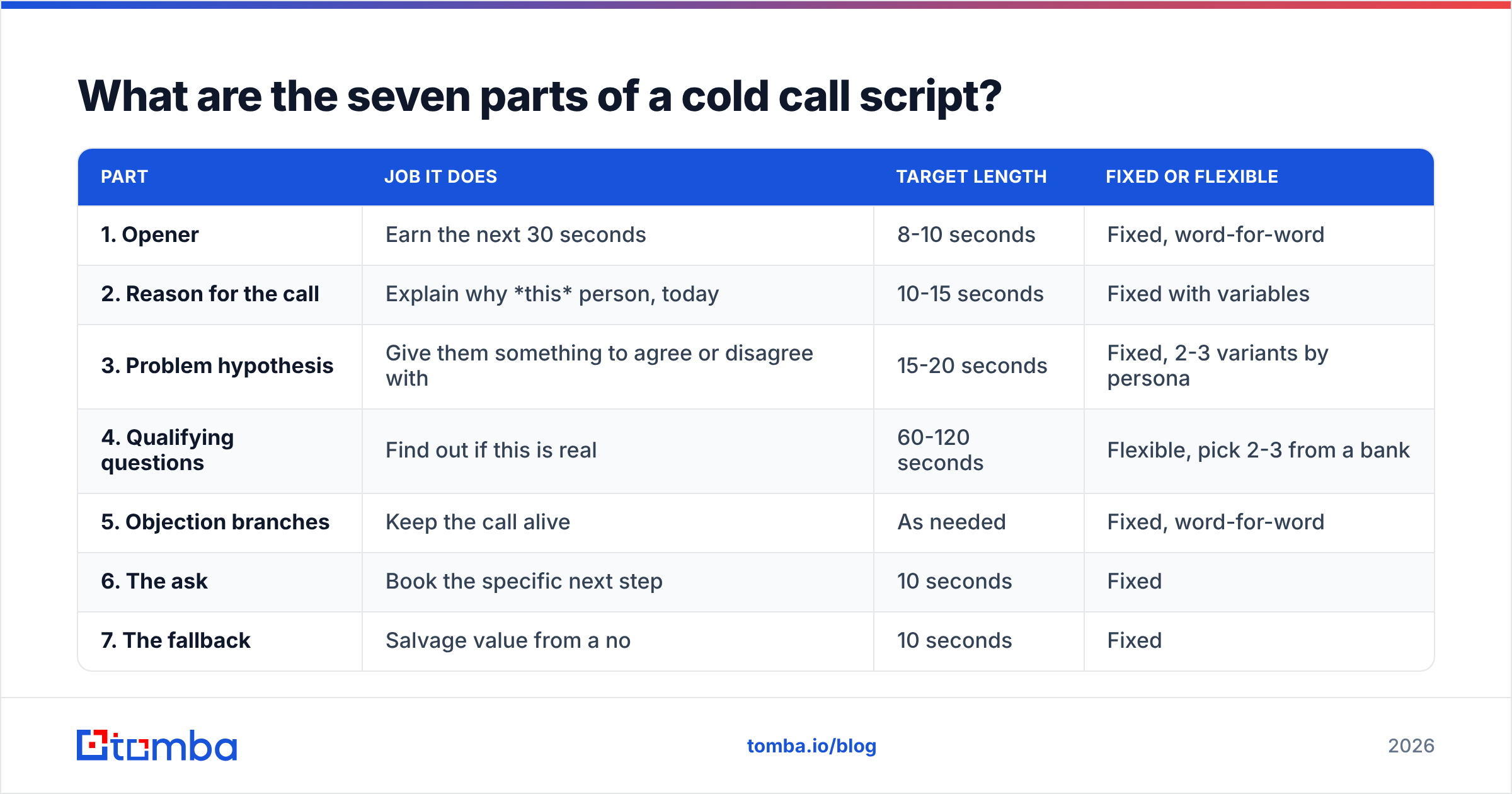
Every script that survives contact with real prospects has the same skeleton. Here is the full structure with the job each part does and how long it should run.
| Part | Job it does | Target length | Fixed or flexible |
|---|---|---|---|
| 1. Opener | Earn the next 30 seconds | 8-10 seconds | Fixed, word-for-word |
| 2. Reason for the call | Explain why this person, today | 10-15 seconds | Fixed with variables |
| 3. Problem hypothesis | Give them something to agree or disagree with | 15-20 seconds | Fixed, 2-3 variants by persona |
| 4. Qualifying questions | Find out if this is real | 60-120 seconds | Flexible, pick 2-3 from a bank |
| 5. Objection branches | Keep the call alive | As needed | Fixed, word-for-word |
| 6. The ask | Book the specific next step | 10 seconds | Fixed |
| 7. The fallback | Salvage value from a no | 10 seconds | Fixed |
The ratio matters as much as the parts. Parts 1-3 are you talking, and together they should run under 45 seconds. Part 4 is them talking, and it should run two to three times longer than everything you said combined. If your talk-to-listen ratio on connected calls is above 50%, your script is a pitch wearing a costume. Gong's conversation research has consistently found that successful discovery calls skew heavily toward prospect talk time.
How do you write the opener?#
Name yourself, name your company, then name why you dialed — in that order, in under ten seconds.
The three openers that reliably outperform "how are you doing today?":
The permission opener. "Hi Dana, it's Marcus from Northbeam. I know I'm an interruption — can I take thirty seconds to tell you why I called, and you can tell me to get lost?" This works because it acknowledges reality and hands them control. The "tell me to get lost" line gives them a socially easy exit, which paradoxically makes them less likely to take it.
The reason-first opener. "Hi Dana, Marcus from Northbeam. I'm calling because I saw you're hiring three more SDRs this quarter and I had a specific question about how you're handling data for the new team." Skips the pleasantries and leads with research. Requires that your research is real.
The direct opener. "Hi Dana, Marcus here from Northbeam. This is a cold call — do you want to hang up, or give me a minute?" Blunt, polarizing, and gets a laugh often enough to be worth testing. It underperforms with senior enterprise buyers and overperforms with founders and sales leaders.
What to cut from every opener:
- "How are you today?" — signals a cold call before you finish the sentence.
- "Did I catch you at a bad time?" — you did, and you just handed them the word "yes."
- "I'll be quick" — everyone says it, nobody is.
- Your title — nobody has ever booked a meeting because the caller was a Senior Account Executive.
- A question about their day — you are not owed that yet.
Say your name at normal speed and your company at normal speed. Reps rush both, and the prospect spends the next fifteen seconds trying to figure out who is talking instead of listening.
What goes in the reason for the call and the problem hypothesis?#
The reason is one sentence of specificity. The hypothesis is one sentence of tension.
The reason ties the call to something observable about their company: a hire, a funding round, a product launch, a tech stack change, a job posting, a conference talk. "I saw you posted for two RevOps roles last month" is a reason. "I wanted to introduce myself" is not.
The hypothesis is where most scripts go soft. You want a statement that is specific enough that they can disagree with it. Vague hypotheses get vague agreement, and vague agreement does not book meetings.
Weak: "A lot of companies struggle with data quality." Strong: "Most teams hiring two RevOps people at once are doing it because the CRM has drifted far enough that nobody trusts the pipeline number in the Monday meeting. Is that anywhere close?"
The second version invites a correction. Corrections are gold — when a prospect says "no, it's actually the attribution model," they just did your discovery for you and started talking about their real problem.
Write two or three hypothesis variants per persona. A VP of Sales, a RevOps manager, and a founder do not lose sleep over the same thing, and one generic hypothesis will land with none of them.
What are the best qualifying questions to script?#
Script a bank of eight to ten and pick two or three live. Never run all of them — this is a cold call, not a discovery call.
- Current state question. "How are you handling [the specific process] right now?" Establishes the baseline without assuming pain.
- Volume or scale question. "How many [reps / accounts / lists] are running through that each month?" Numbers make the problem concrete and help you size the deal.
- Cost-of-the-status-quo question. "When that breaks, who notices first?" Better than "what does it cost you" — people rarely know the dollar figure, but they always know who yells.
- Prior-attempt question. "Have you looked at solving this before?" Tells you whether you are teaching a new category or displacing an incumbent.
- Timing question. "Is this a this-quarter problem or a someday problem?" Disqualifies fast, which is the point.
- Authority question. "If you decided to fix this, who else would be in that conversation?" Softer and more accurate than "are you the decision maker?"
The most common scripting mistake here is writing questions you already know the answer to. If your data enrichment already told you they run HubSpot with 40 seats, do not ask what CRM they use. Ask what broke.
How do you handle objections without sounding scripted?#
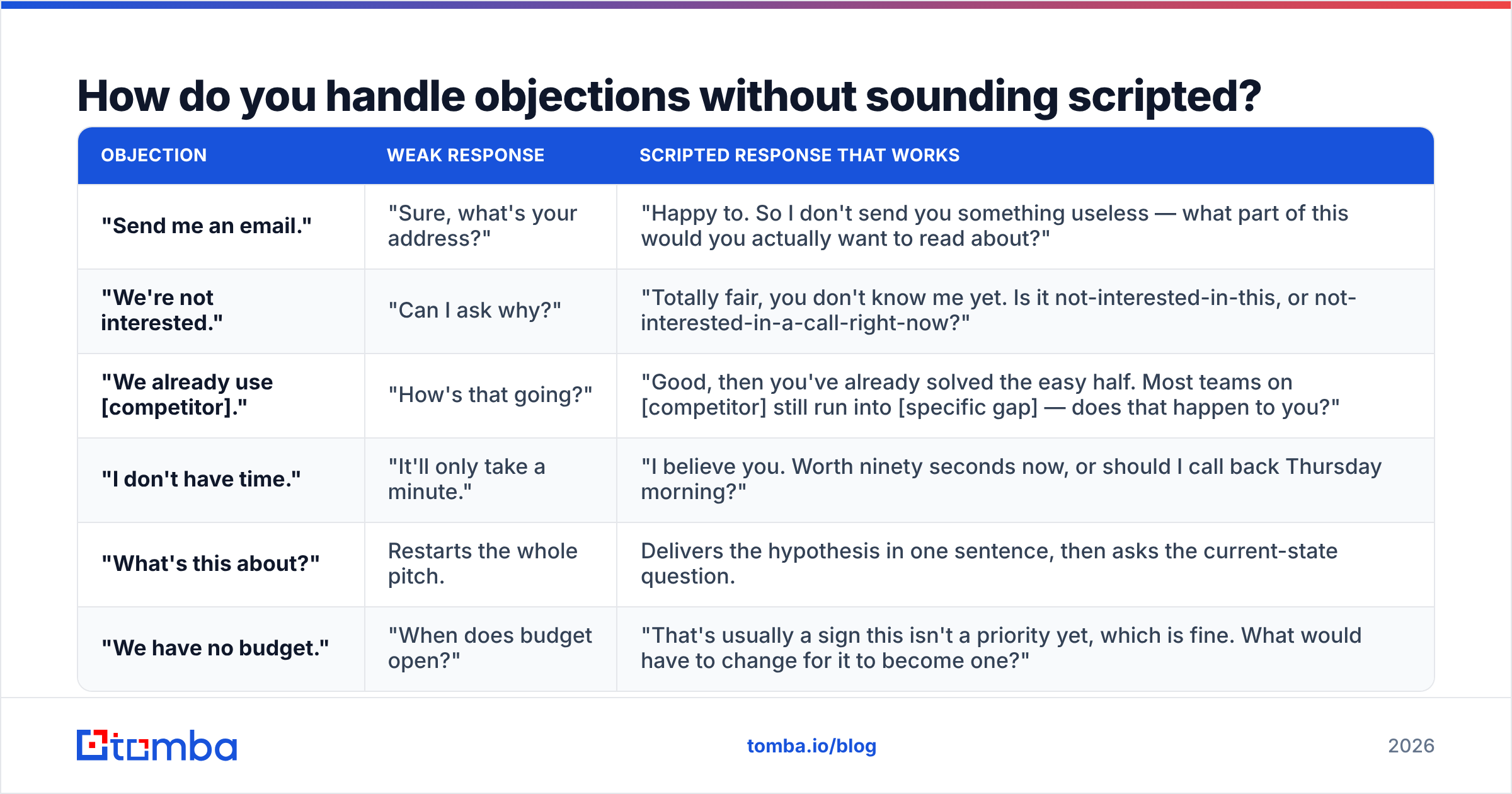
Write the first sentence of every objection response word-for-word, then improvise from sentence two.
The reason: objections trigger a fight-or-flight response in reps, and under stress you fall back to whatever is memorized. Give yourself something good to fall back to.
| Objection | Weak response | Scripted response that works |
|---|---|---|
| "Send me an email." | "Sure, what's your address?" | "Happy to. So I don't send you something useless — what part of this would you actually want to read about?" |
| "We're not interested." | "Can I ask why?" | "Totally fair, you don't know me yet. Is it not-interested-in-this, or not-interested-in-a-call-right-now?" |
| "We already use [competitor]." | "How's that going?" | "Good, then you've already solved the easy half. Most teams on [competitor] still run into [specific gap] — does that happen to you?" |
| "I don't have time." | "It'll only take a minute." | "I believe you. Worth ninety seconds now, or should I call back Thursday morning?" |
| "What's this about?" | Restarts the whole pitch. | Delivers the hypothesis in one sentence, then asks the current-state question. |
| "We have no budget." | "When does budget open?" | "That's usually a sign this isn't a priority yet, which is fine. What would have to change for it to become one?" |
Two rules that keep these from sounding robotic:
- Agree before you redirect. "Totally fair," "I believe you," "Good" — a half-second of agreement drops the defensive posture before you ask the next question.
- Never handle the same objection twice. If they say no twice, take the no and use your fallback. Reps who push through a third objection burn the account and the number.
How does data quality change your script's results?#
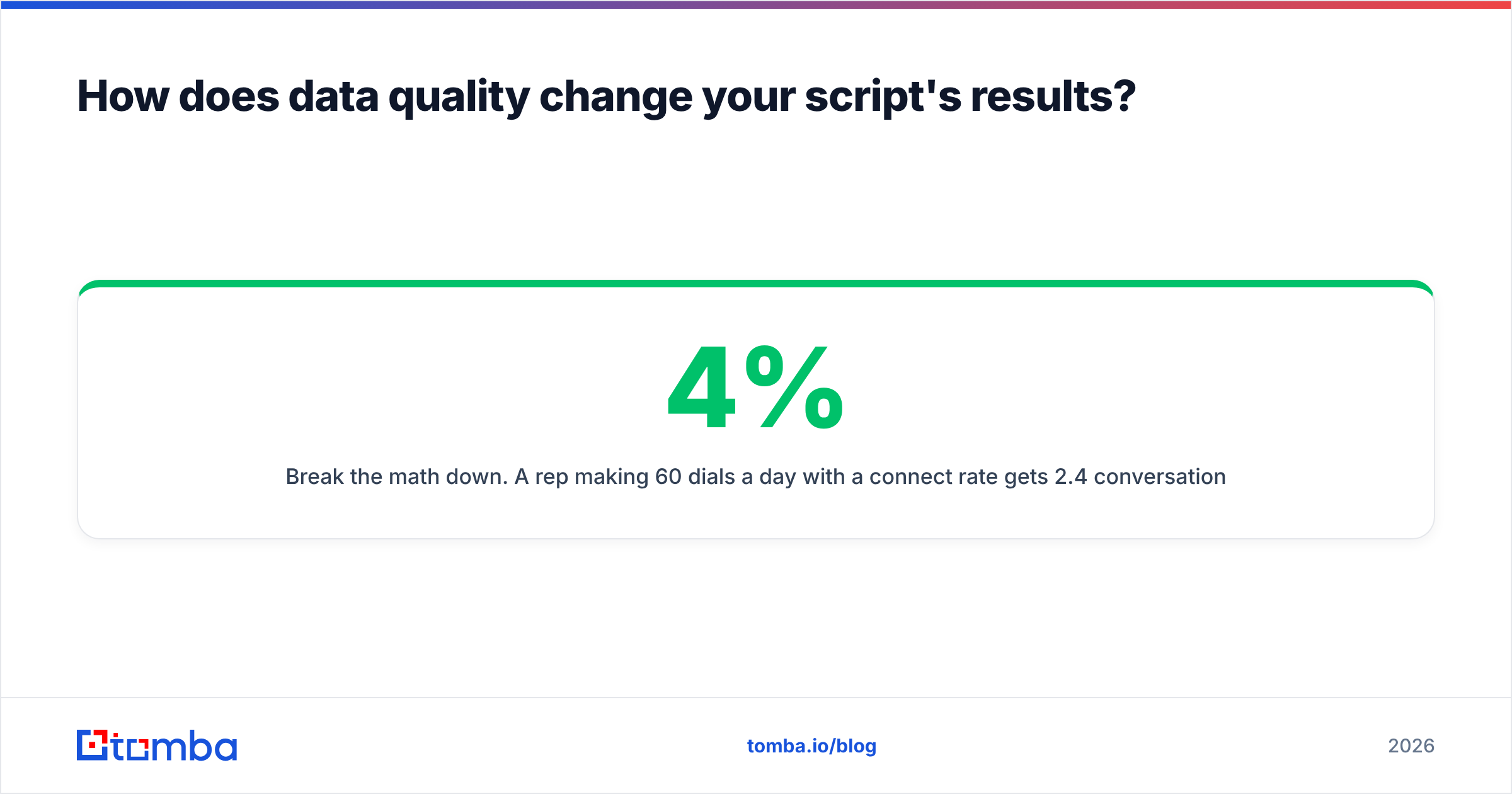
More than any wording change you will ever make. A brilliant script dialed into wrong numbers converts at zero.
Break the math down. A rep making 60 dials a day with a 4% connect rate gets 2.4 conversations. Push the connect rate to 12% by fixing the data, and the same 60 dials produce 7.2 conversations — a 3x improvement without editing a single line of the script.
Three data problems that silently destroy cold call performance:
- Wrong-person numbers. Main switchboards and old direct dials burn the dial without a conversation. A dedicated phone finder that returns verified direct dials changes your connect rate more than any opener test.
- Stale titles. Your hypothesis assumes a VP of Sales. They were promoted to CRO nine months ago, or they left. Enrichment that refreshes on a cycle prevents an opener that instantly signals stale research.
- No email follow-up path. Most connected cold calls end with "send me something." If you cannot reliably reach their inbox afterward, half your positive outcomes evaporate. Pair the call list with a verified email finder run so the follow-up actually lands.
This is also why the pre-call research block belongs in your script document, not just in your head. Write down the three fields a rep must have before dialing — verified direct dial, current title, and one company trigger event — and treat a missing field as a reason not to dial. Running the list through a phone validator before it hits the dialer removes disconnected numbers that would otherwise eat a third of the day.
Should you use an AI-generated cold call script?#
Use AI for the first draft and the variant generation, never for the final version.
What large language models are genuinely good at here: producing eight opener variants in ten seconds, rewriting a clunky objection response, and adapting one script to five personas. What they are bad at: knowing which specific phrase makes a CFO in logistics hang up. That knowledge lives in your call recordings.
A workable process:
- Draft with AI using your real ICP, real product, and three real objections you have heard.
- Strip the tells. Cut "leverage," "solutions," "in today's landscape," and any sentence with three commas. Read it aloud — if you run out of breath, it is too long for the phone.
- Record yourself reading each branch. The parts you stumble over are the parts a prospect will not follow either.
- Field-test 40 dials before changing anything.
- Cut what nobody ever gets to say. Most first drafts have a whole section that never survives to be spoken.
The tell for an AI script is rhythm, not vocabulary. Human phone speech is short, uneven, and full of half-sentences. Model output is uniform-length declaratives. Break every third sentence in half.
How do you test and improve a cold call script?#
Change one variable per week and measure connect-to-meeting rate, not dial volume.
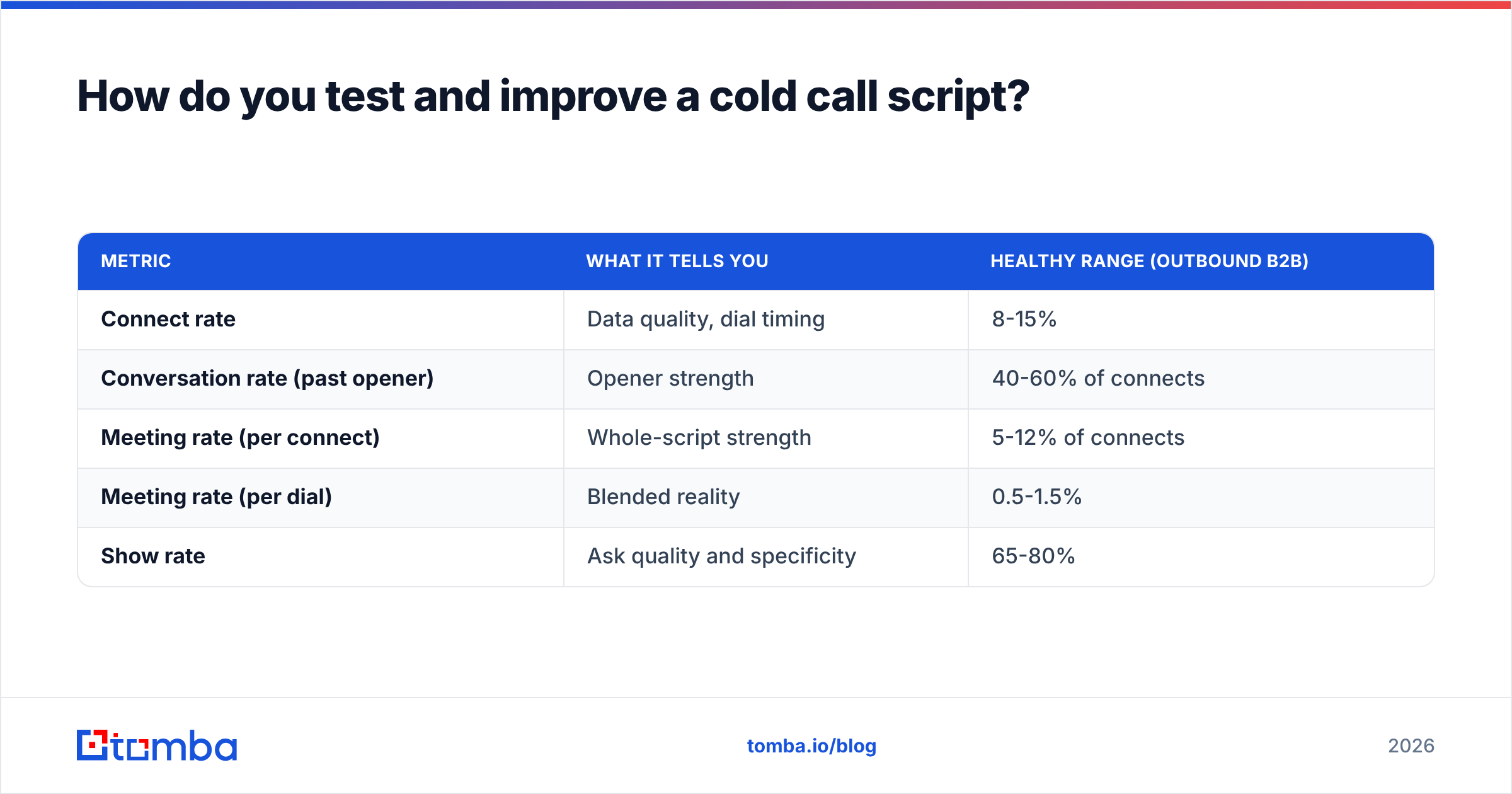
| Metric | What it tells you | Healthy range (outbound B2B) |
|---|---|---|
| Connect rate | Data quality, dial timing | 8-15% |
| Conversation rate (past opener) | Opener strength | 40-60% of connects |
| Meeting rate (per connect) | Whole-script strength | 5-12% of connects |
| Meeting rate (per dial) | Blended reality | 0.5-1.5% |
| Show rate | Ask quality and specificity | 65-80% |
If your conversation rate is low, the opener is the problem. If conversations are long but meetings are rare, the ask is the problem — usually because it is vague. "Would it make sense to grab some time?" is not an ask. "I've got Thursday at 10 or Friday at 2 — which is easier?" is an ask.
Test protocol that avoids fooling yourself:
- Minimum 100 dials per variant before you call anything a winner. Small samples produce confident nonsense.
- One variable at a time. Change the opener OR the hypothesis, never both.
- Same rep, same time block, same list quality. Otherwise you are testing the rep, not the script.
- Log verbatim objections weekly. New objections mean the market moved, and your branches need a new leaf.
Run a monthly review where each rep brings the one line they always skip and the one line that always works. The skipped lines get cut. The working lines get promoted into the fixed section for everyone. Sales teams that treat scripts as living documents rather than onboarding artifacts see the compounding gains; HubSpot's sales research repeatedly points to structured, coached call frameworks over ad-hoc calling.
What does a finished cold call script look like?#
Here is the whole thing assembled, for a hypothetical RevOps tool calling a VP of Sales at a 200-person SaaS company.
Opener: "Hi Dana, it's Marcus from Northbeam. I know I'm an interruption — can I take thirty seconds to tell you why I called, and then you can tell me to get lost?"
Reason: "You posted for two RevOps roles last month, and you're the third sales leader this week hiring for that exact seat."
Hypothesis: "Usually when a team does that, it's because the pipeline number in the Monday meeting stopped matching reality and nobody can say why. Is that close, or is it something else?"
Qualify: "How are you catching that today?" → "How many reps are feeding that pipeline?" → "When the number's wrong, who notices first?"
Ask: "Based on what you just said, I think a 20-minute walkthrough is worth your time. I've got Thursday at 10 or Friday at 2 — which is easier?"
Fallback: "No problem. Can I send you the one-page breakdown of how the other two teams fixed it, and check back in a quarter?"
Six blocks. Under 250 words. Every rep can hold it in their head by day three, and the branches live on a second page they only open when they need them.
Build the list your script deserves#
A script is the second half of the job. The first half is dialing a number that belongs to the right person, at the right company, with a title that is still current — and having a verified email ready for the "send me something" that ends half your good calls.
That is what Tomba's Email Finder is built for: verified professional emails by domain, name, or company, so your follow-up lands in the inbox instead of bouncing. Pair it with the phone finder for direct dials and the free tier gives you 25 searches a month to test the workflow before committing. Paid plans start at $49/mo on Starter, $99/mo on Growth — full Tomba pricing is on the site.
Write the script. Then go get the numbers that make it worth reading.
Related guides#
// get started
Find, verify and enrich your first contacts today
Start on the free plan with 25 searches a month, then scale when your team is ready.
Free plan · No credit card required · GDPR & CCPA
// about the author