How to Create a Sales Funnel That Actually Converts in 2026
Most sales funnels leak because the top is built on bad data and the middle has no exit criteria. Here is a 6-stage build you can ship in a week, with real conversion benchmarks and the tools that fit each stage.
TL;DR
- A sales funnel is not a diagram — it is a set of stages with written entry and exit criteria, an owner, and a conversion rate you measure weekly.
- Build it in six stages: awareness, capture, qualification, evaluation, decision, expansion. Anything more granular collapses under its own admin cost.
- Most funnels leak at the top, not the bottom. Bad contact data and vague MQL definitions kill more pipeline than weak closing skills.
- Benchmark yourself: a healthy B2B funnel converts roughly 2-5% of visitors to leads, 15-25% of qualified leads to opportunities, and 20-30% of opportunities to closed-won.
- Instrument before you optimise. If you cannot say what percentage of stage-2 deals reach stage-3, you are guessing, not managing.
What is a sales funnel, and why do most of them fail?#
A sales funnel is a staged model of how a stranger becomes a paying customer, with a measured drop-off rate at every step. Think of it like a stadium turnstile system: thousands approach the gates, fewer make it past ticket check, fewer still find their seats. The funnel's job is not to make the crowd bigger — it is to tell you which turnstile is jammed.
Most funnels fail for a boring reason. They exist as a slide, not as a system. The stages have names but no exit criteria, so a rep can park a deal in "Qualified" for four months and nobody notices. Forecast accuracy dies. The pipeline review turns into storytelling.
A funnel that works has three properties:
- Objective stage transitions. A deal moves from stage 2 to stage 3 because a specific, verifiable thing happened — not because the rep feels good about it.
- A measured conversion rate per stage. You know that 22% of stage-3 deals reach stage-4, and you know last quarter it was 28%.
- A named owner per stage. Marketing owns stages 1-2, SDRs own stage 3, AEs own 4-5, CS owns 6. Ambiguity at the handoff is where deals go to die.
What are the six stages of a modern B2B sales funnel?#
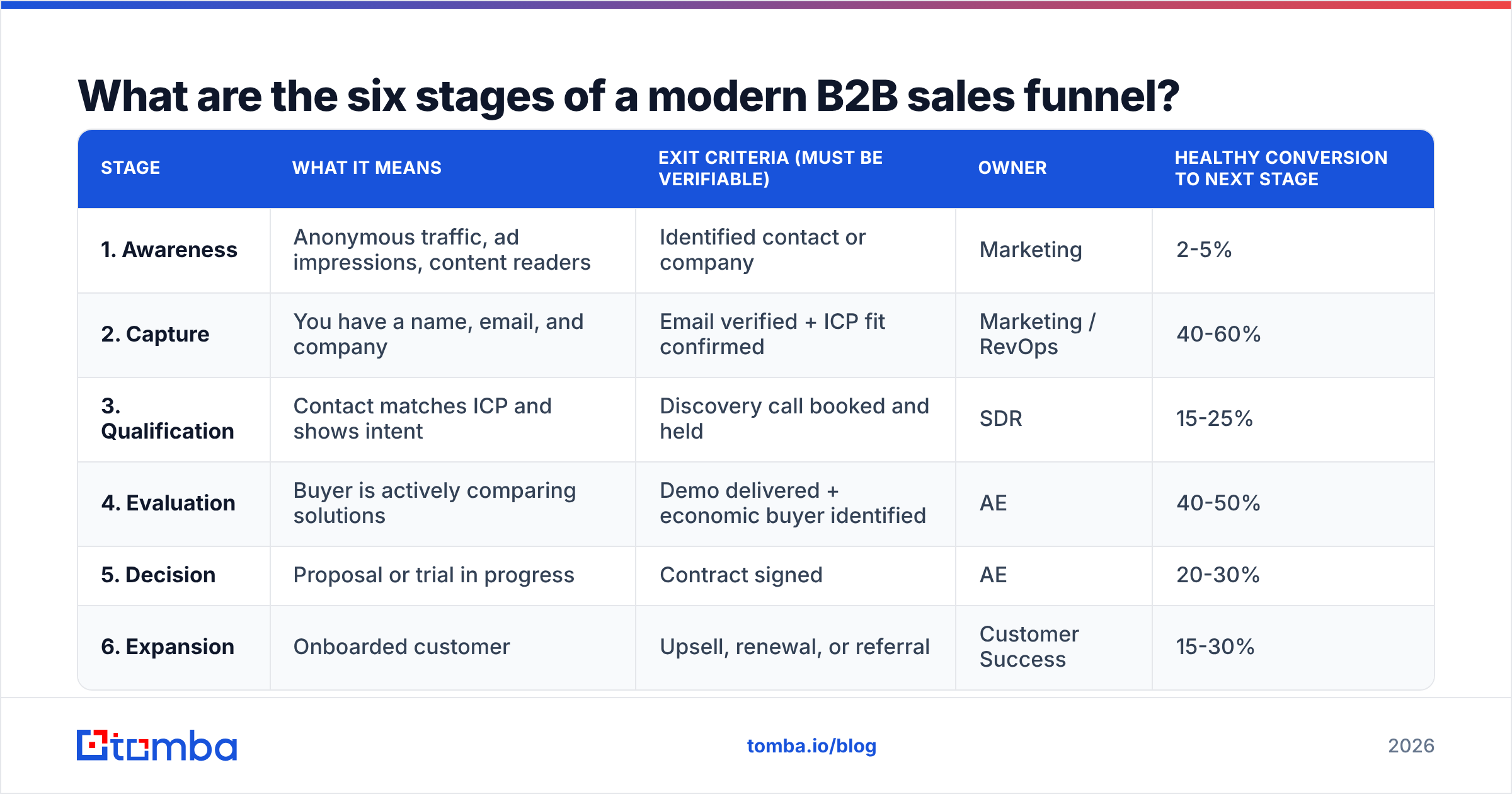
Six stages is the sweet spot. Fewer and you cannot diagnose where the leak is; more and reps start guessing which box to tick.
| Stage | What it means | Exit criteria (must be verifiable) | Owner | Healthy conversion to next stage |
|---|---|---|---|---|
| 1. Awareness | Anonymous traffic, ad impressions, content readers | Identified contact or company | Marketing | 2-5% |
| 2. Capture | You have a name, email, and company | Email verified + ICP fit confirmed | Marketing / RevOps | 40-60% |
| 3. Qualification | Contact matches ICP and shows intent | Discovery call booked and held | SDR | 15-25% |
| 4. Evaluation | Buyer is actively comparing solutions | Demo delivered + economic buyer identified | AE | 40-50% |
| 5. Decision | Proposal or trial in progress | Contract signed | AE | 20-30% |
| 6. Expansion | Onboarded customer | Upsell, renewal, or referral | Customer Success | 15-30% |
Two things to notice. First, the biggest single drop is stage 1 to stage 2 — that is normal and not where your effort should go first. Second, stage 3 to 4 is where most B2B teams actually bleed, because "qualified" is defined loosely. If your stage-3 to stage-4 rate is under 12%, your qualification criteria are decorative.
How do you build stage 1 and 2 without wasting budget?#
Start with the definition of who you are trying to reach, then work backwards to channels. The order matters — most teams pick channels first and reverse-engineer a persona to justify the spend.
Write your ICP as a filter, not a description:
- Firmographics — employee count range, revenue band, geography, industry codes.
- Technographics — what they already run. If your product plugs into a specific CRM or stack, the presence of that tool is a stronger buying signal than headcount.
- Trigger events — funding round, new hire in the buying role, expansion into a new market, a competitor's contract renewal window.
- Disqualifiers — write these down explicitly. Companies under 10 employees, regulated industries you cannot serve, regions you cannot invoice. Disqualifiers save more money than qualifiers make.
For capture, you have three practical routes:
- Inbound content with a gate. Slowest to start, cheapest at scale, best lead quality. Budget six months before it compounds.
- Outbound list building. Fastest to start. Quality depends entirely on your data source — this is where funnels most often rot. You need verified contacts, not scraped guesses.
- Website visitor identification. Turn anonymous traffic into named accounts. Tools like website visitor reveal surface companies already browsing your pricing page — the warmest cold list you will ever get.
For the outbound route, the mechanics are unglamorous: build the account list, find the right person at each account, get a verified email, and enrich the record so your messaging has something to hook onto. A domain search gives you every published address at a target company plus the pattern it uses, which is faster than guessing one contact at a time.
Why does data quality decide your funnel's ceiling?#
Because every downstream stage inherits the errors of the one above it. A 20% bounce rate at stage 2 does not just waste 20% of your sends — it damages sender reputation, which suppresses inbox placement for the 80% of addresses that were fine. One bad list poisons three months of good ones.
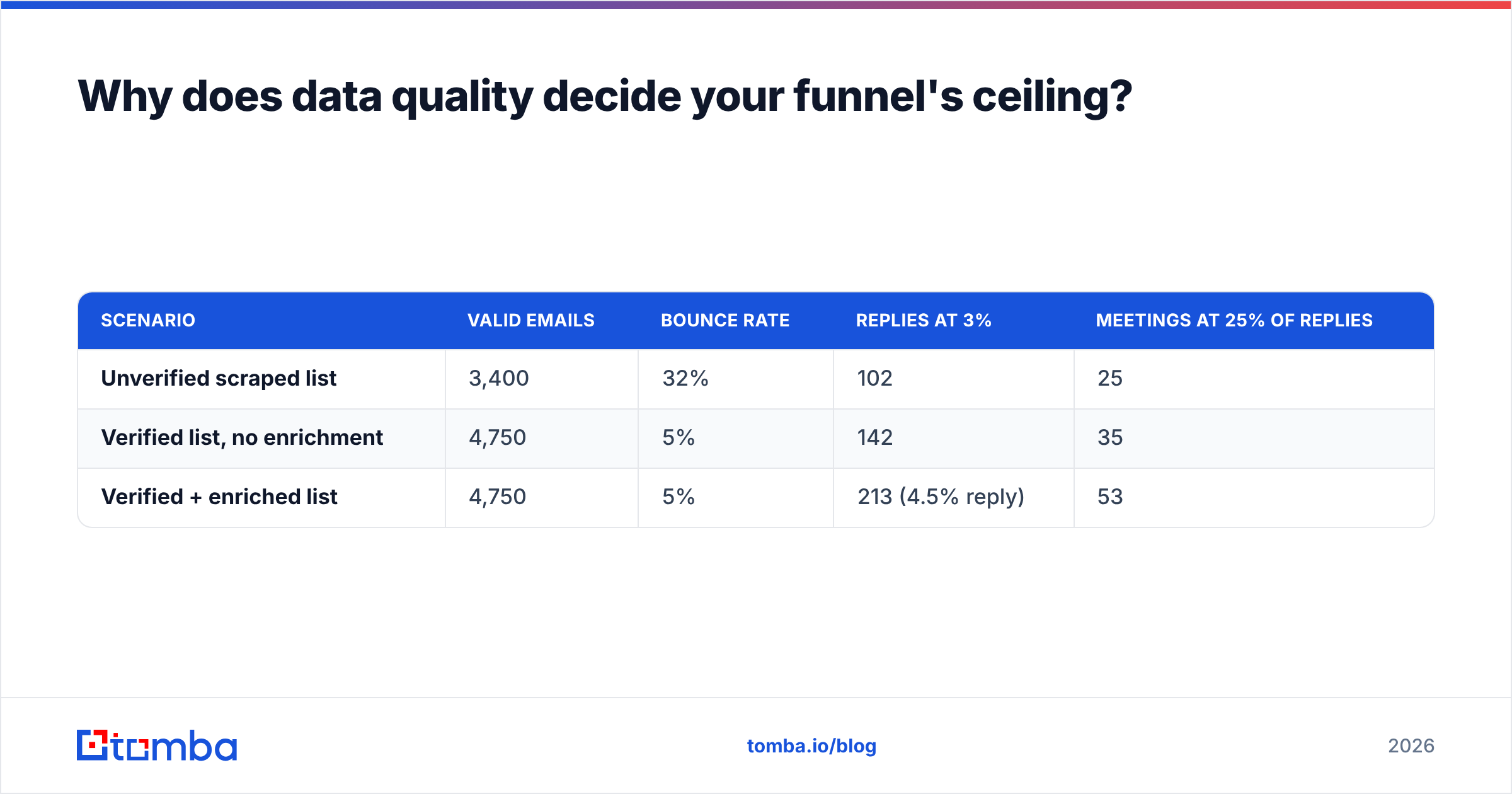
Run the numbers on a 5,000-contact outbound push:
| Scenario | Valid emails | Bounce rate | Replies at 3% | Meetings at 25% of replies |
|---|---|---|---|---|
| Unverified scraped list | 3,400 | 32% | 102 | 25 |
| Verified list, no enrichment | 4,750 | 5% | 142 | 35 |
| Verified + enriched list | 4,750 | 5% | 213 (4.5% reply) | 53 |
Same volume, same reps, same offer. The difference is entirely upstream hygiene. Verification alone adds 40% more replies; enrichment on top of it adds another 50% because the messaging can reference something real.
Practical rules for stage-2 hygiene:
- Verify before every send, not once at import. B2B contact data decays around 22-30% per year as people change jobs. A list verified in January is materially wrong by July.
- Handle catch-all domains separately. They accept everything at the SMTP layer, so a standard check returns "valid" with no real signal. Route them through a catch-all verifier and treat the rest as a lower-confidence segment.
- Deduplicate across sources. Two records for the same person in two campaigns is the fastest way to look amateurish.
- Log the source of every contact. When a segment underperforms, you need to know whether the problem is the message or the list.
How do you define qualification so stage 3 actually filters?#
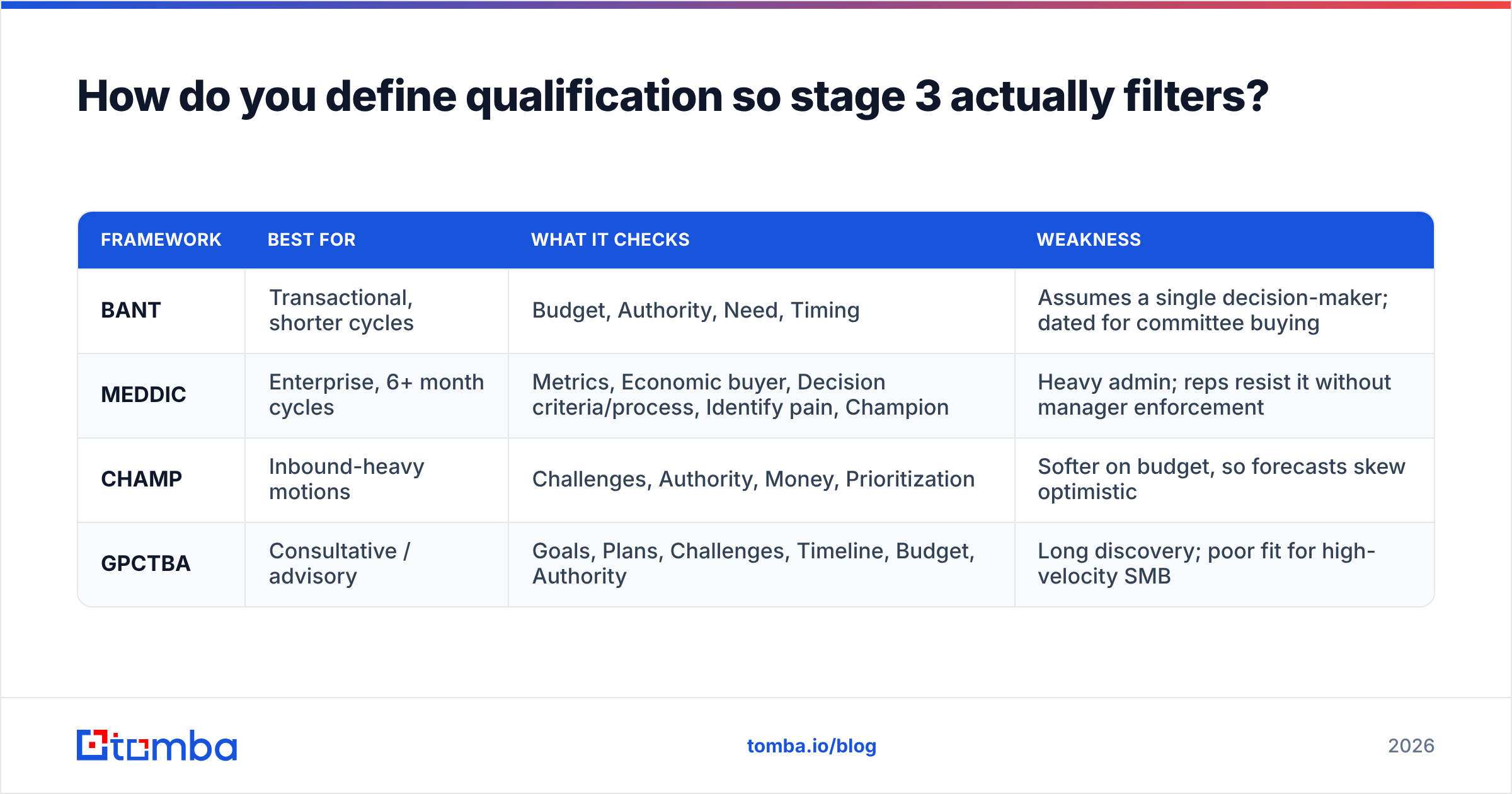
Pick a framework, write it into your CRM as required fields, and make stage advancement impossible without them. The framework matters less than the enforcement.
| Framework | Best for | What it checks | Weakness |
|---|---|---|---|
| BANT | Transactional, shorter cycles | Budget, Authority, Need, Timing | Assumes a single decision-maker; dated for committee buying |
| MEDDIC | Enterprise, 6+ month cycles | Metrics, Economic buyer, Decision criteria/process, Identify pain, Champion | Heavy admin; reps resist it without manager enforcement |
| CHAMP | Inbound-heavy motions | Challenges, Authority, Money, Prioritization | Softer on budget, so forecasts skew optimistic |
| GPCTBA | Consultative / advisory | Goals, Plans, Challenges, Timeline, Budget, Authority | Long discovery; poor fit for high-velocity SMB |
The mistake is adopting MEDDIC for a $4,000 ACV product. Match the qualification weight to the deal size — heavy frameworks on small deals just add cost per lead. As a rough guide: under $10k ACV use BANT or CHAMP, above $50k ACV use MEDDIC.
Whatever you pick, define your marketing qualified lead threshold as a score with explicit components, and review the threshold quarterly. If sales rejects more than 30% of MQLs, the definition is wrong — not the reps.
What tools do you need at each stage?#
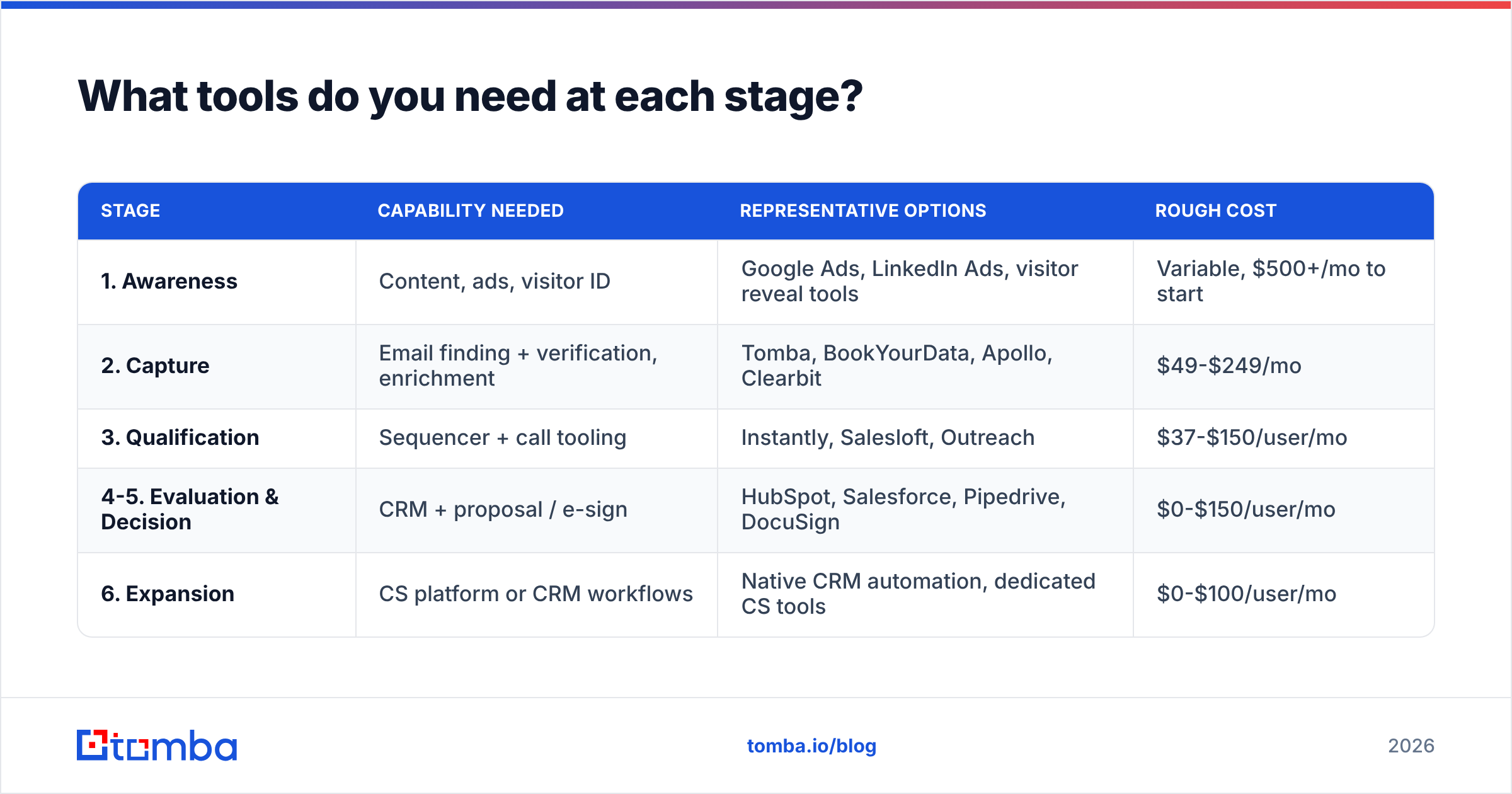
You need fewer than the vendor landscape suggests. A functioning funnel needs four capabilities: data sourcing, engagement, CRM, and analytics. Everything else is optional until you have volume.
| Stage | Capability needed | Representative options | Rough cost |
|---|---|---|---|
| 1. Awareness | Content, ads, visitor ID | Google Ads, LinkedIn Ads, visitor reveal tools | Variable, $500+/mo to start |
| 2. Capture | Email finding + verification, enrichment | Tomba, BookYourData, Apollo, Clearbit | $49-$249/mo |
| 3. Qualification | Sequencer + call tooling | Instantly, Salesloft, Outreach | $37-$150/user/mo |
| 4-5. Evaluation & Decision | CRM + proposal / e-sign | HubSpot, Salesforce, Pipedrive, DocuSign | $0-$150/user/mo |
| 6. Expansion | CS platform or CRM workflows | Native CRM automation, dedicated CS tools | $0-$100/user/mo |
For stage 2 specifically, the choice is between three shapes of vendor. Broad platforms like Apollo bundle data with sequencing but charge for the whole suite. Purchased-list providers such as BookYourData sell verified contacts outright, which suits teams that want a one-time list rather than an ongoing tool — a fair option if your motion is campaign-based rather than continuous. Focused finders like Tomba do sourcing and verification well and hand off to whatever sequencer you already run. Tomba pricing starts free at 25 searches a month, then $49/mo Starter, $99/mo Growth, and $249/mo Pro — which keeps your data layer decoupled from your engagement layer, so you can swap sequencers without rebuilding your list infrastructure.
If you are already running a CRM, wire the data layer into it directly rather than exporting CSVs. A HubSpot integration or the Tomba API means enrichment happens on record creation, so stage-2 hygiene is automatic instead of a monthly cleanup project. HubSpot publishes solid free sales pipeline templates if you need a starting structure.
How do you measure and fix a leaking funnel?#
Measure four numbers per stage and nothing else at first:
- Entry volume — how many records entered the stage this period.
- Conversion rate — what percentage advanced to the next stage.
- Time in stage — median days, not average. Averages hide the stuck deals.
- Loss reason — a required picklist, max six options, no free text.
Then apply one rule: fix the stage with the worst rate relative to benchmark, not the stage with the lowest absolute rate. Stage 1 to 2 will always look terrible at 3%; that is normal. A stage 4 to 5 rate of 22% against a 45% benchmark is the actual emergency, and it is worth ten times more revenue per point of improvement.
Diagnostic patterns worth memorising:
- High stage-2 volume, low stage-3 conversion → your lead magnet attracts the wrong audience, or your MQL score is too loose.
- Long time-in-stage at stage 4 → you have not identified the economic buyer. Deals stall when the champion cannot get budget approval.
- Healthy stage 4-5, poor stage 6 → onboarding is broken, not sales. Check the handoff document.
- Everything looks fine but revenue is flat → check average deal size and cycle length. A funnel can convert beautifully and still shrink.
Review cadence: weekly at stage level for the team, monthly at cohort level for RevOps. G2's buyer behaviour research is a reasonable external reference point when your internal history is too thin to benchmark against. Track your response rate separately from conversion — a rising response rate with a flat meeting rate means your messaging is interesting but your call-to-action is weak.
How long does it take to build one?#
A functional first version takes about a week of focused work, not a quarter.
- Day 1-2: Write the ICP filter and disqualifiers. Define the six stages and their exit criteria in a shared document.
- Day 3: Configure the stages in your CRM with required fields and loss-reason picklists.
- Day 4: Build the first 500-contact list. Verify every address before it enters the CRM.
- Day 5: Write the stage-3 qualification script and the handoff template between SDR and AE.
- Week 2 onward: Run it, log everything, and do not change anything for four weeks. You need a baseline before you optimise.
Resist the urge to add stages, scoring models, or attribution tooling in month one. Every additional field is a field a rep can leave blank, and a funnel with 60% data completeness tells you less than a simpler funnel at 95%.
What should you do next?#
Your funnel's ceiling is set at stage 2. You can fix messaging, retrain reps, and rebuild your CRM, but if the contacts entering the system are wrong, every downstream improvement is capped.
Start there. Use the Tomba Email Finder to build your first verified list against your ICP filter — free tier gives you 25 searches to test whether your target accounts are reachable at all, and paid plans start at $49/mo when you are ready to scale the volume. Build the list clean, and the six stages above have something real to work with.
Related guides#
Ready to find emails that actually work?
Join 150,000+ professionals who stopped guessing and started sending. Free credits on signup — no credit card required.
Get the Tomba newsletter
Practical outbound tactics and product updates — once every two weeks.
About the author