How to Create a Sales Playbook That Reps Actually Use in 2026
Most sales playbooks die in a shared drive. This is the 8-section structure, the build order, and the maintenance cadence that keeps reps opening yours every week.
TL;DR
- A sales playbook is not a training manual. It is a decision guide reps open mid-deal, so optimize for retrieval speed, not completeness.
- Eight sections cover 95% of what a B2B team needs: ICP, buyer personas, qualification framework, messaging library, objection handling, sales process stages, tooling workflow, and metrics.
- Build it in 30 days with a working group of three: your top rep, a sales manager, and someone from marketing or RevOps.
- The playbook fails at the data layer more often than the copy layer. Wrong-fit accounts and bounced emails make even great scripts look broken.
- Version it, date it, and review it quarterly against win-rate data. An unmaintained playbook is worse than none because it teaches reps to distrust internal docs.
What is a sales playbook, exactly?#
A sales playbook is the documented set of plays your team runs to move a deal from first touch to closed-won. Think of it like a restaurant's line cook station guide: not a cookbook full of theory, but laminated cards at each station telling you exactly what goes on the plate, in what order, under what conditions.
That framing matters because most playbooks fail by being cookbooks. They open with a company mission statement, spend four pages on market positioning, and bury the discovery question list on page 41. A rep with a call in nine minutes will never find it.
The useful definition: a sales playbook is a searchable, opinionated answer to "what do I do right now?" for every recurring situation a rep hits. Everything else is enablement content that belongs somewhere else.
Three things a playbook is not:
- A CRM process doc. How to log an activity in CRM is admin training. It belongs in an onboarding checklist.
- A pitch deck script. Decks change quarterly. Playbooks describe the underlying logic that survives deck revisions.
- A product knowledge base. Reps need product answers, but those live in a wiki that support and CS also use.
Why do most sales playbooks fail?#
They get written once, by one person, in a format nobody opens twice.
The pattern is predictable. A VP of Sales inherits a team missing quota, commissions a playbook, and 60 days later a 78-page PDF lands in Google Drive. Adoption spikes for a week during the rollout meeting, then decays to zero. Six months later a new VP arrives and commissions another one.
Four root causes worth naming:
- No rep authorship. If your top performer did not contribute the objection responses, the responses are theoretical. Reps can smell that in one read.
- Wrong format for the moment of need. PDFs are not searchable in the flow of work. Notion, Guru, Confluence, or a shared doc with a real table of contents all beat a PDF.
- No owner after launch. Content decays. Pricing changes, a competitor ships a feature, ICP shifts upmarket. Without a named owner and a review date, the doc becomes actively wrong.
- Built on assumed data, not observed data. The messaging says you sell to Heads of Ops at 200-person manufacturers. Your closed-won list says you sell to IT Directors at 1,200-person logistics firms. The playbook then teaches everyone to prospect the wrong accounts.
That fourth one is the expensive failure. According to Gartner's B2B buying research, buyers spend only about 17% of their purchase journey with any supplier's sales reps — so pointing that scarce time at wrong-fit accounts is the most costly error in the stack.
What are the 8 sections every sales playbook needs?#
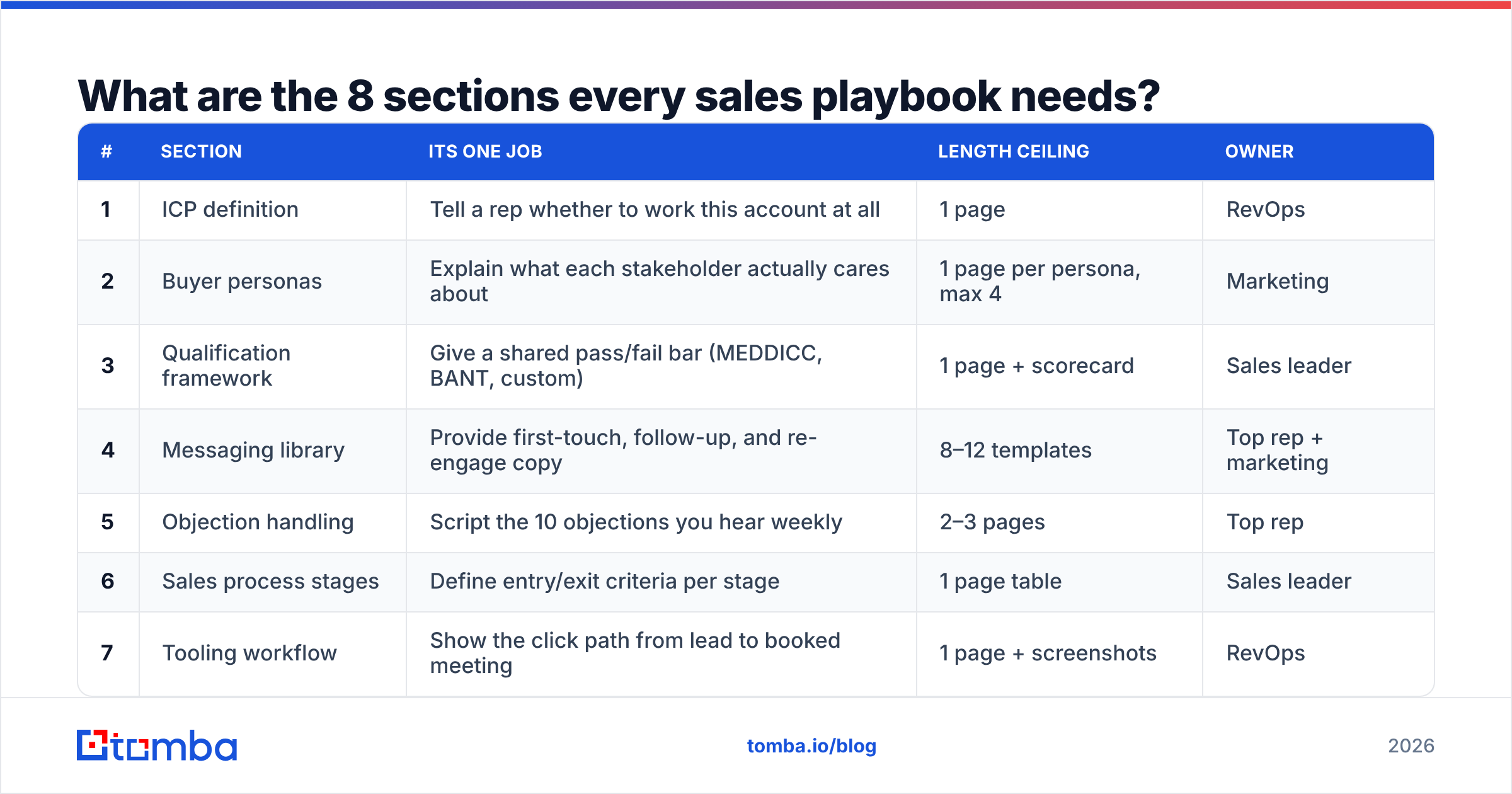
Here is the structure that survives contact with a real team. Each section has one job and a length ceiling — the ceiling is what keeps the doc usable.
| # | Section | Its one job | Length ceiling | Owner |
|---|---|---|---|---|
| 1 | ICP definition | Tell a rep whether to work this account at all | 1 page | RevOps |
| 2 | Buyer personas | Explain what each stakeholder actually cares about | 1 page per persona, max 4 | Marketing |
| 3 | Qualification framework | Give a shared pass/fail bar (MEDDICC, BANT, custom) | 1 page + scorecard | Sales leader |
| 4 | Messaging library | Provide first-touch, follow-up, and re-engage copy | 8–12 templates | Top rep + marketing |
| 5 | Objection handling | Script the 10 objections you hear weekly | 2–3 pages | Top rep |
| 6 | Sales process stages | Define entry/exit criteria per stage | 1 page table | Sales leader |
| 7 | Tooling workflow | Show the click path from lead to booked meeting | 1 page + screenshots | RevOps |
| 8 | Metrics + definitions | Kill arguments about what "SQL" means | 1 page | RevOps |
Total: roughly 12–16 pages. If yours is 60, you have merged a playbook with an onboarding curriculum, and the playbook loses.
Section 1: ICP definition#
Write it as inclusion and exclusion criteria, not adjectives. "Mid-market SaaS companies that value efficiency" is unusable. This is usable:
- Include: 50–500 employees, US/UK/CA, uses HubSpot or Salesforce, has a named RevOps or Sales Ops role, raised a round in the last 24 months or is profitable with 20%+ growth.
- Exclude: agencies, sub-20 employees, government, anyone already on a 3-year contract with an incumbent we have lost to twice.
- Disqualify mid-cycle if: no economic buyer identified by stage 3, or procurement requires SOC 2 Type II and we cannot meet it.
Derive these from closed-won data, not from a workshop. Export your last 50 wins and last 50 losses, and look at what actually differs.
Section 2: Buyer personas#
For each persona, four bullets is enough: what they own, what they get measured on, what breaks their week, and what phrase makes them keep reading. Skip the demographic filler — nobody has ever closed a deal because they knew the buyer's favorite podcast.
Section 3: Qualification framework#
Pick one framework and enforce it. MEDDICC works well for deals over $25k with multiple stakeholders. BANT is fine for transactional motions under $10k. What matters is that "qualified" means the same thing in every forecast call.
Section 4: Messaging library#
Store the templates, but also store the reasoning. A template without its trigger condition gets used in the wrong context and burns the account. Format each entry as: trigger → template → expected reply rate → what to do next. If you need a starting set, our cold email templates library covers the common first-touch and follow-up patterns you can adapt to your own voice.
Section 5: Objection handling#
Record ten real calls. Transcribe the objections verbatim. Have your best rep answer each on video, then write down what they said. Verbatim beats invented, every time.
Section 6: Sales process stages#
Every stage needs an entry criterion and an exit criterion that a manager can verify without asking the rep. "Discovery complete" is not verifiable. "Pain, metric, and decision process documented in the CRM opportunity notes" is.
Section 7: Tooling workflow#
Screenshots of the exact click path. This is the most-skipped and most-used section — new hires reference it daily for their first month.
Section 8: Metrics and definitions#
One table mapping every term you use in pipeline reviews to a precise definition: MQL, SQL, opportunity, win rate, and how each is calculated.
How do you build a sales playbook in 30 days?#
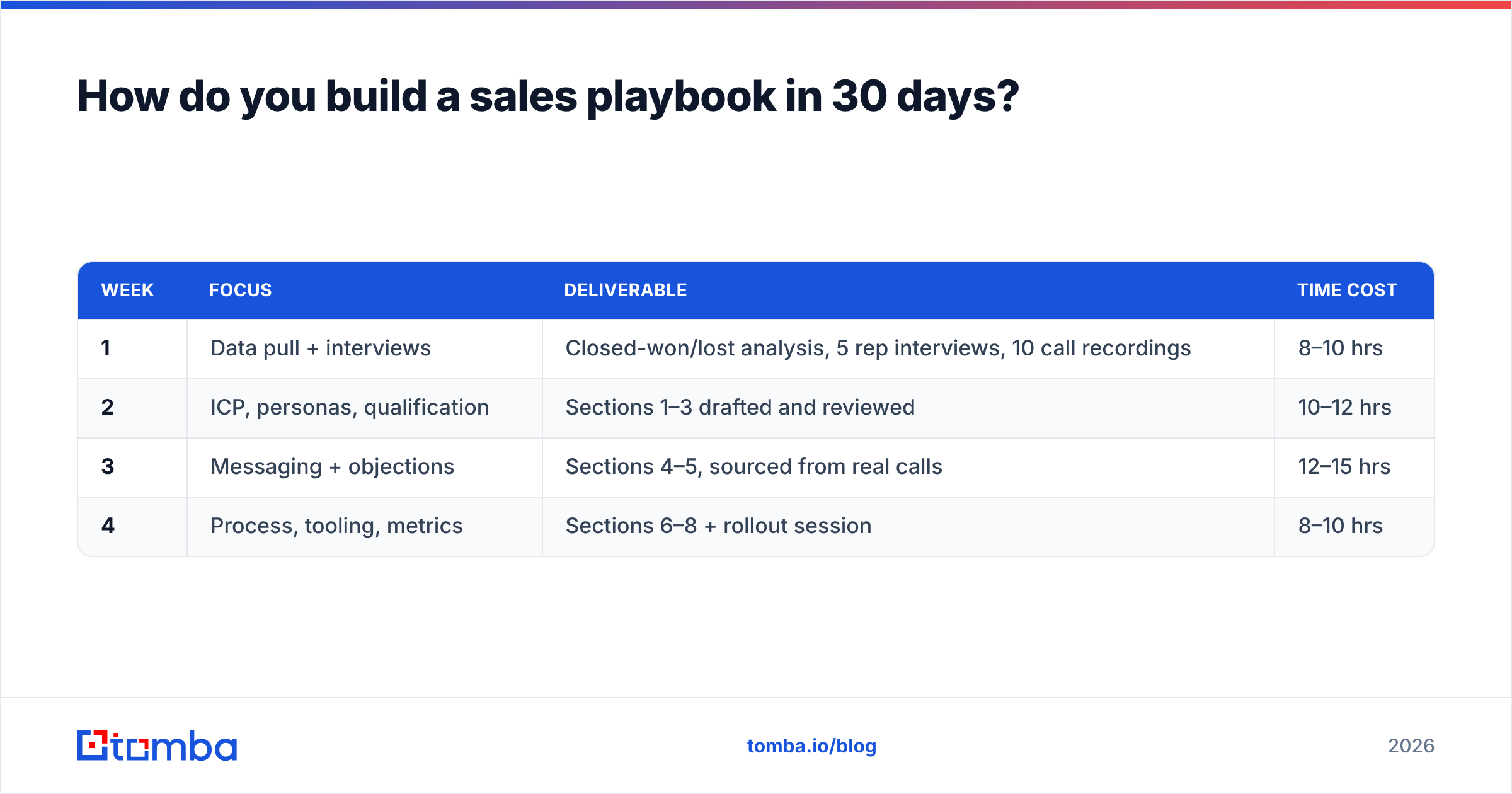
Do not try to write it alone, and do not try to write it all at once. Sequence it by what unblocks reps fastest.
| Week | Focus | Deliverable | Time cost |
|---|---|---|---|
| 1 | Data pull + interviews | Closed-won/lost analysis, 5 rep interviews, 10 call recordings | 8–10 hrs |
| 2 | ICP, personas, qualification | Sections 1–3 drafted and reviewed | 10–12 hrs |
| 3 | Messaging + objections | Sections 4–5, sourced from real calls | 12–15 hrs |
| 4 | Process, tooling, metrics | Sections 6–8 + rollout session | 8–10 hrs |
Week 1 in detail. Export closed-won and closed-lost deals from the last 12 months. For each win, note company size, industry, tech stack, entry persona, and deal cycle length. Patterns emerge fast — usually you discover that two of your five "target segments" produced 80% of revenue and the other three produced churn.
Then interview five reps for 30 minutes each with the same four questions: What do you say in the first 30 seconds of a cold call? What objection do you hate most? What does a deal look like when you know it will close? What do you wish you had known in month one?
Week 3 is the one that slips. Writing messaging is slow because it requires judgment about what is actually true. Budget more time here than you think, and pull real language from call transcripts instead of inventing it.
Rollout matters as much as the writing. A 45-minute live session where reps walk through two of their own open deals using the playbook beats an email announcement by a wide margin. You are teaching retrieval behavior, not content.
What data does your playbook depend on?#
Every play in the book assumes a contact record that is correct. That assumption is where most playbooks quietly break.
You can write a flawless cold email sequence, and it still returns nothing if 22% of the addresses bounce and the rest go to people who left the company 14 months ago. The playbook gets blamed. The data was the problem.
Three data dependencies to make explicit in the playbook itself:
- Contact discovery. Reps need a documented, repeatable way to go from "target account" to "verified contact." Whether that is an email finder, a data vendor, or manual research, name the tool and the steps.
- Verification before send. Any list over 200 records should pass through an email verifier before it touches a sequence. Bounce rates above 3% put your sending domain at risk, and once sender reputation drops, every play in the book underperforms.
- Enrichment for personalization. The "relevant first line" your messaging section demands requires firmographic and role data attached to the record. If reps have to Google each prospect manually, they will skip it under quota pressure.
Write the acceptable thresholds into the playbook: maximum bounce rate, minimum required fields before a record enters a sequence, and who owns list hygiene. Vague standards get ignored.
Which sales playbook format should you choose?#
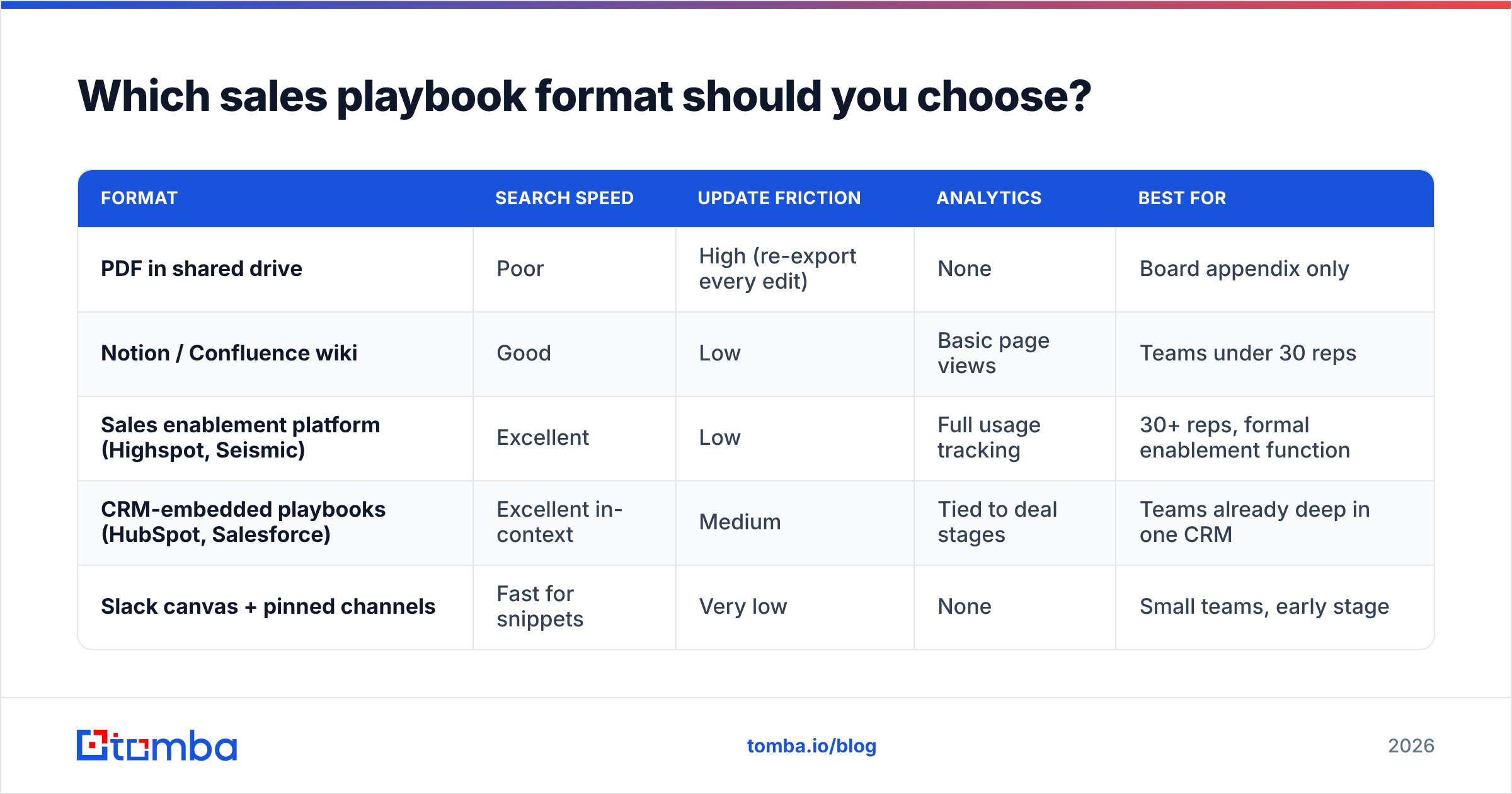
Format determines adoption more than content quality does. Here is the honest comparison.
| Format | Search speed | Update friction | Analytics | Best for |
|---|---|---|---|---|
| PDF in shared drive | Poor | High (re-export every edit) | None | Board appendix only |
| Notion / Confluence wiki | Good | Low | Basic page views | Teams under 30 reps |
| Sales enablement platform (Highspot, Seismic) | Excellent | Low | Full usage tracking | 30+ reps, formal enablement function |
| CRM-embedded playbooks (HubSpot, Salesforce) | Excellent in-context | Medium | Tied to deal stages | Teams already deep in one CRM |
| Slack canvas + pinned channels | Fast for snippets | Very low | None | Small teams, early stage |
For most teams under 30 reps, a wiki with a strict table of contents plus CRM-embedded snippets for the highest-frequency plays is the right combination. HubSpot's playbooks feature surfaces content inside the record a rep is already viewing, which solves the retrieval problem better than any standalone doc.
The rule: content lives in one canonical place, and the two or three highest-frequency plays get duplicated into the CRM where the work happens. Duplicating everything creates version drift.
How do you know your sales playbook is working?#
Measure adoption and outcome separately. Adoption without outcome means the content is wrong. Outcome without adoption means something else drove the number.
Adoption signals (check monthly):
- Page views per rep per week. Under two means nobody is using it. Healthy teams see 5–15 for new hires and 2–4 for tenured reps.
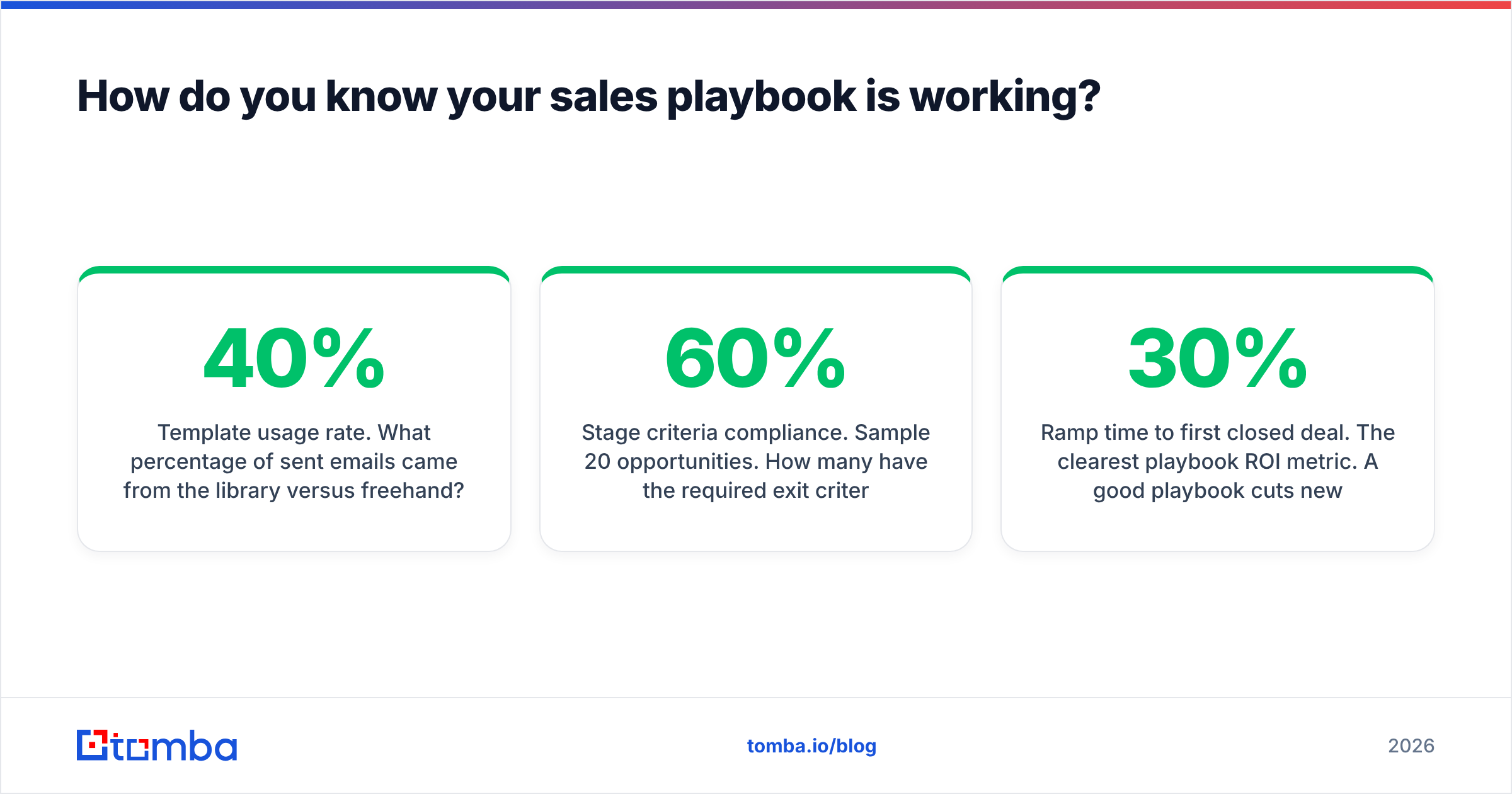
- Template usage rate. What percentage of sent emails came from the library versus freehand? Below 40% means the library does not cover real situations.
- Stage criteria compliance. Sample 20 opportunities. How many have the required exit criteria documented? Below 60% means your stages are too heavy.
Outcome signals (check quarterly):
- Ramp time to first closed deal. The clearest playbook ROI metric. A good playbook cuts new-hire ramp by 20–30%.
- Win rate by stage. If stage 2→3 conversion is flat while stage 3→4 improved, your discovery content works and your demo content does not.
- Response rate on library templates versus freehand. Direct read on messaging quality.
- Variance between top and median rep. The point of a playbook is to lift the median. If the gap has not narrowed in two quarters, the playbook is documenting your top rep rather than transferring what they do.
That last metric is the honest one. Playbooks exist to compress performance variance. Track it explicitly.
How often should you update it?#
Quarterly review, event-driven updates.
Quarterly (scheduled, 2 hours): Re-run the win/loss analysis. Check whether ICP criteria still match reality. Retire templates below a 5% reply rate. Add objections that appeared in the last 90 days of calls.
Event-driven (within a week): A competitor ships something material, pricing changes, a new persona starts appearing in deals, or a regulation shifts your buyers' priorities. G2's category pages and review streams are a fast way to spot competitor positioning shifts before your reps get blindsided on a call — worth checking on G2 once a quarter.
Put a "last reviewed" date at the top of every section. Reps trust dated content and ignore undated content. It is a two-minute change that meaningfully affects adoption.
Assign one owner per section — the same people listed in the structure table above. Shared ownership means no ownership. A single named person per section, with a calendar reminder, is what keeps a playbook alive past month six.
Common mistakes worth avoiding#
- Writing aspirational process instead of observed process. If nobody does the five-step discovery you documented, either fix the process or fix the doc. Do not ship fiction.
- Skipping the exclusion criteria. Telling reps who not to call saves more time than telling them who to call.
- One playbook for every motion. Inbound, outbound, expansion, and partner-sourced deals need different plays. Share sections 1–3, branch on 4–6.
- No mobile readability. Reps check the playbook between meetings on a phone. Test it on one.
- Treating it as a launch project. It is a maintained system. Staff it accordingly.
Where to start this week#
Pick the single section that unblocks the most reps right now. For most teams that is objection handling, because it is the highest-frequency moment of need and the fastest to source from real calls. Write it, ship it, watch whether reps open it, then build outward.
Then fix the data layer underneath it, because a playbook aimed at wrong-fit or unreachable contacts fails no matter how well it is written. Tomba Email Finder gives your reps a documented path from target account to verified contact — domain search to pull the right people at a target company, verification to keep bounce rates under control, and enrichment to fill the personalization fields your messaging section depends on. The free tier includes 25 searches a month so you can test it against your own ICP list before committing; paid plans start at $49/mo, with full Tomba pricing available if you need bulk volume or Tomba API access to wire discovery directly into your CRM workflow.
A playbook makes your reps consistent. Clean contact data makes that consistency pay.
Related guides#
// get started
Find, verify and enrich your first contacts today
Start on the free plan with 25 searches a month, then scale when your team is ready.
Free plan · No credit card required · GDPR & CCPA
// about the author