How to Create a Sales Strategy That Actually Closes in 2026
Most sales strategies are a slide deck nobody opens. Here is a 7-step framework for building one your reps actually run — with ICP math, channel mix, and the numbers that prove it works.
TL;DR
- A sales strategy is not a revenue goal. It is a written set of decisions about who you sell to, how you reach them, what you say, and how you measure it — specific enough that a new rep could execute it on day three.
- Start with segment math, not vibes: pick an ICP you can count, size, and reach. If you cannot build a target list of accounts by name, your ICP is a slogan.
- Channel mix beats channel purity. Most B2B teams under $20M ARR win with outbound email + LinkedIn + phone layered on the same account list, not one channel run to exhaustion.
- Your strategy is only as good as your contact data. A perfect message to a bounced address is a zero.
- Review the strategy on a fixed cadence (monthly pipeline, quarterly assumptions) with three leading indicators, not one lagging revenue number.
Most "sales strategies" die in a Google Slides deck. They get built in Q4 for the board, presented once in January, and never touched again — because they describe an aspiration ("become the category leader in mid-market fintech") instead of a set of executable decisions.
This guide covers how to create a sales strategy that survives contact with a real quarter. Seven steps, each with the output artifact you should have when you finish it.
What is a sales strategy (and what isn't one)?#
A sales strategy is a documented set of choices about which customers you pursue, how you reach and convert them, and what resources you commit — plus the metrics that tell you whether the choices were right.
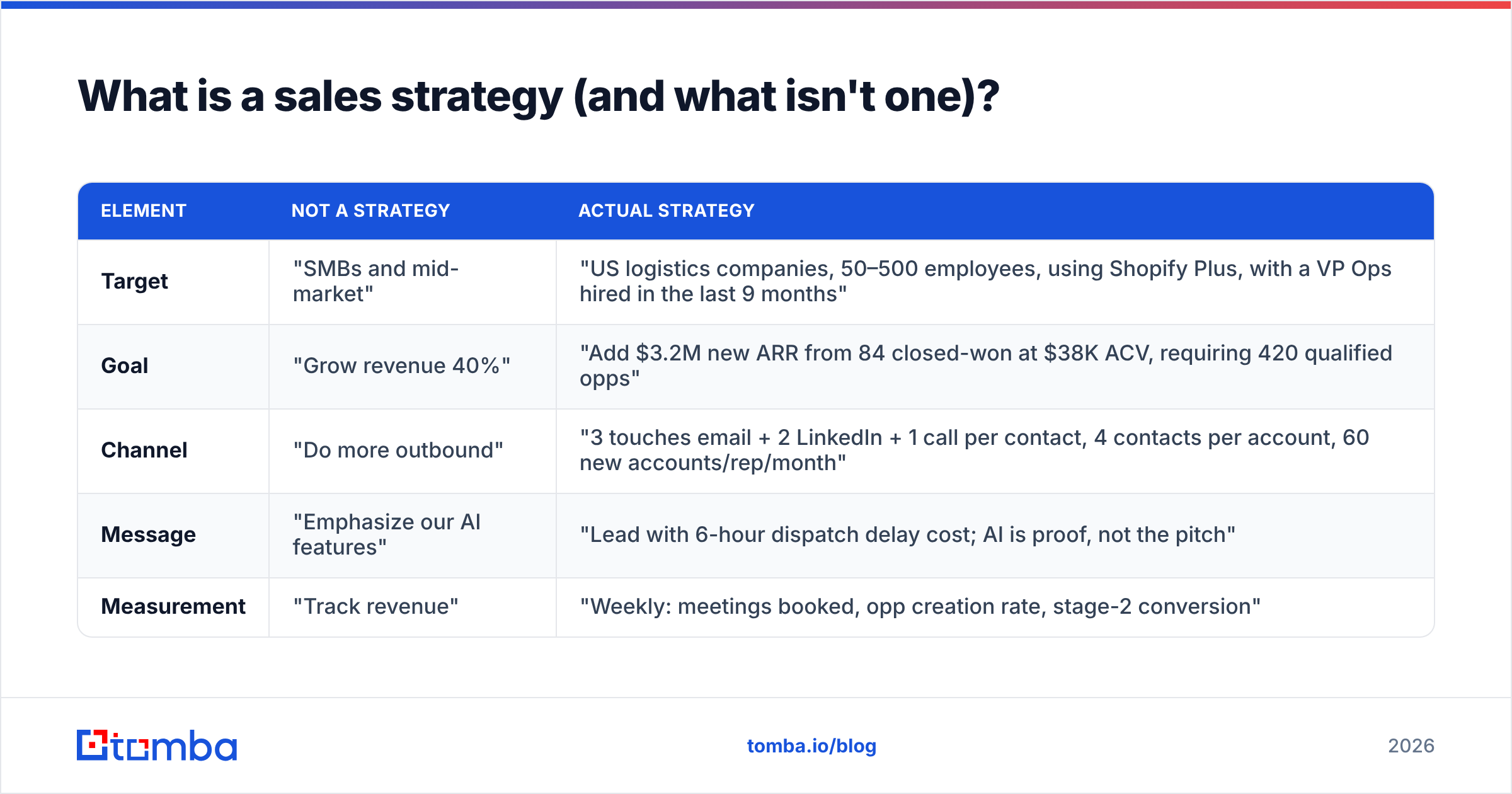
Here is the distinction that matters most:
| Element | Not a strategy | Actual strategy |
|---|---|---|
| Target | "SMBs and mid-market" | "US logistics companies, 50–500 employees, using Shopify Plus, with a VP Ops hired in the last 9 months" |
| Goal | "Grow revenue 40%" | "Add $3.2M new ARR from 84 closed-won at $38K ACV, requiring 420 qualified opps" |
| Channel | "Do more outbound" | "3 touches email + 2 LinkedIn + 1 call per contact, 4 contacts per account, 60 new accounts/rep/month" |
| Message | "Emphasize our AI features" | "Lead with 6-hour dispatch delay cost; AI is proof, not the pitch" |
| Measurement | "Track revenue" | "Weekly: meetings booked, opp creation rate, stage-2 conversion" |
The right column is testable. The left column is a wish. Everything below is about getting from left to right.
Why do most sales strategies fail before Q2?#
Three failure modes account for the majority of dead strategies.
1. The ICP is too wide to act on. If your ideal customer profile includes 400,000 companies, your reps will default to whoever answers. Breadth feels safe and is expensive — it inflates list size while collapsing message relevance.
2. There is no explicit resource math. A strategy that requires 600 conversations a month from three SDRs who can realistically run 350 is not a strategy, it is a shortfall with a deadline.
3. Nobody owns the review. Strategies decay because assumptions decay. Pricing changes, a competitor launches, a channel saturates. Without a scheduled review, you find out from a missed quarter.
Forrester's B2B research has consistently found that buying groups have grown — most enterprise B2B purchases now involve a committee, not a single decision maker. A strategy written around "the buyer" (singular) will systematically under-cover the accounts it targets.
How do you define an ICP you can actually build a list from?#
Your ICP has to be countable. The test: can you produce a spreadsheet of 500 companies that match it, by name, in an afternoon? If not, tighten it.
Build the ICP from evidence you already have, in this order:
- Pull your closed-won accounts from the last 18 months. Not all customers — the ones who closed fast, stayed, and expanded.
- Find the common firmographics. Employee band, revenue band, geography, industry. Look for the tightest band that still covers 60%+ of the good accounts.
- Add technographic or operational signals. What tools do they run? What process do they have? These are far more predictive than industry codes.
- Identify the buying committee, not the buyer. Economic buyer, champion, technical evaluator, blocker. Name the titles.
- Add trigger events. New funding, a relevant executive hire, a job posting, an office opening. Triggers turn a static list into a prioritized queue.
- Write the anti-ICP. The accounts that look right and churn anyway. This saves more money than the ICP does.
Once you have those six, your list is buildable. A domain search run across your target account list will surface the contacts and email patterns per company, and the buying-committee titles from step 4 become your filter — you are not pulling every email at the company, you are pulling four.
How do you turn revenue targets into activity math?#
Work backwards from the number, and be honest about the conversion rates you actually have — not the ones from a benchmark blog post.
The chain looks like this:
Target new ARR ÷ average ACV = closed-won deals needed. Closed-won ÷ win rate = qualified opportunities needed. Qualified opps ÷ meeting-to-opp rate = meetings needed. Meetings ÷ reply-to-meeting rate = replies needed. Replies ÷ reply rate = contacts to reach. Contacts ÷ contacts-per-account = accounts to work.
Run a real example. Target: $3.2M new ARR at $38K ACV = 84 deals. At a 20% win rate, that is 420 qualified opps. At a 55% meeting-to-opp rate, 764 meetings. At a 30% reply-to-meeting rate, 2,547 replies. At a 4% response rate, 63,675 contacts reached.
That last number is where most strategies break. Sixty-three thousand contacts across a year is roughly 5,300 a month. If your ICP only contains 8,000 companies at 4 contacts each — 32,000 contacts total — you cannot hit the target by outbound email alone. You now know, in November, that you need either a wider segment, a second channel, a higher ACV, or a better conversion rate somewhere in the chain.
That is the entire point of the math: it turns a vague worry into a specific decision you can make before the year starts.
What channel mix should your sales strategy use?#
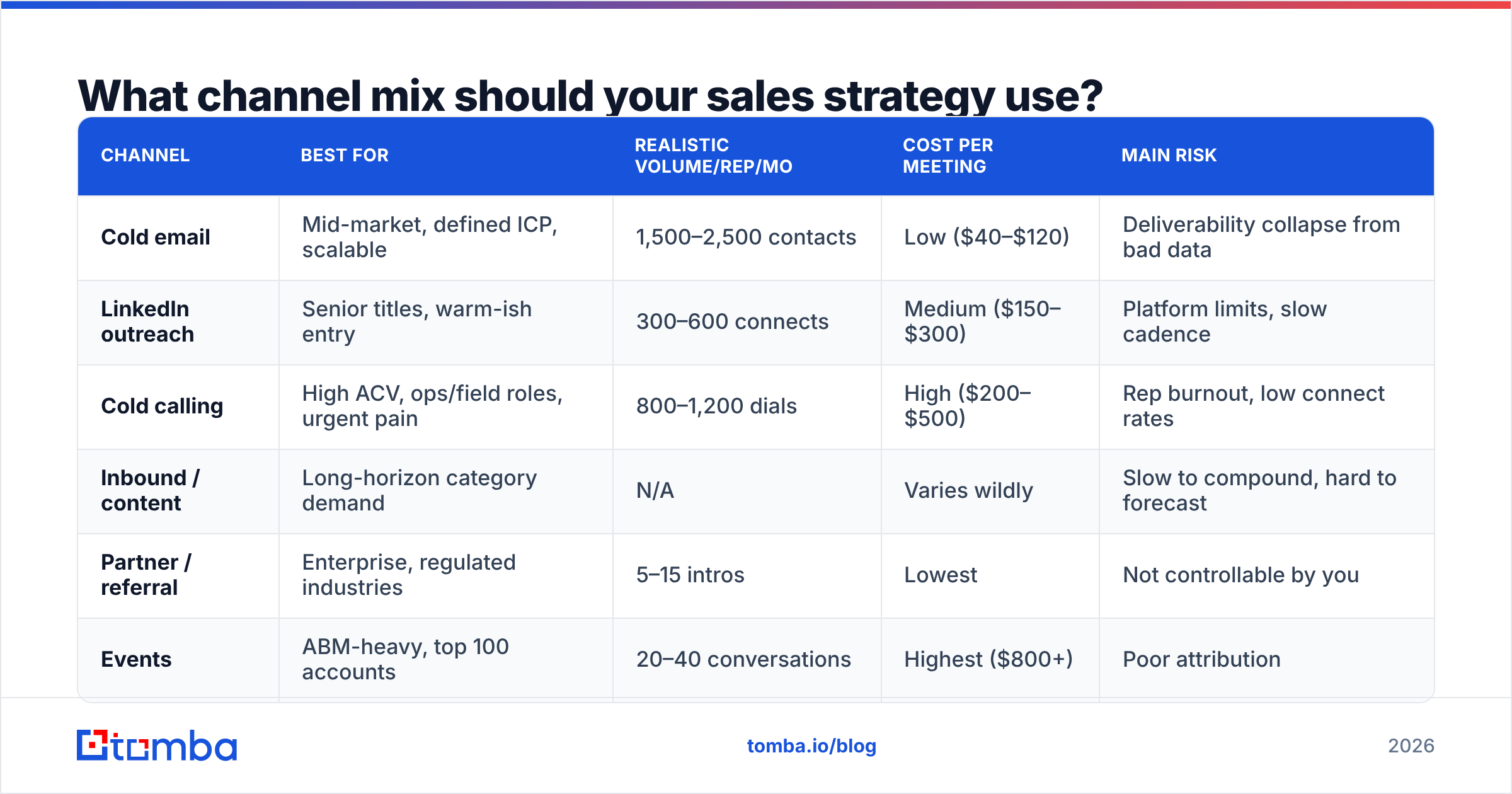
Stop asking "is cold email dead?" and start asking "what does this segment respond to, at what cost, at what volume?"
| Channel | Best for | Realistic volume/rep/mo | Cost per meeting | Main risk |
|---|---|---|---|---|
| Cold email | Mid-market, defined ICP, scalable | 1,500–2,500 contacts | Low ($40–$120) | Deliverability collapse from bad data |
| LinkedIn outreach | Senior titles, warm-ish entry | 300–600 connects | Medium ($150–$300) | Platform limits, slow cadence |
| Cold calling | High ACV, ops/field roles, urgent pain | 800–1,200 dials | High ($200–$500) | Rep burnout, low connect rates |
| Inbound / content | Long-horizon category demand | N/A | Varies wildly | Slow to compound, hard to forecast |
| Partner / referral | Enterprise, regulated industries | 5–15 intros | Lowest | Not controllable by you |
| Events | ABM-heavy, top 100 accounts | 20–40 conversations | Highest ($800+) | Poor attribution |
The winning pattern for most teams under $20M ARR is not picking one. It is layering two or three channels on the same account list so the account hears from you in multiple places within a two-week window. One email in isolation is noise. An email, a LinkedIn view, a comment on their post, and a call in the same fortnight is a pattern the buyer notices.
For LinkedIn-sourced prospecting, a LinkedIn finder lets you convert profile-level research into a reachable business email so the same person can be worked across both channels rather than trapped in one.
How do you make sure the strategy does not die on bad data?#
This is the step teams skip and then blame the messaging for.
Your activity math above assumed a 4% reply rate. If 22% of your list bounces, you do not just lose 22% of the volume — you damage sender reputation, which suppresses delivery for the other 78%. The compounding damage is worse than the arithmetic loss.
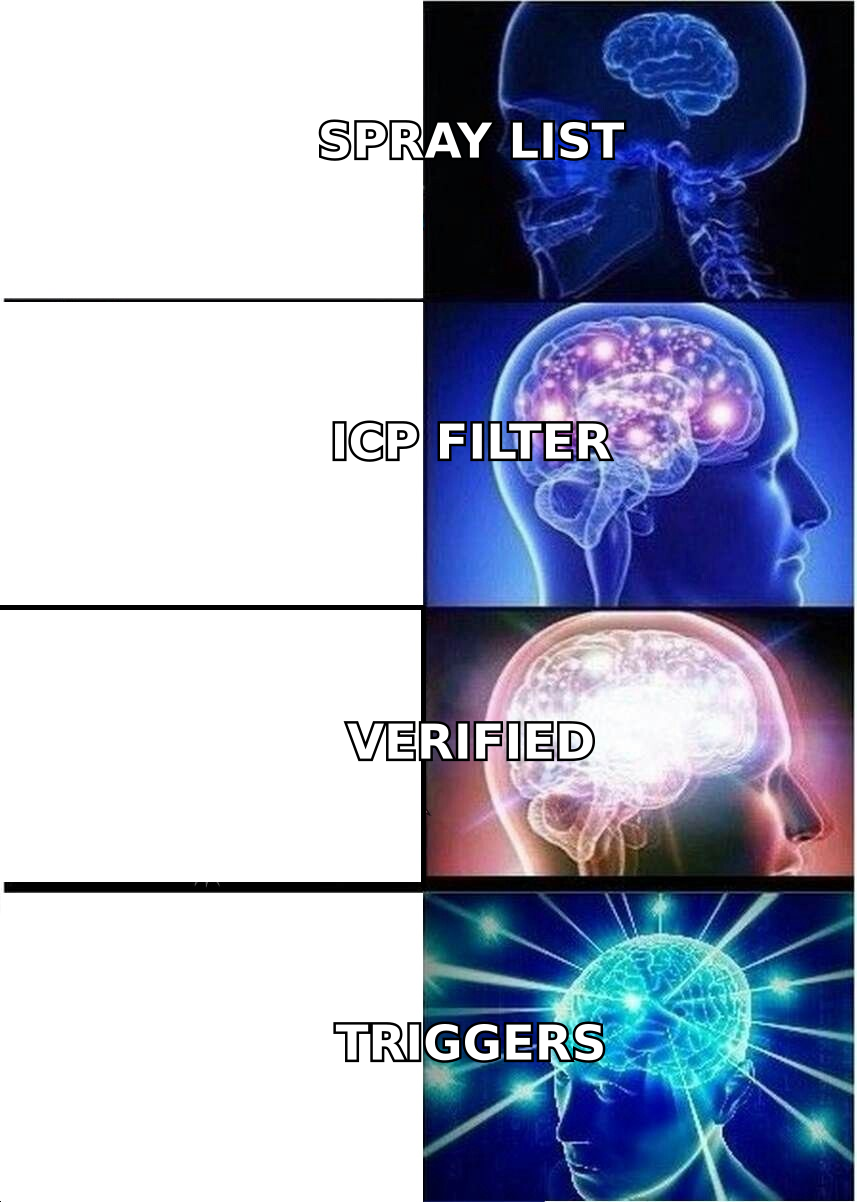
Build these four checks into the strategy document itself, as a gate before any list goes into a sequence:
- Verify before send, every time. Run the full list through an email verifier and drop anything that is not deliverable. Treat unknowns as a separate, lower-volume track.
- Handle catch-all domains deliberately. A large share of enterprise domains accept everything at the SMTP layer. A catch-all verifier distinguishes real mailboxes from accept-all noise instead of letting you guess.
- Deduplicate across reps and sequences. Two reps emailing the same VP in the same week is the fastest way to look like a spam operation.
- Refresh quarterly. B2B contact data decays fast — people change jobs constantly, and a list built in January is meaningfully wrong by July.
What should the messaging framework look like?#
One message per segment, not one message per company and not one message for everyone.
Structure each segment's message around four fields you can fill in a single row of a spreadsheet:
- Trigger — the observable event that makes now the right time (new VP hired, funding round, job posting for a role your product replaces).
- Cost of inaction — the specific, quantified consequence of the status quo. "Your dispatchers lose six hours a week to manual routing" beats "improve efficiency."
- Proof — one customer in their exact segment, with a number.
- Ask — a single, low-friction next step. Not "hop on a 30-minute discovery call to explore synergies."
Write these four fields for each ICP segment before a single sequence is built. If a rep cannot fill in the Trigger field for an account, that account is not ready to be worked — it goes back in the nurture pile. This single rule removes a huge amount of low-quality activity from a team's week.
HubSpot's sales research and most published benchmark data agree on one thing: relevance beats volume per contact, but volume still beats nothing. Your strategy needs both, sequenced correctly — relevance decides who you touch, volume decides how many.
Which metrics prove the strategy is working?#
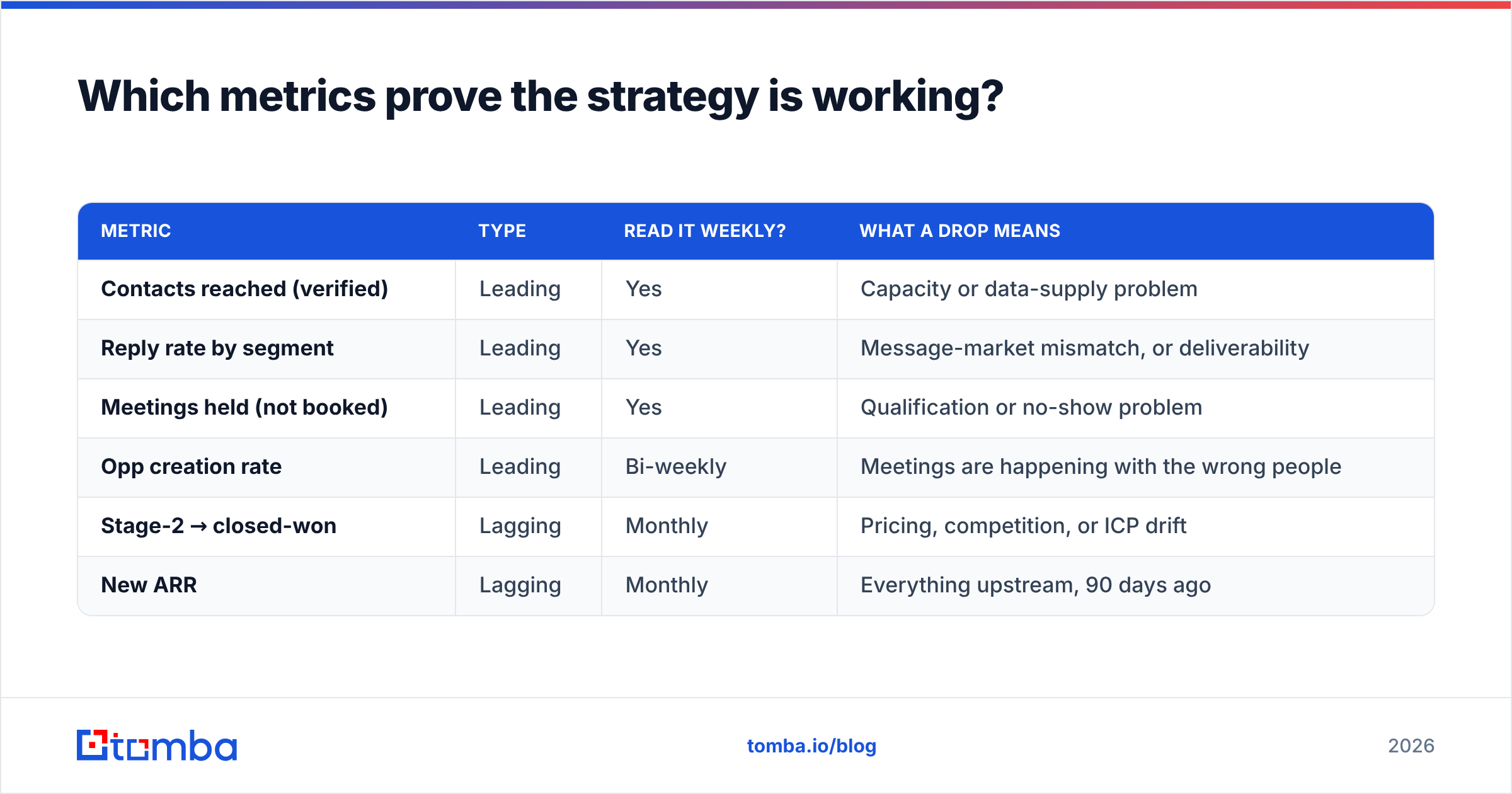
Pick three leading indicators and one lagging one. More than that and nobody watches any of them.
| Metric | Type | Read it weekly? | What a drop means |
|---|---|---|---|
| Contacts reached (verified) | Leading | Yes | Capacity or data-supply problem |
| Reply rate by segment | Leading | Yes | Message-market mismatch, or deliverability |
| Meetings held (not booked) | Leading | Yes | Qualification or no-show problem |
| Opp creation rate | Leading | Bi-weekly | Meetings are happening with the wrong people |
| Stage-2 → closed-won | Lagging | Monthly | Pricing, competition, or ICP drift |
| New ARR | Lagging | Monthly | Everything upstream, 90 days ago |
The critical discipline: segment every metric by ICP segment. A blended 4% reply rate can hide a 9% segment and a 1% segment. The blended number tells you to fix the message. The segmented number tells you to kill one list and double the other — a much better decision, available from the same data.
Run a monthly pipeline review on the leading indicators and a quarterly assumption review on the strategy itself. In the quarterly, explicitly ask: which of our original assumptions is now false? Segment sizing, win rate, ACV, channel cost — one of them will have moved.
How should a small team roll this out in 30 days?#
You do not need a quarter to write this. You need four focused weeks.
- Week 1 — Evidence. Pull closed-won and churned accounts. Interview three customers and two lost deals. Draft the ICP and anti-ICP.
- Week 2 — Math. Build the activity model backwards from the revenue target. Identify the constraint (list size, rep capacity, or conversion rate). Decide which one you are solving.
- Week 3 — Assets. Build the target account list, enrich contacts, verify, and write one messaging framework per segment. Ship two sequences, not ten.
- Week 4 — Instrumentation. Set the three leading indicators in the CRM, define the review cadence, name the owner of each metric, and run the first review with baseline numbers.
At the end of 30 days you should have five artifacts: an ICP doc, an activity model spreadsheet, a target account list, a messaging framework per segment, and a metrics dashboard. If any is missing, the strategy is not finished — it is a draft.
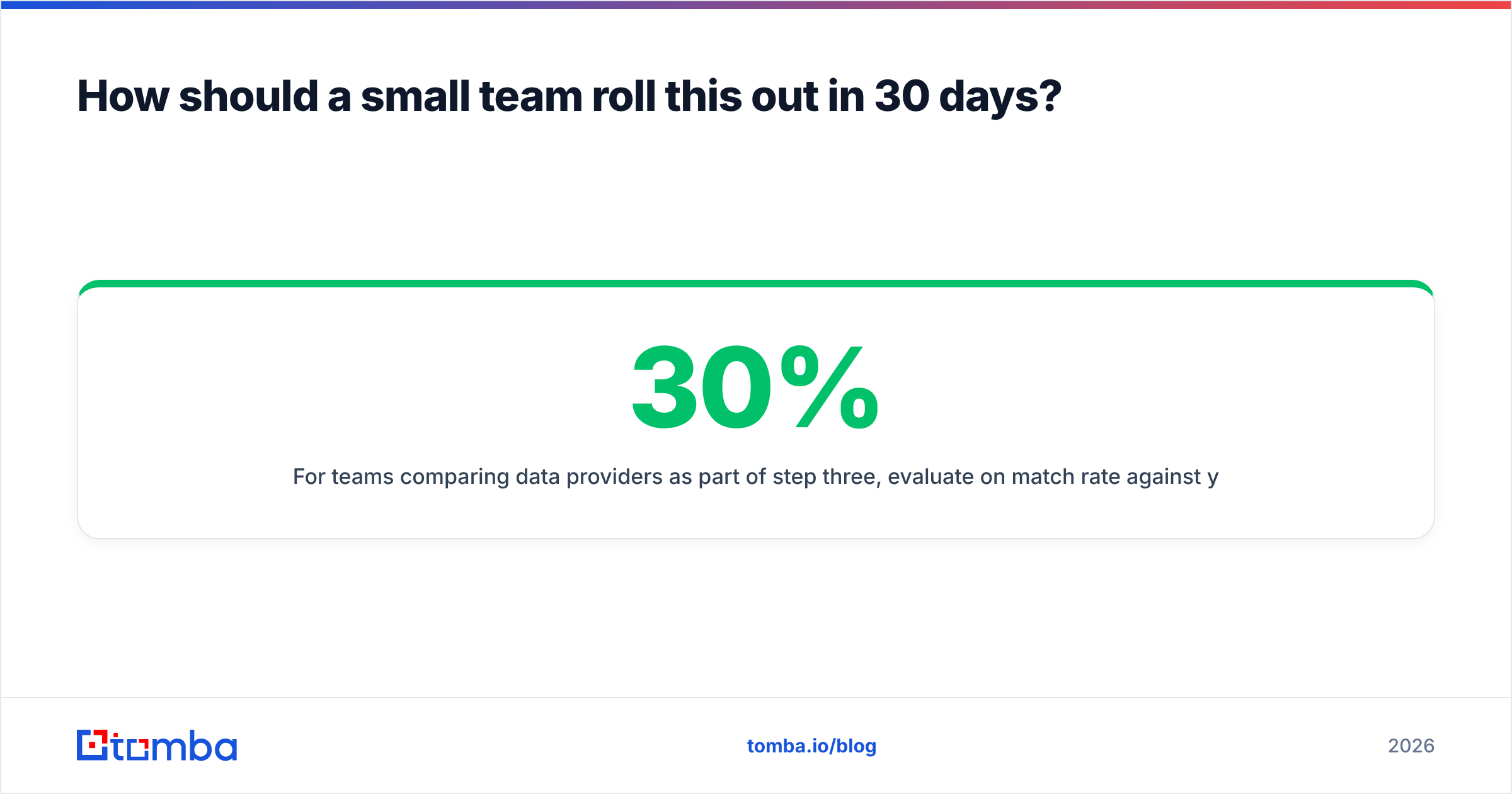
For teams comparing data providers as part of step three, evaluate on match rate against your specific ICP rather than headline database size. A provider with 200M contacts that covers 30% of your niche is worse than one with 60M that covers 80%. Vendors like BookYourData and Tomba take different approaches here — pay-as-you-go bulk lists versus real-time search and verification — and the right pick depends on whether your list is static or continuously rebuilt from triggers. Check where the data sources come from before committing budget, and compare Tomba pricing — Free (25 searches/mo), Starter $49/mo, Growth $99/mo, Pro $249/mo — against your monthly contact requirement from the activity math.
What are the most common mistakes to avoid?#
- Writing the strategy alone. If reps did not contribute, they will not run it. Include two AEs and an SDR in week 1.
- Choosing a channel because you like it. Founders who hate calling write email-only strategies. That is a preference, not an analysis.
- Setting targets from benchmarks instead of your own data. Your reply rate is your reply rate. Model with it, then work to improve it.
- Skipping the anti-ICP. Knowing who to say no to is what makes the yes list workable.
- Treating the strategy as immutable. It is a hypothesis with a review date, not a contract.
Get the contact layer right before you launch#
Every step above — the ICP list, the activity math, the channel mix, the metrics — sits on top of one dependency: reachable, accurate contacts for the people in your buying committee. That is where most strategies quietly leak.
Start with the Tomba Email Finder to build your target account contact list by domain, name, or company, then verify before your first send so your activity model is running on real numbers instead of bounce-inflated ones. The free tier gives you 25 searches a month to pressure-test your ICP list before you commit a budget line to it — enough to find out whether the segment you picked is actually reachable, which is the single most expensive assumption in any sales strategy.
Related guides#
// get started
Find, verify and enrich your first contacts today
Start on the free plan with 25 searches a month, then scale when your team is ready.
Free plan · No credit card required · GDPR & CCPA
// about the author