How to Create an Ideal Client Profile That Actually Fills Pipeline
Most ICPs are a slide nobody opens. This is the 6-step build: pull the data from closed-won accounts, score the attributes that predict revenue, and turn the result into a list your reps can actually email.
TL;DR
- An ideal client profile (ICP) describes the company worth selling to. A buyer persona describes the person inside it. You need both, but the ICP comes first — it decides which doors you knock on.
- Build it from your own closed-won and closed-lost data, not from a workshop whiteboard. Ten to thirty real accounts beat any brainstorm.
- Score attributes by how well they predict revenue retention, not by how easy they are to filter in a database.
- A finished ICP has to convert into a list: firmographic filters, a technographic signal, a trigger event, and verified contact data. If it can't, it's a slide, not a strategy.
- Re-run the analysis every two quarters. ICP drift is the quiet reason a team's reply rate falls 40% without anyone changing the copy.
What is an ideal client profile, and why does it beat a persona?#
An ideal client profile is a description of the company that gets the most value from your product and gives you the most value back — measured in revenue, retention, expansion, and referral. It is account-level. It says "US-based B2B SaaS, 50–200 employees, Series A or B, running HubSpot, with an inside sales team of 5+." It does not say "Marketing Maria, 34, likes podcasts."
Think of it like fishing. The persona tells you what bait to use. The ICP tells you which lake to drive to. Get the lake wrong and the world's best bait catches nothing.
The distinction matters because the two documents fail differently. A weak persona costs you reply rate. A weak ICP costs you the entire quarter — you spend the same effort on accounts that were never going to buy, and you don't find out for 90 days.
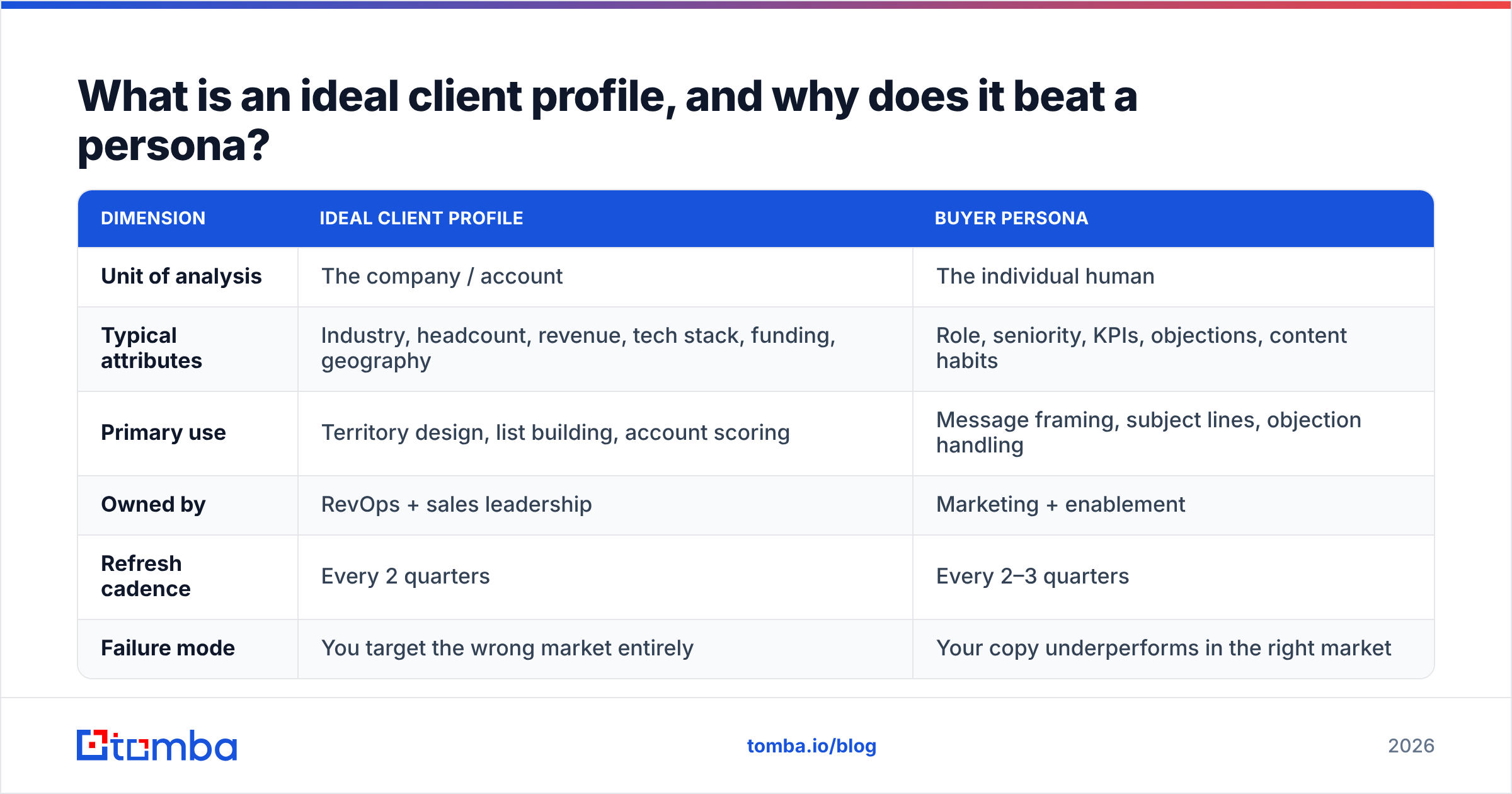
Here's the split most teams should keep in their heads:
| Dimension | Ideal Client Profile | Buyer Persona |
|---|---|---|
| Unit of analysis | The company / account | The individual human |
| Typical attributes | Industry, headcount, revenue, tech stack, funding, geography | Role, seniority, KPIs, objections, content habits |
| Primary use | Territory design, list building, account scoring | Message framing, subject lines, objection handling |
| Owned by | RevOps + sales leadership | Marketing + enablement |
| Refresh cadence | Every 2 quarters | Every 2–3 quarters |
| Failure mode | You target the wrong market entirely | Your copy underperforms in the right market |
Most teams have three personas and no real ICP. That's backwards. Start with the account.
How do you create an ideal client profile in six steps?#
This is the whole build. It takes a focused week if your CRM is clean, two weeks if it isn't.
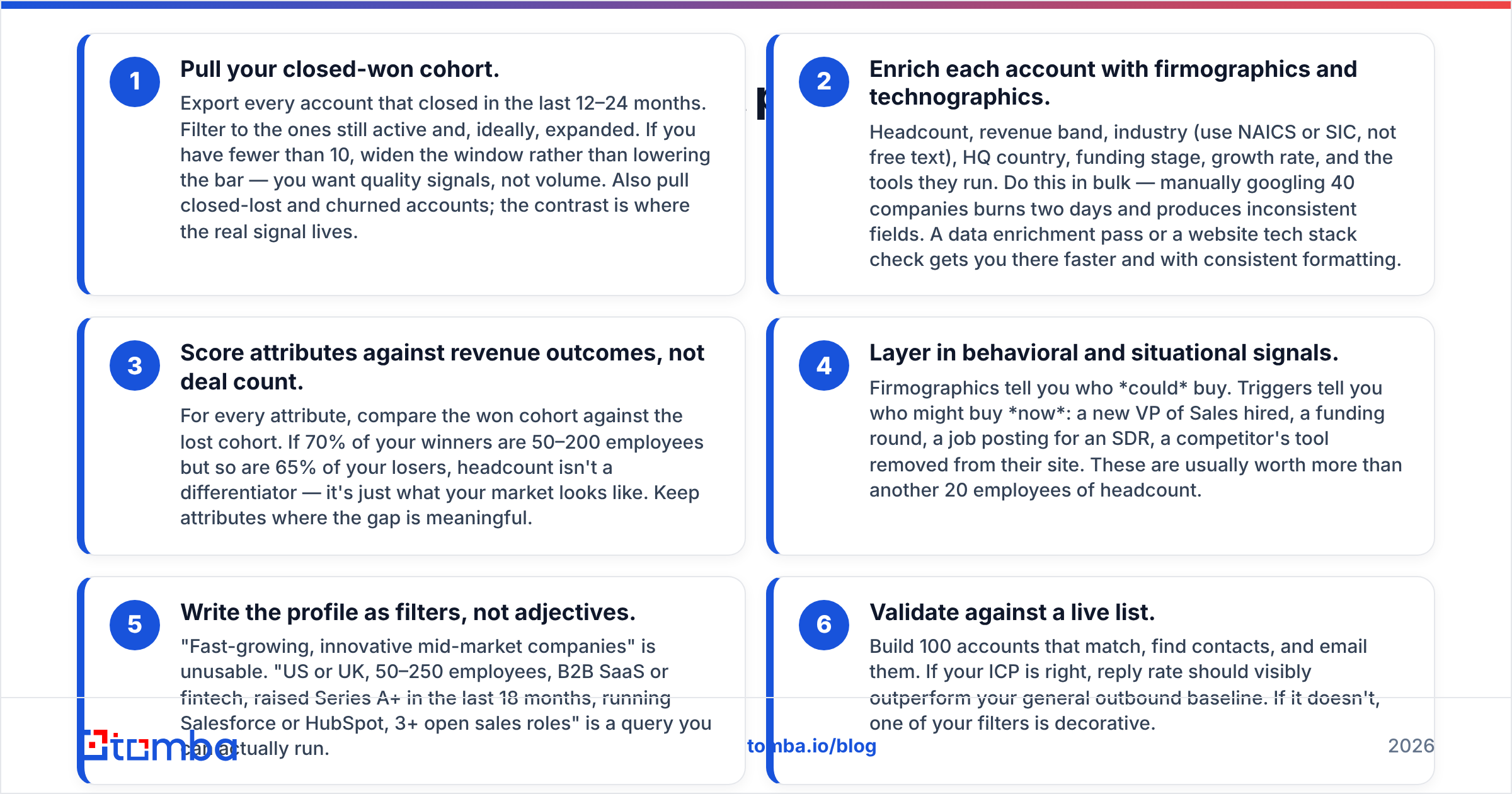
Pull your closed-won cohort. Export every account that closed in the last 12–24 months. Filter to the ones still active and, ideally, expanded. If you have fewer than 10, widen the window rather than lowering the bar — you want quality signals, not volume. Also pull closed-lost and churned accounts; the contrast is where the real signal lives.
Enrich each account with firmographics and technographics. Headcount, revenue band, industry (use NAICS or SIC, not free text), HQ country, funding stage, growth rate, and the tools they run. Do this in bulk — manually googling 40 companies burns two days and produces inconsistent fields. A data enrichment pass or a website tech stack check gets you there faster and with consistent formatting.
Score attributes against revenue outcomes, not deal count. For every attribute, compare the won cohort against the lost cohort. If 70% of your winners are 50–200 employees but so are 65% of your losers, headcount isn't a differentiator — it's just what your market looks like. Keep attributes where the gap is meaningful.
Layer in behavioral and situational signals. Firmographics tell you who could buy. Triggers tell you who might buy now: a new VP of Sales hired, a funding round, a job posting for an SDR, a competitor's tool removed from their site. These are usually worth more than another 20 employees of headcount.
Write the profile as filters, not adjectives. "Fast-growing, innovative mid-market companies" is unusable. "US or UK, 50–250 employees, B2B SaaS or fintech, raised Series A+ in the last 18 months, running Salesforce or HubSpot, 3+ open sales roles" is a query you can actually run.
Validate against a live list. Build 100 accounts that match, find contacts, and email them. If your ICP is right, reply rate should visibly outperform your general outbound baseline. If it doesn't, one of your filters is decorative.
Ignore the URL above — the correct embed is below.
Which attributes actually belong in your ICP?#
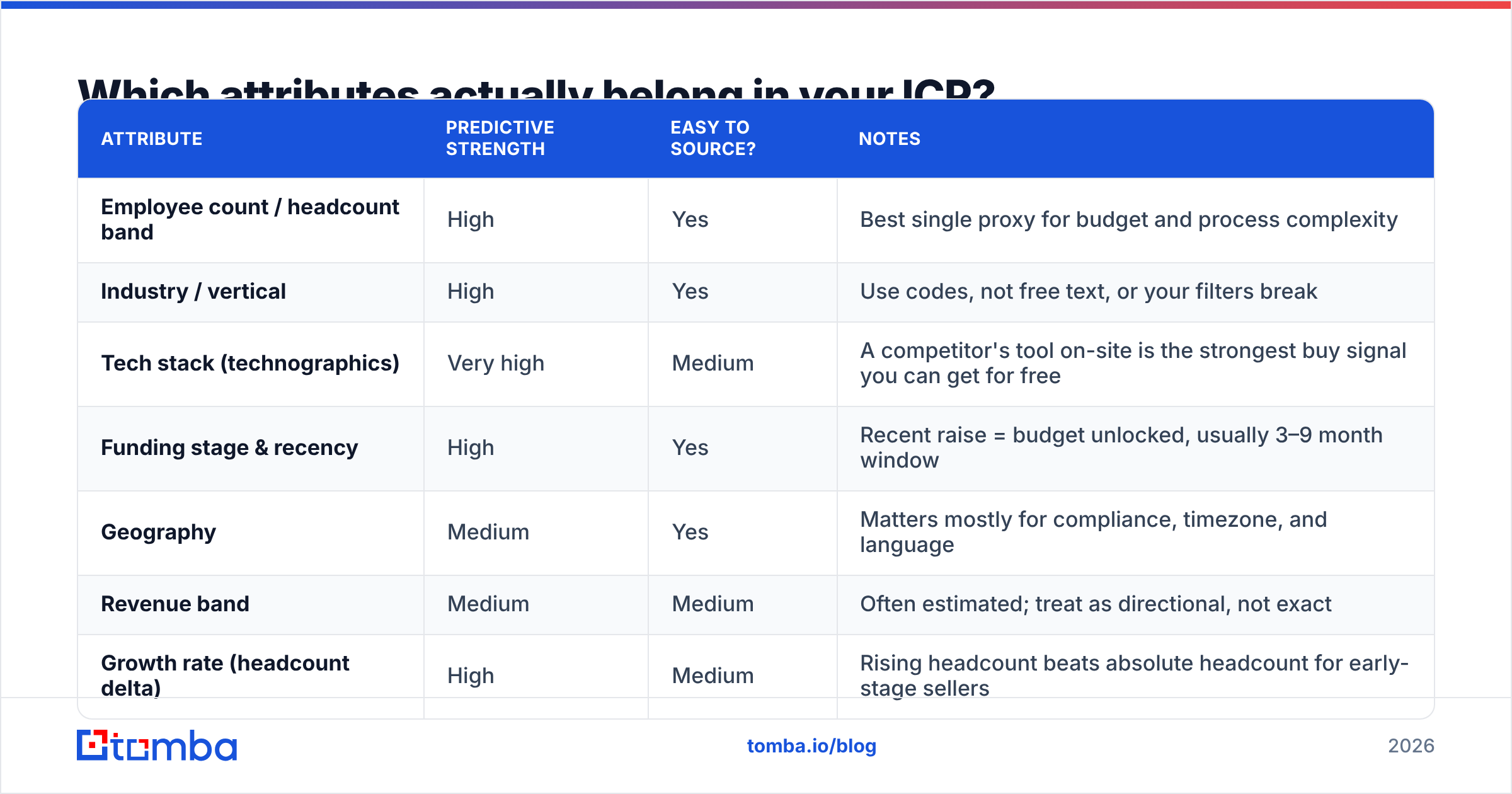
Not all attributes are equal. Some predict revenue; some are just easy to filter on, which is a completely different thing. Here's how the common ones rank in practice for most B2B teams:
| Attribute | Predictive strength | Easy to source? | Notes |
|---|---|---|---|
| Employee count / headcount band | High | Yes | Best single proxy for budget and process complexity |
| Industry / vertical | High | Yes | Use codes, not free text, or your filters break |
| Tech stack (technographics) | Very high | Medium | A competitor's tool on-site is the strongest buy signal you can get for free |
| Funding stage & recency | High | Yes | Recent raise = budget unlocked, usually 3–9 month window |
| Geography | Medium | Yes | Matters mostly for compliance, timezone, and language |
| Revenue band | Medium | Medium | Often estimated; treat as directional, not exact |
| Growth rate (headcount delta) | High | Medium | Rising headcount beats absolute headcount for early-stage sellers |
| Job postings / hiring signals | High | Medium | Cheap, public, and time-bound — a real trigger |
| "Innovative culture" | Zero | No | If you can't filter it, it isn't an attribute |
The pattern: attributes that are time-bound (funding, hiring, tool changes) outperform attributes that are static (industry, geography) because they tell you about the window, not just the fit. Static attributes decide the list. Time-bound attributes decide the order you work it.
One caution on technographics. Detecting a competitor's script on a website tells you they bought something. It doesn't tell you they're unhappy. Pair it with a second signal — a bad review, a churned champion, a contract-renewal month — before you write "I noticed you use X" in a subject line.
How much data do you need before the ICP is trustworthy?#
Less than you think, but more than you have.
If you're pre-product-market fit with under 10 customers, you don't have an ICP — you have a hypothesis. Write it down anyway, mark it as a hypothesis, and set a review date. The mistake isn't guessing; the mistake is treating the guess as settled.
Between 10 and 50 closed-won accounts, you can see real patterns in two or three attributes. Don't build a nine-variable model on 20 data points — you'll fit noise. Pick the two attributes with the widest won-vs-lost gap and build on those.
Above 50 accounts, you can start segmenting: an ICP for your core motion and a second one for an adjacent segment that keeps showing up unbidden. That second cohort is often where next year's growth hides.
Whatever the sample size, get external validation. Look at how G2's category grids segment buyers in your space, and cross-check your assumptions against how established vendors describe their own target markets — HubSpot's own ICP guidance is a reasonable neutral reference point for structure, even if the specifics won't match your business.
How do you turn an ICP into an actual prospecting list?#
This is where most ICP projects die. The document gets approved, gets a nice slide, and then nobody can operationalize it because there's no path from "50–200 employee B2B SaaS in the UK" to "an inbox to email on Tuesday."
The path has four steps, and each one has a tool category attached:
- Source the accounts. Start from a filterable B2B database, an industry directory, a conference attendee list, or a scraped set of companies using a specific technology. You want company domains — that's the join key for everything downstream.
- Find the right people at those accounts. Once you have domains, domain search returns the contacts and email patterns at each company, which is far faster than hunting person-by-person. For named individuals you already know from LinkedIn, an email finder resolves first name + last name + domain into an address.
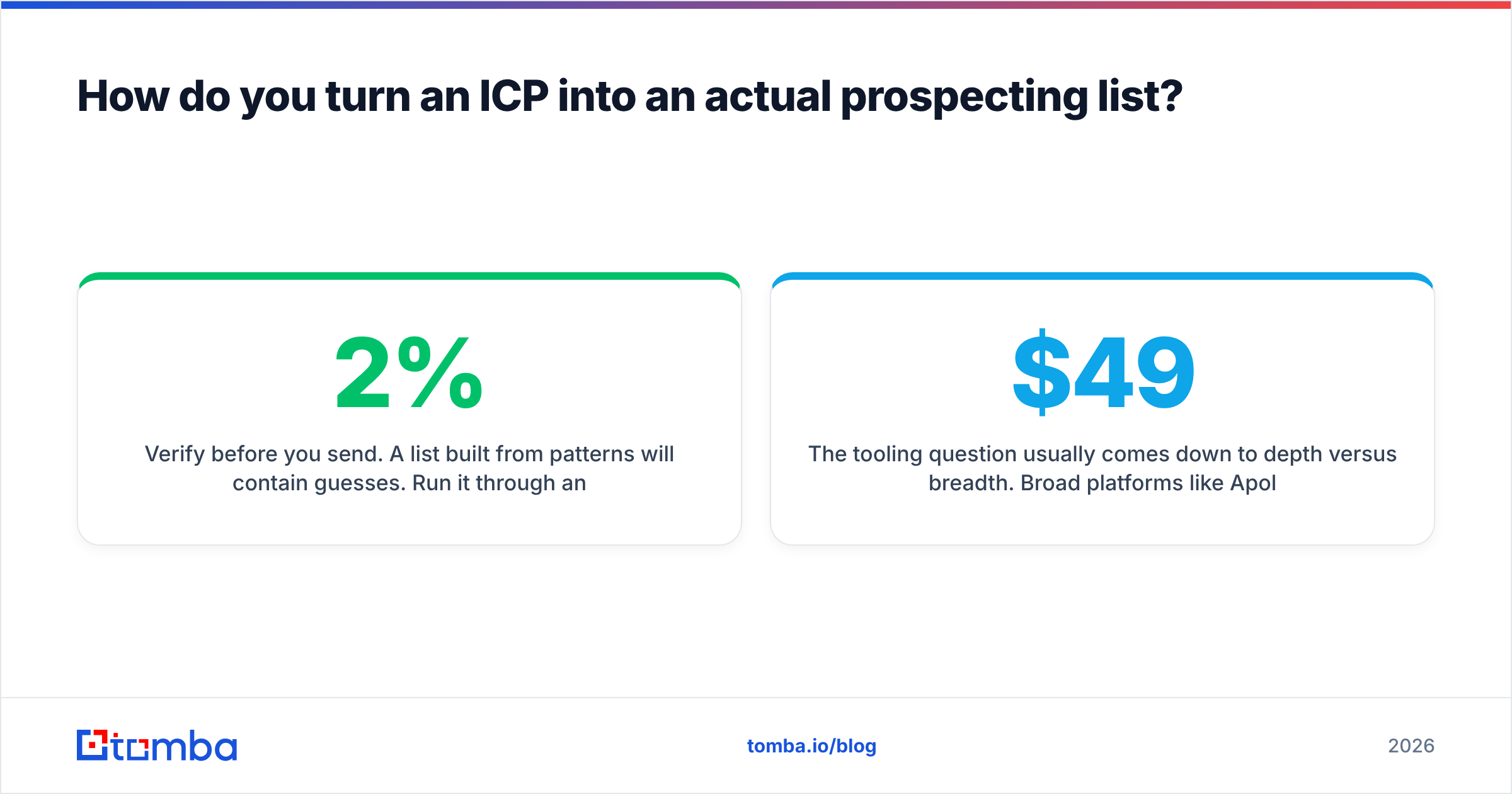
- Verify before you send. A list built from patterns will contain guesses. Run it through an email verifier so your bounce rate stays under 2%. Catch-all domains — very common in enterprise — need a catch-all verifier rather than a standard SMTP check, or you'll get "unknown" on a third of your list.
- Enrich and score. Append the attributes your ICP cares about, score each account, and sort. Your reps should work a ranked list, not an alphabetical one.
The tooling question usually comes down to depth versus breadth. Broad platforms like Apollo or ZoomInfo bundle a database with a sequencer and a dialer, which is convenient if you want one bill. Specialist providers — Tomba, BookYourData, and others — focus on the data layer itself and integrate with whatever sequencer you already run. BookYourData, for instance, leans into pre-verified downloadable lists with a pay-as-you-go model, which suits teams that buy in bursts rather than subscribe. Tomba's Free tier gives you 25 searches a month to test accuracy on your own domains before committing; Starter is $49/mo, Growth $99/mo, and Pro $249/mo.
The honest advice: test any provider against 30 accounts you already know the answer for. Vendor-published accuracy numbers are all measured on the vendor's own favorable sample. Your ICP's segment — small European companies, say, or US healthcare — will produce wildly different hit rates than the marketing page implies.
What are the most common ICP mistakes?#
Building it from opinion. The loudest person in the room names three logos they'd love to land, and those become the ICP. Ask for the closed-won export instead. If the data isn't there, that's the first project.
Confusing your best-fit customer with your biggest customer. One enormous logo that took 14 months, three custom builds, and a discount to close is not a template. Measure by margin and retention, not by ARR alone.
Making it too narrow too early. A five-filter ICP on a 30-account sample will exclude segments you haven't tested yet. Start broader, then tighten as evidence accumulates. Narrow is a destination, not a starting point.
Never revisiting it. Markets move. The segment that converted brilliantly in 2024 may now have three well-funded competitors serving it. Put a recurring calendar item on the two-quarter mark and actually re-run the analysis.
Not connecting it to routing and scoring. If your ICP doesn't change how leads are scored in the CRM or how territories get carved, it isn't operational. The test: can a new SDR on day three tell you whether an inbound lead is ICP or not, using a field in the system rather than judgment? If not, you've documented a preference, not a profile.
Ignoring negative ICP. Write down who you don't sell to, and why. Agencies who resell. Companies under 10 people. Regulated industries you can't support. A disqualification list saves more rep hours than any targeting list adds.
How do you know your ICP is working?#
Four metrics, checked quarterly:
- Win rate, ICP vs non-ICP. If accounts matching your profile don't close at a materially higher rate than those that don't, the profile isn't describing anything real. A 1.5–2x gap is a reasonable signal that it's working.
- Sales cycle length. ICP-fit accounts should close faster. Same buying process, fewer objections, less education required.
- Net revenue retention by segment. The whole point of an ICP is that these customers stay and expand. Track win rate alongside 12-month NRR per segment.
- Reply rate on cold outbound. The fastest feedback loop. Tighten your filters, watch whether response rate moves. If it doesn't, your filters aren't selecting for anything the buyer feels.
Track these per-segment, not in aggregate. Aggregate numbers hide the exact thing you're trying to see — that one slice of the market is carrying the whole number while three others quietly waste rep capacity.
One more practical check: ask three reps independently to describe the ideal account. If you get three different answers, the ICP hasn't landed regardless of what the document says. Documentation isn't adoption.
What does a finished ICP document look like?#
Keep it to one page. Anything longer doesn't get read, and an unread ICP has the same effect as no ICP.
Include:
- The filter set — the literal queryable criteria, written as they'd be entered into a database.
- The negative filters — who to disqualify on sight.
- Two or three trigger events — the signals that move an account from "fits" to "work it now."
- The buying committee sketch — which three roles typically touch the deal, so reps know who to find once the account is selected.
- The evidence — a one-line note on what data this was built from and when, plus the review date. This is what stops the ICP from becoming folklore.
Then link it to the list. The document should end with the exact saved search or filter that produces matching accounts, so there's zero translation step between strategy and Monday morning.
Ready to turn your ICP into a working list?#
An ideal client profile only pays off at the moment a rep sends a message to a real person at a matching account. Everything before that is preparation. Once you've defined the filters, you need company domains resolved into verified, deliverable contacts — quickly and at volume.
Start with the Tomba Email Finder. Feed it the domains your ICP produced, pull the contacts, verify them, and export straight into your sequencer or CRM. The free tier gives you 25 searches a month, which is enough to validate accuracy against accounts you already know before you commit to a plan. Build the profile properly, then let the data layer do the boring part.
Related guides#
// get started
Find, verify and enrich your first contacts today
Start on the free plan with 25 searches a month, then scale when your team is ready.
Free plan · No credit card required · GDPR & CCPA
// about the author