How to Create an Ideal Customer Profile That Actually Closes
Most ICPs are wishlists dressed up as strategy. Here is a 7-step, data-backed process for building an ideal customer profile from closed-won evidence — plus the exact fields, tables, and tools to operationalize it.
TL;DR
- An ideal customer profile describes the company you should sell to, not the person you email. Mixing the two is why most ICP documents are useless.
- Build it backward from closed-won data — your 20-40 best accounts — not forward from a brainstorm whiteboard.
- The minimum viable ICP has five layers: firmographics, technographics, trigger events, economic fit, and disqualifiers. Skip disqualifiers and you will burn a quarter chasing bad fits.
- Score accounts 0-10 against the profile, then only build lists for 7+. A tight ICP with 2,000 accounts beats a loose one with 200,000.
- Refresh quarterly. Your ICP drifts every time you ship a feature, raise a price, or lose a competitor.
What is an ideal customer profile, and how is it different from a persona?#
An ideal customer profile (ICP) is a description of the type of organization that gets the most value from your product, in the shortest time, at the lowest cost to serve, and stays the longest. It is account-level. A buyer persona is person-level: title, seniority, priorities, objections, day-to-day pain.
Think of it like fishing. The ICP tells you which lake to fish in — depth, temperature, what lives there. The persona tells you which lure to tie on. Anglers who skip the first step spend their day casting perfect lures into an empty pond.
The practical consequence: your ICP drives list building and territory design. Your personas drive messaging and sequences. If your ICP document contains the sentence "cares about efficiency and hates manual work," you have written a persona and mislabeled it.
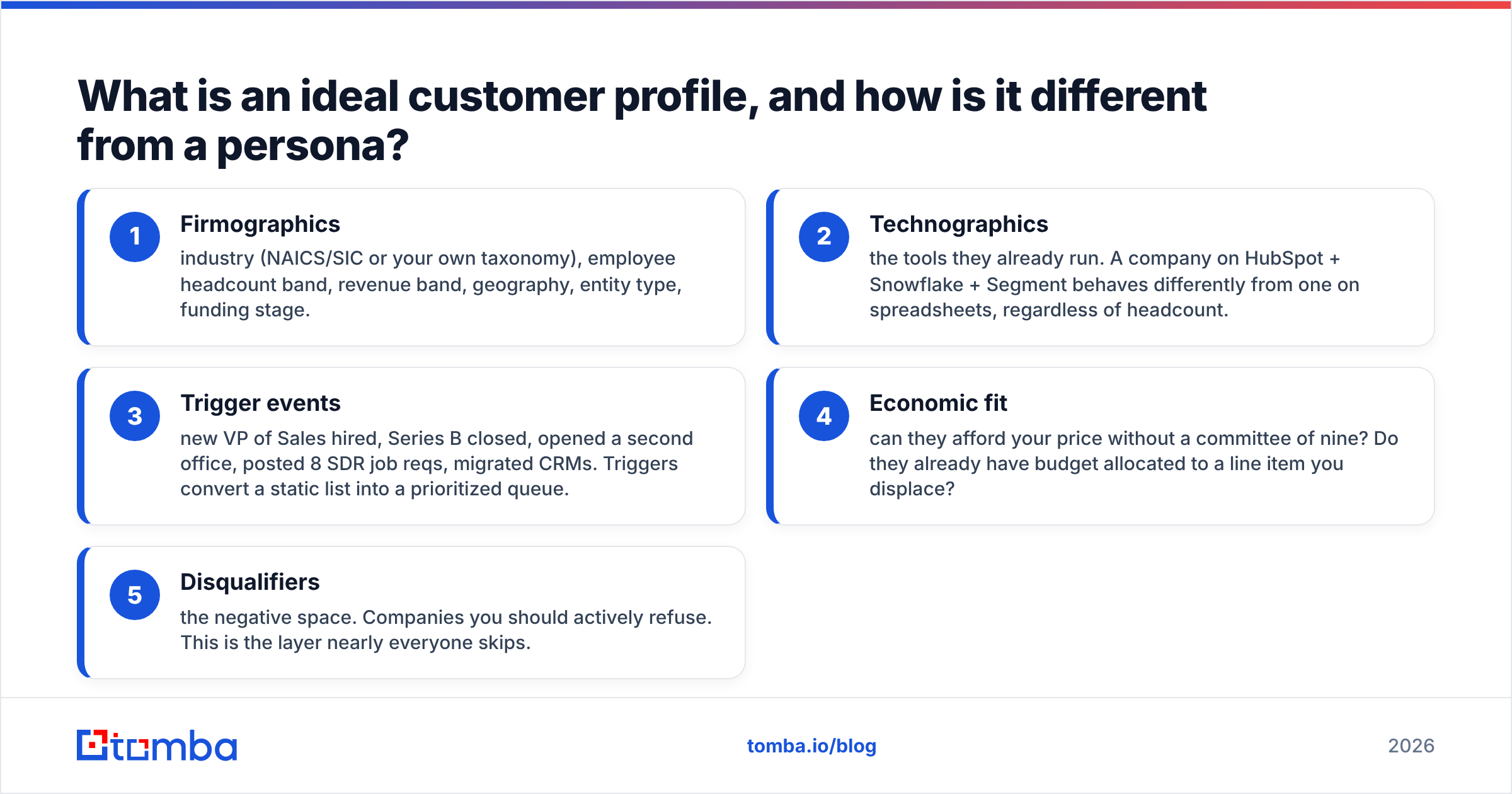
A workable ICP has five layers:
- Firmographics — industry (NAICS/SIC or your own taxonomy), employee headcount band, revenue band, geography, entity type, funding stage.
- Technographics — the tools they already run. A company on HubSpot + Snowflake + Segment behaves differently from one on spreadsheets, regardless of headcount.
- Trigger events — new VP of Sales hired, Series B closed, opened a second office, posted 8 SDR job reqs, migrated CRMs. Triggers convert a static list into a prioritized queue.
- Economic fit — can they afford your price without a committee of nine? Do they already have budget allocated to a line item you displace?
- Disqualifiers — the negative space. Companies you should actively refuse. This is the layer nearly everyone skips.
Why do most ICP documents fail?#
Three failure modes, in order of frequency.
Failure one: it was invented, not observed. Someone ran a workshop, sticky notes went on a wall, and the output was "mid-market B2B SaaS companies in North America who value data-driven decisions." That describes roughly 400,000 companies and excludes nobody. It is a wishlist, not a filter.
Failure two: it has no disqualifiers. A profile that only says yes cannot say no. Without explicit exclusions — "no companies under 20 employees," "no agencies reselling to end clients," "no orgs where procurement requires SOC 2 Type II and we do not have it" — reps will rationalize any account into the pipeline when quota pressure hits in week 11.
Failure three: it never gets operationalized. The ICP lives in a Notion page nobody opens. It never becomes a saved search, a scoring field in the CRM, or a filter on the list-building tool. An ICP that does not change what enters your pipeline on Monday morning is documentation theater.
The fix for all three is the same: derive the profile from evidence you already own.
How do you create an ideal customer profile step by step?#
Step 1: Pull your closed-won accounts#
Export every closed-won deal from the last 12-24 months. If you have fewer than 20, widen the window or include your most engaged trials and pilots. You need enough rows for patterns to survive coincidence.
For each account capture: industry, headcount at time of purchase, revenue band, geography, deal size, sales-cycle length, discount given, seats/usage after 6 months, whether they renewed, and whether they expanded.
Step 2: Rank them by value, not by logo#
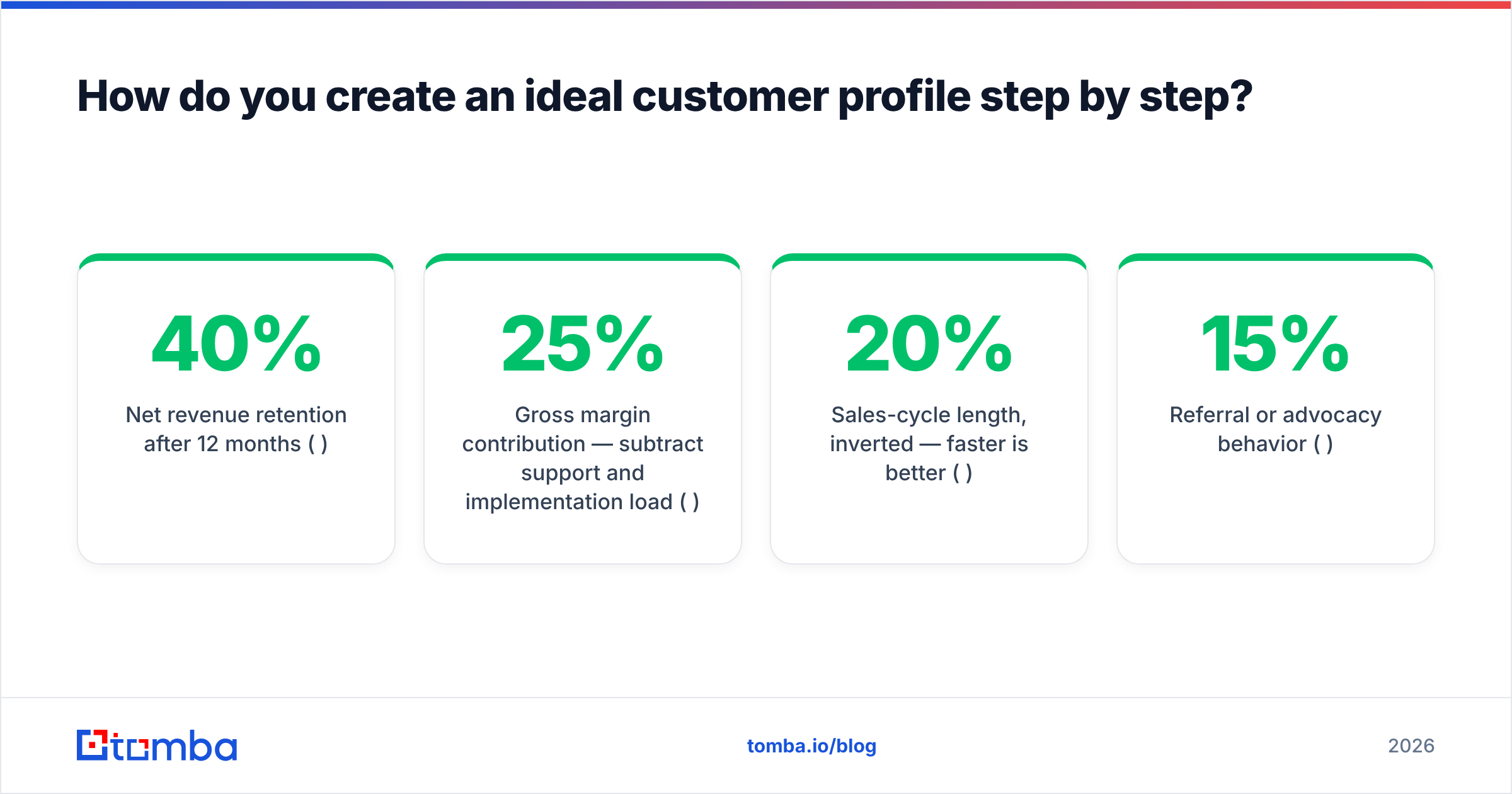
Sort by a composite score, not by ARR alone. A useful weighting:
- Net revenue retention after 12 months (40%)
- Gross margin contribution — subtract support and implementation load (25%)
- Sales-cycle length, inverted — faster is better (20%)
- Referral or advocacy behavior (15%)
Take the top quartile. These are your reference accounts. Also take the bottom quartile — those become your disqualifier evidence.
Step 3: Find what the top quartile shares#
Now look for overlap across your top accounts. Be specific enough to be actionable. "Technology companies" is not actionable. "Vertical SaaS companies serving regulated industries, 50-250 employees, post-Series-A, already running Salesforce" is.
Watch for the non-obvious variables. Common ones that predict fit better than industry:
- Team structure — do they have a dedicated ops person? Companies without one churn on any tool requiring configuration.
- Existing stack maturity — a company already paying for three adjacent tools has proven willingness to pay.
- Growth rate — headcount growth over the last 12 months often predicts urgency better than absolute size.
- Buying committee size — deals with 2-3 stakeholders close in half the time of deals with 7.
Step 4: Write the disqualifiers explicitly#
From your bottom quartile, extract the patterns that predicted pain: heavy customization requests, sub-10-seat deployments, procurement cycles over 90 days, industries where your integrations do not exist. Write them as hard rules, not soft guidance.
Step 5: Turn it into a scoring model#
Assign point values so any account can be scored 0-10 without a debate. Something like: headcount in band (3 points), target industry (2), runs a required integration (2), trigger event in last 90 days (2), no disqualifier present (1, and any disqualifier zeroes the score).
Step 6: Validate against your loss data#
Take 20 closed-lost deals and score them retroactively. If a large share score 8+, your model is not discriminating and you need sharper variables. If most score below 5, your model is working.
Step 7: Operationalize it in the tools reps actually use#
Add an icp_score field to the CRM. Build saved searches matching the criteria. Then build lists — with real, verified contact data — only for accounts scoring 7+. This is where a domain search does the heavy lifting: once you know the account list, you pull the right contacts at each company instead of buying a generic 50,000-row list.
What does a good ICP look like versus a bad one?#
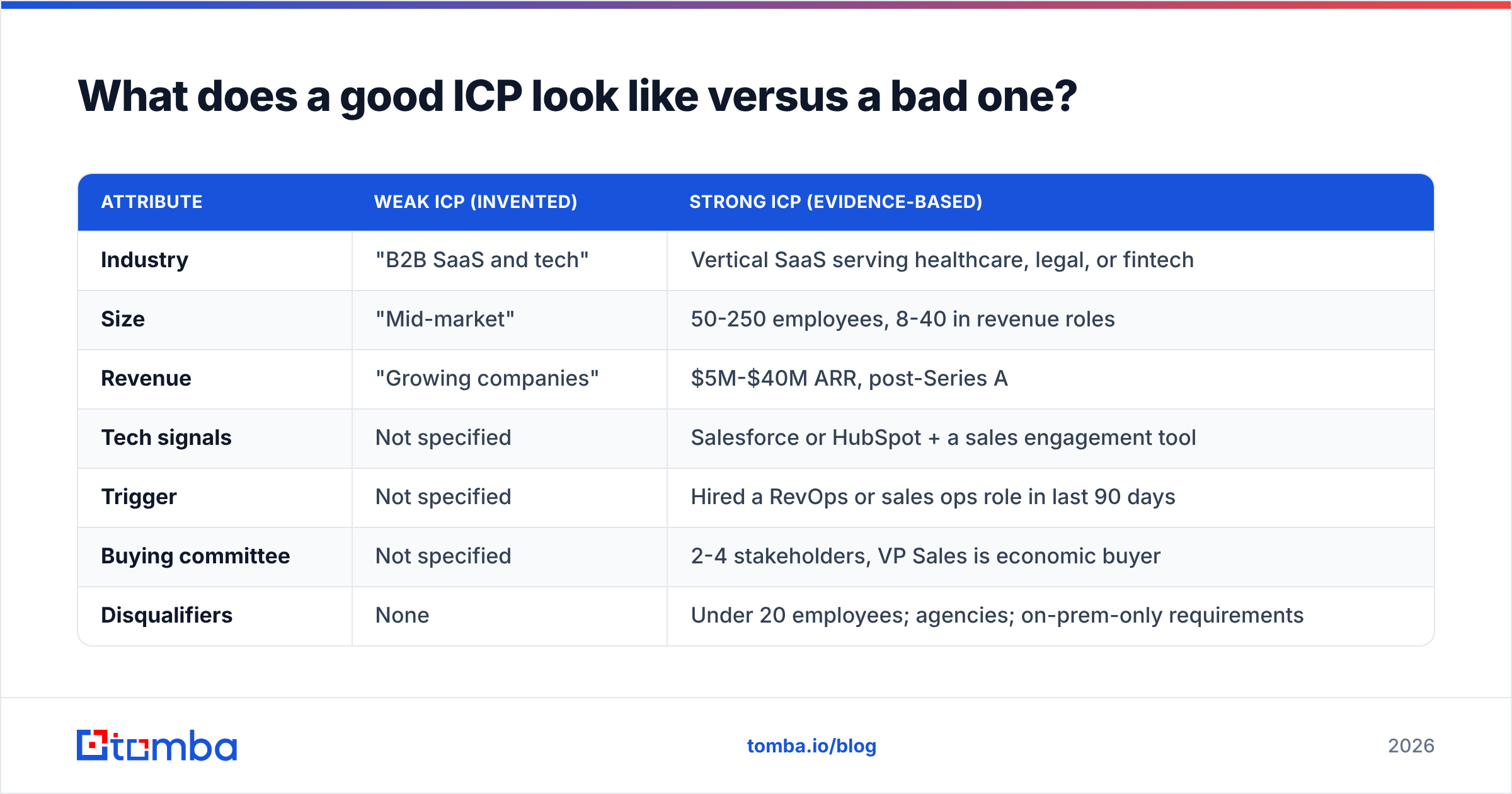
Here is the same company's ICP before and after the exercise. The difference is not length — it is testability.
| Attribute | Weak ICP (invented) | Strong ICP (evidence-based) |
|---|---|---|
| Industry | "B2B SaaS and tech" | Vertical SaaS serving healthcare, legal, or fintech |
| Size | "Mid-market" | 50-250 employees, 8-40 in revenue roles |
| Revenue | "Growing companies" | $5M-$40M ARR, post-Series A |
| Tech signals | Not specified | Salesforce or HubSpot + a sales engagement tool |
| Trigger | Not specified | Hired a RevOps or sales ops role in last 90 days |
| Buying committee | Not specified | 2-4 stakeholders, VP Sales is economic buyer |
| Disqualifiers | None | Under 20 employees; agencies; on-prem-only requirements |
| Addressable accounts | ~380,000 | ~2,400 |
| Usable by a rep on Monday | No | Yes — becomes a saved search + score field |
The right-hand column is smaller by three orders of magnitude. That is the point. Precision beats reach when every contact costs you a credit and every bad email costs you sender reputation.
Which data do you actually need, and where does it come from?#
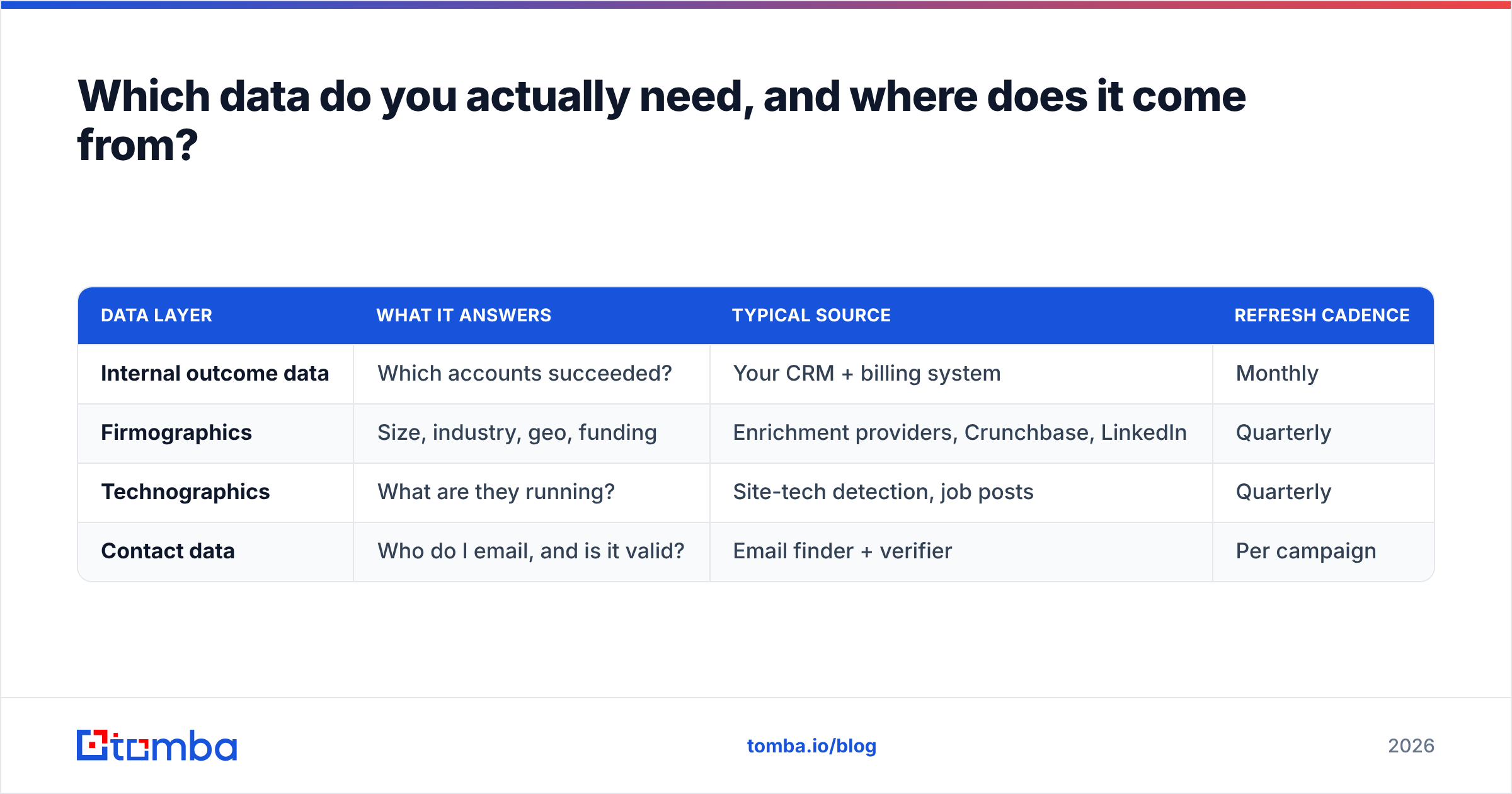
You need four categories of data, and they come from different places. Confusing them leads to teams paying enterprise-intent-data prices for information sitting in their own CRM.
| Data layer | What it answers | Typical source | Refresh cadence |
|---|---|---|---|
| Internal outcome data | Which accounts succeeded? | Your CRM + billing system | Monthly |
| Firmographics | Size, industry, geo, funding | Enrichment providers, Crunchbase, LinkedIn | Quarterly |
| Technographics | What are they running? | Site-tech detection, job posts | Quarterly |
| Contact data | Who do I email, and is it valid? | Email finder + verifier | Per campaign |
The first layer is free and the most valuable — you already own it. Most teams skip straight to buying the second and third, which is like hiring a market researcher before reading your own sales notes.
For the fourth layer, accuracy is the whole ballgame. A perfectly targeted 2,400-account list is worthless if a third of the emails bounce. Run every list through an email verifier before it touches your sequencer, and check formats with a company email pattern lookup when you are working an account with no public contacts.
How do you know if your ICP is too broad or too narrow?#
Use these thresholds as a sanity check rather than as gospel — they vary with ACV and motion.
Signs it is too broad:
- Reply rates below 2% on well-written outbound.
- Reps ask "is this account a fit?" more than once a week.
- Your total addressable account list exceeds 50,000 for a team of five AEs.
- Win rates vary wildly by segment with no explanation.
Signs it is too narrow:
- Fewer than 300 accounts per rep per year.
- You are re-touching the same accounts every 6 weeks.
- Marketing cannot fill a webinar from the list.
- You keep making "strategic exceptions" — which means the ICP does not match reality.
The workable range for most mid-market motions: roughly 500-1,500 target accounts per AE, refreshed quarterly. G2's buyer behavior research and HubSpot's sales benchmarks both point the same direction — concentrated, well-researched account lists outperform volume plays on response rate by a wide margin.
How often should you update your ICP?#
Quarterly review, annual rebuild. Trigger an off-cycle update whenever one of these happens:
- You ship a material feature that unlocks a segment you previously disqualified.
- You change pricing — a 40% price increase can invalidate an entire headcount band overnight.
- A competitor exits or enters your segment, changing the win-rate math.
- You cross a compliance milestone (SOC 2, HIPAA, GDPR posture) that opens regulated verticals.
- Churn concentrates in a segment you thought was core — the loudest possible signal that the profile drifted.
Each review is cheap if you kept the pipeline clean: re-pull closed-won, re-run the top-quartile analysis, compare to last quarter's profile, and change one or two variables. It should take an afternoon, not an offsite.
How do you go from ICP to a working target list?#
Sequence matters here. The order that works:
- Define account criteria from the profile above.
- Build the account list using firmographic and technographic filters — a B2B database or enrichment provider handles this. Peers like BookYourData are a reasonable option when you want pre-built lists with verification included; the tradeoff versus self-serve building is control over the filter logic.
- Score every account with the model from Step 5. Cut everything below 7.
- Map the buying committee per account — usually 3-5 people across an economic buyer, a champion, and a blocker.
- Find and verify contacts for those specific roles. This is where an email finder beats scraping: you request by name and domain and get a verified result with a confidence score, rather than guessing at
first.last@. - Enrich with triggers — recent funding, hiring, tech changes — so the first line of your email is not generic.
- Route into sequences built for the persona, not the account.
Steps 1-3 are strategy. Steps 4-7 are execution, and they are where most ICP work quietly dies. A profile that never becomes a list is a memo.
One practical warning on step 5: bulk-buying contacts for an entire account list before scoring it is the most common way teams waste budget. Score first, then buy contacts only for the accounts that survive. On a 2,400-account list at a 40% pass rate, that is roughly 60% of your data spend saved — and a cleaner list going into your sequencer.
What should you do first if you have no closed-won data yet?#
Pre-revenue or under ten customers, you cannot run the analysis above. Use a hypothesis-driven substitute:
- Interview 10-15 prospects in your best guess segment. You are looking for consistency of pain, not validation of your product.
- Use competitor customer lists as a proxy. Their public case studies and logo walls tell you which segments already buy this category.
- Define your ICP as a testable hypothesis with an explicit falsification condition: "if we run 300 touches into 50-200 employee vertical SaaS and get under 4% positive replies, this segment is wrong."
- Run one segment at a time. Testing four segments simultaneously with 75 touches each produces four inconclusive results.
Then run the real analysis the moment you have 20 closed-won accounts. Everything before that is a placeholder.
Where to start this week#
Block two hours. Export closed-won, rank by the composite score, and write down the five things your top quartile shares and the three things your bottom quartile shares. That single afternoon produces more targeting value than a quarter of intent-data spend.
When you have the account list, the last mile is getting real contacts at those companies without wrecking your deliverability. Tomba's Email Finder returns verified professional emails by name and domain with a confidence score on every result, so your ICP-qualified list arrives clean instead of half-bounced. Start on the free tier (25 searches/month) to test the workflow on 25 of your best-fit accounts, then move to Starter at $49/month or Growth at $99/month once your list is scored and you are ready to run at volume — full Tomba pricing is public, no sales call required.
Related guides#
// get started
Find, verify and enrich your first contacts today
Start on the free plan with 25 searches a month, then scale when your team is ready.
Free plan · No credit card required · GDPR & CCPA
// about the author