How to Cross-Sell in 2026: A Step-by-Step Playbook for B2B
Cross-selling fails when it's a quota reflex instead of a timed response to a real signal. Here's the account data, the triggers, and the six plays that make expansion revenue predictable.
TL;DR
- Cross-selling is selling an adjacent product to an existing customer. Upselling is selling more of the same. Confusing the two is why most expansion plays land badly.
- The single biggest predictor of a successful cross-sell is not the pitch. It's the trigger — a usage threshold, a new hire, a funding round, a support ticket that your other product solves.
- Build a cross-sell motion around four inputs: product usage data, account firmographics, buying-committee contacts, and a defined trigger-to-play mapping.
- Rep-led, in-app, lifecycle-email, and partner motions each fit different ACVs. Pick one primary motion per segment instead of running all four badly.
- Measure cross-sell attach rate, expansion ARR per account, and time-to-second-product. Revenue alone hides whether the motion is repeatable.
What is cross-selling, and how is it different from upselling?#
Cross-selling means selling a customer a different product that complements what they already bought. Upselling means selling them a bigger version of what they already bought. Bundling means selling both at once, at signup, before anyone has used anything.
The distinction matters because each one needs a different proof point. An upsell is justified by volume — you hit your seat cap, you need more. A cross-sell is justified by adjacency — you solved problem A, and problem B is now blocking you. A bundle is justified by price — buying together is cheaper than buying twice.
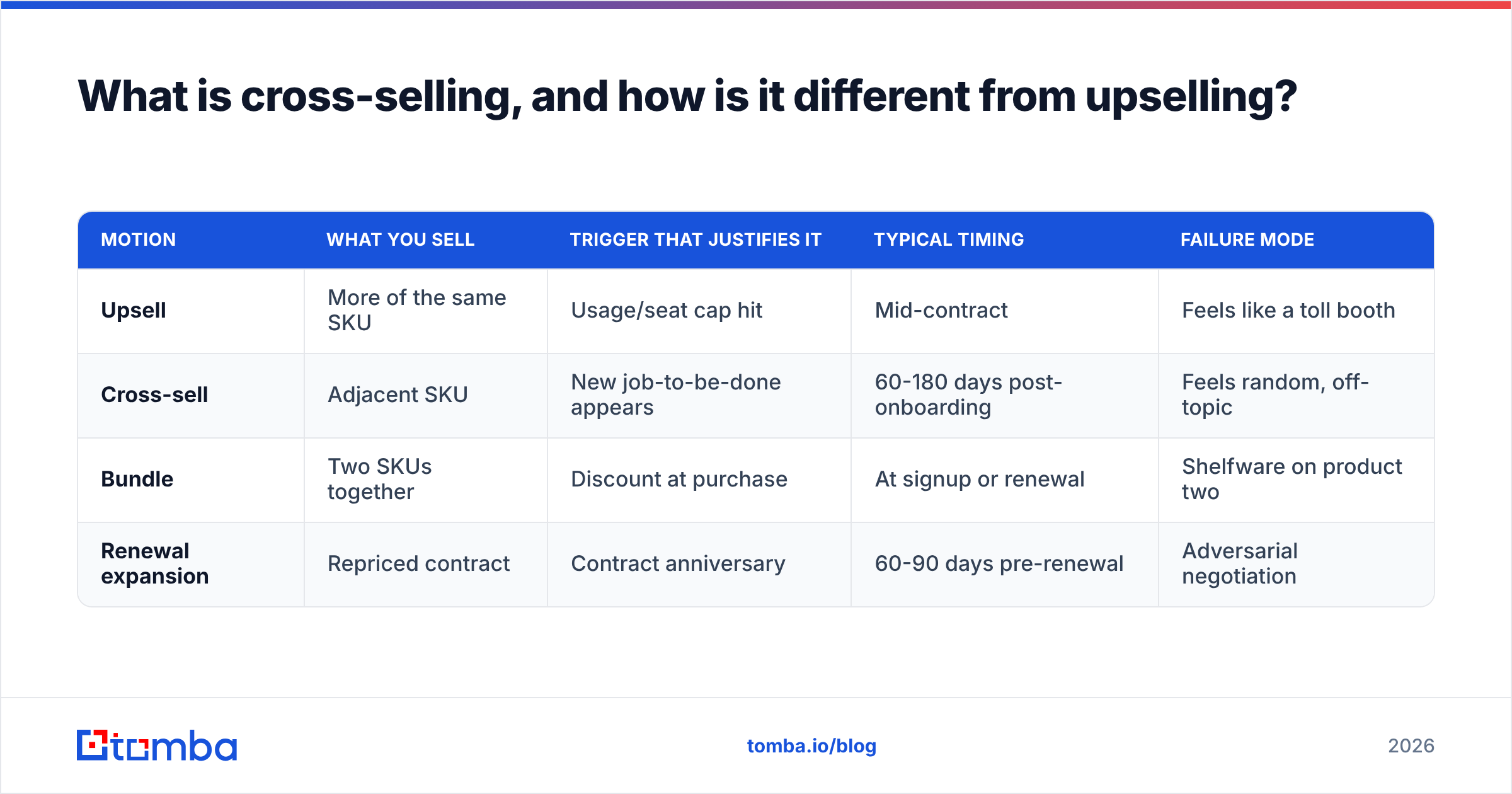
| Motion | What you sell | Trigger that justifies it | Typical timing | Failure mode |
|---|---|---|---|---|
| Upsell | More of the same SKU | Usage/seat cap hit | Mid-contract | Feels like a toll booth |
| Cross-sell | Adjacent SKU | New job-to-be-done appears | 60-180 days post-onboarding | Feels random, off-topic |
| Bundle | Two SKUs together | Discount at purchase | At signup or renewal | Shelfware on product two |
| Renewal expansion | Repriced contract | Contract anniversary | 60-90 days pre-renewal | Adversarial negotiation |
If you want the textbook framing, the Wikipedia entry on cross-selling covers the retail origins of the term. In B2B, the mechanics are different: there is a buying committee, a procurement cycle, and a champion whose credibility is on the line if product two disappoints.
Why do most cross-sell attempts fail?#
Because they are scheduled, not triggered.
The typical broken version looks like this: a rep has a quarterly expansion quota, opens the account list, sorts by contract value, and emails the same three customers the same "have you seen our new module?" note. Nothing about that message references what the customer is actually doing. The customer reads it as a quota email, because it is one.
Four specific failure patterns show up over and over:
- Pitching before the first product works. If onboarding on product one is still shaky, product two reads as a distraction. Wait for a real activation milestone.
- Pitching to the wrong person. The user who loves product one often has no budget for product two. The economic buyer for the adjacent product frequently sits in a different department entirely.
- No adjacency logic. "We also sell X" is not a reason. "Your team exported 4,000 records to a spreadsheet last month, which is exactly what X automates" is a reason.
- Discounting instead of framing. A 20% cross-sell discount converts customers who were going to buy anyway and insults the ones who weren't ready.

What signals tell you an account is ready to cross-sell?#
Ready accounts announce themselves. You just have to be listening on the right channels. The strongest signals fall into four buckets, and you should be able to query all four:
- Product usage thresholds. A customer who has hit 80% of a plan limit, run the same manual workaround three months in a row, or invited users from a second department is telling you their scope expanded.
- Org changes. A new VP in an adjacent function, a hiring spree on a team you don't currently serve, or a reorg that merges two departments creates a fresh budget line and a fresh problem owner.
- Funding and growth events. A raise, an acquisition, or a new market entry compresses the timeline on problems the company was tolerating.
- Support and CS conversations. Tickets that start with "is there a way to..." are cross-sell briefs written by the customer.
- Competitive displacement. A customer who just churned off a point solution in an adjacent category has an open seat and a fresh scar.
- Integration activity. Connecting your product to a tool in the adjacent category shows the workflow already spans both products.
The operational problem is that these signals live in four different systems: your product database, your CRM, your support desk, and the open web. Cross-sell programs die when nobody owns the job of pulling them into one view. Assign that job explicitly, even if the "system" is a weekly query into a shared table.
Once a signal fires, you still need a human to talk to — and it is frequently not the person already in your CRM. This is where data enrichment earns its keep: you know the account and the department, and you need the name, title, and verified email of the person who owns the adjacent budget. Enriching the account before the play, rather than after, is the difference between a targeted message and a forwarded one.
How do you build a cross-sell play, step by step?#
Here is the sequence that survives contact with a real pipeline.
Step 1 — Map product adjacency honestly. For every product pair in your catalog, write down the customer problem that connects them. If you can't write one sentence linking product A's outcome to product B's problem, that pair is not a cross-sell. It's a catalog.
Step 2 — Define the trigger for each pair. One pair, one primary trigger, one backup. Write it as a query, not a vibe: "Accounts on the Growth plan with >70% seat utilization and at least one user from Marketing." Vague triggers produce vague plays.
Step 3 — Set an eligibility floor. No cross-sell before the account has hit its product-one activation milestone and cleared its first renewal risk review. This floor protects your NRR more than any pitch protects your quota.
Step 4 — Identify the second buying committee. Product two usually has a different owner, a different influencer, and sometimes a different procurement path. Build the contact list before you need it. A domain search across the customer's company surfaces the roles you're missing, and verifying emails before you send keeps the expansion sequence off your bounce log.
Step 5 — Write the play, not the email. A play has a trigger, an owner, a channel sequence, an internal-referral ask, and an exit condition. The email is one artifact inside it.
Step 6 — Instrument and review monthly. Track which triggers convert. Kill the bottom two every quarter. Cross-sell programs rot fast because product roadmaps move and last year's adjacency stops being true.
Which cross-sell motion should you run?#
Motion choice is mostly a function of contract value and how much the second product costs to explain.
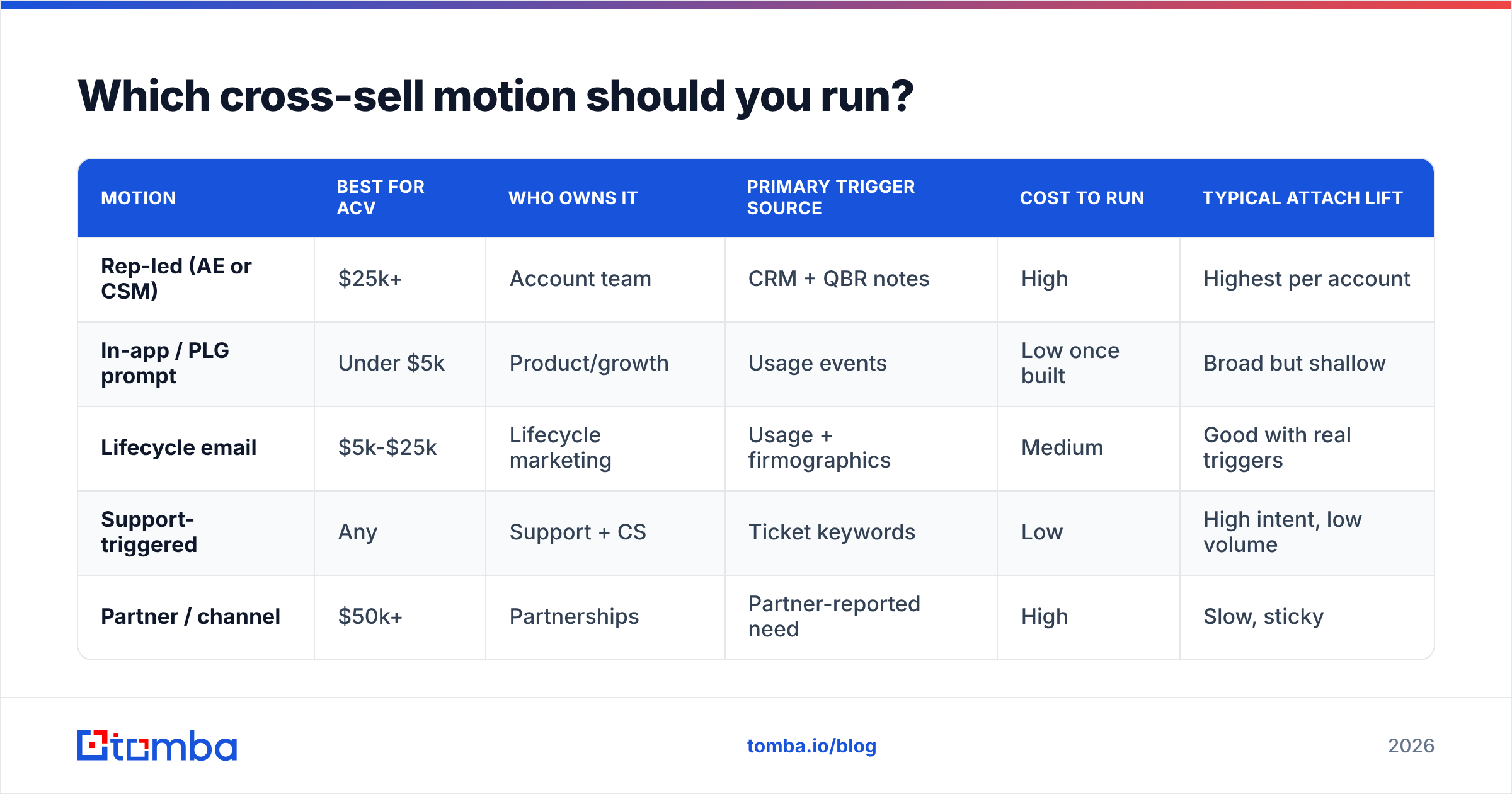
| Motion | Best for ACV | Who owns it | Primary trigger source | Cost to run | Typical attach lift |
|---|---|---|---|---|---|
| Rep-led (AE or CSM) | $25k+ | Account team | CRM + QBR notes | High | Highest per account |
| In-app / PLG prompt | Under $5k | Product/growth | Usage events | Low once built | Broad but shallow |
| Lifecycle email | $5k-$25k | Lifecycle marketing | Usage + firmographics | Medium | Good with real triggers |
| Support-triggered | Any | Support + CS | Ticket keywords | Low | High intent, low volume |
| Partner / channel | $50k+ | Partnerships | Partner-reported need | High | Slow, sticky |
Two rules of thumb. First, pick one primary motion per segment and one secondary — running all five means none of them get instrumented properly. Second, whichever motion you choose, the ask should be for a conversation about the problem, not a demo of product two. Gartner's research on B2B buying behaviour has been consistent for years that buyers spend the majority of their time on independent research; a cross-sell that opens with a demo request is fighting that pattern instead of using it.
What does a good cross-sell email actually look like?#
Short, trigger-first, and addressed to the person who owns the new problem — not the person who owns the old one.
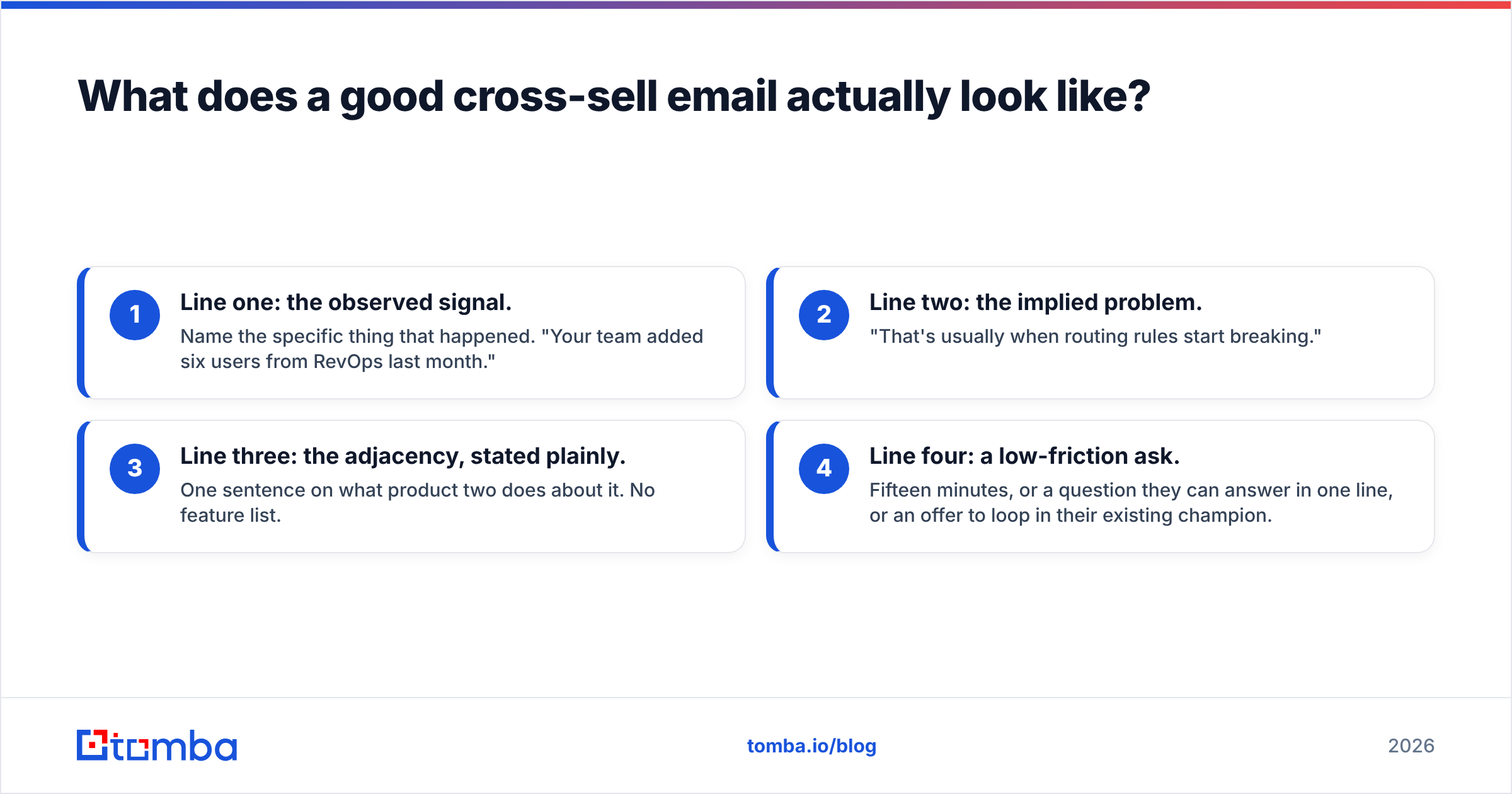
The structure that works:
- Line one: the observed signal. Name the specific thing that happened. "Your team added six users from RevOps last month."
- Line two: the implied problem. "That's usually when routing rules start breaking."
- Line three: the adjacency, stated plainly. One sentence on what product two does about it. No feature list.
- Line four: a low-friction ask. Fifteen minutes, or a question they can answer in one line, or an offer to loop in their existing champion.
What to leave out: the discount, the case study PDF, the phrase "circling back," and any mention of your quarter. HubSpot's guide to cross-selling makes the same point from the other direction — the pitch works when it reads as an extension of the relationship rather than a new sales cycle.
If you're building the sequence from scratch, the cold email templates library is a reasonable starting skeleton — just replace the generic hook with your actual trigger, because a templated cross-sell with no signal in line one is worse than no email at all.

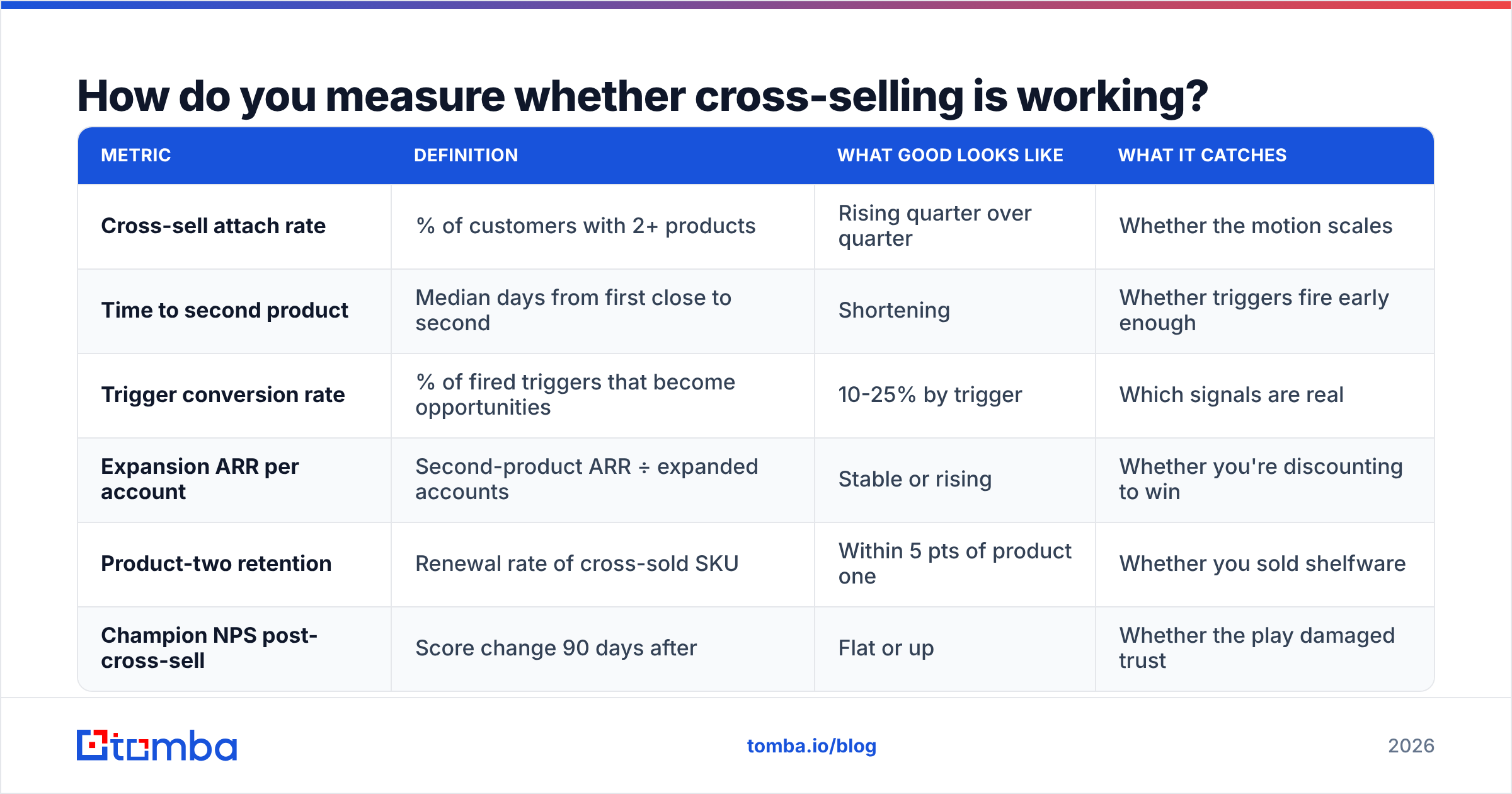
How do you measure whether cross-selling is working?#
Revenue is a lagging, noisy metric. It moves when one big account expands, which tells you nothing about repeatability. Track the mechanics instead.
| Metric | Definition | What good looks like | What it catches |
|---|---|---|---|
| Cross-sell attach rate | % of customers with 2+ products | Rising quarter over quarter | Whether the motion scales |
| Time to second product | Median days from first close to second | Shortening | Whether triggers fire early enough |
| Trigger conversion rate | % of fired triggers that become opportunities | 10-25% by trigger | Which signals are real |
| Expansion ARR per account | Second-product ARR ÷ expanded accounts | Stable or rising | Whether you're discounting to win |
| Product-two retention | Renewal rate of cross-sold SKU | Within 5 pts of product one | Whether you sold shelfware |
| Champion NPS post-cross-sell | Score change 90 days after | Flat or up | Whether the play damaged trust |
That last row is the one most teams skip and the one that matters most. A cross-sell that closes but drops the champion's satisfaction has borrowed revenue from your renewal. Measure it at 90 days, not at close.
Also segment attach rate by how the customer arrived. Accounts that came in through a partner, through self-serve, and through enterprise sales cross-sell at very different rates, and averaging them together hides the segment where your motion actually works.
What data infrastructure do you need before you start?#
Less than vendors want you to think, but not nothing. The minimum viable stack is:
- A usage table you can query. Even a nightly export into a warehouse beats asking product for a one-off pull every month.
- Clean account-to-contact mapping. One account, many contacts, with department and seniority fields populated. This is where most CRMs quietly fail.
- Verified contact data for the adjacent buyer. You will consistently need people who aren't in your CRM yet. A bulk email finder run against your customer domain list, filtered by the department that owns product two, closes that gap in an afternoon rather than a quarter.
- A trigger log. Every fired trigger, timestamped, with the outcome. Without it you cannot tell a bad trigger from a bad rep.
You do not need an AI scoring model in year one. You need four working queries and someone who reads the output every Monday.
Start with the contacts you're missing#
The cross-sell plays above all assume one thing: you can reach the person who owns the adjacent budget. For most teams, that's the actual bottleneck — the signal fires, the play is written, and then the rep spends forty minutes hunting for an email address for a director in a department they've never sold into.
Tomba's Email Finder closes that gap. Point it at your existing customer domains, pull verified addresses for the roles that own product two, and feed them straight into your expansion sequence. The free tier covers 25 searches a month if you want to test the motion on a handful of accounts first; paid plans start at $49/mo on Starter and $99/mo on Growth once you're running triggers at volume. Full Tomba pricing is public, and the Tomba API lets you wire lookups directly into the trigger job so enrichment happens the moment a signal fires — not three days later when the moment has passed.
Related guides#
// get started
Find, verify and enrich your first contacts today
Start on the free plan with 25 searches a month, then scale when your team is ready.
Free plan · No credit card required · GDPR & CCPA
Get the Tomba newsletter
Product and data updates
// about the author