How To Define Your Ideal Customer Profile in 2026
Most ICPs are guesswork dressed up as a slide. Here is a data-backed, seven-step process for defining your ideal customer using your own closed-won deals, plus the firmographic fields that actually predict revenue.
TL;DR
- An ideal customer profile (ICP) describes the company you should sell to; a buyer persona describes the person inside it. You need both, in that order.
- Build the ICP from your closed-won data, not from a whiteboard. Twenty real accounts beat a hundred assumptions.
- The four field groups that actually predict revenue: firmographics, technographics, trigger events, and pain-fit signals. Everything else is decoration.
- Score accounts 0-100 against the profile, then let the score decide who your reps touch this quarter.
- Re-run the analysis every two quarters. ICPs decay fast when your pricing, product, or market moves.
What is an ideal customer profile, and why do most of them fail?#
An ideal customer profile is a description of the type of company that gets the most value from your product in the shortest time, at the lowest cost to serve, and stays the longest. It is a company-level filter, not a person.
Most ICPs fail because they get written in a strategy offsite instead of pulled from a CRM. Someone says "mid-market SaaS in North America," everyone nods, and that sentence gets pasted into a deck that nobody opens again. Six months later the pipeline is full of companies that match the sentence and none of them close.
Think of it like a restaurant deciding who to cater to. You could guess that your regulars want small plates. Or you could look at what actually left the kitchen last year, which tables tipped the most, and which orders came back to the pass. The receipts already have the answer.
The receipts, in your case, are closed-won deals, churned accounts, expansion revenue, and support ticket volume. That data exists. The exercise below turns it into a profile you can act on.
Wait — that image is a placeholder. Here is the real one:

How is an ICP different from a buyer persona or a TAM?#
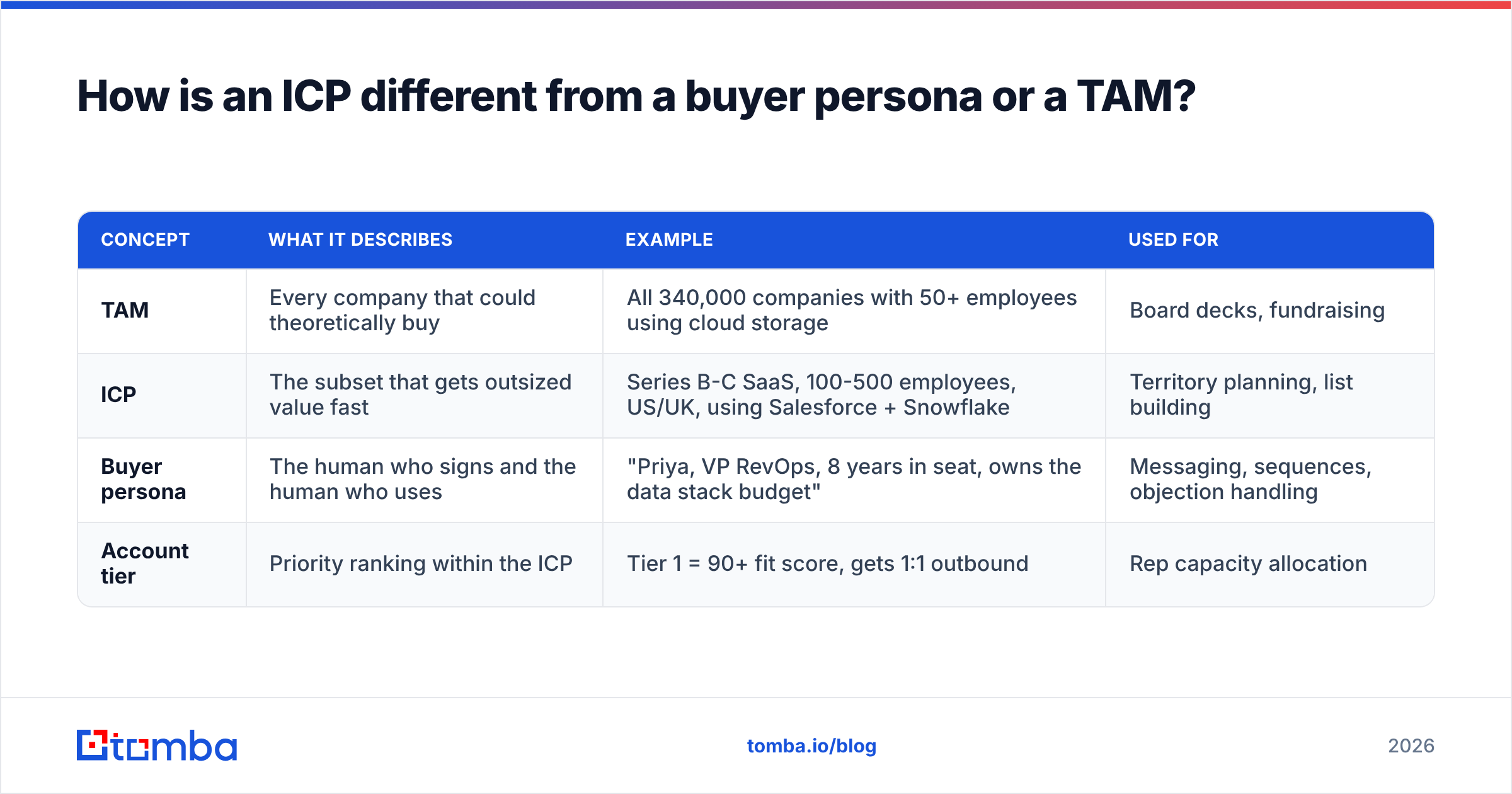
These three get used interchangeably in sales meetings and they should not be. They operate at different altitudes.
| Concept | What it describes | Example | Used for |
|---|---|---|---|
| TAM | Every company that could theoretically buy | All 340,000 companies with 50+ employees using cloud storage | Board decks, fundraising |
| ICP | The subset that gets outsized value fast | Series B-C SaaS, 100-500 employees, US/UK, using Salesforce + Snowflake | Territory planning, list building |
| Buyer persona | The human who signs and the human who uses | "Priya, VP RevOps, 8 years in seat, owns the data stack budget" | Messaging, sequences, objection handling |
| Account tier | Priority ranking within the ICP | Tier 1 = 90+ fit score, gets 1:1 outbound | Rep capacity allocation |
The failure mode is skipping straight to persona. You write beautiful copy for "Priya" and send it to 4,000 companies that were never going to buy. The persona controls what you say; the ICP controls who hears it. Get the second one wrong and the first one does not matter.
How do you define your ideal customer step by step?#
Seven steps. Budget a week if your CRM is clean, three weeks if it is not.
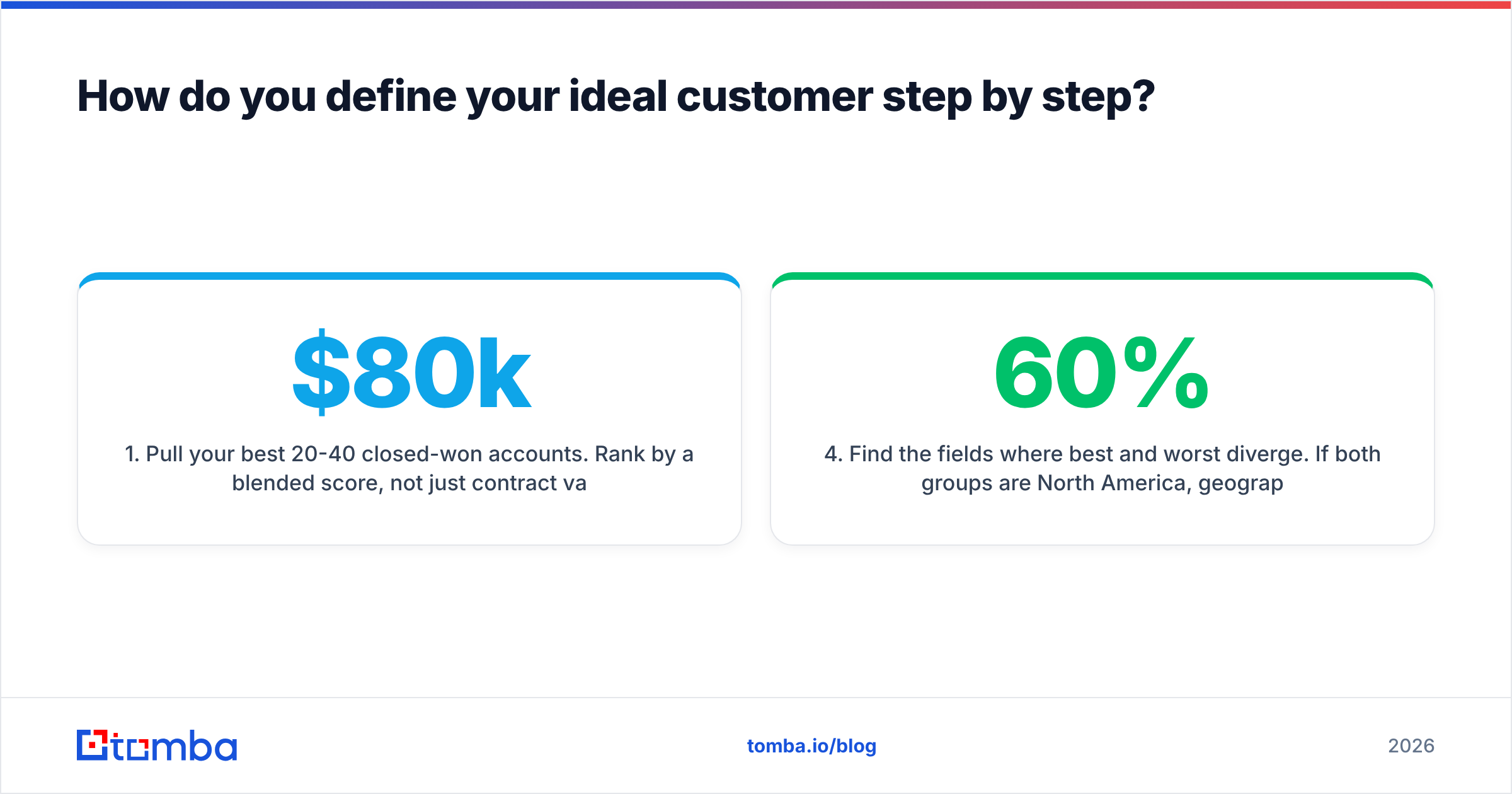
- Pull your best 20-40 closed-won accounts. Rank by a blended score, not just contract value: annual revenue, gross margin, time-to-close, retention past month 18, and expansion. An account that paid $80k and churned at month 13 is not a best customer.
- Pull your worst 20 accounts too. Churned, heavily discounted, or support-hungry. The negative profile is often more actionable than the positive one, because it gives you disqualification rules your reps can apply in thirty seconds.
- Tag every account across four field groups. Firmographic (employee count, revenue band, industry, geography, funding stage), technographic (CRM, data warehouse, marketing automation, competing tool), trigger (new exec hire, funding round, office opening, compliance deadline), and pain-fit (the specific operational problem they had before you).
- Find the fields where best and worst diverge. If both groups are 60% North America, geography is noise — drop it. If 80% of your best accounts had a VP-level RevOps hire in the prior nine months and 10% of your worst did, you found a trigger worth building a list around.
- Write the profile as testable criteria. Not "growth-stage companies with a modern data stack." Instead: "100-500 employees, Series B or later, running Salesforce, has hired a RevOps leader in the last 12 months, sells B2B." Every clause must be checkable against a data source.
- Build the scoring model. Weight each criterion by how strongly it separated best from worst. Sum to 100. Anything above 70 is Tier 1.
- Ship it into the workflow. The profile lives in your list-building filters, your CRM fields, and your rep qualification checklist — not in a document.
Step 5 is where most teams stop short. "Modern data stack" cannot be filtered. "Uses Snowflake" can. If a criterion cannot become a filter in a database or an enrichment field, rewrite it until it can.
Which data points actually predict a good customer?#
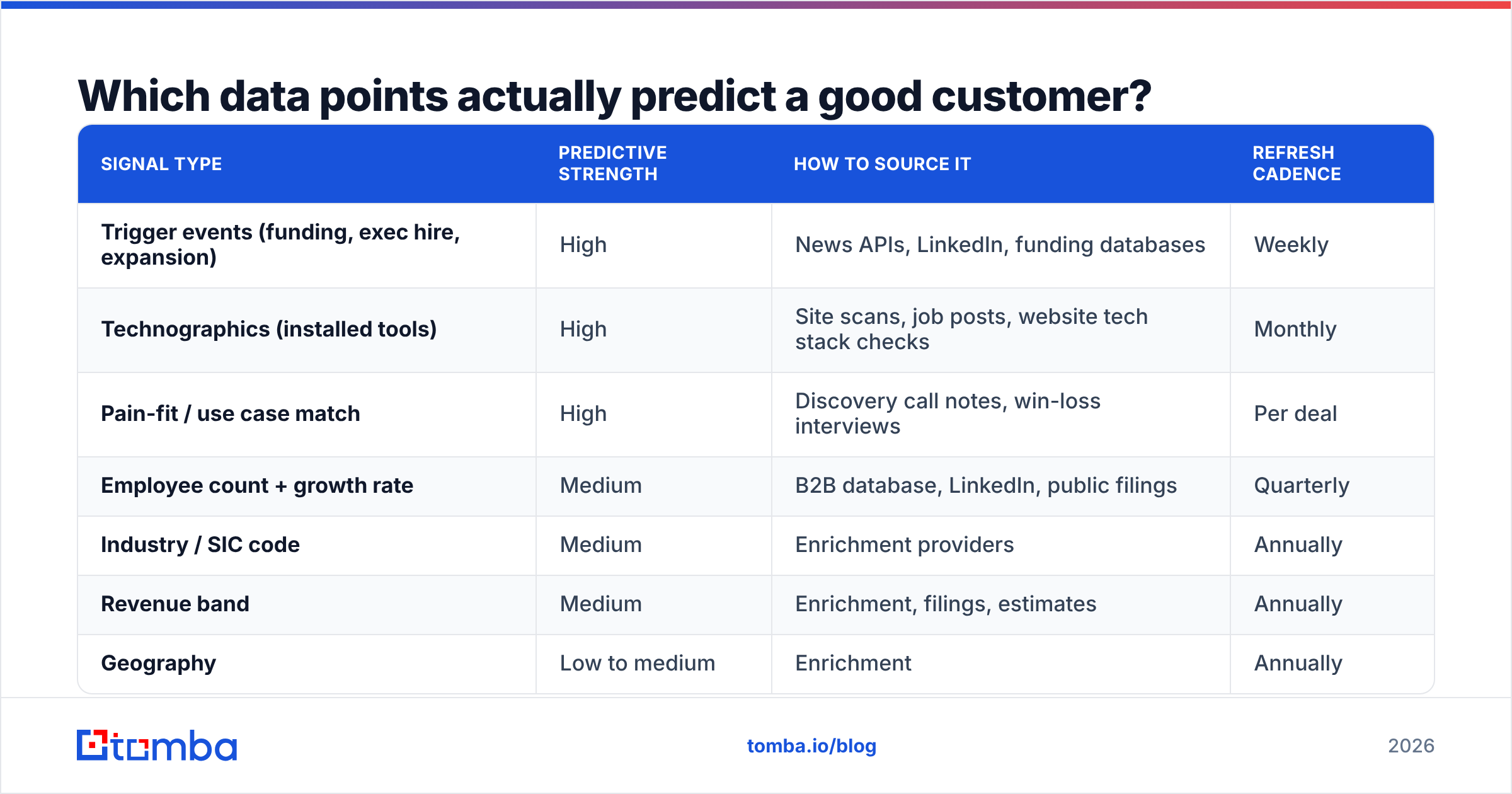
Not all criteria carry equal weight. Here is roughly how they rank across most B2B motions, based on what separates high-retention accounts from churned ones.
| Signal type | Predictive strength | How to source it | Refresh cadence |
|---|---|---|---|
| Trigger events (funding, exec hire, expansion) | High | News APIs, LinkedIn, funding databases | Weekly |
| Technographics (installed tools) | High | Site scans, job posts, website tech stack checks | Monthly |
| Pain-fit / use case match | High | Discovery call notes, win-loss interviews | Per deal |
| Employee count + growth rate | Medium | B2B database, LinkedIn, public filings | Quarterly |
| Industry / SIC code | Medium | Enrichment providers | Annually |
| Revenue band | Medium | Enrichment, filings, estimates | Annually |
| Geography | Low to medium | Enrichment | Annually |
| Company age | Low | Registry data | Annually |
Trigger events beat static firmographics because they carry timing. A company that fits your firmographic profile perfectly but has no budget cycle open for eight months is a worse target this quarter than a slightly imperfect fit that just closed a Series B. Gartner's B2B buying research consistently finds that buying groups only engage seriously once an internal trigger forces the question — the vendor's timing has to meet the buyer's.
Technographics are the second-strongest signal because they tell you about workflow compatibility and about competitive displacement. If your integration story starts with HubSpot, a HubSpot shop is structurally a better fit than an identical company running something you do not integrate with. HubSpot's own research on buyer fit makes the same point from the other side of the table.
How do you turn the profile into an actual target list?#
The profile is a filter. Now you need a database to run it against, plus contact data for the people inside the accounts that pass.
The sequence that works:
- Define the account universe. Start from a source that lets you filter on your criteria — a B2B database, an industry directory, a conference attendee list, a review-site category page on G2, or a job-board scrape if your trigger is hiring-based.
- Apply hard disqualifiers first. Wrong geography, under headcount floor, in a regulated vertical you cannot serve. This is cheaper than scoring everyone. Cutting 60% of the universe before enrichment saves real money.
- Score what survives. Run your weighted model. Sort descending.
- Enrich the top tier only. Do not buy contact data for accounts you will never work. Pull decision-maker contacts for Tier 1 and Tier 2 with a domain search across each target company, then verify before you send.
- Verify before the first send. A tight ICP list is worthless if 22% of the addresses bounce. Run the list through an email verifier and drop anything that comes back risky.
- Route by tier. Tier 1 gets 1:1 research and multithreaded outreach. Tier 2 gets a lighter sequence. Tier 3 gets nurture only, or nothing.
The enrichment order matters more than teams expect. Enriching before scoring is the single most common budget leak in outbound — you pay for contact data on accounts your own model would have rejected. Score first, enrich second.
How many criteria should your ICP have?#
Between five and eight. Fewer than five and the profile is not discriminating — you will pass 40% of the market and your reps will learn to ignore it. More than eight and almost nothing qualifies, so reps override the model on instinct and you are back to guessing.
A useful test: run the finished profile against your last 50 closed-won deals. It should capture 60-75% of them. If it captures 95%, it is too loose to be a filter. If it captures 25%, you have overfit to a handful of favorite logos and you are about to shrink your pipeline for no reason.
Also separate must-have from nice-to-have. Must-haves are binary disqualifiers — if a company fails one, it is out regardless of everything else. Nice-to-haves add points. Most teams have two or three must-haves and four or five weighted scoring criteria. Any more than three must-haves and you have built a wall, not a filter.
What are the most common mistakes when defining an ideal customer?#
Building it from your best-known customers instead of your best customers. The account everyone in the company can name is usually the biggest logo, not the highest-margin one. Rank on retention and margin, not on brand recognition.
Confusing the buyer with the user. In many categories the person who feels the pain has no budget. Your ICP must account for whether the pain-holder can reach the budget-holder inside that company's structure. In organizations above a certain size, they often cannot.
Treating the ICP as permanent. Pricing changes, a new module ships, a competitor exits the market — each of those moves the profile. Review it every two quarters against fresh closed-won data. Forrester's B2B research has documented how quickly buying-group composition shifts, and your criteria shift with it.
Ignoring cost to serve. A segment that closes fast but generates four times the support load is not ideal. Pull ticket volume per account into the analysis if you can get it.
Letting marketing and sales run different profiles. If marketing's MQL definition and sales' qualification criteria describe different companies, you get the classic lead-quality argument every Monday. One profile, one marketing qualified lead definition, both teams signed off.
Not writing down the negative profile. "We do not sell to companies under 40 employees, agencies, or anyone in a two-week evaluation cycle" saves more rep hours than any positive criterion.
How do you validate the profile before you commit budget?#
Run a two-cell test for four to six weeks.
Take 200 accounts that score 80+ and 200 that score 40-60. Same sequence, same reps, same offer, same send window. Track reply rate, meeting rate, opportunity creation, and — if your cycle is short enough — close rate.
If the high-fit cell does not outperform on meeting rate by a meaningful margin, your model is not working. Usually the fix is that you weighted a static firmographic too heavily and a trigger event too lightly. Re-weight and re-test.
Track your response rate separately from your meeting rate. A profile can lift replies while doing nothing for meetings, which usually means you targeted the right companies but the wrong role inside them — a persona problem, not an ICP problem. That distinction saves you from tearing up a profile that was fine.
Keep the test honest: do not let reps see the scores. If they know which cell is which, they will work the high-fit accounts harder and prove your model right by effort alone.
What does a finished ICP look like in practice?#
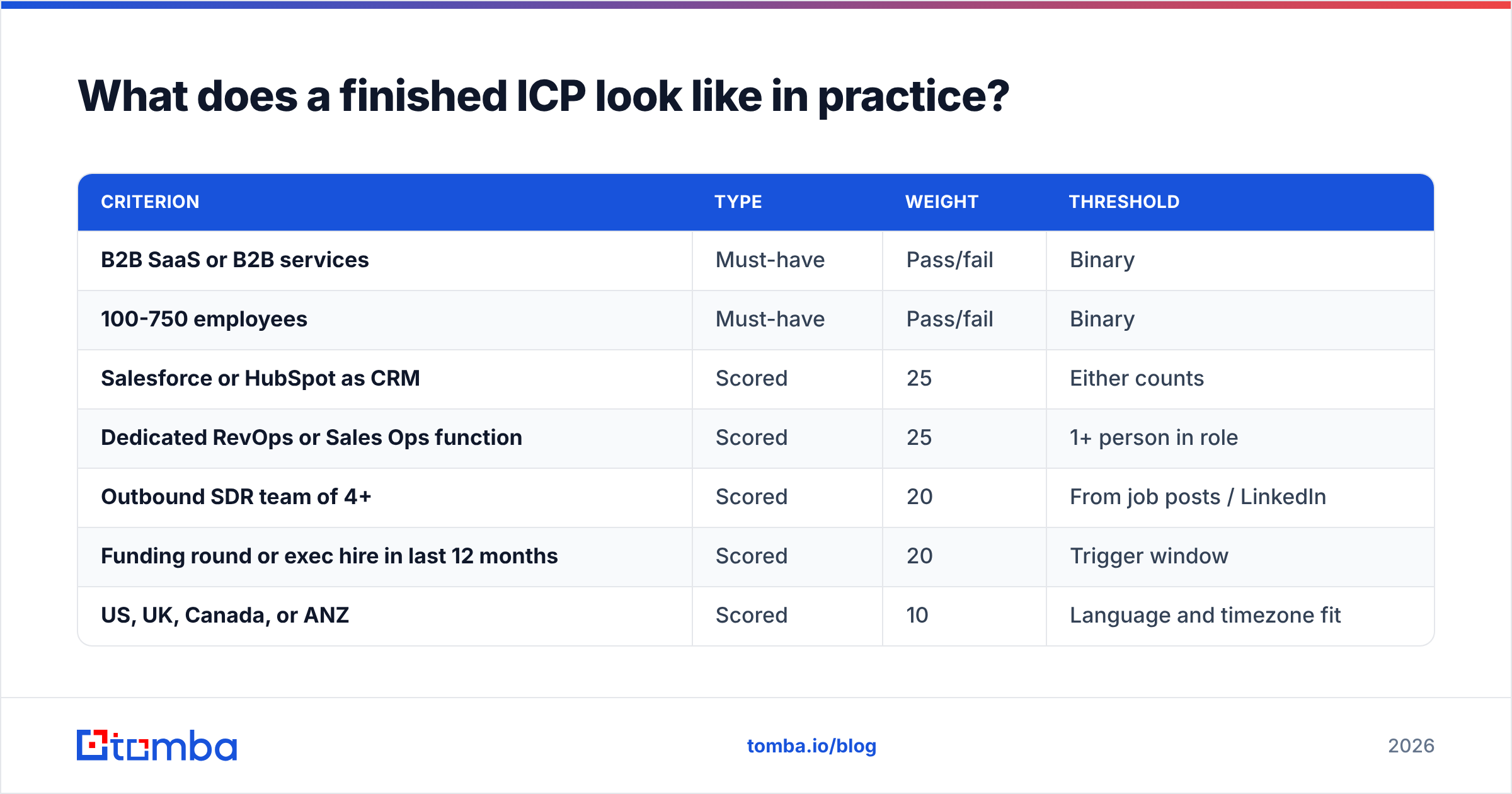
Here is a worked example for a hypothetical revenue-intelligence tool.
| Criterion | Type | Weight | Threshold |
|---|---|---|---|
| B2B SaaS or B2B services | Must-have | Pass/fail | Binary |
| 100-750 employees | Must-have | Pass/fail | Binary |
| Salesforce or HubSpot as CRM | Scored | 25 | Either counts |
| Dedicated RevOps or Sales Ops function | Scored | 25 | 1+ person in role |
| Outbound SDR team of 4+ | Scored | 20 | From job posts / LinkedIn |
| Funding round or exec hire in last 12 months | Scored | 20 | Trigger window |
| US, UK, Canada, or ANZ | Scored | 10 | Language and timezone fit |
Two binary gates, five weighted criteria, 100 points available. Tier 1 is 70+, Tier 2 is 45-69, Tier 3 is below 45 and gets nurture only.
Note what is absent: no revenue band (unreliable for private companies), no industry code beyond the top-level gate (too coarse), no company age. Each was tested against closed-won data and did not separate winners from losers, so each got cut. A criterion that does not discriminate is worse than no criterion — it adds cost and a false sense of rigor.
Turn your profile into a contactable pipeline#
A scored account list is a list of logos until you have the people inside it. Once your criteria are set and your target accounts are ranked, use the Tomba Email Finder to pull verified decision-maker addresses for every Tier 1 account by company domain, name, or role — then verify the list before your first send so your fit work is not undone by bounces.
The free tier covers 25 searches a month if you want to test the workflow on a sample of your top accounts first. Paid plans start at $49/mo for Starter and $99/mo for Growth; full Tomba pricing is on the site. Build the profile from your own data, score against it honestly, and let the model — not the loudest logo in the room — decide where your reps spend next quarter.
Related guides#
Ready to find emails that actually work?
Join 150,000+ professionals who stopped guessing and started sending. Free credits on signup — no credit card required.
Get the Tomba newsletter
Practical outbound tactics and product updates — once every two weeks.
About the author