How to Design a Sales Funnel That Actually Converts in 2026
Most sales funnels leak at stages nobody measures. Here is a 7-step framework for designing a B2B sales funnel around real buyer behavior, with stage exit criteria, conversion benchmarks, and the data layer that keeps it from breaking.
TL;DR
- A sales funnel is not a picture for your deck. It is a set of stages with written exit criteria — observable buyer actions that let a deal move forward. No exit criteria, no funnel.
- Design backwards from your closed-won number: revenue target → deals → opportunities → qualified conversations → contacts needed. That last number decides everything about your data layer.
- Five to six stages is the sweet spot for most B2B teams. Twelve-stage funnels look rigorous and produce forecast noise, because reps guess.
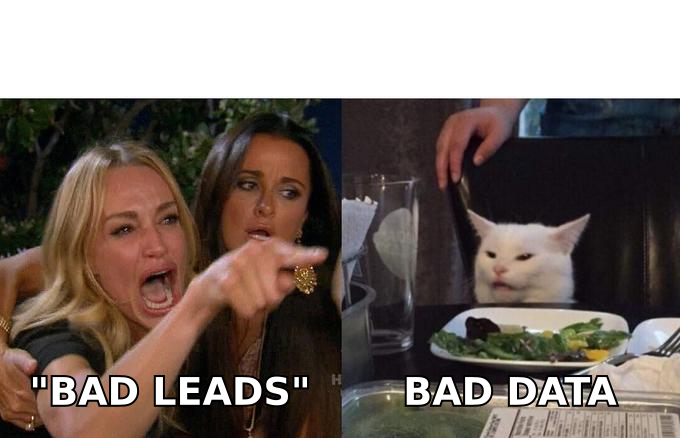
- The most common funnel leak is not messaging. It is bad contact data at the top — bounced emails, wrong titles, dead phone numbers — which quietly inflates your "poor response rate" diagnosis.
- Instrument three metrics per stage: conversion rate, time in stage, and volume. If you only track the first, you will never catch stalls.
What is a sales funnel, and why do most designs fail?#
A sales funnel is the ordered sequence of states a buyer passes through from "never heard of you" to "signed." Think of it like airport security: each checkpoint has a specific thing it verifies, and you cannot skip one. The failure mode is the same in both places — when a checkpoint's rules are vague, the line backs up and nobody knows why.
Most funnel designs fail for three reasons.
They describe seller activity instead of buyer state. A stage called "Demo Scheduled" tells you what your rep did. A stage called "Problem Confirmed by Buyer" tells you what the buyer believes. Only the second one predicts revenue.
They have no exit criteria. If two reps can look at the same deal and place it in different stages, your pipeline data is fiction. Your win rate becomes an average of guesses.
They are designed once and never re-cut. Buying committees changed. Your ICP shifted upmarket. The funnel didn't move.
The fix is mechanical, not philosophical. Write the stages, write the exit criteria, instrument the transitions, then review the whole thing quarterly against actual closed-won paths.
How do you design a sales funnel step by step?#
Seven steps, in order. Do not skip step 1 — the math constrains every later decision.
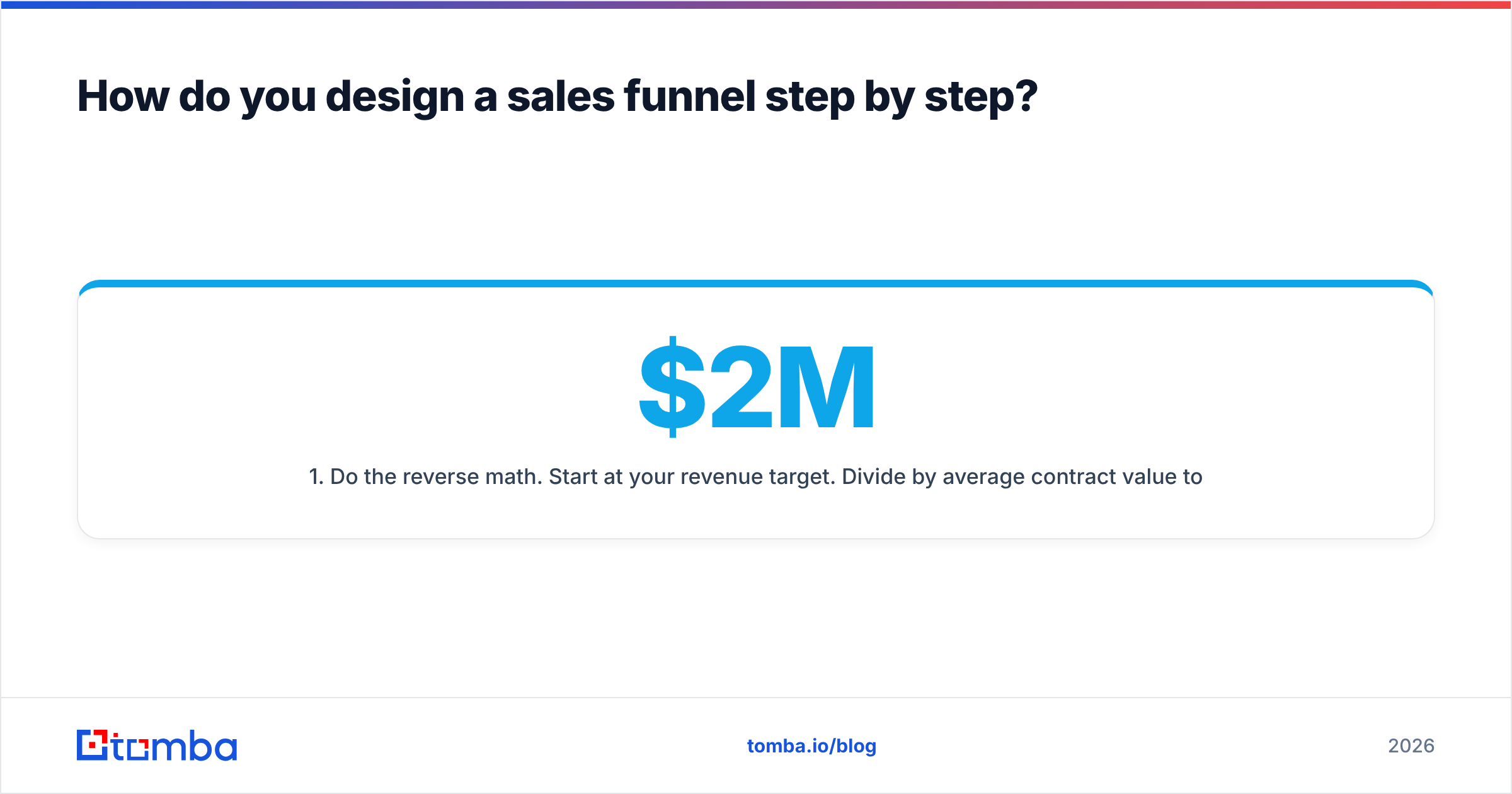
- Do the reverse math. Start at your revenue target. Divide by average contract value to get deals needed. Divide by close rate to get opportunities. Divide by opportunity-creation rate to get qualified conversations. Divide by reply rate to get contacts needed. If your annual target is $2M at $25K ACV, that's 80 deals; at a 22% close rate that's 364 opportunities; at 15% conversation-to-opportunity that's ~2,400 conversations; at a 6% reply rate that's roughly 40,000 contacts touched. That last number is a data requirement, not a motivational poster.
- Map the buyer's actual decision path. Interview five recent closed-won accounts and three closed-lost. Ask what happened between first contact and signature — who got involved, what triggered urgency, what nearly killed the deal. Your stages should mirror what they describe.
- Define stages as buyer states. Name them from the buyer's side: Aware, Problem Confirmed, Solution Fit Confirmed, Economic Buyer Engaged, Commercial Agreement, Closed.
- Write exit criteria for each stage. One to three observable, binary conditions. "Buyer named a metric they want to improve and a deadline" is testable. "Buyer seems interested" is not.
- Assign the data and content each stage needs. Stage 1 needs verified contacts. Stage 3 needs a technical one-pager. Stage 4 needs a business case template. Missing assets create stalls that look like buyer objections.
- Instrument transitions. Every stage move should timestamp in your CRM. Without timestamps you cannot compute time-in-stage, and time-in-stage is where stalls hide.
- Set review cadence. Weekly for stage hygiene, monthly for conversion rates, quarterly for the stage definitions themselves.
What should each funnel stage actually contain?#
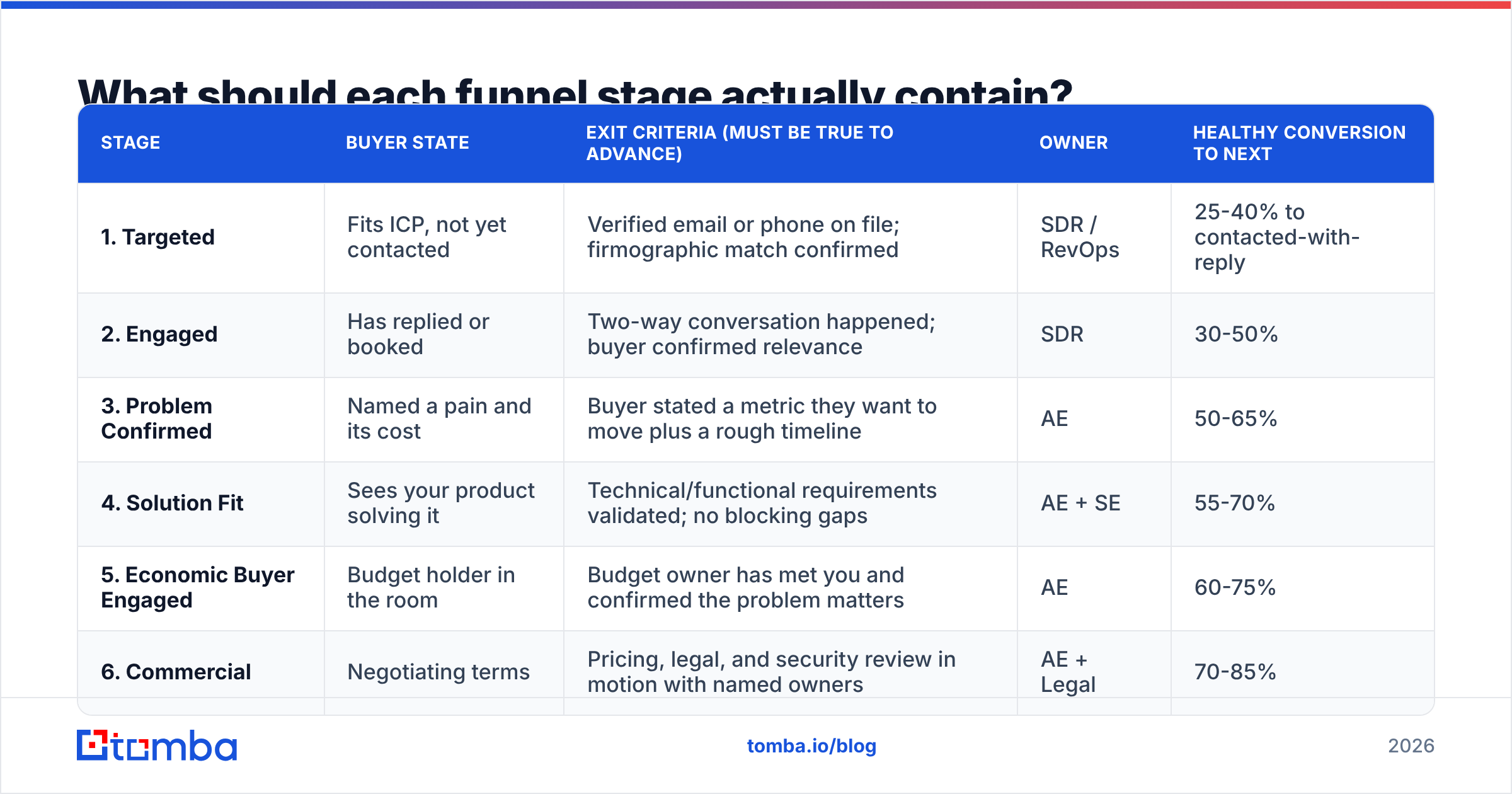
Here is a working six-stage B2B funnel you can copy and adapt. The exit criteria column is the part most teams skip, and it is the part that makes the funnel real.
| Stage | Buyer state | Exit criteria (must be true to advance) | Owner | Healthy conversion to next |
|---|---|---|---|---|
| 1. Targeted | Fits ICP, not yet contacted | Verified email or phone on file; firmographic match confirmed | SDR / RevOps | 25-40% to contacted-with-reply |
| 2. Engaged | Has replied or booked | Two-way conversation happened; buyer confirmed relevance | SDR | 30-50% |
| 3. Problem Confirmed | Named a pain and its cost | Buyer stated a metric they want to move plus a rough timeline | AE | 50-65% |
| 4. Solution Fit | Sees your product solving it | Technical/functional requirements validated; no blocking gaps | AE + SE | 55-70% |
| 5. Economic Buyer Engaged | Budget holder in the room | Budget owner has met you and confirmed the problem matters | AE | 60-75% |
| 6. Commercial | Negotiating terms | Pricing, legal, and security review in motion with named owners | AE + Legal | 70-85% |
Two notes on reading this table. First, the conversion percentages are directional ranges from typical mid-market B2B motions — benchmark against your own trailing four quarters before treating them as targets. HubSpot's sales research and Gartner's B2B buying research both consistently show buyers spend most of their process independent of sellers, so early-stage conversion will look worse than late-stage no matter how good your reps are.
Second, notice that stage 1's exit criteria is a data condition. That is deliberate.
How many stages should a sales funnel have?#
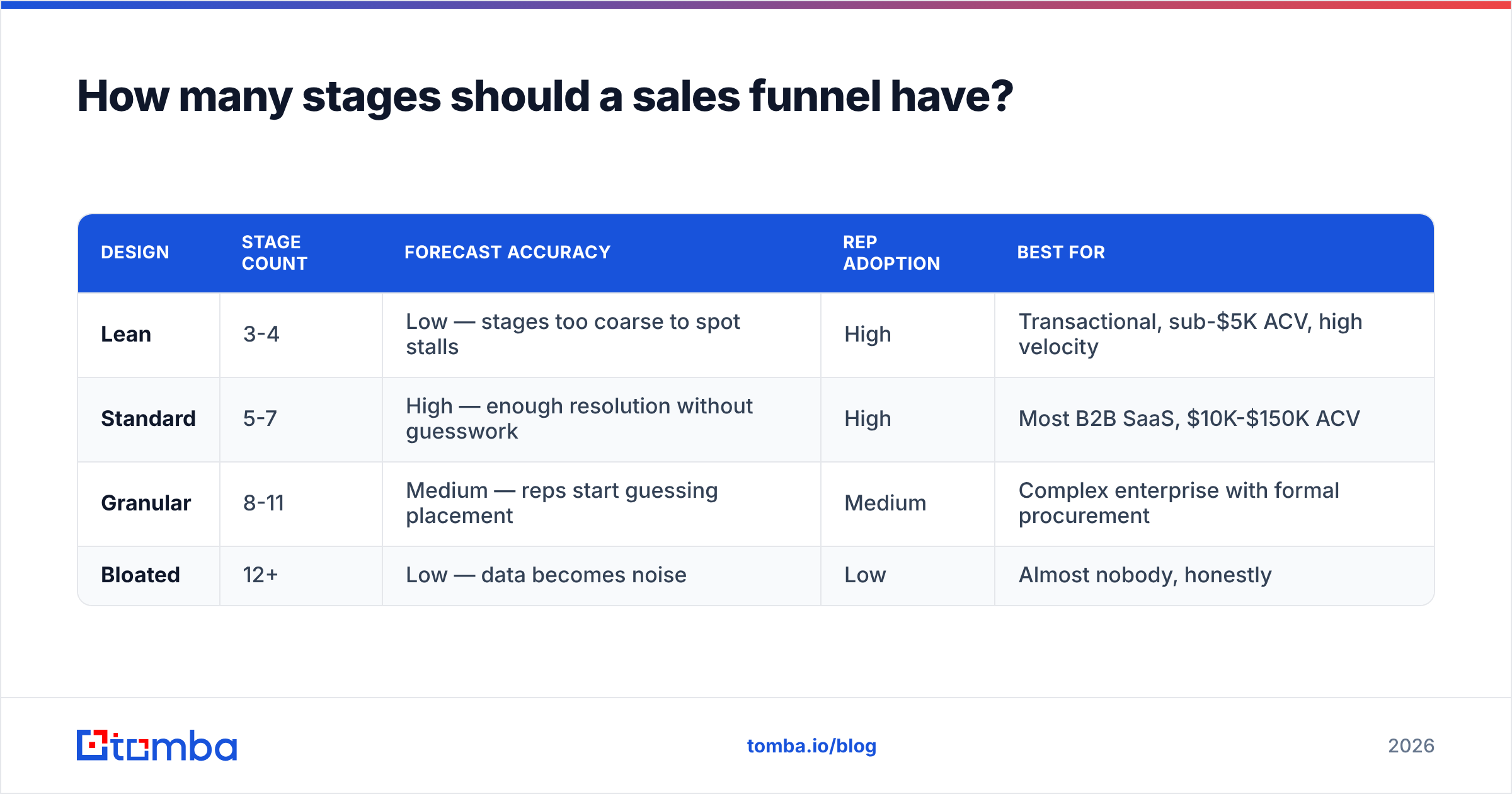
Five to seven for most B2B teams. Here is the trade-off, laid out plainly.
| Design | Stage count | Forecast accuracy | Rep adoption | Best for |
|---|---|---|---|---|
| Lean | 3-4 | Low — stages too coarse to spot stalls | High | Transactional, sub-$5K ACV, high velocity |
| Standard | 5-7 | High — enough resolution without guesswork | High | Most B2B SaaS, $10K-$150K ACV |
| Granular | 8-11 | Medium — reps start guessing placement | Medium | Complex enterprise with formal procurement |
| Bloated | 12+ | Low — data becomes noise | Low | Almost nobody, honestly |
The rule of thumb: if a rep cannot recite your stage names and their exit criteria from memory in a hallway conversation, you have too many stages. Complexity you cannot enforce is complexity you do not have — you just have inconsistent data.
For a longer-cycle enterprise motion, resist adding stages. Add required fields within a stage instead. "Security review status" as a field inside Commercial beats splitting Commercial into three stages.
What data does your funnel need at the top?#
This is where funnel design meets reality. Your stage-1 exit criteria said "verified email or phone on file." That single condition determines whether the rest of the funnel gets a fair test.
Run the numbers. If you push 40,000 contacts through the top and 18% of the emails are invalid, you did not run a 40,000-contact experiment. You ran a 32,800-contact experiment and then blamed your subject lines for the difference. Worse, high bounce rates damage sender reputation, which suppresses inbox placement for the valid addresses too. One data problem becomes two.
Build the top of your funnel in this order:
- Define the target list criteria — industry, headcount band, tech stack, trigger events. Write it down; a list nobody can reproduce is not a strategy.
- Source contacts against those criteria. Use a domain search to pull the relevant contacts at each target company rather than buying a generic list you cannot audit.
- Verify before sending. Run every address through an email verifier and drop anything that fails. Handle catch-all domains separately — they need a catch-all verifier, not the standard check.
- Enrich for routing and personalization. Title, seniority, and department decide which sequence a contact enters. Missing enrichment means every contact gets the generic message.
- Deduplicate against your CRM. Nothing burns credibility faster than cold-emailing an active customer's VP.
Skip any of these and your stage-1-to-stage-2 conversion rate measures your data hygiene, not your messaging.
How do you measure and fix a leaking funnel?#
Track three numbers per stage, not one.
Conversion rate tells you where deals die. Time in stage tells you where deals stall — a deal that sits 60 days in Solution Fit is dead, it just hasn't been buried. Volume tells you whether the stage is even statistically meaningful; a 20% conversion rate on five deals is noise.
Diagnose in this order:
- Find the worst stage-to-stage drop relative to your own trailing average, not relative to a benchmark blog post.
- Check volume first. Under ~30 transitions per quarter, treat the rate as anecdote.
- Check whether the drop is a rate problem or a stall problem. If time-in-stage crept up alongside the conversion drop, you have a stall — usually a missing asset or an unengaged stakeholder.
- Read ten lost deals in that stage. Not summaries — actual notes and email threads.
- Change one variable and re-measure over a full sales cycle. Changing three things at once teaches you nothing.
The classic misdiagnosis: a team sees a weak stage 1→2 conversion, rewrites the cold email six times, and never checks bounce rates. If your bounce rate is above 3%, fix the data before you touch the copy. Review your email deliverability fundamentals — SPF, DKIM, DMARC, sending volume ramp — in the same pass, because a valid address delivered to spam converts exactly like an invalid one.
What tooling do you need to run the funnel?#
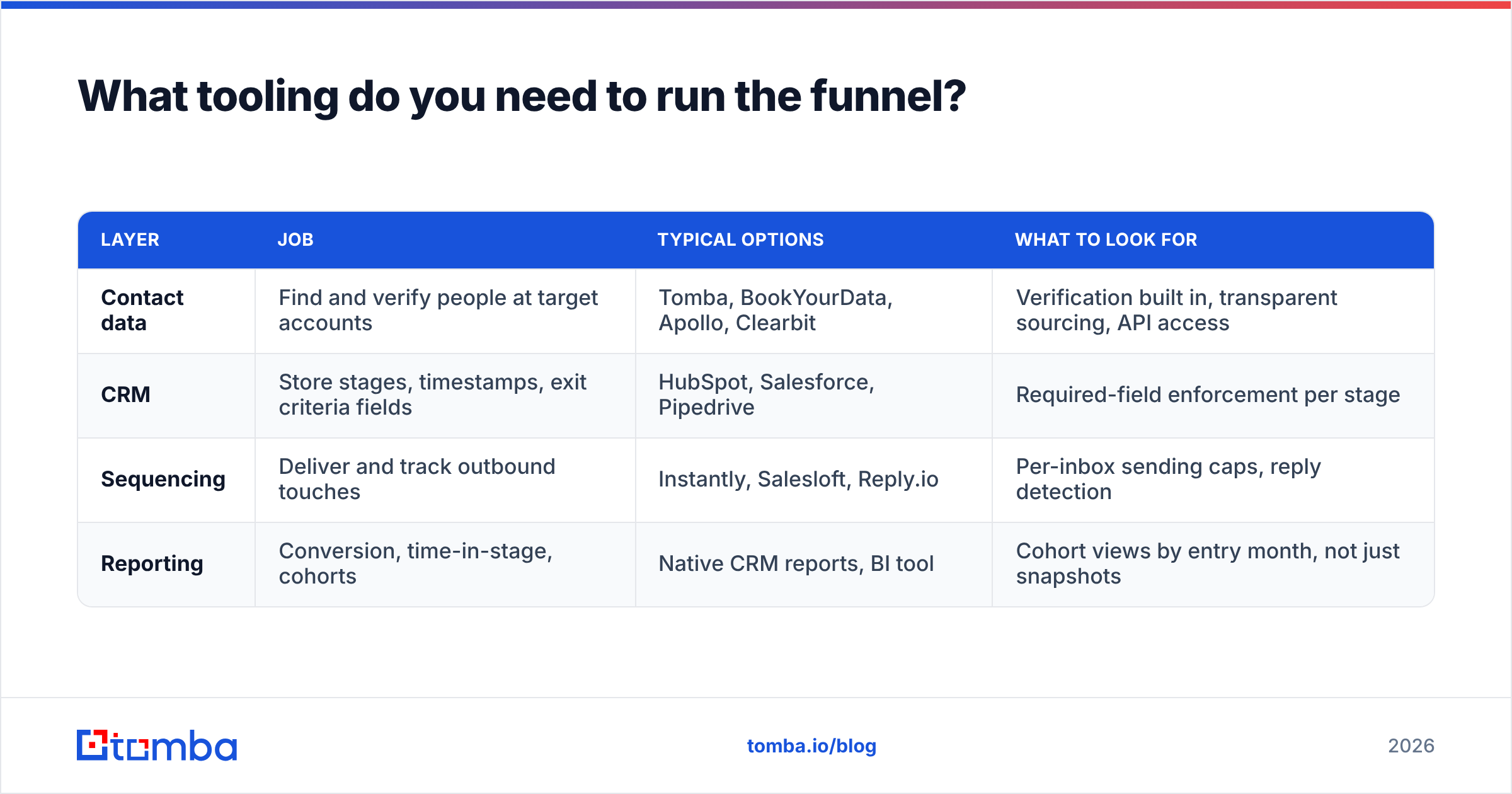
Less than vendors want you to believe. Four layers cover it.
| Layer | Job | Typical options | What to look for |
|---|---|---|---|
| Contact data | Find and verify people at target accounts | Tomba, BookYourData, Apollo, Clearbit | Verification built in, transparent sourcing, API access |
| CRM | Store stages, timestamps, exit criteria fields | HubSpot, Salesforce, Pipedrive | Required-field enforcement per stage |
| Sequencing | Deliver and track outbound touches | Instantly, Salesloft, Reply.io | Per-inbox sending caps, reply detection |
| Reporting | Conversion, time-in-stage, cohorts | Native CRM reports, BI tool | Cohort views by entry month, not just snapshots |
Two buying notes. On contact data, price per verified contact matters more than price per credit — a cheap credit spent on an invalid address costs more than an expensive one that lands. Tomba pricing starts free at 25 searches a month, with Starter at $49/mo, Growth at $99/mo, and Pro at $249/mo; BookYourData is a solid option if you prefer buying pre-built lists with a pay-as-you-go structure rather than a subscription. Both approaches work — the question is whether your motion is list-based or account-by-account.
On CRM, do not buy a new one to fix a funnel problem. Ninety percent of "our CRM doesn't support our process" complaints are actually "we never configured required fields per stage." Check G2's CRM category if you genuinely need to switch, but configure first.
How often should you redesign the funnel?#
Re-cut stage definitions once or twice a year, and only with evidence.
Triggers that justify a redesign:
- ACV moved more than 50% in either direction — the buying process changed with it.
- A new persona became the primary buyer. Selling to a VP of Engineering instead of a Head of Ops rewrites stages 3-5.
- Two consecutive quarters of forecast miss above 20% despite decent activity volume. Your stages are not predicting.
- Reps consistently skip a stage. That stage is either misplaced or unnecessary. Watch what they do, not what they say in pipeline review.
Between redesigns, change exit criteria — that is a lighter-weight lever. Tightening "Economic Buyer Engaged" from "budget owner identified" to "budget owner attended a call" will drop your late-stage volume and raise your forecast accuracy immediately. That is a good trade.
One last thing worth stating plainly: a funnel is a measurement instrument, not a control system. It tells you where reality diverges from your model. When a stage conversion collapses, the funnel did its job — it found the problem. Redesigning the funnel to hide the drop is the one move guaranteed to make things worse.
Start with the data layer#
Every funnel design in this post depends on step 1: a targeted list of real people with verified contact details. That is the input constraint you cannot message your way around.
If you are rebuilding a funnel from scratch, start by proving you can reliably reach the accounts you just defined as ICP. Run a sample of 200 target companies through Tomba Email Finder and check how many verified, deliverable contacts you get per account. Free tier gives you 25 searches to test the fit before you commit to anything, and the Tomba API plugs straight into whatever enrichment step you build into stage 1. Get that number honest, and the rest of the funnel math finally means something.
Related guides#
// get started
Find, verify and enrich your first contacts today
Start on the free plan with 25 searches a month, then scale when your team is ready.
Free plan · No credit card required · GDPR & CCPA
// about the author