How to Develop a Go-To-Market Strategy in 2026: A Practical Guide
Most GTM plans fail because they skip the boring parts: a scoped ICP, a real channel test, and data you can actually email. Here is the 7-step framework, with a build-vs-buy cost table.
TL;DR
- A go-to-market strategy is four decisions locked together: who you sell to, what you promise them, how you reach them, and what it costs to close them. Everything else is decoration.
- Start with a segment small enough to name 200 accounts in a spreadsheet. "Mid-market SaaS in North America" is not a segment — it is a market size.
- Pick one primary motion (sales-led, product-led, partner-led, or community-led) and one secondary. Teams that run four motions at 25% each never learn which one works.
- Budget for data quality before you budget for tooling. A 40% bounce rate kills a channel test before it produces a signal.
- Set a 90-day kill criterion per channel before launch. Write it down. Otherwise every channel "just needs more time."
What is a go-to-market strategy, actually?#
A go-to-market strategy is your plan for turning a product into revenue from a specific group of buyers, through a specific set of channels, at a cost that works.
That is narrower than it sounds. A GTM strategy is not your brand positioning, not your product roadmap, and not your annual sales plan. It is the connective tissue between them. When a Series A company says "we need a GTM strategy," what they usually mean is: we are getting inconsistent results and we cannot tell whether the problem is the audience, the message, or the channel.
The distinction matters because each of those three failures has a different fix, and a good GTM document isolates them.
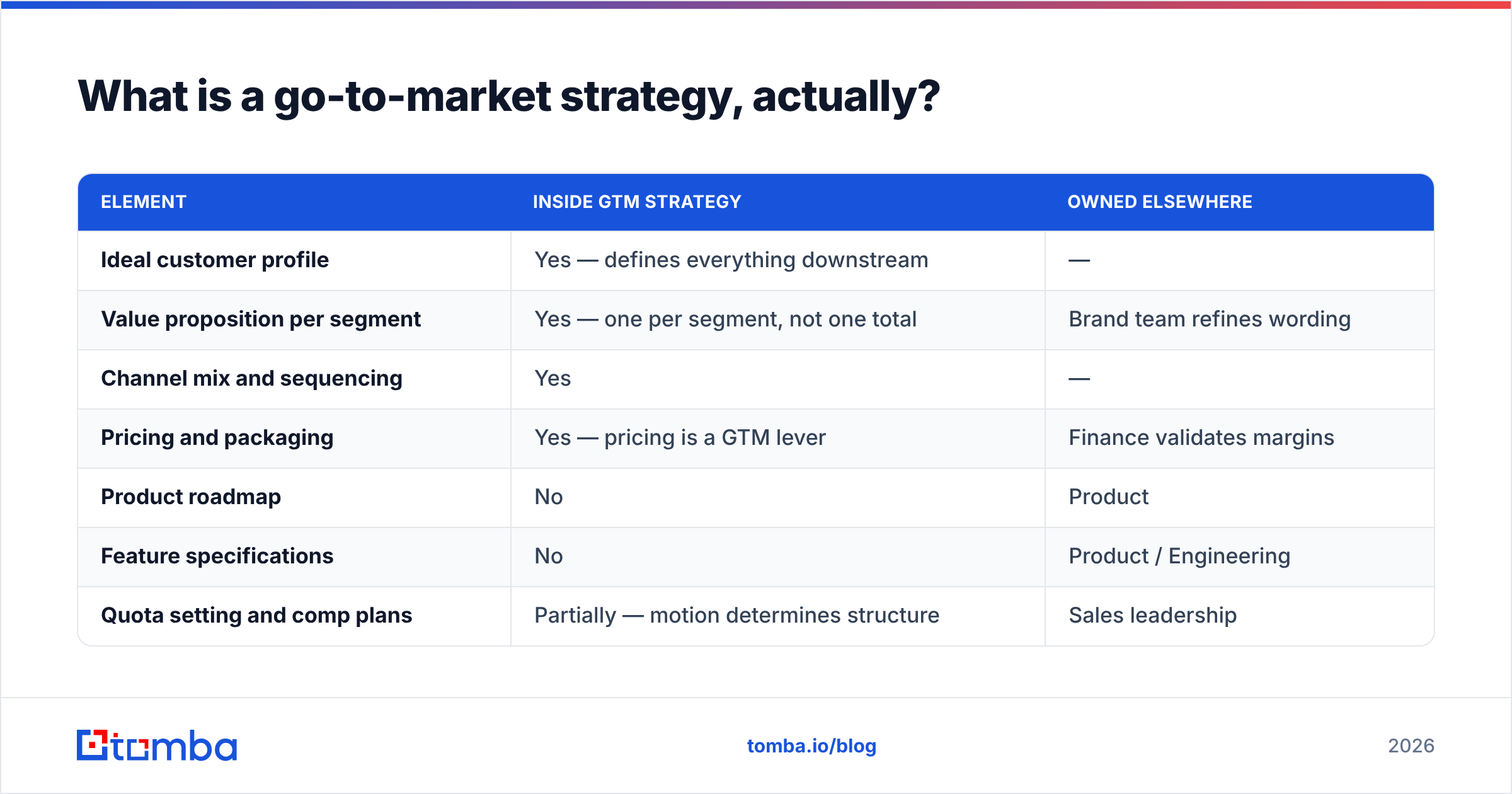
Here is the practical scope of what a GTM strategy covers versus what it does not:
| Element | Inside GTM strategy | Owned elsewhere |
|---|---|---|
| Ideal customer profile | Yes — defines everything downstream | — |
| Value proposition per segment | Yes — one per segment, not one total | Brand team refines wording |
| Channel mix and sequencing | Yes | — |
| Pricing and packaging | Yes — pricing is a GTM lever | Finance validates margins |
| Product roadmap | No | Product |
| Feature specifications | No | Product / Engineering |
| Quota setting and comp plans | Partially — motion determines structure | Sales leadership |
| Brand identity and visual system | No | Marketing/brand |
Keep the document to the first column. The moment a GTM plan starts specifying features, it stops being a GTM plan.
Why do most go-to-market strategies fail?#
They fail on scope, not on insight.
The most common pattern: a team writes a beautiful 40-slide deck with a $4B TAM, three personas, five channels, and a hockey-stick projection. Six months later nobody can say which channel produced the last ten deals. The deck was never wrong — it was just untestable.
Four failure modes account for most of it:
- The segment is too wide to falsify. If your ICP is "companies with 50–5,000 employees," you cannot test a message against it. You can test a message against "Shopify Plus merchants doing $10M–50M GMV who just hired a first head of retention." One of those is a hypothesis; the other is a demographic.
- The motion is copied, not chosen. Product-led growth works when the product delivers value before a human touches it. If your product needs a data migration and an admin's approval, PLG is a fantasy. Choose the motion your product's time-to-value actually supports.
- The data layer is an afterthought. Teams budget $30K for a sequencer and $0 for contact data, then wonder why their sender reputation collapsed in week three. Bad data does not just waste sends — it poisons the domain you will need for the next twelve months.
- There is no kill criterion. Without a pre-committed threshold ("if cold outbound does not produce 8 qualified meetings on 1,000 contacts by day 60, we stop"), every channel gets defended indefinitely by whoever owns it.

How do you define an ICP you can actually sell to?#
Build the ICP from your existing best customers, not from a market map. If you have no customers yet, build it from the ten prospects who moved fastest through your first conversations.
Run this in four passes:
- Firmographic filter. Industry, employee count, revenue band, geography, funding stage. This narrows the universe but tells you nothing about intent. Treat it as a coarse sieve — expect it to leave you with tens of thousands of companies.
- Technographic and operational filter. What do they already run? A company using HubSpot has a different integration story than one on Salesforce. A company with three warehouses has a different pain than one with thirty. This is where the segment starts becoming addressable.
- Trigger filter. What changed recently that makes now the right time? New funding, a new VP in a relevant function, a compliance deadline, a competitor's price increase, a job posting for a role your product replaces. Triggers are what separate a list from a pipeline.
- Contact-level filter. Which specific role signs, which champions, which blocks. Name titles, not "decision makers."
After four passes you should have a named account list of 150–400 companies for a first motion. If you have 40,000, you have not finished. If you have 12, widen one filter.
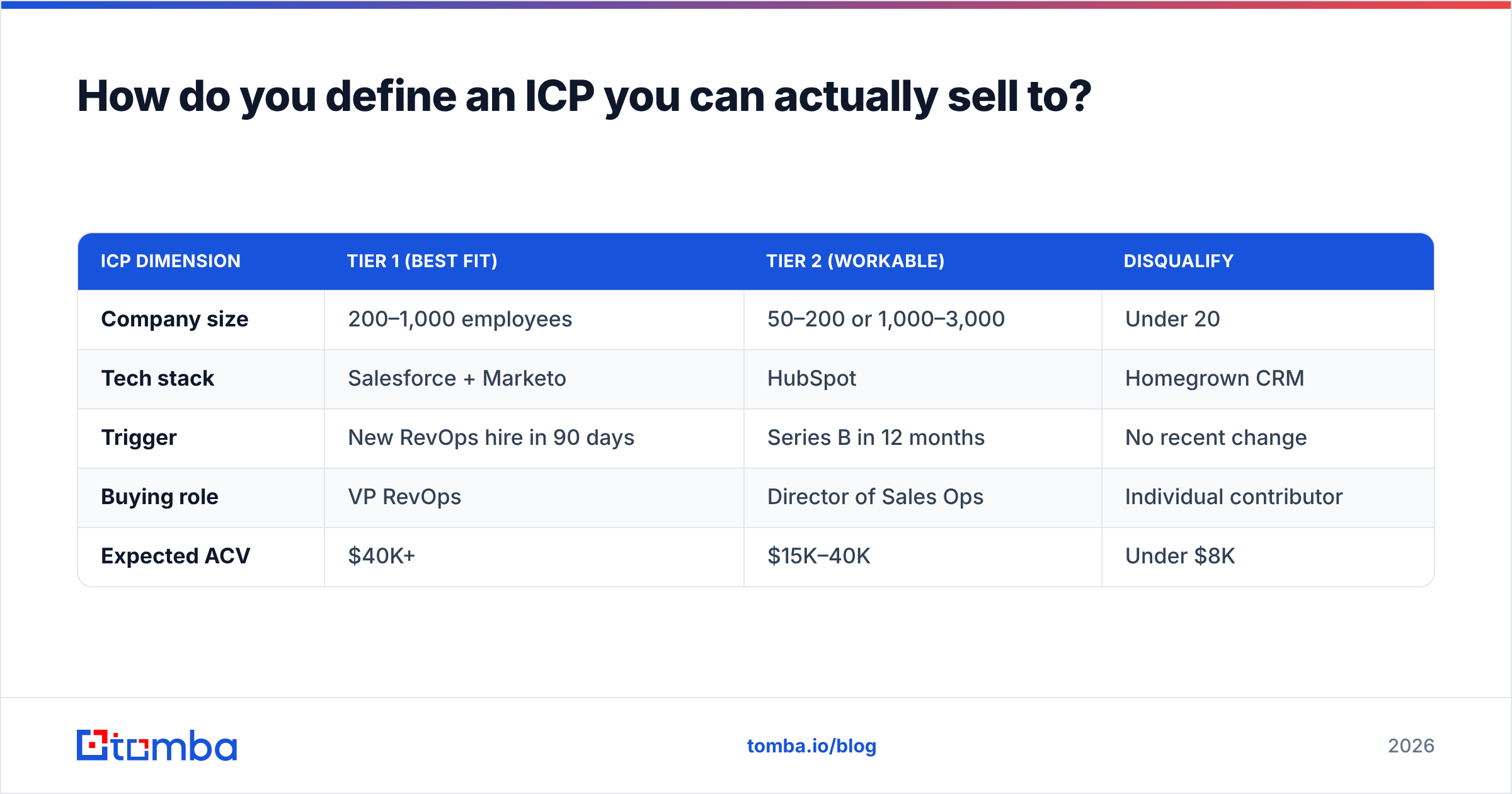
The output should be a table you can hand to a rep without explanation:
| ICP dimension | Tier 1 (best fit) | Tier 2 (workable) | Disqualify |
|---|---|---|---|
| Company size | 200–1,000 employees | 50–200 or 1,000–3,000 | Under 20 |
| Tech stack | Salesforce + Marketo | HubSpot | Homegrown CRM |
| Trigger | New RevOps hire in 90 days | Series B in 12 months | No recent change |
| Buying role | VP RevOps | Director of Sales Ops | Individual contributor |
| Expected ACV | $40K+ | $15K–40K | Under $8K |
Tier 1 gets 1:1 outbound. Tier 2 gets scaled sequences. Disqualify gets nothing — and enforcing that "nothing" is half the discipline of a GTM plan.
What are the seven steps to develop a go-to-market strategy?#
This is the sequence. Do not reorder it — each step depends on the one above.
Step 1 — Validate the problem with ten conversations. Not surveys. Ten recorded calls with people in your target segment, asking what they do today and what it costs them. You are looking for a problem they have already tried and failed to solve. If they have not tried, the pain is not sharp enough to fund.
Step 2 — Write the ICP and tier it. Use the four-pass method above. Publish it as a shared document. Every downstream argument about "is this a good lead" gets resolved by pointing at this doc.
Step 3 — Write one value proposition per tier. Format: For [segment] who [trigger/pain], [product] is the [category] that [outcome], unlike [status quo]. Write it in the buyer's vocabulary, not yours. If your Tier 1 and Tier 2 value props are identical, you have one tier.
Step 4 — Choose your primary motion. Match it to time-to-value and ACV. See the motion table below.
Step 5 — Build the data and infrastructure layer. Contact data, verification, CRM fields, routing rules, sequencing tool, tracking. This is unglamorous and it is where most launches slip two months. Doing it before launch is cheaper than doing it during.
Step 6 — Run one channel at a time with a written kill criterion. Define the sample size, the timeline, and the pass/fail metric before you send anything. A typical cold outbound test: 1,000 verified contacts, 60 days, pass at 6+ qualified meetings.
Step 7 — Instrument, review, and reallocate every 30 days. Track cost per qualified meeting and cost per closed-won by channel. Kill what fails its criterion. Double budget on what passes. Repeat.
Which go-to-market motion fits your product?#
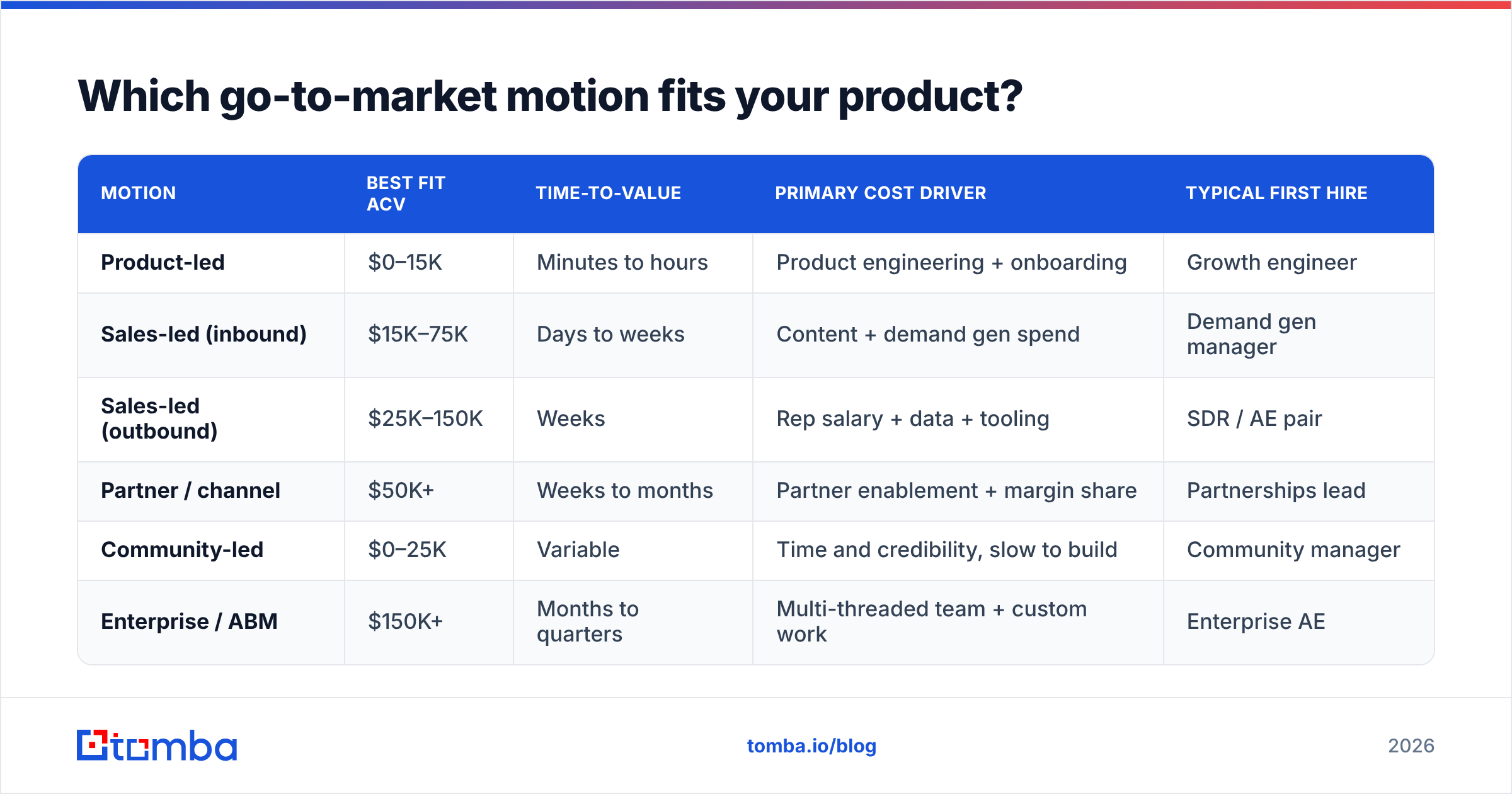
The motion is determined by two variables: how long it takes a user to get value, and how much a deal is worth. Everything else — headcount, tooling, comp — follows from the motion.
| Motion | Best fit ACV | Time-to-value | Primary cost driver | Typical first hire |
|---|---|---|---|---|
| Product-led | $0–15K | Minutes to hours | Product engineering + onboarding | Growth engineer |
| Sales-led (inbound) | $15K–75K | Days to weeks | Content + demand gen spend | Demand gen manager |
| Sales-led (outbound) | $25K–150K | Weeks | Rep salary + data + tooling | SDR / AE pair |
| Partner / channel | $50K+ | Weeks to months | Partner enablement + margin share | Partnerships lead |
| Community-led | $0–25K | Variable | Time and credibility, slow to build | Community manager |
| Enterprise / ABM | $150K+ | Months to quarters | Multi-threaded team + custom work | Enterprise AE |
Two rules from watching this go wrong repeatedly:
- Do not run outbound under a $20K ACV unless your close rate is unusually high or the motion is heavily automated. The math rarely works: a fully loaded SDR costs $85K–120K/year, and at a $10K ACV they need to source roughly 30–40 closed deals to justify the seat.
- Do not run enterprise ABM before you have won five deals in the segment the hard way. ABM amplifies a message that already works. It does not discover one.
For a broader vocabulary on how these functions interlock, revenue operations is the discipline that keeps motion, data, and forecasting in one system rather than three.
How do you build the data layer that GTM actually runs on?#
Every GTM motion above the PLG line runs on contact data. This is the part teams underinvest in and then blame the channel for.
You need four things, in order:
- Account list — the 150–400 companies from your ICP work, with the trigger recorded per account so the rep knows why now.
- Contact discovery — the right people at those accounts, with reliable business email addresses and, where relevant, phone numbers.
- Verification — every address checked before it enters a sequence. Non-negotiable.
- Enrichment and refresh — job changes, headcount shifts, tech-stack changes. B2B contact data decays roughly 25–30% per year, which means a list you built in January is meaningfully wrong by December.
On step 3 in particular: sending to an unverified list is the fastest way to damage your email deliverability. Mailbox providers read a high bounce rate as a spam signal, and once your domain reputation drops, even your warm replies land in Promotions. Google's own Postmaster Tools guidance is blunt about bulk senders keeping complaint and bounce rates low. Run every list through an email verifier before it touches a sequencer, and use a catch-all verifier for domains that accept everything — those are the addresses that look valid and are not.

Build vs. buy: what the data layer costs#
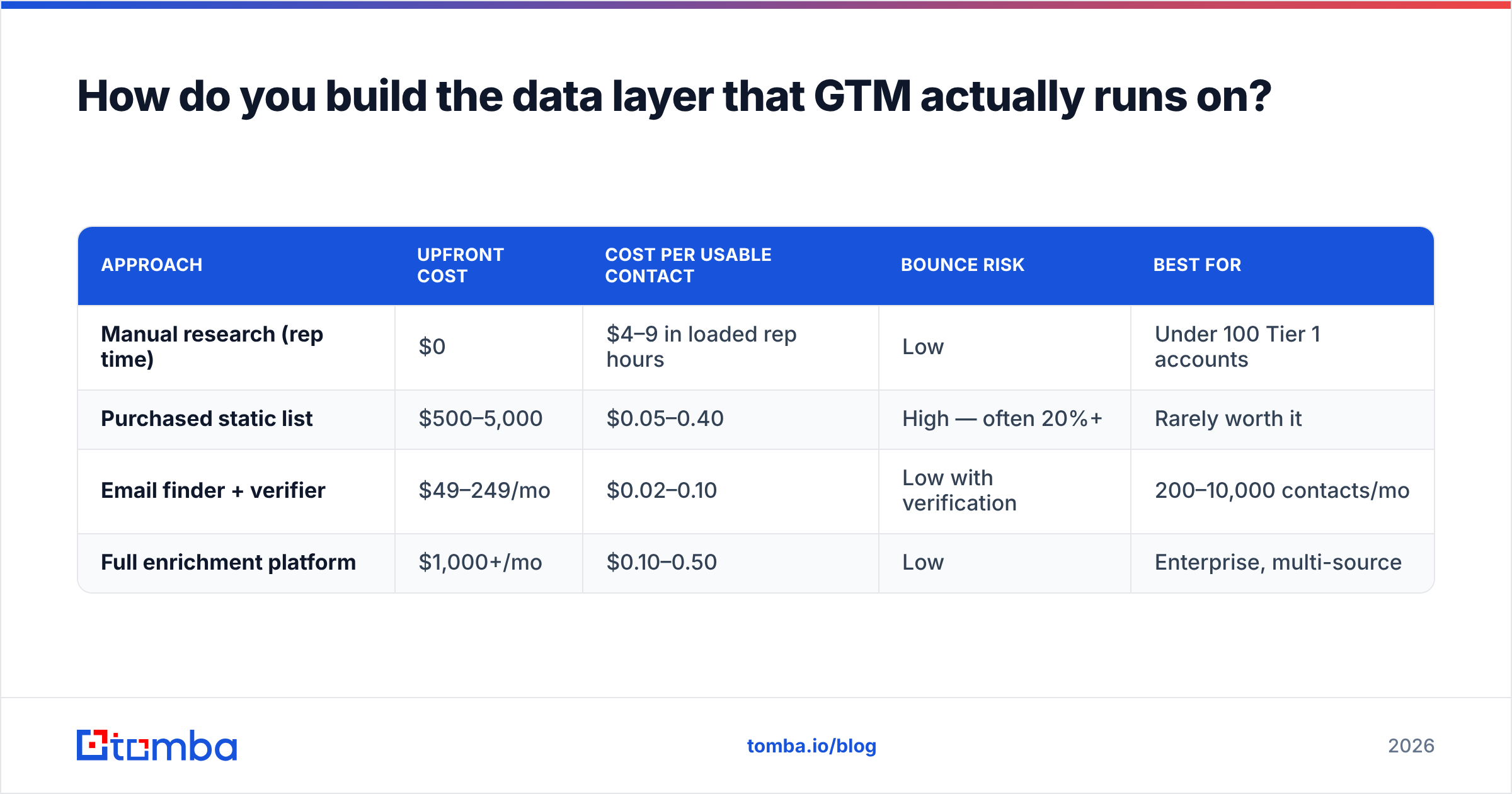
The real decision is whether you assemble contacts manually, buy a bulk list, or use a finder API. The costs diverge sharply once you account for rep time.
| Approach | Upfront cost | Cost per usable contact | Bounce risk | Best for |
|---|---|---|---|---|
| Manual research (rep time) | $0 | $4–9 in loaded rep hours | Low | Under 100 Tier 1 accounts |
| Purchased static list | $500–5,000 | $0.05–0.40 | High — often 20%+ | Rarely worth it |
| Email finder + verifier | $49–249/mo | $0.02–0.10 | Low with verification | 200–10,000 contacts/mo |
| Full enrichment platform | $1,000+/mo | $0.10–0.50 | Low | Enterprise, multi-source |
A bulk email finder sits in the sweet spot for most early GTM teams: you upload the account list, get verified contacts back, and skip both the rep hours and the bounce risk of a purchased file. Tomba pricing starts with a free tier at 25 searches/month for validating the approach, then $49/mo (Starter), $99/mo (Growth), and $249/mo (Pro) as volume grows — which is roughly what one SDR costs in a day and a half.
If your motion is account-based, domain search is usually the faster entry point than searching person by person: feed it a company domain and get the contact structure of that organization, then filter by the roles your ICP table named.
How do you test channels without burning your budget?#
One channel at a time, with a written criterion, at a sample size large enough to produce signal.
The sample-size question trips people up. A 200-contact cold email test that produces two replies tells you almost nothing — that could be a 1% reply rate or a 4% reply rate; the confidence interval is enormous. Aim for 800–1,000 contacts per outbound test, or roughly 200–300 clicks for a paid test.
A workable test template:
- Hypothesis: Tier 1 accounts with a new RevOps hire will reply to a message about onboarding time.
- Sample: 1,000 verified contacts, 400 Tier 1 / 600 Tier 2.
- Duration: 60 days, 4-touch sequence.
- Pass criterion: ≥ 6 qualified meetings, ≥ 2.5% reply rate, < 2% bounce.
- Kill criterion: < 3 meetings at day 45 with no positive replies from Tier 1.
- Cost ceiling: $2,400 all-in.
Write that before the first send. The point of the pre-commitment is that it removes the person with the most political capital from the decision.
Track cost per qualified meeting as your primary comparison metric across channels — not cost per lead, which is gameable, and not cost per closed-won, which takes too long to feed a 30-day loop. Once you have three channels with 90 days of data, G2's category benchmarks and your own CRM history will tell you far more than any external benchmark report.
What does a 90-day GTM launch plan look like?#
Compressed, this is the sequence that has the fewest dependencies blocking each other:
Days 1–21 — Foundation. Ten customer conversations. ICP document written and tiered. Value props drafted per tier. Motion chosen. No sending yet.
Days 22–45 — Infrastructure. Account list built. Contacts found and verified. CRM fields and routing configured. Sending domains warmed — a new domain needs 3–4 weeks of ramp before it can carry volume, so start this on day 22, not day 44. Sequences written. Kill criteria documented and agreed.
Days 46–75 — Channel one. Launch a single channel at full test sample size. Weekly review of leading indicators (open, reply, bounce) but no strategy changes mid-test except to fix technical failures.
Days 76–90 — Read and reallocate. Compare against the pass criterion. If it passed, scale budget 2–3x and start channel two. If it failed, run the post-mortem on which of the three variables broke: audience, message, or channel. Change exactly one and rerun.
The discipline of changing one variable at a time is what turns a launch into a learning system. Teams that change the list, the copy, and the channel simultaneously get a different result and no explanation for it.
For deeper reading on the strategic framing side, HubSpot's go-to-market guidance covers positioning and messaging frameworks well, and Gartner's B2B buying research is worth reading for how buying groups actually move — the average B2B purchase now involves six to ten stakeholders, which reshapes how many contacts per account you need.
What metrics tell you the strategy is working?#
Four, reviewed monthly:
- Cost per qualified meeting, by channel. The fastest signal. If channel A is $340 and channel B is $1,900, you know where next quarter's budget goes.
- Tier 1 win rate vs. Tier 2 win rate. If they are the same, your ICP tiering is wrong and you should merge the tiers or redraw them.
- Time from first touch to closed-won. Rising cycle time usually means you have drifted off-ICP and started selling to people who need internal consensus you have not built.
- Bounce and complaint rate. A health check on the data layer. Anything over 2% bounce means your verification step is failing and the channel data underneath your other three metrics is unreliable.
Add pipeline coverage against target if you have a quota, but resist adding a fifth vanity metric. GTM dashboards die from column count.
Get the contact data layer right first#
The strategy work above is free. The execution is not — and the single most common place a well-designed GTM plan dies is at the moment a rep opens a list of 800 contacts and 200 of them bounce.
Start with the account list, then find and verify the people on it. The Tomba Email Finder gives you verified business email addresses by domain, name, or company, with a free tier at 25 searches/month to validate your ICP list before you commit budget to a sequencer, a rep, or a channel test. Build the list, verify it, then run the plan.
Related guides#
// get started
Find, verify and enrich your first contacts today
Start on the free plan with 25 searches a month, then scale when your team is ready.
Free plan · No credit card required · GDPR & CCPA
Get the Tomba newsletter
Product and data updates
// about the author