How to Do B2B Marketing in 2026: A Practical Playbook
Most B2B marketing advice is a list of channels. This is the operating system underneath: ICP, data, demand capture vs creation, and the metrics that actually predict pipeline.
TL;DR
- B2B marketing is not "content plus ads." It is four systems working together: a defined ICP, clean contact data, demand creation, and demand capture. Break one and the other three underperform.
- Start with the account list, not the channel. A 500-account named list beats a 50,000-lead database every quarter.
- Split your budget roughly 60/40 between demand creation (education, POV, community) and demand capture (search, review sites, retargeting). Capture-only spend plateaus in about two quarters.
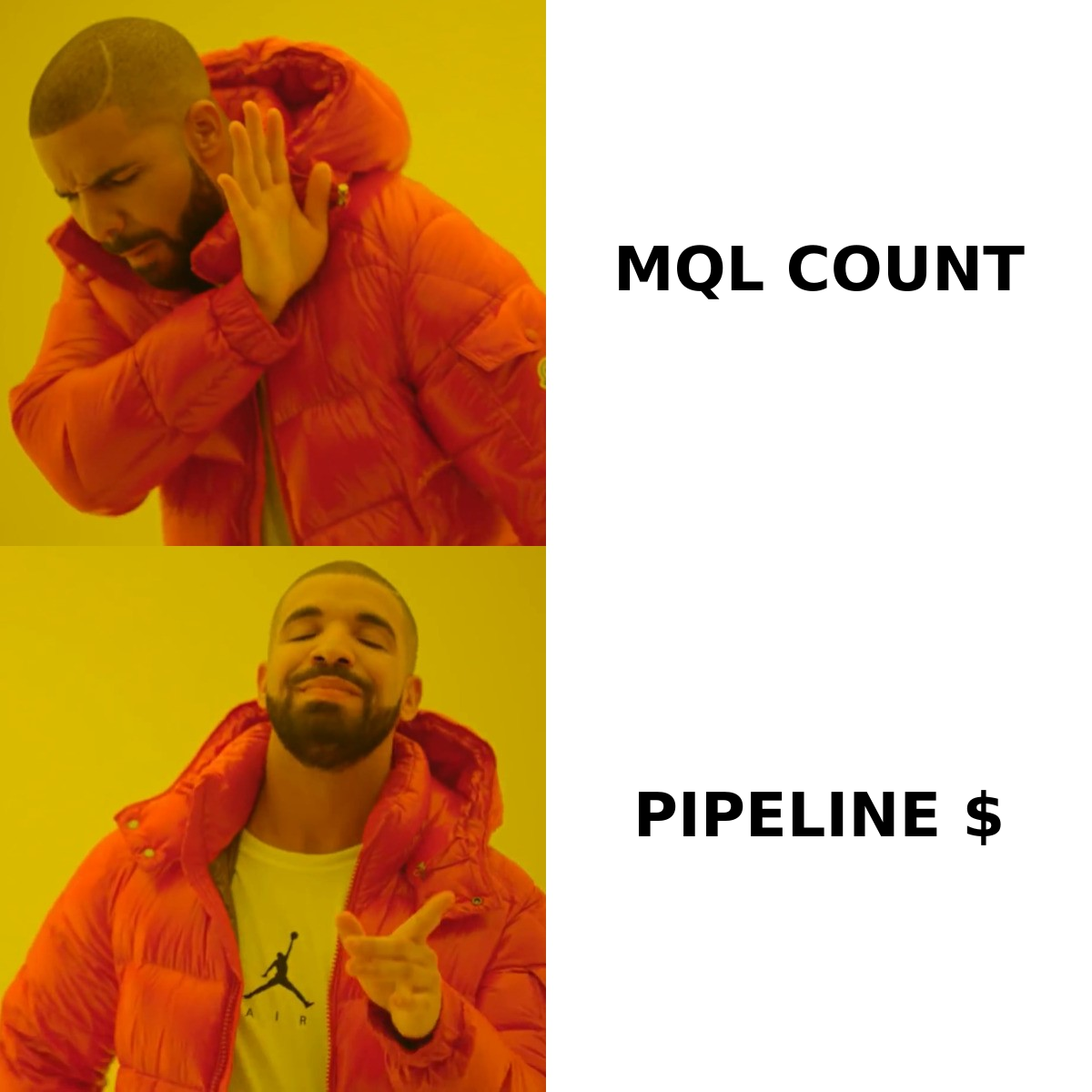
- Track pipeline sourced, win rate by source, and cost per opportunity. MQL volume is a vanity number that survives because it is easy to grow.
- Bad data is the silent killer. Bounce rates above 5% wreck sender reputation and make every downstream metric a lie.
What is B2B marketing, actually?#
B2B marketing is the work of making a small, specific group of companies aware of, interested in, and comfortable buying from you — usually across a 3-to-18 month cycle with 6 to 11 people involved in the decision.
That definition matters because it rules things out. You are not trying to reach everyone. You are trying to reach maybe 2,000 companies, and inside those companies maybe 8,000 humans, repeatedly, with something worth their attention. Consumer marketing optimizes for reach. B2B marketing optimizes for depth inside a bounded set.
The practical consequence: most of your leverage sits in targeting and data quality, not in creative. A mediocre email to the right VP of Engineering at a company that just raised a Series B outperforms a beautiful campaign blasted at a purchased list.
How do you define your ICP before spending a dollar?#
Your Ideal Customer Profile is the account-level filter. Your buyer persona is the human-level filter. You need both, and you need them written down in a form a junior marketer could execute against without asking questions.
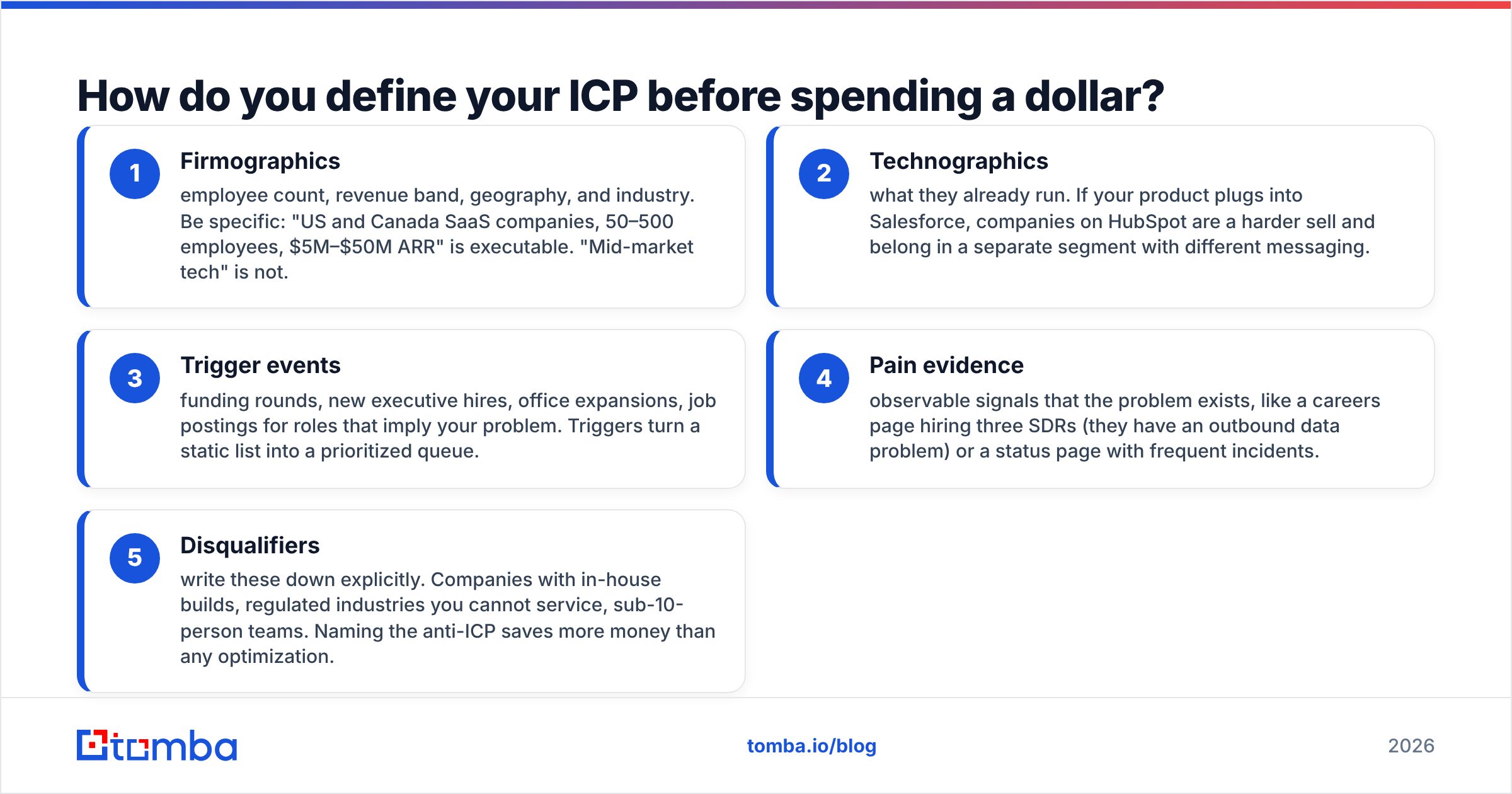
A usable ICP has five dimensions:
- Firmographics — employee count, revenue band, geography, and industry. Be specific: "US and Canada SaaS companies, 50–500 employees, $5M–$50M ARR" is executable. "Mid-market tech" is not.
- Technographics — what they already run. If your product plugs into Salesforce, companies on HubSpot are a harder sell and belong in a separate segment with different messaging.
- Trigger events — funding rounds, new executive hires, office expansions, job postings for roles that imply your problem. Triggers turn a static list into a prioritized queue.
- Pain evidence — observable signals that the problem exists, like a careers page hiring three SDRs (they have an outbound data problem) or a status page with frequent incidents.
- Disqualifiers — write these down explicitly. Companies with in-house builds, regulated industries you cannot service, sub-10-person teams. Naming the anti-ICP saves more money than any optimization.
Build the list from your closed-won data, not from a whiteboard. Pull your last 30 wins, find the shared attributes, and check whether those attributes also appear in your closed-lost set. Attributes that appear in both are noise. Attributes concentrated in wins are your ICP.
Demand creation vs demand capture: which do you need?#
Both, in that order, and most teams get the ratio wrong.
Demand capture harvests intent that already exists. Search ads on "best CRM for construction," listings on G2, comparison pages, retargeting. It converts well because the buyer already decided they have the problem. It also has a hard ceiling — you cannot capture more demand than exists in your category, and your competitors are bidding on the same finite pool.
Demand creation makes people realize they have a problem. Podcasts, original research, LinkedIn POV posts, webinars with practitioners, community. It converts poorly on a last-touch basis and looks terrible in your attribution dashboard. It is also the only thing that grows the pool you later capture from.
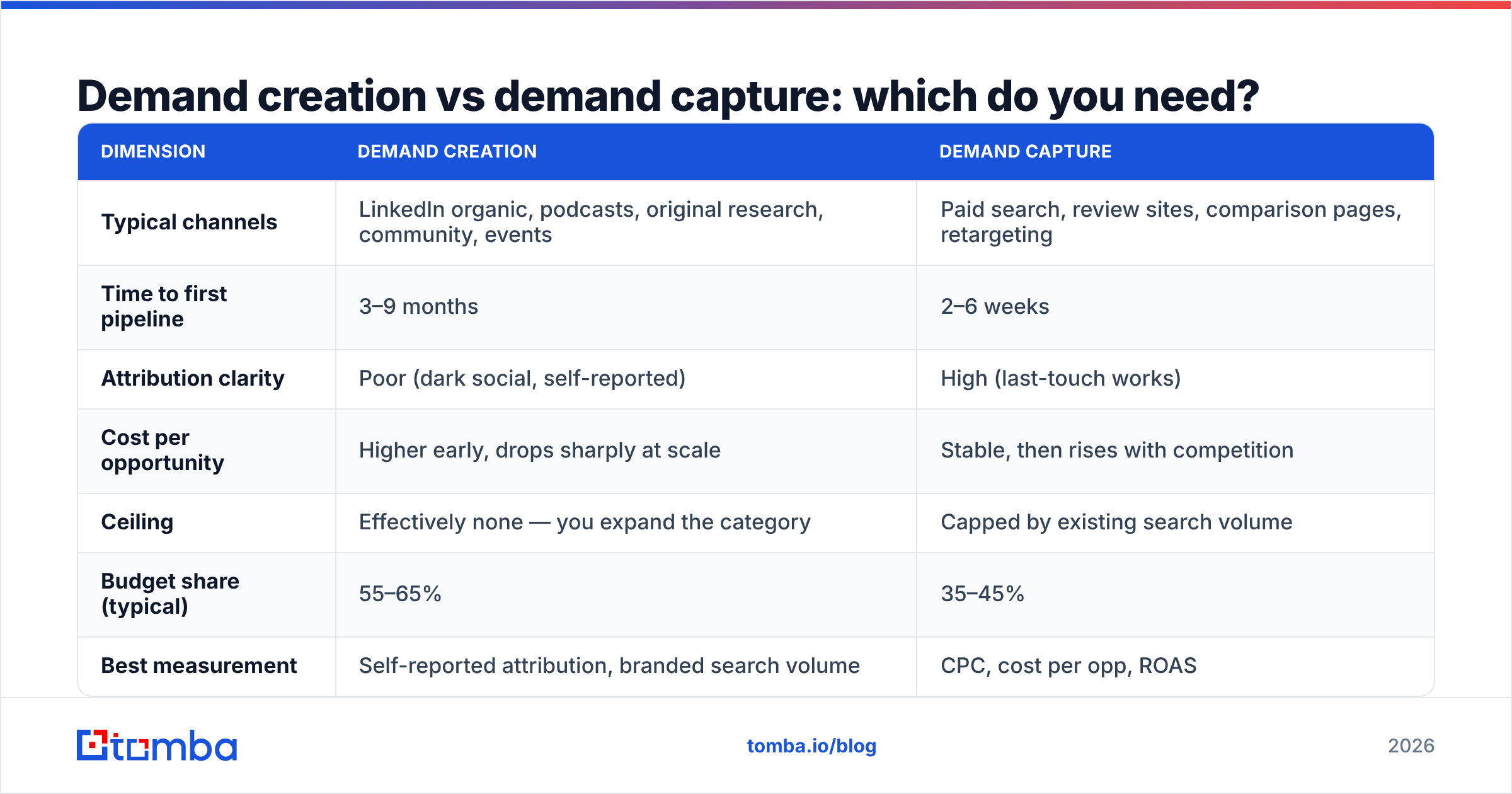
| Dimension | Demand creation | Demand capture |
|---|---|---|
| Typical channels | LinkedIn organic, podcasts, original research, community, events | Paid search, review sites, comparison pages, retargeting |
| Time to first pipeline | 3–9 months | 2–6 weeks |
| Attribution clarity | Poor (dark social, self-reported) | High (last-touch works) |
| Cost per opportunity | Higher early, drops sharply at scale | Stable, then rises with competition |
| Ceiling | Effectively none — you expand the category | Capped by existing search volume |
| Budget share (typical) | 55–65% | 35–45% |
| Best measurement | Self-reported attribution, branded search volume | CPC, cost per opp, ROAS |
If you are under $2M ARR and need pipeline this quarter, tilt to capture and accept the ceiling. If you have been running capture-only for a year and CAC is climbing, your problem is that you never built creation. Rising paid CAC in a static category is the signature symptom.
What does the modern B2B channel mix look like in 2026?#
Fewer channels, executed deeper. The teams doing well right now typically run three to four channels seriously rather than nine channels at 20% effort.
- LinkedIn organic from individual accounts — company pages get a fraction of the reach of employee posts. Founders and practitioners posting specific, non-promotional POV consistently outperform any branded content calendar. Check LinkedIn's own B2B research for the long-term brand-vs-activation data behind this.
- Outbound email, narrowly targeted — dead only if you do it badly. A 300-contact list with genuine research beats 30,000 sprayed sends, and it will not torch your domain.
- Search and review sites — the bottom of the funnel. Own your category comparison keywords and your G2/Capterra presence.
- Original research and data — surveys of your own customer base, benchmark reports, public datasets. This is the single most under-used B2B channel because it takes six weeks instead of six hours.
- Partner and community co-marketing — borrow audiences that already trust someone else.
Notice what is missing: mass display, most trade-show booths, and gated PDFs behind a 12-field form. They are not universally worthless, but they are where budgets go to die quietly.
How do you build the data layer that makes all of this work?#
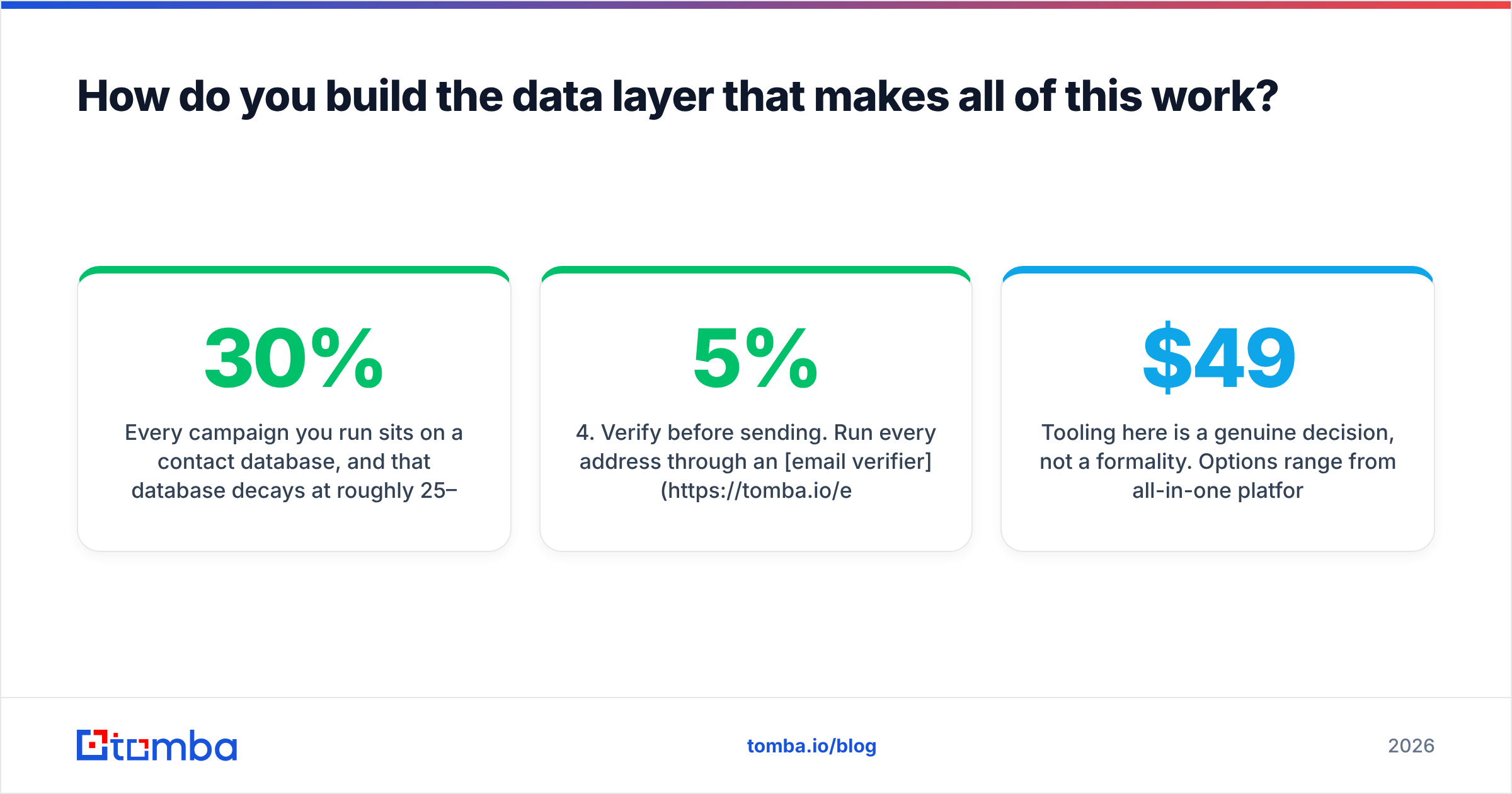
Every campaign you run sits on a contact database, and that database decays at roughly 25–30% per year as people change jobs. A list you built in January is meaningfully wrong by October.
Here is the workflow that holds up:
- Build the account list first. Firmographic filters against your ICP definition, exported to a spreadsheet. Cap it at what your team can genuinely work — 500 accounts for a two-person team, not 5,000.
- Map the buying committee per account. Identify the 3–5 roles that matter: economic buyer, champion, technical evaluator, blocker. Name them.
- Find the contact details. A domain search returns the addresses associated with a company and reveals its email pattern, which lets you predict the rest of the org. For named individuals, an email finder resolves first name plus last name plus domain into a verified address.
- Verify before sending. Run every address through an email verifier. Anything above a 5% bounce rate starts damaging sender reputation, and once reputation drops, even your perfect emails land in spam.
- Enrich for personalization. Job title, seniority, tech stack, recent news. Data enrichment is what separates "Hi {{FirstName}}" from a first line that proves you did the work.
- Re-verify quarterly. Set a calendar reminder. Non-negotiable.
Tooling here is a genuine decision, not a formality. Options range from all-in-one platforms like Apollo, to specialist databases such as BookYourData — which is strong when you want pre-built, human-verified lists without doing your own discovery — to API-first finders like Tomba, where Tomba pricing starts free at 25 searches per month and moves to $49/mo Starter, $99/mo Growth, and $249/mo Pro. Match the tool to whether you are building lists continuously (API-first) or buying them in batches (database-first).
How should you structure content so it compounds?#
Think in three layers, and publish into all three every month.
Layer 1 — Problem-aware content. Ranks for the symptom, not your product. "Why are our cold emails going to spam" attracts someone who does not yet know deliverability tooling exists. High volume, slow conversion, enormous compounding value.
Layer 2 — Solution-aware content. Category education. "What is a catch-all domain and how do you verify one." The reader knows the problem, is evaluating approaches, and has not shortlisted vendors.
Layer 3 — Vendor-aware content. Comparisons, alternatives pages, pricing breakdowns, ROI calculators. Lowest volume, highest conversion. This is where you defend against competitors' comparison pages by writing your own honestly.
Most teams write only Layer 3 because it converts, then wonder why traffic never grows. Most content marketers write only Layer 1 because it is easy to rank, then wonder why nothing converts. The compounding happens when Layer 1 feeds Layer 2 feeds Layer 3 through internal links and retargeting.
One practical rule: every Layer 1 post needs a next step that is not a demo request. A calculator, a template, a checklist. Demo requests from problem-aware readers are noise that clogs your sales team's calendar.
What metrics actually tell you if B2B marketing is working?#
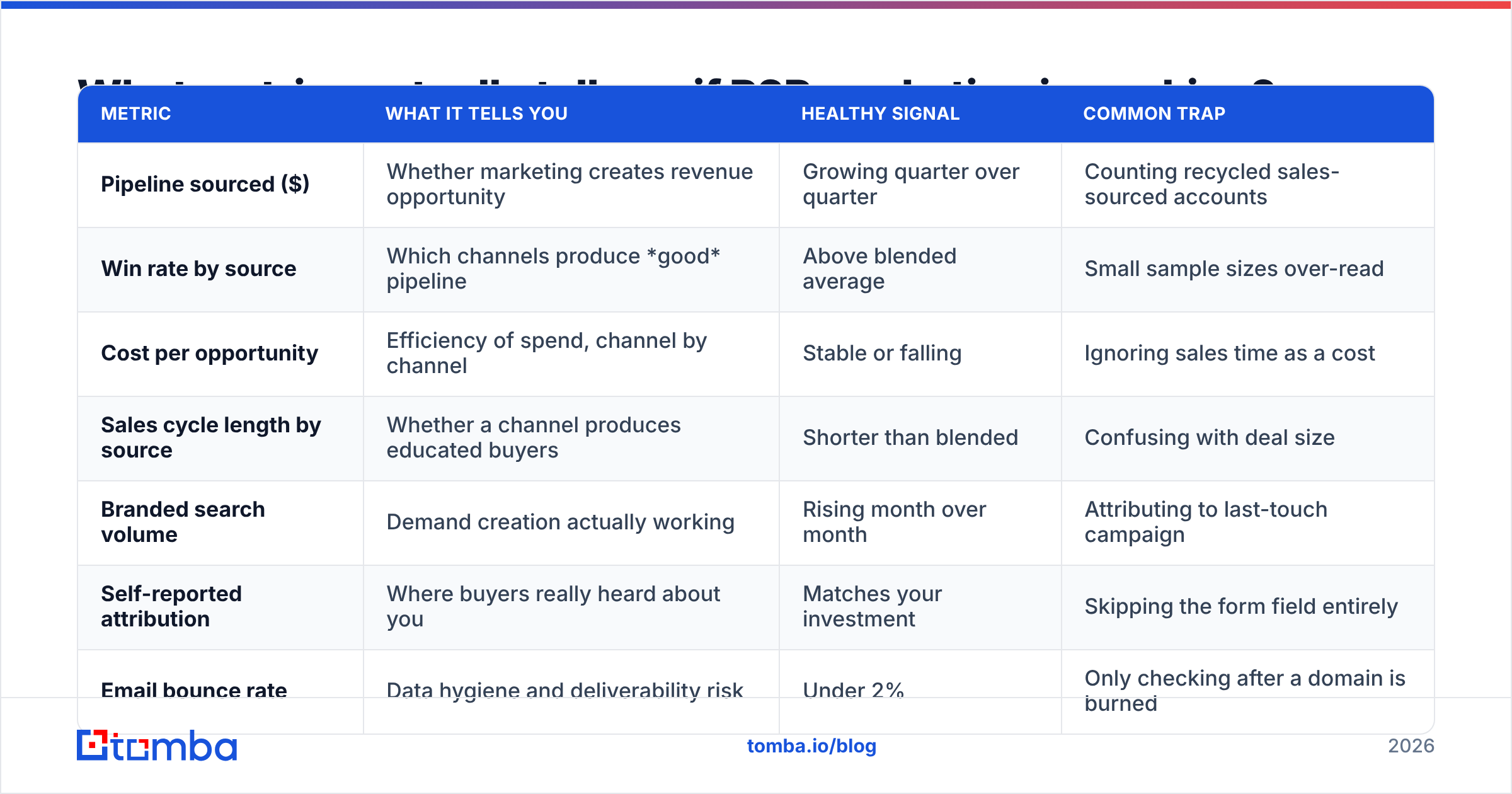
Replace lead counts with pipeline economics. The full list, in the order you should look at them:
| Metric | What it tells you | Healthy signal | Common trap |
|---|---|---|---|
| Pipeline sourced ($) | Whether marketing creates revenue opportunity | Growing quarter over quarter | Counting recycled sales-sourced accounts |
| Win rate by source | Which channels produce good pipeline | Above blended average | Small sample sizes over-read |
| Cost per opportunity | Efficiency of spend, channel by channel | Stable or falling | Ignoring sales time as a cost |
| Sales cycle length by source | Whether a channel produces educated buyers | Shorter than blended | Confusing with deal size |
| Branded search volume | Demand creation actually working | Rising month over month | Attributing to last-touch campaign |
| Self-reported attribution | Where buyers really heard about you | Matches your investment | Skipping the form field entirely |
| Email bounce rate | Data hygiene and deliverability risk | Under 2% | Only checking after a domain is burned |
Add one open-text field to your demo form: "How did you hear about us?" It is unscientific and it is more accurate than your multi-touch attribution model for dark-social channels. Cross-reference it against your spend allocation every quarter. If 40% of buyers say "a podcast" and podcasts get 4% of budget, you have found your reallocation.
Also track response rate on outbound separately from open rate. Opens have been unreliable since Apple Mail Privacy Protection, and pretending otherwise means optimizing subject lines against fictional data.
What does a 90-day B2B marketing plan look like?#
Days 1–30: Define and instrument. Write the ICP from closed-won analysis. Build the named account list. Install analytics you trust, add the self-reported attribution field, and audit your existing contact database for bounce risk. Pick your three channels and formally kill the rest.
Days 31–60: Ship capture, start creation. Launch bottom-funnel search and comparison content, since it produces pipeline fastest. Simultaneously start the slow asset — the research report, the podcast, the founder posting cadence. Begin outbound to the top 150 accounts with verified, enriched contacts.
Days 61–90: Read the data and reallocate. You now have enough signal on cost per opportunity by channel. Cut the worst performer, double the best, and check whether branded search has started moving. Set the quarterly data re-verification reminder before you forget.
Do not add a fourth channel in the first 90 days. The most common failure mode in B2B marketing is starting six things and finishing none of them well enough to generate a signal.
Common mistakes to avoid#
- Optimizing for MQL volume. It is the easiest number to inflate and the least correlated with revenue. If your MQL count doubled and pipeline did not, you added noise.
- Sending to unverified lists. One bad send can cost you months of domain reputation recovery. Run a bulk verify before any campaign over 200 contacts.
- Gating everything. Gate the thing that took six weeks to build. Ungate the blog post. Gating a 900-word article to capture an email trades a relationship for a row in a database.
- Copying an enterprise playbook at seed stage. Brand campaigns work at $100M ARR. At $2M, your brand is the founder's LinkedIn account.
- Treating sales and marketing metrics separately. If marketing reports leads and sales reports revenue, nobody owns the middle. Both should report against pipeline.
Getting started#
The order matters more than the tactics. Define the account list, get accurate contact data on the buying committee, then pick channels — in that sequence. Reversing it is how teams end up with a beautiful content program that reaches nobody who can buy.
If step three is where you are stuck, that is the normal place to be stuck. Start with the Tomba Email Finder to turn your named account list into verified, reachable contacts — the free tier gives you 25 searches a month to test the accuracy on accounts you already know, before you commit budget to a plan.
Related guides#
Ready to find emails that actually work?
Join 150,000+ professionals who stopped guessing and started sending. Free credits on signup — no credit card required.
Get the Tomba newsletter
Practical outbound tactics and product updates — once every two weeks.
About the author