How To Do High Ticket Sales: A 2026 Playbook That Closes
High-ticket deals are not small deals with bigger numbers. Here is the sourcing, qualification, and multi-threading process that actually closes $25k+ contracts in 2026.
TL;DR
- High-ticket sales is not a scaled-up version of transactional sales. The buying committee grows from 1 person to 6-10, the cycle stretches to 60-180 days, and the deal dies from indifference far more often than from price.
- Your funnel math flips: you need fewer accounts, but far deeper contact coverage inside each one. Ten perfect accounts with nine verified contacts each beats 500 half-researched leads.
- Qualification is the highest-leverage skill. Disqualifying fast is worth more than any closing technique, because a stalled $60k deal costs a quarter.
- Multi-threading is the single biggest predictor of a closed-won large deal. Single-threaded deals collapse when your champion leaves, reorganizes, or goes quiet.
- Never lead with price and never discount to create urgency. Anchor to the cost of inaction, then let the pricing conversation happen on your terms.
What counts as high ticket sales?#
There is no universal dollar line, but a working definition: a high-ticket sale is any deal where the buyer cannot approve it alone. That threshold moves by market — $5,000 for a solo consultant selling to SMBs, $25,000 for mid-market SaaS, $250,000+ for enterprise platform deals. What matters is the structural consequence, not the number.
Once a purchase requires sign-off from someone who has never spoken to you, three things change permanently:
- The economic buyer is not your first conversation. You will meet a user, a manager, or a researcher first. The person who signs is often two levels up and three weeks away.
- Risk beats value in the decision. Nobody gets fired for not buying. Your job shifts from "prove the upside" to "de-risk the downside."
- Internal selling happens without you. 80% of the decision conversation occurs in rooms you are not in. Your champion is your proxy, and they need ammunition, not enthusiasm.
- Time is the real competitor. Most large deals are lost to "no decision," not to a rival vendor. Gartner's research on B2B buying has consistently pointed at decision paralysis inside large buying groups as the dominant failure mode.
That last point should reshape your process. If your loss column is full of "went dark" and "revisit next quarter," you do not have a closing problem. You have a qualification and multi-threading problem.
How is high ticket sales different from transactional selling?#
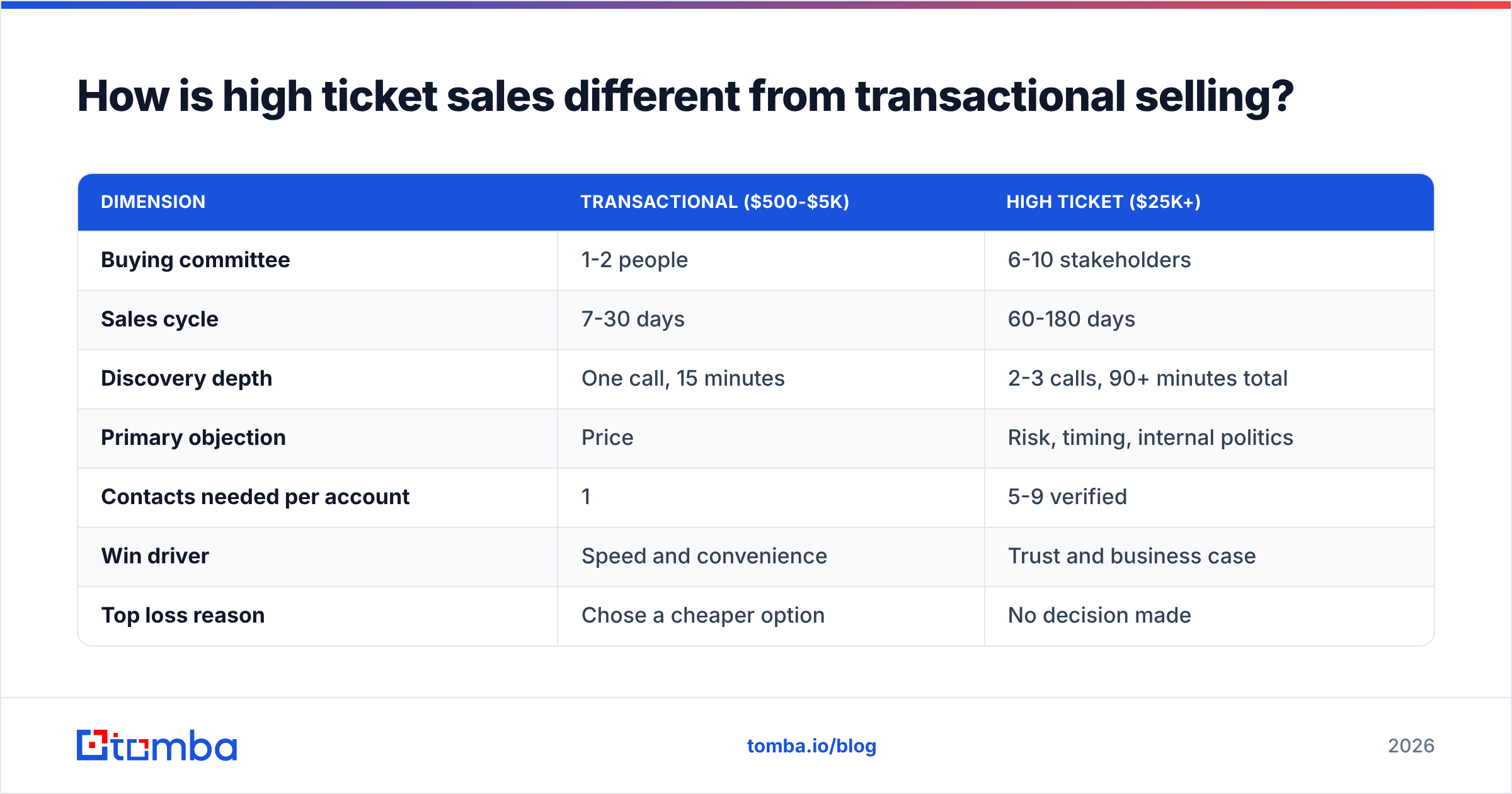
Run the two motions side by side and the differences stop being philosophical.
| Dimension | Transactional ($500-$5k) | High ticket ($25k+) |
|---|---|---|
| Buying committee | 1-2 people | 6-10 stakeholders |
| Sales cycle | 7-30 days | 60-180 days |
| Discovery depth | One call, 15 minutes | 2-3 calls, 90+ minutes total |
| Primary objection | Price | Risk, timing, internal politics |
| Contacts needed per account | 1 | 5-9 verified |
| Win driver | Speed and convenience | Trust and business case |
| Top loss reason | Chose a cheaper option | No decision made |
| Follow-up cadence | 4-6 touches | 15-25 touches across 3+ people |
| Required assets | Pricing page, demo video | Business case, security review, ROI model, reference calls |
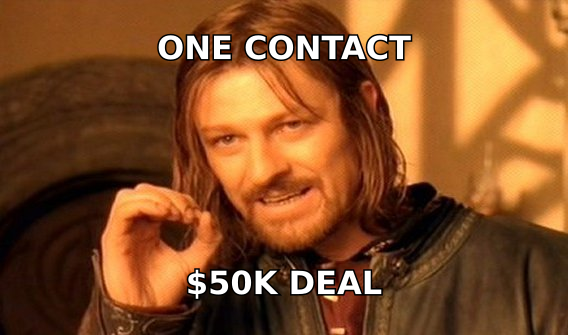
The row that trips most reps is "contacts needed per account." Transactional sellers build lists of individuals. High-ticket sellers build maps of organizations. If your CRM has one contact attached to a $75,000 opportunity, that opportunity is a wish, not a forecast.

How do you build a high ticket target list?#
Start with fit, not volume. A high-ticket list of 40 accounts researched properly will outperform 2,000 scraped rows every quarter, because your entire cost structure is per-conversation, not per-send.
Work through this sequence:
- Define the trigger, not the persona. "VP of Ops at a 500-person logistics company" is a segment. "VP of Ops at a logistics company that just opened a second distribution center" is a trigger. Triggers buy; segments browse.
- Score accounts against closed-won reality. Pull your last 20 wins and find the three attributes they actually share — headcount band, tech stack, funding stage, regulatory pressure. Ignore the attributes you assume matter.
- Map the committee before you email anyone. For each account, name the likely champion, the economic buyer, the technical evaluator, and the blocker (usually finance, security, or legal).
- Source contact data for all four roles. This is where most teams stop at one name and lose the deal six weeks later. Use a domain search to pull the full roster for a company, then filter by department and seniority.
- Verify before you touch the account. A bounce on your first outbound to a target account can damage your sending domain and burn the account's spam filter for every subsequent rep. Run everything through an email verifier first.
- Enrich with phone numbers. High-ticket cycles need channel variety. Email opens the door; a call to a direct line is what gets you the second meeting. A phone finder turns a name into a callable contact.
Practical benchmark: for a $50k ACV motion, budget 45-90 minutes of research per account before the first touch. That sounds absurd to an SDR trained on 300 dials a day. It is entirely rational when one closed deal pays for a quarter of research time.
What does qualification look like at this deal size?#
The classic frameworks — BANT, MEDDIC, MEDDPICC — all point at the same underlying question: is there a funded, sponsored, time-bound reason to change? Most reps ask about budget and skip the other three.
Here is the qualification checklist that separates real high-ticket pipeline from optimism:
- Metric. Can the buyer state the number that will improve, in their own words, without you feeding it to them? "We're losing 14 hours a week to manual reconciliation" is a metric. "We want to be more efficient" is a mood.
- Economic buyer identified and named. Not "probably the CFO." A name, a title, and a stated path to reaching them.
- Decision process mapped. Who reviews? What does procurement require? Is there a security review, and how long did the last vendor's take?
- Compelling event. A date something breaks: a contract renewal, an audit, a product launch, a funding milestone. No compelling event means no deadline, and no deadline means the deal slides forever.
- Champion tested. A champion is not someone who likes you. A champion is someone who takes a risk on your behalf — makes an introduction, forwards your business case, defends your price internally. Test it by asking for something small and specific.
- Competition and status quo understood. The status quo is always the primary competitor. Know exactly what "doing nothing" costs them.
If three or more of these are missing after the second call, downgrade the deal. Reps who protect their forecast by keeping zombie deals alive are the reason forecast accuracy collapses at quarter-end. Salesforce's own sales research library has repeatedly flagged pipeline hygiene as a bigger revenue lever than activity volume.
How do you run discovery that earns a $50k conversation?#
Discovery on a high-ticket deal is not a questionnaire. It is a diagnostic conversation where the buyer talks 70% of the time and leaves understanding their own problem better than when they arrived.
Structure it in three layers:
Layer 1 — Situation. Ten minutes. How the process works today, who touches it, what tools are involved. Keep it factual; do not sell here.
Layer 2 — Cost. Twenty minutes. This is where the deal is actually won. Quantify. "How many hours per week?" "What is a fully loaded hour worth?" "How many deals slipped last quarter because of it?" You are building the number that will later justify your price. If the buyer cannot articulate a cost, you do not have a high-ticket deal — you have a nice-to-have.
Layer 3 — Consequence. Fifteen minutes. What happens if nothing changes for four more quarters? What does the CFO say when this shows up in next year's budget cycle? This layer creates urgency without a single manufactured discount deadline.
Close discovery by summarizing back what you heard and asking one question: "Did I get that right, and is there anything I'm missing?" The correction you get is worth more than everything else in the call.
How do you multi-thread without annoying your champion?#
Multi-threading is the discipline of building relationships with several stakeholders in an account simultaneously. It is the strongest predictor of closed-won at large deal sizes, and it is the step reps skip most often because it feels impolite.
The reframe: multi-threading done well makes your champion look good, not bypassed. Nobody wants to be the single point of failure for a $75,000 decision.
Three ways to expand access without going around anyone:
- Ask for the introduction, with a reason. "To build the security section of the business case properly, I'd want 20 minutes with whoever owns your infosec review. Can you connect us, or would you prefer I reach out directly and copy you?"
- Invite the committee to a working session. Not a demo. A 45-minute session where you present the draft business case and ask the group to poke holes in it. Attendance tells you who actually matters.
- Source and warm the rest of the committee independently. For stakeholders your champion will not introduce, find them yourself. A LinkedIn finder turns a profile you already identified into a verified work email, and data enrichment fills in role and seniority so you tailor the message instead of blasting it.
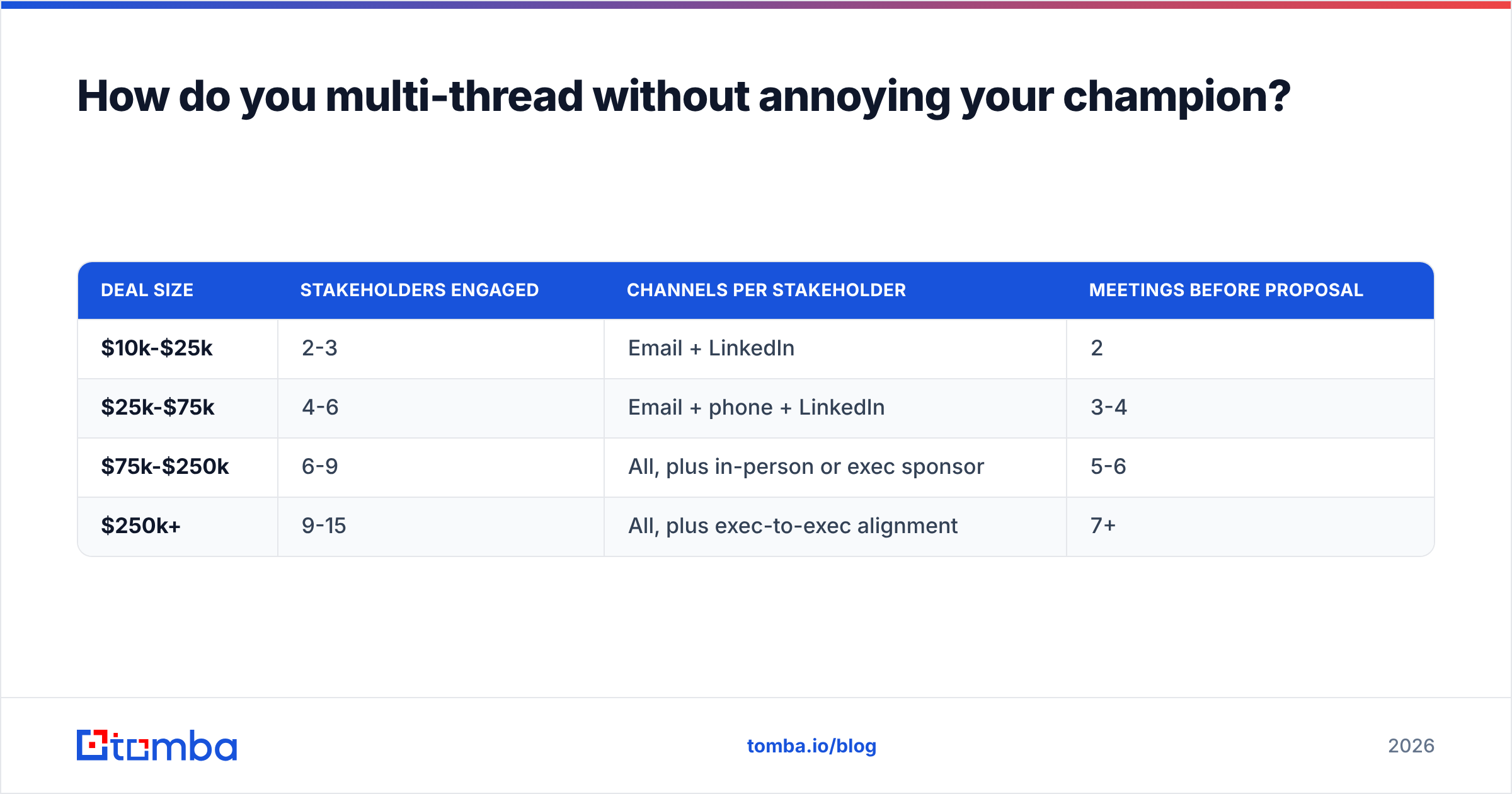
Coverage target by deal size, based on how most enterprise teams staff their account plans:
| Deal size | Stakeholders engaged | Channels per stakeholder | Meetings before proposal |
|---|---|---|---|
| $10k-$25k | 2-3 | Email + LinkedIn | 2 |
| $25k-$75k | 4-6 | Email + phone + LinkedIn | 3-4 |
| $75k-$250k | 6-9 | All, plus in-person or exec sponsor | 5-6 |
| $250k+ | 9-15 | All, plus exec-to-exec alignment | 7+ |
If you are at the bottom of the "stakeholders engaged" column for your deal size, your close probability is materially lower than your CRM believes.
How should you handle pricing and objections?#
Three rules, in order of importance.
Rule 1: Present price after value is quantified, never before. If the buyer asks for pricing on call one, give a range with a condition attached: "Deals like yours typically land between $40k and $70k depending on seat count and integration scope. I'd rather scope it properly than quote you something wrong — can I ask three questions first?" You have answered honestly and kept the sequence intact.
Rule 2: Anchor against the cost of inaction, not against competitors. If discovery established that the problem costs $30,000 a month, a $60,000 annual contract is a two-month payback. That framing survives a CFO review; "we're 15% cheaper than the other guy" does not.
Rule 3: Do not discount to create urgency. Every end-of-quarter discount teaches the buyer that your price is fiction and that waiting is profitable. If you must move on price, trade for something: a longer term, a case study, an upfront payment, a reference call. Concession without exchange is just a smaller deal.
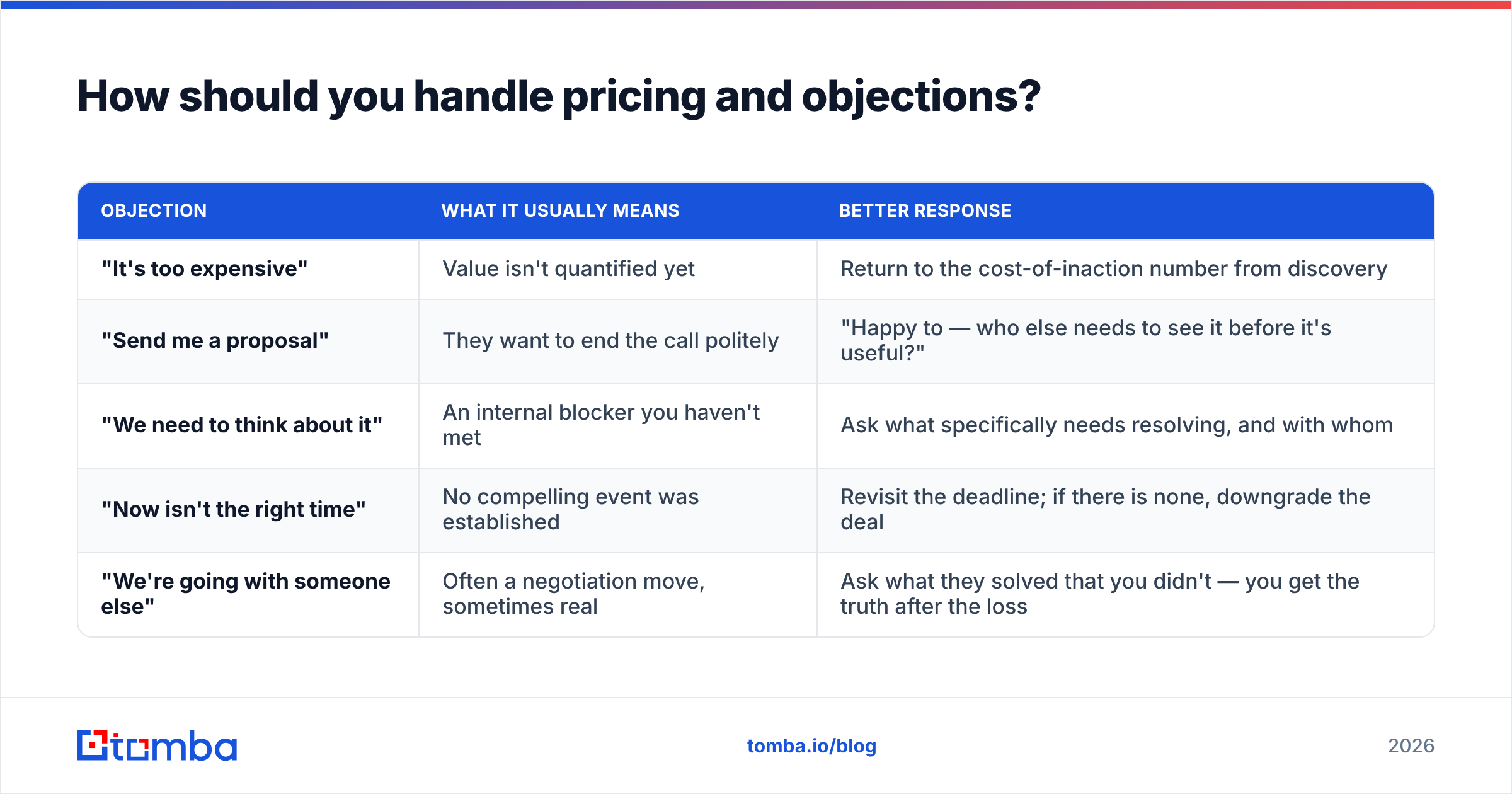
Common high-ticket objections and what they usually mean:
| Objection | What it usually means | Better response |
|---|---|---|
| "It's too expensive" | Value isn't quantified yet | Return to the cost-of-inaction number from discovery |
| "Send me a proposal" | They want to end the call politely | "Happy to — who else needs to see it before it's useful?" |
| "We need to think about it" | An internal blocker you haven't met | Ask what specifically needs resolving, and with whom |
| "Now isn't the right time" | No compelling event was established | Revisit the deadline; if there is none, downgrade the deal |
| "We're going with someone else" | Often a negotiation move, sometimes real | Ask what they solved that you didn't — you get the truth after the loss |
How do you follow up over a 90-day cycle?#
Transactional follow-up is a cadence. High-ticket follow-up is a campaign, and every touch has to carry something the buyer can use internally.
A workable structure across a 90-day cycle:
- Days 1-14 — Access. Multi-channel outreach to 4-6 mapped stakeholders. Distinct message per role; the CFO and the ops manager do not care about the same thing.
- Days 15-40 — Diagnosis. Discovery calls, technical validation, and a draft business case built collaboratively with your champion.
- Days 41-65 — Consensus. Working session with the committee, security and procurement kicked off in parallel, references arranged.
- Days 66-90 — Decision. Proposal, negotiation, mutual action plan with dated milestones and named owners on both sides.
Two mechanics matter more than the calendar. First, every follow-up must add value — a benchmark, a relevant customer story, an answer to a question raised internally. "Just checking in" is a withdrawal from a relationship account you have not funded. Second, use a mutual action plan. A shared document listing each remaining step, owner, and date turns your follow-ups from nagging into project management, and it surfaces stalls two weeks earlier than silence would.
For teams running this at scale, keep the data layer clean. Contacts churn out of roles constantly, and a 90-day cycle is long enough for your champion to change jobs mid-deal. Re-verify your committee contacts at the halfway mark and enrich any gaps rather than assuming the map you built in week one still holds. If you are managing dozens of accounts, a bulk email finder run against your target account list keeps coverage current without manual lookups. Peers like BookYourData take a similar view on data freshness — for large-deal motions, stale contact records are a silent forecast killer, and both prebuilt-list and search-based approaches are legitimate ways to solve it depending on how narrow your ICP is.
What tools does a high ticket seller actually need?#
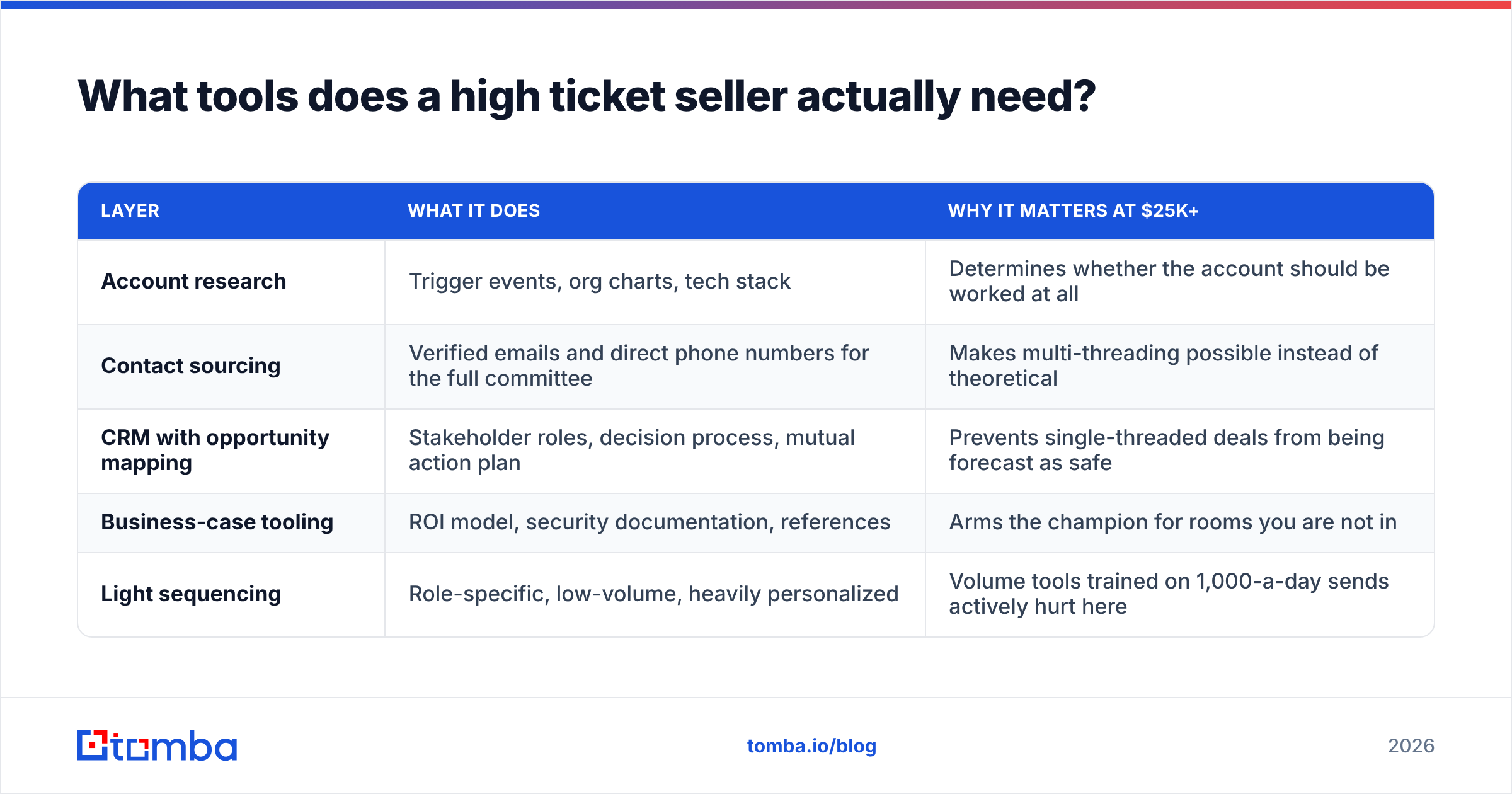
Fewer than the average stack suggests. The failure points in high-ticket sales are research depth, contact coverage, and internal-selling assets — not another automation layer.
| Layer | What it does | Why it matters at $25k+ |
|---|---|---|
| Account research | Trigger events, org charts, tech stack | Determines whether the account should be worked at all |
| Contact sourcing | Verified emails and direct phone numbers for the full committee | Makes multi-threading possible instead of theoretical |
| CRM with opportunity mapping | Stakeholder roles, decision process, mutual action plan | Prevents single-threaded deals from being forecast as safe |
| Business-case tooling | ROI model, security documentation, references | Arms the champion for rooms you are not in |
| Light sequencing | Role-specific, low-volume, heavily personalized | Volume tools trained on 1,000-a-day sends actively hurt here |
Note what is missing: mass-send infrastructure. At 40 target accounts a quarter, personalization beats throughput every time. If you want a broader view of the category, G2's sales intelligence grid is a reasonable neutral starting point for comparing vendors on coverage and review volume rather than marketing claims.
For the contact-sourcing layer specifically, budget matters less than accuracy — a bad email costs you an account, not a credit. Tomba pricing starts free at 25 searches a month, with Starter at $49/mo, Growth at $99/mo, and Pro at $249/mo, which comfortably covers a full-committee mapping motion for a team working 40-60 accounts a quarter.
Where do most high ticket deals actually break?#
Five recurring failure points, in rough order of frequency:
- Single-threaded. Champion leaves, deal dies. Fixed by the coverage table above.
- No compelling event. The buyer agrees the problem is real and does nothing about it for eighteen months. Fixed in qualification.
- Value never quantified. Price becomes the only comparison axis. Fixed in discovery Layer 2.
- Champion under-armed. They believe in you and lose the internal argument anyway. Fixed by giving them a one-page business case they can forward without editing.
- Bad contact data. You email three stakeholders, two bounce, the account's filter flags your domain, and your fourth message never arrives. Fixed before the first touch, not after.
That last one is unglamorous and disproportionately expensive. At transactional volumes, a 12% bounce rate is a rounding error. At high-ticket volumes, where you have 40 accounts and one shot at each, it is the difference between a made quarter and a missed one.
Start with the committee, not the contact#
High-ticket selling rewards depth over activity. Pick fewer accounts, map every stakeholder who can say no, verify the data before you touch anything, quantify the cost of inaction in the buyer's own numbers, and run the deal like a project with dated milestones instead of a hopeful cadence.
The part you can fix today is coverage. If your open opportunities have one or two contacts attached, start there — pull the full roster for each target account, verify it, and build the map. The Tomba Email Finder gives you verified work emails by domain, name, or company, so you can go from a single champion to a fully mapped buying committee before your next forecast call. The free tier is enough to test it against ten of your live deals and see how much of the committee you have been missing.
Related guides#
// get started
Find, verify and enrich your first contacts today
Start on the free plan with 25 searches a month, then scale when your team is ready.
Free plan · No credit card required · GDPR & CCPA
Get the Tomba newsletter
Product and data updates
// about the author