How To Do Social Selling in 2026: A Practical 6-Step System
Social selling is not posting more on LinkedIn. Here is the six-step system top reps use to turn engagement into booked meetings — plus the tool stack, benchmarks, and the mistakes that kill pipeline.
TL;DR
- Social selling is a research-and-relationship motion, not a posting contest. The posting is the smallest part of it.
- The system that works: pick a narrow ICP, listen for buying signals, engage before you pitch, move the conversation off-platform, then follow up on email with verified contact data.
- Expect 8-12 weeks before pipeline shows up. Reps who quit at week 4 conclude "social selling doesn't work."
- LinkedIn connection limits (~100-200/week) mean social alone cannot fill a quota. Pair it with email — that is where the meetings actually get booked.
- The stack is cheap: LinkedIn (free or Sales Navigator), a scheduling tool, and an email finder to bridge from profile to inbox.
What is social selling, actually?#
Social selling is using social networks to research prospects, build familiarity, and start conversations that lead to sales conversations. That is the whole definition. Everything else — content calendars, engagement pods, "thought leadership" — is tactics stacked on top.
The confusion comes from two camps talking past each other. Camp one thinks social selling means publishing posts until inbound leads appear. Camp two thinks it means blasting LinkedIn connection requests with a pitch attached. Both are wrong, and both produce the same result: activity with no pipeline.
Here is the useful mental model. Social selling is the coffee shop you keep showing up at. You are not selling espresso to the regulars. You are becoming a familiar face, learning what people care about, and being the obvious person to ask when someone needs what you sell. Technically: you are compressing the trust-building phase of the sales cycle into asynchronous, public interactions that scale better than one-to-one calls.
LinkedIn's own research has consistently found that reps who score high on their Social Selling Index create more opportunities than low scorers. Treat that as directional, not gospel — LinkedIn sells Sales Navigator. But the underlying mechanic is real: buyers who recognize your name open your emails at meaningfully higher rates than buyers who don't.
Why does most social selling fail?#
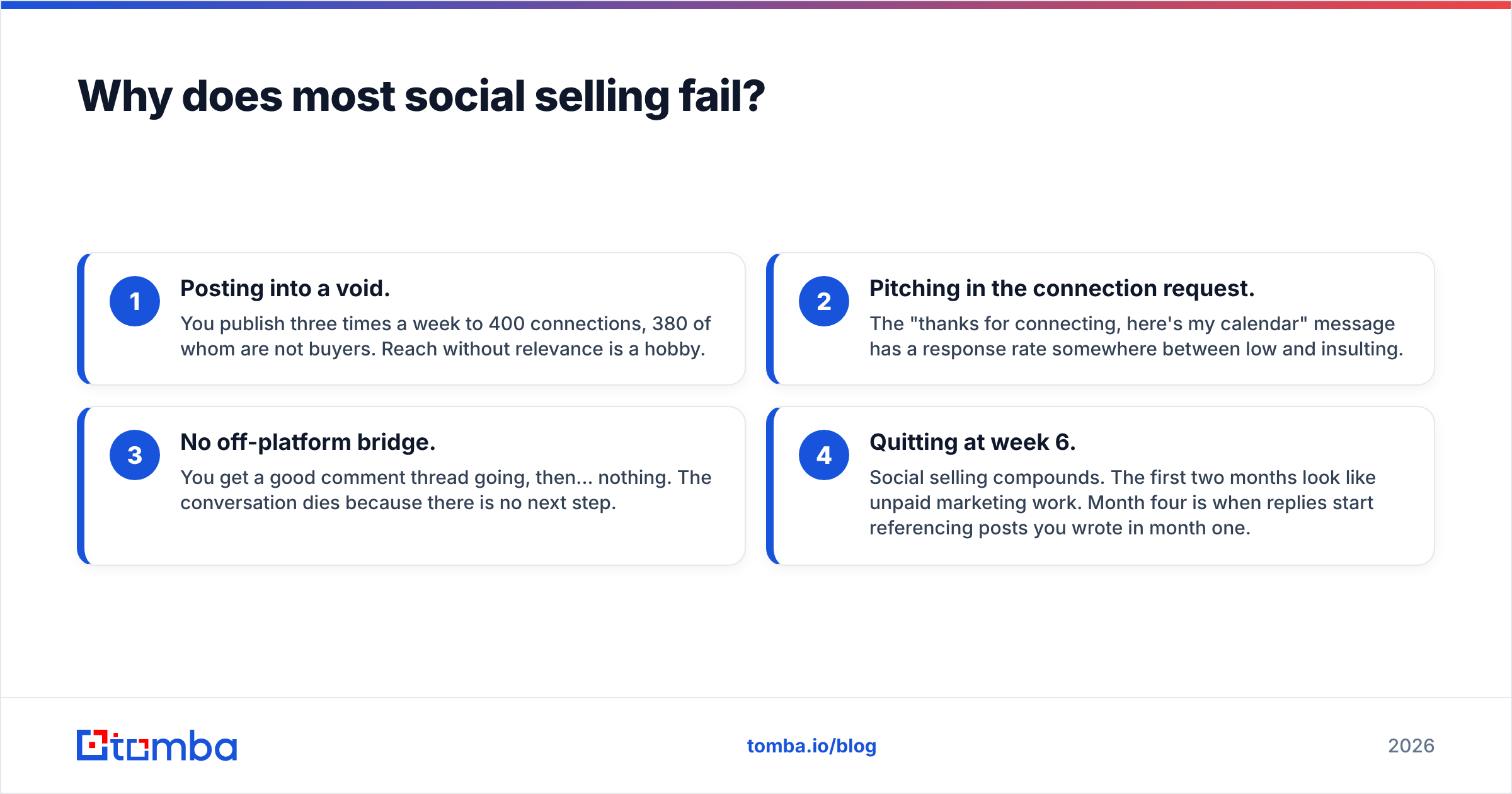
Four failure modes account for nearly everything:
- Posting into a void. You publish three times a week to 400 connections, 380 of whom are not buyers. Reach without relevance is a hobby.
- Pitching in the connection request. The "thanks for connecting, here's my calendar" message has a response rate somewhere between low and insulting.
- No off-platform bridge. You get a good comment thread going, then... nothing. The conversation dies because there is no next step.
- Quitting at week 6. Social selling compounds. The first two months look like unpaid marketing work. Month four is when replies start referencing posts you wrote in month one.
The fix for all four is the same: treat social as the top of a system that ends in a booked meeting, not as a channel that magically produces one.
How do you do social selling step by step?#
Six steps. Run them in order — skipping ahead is why step three feels awkward.
1. Narrow your ICP until it is uncomfortable#
"B2B SaaS companies" is not an ICP. "Series A-B vertical SaaS companies, 30-120 employees, with a named RevOps hire in the last 6 months" is. The narrower the definition, the more your content lands and the more obvious your outreach becomes.
Write it down as a filter you can actually apply: industry, headcount band, funding stage, tech stack, and one trigger event. If you cannot search for it in Sales Navigator or a B2B database, it is too vague.
2. Build the listening layer before you build the posting layer#
Spend the first two weeks consuming, not producing. Follow 30-50 people who fit your ICP plus the 10 loudest voices in their space. Save searches for your trigger events — new role announcements, funding news, hiring posts for roles adjacent to your product.
This is where most reps skip and pay for it later. You cannot write a post that resonates with a buyer whose vocabulary you have not learned.
3. Engage on their terms for 2-3 weeks before any outreach#
Comment on their posts. Not "great post!" — that is noise. Add a data point, a counterexample, or a specific question. Aim for comments a stranger would upvote.
Rough cadence per target account: 2-3 substantive comments over three weeks, one profile view (leave it public), and zero pitches. When you finally send a connection request, you are not a stranger, you are "that person who made the good point about churn cohorts."
4. Publish content that filters, not content that flatters#
Post 2-3 times a week. The content that works for social selling is not viral content — it is content that makes the right 200 people think "this person understands my job."
Three formats that reliably work:
- The specific teardown. "We audited 40 outbound sequences. 31 opened with 'I hope this finds you well.' Here's what the other 9 did."
- The contrarian operational take. Something your ICP quietly believes but doesn't say publicly.
- The receipt. A screenshot, a number, a before/after. Proof beats opinion.
Avoid the motivational genre entirely. It gets likes from your peers, not your buyers.
5. Move the conversation off-platform deliberately#
This is the step that converts. Once you have a real exchange — a DM thread, a comment reply chain, a shared connection intro — propose a specific next step. Not "let's hop on a call." Something like: "I pulled together the benchmark data I mentioned for three companies your size. Want me to send it over? What's the best email?"
Half the time they give you the email. The other half, you find it. This is where a Tomba Email Finder or the LinkedIn finder does the work — profile in, verified work email out — so the thread continues in an inbox you control instead of an algorithm you don't.
6. Run a real follow-up sequence on email#
Social starts conversations. Email closes them. A three-to-four touch email sequence referencing the actual social interaction ("you mentioned your team was rebuilding attribution — here's how three similar teams handled it") converts far better than a cold sequence, because it isn't cold anymore.
Before you send, run the addresses through an email verifier. A warm social relationship does not survive a bounce that flags your domain.
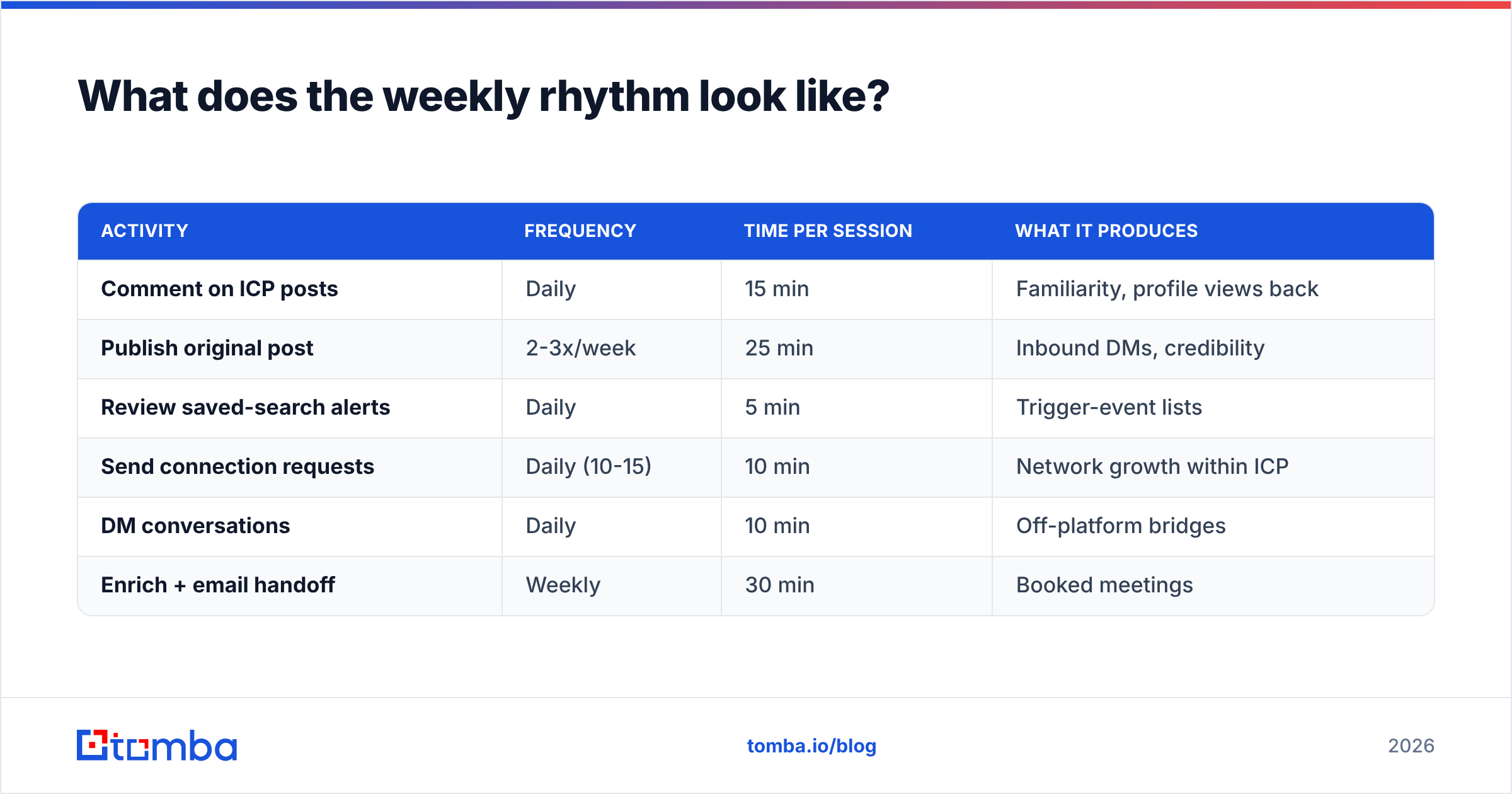
What does the weekly rhythm look like?#
Social selling dies when it has no fixed slot in the calendar. Here is a schedule that fits inside 45 minutes a day for a full-cycle rep:
| Activity | Frequency | Time per session | What it produces |
|---|---|---|---|
| Comment on ICP posts | Daily | 15 min | Familiarity, profile views back |
| Publish original post | 2-3x/week | 25 min | Inbound DMs, credibility |
| Review saved-search alerts | Daily | 5 min | Trigger-event lists |
| Send connection requests | Daily (10-15) | 10 min | Network growth within ICP |
| DM conversations | Daily | 10 min | Off-platform bridges |
| Enrich + email handoff | Weekly | 30 min | Booked meetings |
The enrichment block is the one people cut first and regret. Batch it: pull the week's engaged profiles, run them through a bulk email finder, verify, and load them into your sequencer on Friday.
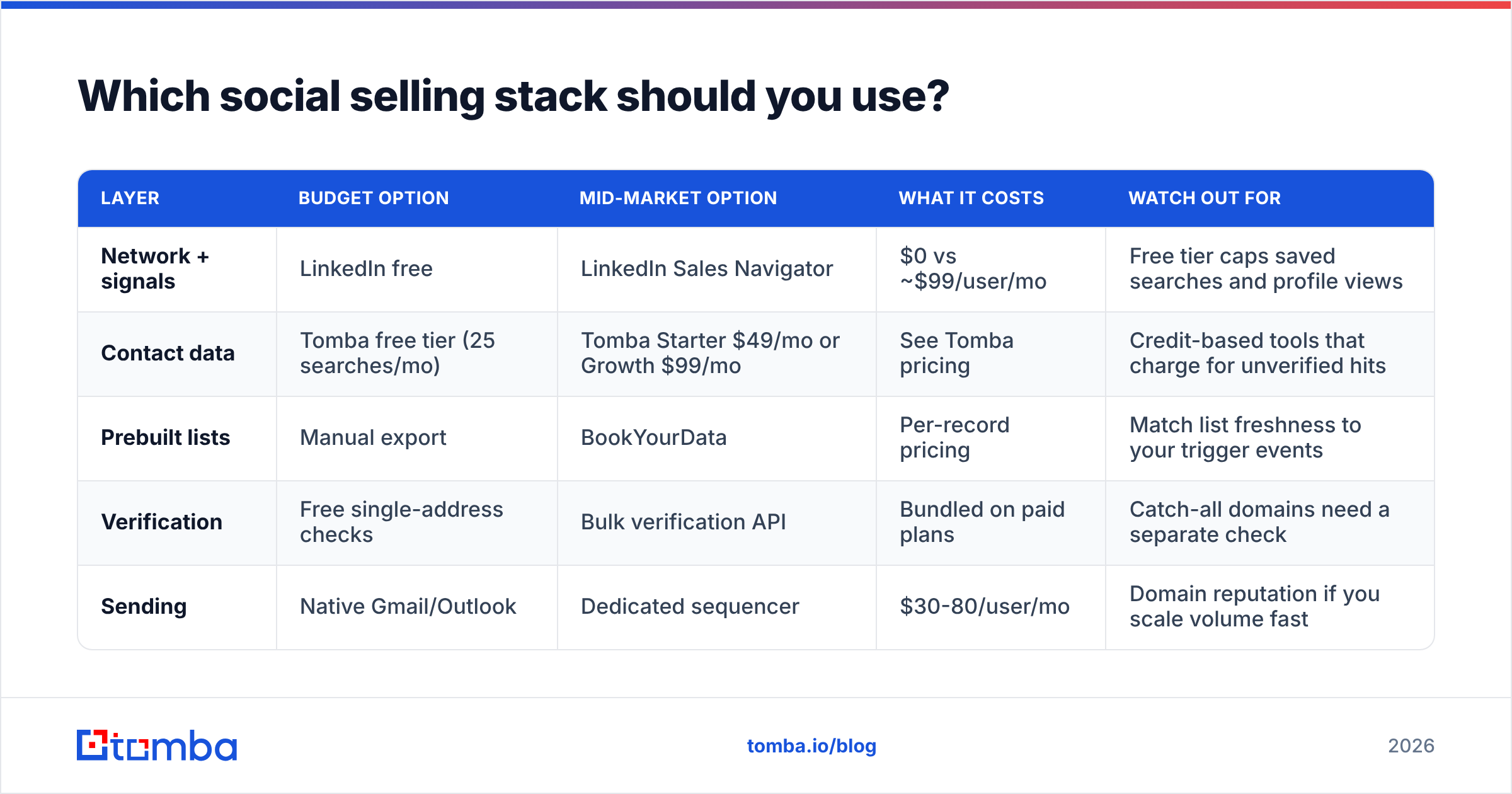
Which social selling stack should you use?#
You do not need eight tools. You need a network, a signal source, a way to get contact data, and a place to send email. Here is how the common options compare on the dimensions that matter for a social-selling motion specifically.
| Layer | Budget option | Mid-market option | What it costs | Watch out for |
|---|---|---|---|---|
| Network + signals | LinkedIn free | LinkedIn Sales Navigator | $0 vs ~$99/user/mo | Free tier caps saved searches and profile views |
| Contact data | Tomba free tier (25 searches/mo) | Tomba Starter $49/mo or Growth $99/mo | See Tomba pricing | Credit-based tools that charge for unverified hits |
| Prebuilt lists | Manual export | BookYourData | Per-record pricing | Match list freshness to your trigger events |
| Verification | Free single-address checks | Bulk verification API | Bundled on paid plans | Catch-all domains need a separate check |
| Sending | Native Gmail/Outlook | Dedicated sequencer | $30-80/user/mo | Domain reputation if you scale volume fast |
A few notes on the choices. Sales Navigator is worth it once you are running more than ~20 target accounts, mostly for saved searches and alerts rather than the messaging. BookYourData is a solid fit when you want a prebuilt, verified list to seed a segment rather than building account-by-account — different job than a profile-to-email finder, and the two pair well. And on the contact-data layer: the deciding factor is not price per credit, it is whether the tool returns a verified address or a guessed pattern. A guessed address that bounces costs you more than the credit.
If your targets sit behind catch-all domains — common in enterprise — you will want a catch-all verifier in the loop, because standard SMTP checks return "accept-all" and tell you nothing.
How is social selling different from cold outreach?#
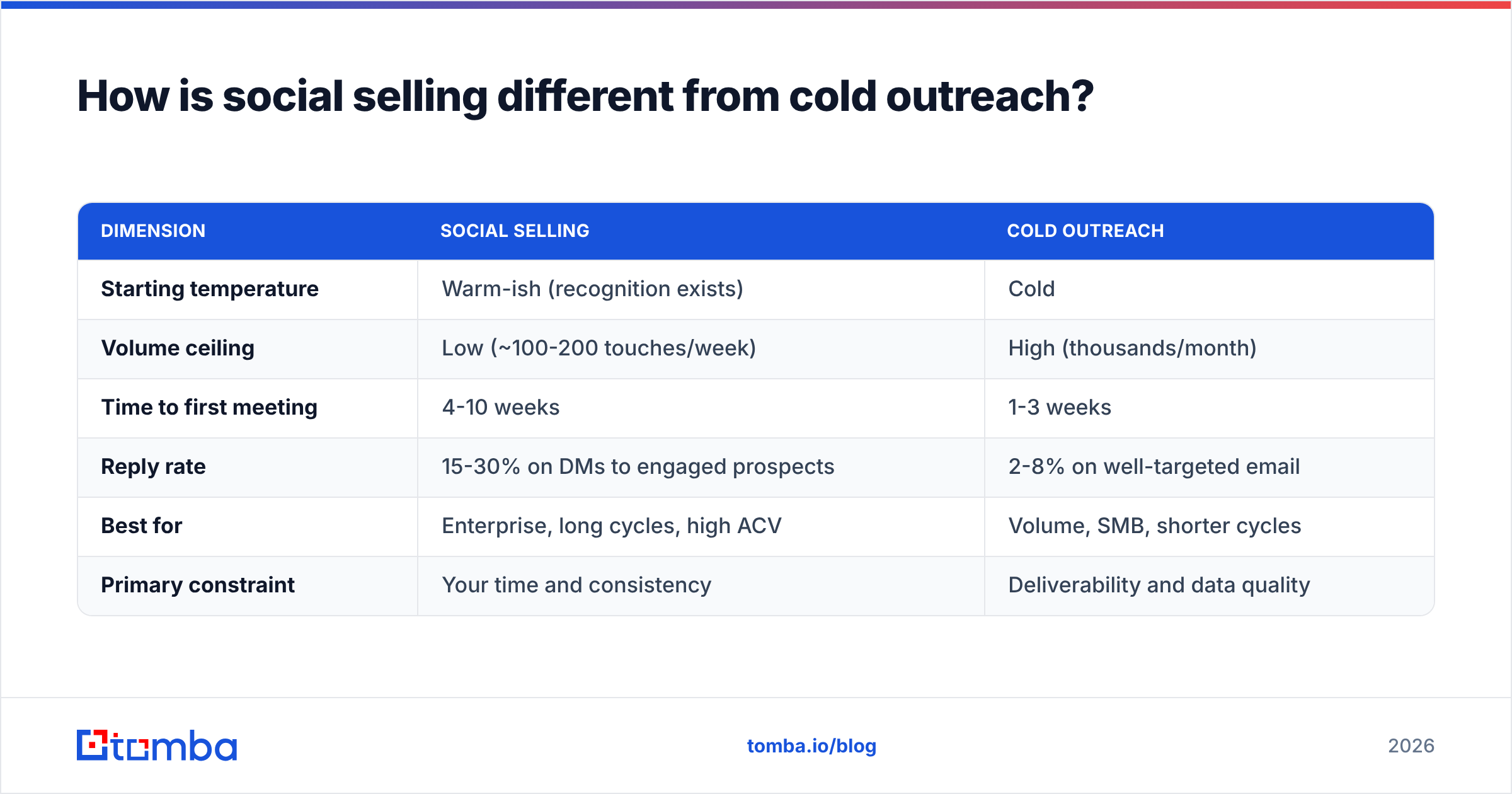
They are not competitors. They are sequential stages of the same motion, and the confusion costs teams a lot of wasted effort.
| Dimension | Social selling | Cold outreach |
|---|---|---|
| Starting temperature | Warm-ish (recognition exists) | Cold |
| Volume ceiling | Low (~100-200 touches/week) | High (thousands/month) |
| Time to first meeting | 4-10 weeks | 1-3 weeks |
| Reply rate | 15-30% on DMs to engaged prospects | 2-8% on well-targeted email |
| Best for | Enterprise, long cycles, high ACV | Volume, SMB, shorter cycles |
| Primary constraint | Your time and consistency | Deliverability and data quality |
Read that table as a portfolio decision. Social selling has a hard volume ceiling because platform limits and human attention are finite. Cold email has the volume but starts colder. Running both means your email lands on people who half-recognize your name — which is where response rate improvements actually come from.
What metrics should you track?#
Vanity metrics will lie to you for months. Track these instead:
- Profile views from ICP accounts — the leading indicator that your content is reaching buyers, not peers.
- DM conversations started per week — the real activity metric. Target 5-10.
- Social-sourced meetings booked — the only number your manager cares about. Tag the source in your CRM or you will never be able to defend the time investment.
- Email reply rate on socially-warmed contacts vs cold — if the gap isn't at least 2x, your social engagement is too shallow.
- Time to first meeting per account — should compress over quarters as your network density in the ICP grows.
Review monthly, not weekly. Social selling data is noisy at weekly granularity and you will over-correct.
What mistakes should you avoid?#
- Automating engagement. Comment bots are detectable, and getting flagged burns the account you have been building. G2 reviews of LinkedIn automation tools are full of restriction stories.
- Selling in public comments. Add value publicly, sell privately. Pitching under someone else's post reads as hijacking.
- Treating every platform the same. LinkedIn rewards text and carousels. X rewards speed and opinions. If your buyers live in Slack communities or subreddits, that is where you go — even if it is less measurable.
- Ignoring the data handoff. The single most common leak: a great conversation that never makes it into a CRM or an email sequence. Build the data enrichment step into your Friday routine and stop losing warm contacts to your own DM backlog.
- Confusing consistency with volume. Three thoughtful comments beat thirty reactions. Every time.
How long until social selling produces pipeline?#
Weeks 1-3: nothing. You are listening and commenting. It will feel unproductive.
Weeks 4-8: DMs start. A few discovery calls. Your posts get replies from names you recognize from your target list.
Weeks 9-16: compounding starts. Inbound DMs appear. Cold emails to people who follow you get answered. Referrals from second-degree connections show up.
Beyond month four: the network works for you. This is why reps who have done social selling for two years at the same company have pipelines that look unfair.
If you need pipeline in three weeks, social selling is not the lever — targeted outbound is. Run both, and let the slow one compound while the fast one pays this quarter's rent.
Where should you start this week?#
Pick 25 accounts that match your narrowed ICP. Follow the top two people at each. Comment substantively on five posts a day for two weeks. Do not pitch anyone.
In week three, take the profiles of everyone who engaged back — likes, replies, profile views — and turn them into contactable records. That is the pivot point where social effort becomes measurable pipeline.
The Tomba Email Finder is built for exactly that handoff: give it a name and a company domain and it returns a verified work email with the sources behind it, so the conversation you started in a comment thread continues in an inbox. The free tier gives you 25 searches a month to test the workflow before you commit, and Starter runs $49/mo when you are ready to scale the enrichment step across a full territory.
Start the listening this week. Start the handoff in week three. That is the whole system.
Related guides#
// get started
Find, verify and enrich your first contacts today
Start on the free plan with 25 searches a month, then scale when your team is ready.
Free plan · No credit card required · GDPR & CCPA
// about the author