How to Drive Urgency in Sales Without Fake Deadlines (2026)
Fake deadlines and countdown timers stopped working years ago. Here are seven ways to drive real urgency in B2B sales — built on the buyer's cost of inaction, not your quota.
TL;DR
- Urgency you manufacture ("this discount dies Friday") lowers trust and win rates. Urgency you uncover — a compliance date, a renewal, a hiring freeze, a board metric — shortens cycles without discounting.
- The strongest urgency lever in B2B is cost of inaction (COI) quantified in the buyer's own numbers, not yours.
- Urgency must be built in discovery. If you're adding it at the proposal stage, you're already negotiating against a stalled deal.
- Deals die of "no decision" far more often than they're lost to a competitor — so your real opponent is the status quo, not the other vendor.
- Timing beats pressure: reaching the right person during a trigger event does more for velocity than any script.
Why does most sales urgency fail?#
Because buyers have seen it all. The end-of-quarter discount, the "I can only hold this pricing until Friday," the artificial seat scarcity on a SaaS product with infinite seats — every B2B buyer with three years of experience has a mental filter for these. When you deploy one, you don't create urgency. You create suspicion, and suspicion adds procurement steps.
There's a structural reason too. Manufactured urgency is seller-side: it's about your quarter, your quota, your forecast. Nothing in it changes the buyer's world. A VP of Operations who was comfortable waiting until Q3 is still comfortable waiting until Q3 — she'll just take your discount when she gets there, because she now knows the discount exists.
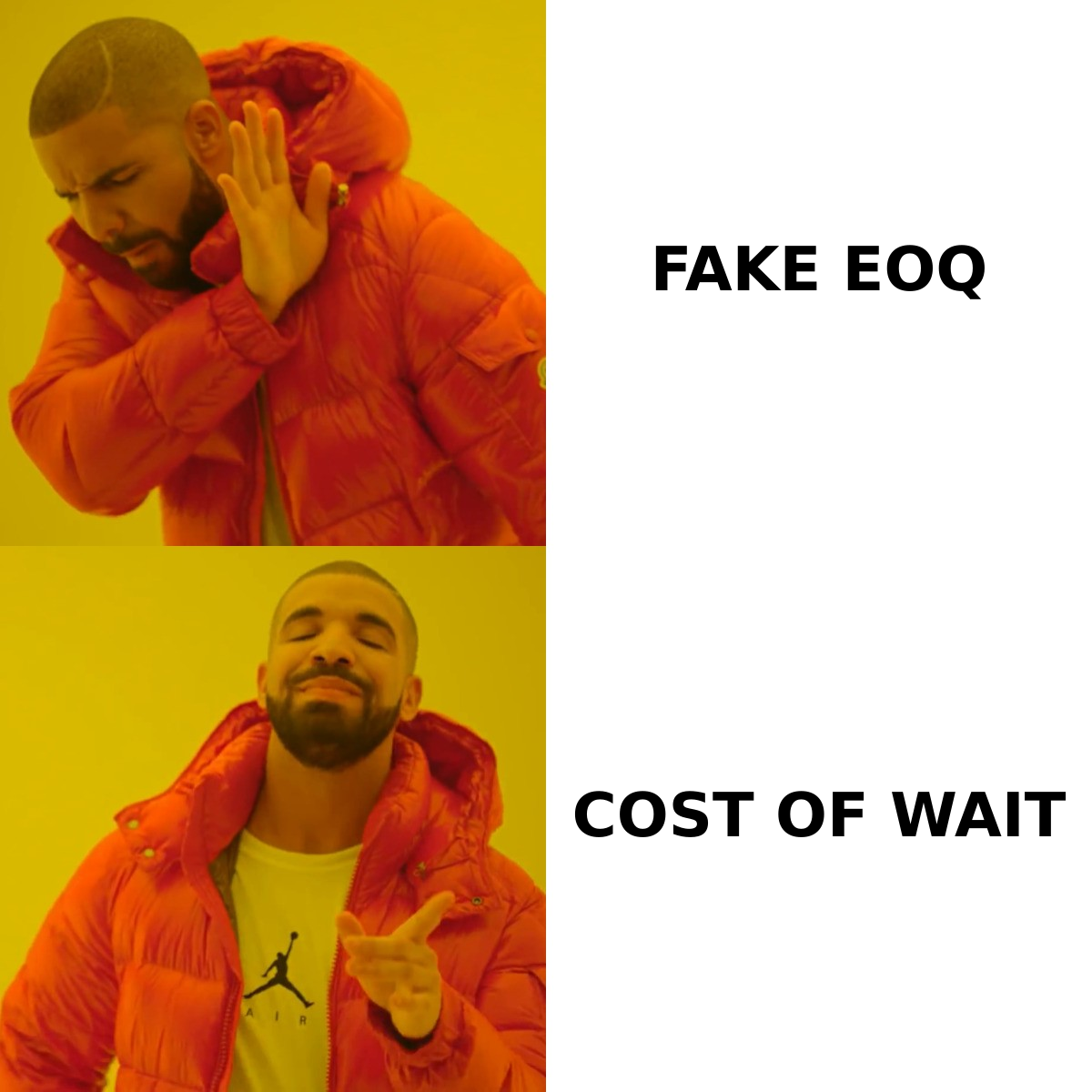
Real urgency is buyer-side. It answers one question: what does waiting cost them, in money, risk, or time? If you can't answer that with a number the buyer recognizes, you don't have a deal with urgency. You have a deal with a nice conversation attached.
What's the difference between manufactured and discovered urgency?#
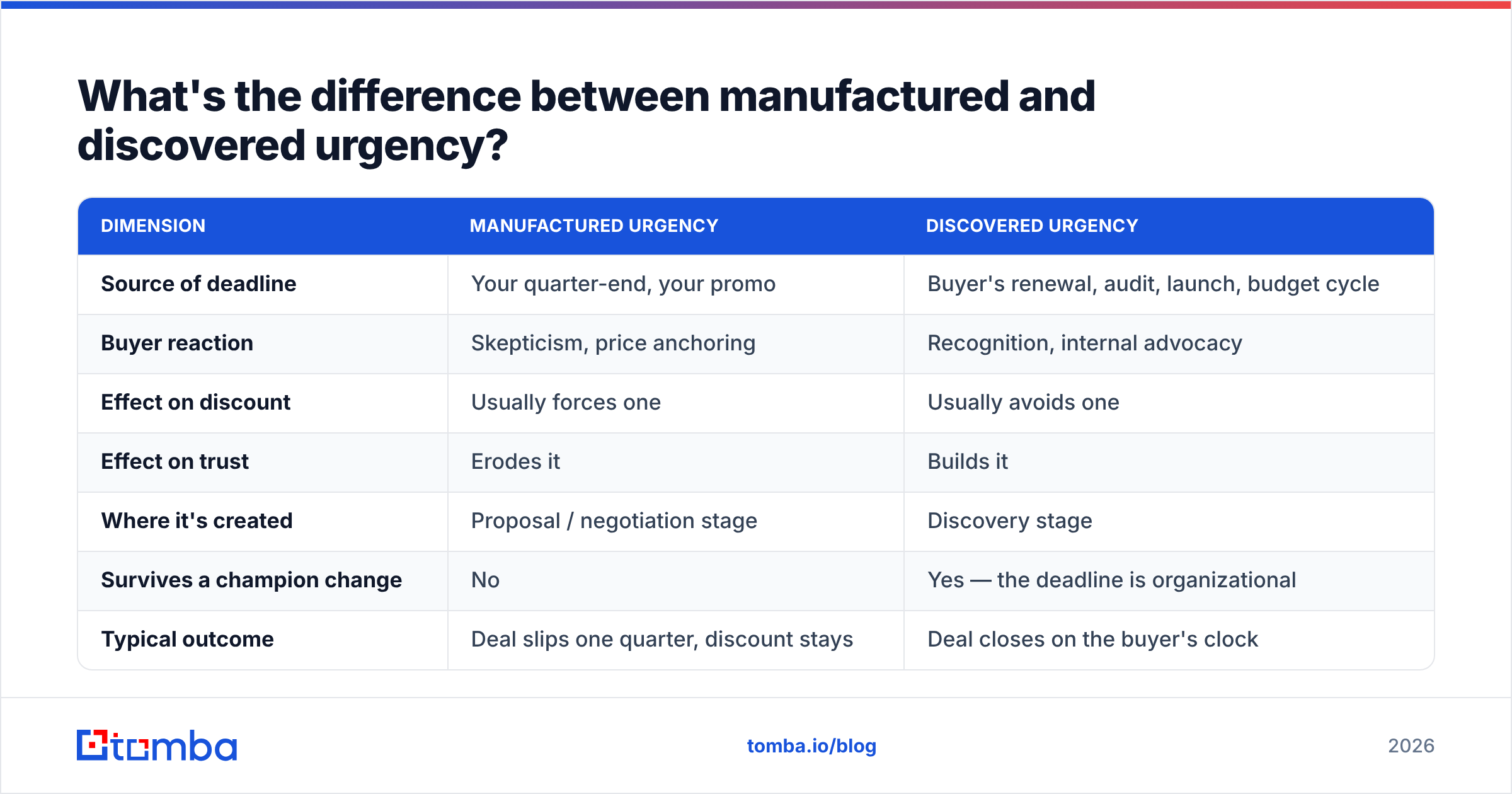
The distinction is where the deadline lives. Manufactured urgency puts the deadline on your calendar. Discovered urgency finds a deadline already sitting on theirs.
| Dimension | Manufactured urgency | Discovered urgency |
|---|---|---|
| Source of deadline | Your quarter-end, your promo | Buyer's renewal, audit, launch, budget cycle |
| Buyer reaction | Skepticism, price anchoring | Recognition, internal advocacy |
| Effect on discount | Usually forces one | Usually avoids one |
| Effect on trust | Erodes it | Builds it |
| Where it's created | Proposal / negotiation stage | Discovery stage |
| Survives a champion change | No | Yes — the deadline is organizational |
| Typical outcome | Deal slips one quarter, discount stays | Deal closes on the buyer's clock |
The last row matters most. When you use a fake deadline and the deal slips anyway, you've lost your only lever and taught the buyer your pricing is soft. When you use a discovered deadline and the deal slips, the deadline is still there next quarter working for you.
How do you quantify cost of inaction?#
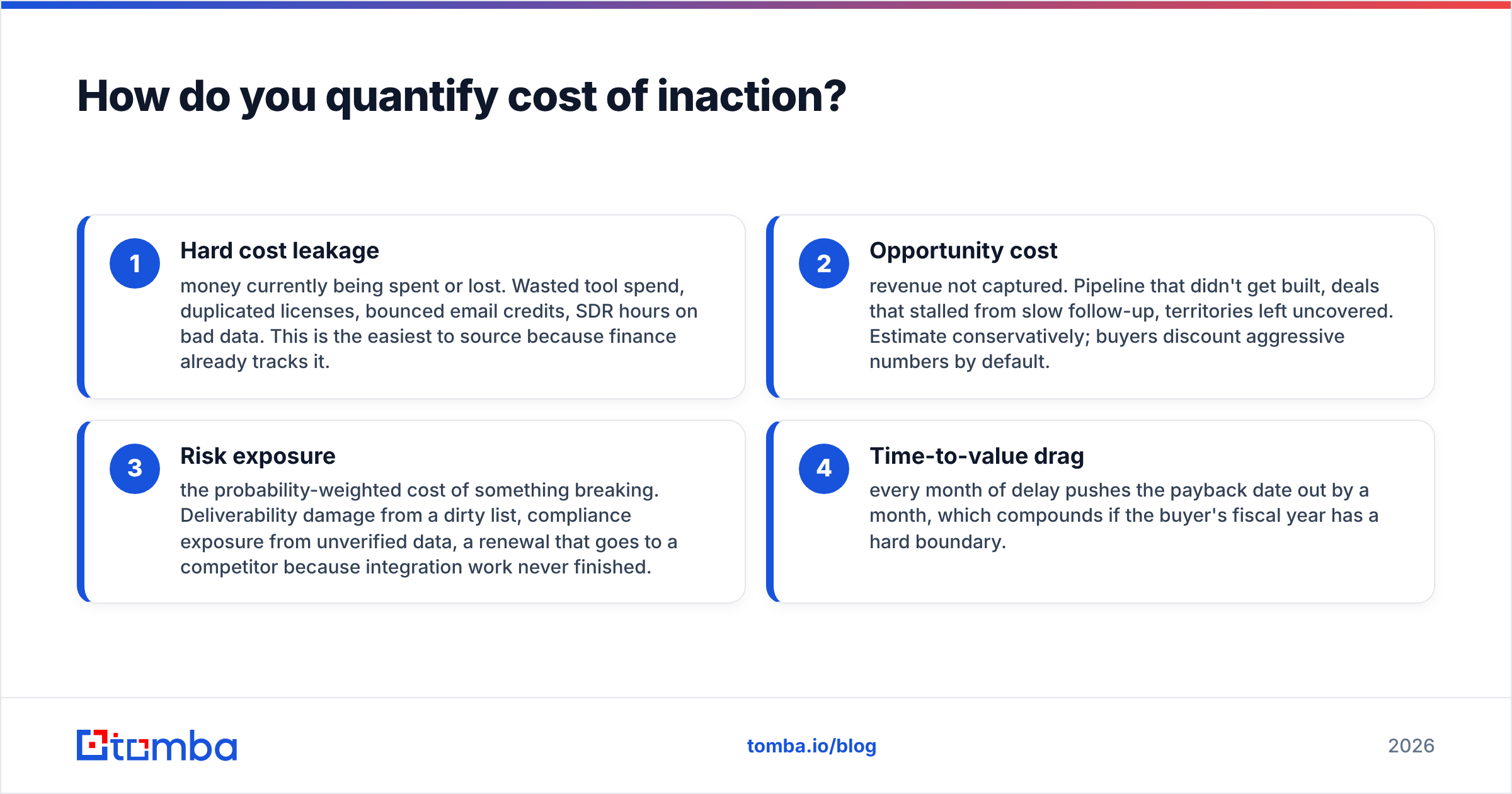
Cost of inaction is the price of the buyer's status quo, expressed over a time window they care about. It has three components, and you need at least two of them to be credible.
- Hard cost leakage — money currently being spent or lost. Wasted tool spend, duplicated licenses, bounced email credits, SDR hours on bad data. This is the easiest to source because finance already tracks it.
- Opportunity cost — revenue not captured. Pipeline that didn't get built, deals that stalled from slow follow-up, territories left uncovered. Estimate conservatively; buyers discount aggressive numbers by default.
- Risk exposure — the probability-weighted cost of something breaking. Deliverability damage from a dirty list, compliance exposure from unverified data, a renewal that goes to a competitor because integration work never finished.
- Time-to-value drag — every month of delay pushes the payback date out by a month, which compounds if the buyer's fiscal year has a hard boundary.
A worked example from an outbound team: 6 SDRs, each sending 800 emails/month, with a 22% bounce rate on unverified data. That's roughly 1,050 wasted sends per month, plus a sender reputation hit that suppresses inbox placement for the other 78%. Convert that into meetings lost at the team's actual meeting rate and you have a number the VP can defend in a budget meeting. That's urgency — no deadline required.
The mechanics matter here: HubSpot's research library on sales statistics is a decent public source for benchmark conversion rates when the buyer doesn't have their own. Use their numbers when you can, benchmarks when you can't, and label which is which.
What actually creates urgency in a B2B deal?#
Seven levers, ranked roughly by how much velocity they add relative to the effort required.
1. Compelling event. A dated, organizational commitment that exists whether or not you show up: a contract renewal, a compliance deadline, a product launch, a funding round with milestones attached, a reorg. Ask directly: "What's already on the calendar between now and December that this touches?"
2. Cost of inaction, quantified. Covered above. Do the math with the buyer, in a shared doc, using their inputs. A number they helped build is a number they'll repeat internally when you're not in the room.
3. Champion's personal stake. Your champion has a review, a promotion track, or a metric with their name on it. Urgency travels through people, not companies. Find what the deal does for them specifically.
4. Trigger-event timing. New VP of Sales in seat, a funding announcement, a competitor's outage, a hiring spike in a relevant department. These windows are short — usually 30 to 60 days — which is exactly why they generate speed. Reaching out during one beats reaching out perfectly at a random time.
5. Mutual action plan. A shared, dated, two-sided close plan. It converts vague intent into a sequence with named owners. When a date slips, you have a legitimate reason to escalate that isn't "checking in."
6. Scarcity that's actually real. Implementation capacity, onboarding slots before a holiday freeze, a legacy pricing tier being genuinely retired. If it's real, say it plainly and provide proof. If you have to squint at it, don't use it.
7. Loss framing over gain framing. Behavioral research consistently finds losses weigh heavier than equivalent gains — the loss aversion effect. "You're currently losing 1,050 sends a month" lands harder than "you could gain 1,050 sends a month." Same fact, different weight.
How do you build urgency during discovery?#
Urgency is a discovery output. If your discovery call produces pain but not a date, you've done half the job.
Three questions do most of the work:
- "What happens if you don't solve this at all this year?" The answer tells you whether a compelling event exists. If the honest answer is "nothing much," you have a nice-to-have, and no amount of closing technique fixes that. Disqualify or park it.
- "What's driving the timing now, versus six months ago?" This surfaces the trigger. If nothing changed, the deal will move at status-quo speed regardless of your effort.
- "Who else feels this problem, and what does it cost them?" This maps the urgency to other stakeholders, which is how you survive a champion leaving.
Then write the answers down verbatim and reuse the buyer's language in every subsequent touchpoint. Reps who paraphrase pain into their own vocabulary lose the emotional charge that made it urgent.
One tactical note on timing: urgency decays fast between touches. A buyer who told you on Tuesday that bounce rates are killing their Q3 number will have moved on to a different fire by the following Monday. Gartner's work on B2B buying behavior describes buying as a set of parallel, non-linear jobs rather than a funnel — which means your deal is competing for attention against four other initiatives at all times. Short gaps between touches aren't pushiness; they're how you stay in the active set.
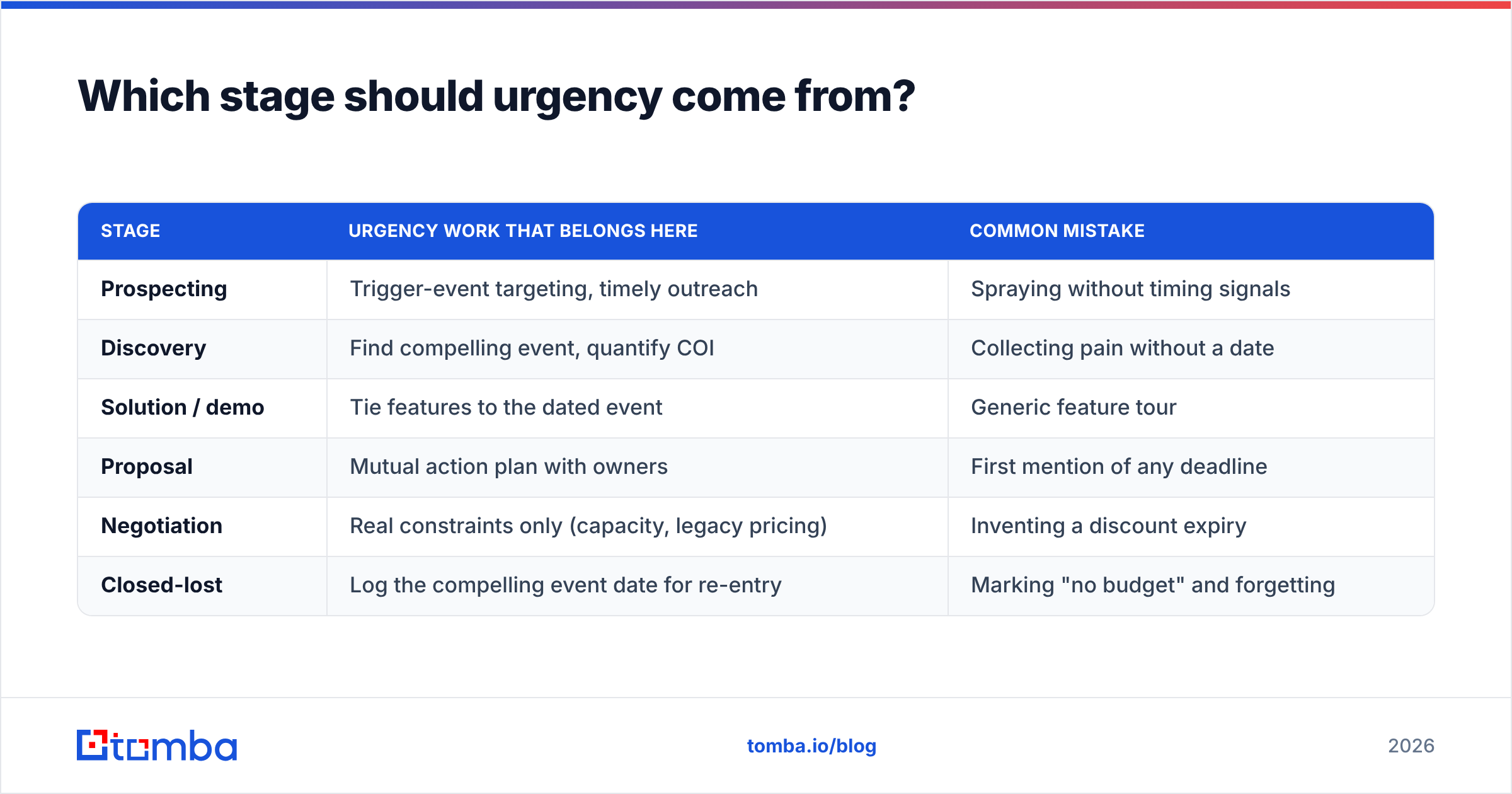
Which stage should urgency come from?#
| Stage | Urgency work that belongs here | Common mistake |
|---|---|---|
| Prospecting | Trigger-event targeting, timely outreach | Spraying without timing signals |
| Discovery | Find compelling event, quantify COI | Collecting pain without a date |
| Solution / demo | Tie features to the dated event | Generic feature tour |
| Proposal | Mutual action plan with owners | First mention of any deadline |
| Negotiation | Real constraints only (capacity, legacy pricing) | Inventing a discount expiry |
| Closed-lost | Log the compelling event date for re-entry | Marking "no budget" and forgetting |
Note the last row. A "no decision" outcome with a known compelling event six months out is one of the highest-conversion re-entry points you have. Most teams throw that data away. Log the date, set the task, come back two months before it hits.
How does data quality affect urgency?#
Directly, and in a way most teams underrate. Urgency is a timing game, and timing games are won by whoever reaches the right person while the window is open.
Three failure modes kill more urgent deals than bad pitching does:
- Wrong person. You built beautiful urgency with someone who can't sign. The compelling event is real; your champion just isn't attached to it.
- Stale contact. Your prospect changed jobs four months ago. The trigger event fired, you sent the email, it bounced, and a competitor got the meeting.
- Slow reach. The funding announcement was Tuesday. You found a verified contact the following Thursday. The window narrowed by 40% while you were sourcing an address.
This is the unglamorous infrastructure layer of urgency. A verified contact record found in minutes rather than days is worth more velocity than any closing script. If you're working trigger lists, a fast email finder paired with email verification turns a 3-day sourcing lag into a same-day send. For account-level sweeps after a funding round or leadership change, domain search pulls the full contact map at once instead of one name at a time.
What urgency tactics should you stop using in 2026?#
A short kill list, based on what buyers now pattern-match instantly:
- "This pricing expires Friday" on a product with published pricing. One click to your pricing page and the claim collapses.
- Countdown timers in B2B email. They read as consumer ecommerce and undercut a six-figure conversation.
- "I have to give this slot to another client." Nobody believes it, and it invites the buyer to call the bluff.
- Manufactured seat scarcity on software. Seats are not a finite physical resource and buyers know it.
- The end-of-quarter guilt trip. Making your quota the buyer's problem is the single fastest way to hand negotiation leverage to procurement.
- Rapid "just circling back" cadences with no new information. Frequency without value is noise; frequency with a new data point is momentum.
Replace each with the buyer-side equivalent. Instead of a discount expiry, use an implementation-capacity constraint that's true. Instead of a countdown timer, send a dated mutual action plan. Instead of quarter-end pressure, show the monthly cost of the status quo running.
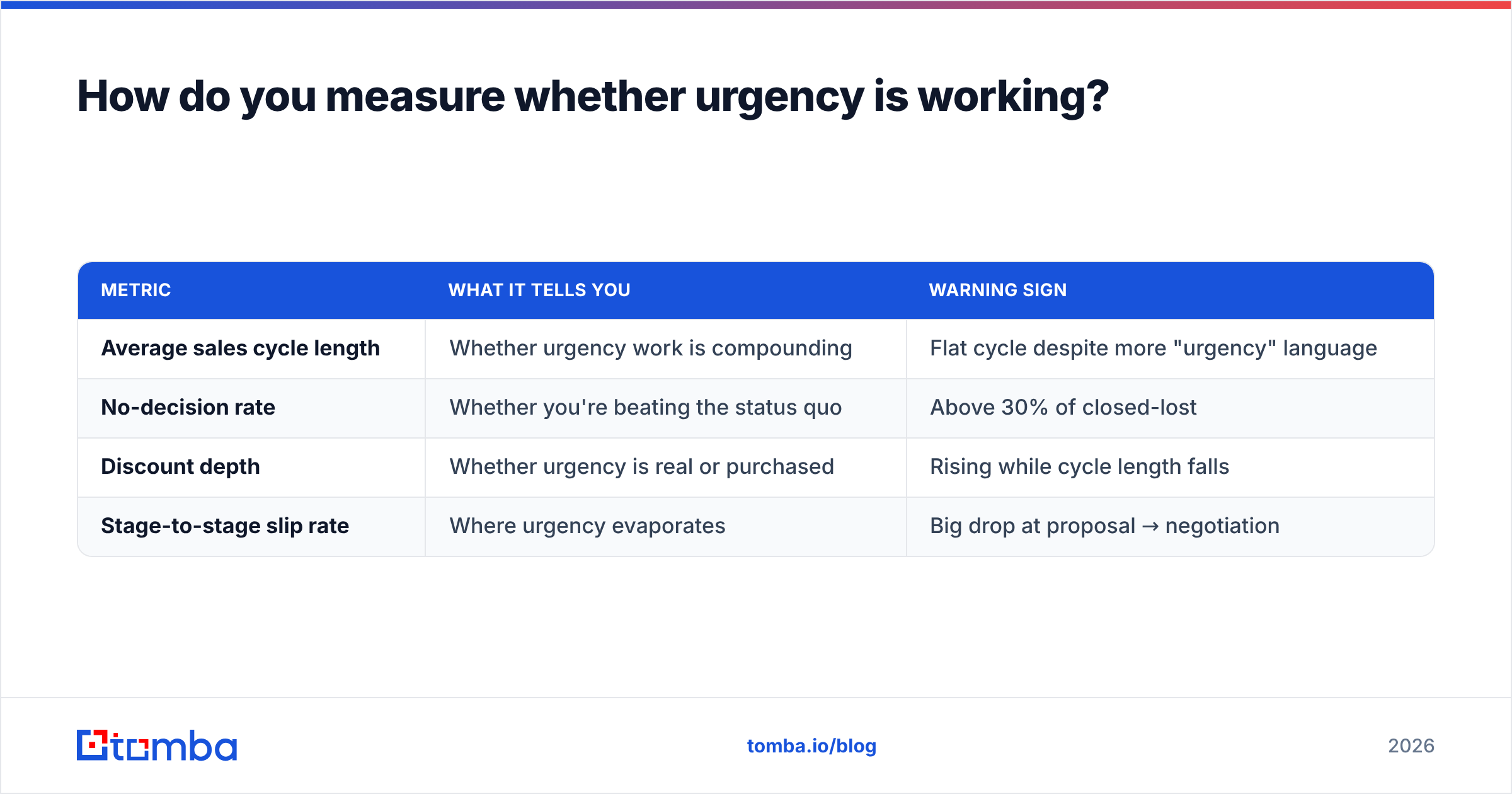
How do you measure whether urgency is working?#
Watch four numbers. Each one isolates a different failure.
| Metric | What it tells you | Warning sign |
|---|---|---|
| Average sales cycle length | Whether urgency work is compounding | Flat cycle despite more "urgency" language |
| No-decision rate | Whether you're beating the status quo | Above 30% of closed-lost |
| Discount depth | Whether urgency is real or purchased | Rising while cycle length falls |
| Stage-to-stage slip rate | Where urgency evaporates | Big drop at proposal → negotiation |
The pairing to watch is cycle length against discount depth. If cycles shorten while discounts deepen, you're not creating urgency — you're buying it, and the price goes up every quarter. If cycles shorten while discount depth holds flat or drops, the urgency is genuine.
Track no-decision separately from competitive losses in your CRM. They're different diseases with different treatments: competitive losses are a differentiation problem, no-decisions are an urgency problem. Teams that lump them into "lost" can't tell which one they have.
What does a good urgency sequence look like end to end?#
A compressed example on a mid-market deal with a real compelling event.
Week 0 — trigger. Target company announces a Series B. You pull the new VP of Revenue Operations plus two directors, verify the addresses, and send within 48 hours. The message references the raise and one specific scaling problem it creates.
Week 1 — discovery. You establish the compelling event: they've committed to the board that outbound pipeline doubles by Q1. That's a dated organizational promise with a person's name on it.
Week 2 — quantify. Joint working session. You build the COI model with their numbers: current bounce rate, current meeting rate, current SDR headcount. The output is a monthly figure attached to doing nothing.
Week 3 — mutual action plan. Dated close plan working backward from their Q1 board date, with security review, procurement, and onboarding as named steps with named owners.
Week 4-6 — execution. Every touch advances a step on the plan. No "checking in." When a step slips, you escalate against the plan, not against your quarter.
Notice there's no invented deadline anywhere in that sequence, and no discount. The urgency came from the board commitment and the monthly cost of missing it. Your job was to find it, quantify it, and build a path that respected it.
The whole thing depends on step one being fast. If sourcing verified contacts after that Series B announcement takes a week, you enter the conversation after two competitors and the window has already narrowed.
Start with the timing layer#
Urgency is mostly a timing problem wearing a persuasion costume. The reps who consistently close faster aren't better at pressure — they're better at arriving during the window when the buyer's own deadline is already generating pressure for them.
That means your trigger-event workflow needs to move in hours, not days. Tomba's Email Finder gets you verified contacts at newly funded, newly hired, or newly reorganized accounts fast enough to reach decision-makers while the event is still fresh — with a free tier at 25 searches/month to test the workflow, and paid Tomba plans starting at $49/mo when you scale it across the team. Find the real deadline, quantify what waiting costs, and let the buyer's calendar do the closing.
Related guides#
Ready to find emails that actually work?
Join 150,000+ professionals who stopped guessing and started sending. Free credits on signup — no credit card required.
Get the Tomba newsletter
Practical outbound tactics and product updates — once every two weeks.
About the author