How to Email a CEO: The Cold Outreach Playbook That Works
CEOs read more cold email than anyone assumes — they just delete 98% of it in under four seconds. Here is the exact research, structure, and send process that gets the other 2% answered.
TL;DR
- CEOs do read cold email — most executive inboxes are scanned personally on mobile, usually before 8am or after 8pm. The filter is speed, not gatekeeping.
- Your email gets roughly four seconds. That budget covers the sender name, subject line, and first 12 words. Everything else only matters if those pass.
- The winning structure is 50-125 words: one line of specific proof you did research, one line of relevance, one soft ask. No attachments, no calendar link on the first touch.
- Verify the address before you send. A bounce on a CEO domain costs you the whole company, not just one contact.
- If the CEO is at a 500+ person company, you are usually better off emailing a VP and letting the request travel upward. Know which situation you are in before you write.
Emailing a CEO is not a harder version of emailing anyone else. It is a different game with different rules. A director will forgive a mediocre first line because they have time. A CEO will not, because they are triaging 200+ messages a day between board calls. The good news: the bar for standing out is embarrassingly low, because 95% of the cold email hitting executive inboxes is templated garbage.
This guide covers the research, the structure, the send mechanics, and the specific mistakes that make executives archive you instantly.
Do CEOs actually read cold emails?#
Yes — more than most reps believe, and less carefully than most reps hope.
Three things are true at once about executive inboxes:
- Most CEOs read their own email. Dedicated executive assistants filtering inbound are a feature of Fortune 500 life, not the 10-500 employee companies most B2B sellers target. At a 40-person Series A company, the CEO's inbox is the CEO's inbox.
- They scan on mobile, in gaps. Between meetings, in a car, at 6am. That means your email is being judged on a 4-inch screen where roughly 35 characters of subject line and two lines of preview text are visible.
- They archive ruthlessly. The default action is delete. You are not being evaluated; you are being triaged. Your job is to survive triage, not to win an argument.
The practical consequence: optimize for the scan, not for the read. If your first sentence is "I hope this email finds you well" or "My name is X and I work at Y," you have spent your entire four-second budget on nothing.
Should you email the CEO at all?#
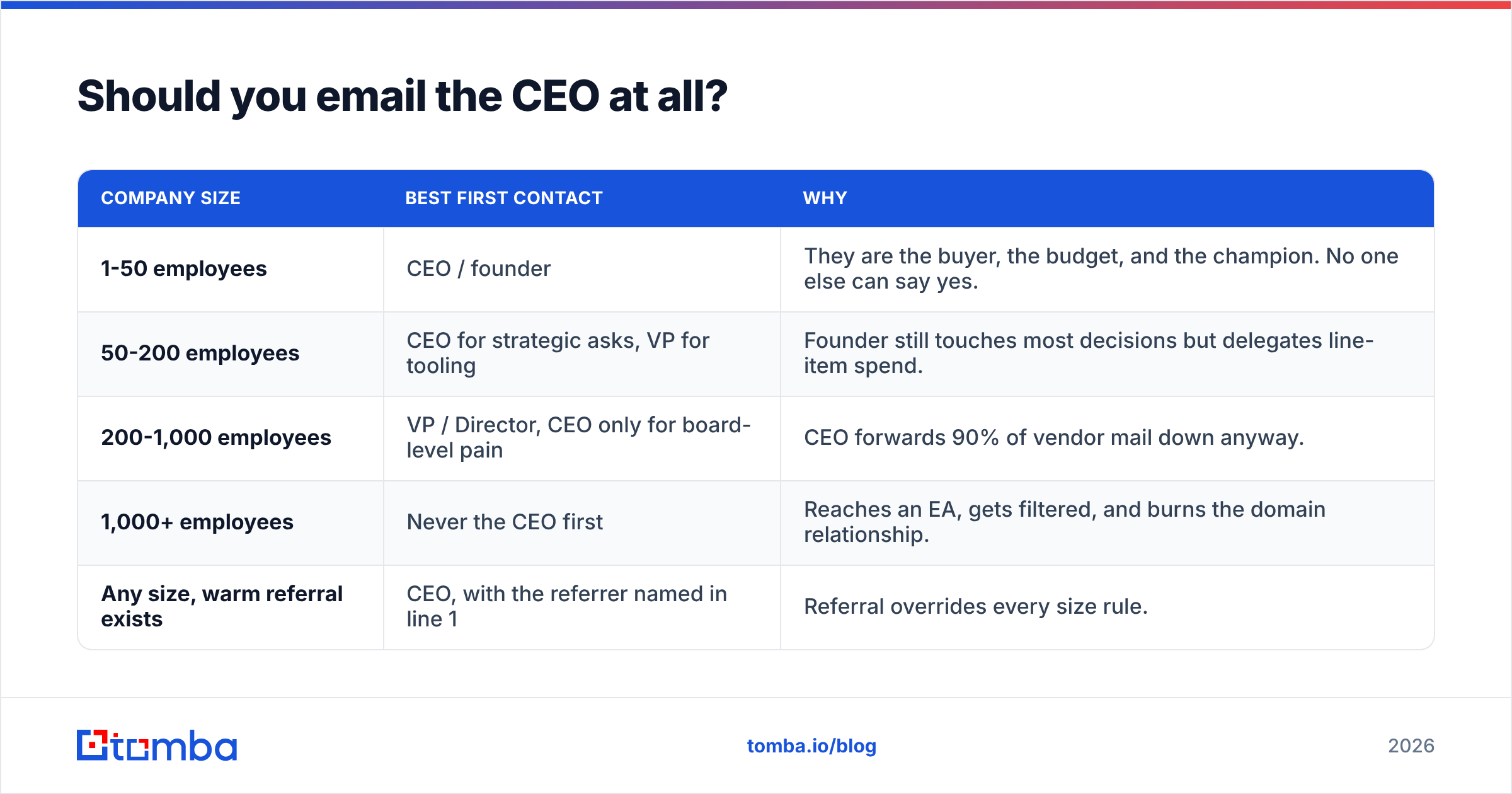
Answer this before you write a word. Emailing the wrong altitude wastes the contact permanently — you rarely get a second cold shot at the same person.
Use this rule of thumb:
| Company size | Best first contact | Why |
|---|---|---|
| 1-50 employees | CEO / founder | They are the buyer, the budget, and the champion. No one else can say yes. |
| 50-200 employees | CEO for strategic asks, VP for tooling | Founder still touches most decisions but delegates line-item spend. |
| 200-1,000 employees | VP / Director, CEO only for board-level pain | CEO forwards 90% of vendor mail down anyway. |
| 1,000+ employees | Never the CEO first | Reaches an EA, gets filtered, and burns the domain relationship. |
| Any size, warm referral exists | CEO, with the referrer named in line 1 | Referral overrides every size rule. |
The exception worth knowing: a "top-down forward" can be more valuable than a direct reply. If a CEO forwards your email to their VP of Revenue with "worth a look," you have skipped four weeks of pipeline. That means an email written for a CEO should still be forwardable — legible to the person one level down who actually evaluates it.
What research do you need before writing?#
Specificity is the entire strategy. A CEO can spot a mail-merge in one glance because they receive fifty of them a week. What they cannot ignore is evidence that a human spent 15 minutes on their company.
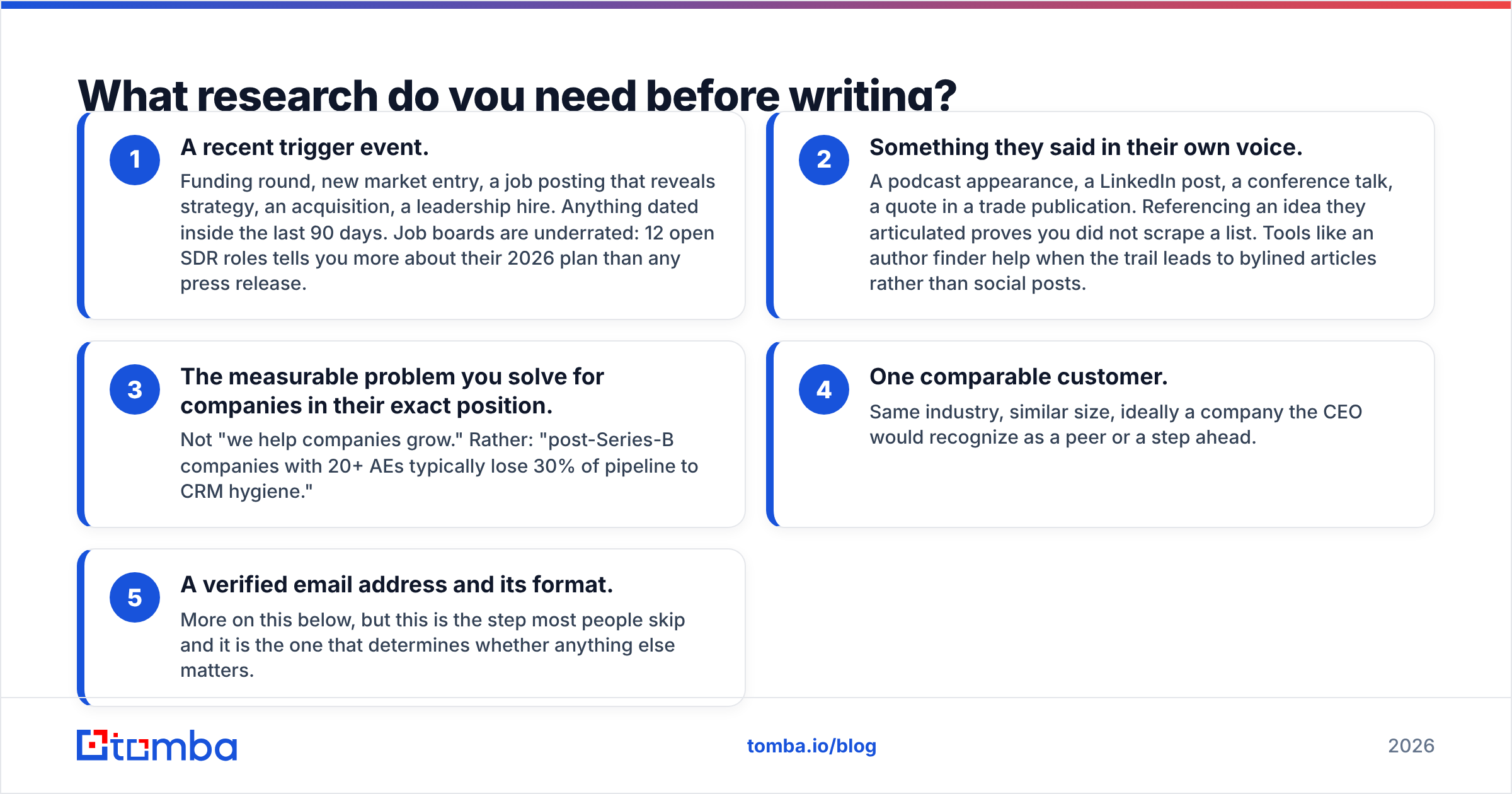
Gather these five things. Budget 10-15 minutes per target — this is not a scale play.
- A recent trigger event. Funding round, new market entry, a job posting that reveals strategy, an acquisition, a leadership hire. Anything dated inside the last 90 days. Job boards are underrated: 12 open SDR roles tells you more about their 2026 plan than any press release.
- Something they said in their own voice. A podcast appearance, a LinkedIn post, a conference talk, a quote in a trade publication. Referencing an idea they articulated proves you did not scrape a list. Tools like an author finder help when the trail leads to bylined articles rather than social posts.
- The measurable problem you solve for companies in their exact position. Not "we help companies grow." Rather: "post-Series-B companies with 20+ AEs typically lose 30% of pipeline to CRM hygiene."
- One comparable customer. Same industry, similar size, ideally a company the CEO would recognize as a peer or a step ahead.
- A verified email address and its format. More on this below, but this is the step most people skip and it is the one that determines whether anything else matters.
Free public sources cover most of this: the company's own newsroom, G2 reviews of their current stack, their careers page, and their LinkedIn activity feed. For the technical side of research — figuring out what a company runs before you pitch a replacement — a website tech stack check takes ten seconds and often produces the sharpest opening line you will get.
How do you find a CEO's email address?#
Executive addresses are usually the easiest in the company to derive and the hardest to verify. Founders often use first@company.com or firstname@company.com — short, clean patterns set up when the domain was registered.
Here is the reliable order of operations:
Step 1 — Determine the company's email pattern. Find any employee email at the domain (a press contact, a support address in a signature, a GitHub commit). Once you know it is first.last@, you can construct the CEO's address. A company email pattern lookup automates this.
Step 2 — Run a domain-level search. A domain search returns known addresses at the company with their roles attached, which often surfaces the CEO directly along with the confidence score.
Step 3 — Search by name. If you have "Sarah Chen, CEO, Acme Corp," an email finder resolves name + domain into a specific address rather than a pattern guess.
Step 4 — Verify before sending. Always. This is not optional at the executive level. A hard bounce to a CEO's address on a small domain can register against your sending reputation on a domain where you might have five other prospects. Run the address through an email verifier and only send on a valid result. If the domain is catch-all — common at companies using Google Workspace defaults — a catch-all verifier tells you whether the mailbox genuinely exists rather than the server accepting everything.
Step 5 — Do not use personal addresses. Someone's Gmail found through a data breach dump is not a prospecting channel. It is a fast route to a spam complaint and a very annoyed executive.
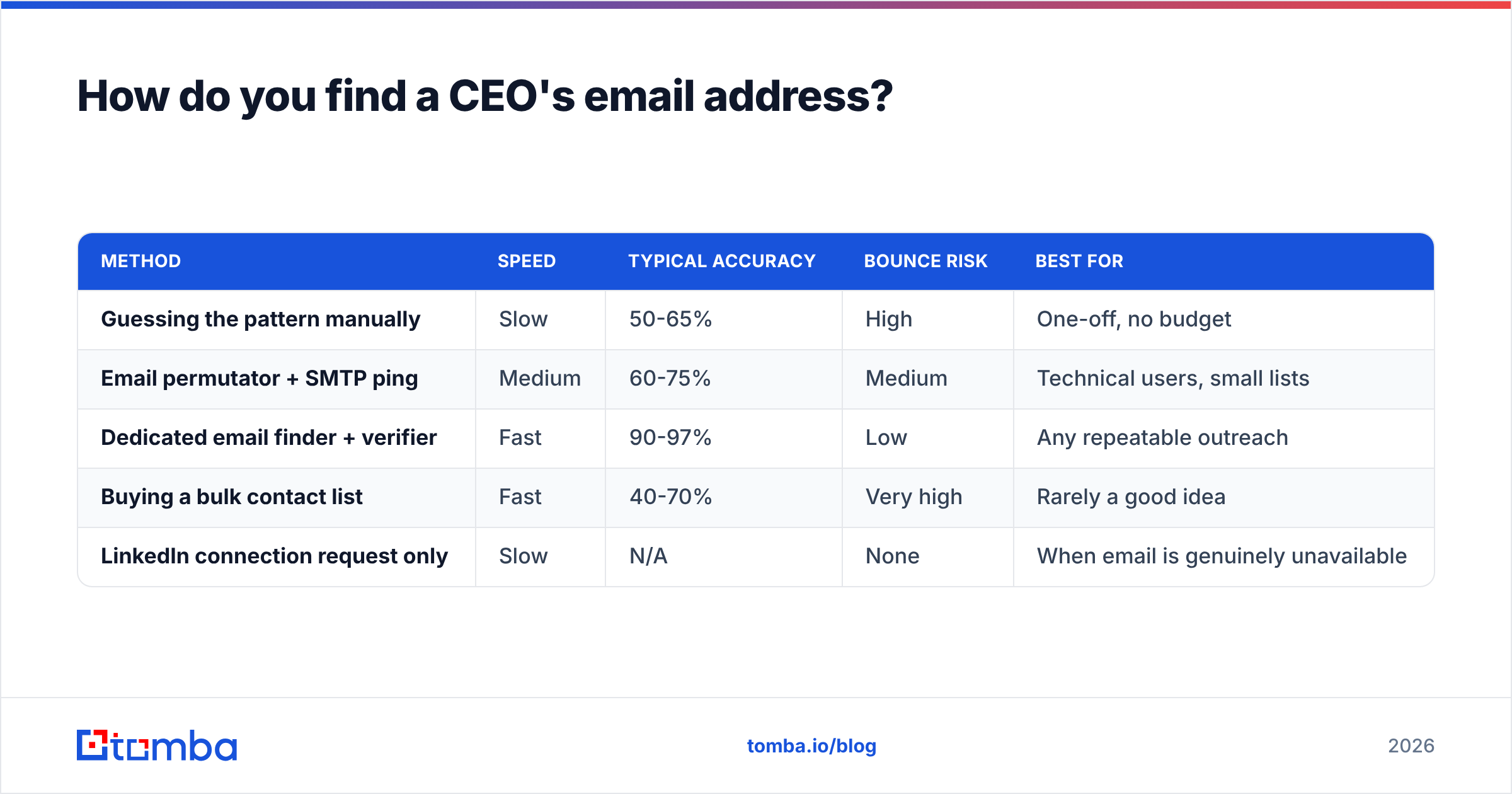
Here is how the common approaches compare in practice:
| Method | Speed | Typical accuracy | Bounce risk | Best for |
|---|---|---|---|---|
| Guessing the pattern manually | Slow | 50-65% | High | One-off, no budget |
| Email permutator + SMTP ping | Medium | 60-75% | Medium | Technical users, small lists |
| Dedicated email finder + verifier | Fast | 90-97% | Low | Any repeatable outreach |
| Buying a bulk contact list | Fast | 40-70% | Very high | Rarely a good idea |
| LinkedIn connection request only | Slow | N/A | None | When email is genuinely unavailable |
If you are running this at any volume, a bulk email finder handles a list of executive names against their domains in one pass. Tomba pricing starts with a free tier at 25 searches per month, which is enough to test the workflow on a handful of target accounts before committing; paid plans begin at $49/mo for Starter.
What does a CEO-ready email actually look like?#
Short. Specific. One ask. Here is the structure that works, section by section.
Subject line (3-6 words, lowercase is fine). No pitch, no capitalization gimmicks, no "Quick question." Reference the thing you researched: your Q3 EMEA hiring, re: your Stratechery interview, the 12 open SDR reqs. It should read like internal mail, because internal mail is the only mail that reliably gets opened.
First line (≤ 12 words, must be about them). This is the whole email. Delete "I hope you're well." Delete your name — it is in the From field. Open with the research:
Saw you're hiring 12 SDRs before Q1 — that's a big bet on outbound.
Second line: the relevance bridge (1-2 sentences). Connect their situation to a specific, quantified outcome for a peer company.
Teams that scale SDR headcount that fast usually hit a data problem around month three — [comparable company] was burning ~30% of dial time on stale contacts before they fixed the source.
Third line: the ask (one sentence, low commitment). Not "do you have 15 minutes Tuesday at 2pm?" A CEO does not manage their own calendar in a cold reply. Ask a question they can answer in one word or forward in one click.
Worth a note to whoever owns data quality on your side, or is that already handled?
Signature: minimal. Name, company, one link. No banner images, no six social icons, no legal footer on a first touch — those add weight and trip spam filters.
Total: 50-90 words. If your draft is over 125 words, you are writing for yourself, not for them.
A useful test before sending: read only the sender name, the subject, and the first line. Would you open it? If not, nothing after that matters. When you need to pressure-test a subject line at volume, a subject line tester removes the guesswork, and the cold email templates library is a reasonable place to see structures that have survived contact with real inboxes.
What are the mistakes that get you deleted?#
Four kill your email outright. They are all common.
- The autobiography opener. "I'm reaching out because I'm the founder of X, a platform that..." No CEO has ever read past this. Their situation comes first, always.
- The calendar link on first touch. Sending a Calendly link before establishing any reason to talk reads as presumptuous. It also signals mass outreach, because that is what mass outreach does.
- The attachment. PDFs and decks on a cold email trigger spam filters, will not open cleanly on mobile, and imply a time cost the recipient has not agreed to.
- The fake-familiar tone. "Hey! Loved your post!" with no evidence you read it. Executives detect flattery instantly because they receive it constantly.
Two more that are less obvious but equally fatal:
- Sending from a cold domain. If your sending domain has no history, no SPF record, and no warmup, your carefully written email lands in Promotions or Spam and the quality of the copy is irrelevant. Check your setup with an SPF checker and confirm your domain is not on a blocklist before you start.
- Following up four times in eight days. Executive follow-up cadence should be slower and lighter than standard outbound: one follow-up at day 4, one at day 12, then stop. Each follow-up must add something new — a relevant article, a second data point — not "just bumping this up."
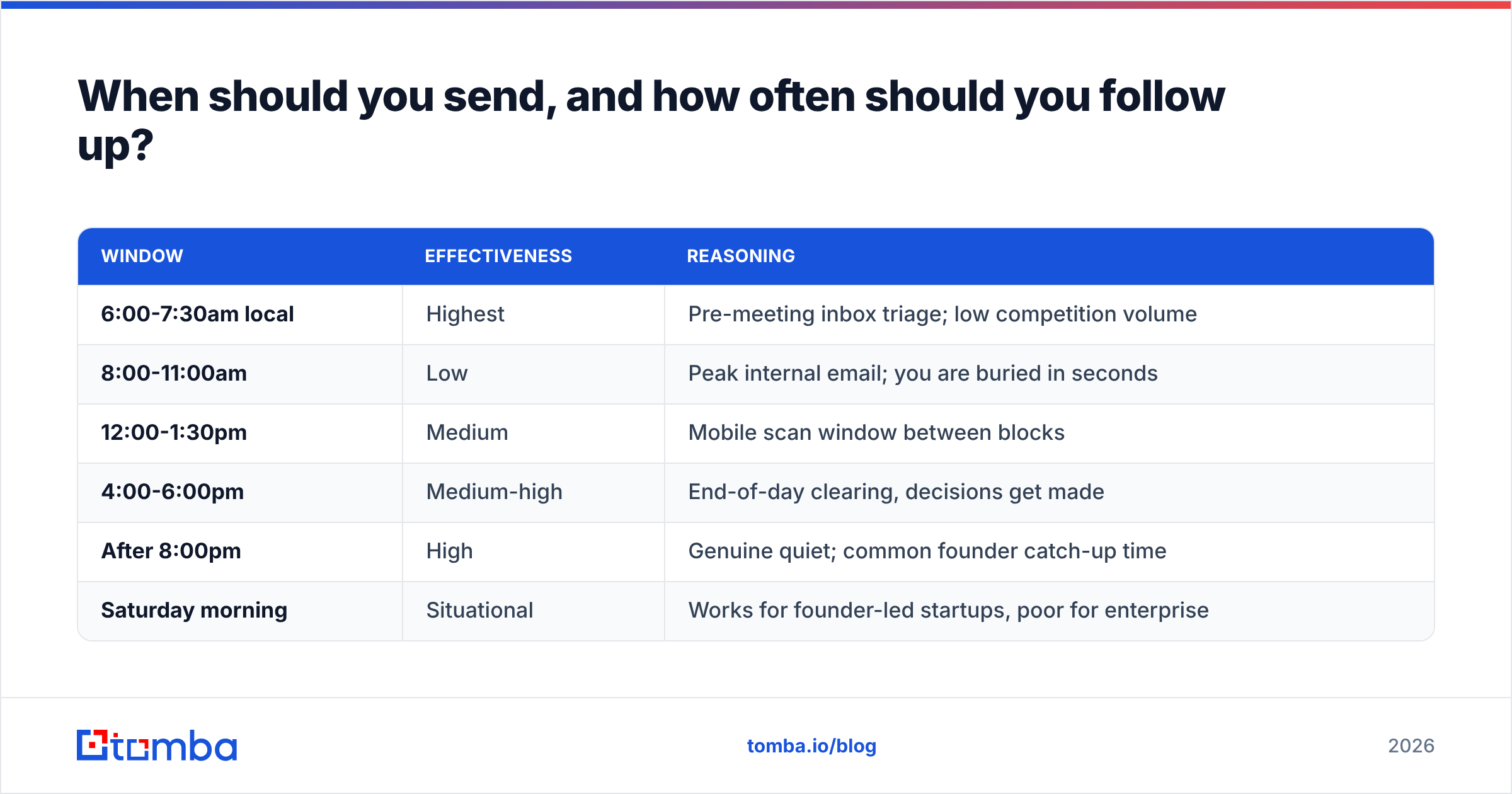
When should you send, and how often should you follow up?#
Timing matters more for executives than for any other role, because their inbox behavior is bursty rather than continuous.
| Window | Effectiveness | Reasoning |
|---|---|---|
| 6:00-7:30am local | Highest | Pre-meeting inbox triage; low competition volume |
| 8:00-11:00am | Low | Peak internal email; you are buried in seconds |
| 12:00-1:30pm | Medium | Mobile scan window between blocks |
| 4:00-6:00pm | Medium-high | End-of-day clearing, decisions get made |
| After 8:00pm | High | Genuine quiet; common founder catch-up time |
| Saturday morning | Situational | Works for founder-led startups, poor for enterprise |
Two operational notes. First, send to the recipient's local timezone, not yours — this is a five-minute setup detail that most sequences get wrong. Second, avoid Monday morning entirely; it is the highest-volume inbox moment of the week.
On cadence: three total touches, spread across three weeks, is the ceiling for executive outreach. If you get nothing, the answer is no, and continuing to send damages both your sender reputation and your company's name at that account. Move to a different contact or wait for a new trigger event.
How do you scale this without making it generic?#
The honest answer is that you mostly do not — but you can systematize the parts that are not judgment calls.
What you can automate: finding and verifying the address, appending firmographics, resolving the email pattern, pulling the trigger-event data, and scheduling the send in local time. Data enrichment fills in company size, funding stage, and tech stack so you are not tab-hopping for every prospect.
What you cannot automate: the first line. Every CEO email needs a sentence that could only have been written to that one person. The moment you templatize line one, your reply rate collapses to the mass-outreach baseline of roughly 1-2%.
A workable split for a rep running executive outreach: 25-40 highly researched emails per week, batched — do all the research on Monday, all the writing on Tuesday, all the sending across the week. The Tomba API or the Google Sheets add-on handles the find-and-verify step in bulk so your time goes into the sentence that actually determines the outcome. If you prefer everything to land in your CRM automatically, the HubSpot integration pushes verified contacts straight through. HubSpot's own sales email research is also a reasonable neutral benchmark for reply-rate expectations by segment.
What should you do next?#
Pick five target companies where the CEO is genuinely the right buyer — under 200 employees, clear trigger event in the last quarter, and a problem you can quantify. Spend fifteen minutes on each. Write five emails under 90 words. Send them at 6:45am local time on a Tuesday. Measure replies, not opens.
That is a better use of a week than 500 templated sends, and it is the only version of this that compounds — because the CEO who replies once tends to reply again.
Before any of it works, though, the address has to be right. Start with the Tomba Email Finder: enter the executive's name and company domain, get a verified address with a confidence score, and send knowing it will land. The free tier covers 25 searches a month, which is exactly enough to run your first batch of five and find out whether your first line is as good as you think it is.
Related guides#
// get started
Find, verify and enrich your first contacts today
Start on the free plan with 25 searches a month, then scale when your team is ready.
Free plan · No credit card required · GDPR & CCPA
// about the author