How to End a Cold Call: Closing Lines That Book Meetings
Most cold calls die in the last 20 seconds, not the first 20. Here are the exact closes, objection exits, and voicemail endings that turn a conversation into a booked meeting.
TL;DR
- The end of a cold call decides the outcome more than the opener. A strong opener with a vague ending produces zero pipeline.
- Never end on "I'll send you some information." Ending without a calendar-specific next step is the single most common reason cold calls evaporate.
- Use a two-part close: a specific time proposal plus a low-commitment framing ("15 minutes, and if it's not relevant I'll never call again").
- Rejections still need a proper ending — a clean exit protects your reputation and keeps the door open for the 6-month retry.
- Bad phone data wastes the close. If half your dials hit wrong numbers or dead extensions, fix the data layer before you fix the script.
Why Does the End of a Cold Call Matter More Than the Opener?#
Because the opener buys you 30 seconds, but the ending is where you actually ask for something.
Think of a cold call like a job interview. A great handshake gets you into the room. But if you leave without asking about next steps, you walk out with nothing, no matter how well the middle went. Every rep obsesses over the first line — "Did I catch you at a bad time?" versus a permission-based opener — and then fumbles the part that determines whether a meeting appears on the calendar.
Look at what actually happens in the last 20 seconds of most cold calls. The prospect says something mildly positive. The rep, sensing the win, gets nervous about pushing. They say, "Great — I'll send over some info and follow up next week." Call ends. No meeting. No commitment. The prospect forgets the conversation within the hour, and the follow-up email lands as cold as the call.
That ending is not a close. It's an unpaid invoice you're hoping someone remembers.
The end of a cold call has three jobs:
- Confirm value — restate, in one sentence, the specific problem you'd help solve. Not your product. The problem.
- Propose a concrete next step — a day, a time, a duration. Never "sometime next week."
- Lower the perceived cost — make saying yes feel smaller than saying no.
Miss any of the three and you get a polite non-answer.
What Are the Best Ways to End a Cold Call?#
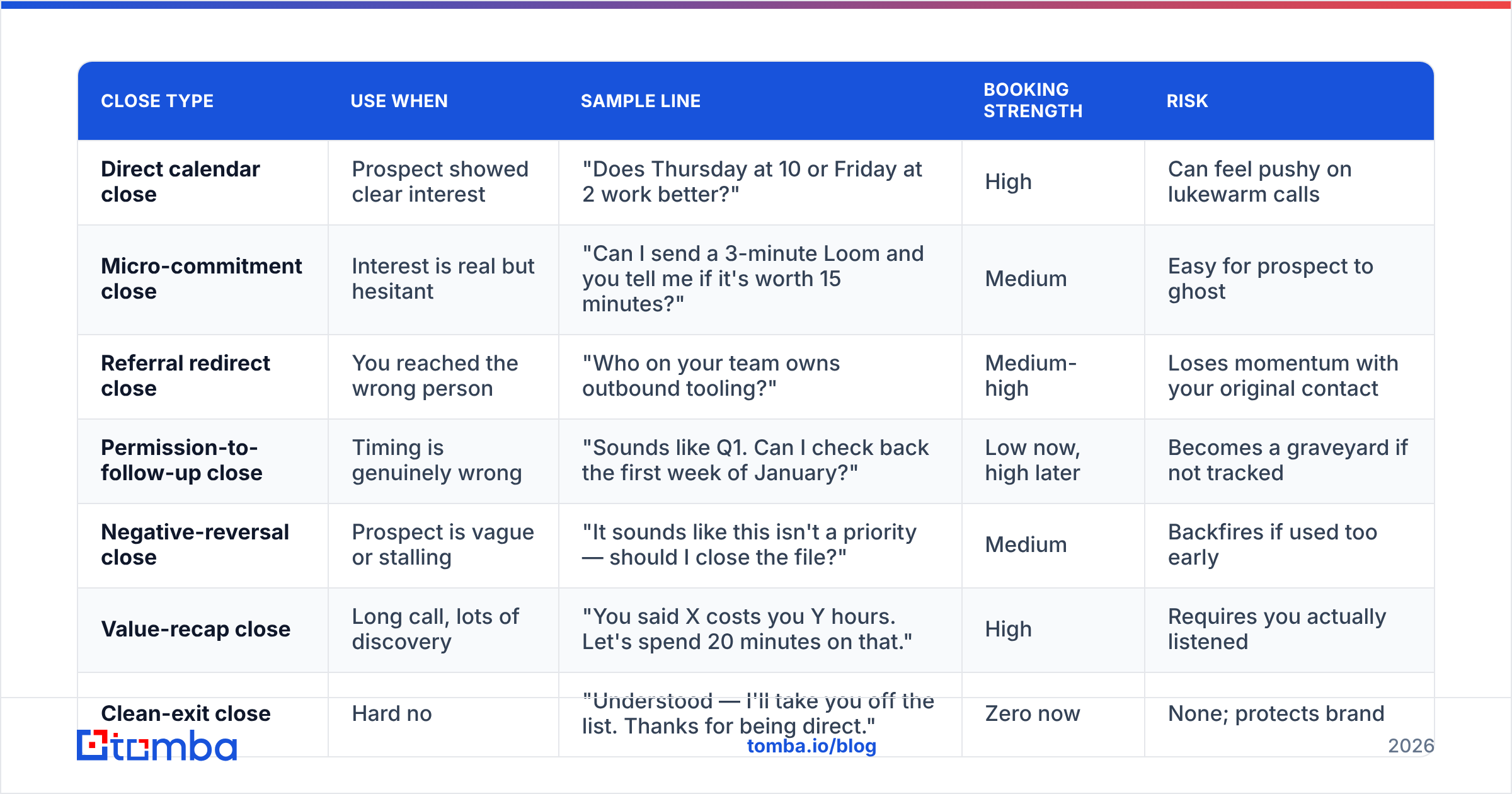
There isn't one universal close — there are seven, and the right one depends on how the conversation actually went. Here's how they compare.
| Close type | Use when | Sample line | Booking strength | Risk |
|---|---|---|---|---|
| Direct calendar close | Prospect showed clear interest | "Does Thursday at 10 or Friday at 2 work better?" | High | Can feel pushy on lukewarm calls |
| Micro-commitment close | Interest is real but hesitant | "Can I send a 3-minute Loom and you tell me if it's worth 15 minutes?" | Medium | Easy for prospect to ghost |
| Referral redirect close | You reached the wrong person | "Who on your team owns outbound tooling?" | Medium-high | Loses momentum with your original contact |
| Permission-to-follow-up close | Timing is genuinely wrong | "Sounds like Q1. Can I check back the first week of January?" | Low now, high later | Becomes a graveyard if not tracked |
| Negative-reversal close | Prospect is vague or stalling | "It sounds like this isn't a priority — should I close the file?" | Medium | Backfires if used too early |
| Value-recap close | Long call, lots of discovery | "You said X costs you Y hours. Let's spend 20 minutes on that." | High | Requires you actually listened |
| Clean-exit close | Hard no | "Understood — I'll take you off the list. Thanks for being direct." | Zero now | None; protects brand |
The two that carry most of the weight are the direct calendar close and the negative-reversal close. The first works when you've earned it. The second works when you haven't and need to force clarity instead of collecting another fake maybe.
The direct calendar close, done properly#
Wrong: "Would you be open to a meeting sometime next week?"
Right: "I'd suggest 15 minutes so I can show you exactly how this looks for a team your size. I've got Thursday at 10 or Friday at 2 — which is easier?"
The difference is that the second version does three things at once: it names the duration (small), states the payoff (specific to them), and offers a binary choice (no calendar archaeology required). You've reduced the prospect's cognitive load from "when am I free and do I want this?" to "A or B?"
Follow it immediately with a confirmation ritual. Say the calendar invite is going out while you're still on the phone. Read their email address back to them and confirm the spelling. That single step kills a meaningful share of no-shows, because a meeting that exists on a calendar is a meeting; a meeting that exists in a promise is not.
The negative-reversal close#
When a prospect gives you a soft, mushy signal — "yeah, send something over, we might look at it later" — you have two options. Accept it and add a ghost to your pipeline, or force the issue politely.
"Honestly, it sounds like this isn't near the top of your list right now. Would it be more useful if I just closed the file and reached out next year?"
Roughly half the time, the prospect corrects you: "No, no — it's interesting, I just need to loop in our ops lead." Now you have real information and a real next step. The other half, they agree, and you've saved yourself four follow-up emails and a fake forecast entry. Both outcomes beat ambiguity.
How Do You End a Cold Call After a Rejection?#
Cleanly, quickly, and without arguing. The goal shifts from booking a meeting to protecting the next conversation.
A rejection is not a failure state — it's a data point plus a reputation event. How you leave a call you lost determines whether that contact answers when you call in nine months with a better-fitting product.
Do this:
- Acknowledge without rebuttal. "Understood, thanks for telling me straight." One sentence. No fourth objection handle.
- Ask one clarifying question, max. "Is it a timing thing or is it just not a fit at all?" This separates dead leads from delayed ones.
- Offer the exit. "I'll take you off my list — I'd rather do that than keep bothering you."
- Log the reason. Write the specific rejection reason in your CRM. "Not interested" is useless. "Uses in-house tool, renewal March" is a future meeting.
- Say thank you and hang up first. Ending the call yourself, courteously, reads as confidence rather than defeat.
Don't do this: three consecutive objection rebuttals, guilt-tripping ("I'm just trying to help you"), or the passive-aggressive "no worries, I'll just email you then." Reps who fight past the third no burn the account and their own morale.
One nuance worth naming: "not interested" delivered in the first eight seconds is a reflex, not a decision. That's worth one gentle push — "Totally fair, most people say that before they know why I'm calling. Ten seconds and you can hang up on me?" A rejection delivered after real conversation is a decision. Respect it.
What Should You Say When You Reach Voicemail?#
End the voicemail with a reason to call back that isn't "call me back."
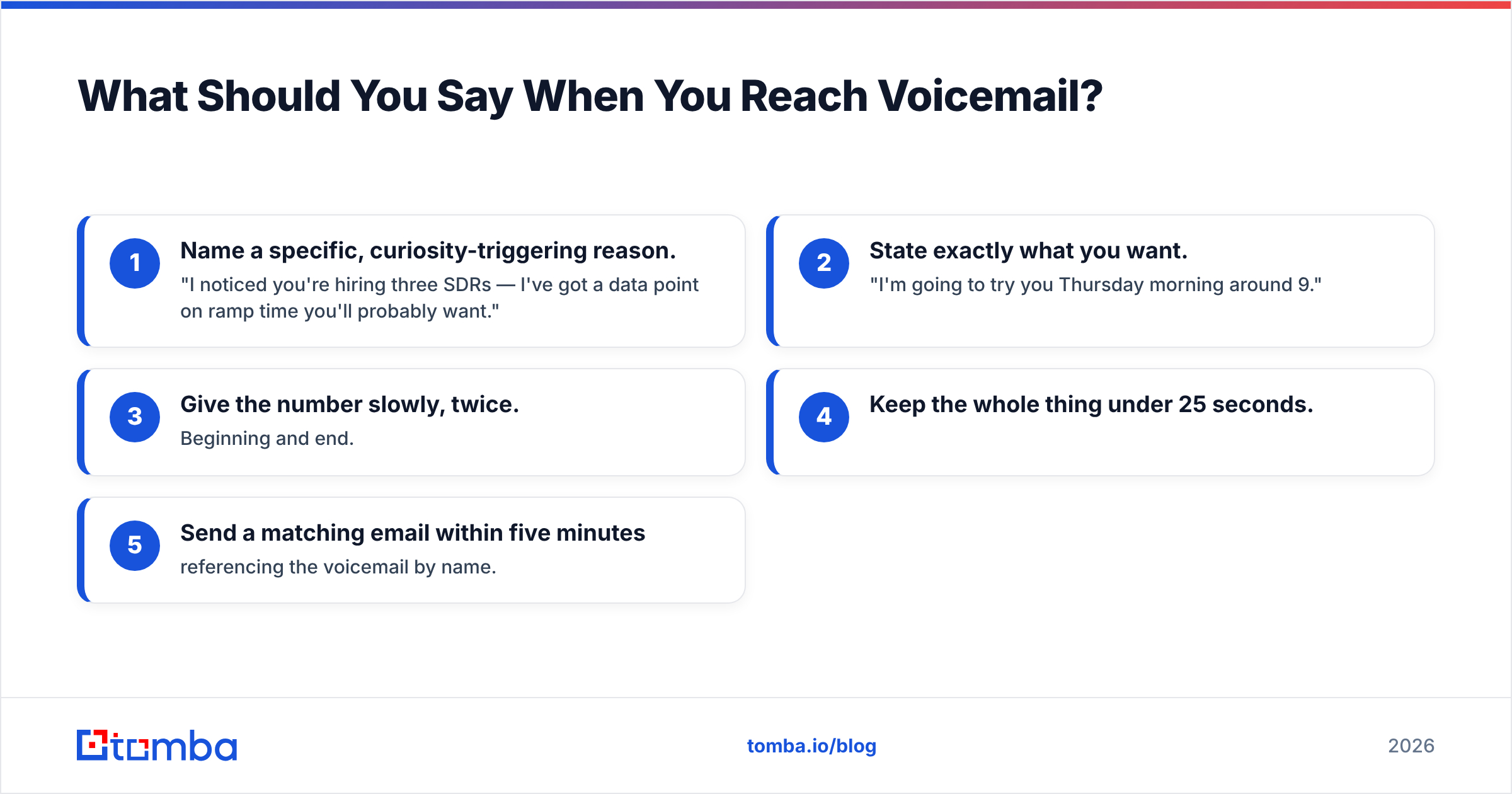
Most voicemails end with a phone number mumbled at speed and a hopeful "talk soon." Nobody calls back. Structure the ending instead:
- Name a specific, curiosity-triggering reason. "I noticed you're hiring three SDRs — I've got a data point on ramp time you'll probably want."
- State exactly what you want. "I'm going to try you Thursday morning around 9."
- Give the number slowly, twice. Beginning and end.
- Keep the whole thing under 25 seconds.
- Send a matching email within five minutes referencing the voicemail by name.
That last step matters most. A voicemail and an email that arrive together convert far better than either alone, because the email gives them a zero-effort way to respond. That only works if the email address is right — which is why reps who run a phone-first motion still need a reliable email finder sitting next to the dialer.
Which Closing Phrases Kill Cold Calls?#
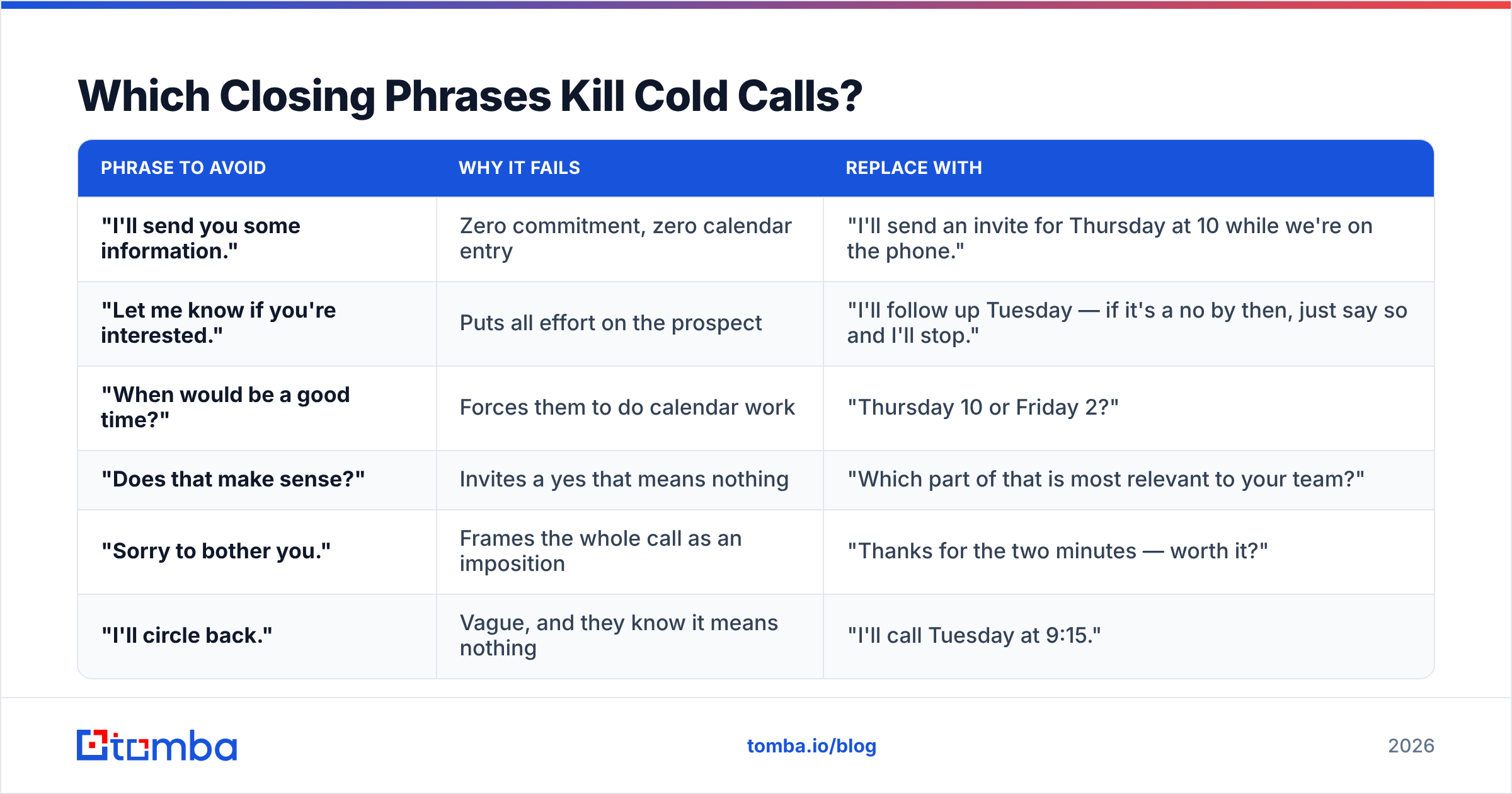
Some endings are so common that prospects have learned to use them as escape hatches. Here's the swap list.
| Phrase to avoid | Why it fails | Replace with |
|---|---|---|
| "I'll send you some information." | Zero commitment, zero calendar entry | "I'll send an invite for Thursday at 10 while we're on the phone." |
| "Let me know if you're interested." | Puts all effort on the prospect | "I'll follow up Tuesday — if it's a no by then, just say so and I'll stop." |
| "When would be a good time?" | Forces them to do calendar work | "Thursday 10 or Friday 2?" |
| "Does that make sense?" | Invites a yes that means nothing | "Which part of that is most relevant to your team?" |
| "Sorry to bother you." | Frames the whole call as an imposition | "Thanks for the two minutes — worth it?" |
| "I'll circle back." | Vague, and they know it means nothing | "I'll call Tuesday at 9:15." |
Notice the pattern: every replacement swaps a vague, prospect-effort phrase for a specific, rep-effort commitment. You do the work of scheduling. They do the work of saying yes or no.
How Do You Confirm the Next Step So It Actually Happens?#
Book it live, on the call, with the invite going out before you hang up.
The gap between "we agreed to meet" and "a meeting exists" is where most cold-call pipeline leaks out. Close it with a fixed sequence:
- Send the invite while still on the phone. "Sending it now — you should see it in about ten seconds. Got it?"
- Confirm the email address out loud. Spell it. Wrong emails are the top cause of phantom meetings, and a quick email verification pass on your list beforehand prevents most of them.
- Confirm attendees. "Should anyone else be on this? Your ops lead, maybe?" Multi-threading starts here, not later.
- Set the agenda in one line inside the invite. "15 min: how [Company] handles X; whether our approach fits."
- Agree on the reminder. "I'll drop you a note the morning of — if something comes up, just reply and we'll move it."
That last line is quietly powerful. You've pre-authorized rescheduling, which makes cancelling feel less socially costly than ghosting — and a rescheduled meeting is still a meeting.
For teams tracking this properly, the metric to watch isn't calls made or even meetings booked. It's meetings held divided by meetings booked. If that number sits below 65%, your closing ritual is the problem, not your dialing volume. Research from vendors and analysts across the space — HubSpot's sales statistics is a reasonable starting point — consistently shows follow-through mechanics moving the needle more than raw activity.
Does Your Data Quality Change How You Close?#
Yes, more than most managers admit.
Here's the uncomfortable connection. A rep who dials 60 numbers and reaches eight real humans has eight chances to practice a close. A rep with a clean, verified list who dials 60 and reaches 22 humans gets nearly three times the reps at the exact skill that determines pipeline. Closing technique compounds with connect rate; it doesn't substitute for it.
Three data problems that quietly wreck your endings:
- Wrong-title contacts. You close hard on someone with no budget authority. The meeting books and then dies. Fix with role-level filtering before the list ever reaches the dialer.
- Dead or reassigned direct dials. You end up closing gatekeepers instead of buyers. A phone validator pass strips out disconnected and reassigned numbers before they cost you dial time.
- Missing email for the follow-through. You get a verbal yes, promise an invite, and then discover you only have info@company.com. The close evaporates in the gap. Pairing dials with a domain search for verified work addresses closes that gap.
There's a related discipline worth borrowing from outbound email: teams who verify before they contact get better response rate numbers across every channel, phone included. The rigor transfers.
If you're building a phone motion from scratch, G2's sales intelligence category is a fair place to compare data vendors on connect-rate claims — and worth reading skeptically, since self-reported accuracy figures vary widely between vendors and independent tests.
What Does a Full Cold Call Ending Sound Like?#
Here are three complete endings you can adapt, covering the three most common outcomes.
Outcome 1 — Interested prospect
"So based on what you described — three reps spending half their week building lists manually — the 15 minutes I'd want is showing you exactly what that workflow looks like automated. Not a demo of everything, just that. I have Thursday at 10 or Friday at 2. Which is easier? … Great, sending the invite now. Confirm your email for me — j-dot-carter at northlane dot com? Perfect, it's on your calendar. I'll send a one-line reminder Thursday morning. If something comes up, just reply and we'll move it."
Outcome 2 — Genuine timing objection
"That's fair — if the budget cycle resets in January, there's no point pretending otherwise. Here's what I'd suggest: I'll reach out the first week of January, and between now and then I'll send you one email a month with something actually useful, not a pitch. If any of it lands, reply and we'll talk sooner. Sound reasonable? … What's the best address for that?"
Outcome 3 — Hard no
"Understood, and I appreciate you being direct rather than sending me to voicemail forever. Quick question so I don't waste your time again: is it a timing thing, or is it just not a fit at all? … Got it, in-house tool. I'll note that and take you off my list. Thanks for the two minutes."
Each one ends with something concrete: a calendar entry, a permission, or a clean record in the CRM. None of them ends with "I'll send some info."
How Should You Practice and Measure Your Closes?#
Record, tag, and review the last 30 seconds specifically — not the whole call.
Most call reviews start at the opener and run out of energy before the ending. Flip it. Pull the final 30 seconds from ten recorded calls and listen to those back to back. Patterns jump out immediately: the filler apologies, the vague "circle backs," the moment the rep's voice drops in confidence right at the ask.
A simple weekly review loop:
- Tag every call outcome with one of: booked, soft-yes, timing, hard-no, wrong person.
- Count soft-yes calls. More than 20% of your calls landing in that bucket means your close is too soft — deploy the negative-reversal.
- Track booked-to-held rate weekly, per rep.
- Roleplay only the ending. Five minutes, three scenarios, twice a week. Openers get practiced constantly by accident; endings don't.
- Read your own CRM notes from 90 days ago and check whether any of them were actionable. If "not interested" is your most common note, your rejection endings are throwing away future pipeline.
Reps who improve their close typically don't learn a new script. They stop apologizing, stop hedging, and start naming a specific time. That's most of it.
Start With Contacts Worth Closing#
The best closing script in the world can't fix a call to the wrong person at a disconnected number. Before you refine the last 20 seconds, make sure the first second connects.
Tomba Email Finder gives you verified work emails to pair with every dial — so the invite you promise on the call actually lands, and the follow-up you send after a "not right now" reaches a real inbox instead of a bounce log. Start on the free tier with 25 searches a month, or move to Starter at $49/mo when your list-building outgrows it; full Tomba pricing runs from there up to Growth at $99/mo and Pro at $249/mo.
Fix the data, then fix the close. In that order.
Related guides#
// get started
Find, verify and enrich your first contacts today
Start on the free plan with 25 searches a month, then scale when your team is ready.
Free plan · No credit card required · GDPR & CCPA
Get the Tomba newsletter
Product and data updates
// about the author