How to End a Cold Email: Closing Lines That Get Replies
Your closing line decides whether a prospect replies or archives you. Here are the CTA formats, sign-offs, and P.S. lines that actually move cold email reply rates in 2026.
TL;DR
- The last two lines of a cold email do more work than the subject line for reply rate — the subject gets the open, the close gets the response.
- Low-friction, single-question CTAs ("Worth a look?") beat calendar-link demands on first touch. Save the booking link for touch two or three.
- One ask per email. Two CTAs is the fastest way to get zero replies, because a choice between two actions defaults to neither.
- Sign-offs matter less than people think, but "Best" and "Thanks" are safe; "Cheers" is fine outside enterprise; "Regards" reads like a collections notice.
- None of this rescues a bad list. A perfect close sent to a guessed address bounces the same as a bad one — verify before you send.
Why does the ending of a cold email matter more than the opening?#
Because the opening buys you three seconds and the ending asks for something. A prospect who read your whole email and then hit archive did not fail to understand your value prop — they failed to see an action small enough to be worth taking right now.
Think of it like a restaurant check. The meal can be excellent, but if the check arrives with a confusing itemization and no obvious total, the customer stalls. Your CTA is the total. It should be a single number the reader can act on without thinking.
The mechanics are simple. Cold email replies are governed by perceived cost. Every element of your ending either raises or lowers that cost:
- The ask itself — "Book 30 minutes" costs more than "Worth a look?" One requires a calendar decision; the other requires a yes or no.
- The number of asks — two CTAs force a comparison. Comparison invites deferral, and deferral is functionally a no.
- The specificity of the next step — vague ("let me know your thoughts") makes the reader do the work of defining what a reply looks like.
- The sign-off and signature — a bloated signature with four social icons and a banner image signals mass send and hurts both trust and email deliverability.
- The P.S. — the second-most-read line in any email after the first sentence. Wasting it on "Have a great week" is a real cost.
Sorry — corrected below.
What are the CTA types you can end a cold email with?#
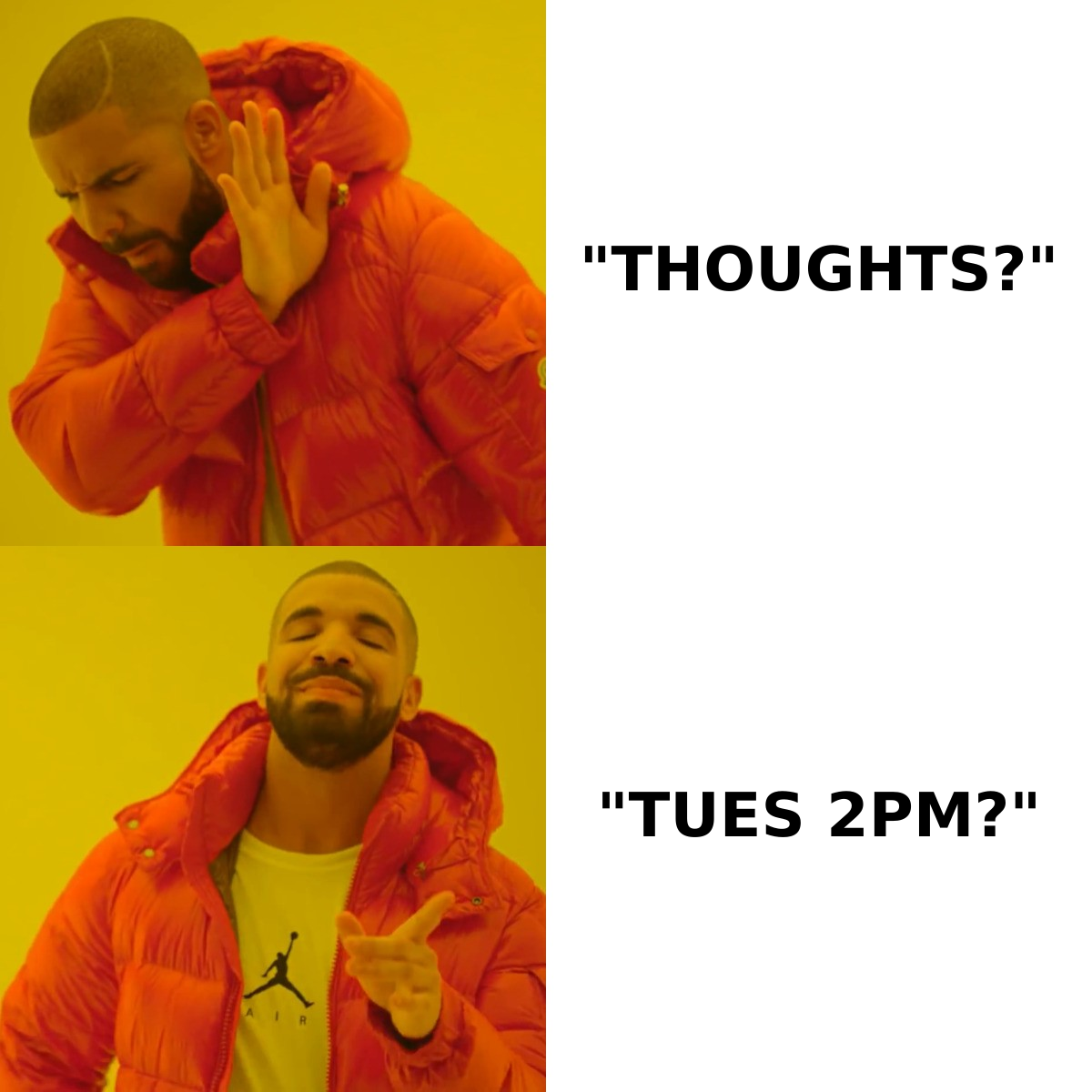
There are five workable CTA families. Each has a different cost profile and a different best-fit stage in the sequence.
| CTA type | Example line | Reader cost | Best for | Typical weakness |
|---|---|---|---|---|
| Interest check | "Worth a look?" | Very low | First touch, cold list | Yes replies are soft; needs a follow-up to convert |
| Opinion ask | "Is this handled by you or someone on the RevOps side?" | Low | Unknown org structure | Can feel like a routing trick if overused |
| Resource offer | "Want the 2-page teardown I made for your site?" | Low-medium | Content-led outbound | Requires you to actually have the asset |
| Specific time | "Does Tuesday 2pm ET work for 15 minutes?" | Medium | Warm-ish, touch 2-3 | Wrong timezone guess kills it instantly |
| Calendar link | "Grab a slot here: [link]" | High | Inbound, re-engagement, replies | Reads as presumptuous on a true cold first touch |
The pattern most teams get wrong: they open with the highest-cost CTA on the coldest touch. You would not ask someone to block a half hour thirty seconds after meeting them. Start with the interest check, escalate as the thread warms.
The one-ask rule#
Your email should contain exactly one question mark that requires an answer. If you write "Does this resonate? Happy to send over the case study, or we could grab 15 minutes Thursday," you have created a three-way decision. The reader is not going to sort it out for you.
Rewrite: "Want me to send the case study?" Done. If they say yes, you have a thread, and the meeting ask becomes trivially easier.
How should you write the final CTA line specifically?#
Four rules, applied in order.
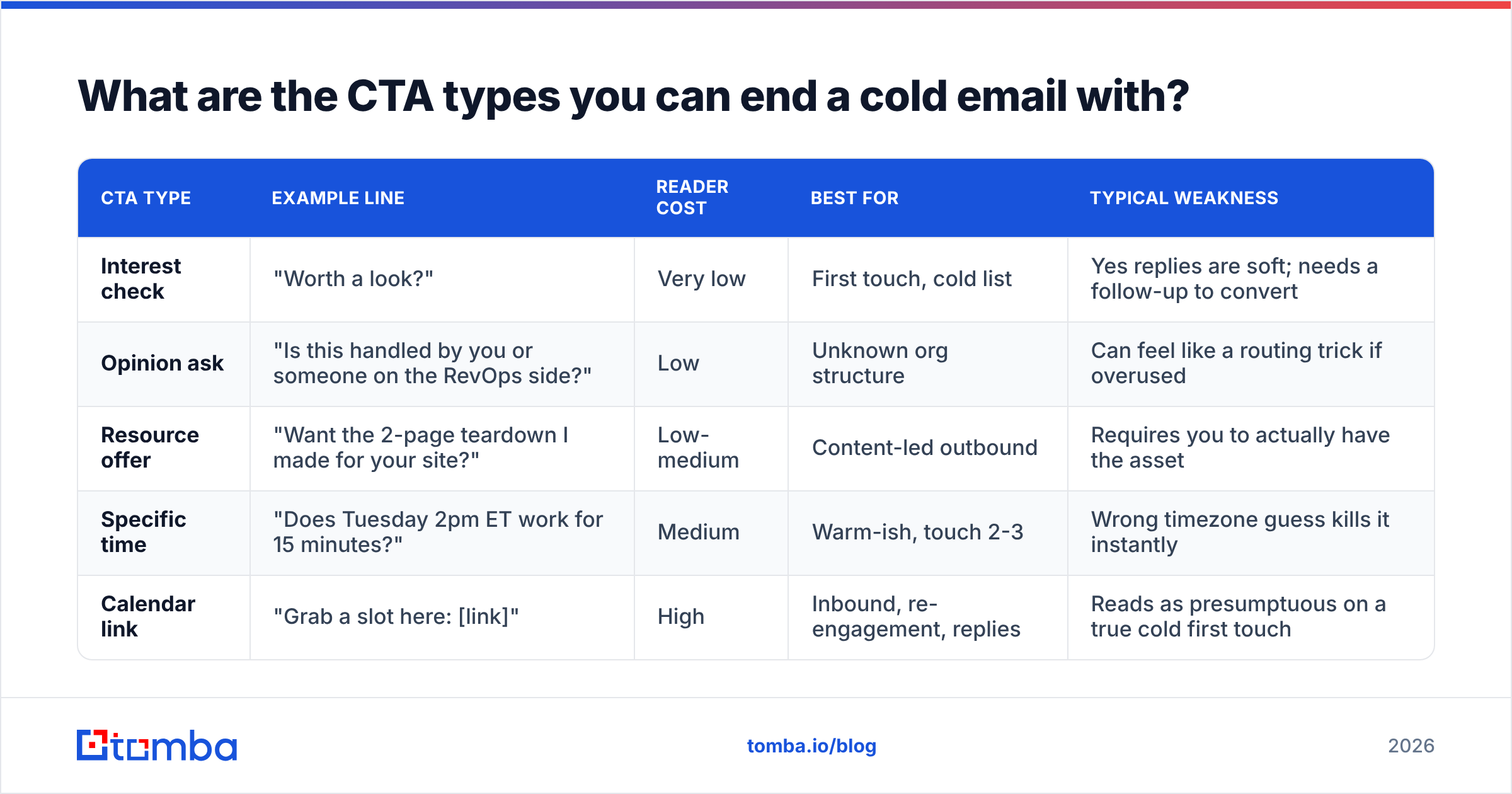
Make it answerable in under seven words. The best CTAs can be replied to with "yes," "no," or "who else?" If the reader has to compose a paragraph to respond, they will not respond. This is why "Thoughts?" underperforms — it's short but demands an essay.
Anchor to something concrete from the email. "Worth a look?" alone is fine. "Worth a look at how the other three Shopify Plus brands in your category handled it?" is better because it carries the specific value forward into the ask.
Remove permission-seeking hedges. "I was just wondering if you might possibly have a few minutes sometime" contains four hedges. Cut to "Open to a quick look?" Hedging reads as low confidence, and low confidence reads as low value.
Give an easy out. Counterintuitively, "If this isn't a priority right now, just say so and I'll close the loop" increases reply rate. You are lowering the social cost of the negative answer, and negatives are useful — they clear your pipeline and protect your sender reputation by keeping you from hammering dead contacts.
CTA lines that work, by scenario#
- Cold, first touch, no prior signal: "Worth a quick look, or not a fit right now?"
- Cold, you found a specific trigger: "Since you're hiring three SDRs — want the playbook we built for that ramp?"
- Wrong-person hedge: "If this sits with someone else, happy to be pointed their way."
- Follow-up 2: "Still want me to send the teardown? One line back and it's yours."
- Breakup email: "I'll assume the timing's off and stop here — reply 'later' if you'd rather I circle back in Q3."
What sign-off should you use to end a cold email?#
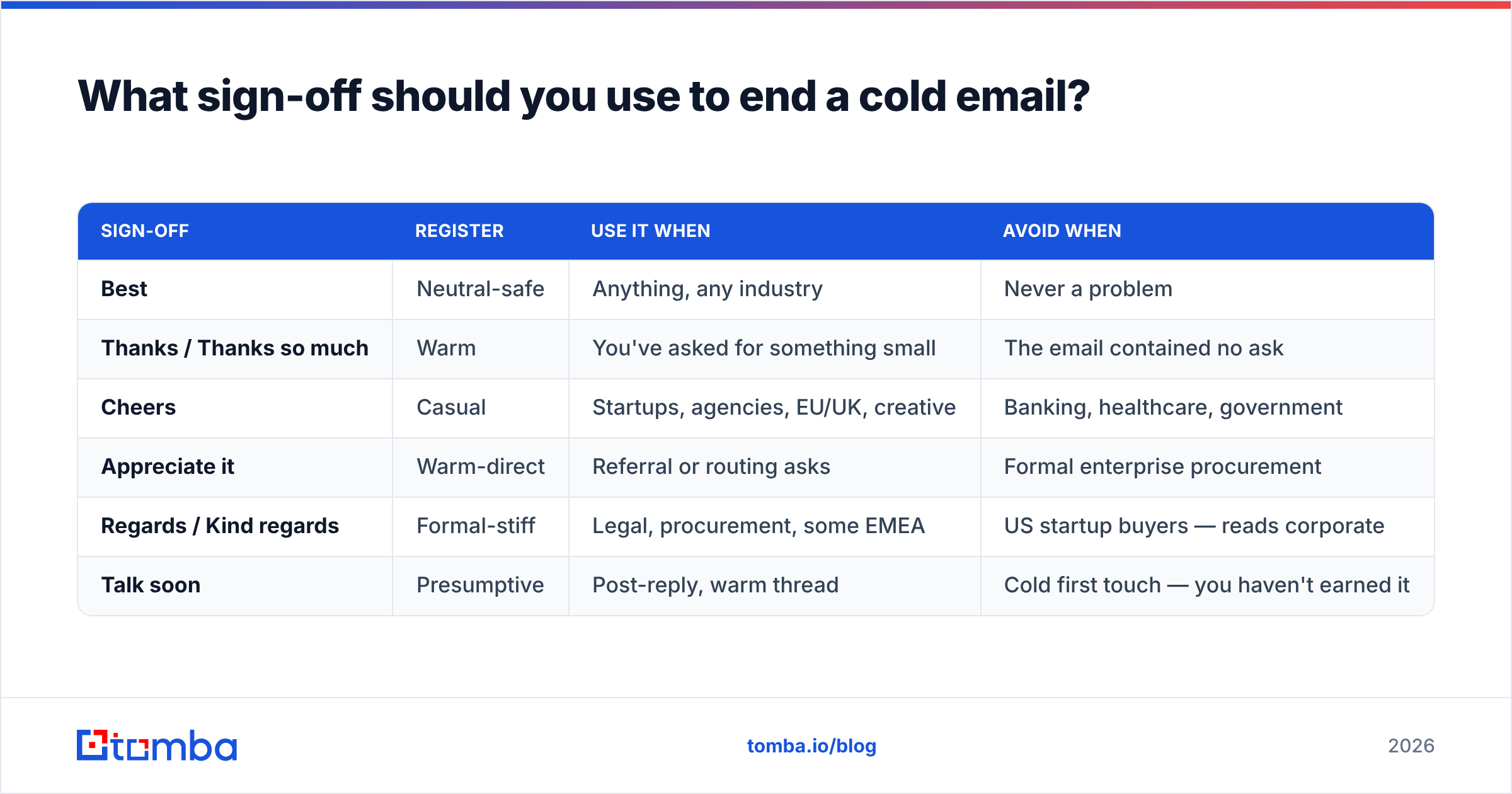
Less than you think rides on this, but there is a floor you should not fall through. Data from HubSpot's own sales research and years of aggregate outbound testing land in roughly the same place: gratitude-adjacent sign-offs edge out neutral ones, and formal ones underperform in tech and SMB segments.
| Sign-off | Register | Use it when | Avoid when |
|---|---|---|---|
| Best | Neutral-safe | Anything, any industry | Never a problem |
| Thanks / Thanks so much | Warm | You've asked for something small | The email contained no ask |
| Cheers | Casual | Startups, agencies, EU/UK, creative | Banking, healthcare, government |
| Appreciate it | Warm-direct | Referral or routing asks | Formal enterprise procurement |
| Regards / Kind regards | Formal-stiff | Legal, procurement, some EMEA | US startup buyers — reads corporate |
| Talk soon | Presumptive | Post-reply, warm thread | Cold first touch — you haven't earned it |
Then keep your signature to four lines: name, title, company, one link. Every additional element — tracking pixel-heavy banners, six social icons, a "sent from" line, a legal disclaimer block — adds HTML weight and spam-filter surface area. If you want to see what your template is doing to your score, run it through a spam checker before you scale the campaign.
Should you use a P.S. at the end of a cold email?#
Yes, on roughly one in three emails — not every one, or it becomes noise.
The P.S. gets read because the eye jumps to it. That makes it valuable real estate, so it should carry a second, different kind of value than the body. Three formats that earn their space:
- Proof P.S. — "P.S. We did this for Brightloom last quarter; their SDR ramp dropped from 90 days to 41."
- Objection preempt — "P.S. If you're mid-migration, this is usually a Q3 conversation. Say the word and I'll ping you then."
- Genuine personal note — "P.S. Your post on ditching MQLs was the reason I reached out. We killed our MQL scoring model in January for the same reason."
What does not work: repeating the CTA in the P.S. It doubles the ask and dilutes both. And do not use the P.S. for a discount on a first touch — you are negotiating before they've agreed there's anything to buy.
How do you end a cold email follow-up differently?#
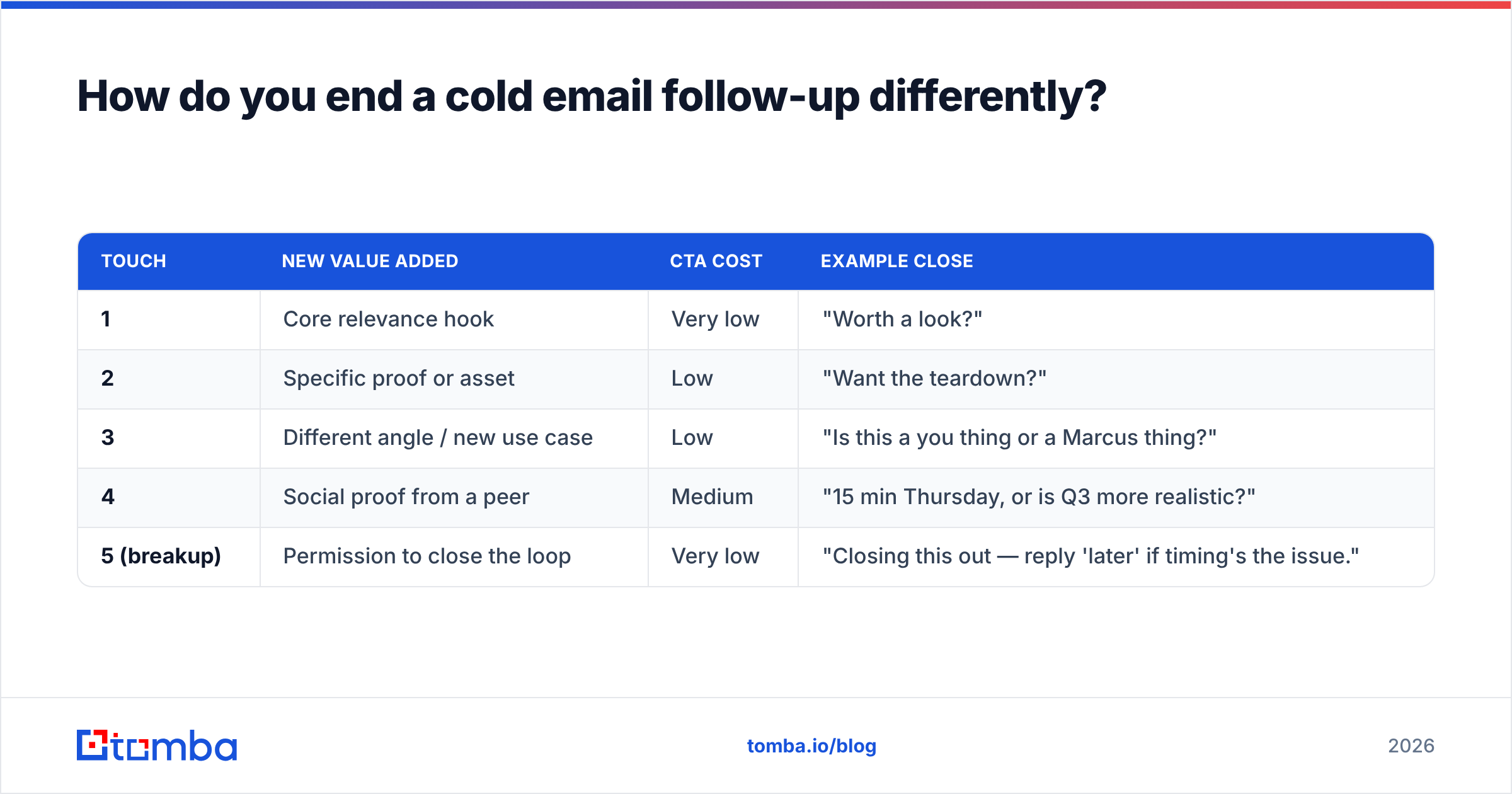
Follow-ups fail for the opposite reason first touches do: they ask the same thing at the same cost, three times, and the reader learns to ignore the thread.
Escalate the value while holding the ask flat or lowering it:
| Touch | New value added | CTA cost | Example close |
|---|---|---|---|
| 1 | Core relevance hook | Very low | "Worth a look?" |
| 2 | Specific proof or asset | Low | "Want the teardown?" |
| 3 | Different angle / new use case | Low | "Is this a you thing or a Marcus thing?" |
| 4 | Social proof from a peer | Medium | "15 min Thursday, or is Q3 more realistic?" |
| 5 (breakup) | Permission to close the loop | Very low | "Closing this out — reply 'later' if timing's the issue." |
The breakup email consistently earns the highest reply rate in the sequence, and most of those replies are negative. That's the point. A clean no protects your response rate metrics and stops you from burning domain reputation on contacts who were never going to convert.
One warning on breakup emails: do not fake finality. "This is my last email" followed by three more emails trains the reader that your words don't mean anything, and it is a fast route to a spam complaint.
Does the ending matter if your list is bad?#
No, and this is the part most closing-line advice skips.
A cold email closing line is a conversion-rate lever. It multiplies whatever reach you already have. If 22% of your sends are bouncing because the addresses were pattern-guessed from a LinkedIn scrape, no CTA rewrite fixes that — you are multiplying a smaller number.
Worse, high bounce rates actively suppress the emails that do land. Mailbox providers read bounce rate as a spam signal. Google and Yahoo's 2024 bulk sender requirements formalized what was already true in practice: a spam complaint rate above 0.3% and inconsistent authentication get you throttled or foldered regardless of how well-written the message is. You can read the current requirements straight from Google's Postmaster documentation.
So the practical sequence is:
- Source addresses from a verified provider, not a pattern generator. A domain search that returns confidence scores per address is worth more than a permutation list ten times its size.
- Verify before every campaign, not once at import. B2B contact data decays roughly 25-30% per year as people change roles. Run the list through an email verifier at send time.
- Handle catch-all domains explicitly. They accept everything at SMTP and bounce later. A catch-all verifier is the only way to get a real signal on those.
- Then optimize the close. Now your CTA improvements compound against a clean denominator.
Teams that reverse this order spend six weeks A/B testing sign-offs and conclude cold email doesn't work.
What tools help you write and test cold email endings?#
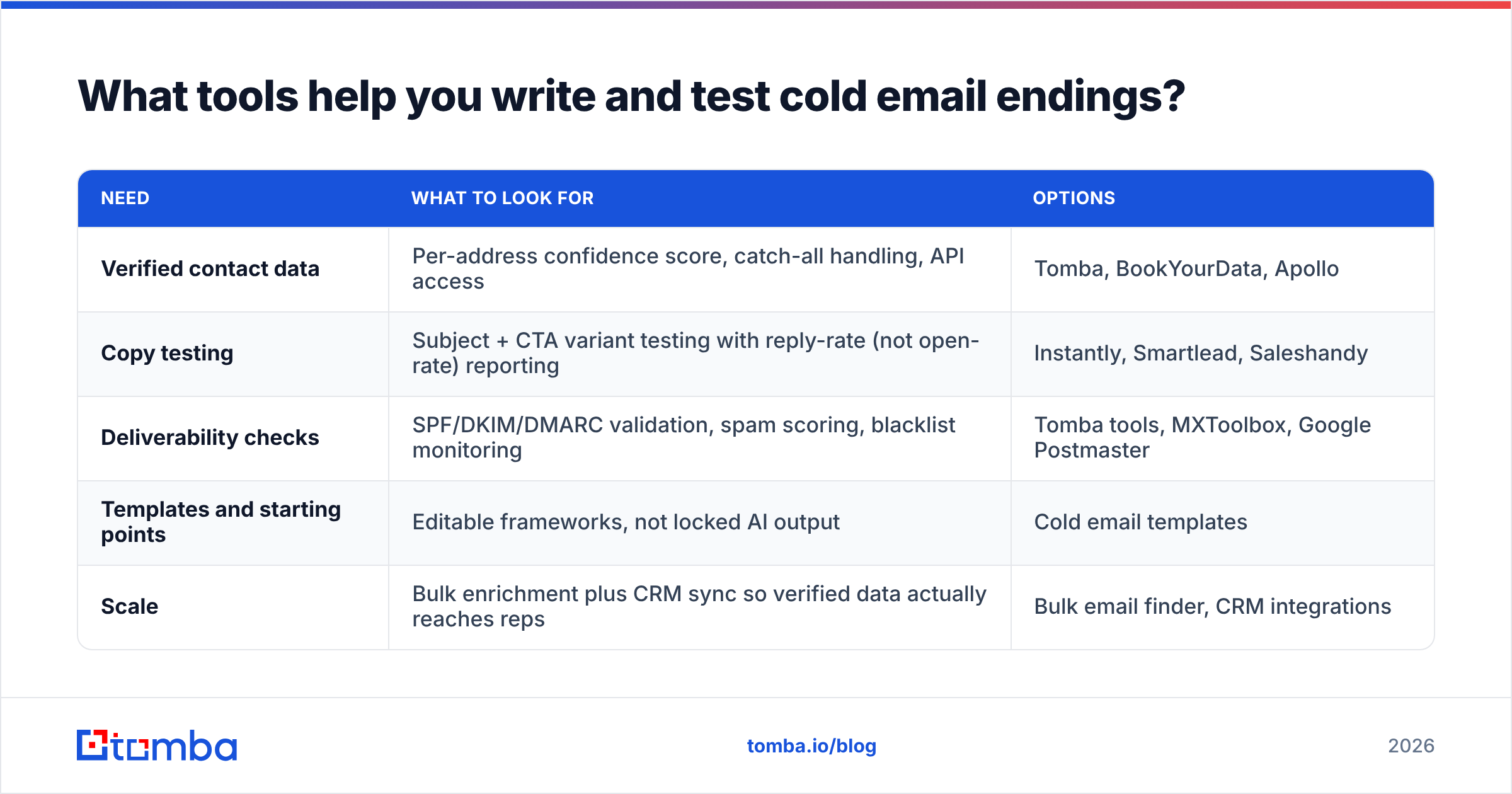
You do not need a big stack. You need a source of accurate addresses, a way to test copy, and a sending platform that reports per-variant reply rates.
| Need | What to look for | Options |
|---|---|---|
| Verified contact data | Per-address confidence score, catch-all handling, API access | Tomba, BookYourData, Apollo |
| Copy testing | Subject + CTA variant testing with reply-rate (not open-rate) reporting | Instantly, Smartlead, Saleshandy |
| Deliverability checks | SPF/DKIM/DMARC validation, spam scoring, blacklist monitoring | Tomba tools, MXToolbox, Google Postmaster |
| Templates and starting points | Editable frameworks, not locked AI output | Cold email templates |
| Scale | Bulk enrichment plus CRM sync so verified data actually reaches reps | Bulk email finder, CRM integrations |
On price: Tomba runs a free tier at 25 searches/month, then Starter at $49/mo, Growth at $99/mo, and Pro at $249/mo, with Enterprise custom. BookYourData sells credits outright, which suits teams that buy lists in bursts rather than continuously. Full Tomba pricing is worth comparing against your actual monthly send volume rather than your aspirational one — most teams overbuy.
For copy iteration specifically, G2's cold email software category is a reasonable place to compare reply-rate reporting depth across sending platforms, since that feature varies more than the vendors admit.
What are the most common mistakes when ending a cold email?#
- Stacking two CTAs. Covered above, but it's the single most common failure. One ask.
- "Let me know your thoughts." This asks the reader to invent the response format. Replace with a yes/no question.
- A calendar link on touch one. You are asking a stranger to give you a slot on their calendar before they've agreed you're worth talking to.
- Fake urgency. "Slots for this quarter are filling up" on a cold outreach email is transparent, and buyers in 2026 have seen it ten thousand times.
- The over-apologetic close. "Sorry to bother you, I know you're busy" tells the reader the email is a bother. They will agree with you.
- A signature heavier than the email. Four lines maximum. Banner images and social icon rows raise spam scores and add nothing.
- No easy out. Without an explicit "not a fit" option, uninterested prospects just go silent, and silence is indistinguishable from "didn't see it" in your reporting.
- Sending to unverified addresses. The close is irrelevant if the message never renders in an inbox.
How do you A/B test cold email closings properly?#
Test one variable, on enough volume, measured on reply rate — not opens.
Open rate has been unreliable since Apple Mail Privacy Protection started pre-fetching images in 2021, and it was never the metric that mattered for a closing line anyway. Your closing line has no effect on opens by definition.
Practical setup:
- Minimum 200 sends per variant before you read anything into the result. Below that, you're reading noise.
- Change one element. CTA phrasing or sign-off or P.S. presence. Not all three.
- Hold the list quality constant. Split the same verified list randomly; do not test variant A on one source and variant B on another.
- Measure positive reply rate, not total replies. "Unsubscribe" is a reply. Segment it out.
- Run for a full week minimum. Tuesday and Thursday send behavior differs enough to skew a two-day test.
Expect modest effects. A CTA rewrite that moves reply rate from 3.1% to 4.4% is a strong result — that's a 42% relative lift, and it compounds across every campaign you run afterward. Anyone promising a closing line that triples replies is selling something.
Ready to make your closing lines count?#
A great closing line multiplies your reach. It doesn't create it. Before you spend another sprint testing "Worth a look?" against "Open to a quick chat?", make sure the addresses underneath are real.
Tomba Email Finder pulls verified professional addresses by name, domain, or company, with a confidence score attached to each one so you know what you're sending into before you hit go. Start on the free tier at 25 searches a month, confirm your bounce rate drops, then scale the copy testing on a list that actually lands. That's the order that works.
Related guides#
// get started
Find, verify and enrich your first contacts today
Start on the free plan with 25 searches a month, then scale when your team is ready.
Free plan · No credit card required · GDPR & CCPA
// about the author