How to End a Sales Call: Closing Lines That Get a Yes
The last 90 seconds of a sales call decide whether the deal moves or dies. Here are seven ways to end a sales call, the exact lines to use, and the three closes that quietly kill pipeline.
TL;DR
- The close is not the pitch. The close is a decision request: one specific next step, a named date, and a named owner. Everything else is a follow-up you will chase for six weeks.
- "I'll send over some info" is the most expensive sentence in B2B sales. It converts worse than simply asking for the calendar slot on the call.
- Summarize in the buyer's words, confirm the gap, then propose the next meeting with two concrete time options. Three moves, roughly 90 seconds.
- Multi-threading beats persistence. If you end a call with only one contact, you're one job change away from a dead deal — get the second name before you hang up.
- Send the recap within two hours, to a verified address, with the invite already attached. A recap that bounces is worse than no recap.
Why does the end of a sales call matter more than the middle?#
Because the middle is where the buyer learns, and the end is where the buyer decides. You can run a flawless discovery call — sharp questions, real pain surfaced, budget confirmed — and still end up in the graveyard of "let me take this to the team." The transition from conversation to commitment is a separate skill from discovery, and most reps never practice it.
Look at your own pipeline. Count the opportunities sitting in a stage with no scheduled next meeting. That number is a direct measure of how you're ending calls. Deals without a calendared next step do not slowly progress; they decay. Momentum in B2B is not a feeling, it's a date on a calendar.
The mechanical reason is simple. When a call ends without a commitment, the buyer's decision cost moves from zero (say yes now, while engaged) to high (open your email later, re-load context, reply, coordinate internally). You handed them work. They will not do it.
What are the seven ways to end a sales call?#
Here are the endings that actually appear in calls, ranked by how often they produce a next meeting. Use the top three. The bottom two are habits worth breaking.
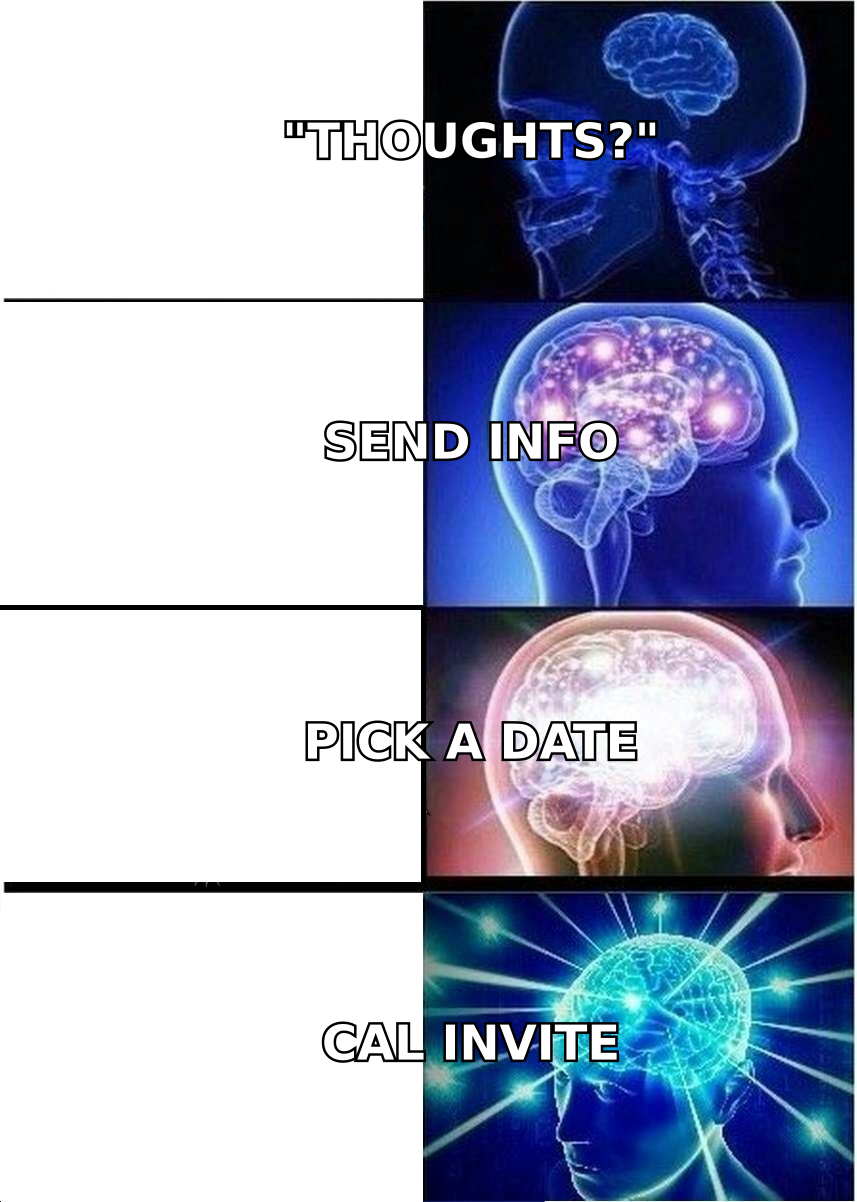
- The calendared next step. You propose a specific meeting with a purpose, offer two times, and send the invite before the call ends. Highest conversion, lowest drama.
- The conditional close. "If we can show you X by Thursday, are you comfortable moving to a pilot?" You get either a yes or the real objection. Both are wins.
- The summary-and-confirm. You replay their problem in their words, confirm you got it right, then ask what they'd need to see next. Best on early discovery when a hard close would feel pushy.
- The stakeholder ask. "Who else feels this problem?" — then name that person and get an intro on the call. This is the single highest-leverage 30 seconds in most deals.
- The trial close. "On a scale of 1 to 10, how well does this fit what you're trying to fix?" Anything under 8 means you missed something, and you get to ask what.
- The soft fade. "I'll send some info over and follow up next week." No date, no owner, no commitment. This is where deals go to die quietly.
- The hard pressure close. "This price is only good until Friday." Manufactured urgency the buyer can smell. Burns trust with anyone who's bought software before.
How do you actually close the last 90 seconds?#
Run the same three-beat sequence every time. It works because it's short and because the buyer never has to guess what happens next.
Beat one — recap in their language (20 seconds). Not your feature list. Their words. "So the core issue is that your SDRs are burning half a day a week cleaning lists, and the data you're paying for bounces at around 12%." If you got it wrong, they'll correct you, and the correction is gold.
Beat two — confirm the gap (15 seconds). "Is that the thing that's actually costing you, or is there something bigger underneath it?" This one question surfaces more real objections than any objection-handling script.
Beat three — propose the specific next step (30 seconds). Purpose first, then time. "The right next step is a 30-minute working session where I pull 100 contacts from your ICP and we check them against your CRM. I've got Tuesday at 10 or Thursday at 2. Which works?" Then send the invite while you're both still on the line.
That's it. The remaining 25 seconds are for the stakeholder ask: "Should your RevOps lead be on that call?"
Which closing lines work and which ones kill deals?#
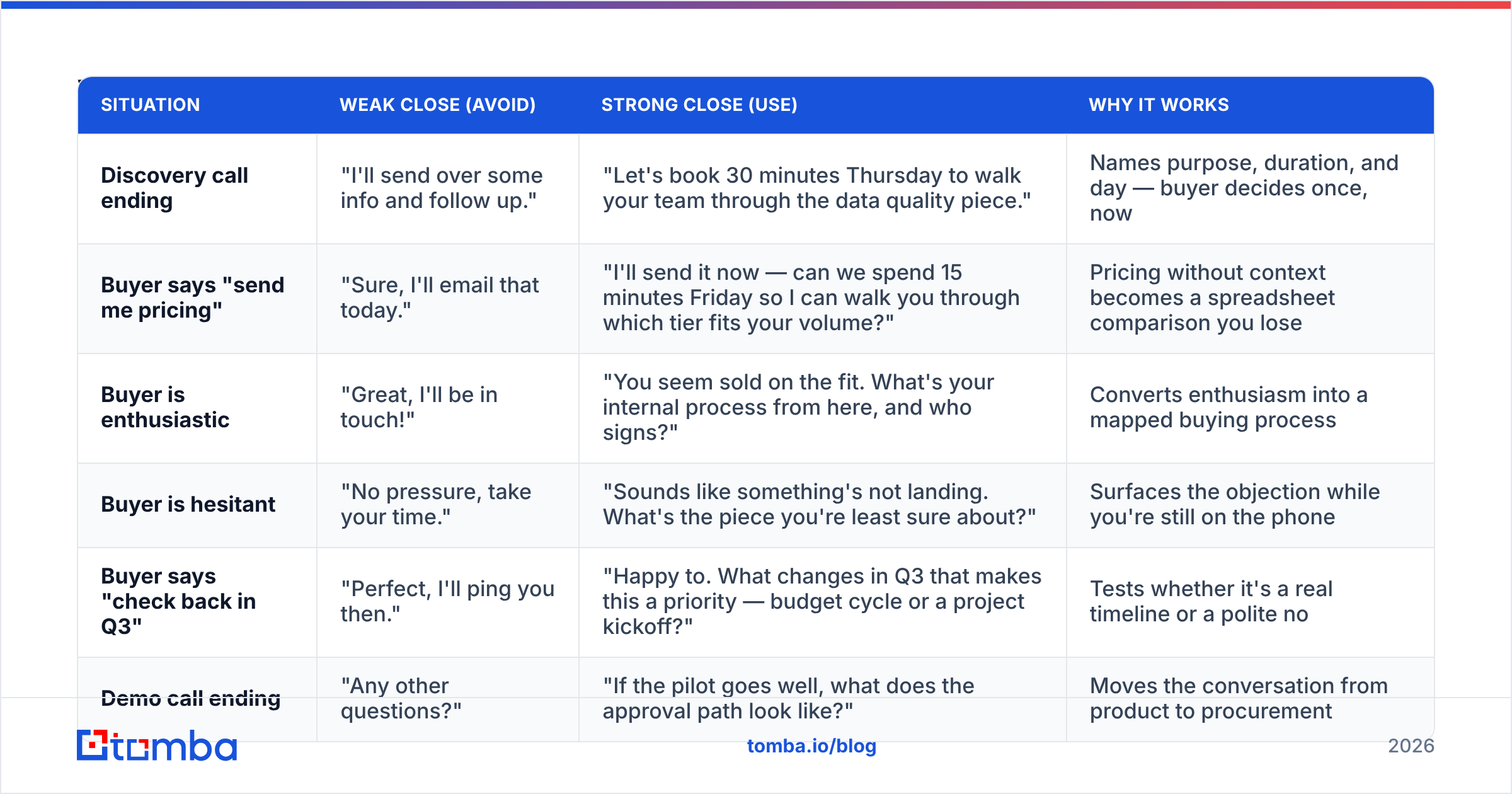
The difference is usually one word: specificity. Compare these side by side.
| Situation | Weak close (avoid) | Strong close (use) | Why it works |
|---|---|---|---|
| Discovery call ending | "I'll send over some info and follow up." | "Let's book 30 minutes Thursday to walk your team through the data quality piece." | Names purpose, duration, and day — buyer decides once, now |
| Buyer says "send me pricing" | "Sure, I'll email that today." | "I'll send it now — can we spend 15 minutes Friday so I can walk you through which tier fits your volume?" | Pricing without context becomes a spreadsheet comparison you lose |
| Buyer is enthusiastic | "Great, I'll be in touch!" | "You seem sold on the fit. What's your internal process from here, and who signs?" | Converts enthusiasm into a mapped buying process |
| Buyer is hesitant | "No pressure, take your time." | "Sounds like something's not landing. What's the piece you're least sure about?" | Surfaces the objection while you're still on the phone |
| Buyer says "check back in Q3" | "Perfect, I'll ping you then." | "Happy to. What changes in Q3 that makes this a priority — budget cycle or a project kickoff?" | Tests whether it's a real timeline or a polite no |
| Demo call ending | "Any other questions?" | "If the pilot goes well, what does the approval path look like?" | Moves the conversation from product to procurement |
Notice that none of the strong versions are aggressive. They're just specific. Buyers don't resent specificity; they resent ambiguity, because ambiguity turns into six follow-up emails they have to ignore.
How should you end a discovery call vs. a demo vs. a negotiation?#
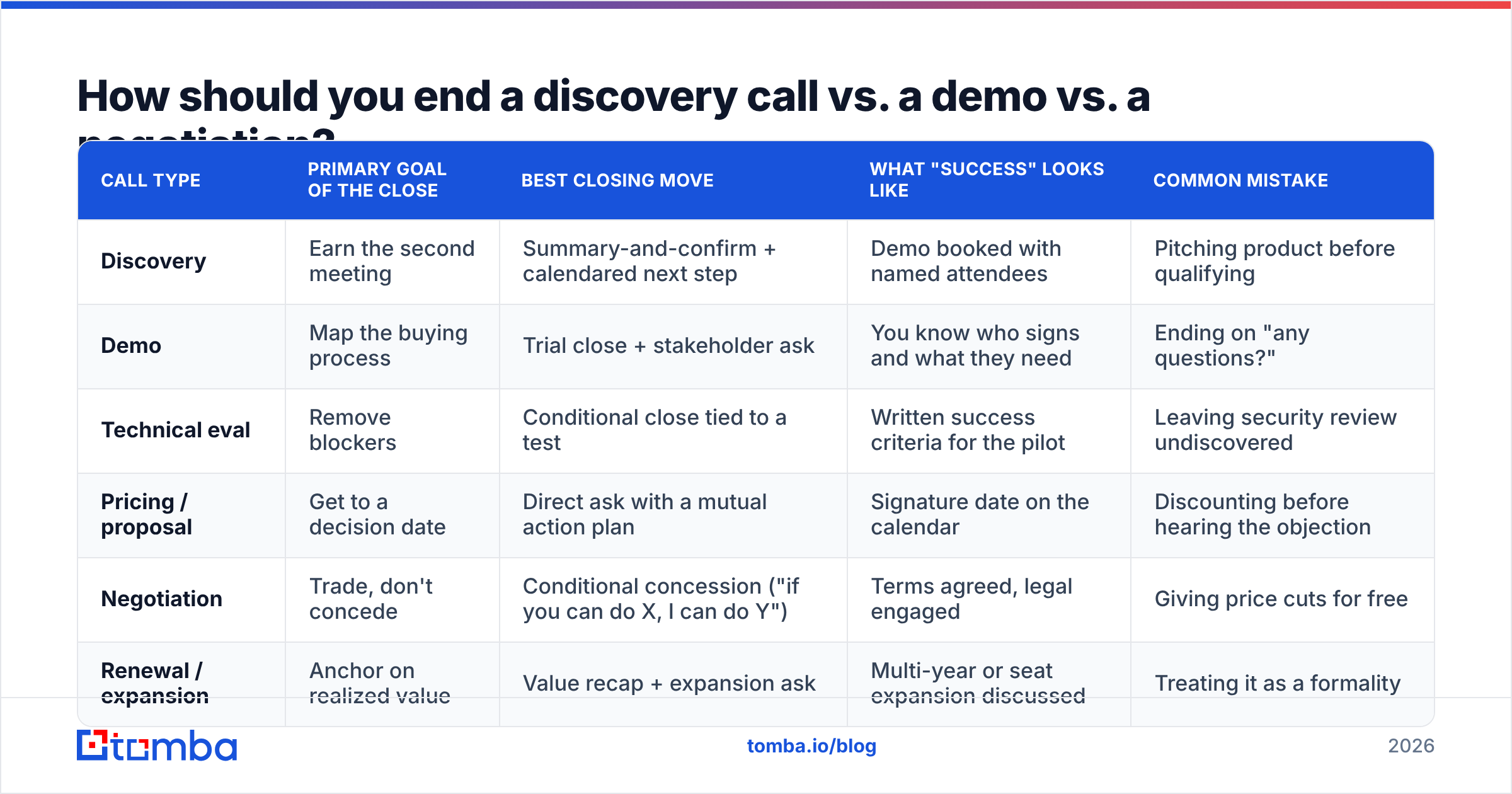
The close changes shape depending on where you are. Using a demo close on a discovery call reads as desperate; using a discovery close on a negotiation call reads as unprepared.
| Call type | Primary goal of the close | Best closing move | What "success" looks like | Common mistake |
|---|---|---|---|---|
| Discovery | Earn the second meeting | Summary-and-confirm + calendared next step | Demo booked with named attendees | Pitching product before qualifying |
| Demo | Map the buying process | Trial close + stakeholder ask | You know who signs and what they need | Ending on "any questions?" |
| Technical eval | Remove blockers | Conditional close tied to a test | Written success criteria for the pilot | Leaving security review undiscovered |
| Pricing / proposal | Get to a decision date | Direct ask with a mutual action plan | Signature date on the calendar | Discounting before hearing the objection |
| Negotiation | Trade, don't concede | Conditional concession ("if you can do X, I can do Y") | Terms agreed, legal engaged | Giving price cuts for free |
| Renewal / expansion | Anchor on realized value | Value recap + expansion ask | Multi-year or seat expansion discussed | Treating it as a formality |
The pattern across all six: never end on a question you asked them to answer later. End on a question they answer now, or on a decision they make now.
What do you do in the two hours after the call?#
The close doesn't end when you hang up. It ends when the recap lands and the invite is accepted.
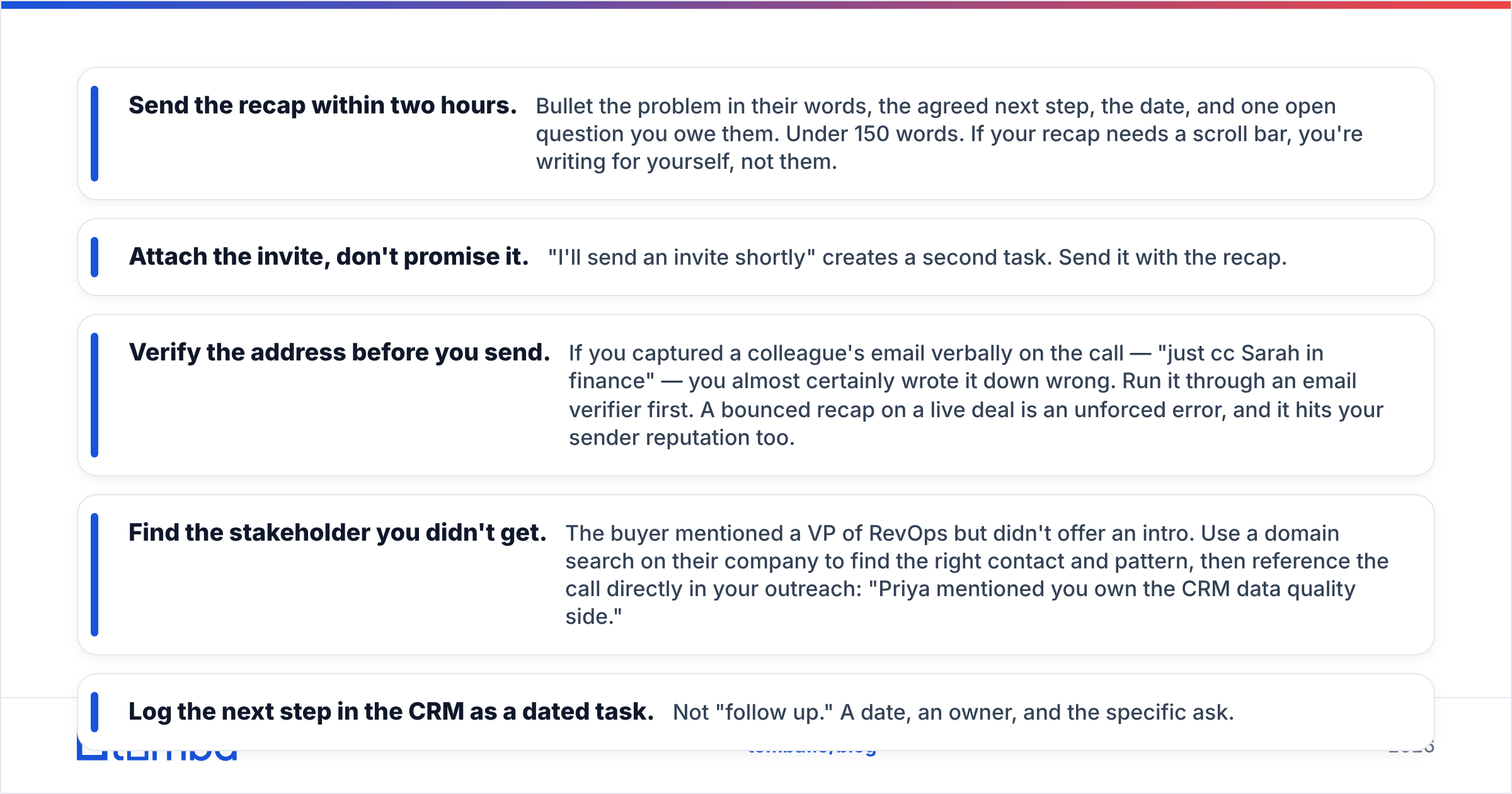
- Send the recap within two hours. Bullet the problem in their words, the agreed next step, the date, and one open question you owe them. Under 150 words. If your recap needs a scroll bar, you're writing for yourself, not them.
- Attach the invite, don't promise it. "I'll send an invite shortly" creates a second task. Send it with the recap.
- Verify the address before you send. If you captured a colleague's email verbally on the call — "just cc Sarah in finance" — you almost certainly wrote it down wrong. Run it through an email verifier first. A bounced recap on a live deal is an unforced error, and it hits your sender reputation too.
- Find the stakeholder you didn't get. The buyer mentioned a VP of RevOps but didn't offer an intro. Use a domain search on their company to find the right contact and pattern, then reference the call directly in your outreach: "Priya mentioned you own the CRM data quality side."
- Log the next step in the CRM as a dated task. Not "follow up." A date, an owner, and the specific ask.
How do you handle the awkward endings?#
Three endings trip up most reps. Each has a clean script.
"We need to discuss internally." Don't accept this as a closing statement — it's a starting point. Ask: "Totally makes sense. Who's in that conversation, and what will they push back on?" Then offer to give them the ammunition: a one-pager, a reference call, a security doc. Then book the debrief. "Let's put 20 minutes on the calendar for Wednesday so I'm not chasing you."
"This isn't a fit right now." Get the reason, not the sentiment. "Fair enough — is it the price, the timing, or the fact that it doesn't solve the main problem?" Reps who ask this discover that roughly a third of "not a fit" calls are actually "you didn't explain the second use case." And if it genuinely isn't a fit, ask for a referral. It costs nothing.
Silence after your price. Wait. The rep who speaks first after a price is stated is the rep who discounts. Count to five in your head. If the silence holds, ask a neutral question: "What's your reaction to that?" Not "I can look at flexibility on that number."
The call that ran long. If you're at minute 28 of a 30-minute slot and haven't closed, stop the demo. "We're near time — I want to make sure we lock the next step before I lose you." Never let the close get cut off by the clock. The close is the only part of the call you cannot skip.
What tools actually help you close the loop?#
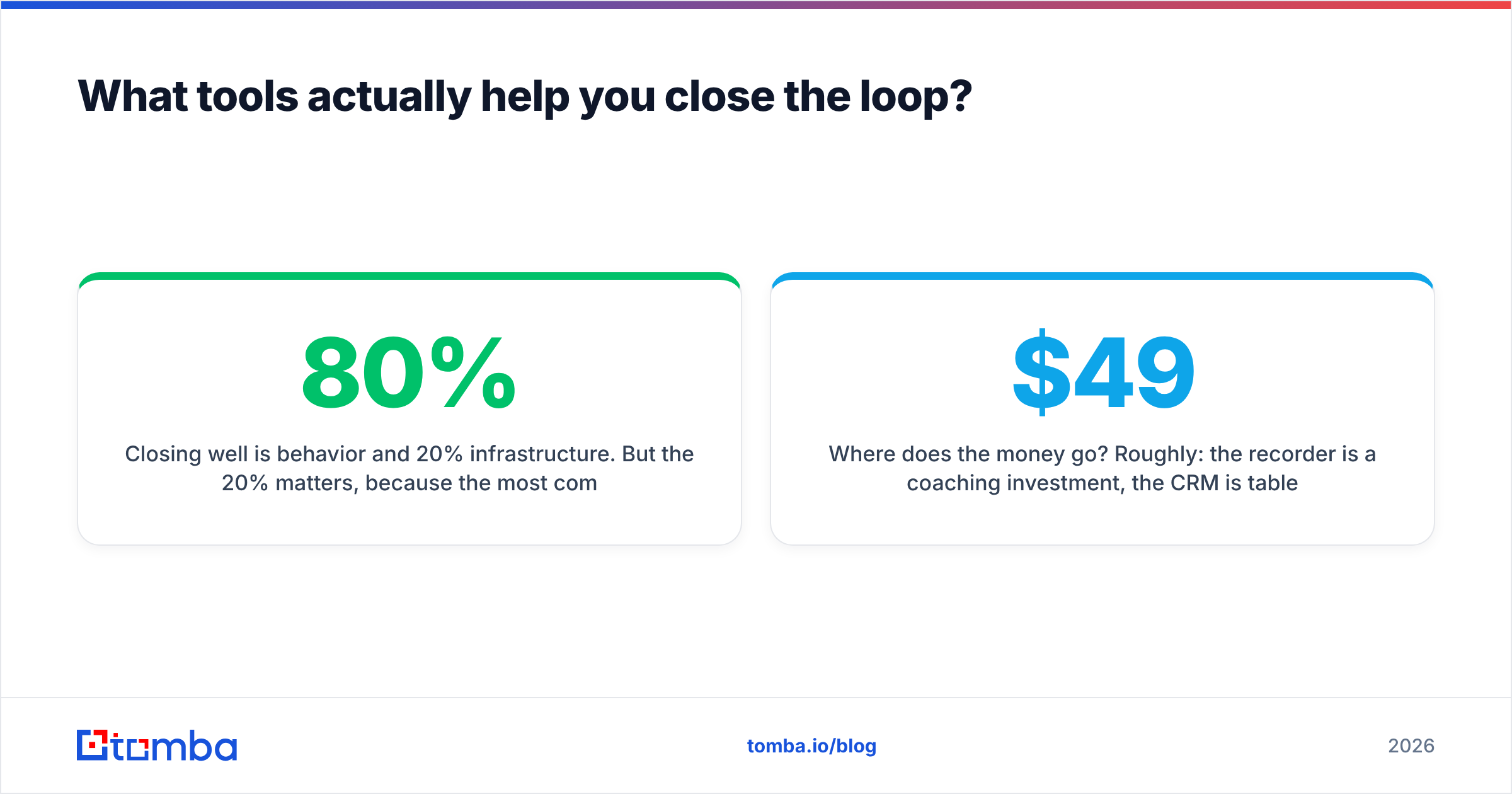
Closing well is 80% behavior and 20% infrastructure. But the 20% matters, because the most common post-call failure is administrative: the recap goes to the wrong address, the second stakeholder never gets contacted, or the CRM record is too thin for anyone to pick up the thread.
Three categories are worth having:
- A call recorder with searchable transcripts. Gong and similar tools let you audit your own closes — pull the last 20 calls, jump to the final two minutes, and count how many ended with a date. Most reps are shocked by the number.
- A CRM with mutual action plans. HubSpot and Salesforce both support next-step fields and deal-stage exit criteria. Enforce them: no deal advances without a dated next step.
- Contact data you can trust. When a buyer names a colleague on a call, you need that person's real address today, not next week. An email finder plus contact enrichment turns a name dropped in passing into a live thread. If you'd rather compare options first, G2's sales intelligence category is a reasonable neutral starting point.
Where does the money go? Roughly: the recorder is a coaching investment, the CRM is table stakes, and the data layer is the cheapest of the three but the one that most directly prevents dropped deals. Tomba pricing starts free at 25 searches per month, with the Starter plan at $49/mo and Growth at $99/mo — enough for most individual reps to cover every stakeholder they meet in a quarter.
How do you practice closing without burning real deals?#
Closing is a motor skill, not a knowledge problem. You already know you should book the next meeting. You don't do it because the moment arrives and your mouth defaults to "I'll send some info."
Fix that with three drills:
- The last-two-minutes review. Once a week, pull five recorded calls and listen only to the final two minutes. Score each one: was there a date? A named owner? A specific purpose? Most reps hit 1 out of 3 on their first audit.
- The script rehearsal. Write your three-beat close for your top two call types and say them out loud ten times. Not read — said. The goal is that the words arrive without thinking when you're at minute 27 and slightly rattled.
- The peer swap. Have a colleague play a buyer who says "send me some info." Practice the redirect until it feels natural: "Happy to — what specifically would be most useful, and can we grab 15 minutes Thursday so I'm not guessing?"
Track one metric: percentage of calls that end with a calendared next step. If it's below 50%, that number is your entire problem. Fixing it moves more revenue than any new script, sequence, or tool. It also does more for your win rate than adding another touch to your follow-up cadence.
The bottom line#
End every sales call the same way: recap in their words, confirm the gap, propose a specific next step with two time options, send the invite before you hang up. Ask for the second stakeholder. Send the recap in under two hours.
The reason most deals stall is not that the buyer wasn't interested. It's that the rep ended the call with a promise instead of a date.
And when the buyer hands you a name — "you should really talk to our head of demand gen" — don't let it sit in your notes for a week. Run it through Tomba's Email Finder and have a verified address before the recap goes out. Free tier gives you 25 searches a month to test it against contacts you already know; Starter is $49/mo when you're ready to cover every stakeholder in your pipeline. The close only counts if the follow-up lands.
Related guides#
// get started
Find, verify and enrich your first contacts today
Start on the free plan with 25 searches a month, then scale when your team is ready.
Free plan · No credit card required · GDPR & CCPA
// about the author