How To End A Sales Pitch: 7 Closing Moves That Work
Most pitches die in the last 90 seconds. Here are seven closing sequences — with scripts, timing, and a comparison of which close fits which deal stage.
TL;DR
- The last 90 seconds of a pitch decide more than the deck does. Ending with "so, any questions?" hands control back to a buyer who has no reason to use it.
- Every effective ending does three things in order: compress the value, surface the objection, name the next step with a date. Skip any one and the deal stalls.
- There are seven closing patterns worth knowing. Which one you use depends on deal size, buying stage, and whether the person in the room can sign.
- Silence after the ask is a tool, not a failure. Ask, then stop talking — the first person to speak concedes the frame.
- The close is only half the job. A pitch ending that lands still dies if your follow-up email bounces because you never verified the address.
Why do most sales pitches fall apart in the last 90 seconds?#
Because reps treat the ending as an exit rather than a decision point.
Think of a pitch like landing a plane. You can fly the whole route perfectly and still write off the aircraft in the final thirty seconds. Most reps spend 80% of their prep on the middle — features, case studies, ROI math — and improvise the landing. Then they trail off with "so yeah, that's basically it, let me know what you think," and the buyer politely says they'll circulate it internally. That is the sound of a deal entering the pipeline graveyard.
Three specific failures show up over and over:
- The value never gets compressed. You spent 20 minutes on details and never restated, in one sentence, what changes for the buyer. They can't repeat your pitch to their boss, so they don't.
- The objection stays underground. Nobody says "we don't have budget" unless you invite it. If you don't surface it in the room, you'll hear it three weeks later by email — or never.
- The next step is vague. "I'll follow up" is not a next step. A next step has a date, a name, and an outcome.
Fix those three and your close rate moves before you change a single word of your deck.
What are the three parts every strong pitch ending needs?#
Compress, surface, commit. In that order, every time, regardless of which closing style you layer on top.
- Compress the value (15–20 seconds). One sentence, in the buyer's language, about the outcome. Not "our platform offers multi-channel enrichment." Instead: "You'd stop paying two SDRs to hand-build lists and get that time back for calls."
- Surface the objection (30–45 seconds). Ask directly for the thing you're afraid of. "What's the part of this that your CFO pushes back on?" You're not inviting a no — you're pulling the real blocker into daylight where you can answer it.
- Commit to a next step (20–30 seconds). Propose something specific: a date, an attendee list, a deliverable. "Can we get 30 minutes Thursday with your ops lead, and I'll bring a cost model using your actual volumes?"
- Confirm the mechanics (10 seconds). Who else needs to be on the invite? What's their email? This is where a surprising number of deals quietly leak — you leave with a first name and no way to reach the person who actually signs.
Roughly 75 seconds total. Rehearse it as a block, not as separate lines. The reason this works is the same reason a good waiter doesn't ask "anything else?" — they ask "coffee or dessert?" You're narrowing the decision space, not expanding it.
Which closing technique should you use — and when?#
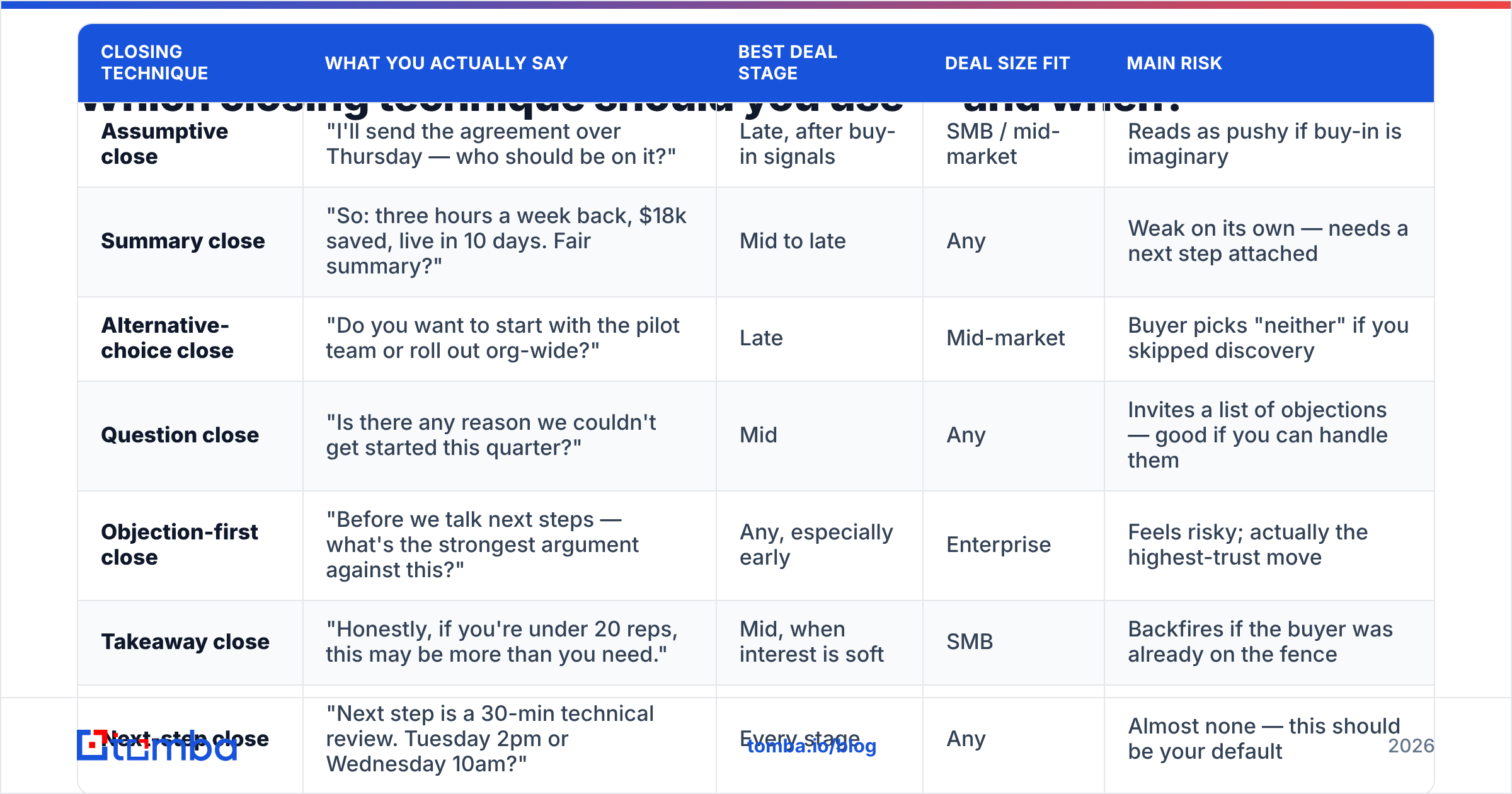
There is no single best close. There's a best close for this deal, at this stage, with this person. Here's how the seven main patterns compare.
| Closing technique | What you actually say | Best deal stage | Deal size fit | Main risk |
|---|---|---|---|---|
| Assumptive close | "I'll send the agreement over Thursday — who should be on it?" | Late, after buy-in signals | SMB / mid-market | Reads as pushy if buy-in is imaginary |
| Summary close | "So: three hours a week back, $18k saved, live in 10 days. Fair summary?" | Mid to late | Any | Weak on its own — needs a next step attached |
| Alternative-choice close | "Do you want to start with the pilot team or roll out org-wide?" | Late | Mid-market | Buyer picks "neither" if you skipped discovery |
| Question close | "Is there any reason we couldn't get started this quarter?" | Mid | Any | Invites a list of objections — good if you can handle them |
| Objection-first close | "Before we talk next steps — what's the strongest argument against this?" | Any, especially early | Enterprise | Feels risky; actually the highest-trust move |
| Takeaway close | "Honestly, if you're under 20 reps, this may be more than you need." | Mid, when interest is soft | SMB | Backfires if the buyer was already on the fence |
| Next-step close | "Next step is a 30-min technical review. Tuesday 2pm or Wednesday 10am?" | Every stage | Any | Almost none — this should be your default |
If you only internalize one row: the next-step close is the workhorse. It works on discovery calls, demos, and final pitches. The other six are situational flourishes.
How do you know which close a buyer is ready for?#
Watch for the shift from evaluating to imagining. Buyers who ask "does it integrate with Salesforce?" are still evaluating. Buyers who ask "how would we roll this out to the west coast team?" have already mentally bought — they're running implementation in their head. That's your cue for an assumptive or alternative-choice close.
Language cues that signal readiness:
- Pronoun shift — "your tool" becomes "our setup" or "we'd use it for."
- Timeline questions — "how long does onboarding take?"
- Internal logistics — "I'd need to loop in security."
- Price specificity — "what does the Growth tier include exactly?"
- Objection softening — "the only thing is..." (that's an invitation, not a rejection)
If you hear none of those, don't close hard. Close on a next step and buy yourself another meeting.
What exactly should you say? (scripts you can steal)#
Ending a first discovery call:
"Quick recap of what I heard: you're at 40 meetings a month and want 70, and list-building is eating two days a week. If that's right, the next useful thing is a 30-minute walkthrough with whoever owns your data stack. Is that Priya, or someone else? I'll send an invite for Tuesday — what's the best email for her?"
Ending a demo to a champion who can't sign:
"This clearly solves your team's problem. The person who has to be convinced is your VP. Two options: I can put together a one-pager you forward, or we get 20 minutes with all three of us and I answer her questions directly. Which one is less friction for you?"
Ending a final pitch to a decision-maker:
"You've seen the numbers. Before I ask for anything — what's the strongest argument against doing this? ... [listen fully, answer it] ... Okay. If that's handled, is there any reason we couldn't get a signed order form this quarter?"
Ending a pitch that's clearly not landing:
"I get the sense the timing isn't right, and I'd rather know that than chase you. Is this a 'not now' or a 'not this'? If it's not now, when should I check back — Q3?"
That last one saves an enormous amount of wasted pipeline. A clean "no" is worth more than a soft maybe, because it frees your calendar for deals that can actually close. Track this in your CRM as a real disposition, not a stalled opportunity.
How do you handle silence after you ask?#
You wait. That's the entire technique, and it's the hardest one on this list.
After you deliver the ask, stop. Do not fill the gap with "or, you know, whenever works," or "no pressure obviously." Four to eight seconds of silence feels like a minute to the person who just spoke, and roughly zero to the person thinking. If you break it, you've just negotiated against yourself before the buyer said a word.
Practical mechanics:
- On video calls, mute yourself for two seconds after the ask if you're prone to filler. It's a crude hack and it works.
- On the phone, count. Literally count to six in your head.
- In person, look at your notes, not at them. Staring turns a pause into pressure.
The one exception: if silence stretches past ~10 seconds, offer a structured out. "Take a second — or if it's easier, tell me what part you're weighing." That respects the pause without abandoning the ask.
What should happen in the 24 hours after the pitch?#
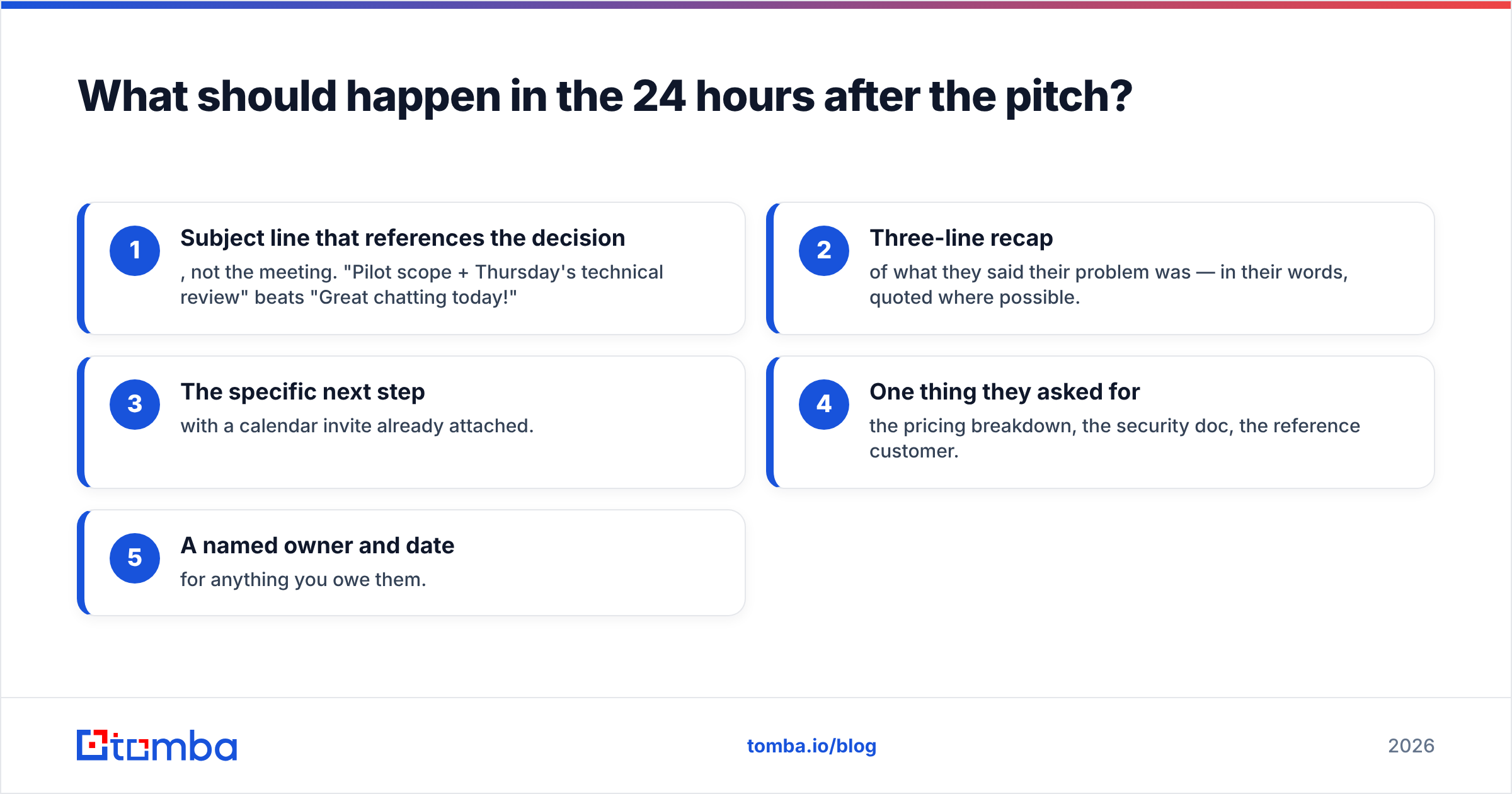
The close continues in your inbox. Most reps send a summary email; the ones who win send a decision document.
Send within four hours, while the meeting is still fresh, and structure it as:
- Subject line that references the decision, not the meeting. "Pilot scope + Thursday's technical review" beats "Great chatting today!"
- Three-line recap of what they said their problem was — in their words, quoted where possible.
- The specific next step with a calendar invite already attached.
- One thing they asked for — the pricing breakdown, the security doc, the reference customer.
- A named owner and date for anything you owe them.
Then the part nobody talks about: make sure the email actually arrives. You just spent 45 minutes earning attention from a VP whose address you wrote down phonetically from a Zoom call. If it bounces, your entire close evaporates and you'll never know why. Run new contacts through an email verifier before you hit send, and use a domain search to pull the other stakeholders on the buying committee — the security lead and the ops manager who were named but never introduced.
According to HubSpot's sales research, the majority of deals require multiple follow-up touches after the initial pitch, yet a large share of reps stop after one or two. The ending of your pitch sets up those touches. If you left with a vague "I'll be in touch," every follow-up reads as nagging. If you left with "Thursday, 2pm, with Priya," every follow-up is just logistics.
How does the close change by deal size?#
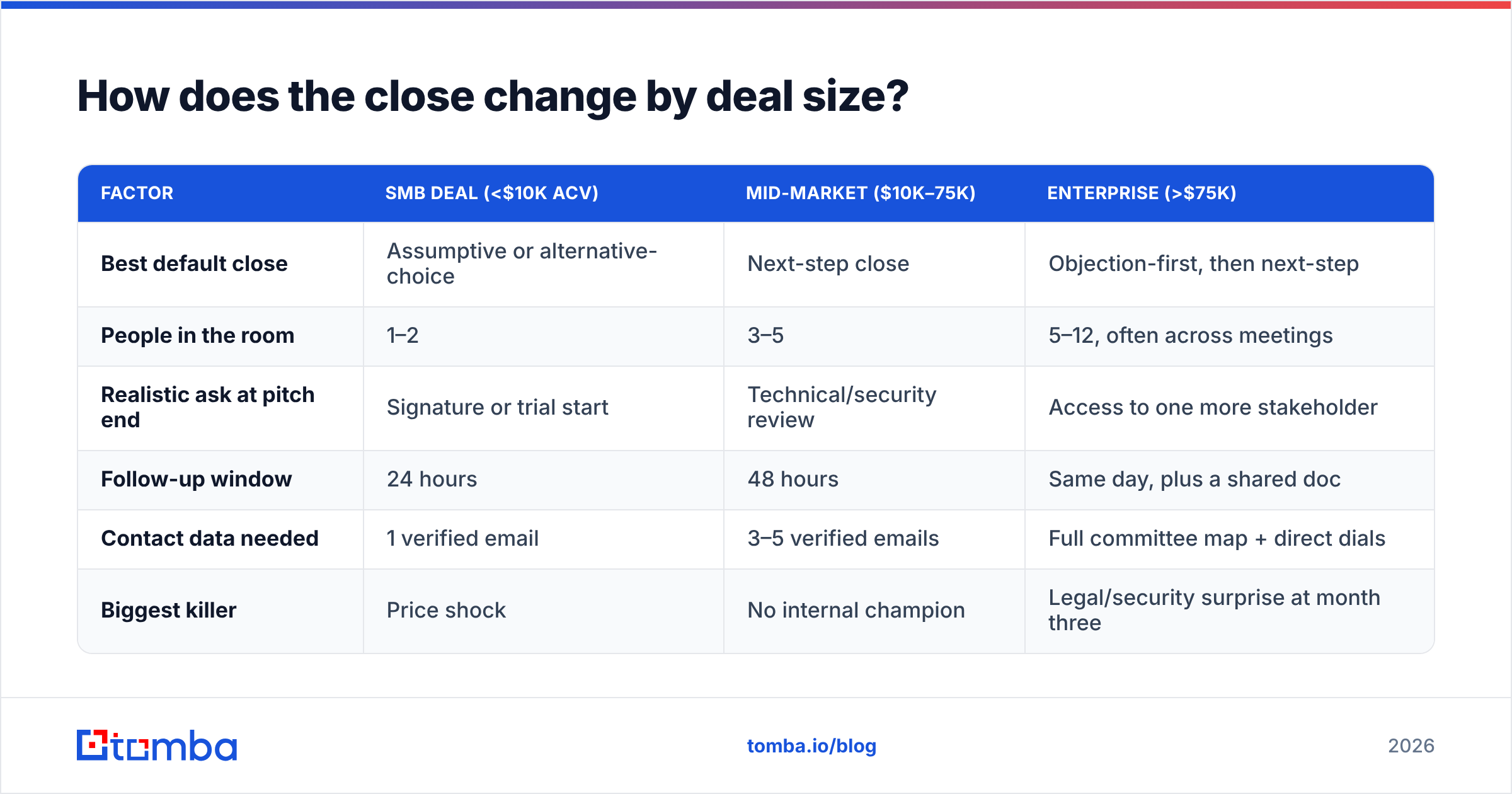
| Factor | SMB deal (<$10k ACV) | Mid-market ($10k–75k) | Enterprise (>$75k) |
|---|---|---|---|
| Best default close | Assumptive or alternative-choice | Next-step close | Objection-first, then next-step |
| People in the room | 1–2 | 3–5 | 5–12, often across meetings |
| Realistic ask at pitch end | Signature or trial start | Technical/security review | Access to one more stakeholder |
| Follow-up window | 24 hours | 48 hours | Same day, plus a shared doc |
| Contact data needed | 1 verified email | 3–5 verified emails | Full committee map + direct dials |
| Biggest killer | Price shock | No internal champion | Legal/security surprise at month three |
The pattern: the bigger the deal, the smaller the ask at the end of any single pitch. Asking an enterprise buyer to sign at the end of a demo signals you don't understand their procurement process. Asking for 20 minutes with their security lead signals you do.
That also means your data requirements scale. Enterprise closing is a committee sport, and you can't run the play with one contact. Building out that committee map — names, roles, verified emails, direct lines — is prep work, not follow-up work. Tools that let you find email addresses by domain and role make the difference between pitching one person and pitching the actual buying unit.
What are the most common closing mistakes?#
- Ending on a feature. The last thing they hear should be an outcome or an ask. Never a spec.
- Asking "any questions?" It's a dead end. Replace with "what's the part you're least sure about?" — same intent, but it presumes an answer exists.
- Closing on someone who can't buy. You'll get an enthusiastic yes with no authority behind it. Ask early: "Walk me through how a decision like this gets made here."
- Discounting to close. Price cuts at the buzzer teach buyers that your list price is fiction. If you must move, trade — a shorter term, a case study, a faster start date.
- Over-closing. Asking three different ways in two minutes reads as desperation. One clear ask, then silence.
- Leaving without contact details. You named four stakeholders in the meeting and left with zero ways to reach three of them.
For teams comparing tooling on the data side of this problem, both BookYourData and Tomba are reasonable starting points — BookYourData leans toward pre-built list purchase, while Tomba leans toward real-time lookup and verification. Which fits depends on whether you're building committee maps deal-by-deal or buying a territory in bulk. Independent user reviews on G2 are the fastest way to sanity-check either against your own segment.
How do you practice this without burning real deals?#
Record your last five pitch endings and transcribe just the final two minutes. Most reps are horrified by what they find: filler words, a value summary that never happened, and an ask so hedged it wasn't an ask.
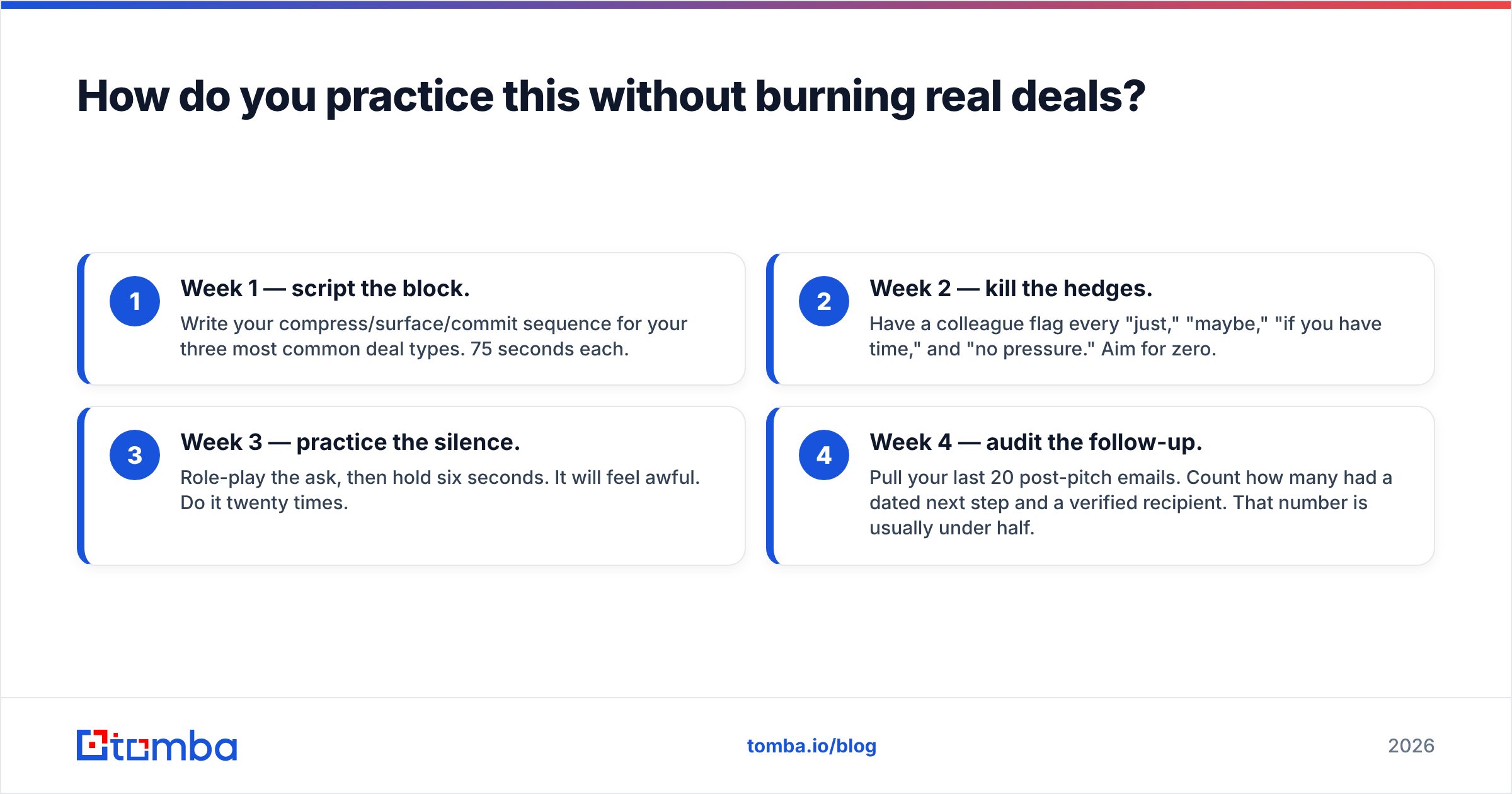
A four-week drill that works:
- Week 1 — script the block. Write your compress/surface/commit sequence for your three most common deal types. 75 seconds each.
- Week 2 — kill the hedges. Have a colleague flag every "just," "maybe," "if you have time," and "no pressure." Aim for zero.
- Week 3 — practice the silence. Role-play the ask, then hold six seconds. It will feel awful. Do it twenty times.
- Week 4 — audit the follow-up. Pull your last 20 post-pitch emails. Count how many had a dated next step and a verified recipient. That number is usually under half.
Track response rate on post-pitch emails as your leading indicator. If it climbs while your pitch content stays identical, the ending is doing the work.
Ready to make your follow-ups actually land?#
A great close creates a next step. A bounced email destroys it. Before your next pitch, map the full buying committee and verify every address you'll need afterward — the champion, the economic buyer, the security reviewer.
Tomba Email Finder finds professional email addresses by domain, name, or company, with verification built in so your post-pitch follow-up reaches the person who can actually sign. Start on the free tier with 25 searches a month, or check Tomba pricing — Starter runs $49/mo and Growth $99/mo — when you're mapping committees across a full territory. Close the pitch, then make sure the email arrives.
Related guides#
Ready to find emails that actually work?
Join 150,000+ professionals who stopped guessing and started sending. Free credits on signup — no credit card required.
Get the Tomba newsletter
Practical outbound tactics and product updates — once every two weeks.
About the author