How to End an Email to a CEO: Sign-Offs That Get Replies
The last three lines of your email decide whether a CEO replies or archives. Here's how to end an email to a CEO with a close, a sign-off, and a signature that actually convert.
TL;DR
- A CEO reads your last three lines harder than your first. The close, the sign-off, and the signature decide whether you get a reply or an archive.
- Use one ask, phrased as a yes/no question with a low time cost. "Worth 10 minutes Thursday?" outperforms "Let me know if you'd like to connect."
- "Best" and "Thanks" are the safest sign-offs for executive email. "Cheers," "Warm regards," and "Sincerely" all carry baggage depending on region and seniority.
- Never end with a calendar link as the only CTA on a cold first touch — it asks the CEO to do the scheduling work before they've agreed to anything.
- The whole thing collapses if the address is wrong. Verify the executive's email before you obsess over the closing line.
You can write a flawless opening line to a CEO and still lose the reply in the last 40 words. The close is where most cold emails to executives quietly die — not because the sign-off word was wrong, but because the ask was vague, stacked, or expensive.
This guide breaks the ending of an executive email into its three working parts, ranks the sign-offs by what they actually signal, and gives you copy you can paste today.
What are the three parts of an email ending?#
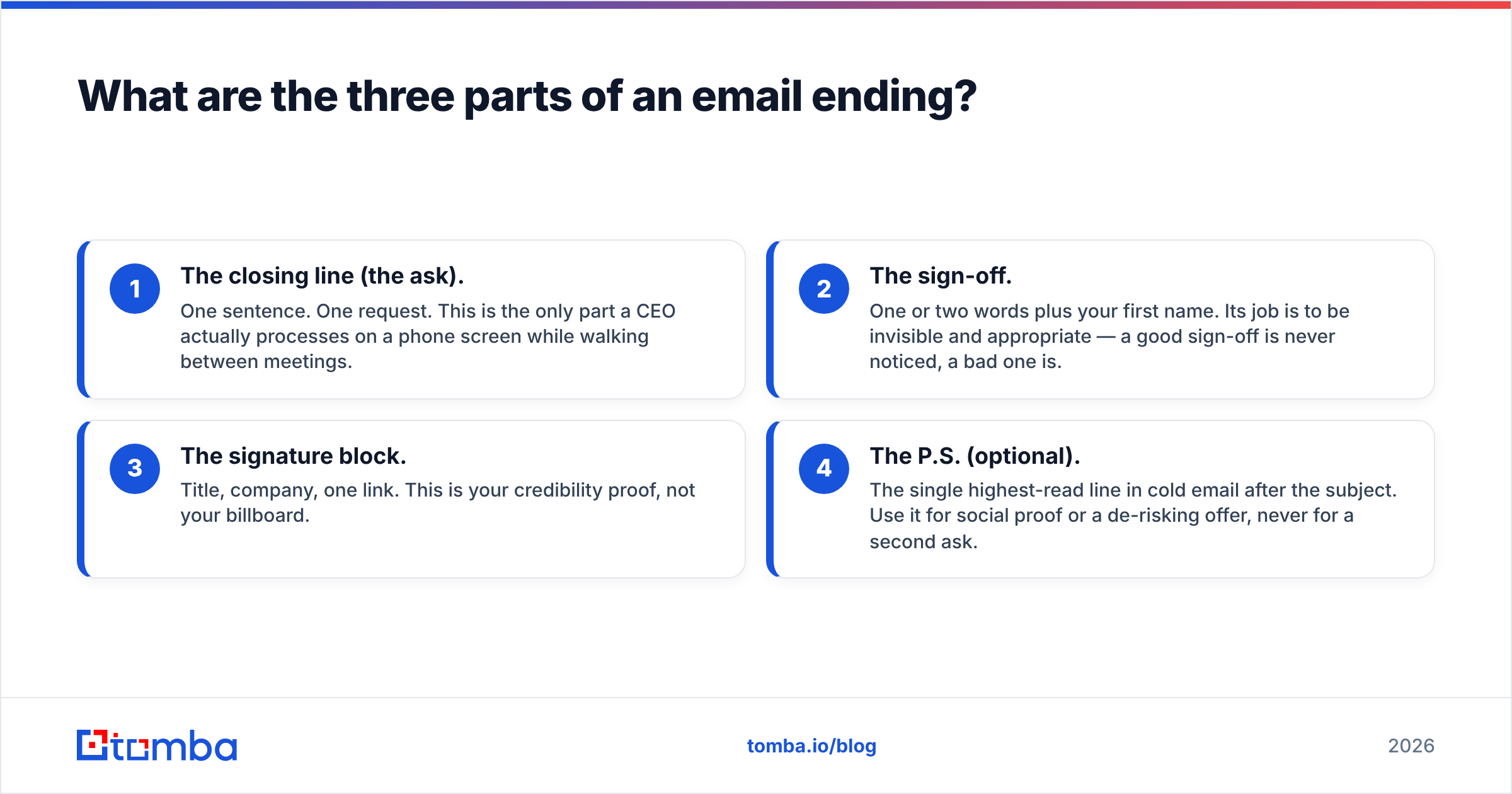
Every email ending is doing three separate jobs. Most people collapse them into one mushy paragraph and wonder why nothing lands.
- The closing line (the ask). One sentence. One request. This is the only part a CEO actually processes on a phone screen while walking between meetings.
- The sign-off. One or two words plus your first name. Its job is to be invisible and appropriate — a good sign-off is never noticed, a bad one is.
- The signature block. Title, company, one link. This is your credibility proof, not your billboard.
- The P.S. (optional). The single highest-read line in cold email after the subject. Use it for social proof or a de-risking offer, never for a second ask.
Get those four in the right order and the ending does its job. Invert them — signature bloat, three asks, a jokey sign-off — and you signal "mass send" in under two seconds.
Why does the closing line matter more for a CEO than anyone else?#
Because a CEO's decision cost is different from a manager's. A director can forward your email to someone who has time. A CEO's only two options are reply or delete, and replying commits their calendar — the scarcest thing they own.
That changes what a good closing line looks like:
- Time cost must be explicit and small. "15 minutes" beats "a quick call." "A quick call" is unbounded and therefore expensive.
- The decision must be binary. Give them a yes/no, not a scheduling puzzle. Executives answer questions; they don't solve logistics for strangers.
- Delegation must be easy. Many CEO replies are literally "Looping in Sarah." Your close should make that forward frictionless — which means naming the function, not just the outcome.
- The out must be real. "If this isn't a priority right now, no problem — I'll close the loop" gets more replies than pressure, because it costs the CEO nothing to say no and no-replies are worthless to you anyway.
Research from HubSpot's sales benchmarks has consistently shown that emails ending in a specific, low-commitment question outperform open-ended closes. The mechanism is boring: a question creates an unanswered obligation; a statement doesn't.
Which sign-off should you use in an email to a CEO?#
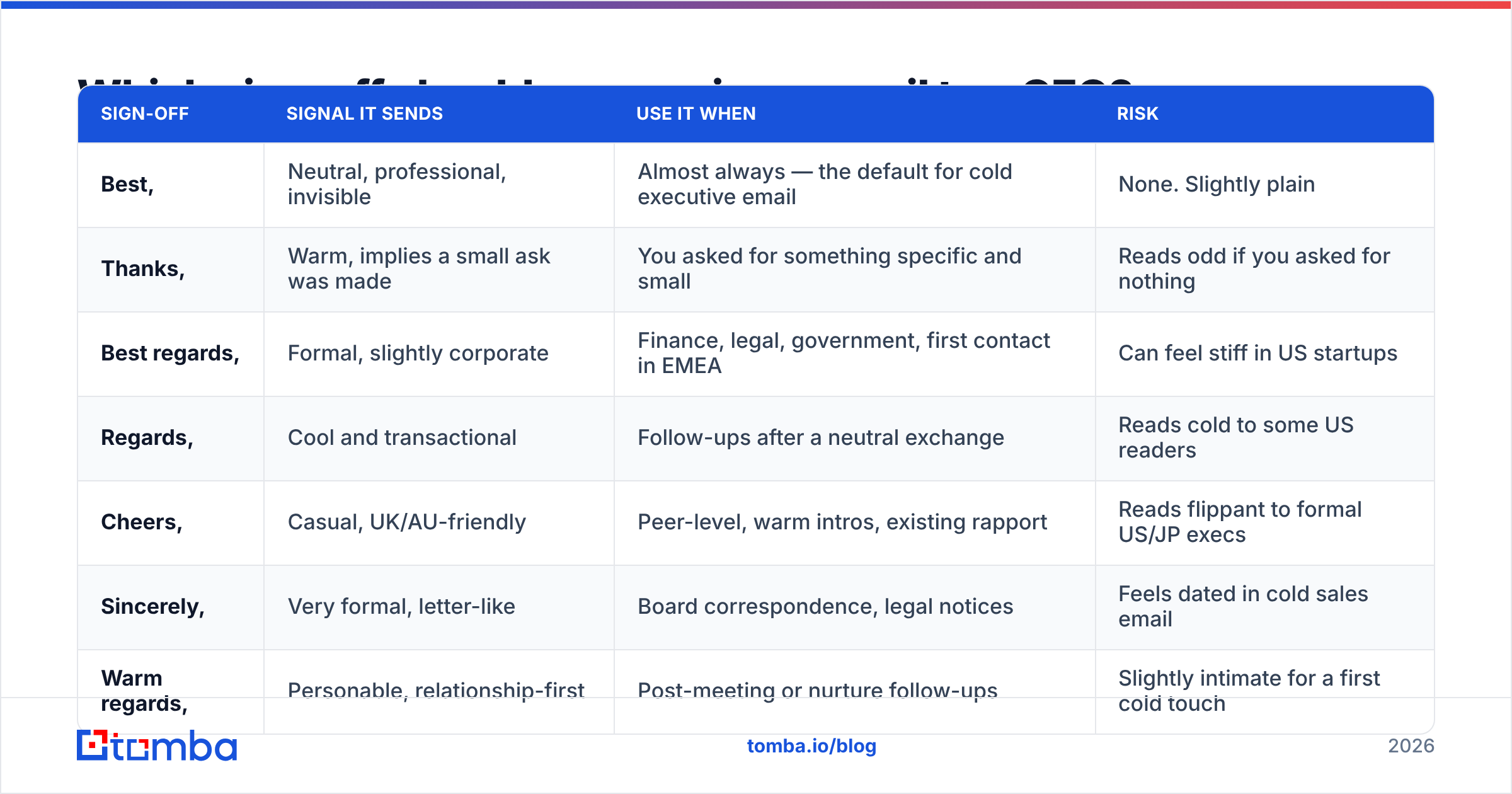
Here's the honest ranking. Sign-offs don't win deals, but the wrong one can cost you credibility with a specific reader.
| Sign-off | Signal it sends | Use it when | Risk |
|---|---|---|---|
| Best, | Neutral, professional, invisible | Almost always — the default for cold executive email | None. Slightly plain |
| Thanks, | Warm, implies a small ask was made | You asked for something specific and small | Reads odd if you asked for nothing |
| Best regards, | Formal, slightly corporate | Finance, legal, government, first contact in EMEA | Can feel stiff in US startups |
| Regards, | Cool and transactional | Follow-ups after a neutral exchange | Reads cold to some US readers |
| Cheers, | Casual, UK/AU-friendly | Peer-level, warm intros, existing rapport | Reads flippant to formal US/JP execs |
| Sincerely, | Very formal, letter-like | Board correspondence, legal notices | Feels dated in cold sales email |
| Warm regards, | Personable, relationship-first | Post-meeting or nurture follow-ups | Slightly intimate for a first cold touch |
| Talk soon, | Presumptuous | Only after a call is actually booked | Assumes a yes you haven't earned |
| Looking forward, | Pressure-y | Rarely | Implies they've already agreed |
The practical rule: default to "Best," on cold outreach and switch to "Thanks," once you've made an explicit ask. Everything below "Cheers" on this table is a situational tool, not a default.
Two more rules that matter more than word choice:
- Always use your first name only on the sign-off line. Full name goes in the signature block. "Best, Mohamed" reads human; "Best, Mohamed Ben Rebia | Senior Account Executive" reads like a template.
- Never end with a quote. Inspirational quotes under a sign-off are the single fastest way to signal that the sender has never talked to an executive.
What are the best closing lines for a cold email to a CEO?#
Copy these, then rewrite them in your own voice. The pattern matters more than the phrasing.
For a first cold touch (asking for time):
- "Worth 12 minutes on Thursday or Friday to see if this maps to your Q1 pipeline goals?"
- "Open to a short call, or should I send the two-slide version instead?"
- "Is reducing ramp time for new AEs on your list this quarter? If yes, I'll send times."
For a first cold touch (asking for a referral instead of time):
- "If this belongs with your VP Sales rather than you, happy to go direct — who should I ask for?"
- "Are you the right person for this, or is there someone closer to the problem?"
That second pattern is underrated. It gives the CEO a cheaper yes than a meeting, and a forwarded intro from the CEO lands harder than any cold email you could send to the VP directly.
For a follow-up (second or third touch):
- "Still worth a conversation, or should I close this out?"
- "Sending one more note next week, then I'll stop — is that useful or noise?"
- "No reply is a fine answer. If you'd rather I check back in Q3, just say 'Q3.'"
For a warm or referred email:
- "Priya suggested I reach out — happy to work around your calendar. Does next Tuesday morning work?"
- "Thanks again for the intro context from Priya. 15 minutes next week?"
For a post-meeting email:
- "I'll send the security doc by Friday. Anything else you'd want before you loop in your CFO?"
Notice what none of these do: none stack two asks, none say "let me know your thoughts," and none require the reader to open a calendar link to answer.
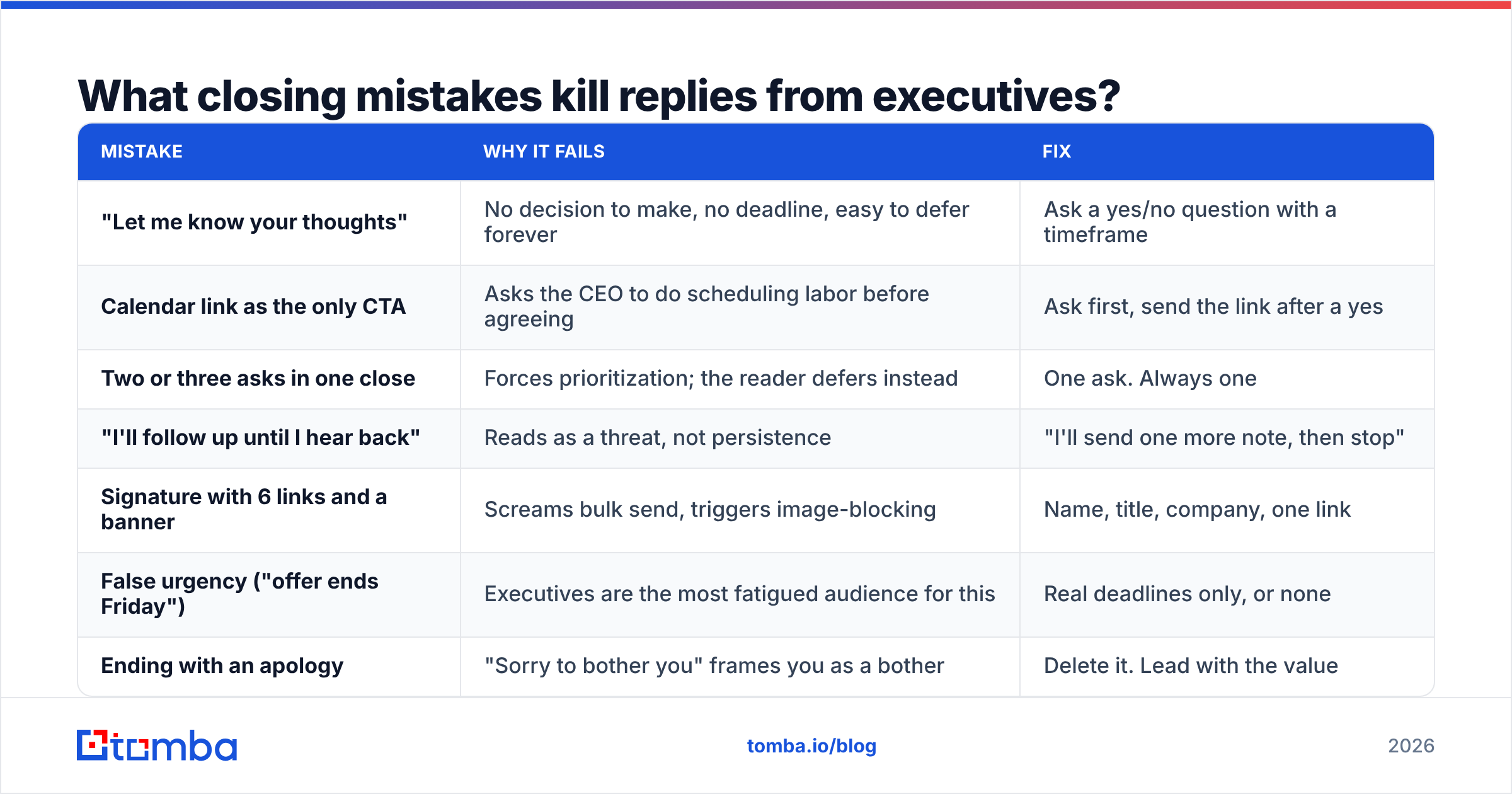
What closing mistakes kill replies from executives?#
| Mistake | Why it fails | Fix |
|---|---|---|
| "Let me know your thoughts" | No decision to make, no deadline, easy to defer forever | Ask a yes/no question with a timeframe |
| Calendar link as the only CTA | Asks the CEO to do scheduling labor before agreeing | Ask first, send the link after a yes |
| Two or three asks in one close | Forces prioritization; the reader defers instead | One ask. Always one |
| "I'll follow up until I hear back" | Reads as a threat, not persistence | "I'll send one more note, then stop" |
| Signature with 6 links and a banner | Screams bulk send, triggers image-blocking | Name, title, company, one link |
| False urgency ("offer ends Friday") | Executives are the most fatigued audience for this | Real deadlines only, or none |
| Ending with an apology | "Sorry to bother you" frames you as a bother | Delete it. Lead with the value |
| Over-formality mismatch | "Dear Sir/Madam" + "Sincerely" on a startup CEO | Match their public writing register |
The signature deserves its own note. Gartner's B2B buying research has repeatedly found that buyers spend the majority of their journey doing independent research, which means your signature is a research shortcut, not an ad. One link to the thing that proves you're real. If you need a clean starting point, an email signature generator will get you to a standard block faster than hand-coding HTML that breaks in Outlook.
How should the ending change by scenario?#
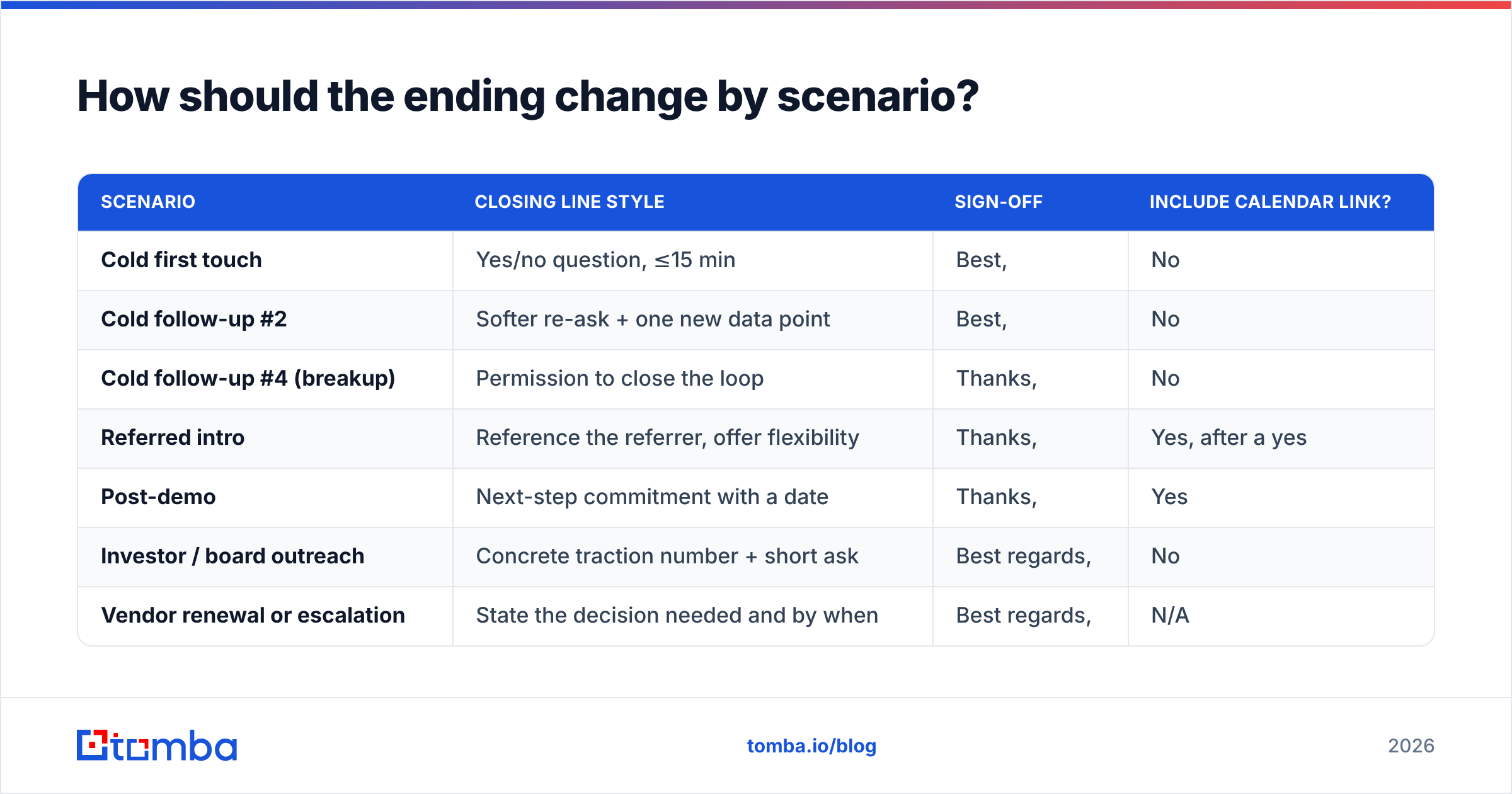
The ending isn't a fixed template. Match it to the relationship and the sequence position.
| Scenario | Closing line style | Sign-off | Include calendar link? |
|---|---|---|---|
| Cold first touch | Yes/no question, ≤15 min | Best, | No |
| Cold follow-up #2 | Softer re-ask + one new data point | Best, | No |
| Cold follow-up #4 (breakup) | Permission to close the loop | Thanks, | No |
| Referred intro | Reference the referrer, offer flexibility | Thanks, | Yes, after a yes |
| Post-demo | Next-step commitment with a date | Thanks, | Yes |
| Investor / board outreach | Concrete traction number + short ask | Best regards, | No |
| Vendor renewal or escalation | State the decision needed and by when | Best regards, | N/A |
| Congratulations / no-ask note | No ask at all — genuinely none | Best, | No |
That last row is the one most sellers can't resist ruining. If you're emailing a CEO to congratulate them on a funding round, do not append "and by the way, would you be open to a call?" A no-ask email builds more permission for the next one than a bolted-on CTA ever will.
Does any of this matter if the email address is wrong?#
No. And this is where most executive outreach actually fails.
A perfect closing line delivered to firstname@company.com when the pattern is f.lastname@company.com produces a bounce, not a reply. Worse, a run of bounces damages your sender reputation, which means your next correctly-addressed email lands in spam regardless of how good the close is. C-suite addresses are also the most likely to be aliased, forwarded, or gated behind a catch-all domain — so guessing is unusually expensive at this level.
Three things to do before you obsess over the sign-off:
- Confirm the pattern, not the person. Company email formats are consistent. Establish the company email pattern once and every future contact at that org gets cheaper.
- Find the actual address. A dedicated email finder resolves name plus domain into a real, sourced address rather than a permutation guess.
- Verify before you send. Run the address through an email verifier so you're not burning domain reputation on executives who will never see the message anyway. Catch-all domains — common at larger enterprises — need catch-all-specific handling rather than a simple SMTP ping.
There's a second-order benefit here. When you know the address is right and the message was delivered, silence becomes real data. You can stop rewriting your sign-off and start testing the actual ask, because you've eliminated the deliverability variable. Without verification, every A/B test on closing lines is measuring noise.
For teams doing this at scale, Tomba pricing starts with a free tier at 25 searches per month, with the Starter plan at $49/mo and Growth at $99/mo — enough to build and verify an executive list without committing to enterprise data contracts. Peers in this space like BookYourData take a prepaid, pay-as-you-go approach to prebuilt B2B lists, which suits teams that want a one-time list purchase rather than an ongoing search workflow. Both models work; the deciding factor is usually whether your prospecting is continuous or campaign-based.
How do you test and improve your email endings?#
Treat the ending as its own variable and test it in isolation.
- Hold everything else constant. Same subject, same opening, same body, same send window. Change only the closing line. If you change two things, you learn nothing.
- Test the ask, not the sign-off, first. "Best" vs "Thanks" moves reply rate by noise-level amounts. "Worth 15 minutes?" vs "Let me know your thoughts" can move it by double digits.
- Use a large enough sample. Executive-list volumes are small by nature. Don't call a winner on 40 sends; you need a few hundred per variant before the difference means anything.
- Segment by seniority. The close that works on a 30-person startup CEO will not work on a Fortune 500 CEO's chief of staff, who is the actual reader.
- Track replies, not opens. Open rates have been unreliable since Apple Mail Privacy Protection. Reply rate is the only metric an ending affects. Benchmark yourself against your own response rate baseline, not against a blog post's numbers.
One structural tip: keep a swipe file of every closing line that got a CEO reply, tagged by company size and industry. After a quarter, patterns emerge that no general guide can give you — including which specific words your particular market rewards. Peer reviews on G2 are also a decent place to see how buyers describe the outreach they actually respond to, in their own language.
What does a complete executive email ending look like?#
Putting all four parts together, on a cold first touch to a Series B CEO:
...which is why your new AEs are probably taking five months to ramp instead of three.
Worth 12 minutes on Thursday to see whether that's actually your bottleneck? If it isn't, tell me and I'll close the loop.
Best,
Mohamed
Mohamed Ben Rebia
Head of Growth, Acme
acme.com
P.S. — We did this with two companies in your portfolio; happy to share the before/after numbers whether or not we talk.
Four parts, 60 words, one ask, one link, one genuinely useful P.S. The CEO can reply "yes," reply "no," or forward it to their VP Sales in three seconds. That's the entire goal.
Get the address right before you polish the close#
The best sign-off in the world is worthless if the message bounces. Before your next executive sequence, run your target list through the Tomba Email Finder to resolve verified, sourced addresses for the CEOs and founders you're targeting — then spend your energy where it actually moves reply rate: the one-sentence ask above your sign-off. Start free with 25 searches a month and see how much of your "no reply" problem was really a "never delivered" problem.
Related guides#
// get started
Find, verify and enrich your first contacts today
Start on the free plan with 25 searches a month, then scale when your team is ready.
Free plan · No credit card required · GDPR & CCPA
// about the author