How to Engage Prospects in 2026: A Practical Playbook
Most outreach fails before the first reply because the prospect was never actually engaged. Here is a step-by-step system for engaging prospects in 2026, with channel benchmarks, timing tables, and the research that earns a response.
TL;DR
- Engagement is not activity. Sending 400 emails is activity; getting 12 conversations is engagement. Measure replies and meetings, not sends.
- The single biggest lever is pre-send accuracy. Bad contact data caps your reply rate before you write a word — verify every address and every phone number first.
- A working sequence is multi-channel and patient: 7–12 touches across email, LinkedIn, and phone over 21–28 days, each one carrying new information.
- Personalization that works is trigger-based (funding, hiring, tech change, new role), not cosmetic ("Loved your post!").
- Track reply rate, positive reply rate, and meetings booked per 100 verified contacts. Everything else is vanity.
What does it actually mean to engage a prospect?#
Engaging a prospect means getting them to spend attention on you voluntarily. That is the whole definition. A prospect who opens your email and deletes it has not engaged. A prospect who replies "not now, ask me in Q3" has.
Think of it like knocking on doors in an apartment building. Activity is how many doors you knock on. Engagement is how many people open the door and stay in the doorway long enough to hear a sentence. If you knock on 200 doors in a building where half the apartments are empty, your knock count looks great and your conversation count is zero.
That is exactly what happens with unverified lists. Industry data consistently shows B2B contact databases decaying at roughly 25–30% per year as people change jobs, companies rebrand, and domains consolidate. Every stale record is an empty apartment.
So the work of engaging prospects splits into three layers, in this order:
- Reachability — is this a real, current, deliverable contact? Nothing else matters until this is true.
- Relevance — is there a reason for this person to care right now, that you can state in one sentence?
- Repetition — will you show up enough times, across enough channels, to be remembered without being annoying?
Most teams obsess over layer 2, ignore layer 1, and quit before layer 3.

How do you research a prospect without spending an hour per lead?#
Cap research at 90 seconds per prospect and force yourself to find exactly one usable fact. One. Not a dossier.
The 90-second research stack:
- Company trigger (30s) — funding round, new office, layoffs, product launch, leadership change. Check the company's news page and LinkedIn company feed.
- Person trigger (20s) — new role in the last 6 months, a promotion, a conference talk, a published article. If they wrote something, the author finder pulls the contact behind a byline directly.
- Tech or process signal (20s) — what they run. If they just added a CDP, a data warehouse, or a new support platform, that is a real reason to reach out.
- Contact data (20s) — the verified email and, where the motion justifies it, a direct dial.
Anything beyond that is procrastination dressed as diligence. A rep who spends 15 minutes per prospect touches 25 people a day. A rep who spends 90 seconds and runs a disciplined sequence touches 120 and reaches more of them.
The research is only worth anything if it survives contact with reality. That means the trigger has to be recent (under 60 days), specific (a number, a name, a product), and connected to a problem you solve. "You raised a Series B" is a fact. "You raised a Series B and are hiring six AEs, which usually means your data ops break in about 90 days" is a reason to reply.
Which channel actually gets a response in 2026?#
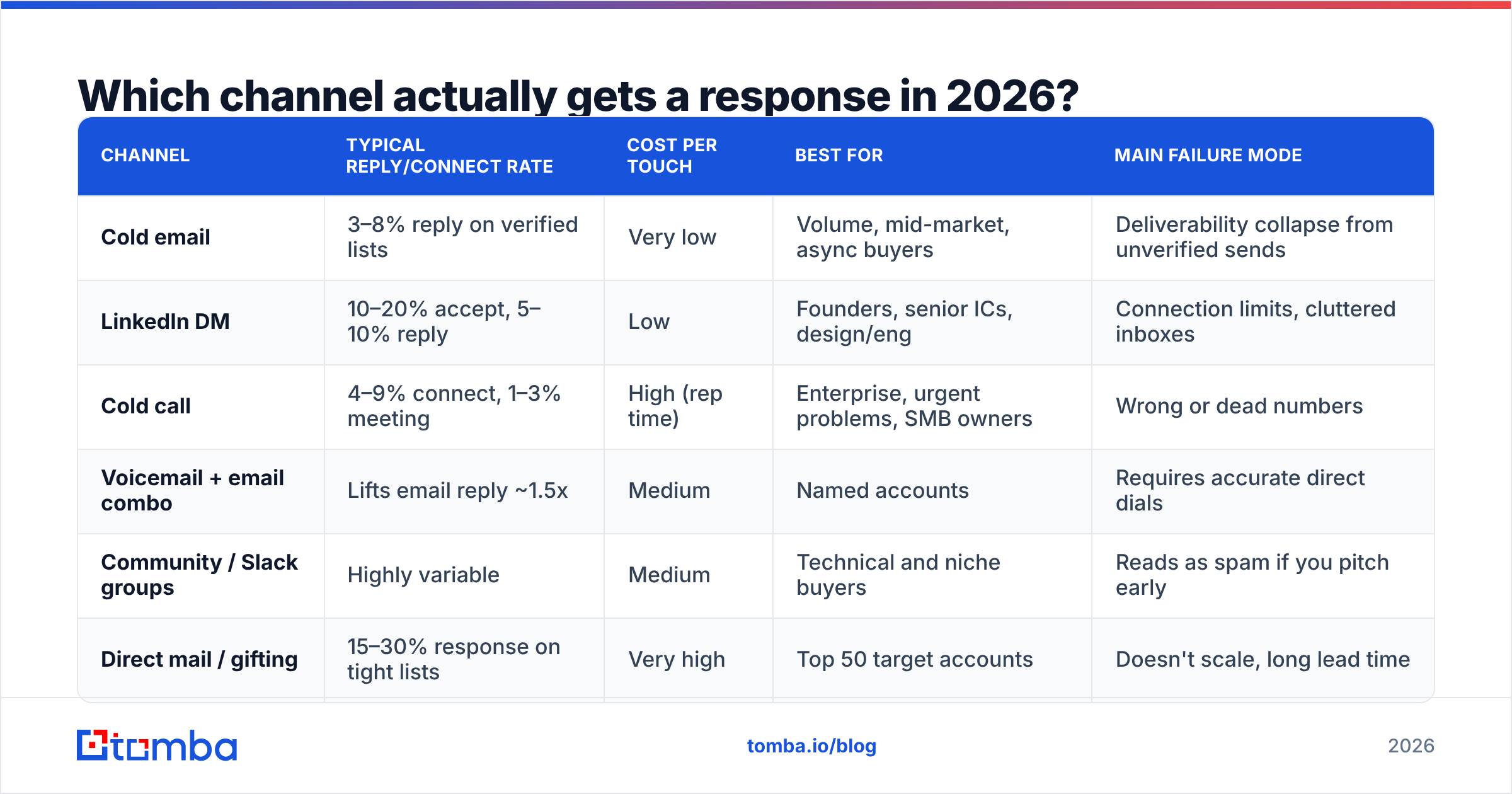
None of them alone. The honest answer is that channel performance depends almost entirely on segment, and the teams that win use two or three in coordination.
| Channel | Typical reply/connect rate | Cost per touch | Best for | Main failure mode |
|---|---|---|---|---|
| Cold email | 3–8% reply on verified lists | Very low | Volume, mid-market, async buyers | Deliverability collapse from unverified sends |
| LinkedIn DM | 10–20% accept, 5–10% reply | Low | Founders, senior ICs, design/eng | Connection limits, cluttered inboxes |
| Cold call | 4–9% connect, 1–3% meeting | High (rep time) | Enterprise, urgent problems, SMB owners | Wrong or dead numbers |
| Voicemail + email combo | Lifts email reply ~1.5x | Medium | Named accounts | Requires accurate direct dials |
| Community / Slack groups | Highly variable | Medium | Technical and niche buyers | Reads as spam if you pitch early |
| Direct mail / gifting | 15–30% response on tight lists | Very high | Top 50 target accounts | Doesn't scale, long lead time |
Two things fall out of that table. First, email is still the cheapest way to start a conversation at scale, which is why it stays the backbone. Second, its numbers depend entirely on list hygiene — a 3% reply rate assumes you actually reached the inbox. Send to a list with 18% invalid addresses and your bounce rate torches your sender reputation, after which nothing you write matters.
Run every list through an email verifier before the first send. Keep hard bounces under 2%. That single discipline moves more numbers than any subject-line experiment you will ever run.
What does a sequence that engages prospects look like?#
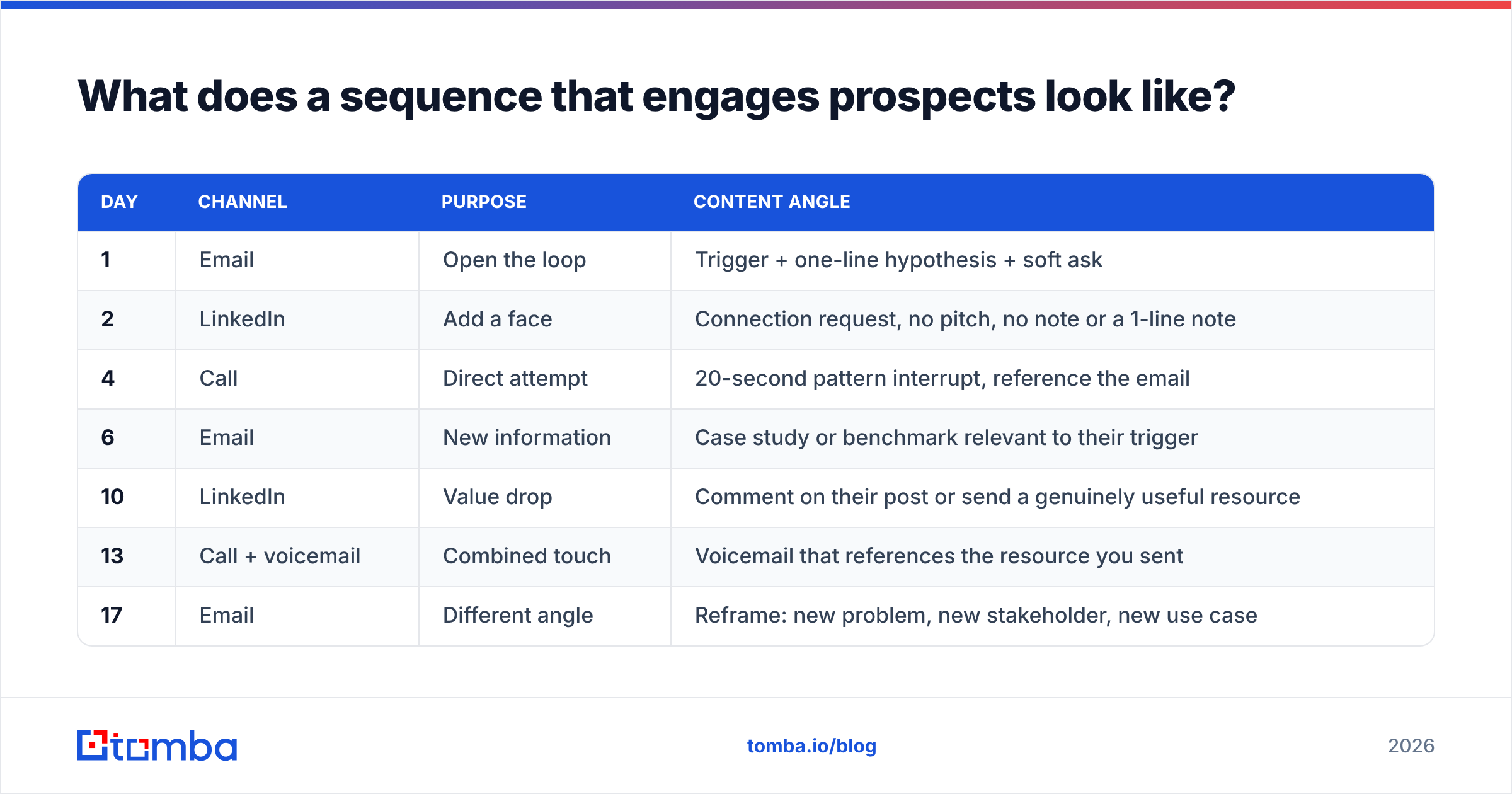
Here is a 24-day, three-channel structure that holds up across most B2B segments. Adjust the volume, keep the shape.
| Day | Channel | Purpose | Content angle |
|---|---|---|---|
| 1 | Open the loop | Trigger + one-line hypothesis + soft ask | |
| 2 | Add a face | Connection request, no pitch, no note or a 1-line note | |
| 4 | Call | Direct attempt | 20-second pattern interrupt, reference the email |
| 6 | New information | Case study or benchmark relevant to their trigger | |
| 10 | Value drop | Comment on their post or send a genuinely useful resource | |
| 13 | Call + voicemail | Combined touch | Voicemail that references the resource you sent |
| 17 | Different angle | Reframe: new problem, new stakeholder, new use case | |
| 24 | Permission close | "Should I close the file?" — highest single-touch reply rate |
Three rules make this work:
- Every touch carries new information. "Just bumping this up" is not a touch, it is a tax on their attention. If you have nothing new, wait until you do.
- Never send more than two consecutive touches on the same channel. Channel switching is what breaks the pattern-recognition that gets you ignored.
- The last email is the best email. The permission close consistently outperforms every other message in a sequence because it removes pressure and asks for a decision that costs nothing.
If you want to pressure-test the copy itself, run drafts through a spam checker before they go live, and test the hook with a subject line tester. Both take under a minute and catch problems that would otherwise cost you a week of a campaign.
How much personalization is enough?#
Enough that the message could not have been sent to anyone else. Not more.
There is a tiered model here that is worth being explicit about:
- Tier 0 — none. Pure template, name merged in. Works only for very high-volume, very low-ACV motions and burns your domain over time.
- Tier 1 — segment personalization. The message is written for "Series B fintech heads of RevOps." No individual research, but every line lands for that segment. This is the sweet spot for most outbound at scale.
- Tier 2 — trigger personalization. Tier 1 plus one specific, recent, verifiable event about this company. Best return on effort for mid-market and up.
- Tier 3 — deep research. A custom point of view on their business, sometimes with a mini-audit or a screenshot of their own funnel. Reserve for your top 50 accounts, because it costs 20–40 minutes each.
- Tier 4 — physical/creative. Gifts, video, direct mail. Only for named enterprise accounts with a defined committee.
Most teams should run Tier 1 as the floor and Tier 2 as the default. Tier 3 is not "better outreach," it is a different play with different economics — using it on a $6k ACV deal loses money even when it works.
A warning about AI-generated personalization: prospects have learned to spot it. A line that reads "I noticed your company is focused on scaling operations" tells the reader you ran a scraper, not that you did homework. If your personalization could be produced by a template with a company name variable, it is Tier 0 wearing a costume. HubSpot's ongoing sales research has tracked this shift in buyer tolerance for years, and the direction is one-way: the bar keeps rising.
Why does contact data quality decide your engagement rate?#
Because every downstream metric is multiplied by it, and multiplication by a bad number is unforgiving.
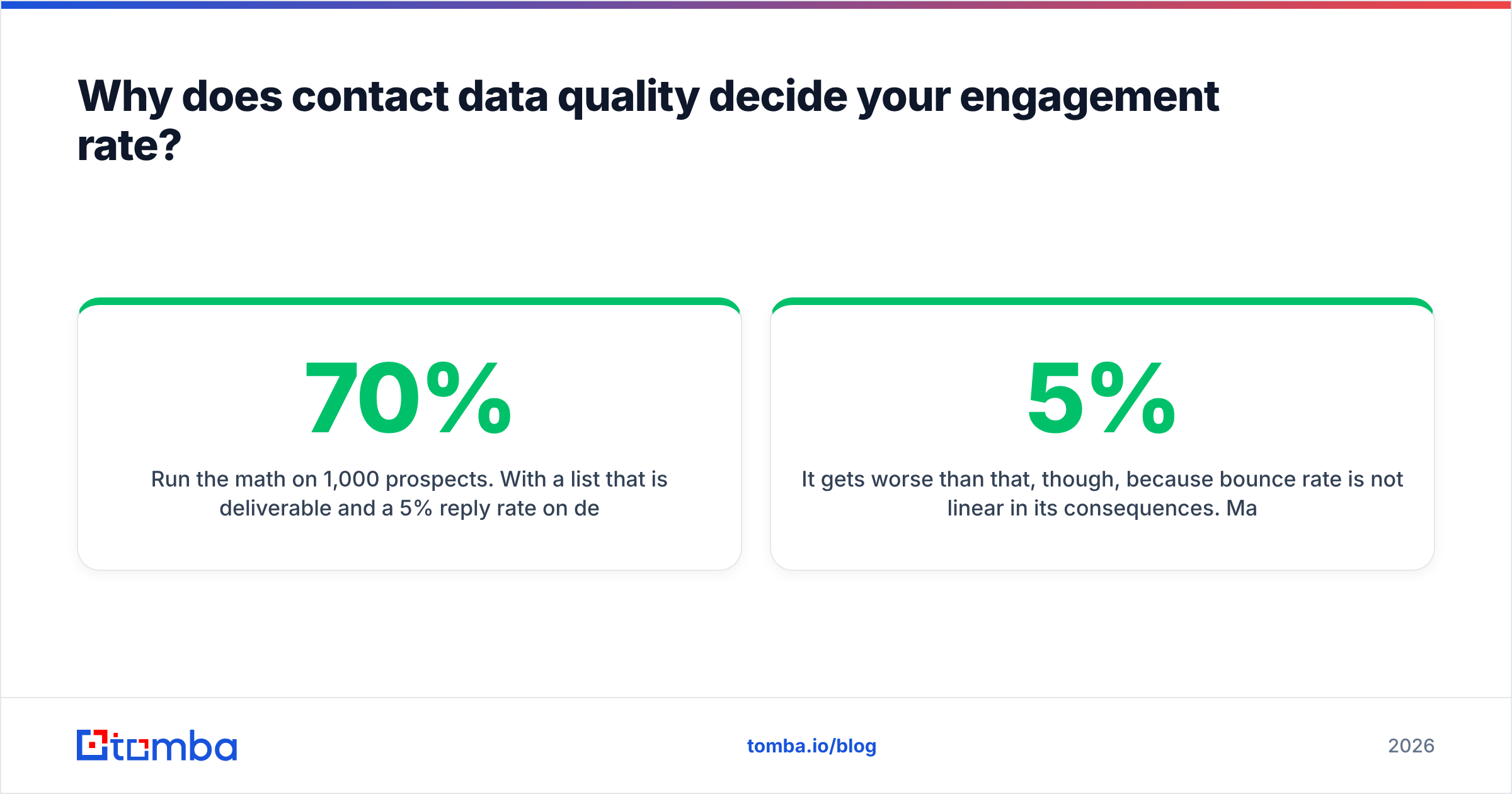
Run the math on 1,000 prospects. With a list that is 70% deliverable and a 5% reply rate on delivered mail, you get 700 delivered and 35 replies. With a 95% verified list at the same reply rate you get 950 delivered and 47 replies — a 34% lift in conversations from zero change to your copy, your timing, or your offer.
It gets worse than that, though, because bounce rate is not linear in its consequences. Mailbox providers treat high bounce volume as a spam signal. Cross roughly 3–5% hard bounces and your inbox placement degrades for the valid addresses too. So the bad half of the list poisons the good half. That is why email deliverability and prospect engagement are not separate topics — they are the same topic viewed from two ends.
Practical hygiene checklist before any campaign:
- Verify every address. Catch-all domains need a separate treatment — use a catch-all verifier rather than guessing.
- Deduplicate across reps and sequences. Two reps hitting the same prospect in the same week is the fastest way to get blacklisted internally at an account.
- Re-verify anything older than 90 days. Decay is continuous, not a one-time event.
- Check your domain's SPF, DKIM, and DMARC before scaling volume. Google and Yahoo's bulk-sender requirements made authentication non-optional, and their published sender guidelines are the authority here, not blog folklore.
- Enrich before you write. Job title, seniority, and company size decide which segment message a prospect gets. Missing fields mean generic messages. A data enrichment pass fills the gaps in bulk.
The tooling landscape here is broad and the differences are real — G2's lead intelligence category is a reasonable neutral place to compare vendors on verified user reviews rather than vendor claims. Providers like BookYourData take a database-first approach with pre-built, filterable lists, which suits teams that want to buy a segment outright; find-and-verify tools like Tomba suit teams building lists from their own ICP definitions and domains. Both models work. Pick based on whether your bottleneck is knowing who to target or reaching who you already identified.
How do you know if your engagement is actually improving?#
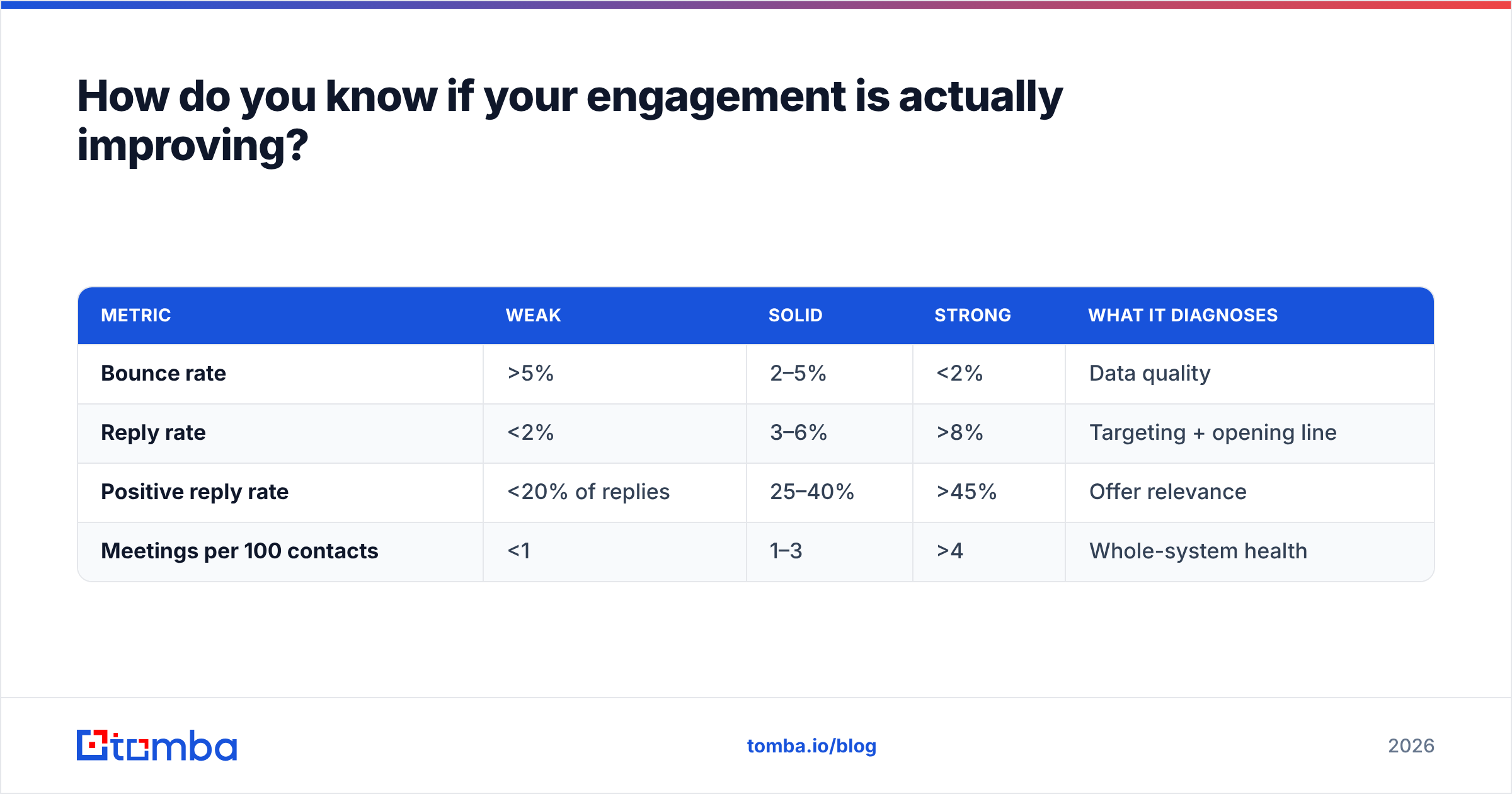
Track four numbers per 100 verified contacts, weekly:
| Metric | Weak | Solid | Strong | What it diagnoses |
|---|---|---|---|---|
| Bounce rate | >5% | 2–5% | <2% | Data quality |
| Reply rate | <2% | 3–6% | >8% | Targeting + opening line |
| Positive reply rate | <20% of replies | 25–40% | >45% | Offer relevance |
| Meetings per 100 contacts | <1 | 1–3 | >4 | Whole-system health |
Read them in order. A bad bounce rate invalidates every metric below it, so fix that first. A good reply rate with a poor positive reply rate means your hook is interesting but your offer is not — that is a copy problem, not a data problem. A good positive reply rate with few meetings means your handoff and scheduling are leaking, which is an ops problem.
Do not track open rate as a primary metric. Since Apple Mail Privacy Protection and its equivalents began pre-fetching images, open rate has been a noisy proxy at best. Watch your response rate instead.
One more discipline: change one variable per week. If you rewrite the subject line, swap the ICP, and change the CTA in the same sprint, you learn nothing from the result. Sequences take three weeks to produce a readable signal, so a two-day A/B test on 40 contacts is noise you will mistake for insight.
What are the fastest wins if you only fix three things?#
If you have limited time this quarter, do these in order:
- Verify and re-verify your list. Cheapest, fastest, largest single lift. Anything above a 3% bounce rate is an emergency.
- Add a permission-close email to the end of every sequence. One message, historically the highest reply rate in the entire sequence, costs an hour to write once.
- Add a second channel. If you are email-only, add LinkedIn. If you are LinkedIn-only, add email. The lift from multi-channel is larger than the lift from any copy change you will make this year.
Everything else — AI personalization, video, gifting, intent data — is a refinement on top of those three. Refinements on a broken base do nothing.
Start with data you can trust#
Engaging prospects is a chain, and the first link is knowing you are writing to a real person at a real address. Use Tomba Email Finder to build verified prospect lists from a domain, a name, or a company, then verify before you send. Free tier gives you 25 searches a month to test your ICP, Starter runs $49/mo, Growth $99/mo, and Pro $249/mo when you scale — full Tomba pricing is public, with no per-seat surprises. Fix the data, then fix the copy. In that order.
Related guides#
// get started
Find, verify and enrich your first contacts today
Start on the free plan with 25 searches a month, then scale when your team is ready.
Free plan · No credit card required · GDPR & CCPA
// about the author