How to Find a Business Owner Name: 9 Proven Methods
Owner names are hidden behind LLC filings, privacy proxies, and generic info@ inboxes. Here are nine practical ways to find the person who actually signs the contract — and reach them.
If you need to know how to find a business owner name, the short answer is that the name is on file somewhere — you just have to know which file. This guide walks through nine ways to get it, from free state records to paid data tools.
TL;DR
- The fastest free route is your state's business registry. Every US LLC and corporation files a name there, and the search takes about a minute.
- WHOIS, LinkedIn, and city license records fill the gaps when the filing shows only a lawyer.
- Outside the US, go to the national register. UK Companies House and Canada's federal registry both name directors for free.
- A name is not a lead. You still need a live email, so pair the name with a domain search or email finder.
- Budget rule: free records for one-off work, paid tools once you need 50 names a week.
How to find a business owner name: why is it so hard?#
The owner does not want sales calls. The law says the owner must be on file. Those two forces pull apart, and the result is a name that exists but hides in plain sight. It sits in systems that were never built to talk to each other.
Think of it like a house. The deed is public at the county office. But no one puts a name on the mailbox. You have to know which office holds the record.
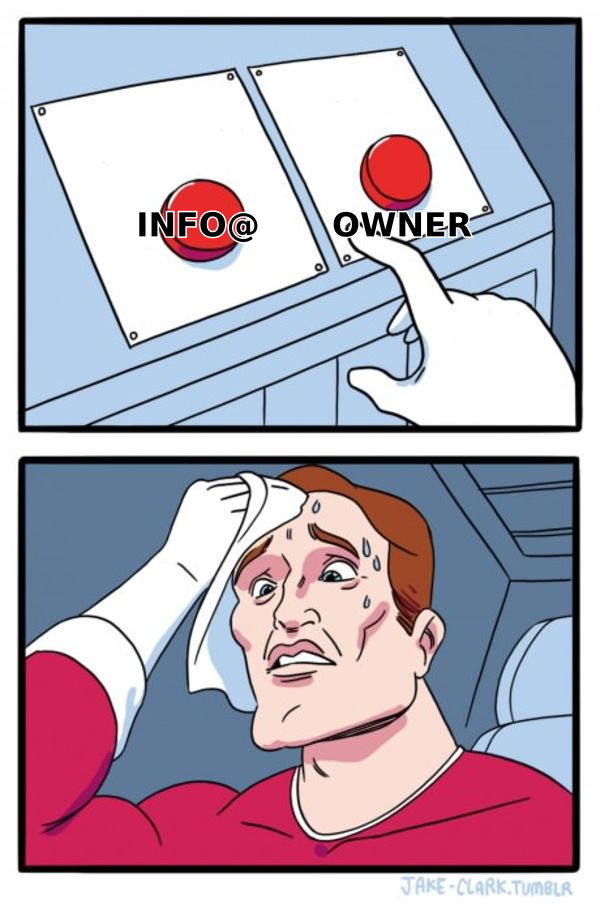
Small firms are the hard case. A three-person HVAC shop has no press page and no team page. Its info@ inbox gets read twice a week. The owner goes by a nickname on Facebook and by a full legal name on the state filing. Neither one matches what you typed into Google.
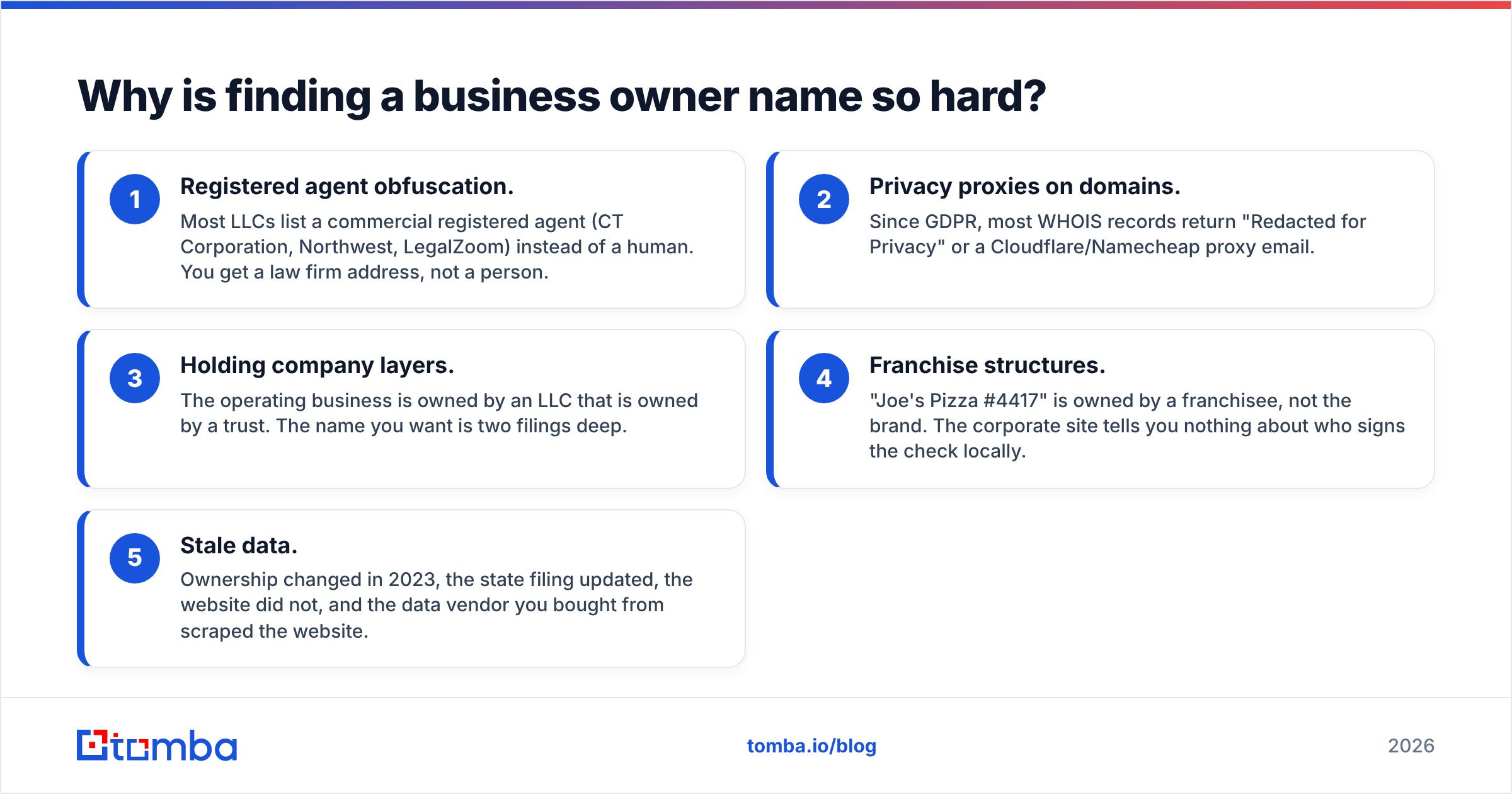
Here is what stands in the way:
- The agent is not the owner. Most LLCs list a paid agent such as CT Corporation, Northwest, or LegalZoom. You get a law firm address, not a person.
- Domain privacy. Since GDPR, most WHOIS records read "Redacted for Privacy" or show a proxy email from Cloudflare or Namecheap.
- Layered ownership. The shop is owned by an LLC. That LLC is owned by a trust. The name you want sits two filings deep.
- Franchises. "Joe's Pizza #4417" belongs to a franchisee, not to the brand. The brand site says nothing about who signs the check.
- Old data. The owner changed in 2023. The state file was updated. The web site was not. Your data vendor scraped the web site.
How to find a business owner name for free?#
Start with the state business registry. For any US firm, the Secretary of State keeps a free, searchable list of every entity in that state. Most of them call it a Division of Corporations.
The whole job takes about 90 seconds:
- Pick the state. Use the firm's street address, not the
.com. A Delaware filing is common, but the working entity is filed where the office sits. - Search the entity name. Try the legal name first, such as "Acme Holdings LLC". If that fails, try the trade name or DBA.
- Open the filing. Look for a field marked Officer, Member, Manager, or Governor. The label shifts from state to state.
- Check the annual report. These reports are often newer than the first filing, and they tend to name the member who runs the firm.
- Note the start date. A 2004 firm with the same manager since 2011 is a stable, owner-run shop. A 2025 firm with an agent and no names may be a shell.
State coverage is uneven. New York and Delaware are thin, and Delaware does not print member names at all. Florida's Sunbiz, Texas SOSDirect, and California's bizfile are much better. They often list full officer names and addresses.
Want the legal backdrop on why the rules differ? The Wikipedia entry on limited liability companies is a decent primer on what each entity type has to disclose.
Which method fits which situation?#
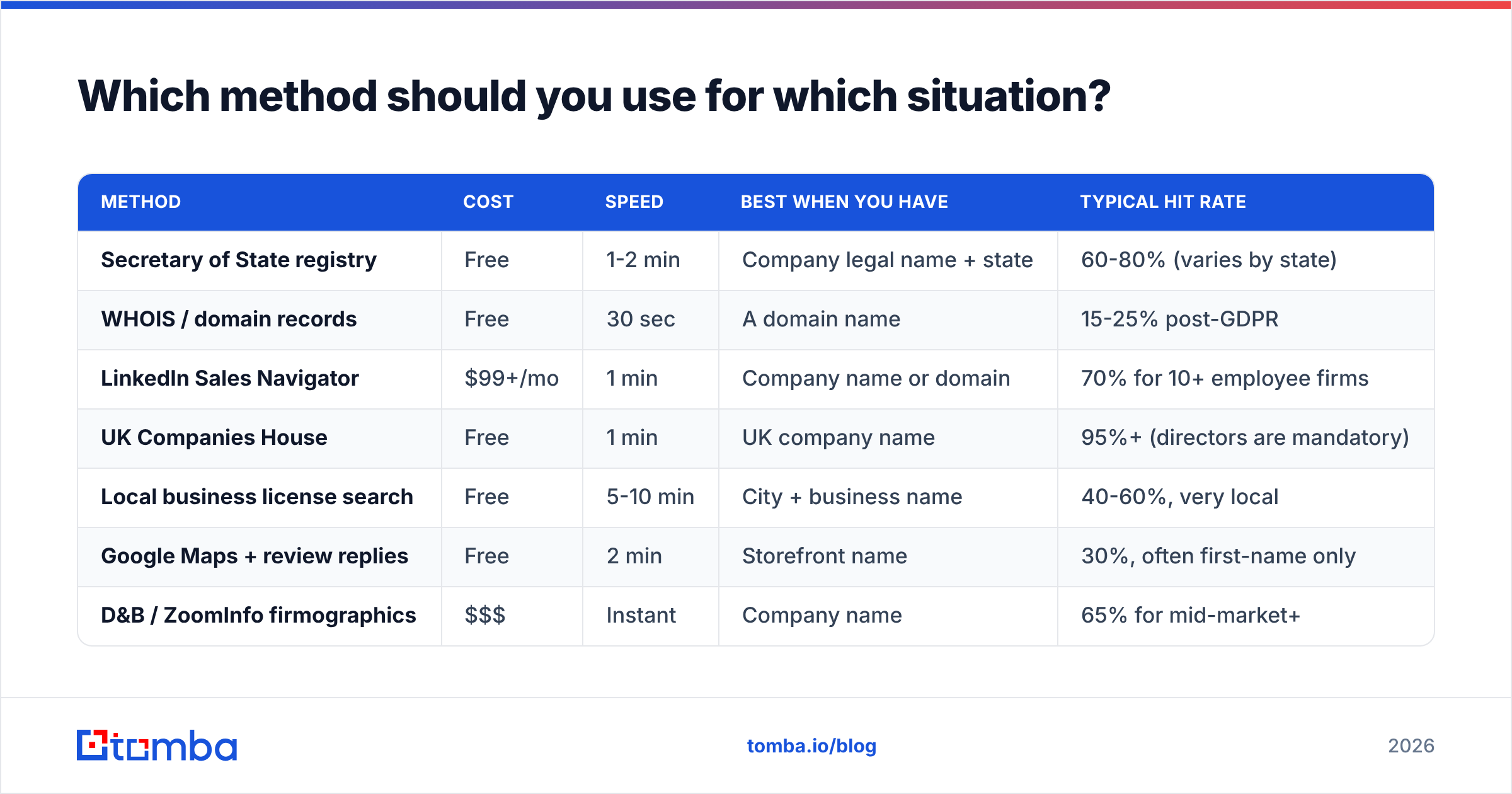
The right tool depends on what you start with. If you have a domain, WHOIS and a domain search beat a registry lookup. If all you have is a shop name, the registry wins.
| Method | Cost | Speed | Best when you have | Typical hit rate |
|---|---|---|---|---|
| Secretary of State registry | Free | 1-2 min | Company legal name + state | 60-80% (varies by state) |
| WHOIS / domain records | Free | 30 sec | A domain name | 15-25% post-GDPR |
| LinkedIn Sales Navigator | $99+/mo | 1 min | Company name or domain | 70% for 10+ employee firms |
| UK Companies House | Free | 1 min | UK company name | 95%+ (directors are mandatory) |
| Local business license search | Free | 5-10 min | City + business name | 40-60%, very local |
| Google Maps + review replies | Free | 2 min | Storefront name | 30%, often first-name only |
| D&B / ZoomInfo firmographics | $$$ | Instant | Company name | 65% for mid-market+ |
| Tomba domain search | Free tier, $49/mo Starter | 10 sec | A domain name | High for role + email pairing |
| Press / news archive search | Free | 5 min | Company name | 25%, skews to funded startups |
Note the split. Free methods are great at proving a name you already suspect. They are weak at finding one from scratch. Paid tools work the other way round. Most old hands run one paid pass, then check the result against a free public record before they write.
How to find a business owner name from a domain?#
Work back from the web site itself before you open any tool.
Read these six pages in order. They cost nothing, and they crack maybe a third of cases on their own:
- /about, /our-story, /team. Obvious, yet often skipped. Owner-run firms love a founder story.
- Terms of Service and Privacy Policy. These are legal pages, so they almost always name the entity in full. "This site is run by Redwood Ventures LLC" gives you the exact string to type into the registry.
- The blog byline. In a small firm, the owner is often the one writing the posts. An author finder pulls the name and email straight from the article page.
- The footer. "© 2026 M. Chen Enterprises" is a name hiding in plain sight.
- Podcast or webinar clips. Search
site:youtube.com "companyname"and see who shows up as the guest. - The WHOIS creation record. Even a redacted record shows the start date and the registrar. WHOIS data from before 2018 is often still open on history lookup sites.
Once you have a domain and a hunch, a domain search returns the named contacts and the email pattern for that domain. That proves the name and hands you the address in one step. It is faster than proving the name and then guessing at firstname@ versus f.lastname@.
Can you check that the name is really the owner?#
Yes, and you should. Knowing how to find a business owner name is only half the job. Proving it is the other half. One source is a guess. Two sources that agree is a fact.
The failure here is common and costly. You find "Sarah Mitchell" listed as the agent on a 2019 filing. You write to her as the owner. It turns out Sarah is the book-keeper who filed the papers. That email lands badly.
Use a three-point check:
- Point one, the legal record. The state filing, business license, or national register names them as member, manager, director, or officer.
- Point two, their own words. Their LinkedIn, the firm's site, or a press quote calls them owner, founder, principal, or CEO of that exact entity.
- Point three, the date. At least one of the two is dated in the last 18 months. Owners change more than people think, and buy-outs have been brisk in trades and service firms since 2021.
If only two of the three line up, use the name but soften the wording. "I gather you lead operations at Acme" survives being wrong. "As the owner of Acme, you…" does not.
Job titles are the other trap. "Founder" on LinkedIn can mean a co-founder who left in 2022 and never fixed the profile. Check the end date on the role, not just the title.
How to find a business owner name outside the US?#
Foreign registers are often better than American ones. Most other countries make director names public with no way out.
UK, Companies House. Free, full, and first rate. You get each director's name, month and year of birth, home country, and the full run of past roles. Anyone who holds 25% or more is listed too. This is the gold standard.
Canada, Corporations Canada plus the provinces. Federal firms list directors. Province by province it varies, though British Columbia and Ontario are fairly open.
EU, the Business Registers Interconnection System. It links the national registers. Germany's Handelsregister and France's Infogreffe both name managing directors, though Germany charges a small fee per document.
Australia, ASIC. You can search company officers, though a full extract costs a few dollars.
Singapore, UAE, and offshore. These get harder as you go. Singapore's ACRA is paid but solid. Classic offshore states are opaque by design, and they are rarely worth the time for sales work.
One catch on foreign work: name formats break tools. "Jean-Pierre de la Croix" yields a very different set of guesses than "John Smith". Run the guesses through an email verifier before you send. A bounce on a small European domain with a strict mail server does real harm to your sender reputation.
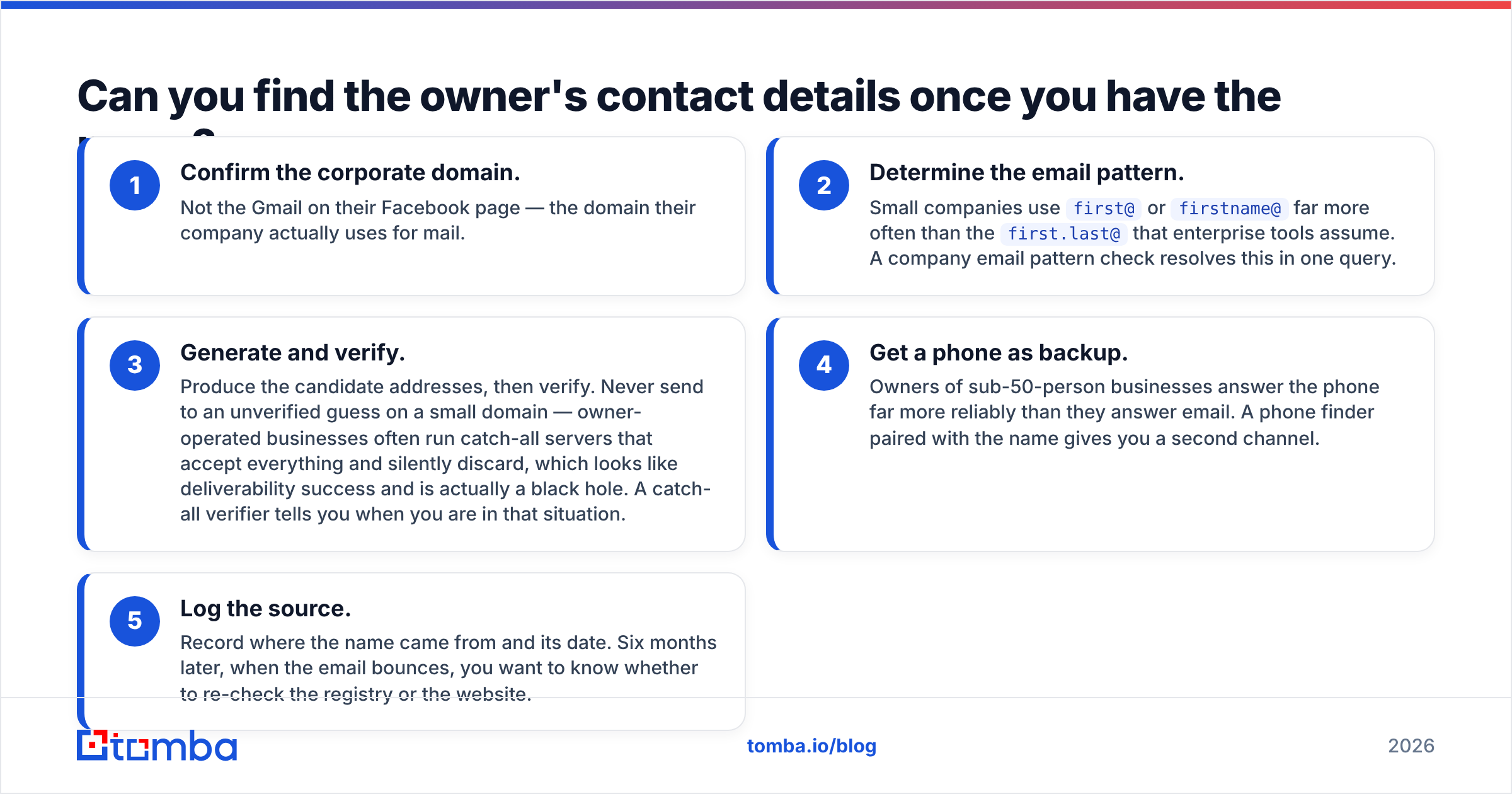
How do you turn the name into contact details?#
This is where the research starts to pay. A name with no way to reach it is trivia.
Here is the sequence that works:
- Confirm the work domain. Not the Gmail on their Facebook page. Use the domain the firm actually sends mail from.
- Work out the email pattern. Small firms use
first@orfirstname@far more often than thefirst.last@that big-company tools assume. A company email pattern check settles this in one query. - Build the address, then test it. Never send to a guess on a small domain.
- Get a phone number as backup. Owners of small firms pick up the phone far more often than they answer email. A phone finder gives you a second channel.
- Log the source. Write down where the name came from and the date. Six months on, when the email bounces, you will know whether to re-check the registry or the site.
Step three earns its own warning. Owner-run firms often use catch-all servers that accept every message and then bin it. That looks like success and is in fact a black hole. A catch-all verifier tells you when you are in one.
For bulk work, say 400 local firms in one metro area, run this as a batch rather than one by one. A bulk email finder takes the domain list and returns named contacts with a score for each. That turns two weeks of grunt work into an afternoon.
One honest note on the ceiling: no tool finds every owner. For a tiny local shop with nothing but a Google Business Profile, the real answer is a phone call to the front desk. Ask who handles vendors. That still works, and it always will.
How do paid tools compare for owner data?#
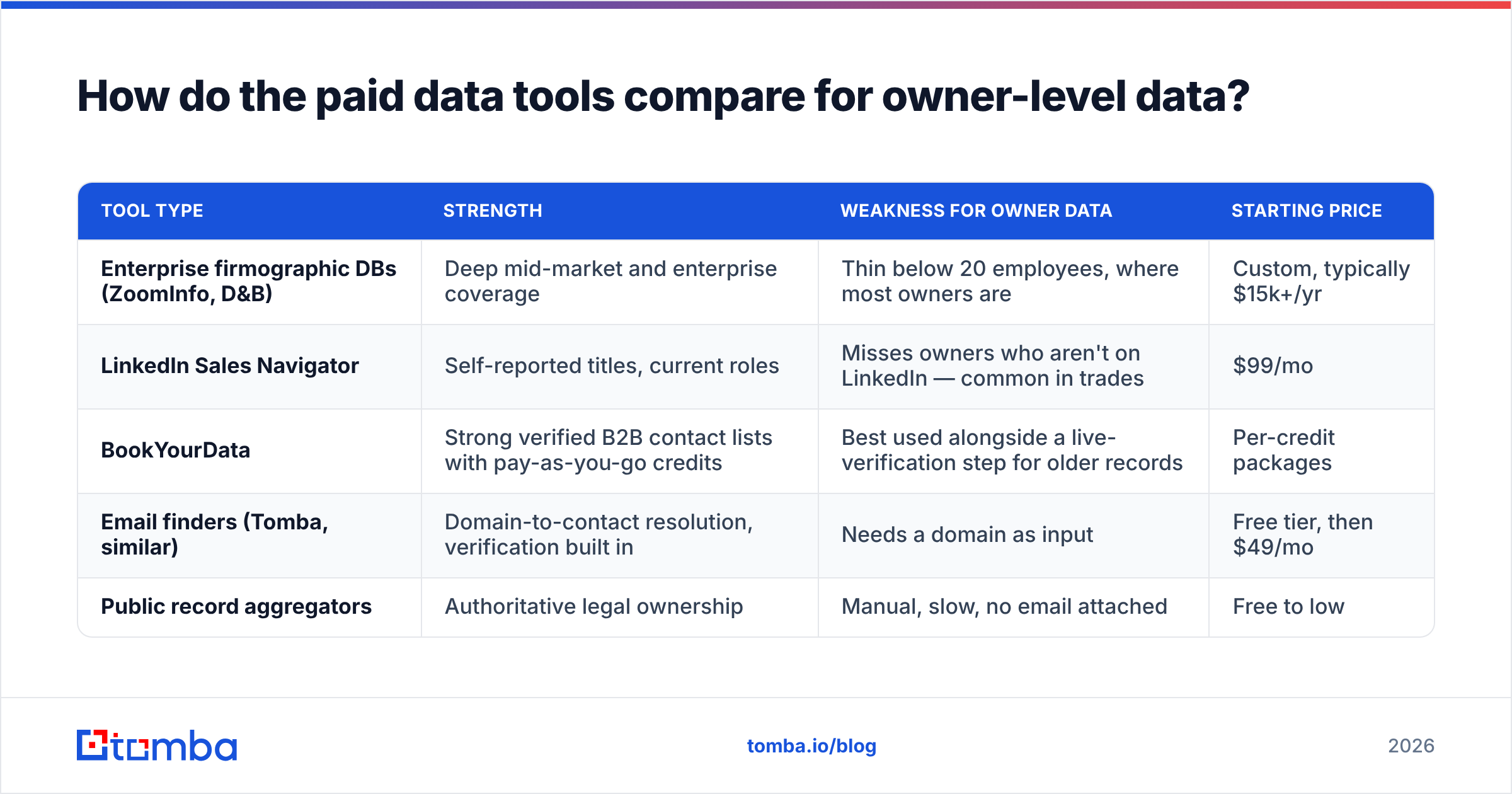
Most B2B data sets are built for big-company org charts, not for owner-run shops. That gap explains a lot of sour trials.
| Tool type | Strength | Weakness for owner data | Starting price |
|---|---|---|---|
| Enterprise firmographic DBs (ZoomInfo, D&B) | Deep mid-market and enterprise coverage | Thin below 20 employees, where most owners are | Custom, typically $15k+/yr |
| LinkedIn Sales Navigator | Self-reported titles, current roles | Misses owners who aren't on LinkedIn — common in trades | $99/mo |
| BookYourData | Strong verified B2B contact lists with pay-as-you-go credits | Best used alongside a live-verification step for older records | Per-credit packages |
| Email finders (Tomba, similar) | Domain-to-contact resolution, verification built in | Needs a domain as input | Free tier, then $49/mo |
| Public record aggregators | Authoritative legal ownership | Manual, slow, no email attached | Free to low |
The real stack has two layers, not one. You need a public or self-reported source for the name, and an email or phone layer for the contact. Teams that try to do both jobs with one big database tend to overpay and still end up with info@.
Weighing a switch? G2's data intelligence category has enough fresh reviews to sort by company size. Read the ones from firms under 50 staff. Their take will match yours far better than a big-firm review will. And check Tomba pricing by credit cost, not by the headline monthly rate. Owner research comes in bursts, and a plan built for 2,000 lookups a month is wrong for a 50-lookup month.
What mistakes should you avoid?#
Treating the agent as the owner. Covered above, but it is still the top error. Agents sell a service. They do not own the firm.
Trusting a scraped "Owner" title with no date. Data firms pass stale titles to each other. A title with no last_verified field is a guess, not a fact.
Skipping the check because the name was hard to find. That is sunk-cost logic. The hours you spent have no bearing on whether the email works.
Using home addresses from public filings. Some state registries print them. Mailing there is legal in most places and a bad look in all of them. Use the work channel.
Ignoring the rules. GDPR treats a named person's work email as personal data. Legitimate interest needs a real case, not a claim. HubSpot's GDPR overview is a readable start if you sell into the EU or UK.
Making it too personal. "I saw you registered Acme LLC in Travis County in 2019" is clever and creepy. Use the research to get the name and the channel right. Then write about their problem, not about your homework.
Where should you start?#
Pick your entry point and take the short path.
- You have a domain: legal pages → domain search → check → send.
- You have a firm name and city: state registry → LinkedIn cross-check → domain search → check.
- You have 100+ domains: bulk enrichment first, then hand work only on the misses.
- You have a shop front and nothing else: Google Business Profile → web site → registry → phone.
Now you know how to find a business owner name, but the work only pays off if it ends in a message that reaches a human. Once you have the name, Tomba's Email Finder turns it into a live, checked address. Type the name and the company domain, and you get the address plus a score. You get 25 free searches a month to try it on your own list before you move to the $49/mo Starter plan. Names are the hard part. Getting the email right should not be.
Related guides#
// get started
Find, verify and enrich your first contacts today
Start on the free plan with 25 searches a month, then scale when your team is ready.
Free plan · No credit card required · GDPR & CCPA
Get the Tomba newsletter
Product and data updates
// about the author