How to Find an Owner of a Business: 9 Proven Methods
Nine repeatable ways to identify who actually owns a company — from state registries and WHOIS to LinkedIn and email pattern lookup — plus how to verify the contact before you send anything.
If you need to know how to find an owner of a business, start here. Nine methods, ranked by speed. Most of them cost nothing.
TL;DR
- The fastest free path is the state or national business registry. It names the registered agent, the officers, and often the owner. Start there, not on Google.
- WHOIS, LinkedIn, and the company's own legal pages (Terms, Privacy, Imprint) fill the gaps when the registry lists only an agent.
- In small businesses, the owner is usually listed as "Member," "Managing Member," "President," or "Registered Agent." It is not always the loudest name on the website.
- A name without a reachable email is a dead end. Pair the name with an email finder and verify it before you send.
- Budget: $0 for identification in most places. About $49/mo if you need contact data at volume.
Why is finding a business owner harder than it looks?#
Because "owner" is not one thing. A 4-person landscaping LLC has one member who signs everything. A 200-person manufacturer is messier. It has shareholders who never appear in public, a CEO who does, and a holding company in Delaware in between.
When you say "find the owner," you usually mean one of three targets:
- The legal owner — the person or entity that holds the equity. Named in state filings, cap tables, or annual reports.
- The decision-maker — whoever can sign your deal. Often a founder, GM, or ops lead, not the equity holder.
- The accountable human — the person you can email today and hear back from. Most sales, hiring, and M&A outreach needs this one.
Pick your target before you start. The research path splits right away. Chase the legal owner of a franchised Subway and you land on a parent company in Miami. Chase the accountable human and you get the franchisee down the street who actually buys the uniforms.
How to Find an Owner of a Business: The 9 Methods That Work#
Here are the nine methods that hold up, ranked by speed for a typical US small or mid-sized business.
State business registry search. Every US state runs a free entity search through the Secretary of State. Type in the business name and you get the entity type, the registered agent, the officers, the formation date, and the status. It is the highest-yield source, and it is free.
WHOIS / domain records. The domain record may list a registrant name, an organization, and an admin email. Privacy proxies hide most of it now. The organization field and old creation-date records still leak through.
Legal pages on the company site. Terms of Service, Privacy Policy, DMCA notices, and EU or German Imprint pages must name a legal entity. They often name an officer too. Scroll to the footer.
LinkedIn company page, People tab. Filter for "Owner," "Founder," "Managing Director," or "Proprietor." Then check tenure. Someone listed since the formation date in the registry is almost always an owner.
Local licensing and permit databases. Liquor licenses, contractor licenses, health inspections, and DBA ("doing business as") filings name individual owners, because liability attaches to a person.
Property and county records. If the business owns or rents its building, the county assessor or recorder ties a name to the address.
Court and lien records. UCC filings, small-claims dockets, and judgments name the responsible principal. Useful for older businesses with no website.
Press, podcasts, and local news. One interview quote ("owner Maria Delgado told us…") can settle what three databases could not. Search the business name plus "owner" in quotes.
Email pattern lookup and enrichment. Once you have a first name, a last name, and a domain, tools resolve the working address. This is the step that turns research into a conversation.
How do you use state and national business registries?#
Start with the state where the business actually operates. If the trail goes cold, check Delaware, Nevada, and Wyoming. Those three host a large share of holding entities.
The mechanics are the same everywhere. Search by entity name, then open the filing detail. Read for:
- Entity type. "LLC" means members. "Inc." means officers and shareholders. A sole proprietorship or a DBA filing means one named human.
- Registered agent. Sometimes the owner. Sometimes a $99/yr service like CT Corporation or Northwest. If the agent is a law firm or a service company, it tells you nothing. Keep going.
- Officers and members list. Gold. Names, and sometimes addresses.
- Annual report filings. These are updated yearly and often list the person who signed. The signer is usually an owner or a senior officer.
- Filing history. An amendment that adds or removes a member is an ownership change with a date on it.
Outside the US, the equivalents are often better. Companies House in the UK publishes named directors, shareholdings, and persons of significant control, all for free. Germany's Handelsregister, Canada's provincial registries, and Australia's ASIC do much the same. The EU imprint rule (Impressum) means most German, Austrian, and Swiss sites name a managing director on the site itself.
One rule of thumb. If a US filing lists only a registered agent and no officers, that state does not require member disclosure. Jump to the licensing databases in method 5 instead. Those almost always name a person.
What does the WHOIS and website trail tell you?#
Domain records got weaker after GDPR. They are still worth 30 seconds. Run the domain through a WHOIS lookup. Note the registrant organization, the creation date, and any email that is not a proxy. Then work the site itself:
- Footer legal links (Terms, Privacy, Imprint, Accessibility) name the legal entity.
/about,/team,/our-story— founder bios, often with photos and full names.- Careers pages — "report to" lines expose the org chart.
- Archived copies of the site from before a privacy cleanup. Old about-pages give up a lot.
- Run a website tech stack check. Billing contacts sometimes show up in DNS records.
Want the whole staff list for a domain instead of one name? A domain search returns known addresses and roles in one pass. It often surfaces the owner faster than reading three registry PDFs.
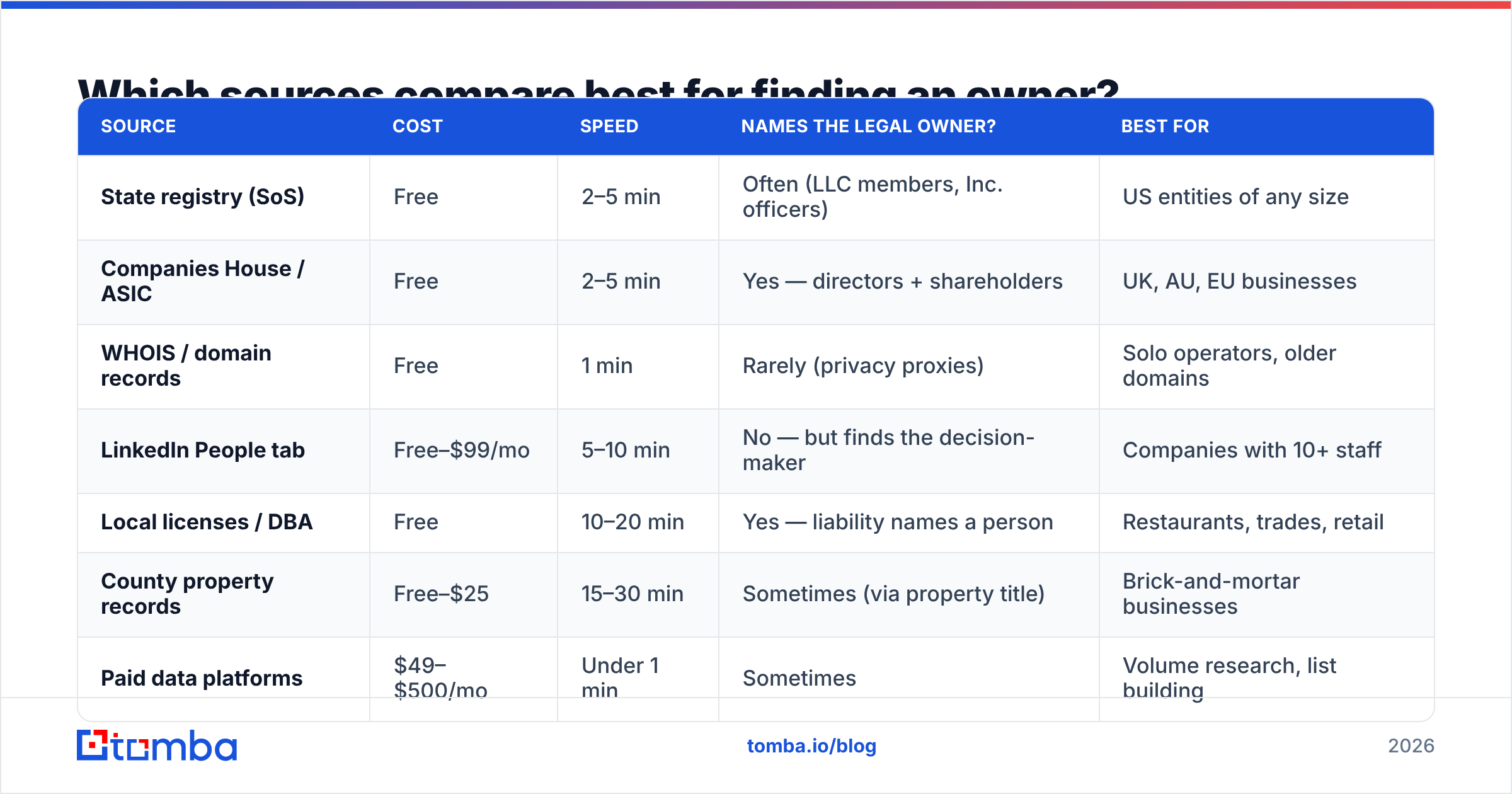
Which sources compare best for finding an owner?#
| Source | Cost | Speed | Names the legal owner? | Best for |
|---|---|---|---|---|
| State registry (SoS) | Free | 2–5 min | Often (LLC members, Inc. officers) | US entities of any size |
| Companies House / ASIC | Free | 2–5 min | Yes — directors + shareholders | UK, AU, EU businesses |
| WHOIS / domain records | Free | 1 min | Rarely (privacy proxies) | Solo operators, older domains |
| LinkedIn People tab | Free–$99/mo | 5–10 min | No — but finds the decision-maker | Companies with 10+ staff |
| Local licenses / DBA | Free | 10–20 min | Yes — liability names a person | Restaurants, trades, retail |
| County property records | Free–$25 | 15–30 min | Sometimes (via property title) | Brick-and-mortar businesses |
| Paid data platforms | $49–$500/mo | Under 1 min | Sometimes | Volume research, list building |
| Email finder + verifier | Free tier–$49/mo | Under 1 min | No — resolves the contact | Turning a name into a reply |
The honest read: free public records win on accuracy for ownership. Paid tools win on speed for contactability. Most people need both, in that order. Registries tell you who. Enrichment tools tell you how to reach them.
How do you find the owner of a very small or unlisted business?#
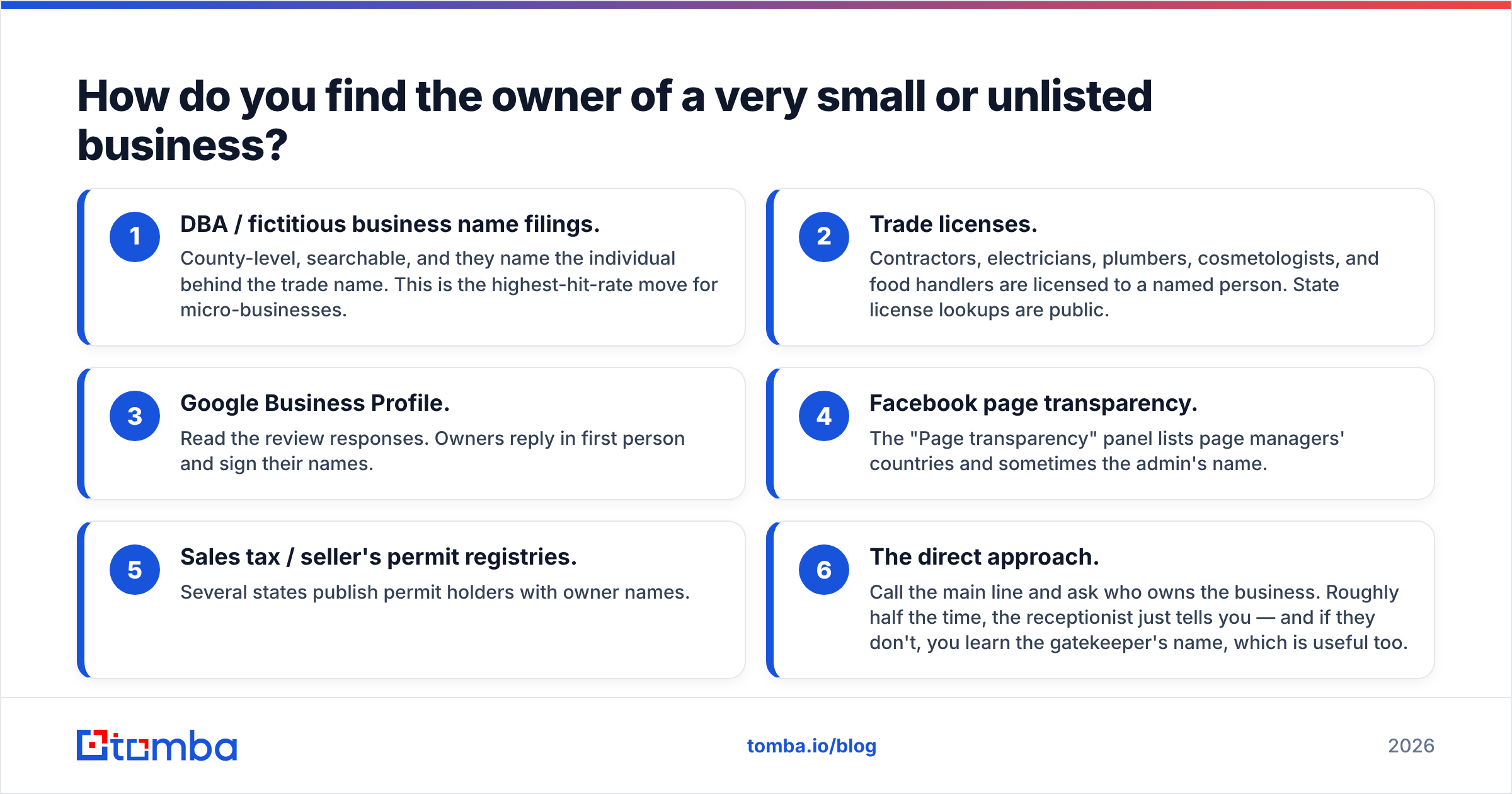
This is the hard case: the 6-person HVAC company with a Facebook page and no website. Work it in this order.
DBA or fictitious business name filings. County-level and searchable. They name the individual behind the trade name. Best hit rate for micro-businesses.
Trade licenses. Contractors, electricians, plumbers, cosmetologists, and food handlers are licensed to a named person. State license lookups are public.
Google Business Profile. Read the review responses. Owners reply in first person and sign their names.
Facebook page transparency. The "Page transparency" panel lists page managers' countries, and sometimes the admin's name.
Sales tax and seller's permit registries. Several states publish permit holders with owner names.
The direct approach. Call the main line and ask who owns the business. About half the time the receptionist just tells you. If not, you learn the gatekeeper's name, which also helps.
Do not skip method 6 out of shyness. For a business under 20 people, a two-minute call beats an hour of database work. Got a name but no line to call? Run a phone finder or a reverse email lookup to close the loop.
How do you turn an owner's name into a working email?#
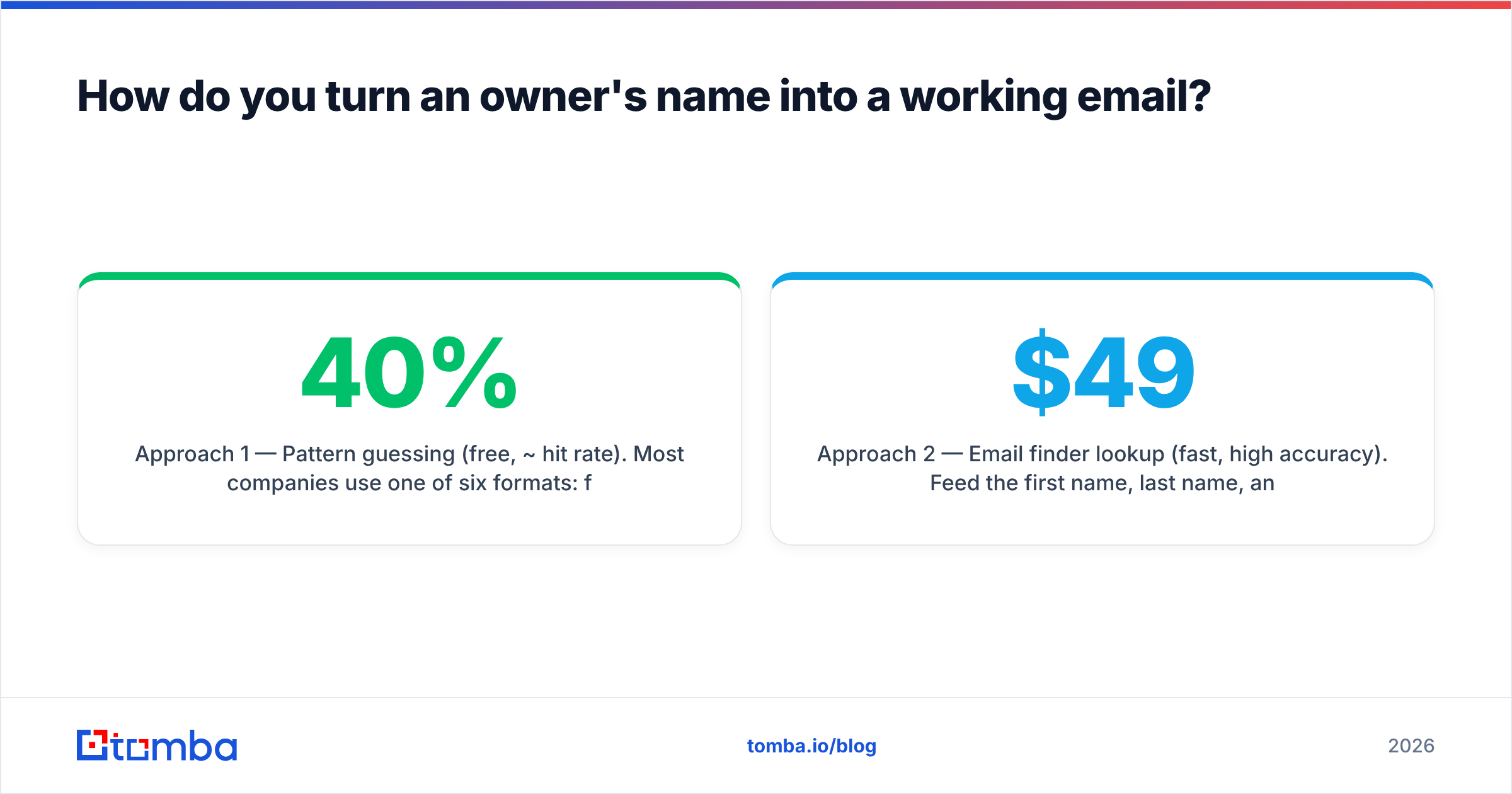
You have "Maria Delgado" and "delgadolandscape.com." Now what? Three approaches, in rising order of reliability.
Approach 1 — Pattern guessing (free, about a 40% hit rate). Most companies use one of six formats: first.last@, first@, flast@, firstl@, first_last@, lastf@. A company email pattern check tells you which format a domain really uses. That beats blind guessing by a wide margin. Generate the candidates with an email permutator, then verify each one.
Approach 2 — Email finder lookup (fast, accurate). Feed the first name, last name, and domain into an email finder. You get back one address, a confidence score, and the sources it was seen on. Owner-level contacts usually resolve in seconds. Tomba's free tier covers 25 searches a month, which is enough to test the workflow before you commit. Paid plans start at $49/mo on Starter and $99/mo on Growth for list-scale work. Peers here — Hunter, Findymail, and BookYourData for pre-built lists — are all credible. Pick based on whether you need per-lookup precision or bulk volume.
Approach 3 — Enrichment from a partial record. Have a LinkedIn URL, a phone number, or a generic company email? Data enrichment fills in the rest: title, verified email, company size, and social handles.
Whichever route you take, verify before you send. Owner emails on small-business domains are often forwarding aliases or catch-alls. A catch-all domain accepts every address at the SMTP layer, so naive validation proves nothing. Run the address through an email verifier. If the domain is catch-all, use a catch-all verifier that tests real deliverability. A bounced first email to an owner is the worst possible hello, and it drags down your sender reputation at the same time.
What are the legal and ethical limits here?#
All nine methods above use public records, published business information, or lawful commercial data. That is normal business research. Credit bureaus, journalists, and every B2B sales team do it daily. Three rules still apply:
- Business contact data vs. personal data. A work email on a company domain is business contact data. A home address pulled from property records is personal. Using it for cold sales is creepy, and in several places it is restricted. Stay on the business side of that line.
- GDPR and CCPA. To contact people in the EU or California you need a lawful basis. Legitimate interest works for relevant B2B outreach. You also need a clear sender identity and a working opt-out. The ICO's guidance on direct marketing is the plainest reference.
- CAN-SPAM basics. Accurate headers. No deceptive subject lines. A physical address. Honor unsubscribes fast. Cheap to follow, expensive to ignore.
Good data vendors say where their records come from. Before you buy, read the vendor's data sources page. If a provider will not say where the data came from, that is your answer.
What does a repeatable owner-research workflow look like?#
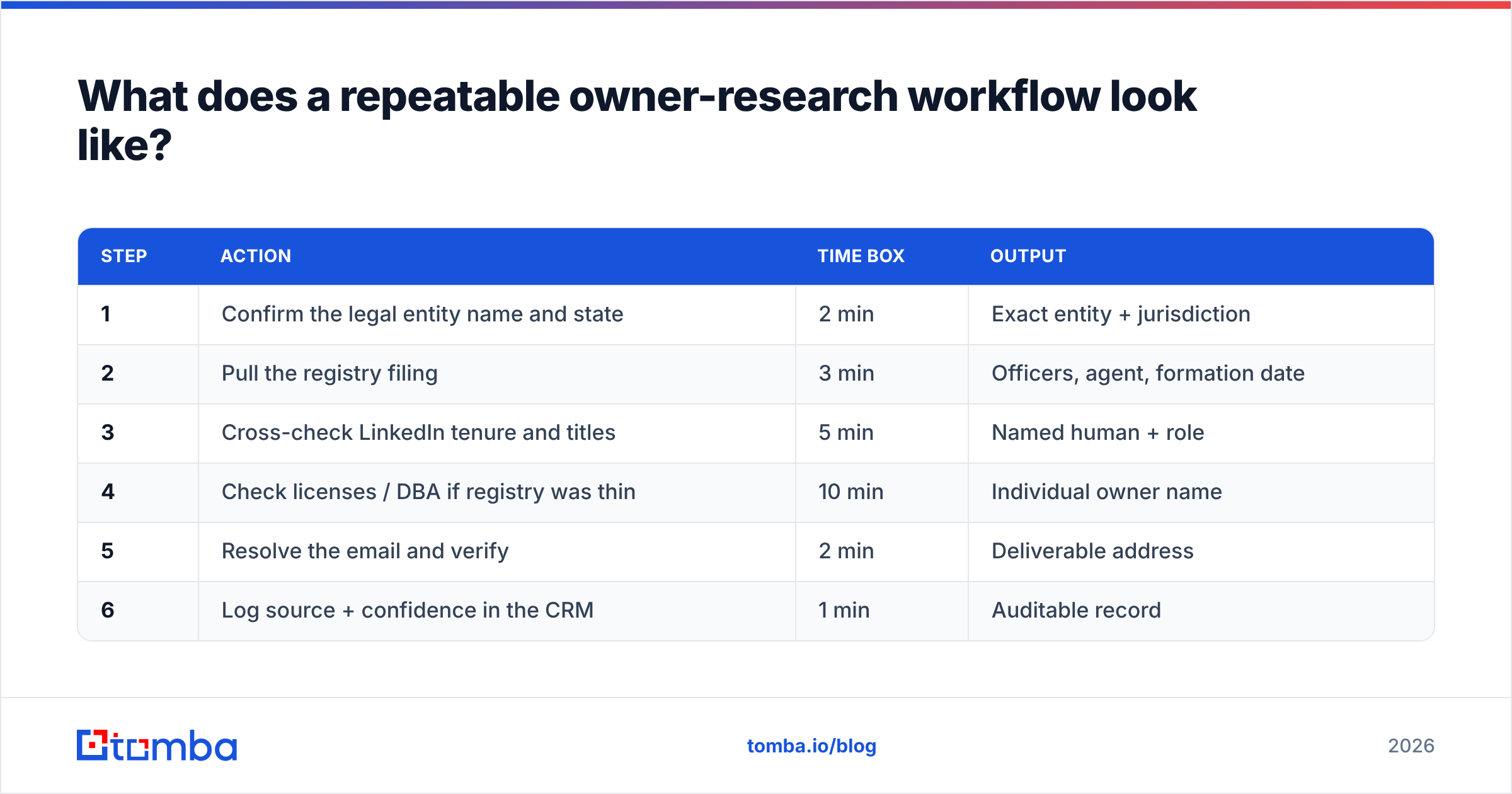
Here is the sequence that holds up across hundreds of lookups. Time-box each step. If a step fails, move on instead of grinding.
| Step | Action | Time box | Output |
|---|---|---|---|
| 1 | Confirm the legal entity name and state | 2 min | Exact entity + jurisdiction |
| 2 | Pull the registry filing | 3 min | Officers, agent, formation date |
| 3 | Cross-check LinkedIn tenure and titles | 5 min | Named human + role |
| 4 | Check licenses / DBA if registry was thin | 10 min | Individual owner name |
| 5 | Resolve the email and verify | 2 min | Deliverable address |
| 6 | Log source + confidence in the CRM | 1 min | Auditable record |
That table is all of how to find an owner of a business, compressed into six steps.
Two habits separate the people who are good at this from the people who are not.
First, log your source. Six weeks later you will not recall whether "Maria Delgado, Owner" came from a 2019 annual report or a podcast. That difference decides whether you open with confidence or with a question.
Second, record a confidence level. "Registry-confirmed member" and "LinkedIn says Founder" are not the same fact. Your opening line should match the one you actually have. Push both fields into your CRM so the next person on your team does not redo the work.
Doing this for more than a handful of companies? Batch it. Drop your company names and domains into a bulk email finder run. Or wire the lookup into your stack with the Tomba API, so enrichment fires the moment a company enters your pipeline. Manual research is the right tool for 10 targets and the wrong tool for 1,000.
Where should you start today?#
Pick one target business and run steps 1–3 above. You will have a name inside ten minutes. You will also see which of the three owners — legal, decision-maker, or accountable human — you actually needed. That one dry run teaches you more about your market's data quality than any guide can.
Now you know how to find an owner of a business, and the bottleneck moves to contactability. That is where Tomba Email Finder fits. Give it a first name, a last name, and a domain. It returns a verified professional email with a confidence score and the public sources it was seen on. The free tier covers 25 searches a month — enough to work through your shortlist before you choose between the $49/mo Starter plan and the $99/mo Growth plan. Compare the tiers on the Tomba pricing page. Pair every find with the email verifier so your first message to an owner actually lands.
Related guides#
// get started
Find, verify and enrich your first contacts today
Start on the free plan with 25 searches a month, then scale when your team is ready.
Free plan · No credit card required · GDPR & CCPA
// about the author