How to Find Clients for Digital Marketing Agency Owners in 2026
Referrals dry up. Upwork races to the bottom. Here is how to find clients for digital marketing agency owners in 2026: nine tested channels, real cost-per-client math, and an outbound system you can build in a week.
Most agency owners ask the same thing every quarter: how to find clients for digital marketing agency work without burning the domain or the budget. The short answer is to pick one niche, then run one fast channel for cash and one slow channel for compounding. The nine channels below are ranked by what a client actually costs.
TL;DR
- Referrals and repeat business still close the fastest, but they are not a growth channel — they are a lagging indicator of work you already did.
- Cold outbound to a tightly-defined niche is the only channel you fully control. It works when your list is clean and your offer is specific; it fails when either is generic.
- Marketplaces (Upwork, Fiverr Pro, Clutch) fill your calendar fastest and pay the least per hour. Use them for cash flow, not for building an agency.
- The realistic cost per closed client in 2026 ranges from roughly $0 (referral) to $4,000+ (paid search for high-ticket retainers). Know your number before you pick a channel.
- The highest-leverage build for most sub-20-person agencies: one narrow niche + a verified contact list + a 4-touch sequence tied to a visible, specific problem on the prospect's site.
Why is finding clients harder for agencies than for SaaS?#
Because you are selling a promise, not a product. A prospect can trial software in ten minutes. They cannot trial your strategist. That single fact reshapes every channel decision you make.
It also means your buying committee is smaller but more skeptical. In most SMB and mid-market deals you talk to one person: a founder, a marketing director, a head of ecommerce. Almost all of them have been burned before, and nearly every agency prospect has an ex-agency story. Your job in the first touch is not to pitch. It is to prove you looked at their business for more than four seconds.
Three structural realities to plan around:
- Long, lumpy sales cycles. A $5K/month retainer typically takes 3–8 weeks from first contact to signature. A $25K/month retainer takes 3–6 months and usually involves procurement.
- Churn eats acquisition. Median agency client tenure sits somewhere between 12 and 24 months. If you acquire ten clients a year and lose eight, you have a treadmill, not a business.
- Your positioning is your best lead magnet. "Full-service digital marketing" competes with 40,000 other listings. "Paid social for DTC supplement brands doing $2M–$10M" competes with nine.
The rest of this guide assumes you have picked, or are willing to pick, a niche. Every channel below performs 3–5x better inside a niche.
How to find clients for digital marketing agency owners: the nine channels#
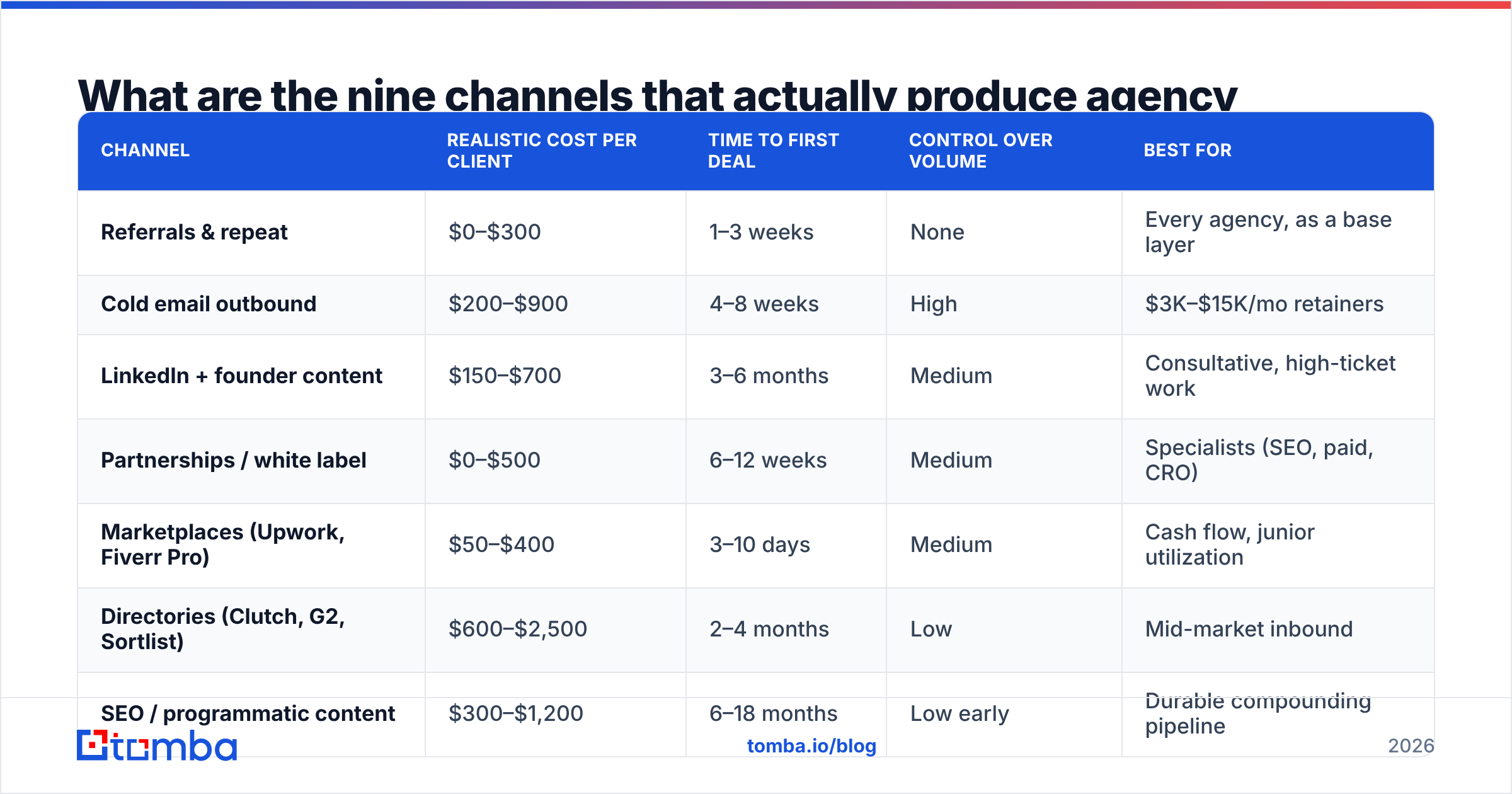
Here is the honest ranking, based on how sub-50-person agencies typically report their pipeline sources. Cost per client (CPC here means cost-per-client, not per click) is a working range, not a guarantee.
| Channel | Realistic cost per client | Time to first deal | Control over volume | Best for |
|---|---|---|---|---|
| Referrals & repeat | $0–$300 | 1–3 weeks | None | Every agency, as a base layer |
| Cold email outbound | $200–$900 | 4–8 weeks | High | $3K–$15K/mo retainers |
| LinkedIn + founder content | $150–$700 | 3–6 months | Medium | Consultative, high-ticket work |
| Partnerships / white label | $0–$500 | 6–12 weeks | Medium | Specialists (SEO, paid, CRO) |
| Marketplaces (Upwork, Fiverr Pro) | $50–$400 | 3–10 days | Medium | Cash flow, junior utilization |
| Directories (Clutch, G2, Sortlist) | $600–$2,500 | 2–4 months | Low | Mid-market inbound |
| SEO / programmatic content | $300–$1,200 | 6–18 months | Low early | Durable compounding pipeline |
| Paid search (Google Ads) | $1,500–$4,500 | 2–5 weeks | High | Proven offers, $10K+ retainers |
| Events & communities | $400–$2,000 | 2–6 months | Low | Enterprise and regional plays |
Read the table as a portfolio, not a menu. Most healthy agencies run one fast channel (outbound or marketplaces) to pay this quarter's bills and one slow channel (content, SEO, partnerships) to pay next year's.

How do you build a cold outbound system that does not get ignored?#
Cold outbound is where most agencies fail, and the failure is almost always upstream of the email itself. You cannot copywrite your way out of a bad list.
Run it in five steps.
1. Define the trigger, not the persona. "Marketing directors at ecommerce companies" is a persona. A trigger is observable: they just launched a Shopify store, they are running Meta ads with a broken pixel, their blog stopped publishing eight months ago, they posted a job for a paid media manager. Triggers give you a first line no competitor can copy.
2. Build the company list before the contact list. Pull 200–400 companies matching your trigger. Use LinkedIn Sales Navigator filters, BuiltWith or a website tech stack check, ad libraries, job boards, or scraped directories. Stay under 500 — you want to research each one for two minutes, which is impossible at 5,000.
3. Find and verify the decision maker's email. This is where lists rot. Guessed patterns like first.last@ are right maybe 60% of the time, and the misses cost you sender reputation, not just replies. Run each domain through a domain search to see the actual pattern and who holds which role. Then push every address through an email verifier before it touches your sending inbox. Anything catch-all should go through a dedicated catch-all verifier rather than being sent blind or discarded.
4. Write for one company, then template the skeleton. The structure that consistently works:
- Line 1 — the observation. Something true about their business you could only know by looking. No "I came across your website."
- Line 2 — the implication. What that observation costs them, in their units (revenue, CAC, hours).
- Line 3 — the proof. One comparable client, one number, one sentence. Not a case-study link.
- Line 4 — the ask. Low-commitment and specific. "Want the 3-page teardown I made? No call needed" beats "Do you have 15 minutes Thursday?"
5. Sequence four touches over 12 days, then stop. Email 1 (day 0), email 2 with a new angle (day 3), LinkedIn connect (day 6), email 3 as a one-line breakup (day 12). Sequences longer than five touches raise complaint rates far more than they raise replies.
Keep daily volume per inbox to 20–40 sends and watch your bounce rate like a hawk. A bounce rate above 3% is a signal your list building broke, not that you need more inboxes. Google and Yahoo's bulk-sender requirements — documented in Google's sender guidelines — make list hygiene a deliverability issue, not a nicety. Poor hygiene will quietly kill your sender reputation across every domain you own.
Which lead-sourcing tools should an agency actually pay for?#
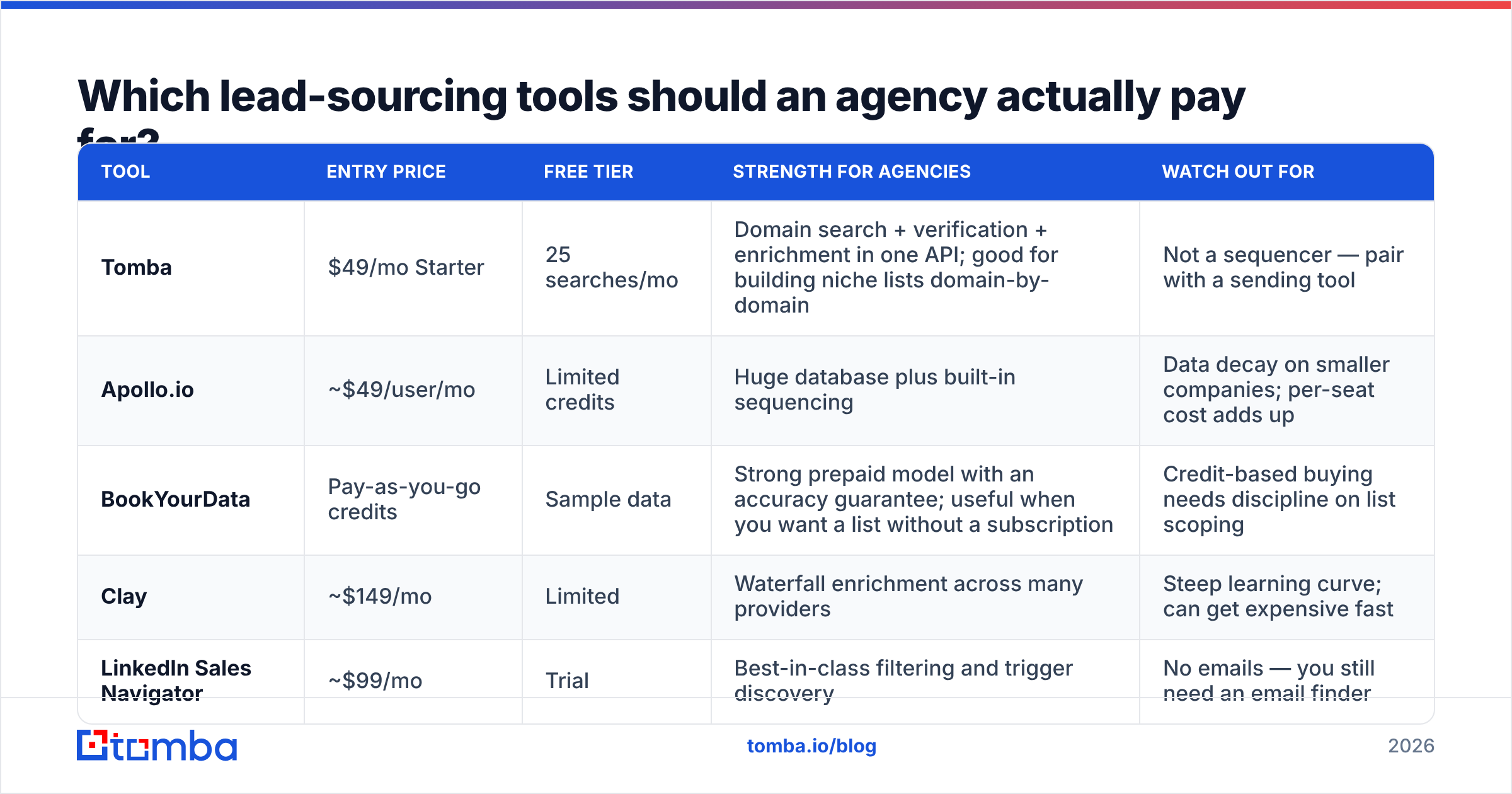
Tool sprawl is a real tax. Most agencies under 20 people need exactly three things: a place to find contacts, a place to send, and a place to track. Here is how the common contact-sourcing options compare for agency use specifically.
| Tool | Entry price | Free tier | Strength for agencies | Watch out for |
|---|---|---|---|---|
| Tomba | $49/mo Starter | 25 searches/mo | Domain search + verification + enrichment in one API; good for building niche lists domain-by-domain | Not a sequencer — pair with a sending tool |
| Apollo.io | ~$49/user/mo | Limited credits | Huge database plus built-in sequencing | Data decay on smaller companies; per-seat cost adds up |
| BookYourData | Pay-as-you-go credits | Sample data | Strong prepaid model with an accuracy guarantee; useful when you want a list without a subscription | Credit-based buying needs discipline on list scoping |
| Clay | ~$149/mo | Limited | Waterfall enrichment across many providers | Steep learning curve; can get expensive fast |
| LinkedIn Sales Navigator | ~$99/mo | Trial | Best-in-class filtering and trigger discovery | No emails — you still need an email finder |
The practical stack for a five-person agency in 2026: Sales Navigator for targeting, a finder plus verifier for contact data, one sending tool with domain rotation, and your CRM. That is under $400/month total and it will support 300–500 well-researched prospects a month. See Tomba pricing if you want to size the data layer specifically. The Growth plan at $99/mo covers most agencies running a single outbound motion. The API is worth wiring up if you enrich inside Google Sheets or a CRM view rather than exporting CSVs.
Also worth knowing: if your niche is publishers, SaaS blogs, or content-driven businesses, the author finder turns a byline into a direct contact faster than any manual LinkedIn search.
Do referrals and partnerships scale, or are they just luck?#
They scale — but only if you treat them as a process instead of a hope.
The mistake is passive referral behavior: doing good work and waiting. The fix is a referral system with three components.
- A named ask, on a schedule. At the 90-day mark of every retainer, ask: "Who else do you know running the same play?" Named, not general. General asks ("know anyone?") convert near zero.
- A reciprocal partner list. Identify 10–15 non-competing agencies and freelancers who serve your exact buyer — a web dev shop if you do SEO, an email agency if you do paid social. Send them one qualified lead before you ask for anything. The reciprocity is the whole mechanism.
- A white-label lane. Larger agencies routinely subcontract specialist work. Margin is thinner (usually 30–50% of retail) but acquisition cost is near zero and the deals recur. Many specialist shops run 40% of revenue through white label without ever telling their end market.
Partnerships have one failure mode worth naming: partner leads convert well but arrive unpredictably. Never build your headcount plan on a partner channel you cannot forecast within ±30%.

How should you use directories, marketplaces, and paid channels?#
These three get lumped together and shouldn't be. They serve different jobs.
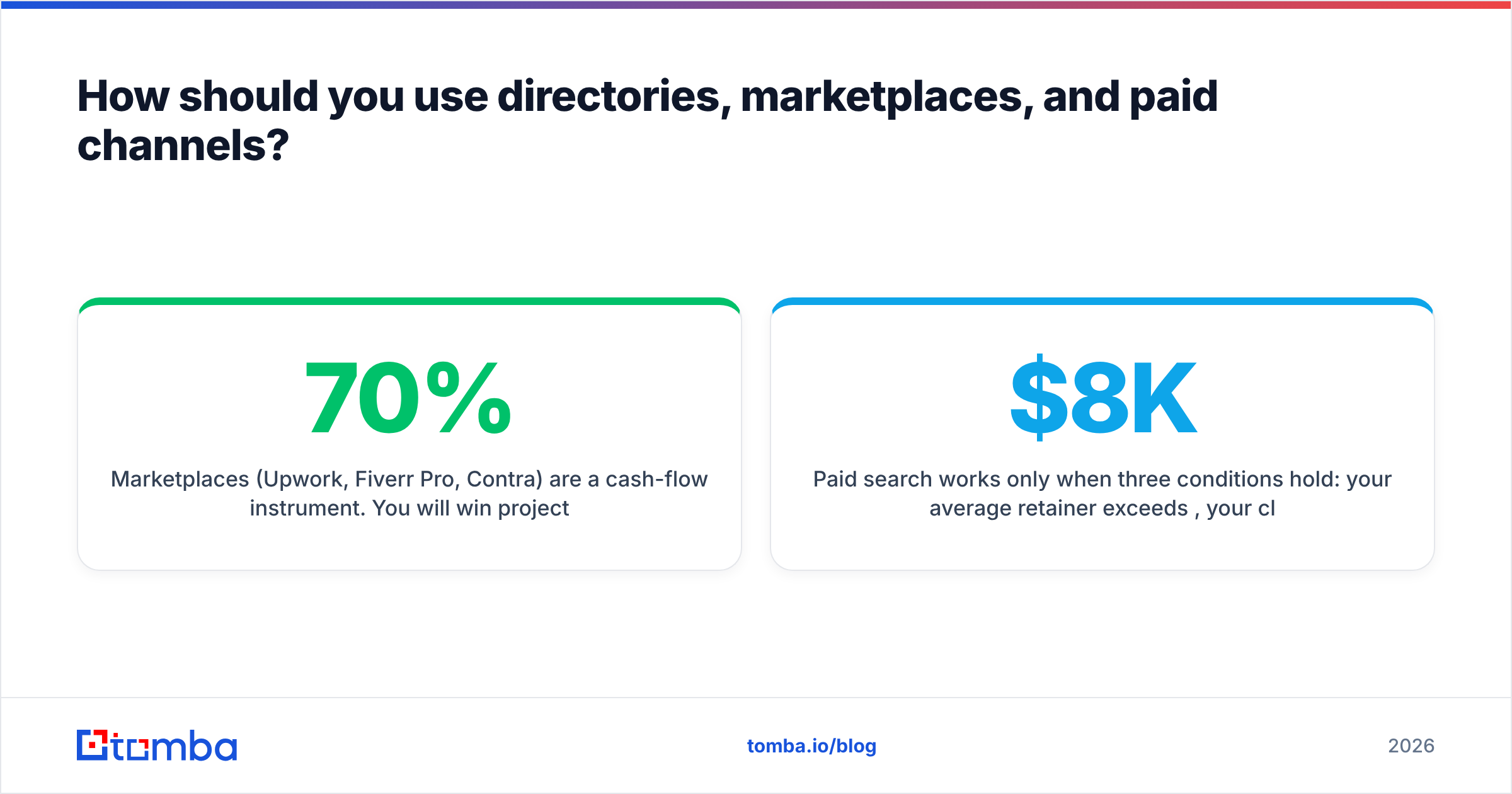
Marketplaces (Upwork, Fiverr Pro, Contra) are a cash-flow instrument. You will win projects in days, at 40–70% of your direct rate, from buyers who compare on price. Their legitimate use: filling junior capacity between retainers, and testing whether a new service offer gets any bites at all before you invest in a landing page. Their illegitimate use: as your primary pipeline. Marketplace clients rarely graduate to strategic retainers, and the platform owns the relationship.
Directories (Clutch, G2, Sortlist, DesignRush) are a mid-market inbound play with a long ramp. What actually moves the needle is review volume with specifics — a Clutch profile with 22 detailed reviews outranks a paid-featured listing with four. Budget 90 days of chasing past clients for reviews before you evaluate the channel. Buyers on these platforms are typically further along in their process, so lead quality is high and lead volume is low.
Paid search works only when three conditions hold: your average retainer exceeds $8K/month, your close rate from qualified call to signed is above 20%, and you have a landing page with real proof. Miss any one and you are subsidizing clicks from competitors and students. Commercial-intent keywords in this category ("ecommerce ppc agency") routinely run $25–$60 per click, which is why the cost-per-client range in the table above starts at $1,500.
Communities and events deserve more credit than they get. A single Slack community where your buyers congregate, participated in honestly for six months, will out-produce a year of LinkedIn broadcasting. The rule: answer 20 questions before you mention what you sell once. HubSpot's research on inbound consistently finds that trust-first channels produce lower churn, which matters more than acquisition speed once you account for tenure.
What does a realistic 90-day client acquisition plan look like?#
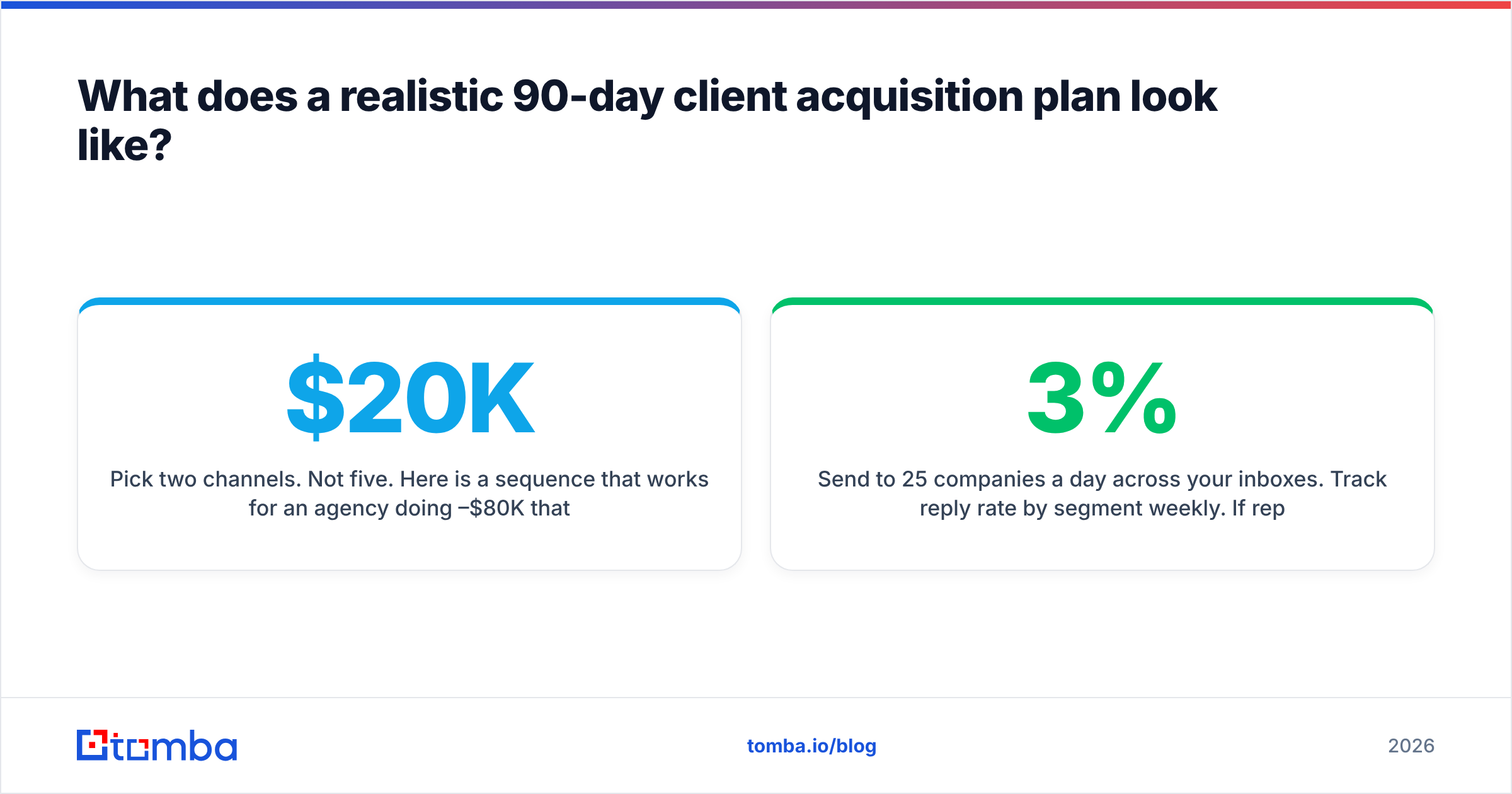
Pick two channels. Not five. Here is a sequence that works for an agency doing $20K–$80K/month that needs three new retainers.
Days 1–14 — Positioning and list. Write your niche statement in one sentence with a dollar range and a service. Build a 300-company list against a single trigger. Find and verify contacts; anything that fails verification gets dropped, not guessed. Set up two sending domains and warm them.
Days 15–45 — Outbound at volume with feedback. Send to 25 companies a day across your inboxes. Track reply rate by segment weekly. If reply rate is under 3% after 300 sends, the problem is targeting or offer — rewrite the offer before touching subject lines. Simultaneously, run your referral ask across every current and past client.
Days 46–75 — Double down and add proof. Kill the worse-performing segment. Take the best-performing observation from your outbound and turn it into a public teardown — a post, a video, a free audit template. This is where outbound and content compound: your emails cite the post, the post warms the next email.
Days 76–90 — Systematize. Whatever produced meetings gets an SOP, a template, and a weekly time block. Whatever didn't gets cut without sentiment. Layer in bulk enrichment so list-building stops eating your Mondays — a bulk email finder run once a week beats ad-hoc lookups every day.
Track four numbers and nothing else: contacts added, replies, qualified calls, signed retainers. Your response rate between the first two tells you if your targeting is right. The ratio between the last two tells you if your sales process is.
What mistakes kill agency pipelines fastest?#
- Selling deliverables instead of outcomes. "12 blog posts a month" invites price comparison. "Organic pipeline for a $4M SaaS" does not.
- Sending on your primary domain. One bad campaign takes down your client communication. Always use separate sending domains.
- No disqualification criteria. If you cannot describe who you say no to, you will fill your roster with clients who churn at month four.
- Skipping verification to save $50. A 12% bounce rate on 500 sends does more damage to your domain than 500 good sends do good.
- Chasing every channel at once. Two channels executed to depth beat six executed to a demo.
Where should you start this week?#
The whole question of how to find clients for digital marketing agency owners collapses into one first move: build a clean list. Everything downstream depends on it. Pick one trigger, pull 100 companies, find the right decision-maker at each, and verify every address before a single send. That one discipline separates a 6% reply rate from a 0.8% reply rate and a burned domain.
The Tomba Email Finder is built for exactly this step. Search by domain, name, or company, and get the verified address with a confidence score and its sources. Export it straight into your sequencer or CRM. The free tier gives you 25 searches a month to test the approach on a small batch. Starter at $49/mo covers a real first campaign, and Growth at $99/mo handles a sustained outbound motion without you thinking about credits again. Build the list properly, and the rest of the system finally has something solid to stand on.
Related guides#
Ready to find emails that actually work?
Join 150,000+ professionals who stopped guessing and started sending. Free credits on signup — no credit card required.
Get the Tomba newsletter
Practical outbound tactics and product updates — once every two weeks.
About the author