How to Find Companies That Need Outsourcing: 7 Buying Signals
Companies broadcast outsourcing demand months before they buy — in job ads, funding rounds, support queues, and tech stacks. Here are the seven signals to track and the exact workflow to turn each one into a contactable decision-maker.
TL;DR
- Companies that need outsourcing almost never say so. They signal it — through stalled hiring, a sudden funding round, a support backlog, or a tech stack they clearly cannot staff.
- The seven highest-yield signals are: repeat job postings, hiring freezes with growing revenue, funding events, geographic expansion, RFP and procurement notices, tech-stack additions, and public complaints about turnaround time.
- Signal sources beat static lists. A job board scrape from this week outperforms a 40,000-row purchased database from last quarter.
- The bottleneck is never finding companies — it is reaching the one person who owns the budget. That is a domain-search-plus-verification problem.
- Budget roughly 60% of your effort on signal collection and 40% on contact discovery and verification. Anything you send to an unverified address is wasted spend.
What does it actually mean when a company "needs outsourcing"?#
A company needs outsourcing when the cost of doing something internally exceeds the cost of buying it — and someone inside the building has already noticed.
That last clause matters more than the first. Plenty of companies should outsource and never will. The ones worth prospecting are the ones where internal pain has surfaced: a director who has re-posted the same engineering role four times, a COO who just closed a Series B and has twelve months to triple output, a support lead whose first-response time has slipped past 24 hours.
Outsourcing demand is a timing problem disguised as a targeting problem. The same company is a bad prospect in March and a great one in July. Your job is to build a system that catches them in July.
Three categories of buyer show up over and over:
- Capacity-constrained — demand exceeds internal headcount. They are hiring and losing. Fastest to close.
- Cost-constrained — they have the headcount but the unit economics do not work. Usually post-layoff or pre-profitability. Slower, price-sensitive, but sticky once won.
- Capability-constrained — they need a skill they do not have and cannot reasonably hire (a niche compliance specialty, a language, a legacy stack). Highest margin, smallest volume.
Pick one. Prospecting for all three at once produces messaging that lands with none of them.
Which buying signals actually predict outsourcing demand?#
These are ranked by how reliably they convert, based on how outsourcing and agency sellers typically report their pipeline sources.
- A job post that has been live 45+ days, or reposted. The single strongest signal in the set. A role that will not fill is a budget already approved and a manager already frustrated. Track the posting date, not just the existence of the ad.
- Volume hiring in one function. Six customer-support reqs in one quarter means the support model is breaking. Six is a signal; one is noise.
- A funding round in the last 90 days. New capital comes with growth commitments and a hard clock. Series A and B companies outsource because building the internal team takes longer than the board will wait.
- Geographic or language expansion. A US company announcing EMEA operations needs local-hours coverage, localisation, and compliance work it does not have staff for.
- New technology in the stack. A company that just deployed a new ERP, data warehouse, or e-commerce platform needs implementation and ongoing maintenance. Stack-detection tools like BuiltWith surface these additions.
- Public procurement notices and RFPs. Slow and competitive, but the intent is explicit — they have already decided to buy.
- Complaints about response time. Review sites, app store reviews, and social replies. When customers publicly say "no one got back to me for a week," someone internal is being asked about it in Monday's meeting.
The signals compound. A company with a 60-day-old job posting and a recent funding round is not twice as likely to buy — in practice it is dramatically more likely, because both signals point to the same underlying pressure. Score prospects on how many signals stack, not on any single one.
Where do you find these companies at scale?#
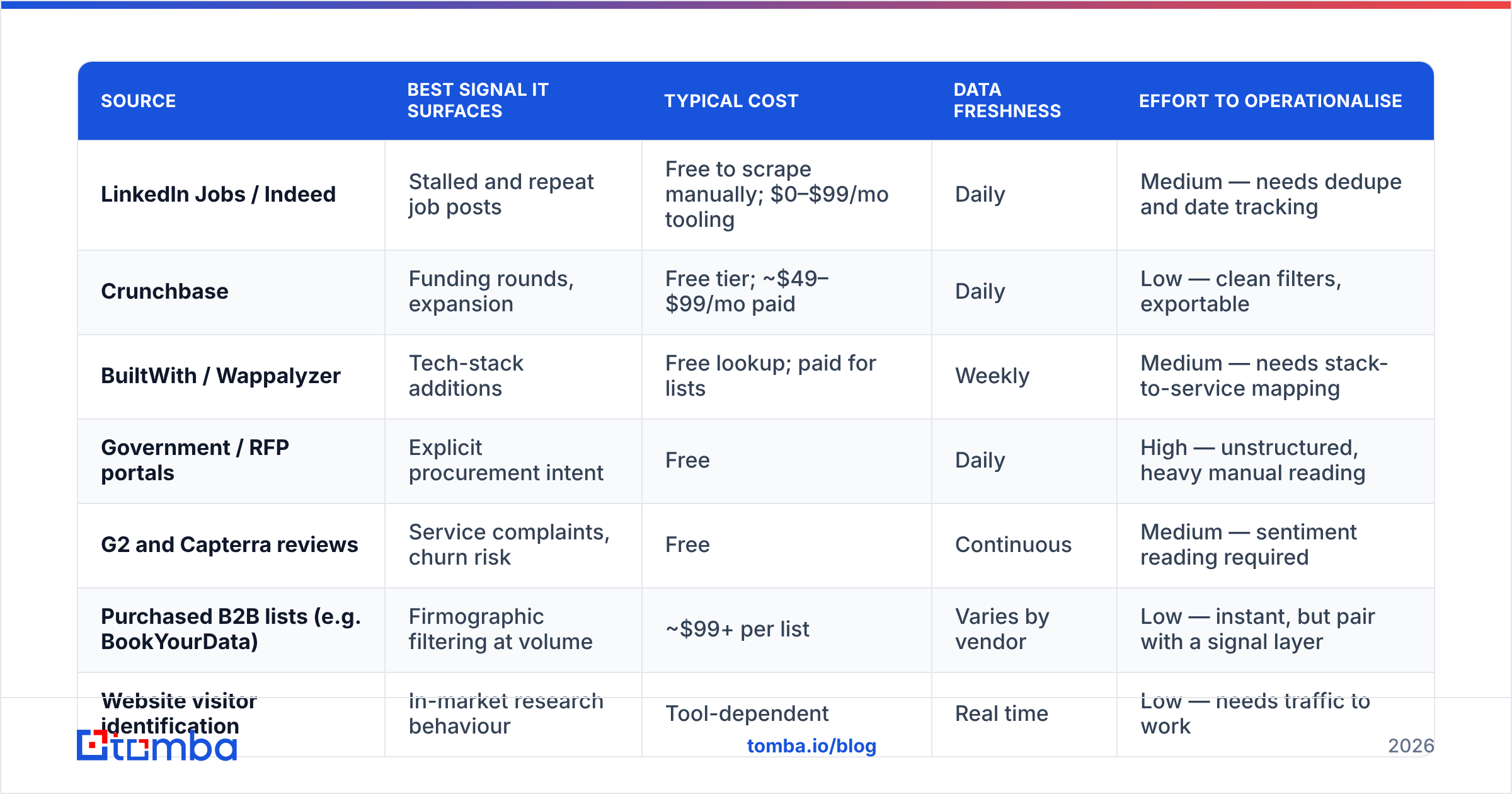
Every source trades freshness against effort. Here is the honest comparison.
| Source | Best signal it surfaces | Typical cost | Data freshness | Effort to operationalise |
|---|---|---|---|---|
| LinkedIn Jobs / Indeed | Stalled and repeat job posts | Free to scrape manually; $0–$99/mo tooling | Daily | Medium — needs dedupe and date tracking |
| Crunchbase | Funding rounds, expansion | Free tier; ~$49–$99/mo paid | Daily | Low — clean filters, exportable |
| BuiltWith / Wappalyzer | Tech-stack additions | Free lookup; paid for lists | Weekly | Medium — needs stack-to-service mapping |
| Government / RFP portals | Explicit procurement intent | Free | Daily | High — unstructured, heavy manual reading |
| G2 and Capterra reviews | Service complaints, churn risk | Free | Continuous | Medium — sentiment reading required |
| Purchased B2B lists (e.g. BookYourData) | Firmographic filtering at volume | ~$99+ per list | Varies by vendor | Low — instant, but pair with a signal layer |
| Website visitor identification | In-market research behaviour | Tool-dependent | Real time | Low — needs traffic to work |
Two notes on that table. First, purchased lists are not the enemy — BookYourData and similar providers are genuinely useful when you need firmographic coverage in a market you do not know yet. The mistake is treating a list as a signal. Buy the list to define the universe, then layer job-post and funding data on top to decide who to contact this week.
Second, if you already get meaningful site traffic, website visitor reveal is the cheapest signal you will ever collect. A company reading your "IT staff augmentation pricing" page for four minutes has told you more than any third-party intent score.
How do you turn a signal into a contactable decision-maker?#
This is where most outsourcing pipelines quietly die. You end up with 300 companies showing real pain and no way to reach anyone who can sign.
The workflow that works:
Step 1 — Resolve the company to a domain. Job boards and news articles give you a company name, not a domain. Normalise every row to a root domain first; everything downstream depends on it.
Step 2 — Map the role, not the person. For capacity-driven outsourcing, the buyer is usually the hiring manager named in the job ad, or their direct superior. For cost-driven, it is Finance or the COO. For capability-driven, it is a functional director. Decide the title pattern before you search.
Step 3 — Pull the contact set for the domain. A domain search returns the published addresses at that company along with the pattern the company uses (first.last@, flast@, and so on). Once you have the pattern, you can construct addresses for named individuals who are not publicly listed.
Step 4 — Find the specific person. With a name and a domain, an email finder resolves the individual address rather than a generic info@. Generic inboxes are where outsourcing pitches go to die — they are routed to whoever handles vendor spam.
Step 5 — Verify before you send. Run every address through an email verifier. Outsourcing outreach is a long-cycle, high-value play; you cannot afford a burned sending domain in month two because 18% of your list bounced.
Step 6 — Enrich for personalisation. Pull the job title, the specific open role, the funding amount. One concrete detail in the first line is worth more than three paragraphs of positioning.

What does a repeatable weekly workflow look like?#
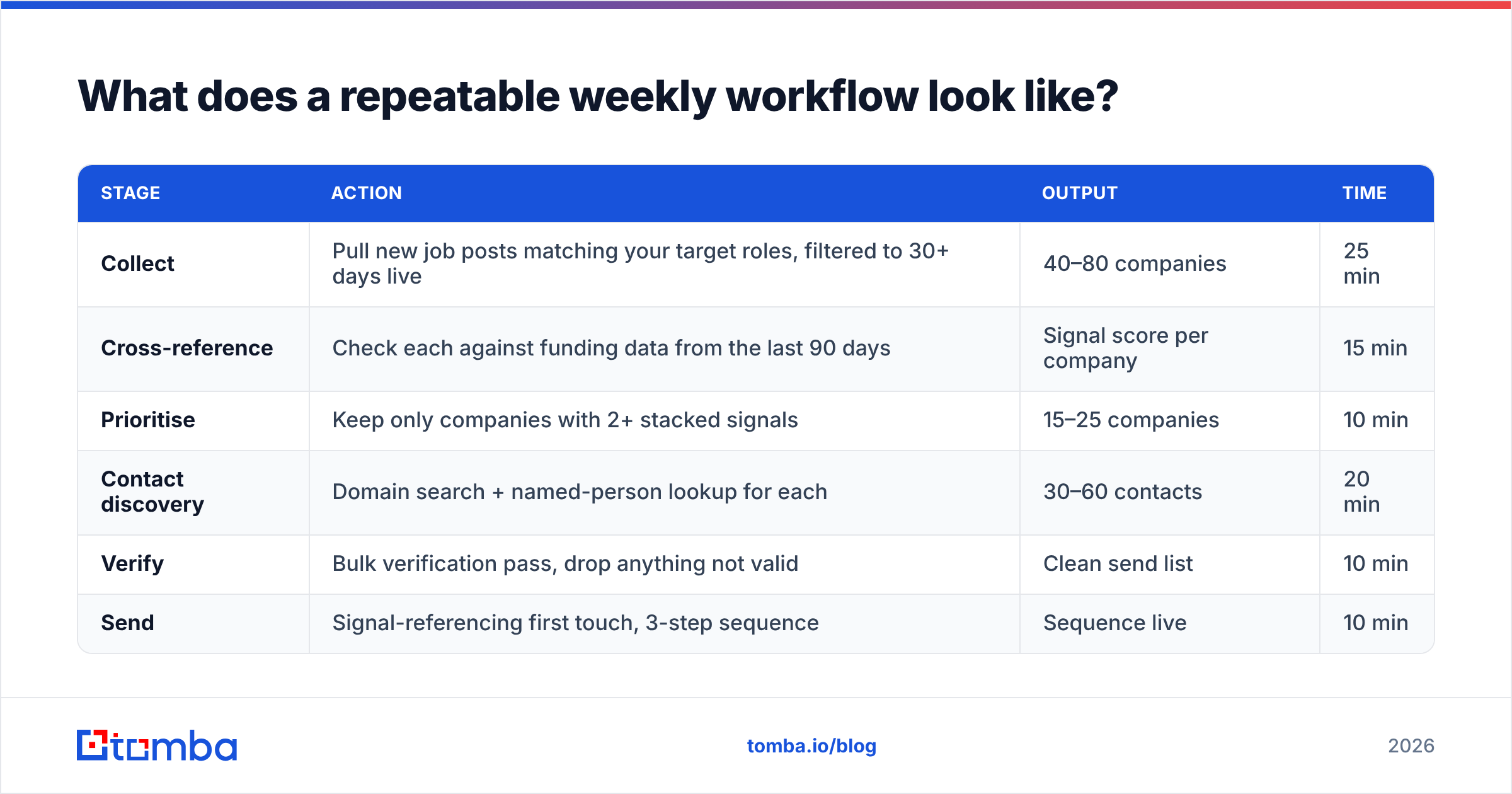
Run this every Monday. It takes about ninety minutes once the sources are set up.
| Stage | Action | Output | Time |
|---|---|---|---|
| Collect | Pull new job posts matching your target roles, filtered to 30+ days live | 40–80 companies | 25 min |
| Cross-reference | Check each against funding data from the last 90 days | Signal score per company | 15 min |
| Prioritise | Keep only companies with 2+ stacked signals | 15–25 companies | 10 min |
| Contact discovery | Domain search + named-person lookup for each | 30–60 contacts | 20 min |
| Verify | Bulk verification pass, drop anything not valid | Clean send list | 10 min |
| Send | Signal-referencing first touch, 3-step sequence | Sequence live | 10 min |
Twenty-five companies a week is 1,300 a year. At a 6% reply rate and a 20% reply-to-meeting rate, that is roughly 156 meetings from a workflow that costs you an hour and a half weekly. The numbers only hold if the list is clean — which is why the verification stage is non-negotiable rather than optional.
For anything above a few hundred rows a month, run the discovery and verification stages through bulk processing or the API instead of doing it row by row.
Which industries outsource the most in 2026?#
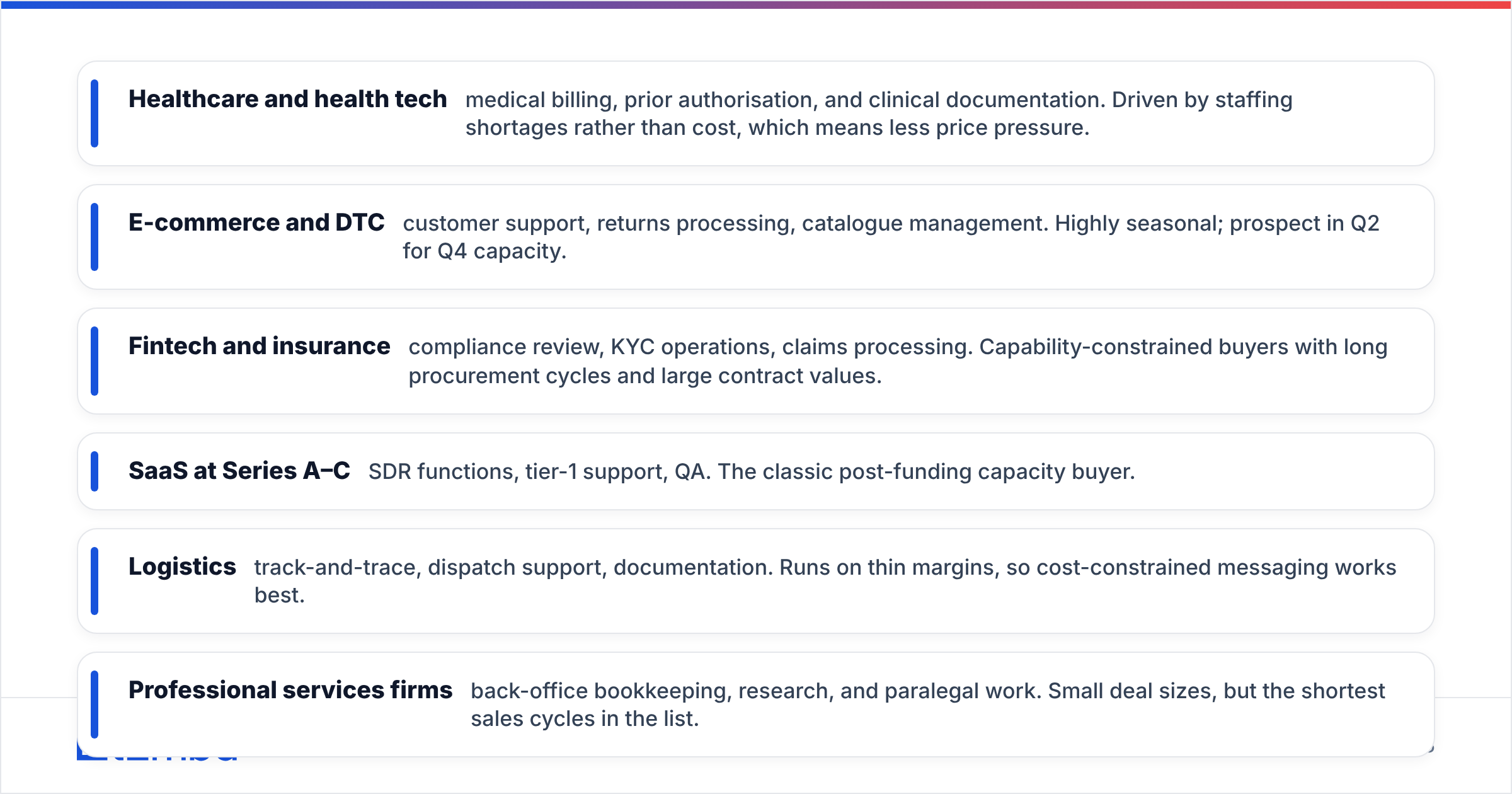
Demand is not evenly distributed. These verticals consistently show the strongest outsourcing intent signals:
- Healthcare and health tech — medical billing, prior authorisation, and clinical documentation. Driven by staffing shortages rather than cost, which means less price pressure.
- E-commerce and DTC — customer support, returns processing, catalogue management. Highly seasonal; prospect in Q2 for Q4 capacity.
- Fintech and insurance — compliance review, KYC operations, claims processing. Capability-constrained buyers with long procurement cycles and large contract values.
- SaaS at Series A–C — SDR functions, tier-1 support, QA. The classic post-funding capacity buyer.
- Logistics — track-and-trace, dispatch support, documentation. Runs on thin margins, so cost-constrained messaging works best.
- Professional services firms — back-office bookkeeping, research, and paralegal work. Small deal sizes, but the shortest sales cycles in the list.
If you sell one service into all six, your positioning is too broad to write a good first email. Rank them by average contract value and pick two.
How do you qualify a signal before you pitch?#
Not every stalled job post is a buyer. Disqualify fast on these:
Company size floor. Below roughly 20 employees, outsourcing budgets are usually founder-discretionary and volatile. Below 10, you are selling to someone who will do it themselves at 11pm.
Regulatory blockers. Some contracts, particularly in defence, healthcare data, and certain public sector work, restrict offshore processing outright. Check before you invest a sequence.
Existing vendor. If their careers page lists a "vendor management" function, or their tech stack shows an established BPO tool, you are displacing an incumbent — a different, longer play. Not bad, just not a first-touch motion.
Signal age. A funding round from fourteen months ago is history, not a signal. Anything older than 90 days on funding, or 120 days on job posts, goes to the nurture list rather than the active sequence.
Score what survives on three axes — signal count, deal-size fit, and reachability of the decision-maker — and only sequence the top third. Volume without qualification just teaches your sending domain to look like spam.
What should the first email actually say?#
Reference the signal in the first line, name the consequence in the second, and ask one small question in the third. That is the whole structure.
The signal reference does the work that personalisation tokens pretend to do. "I noticed you've had the Senior Backend Engineer role open since June" is verifiable, specific, and impossible to send at scale without having done the research — which is precisely why it gets replies.
Avoid three things: leading with your company history, listing your service catalogue, and using the word "synergy" in any form. The buyer does not care who you are until they believe you understand their problem. For subject lines, the shorter and more literal the better — a subject line tester will tell you quickly if yours reads as a pitch.
Follow up three times over two weeks, then stop and move the contact to a quarterly check-in. Outsourcing decisions are rarely made on your timeline; the goal of the first sequence is to be the vendor they remember when the internal decision finally lands.
Start with the contact layer#
You can build the signal engine with free tools in an afternoon. Job boards, Crunchbase, and a stack detector will hand you a live list of companies under real operational pressure this week.
What you cannot improvise is the contact layer — the step that turns "Acme Corp has nine open support roles" into a verified inbox belonging to the person who owns that budget. That is where pipelines stall.
Run your signal list through Tomba Email Finder to resolve named decision-makers from a company domain, verify every address before it enters a sequence, and enrich each row with the title and company data you need for a credible first line. The free tier covers 25 searches a month if you want to test the workflow on a single signal batch; Starter is $49/mo and Growth $99/mo when you are ready to run it weekly. Full Tomba pricing is public, with no per-seat surcharge.
Build the signal habit first. Then make sure the emails you send actually arrive.
Related guides#
// get started
Find, verify and enrich your first contacts today
Start on the free plan with 25 searches a month, then scale when your team is ready.
Free plan · No credit card required · GDPR & CCPA
// about the author