How to Find Direct Phone Numbers: 7 Methods That Work
Switchboards and gatekeepers kill connect rates. Here are seven tested ways to find direct dials and mobile numbers for B2B prospects — plus what each method actually costs.
TL;DR
- A "direct phone number" means a desk line that rings one person or a mobile — not a switchboard that routes you to reception. Connect rates on direct dials run roughly 3-5x higher than on company mains.
- The seven methods that actually work: B2B data providers, reverse email lookup, company filings and legal pages, LinkedIn and social footprints, conference and event material, warm referrals, and voluntary capture (webinars, demos, gated content).
- Mobile match rates are the number to interrogate. Vendors quote 70-90% "coverage" but that usually means any number, including the main line you already had.
- Always validate before dialing. A dead number burns a dialer slot; a wrong-person number burns your reputation and can create TCPA/GDPR exposure.
- The practical stack: find the email first, enrich to a phone, validate the phone, then dial. Skipping the validation step is where most teams waste budget.
What Counts as a "Direct" Phone Number?#
Three tiers exist, and vendors blur them constantly.
- Switchboard / main line — the number on the contact page. It reaches a receptionist or an IVR tree. Nearly free to obtain, nearly worthless for outbound.
- Direct dial (DID) — an extension-level number that rings a specific desk. Useful, but post-2020 hybrid work made a lot of these ring in empty offices.
- Mobile / cell — rings the human wherever they are. Highest connect rate, highest cost per record, highest compliance sensitivity.
When a vendor says "direct dials," ask which of the three they're counting. A provider advertising 90% phone coverage that's mostly tier 1 is selling you a phone book.
Connect rate is the metric that matters, not coverage. If you dial 100 switchboard numbers you might have 4 real conversations with your target. Dial 100 verified mobiles and 15-25 conversations is a normal range for a competent SDR working a decent list. That gap is the entire business case for paying for phone data.

Which Method Should You Use to Find Direct Phone Numbers?#
Here's the honest ranking, ordered by how much volume each method can realistically produce.
- B2B data providers — highest volume, fastest, costs money. Best for repeatable outbound at scale. Match rates on mobiles typically land between 30% and 65% depending on geography and seniority.
- Reverse email lookup and enrichment — you already have the email from an email finder, so you push it through an enrichment step to attach a phone. Cheap incremental cost, good match rate on decision-makers at mid-market and up.
- Public filings and regulatory documents — SEC filings, Companies House, trademark records, and domain WHOIS still leak direct lines. Low volume, high accuracy, zero cost.
- LinkedIn and social footprints — some profiles list numbers in the contact card or the About section. Bio links, Linktrees, and X profiles occasionally expose a business mobile.
- Conference and event material — speaker bios, sponsor packets, exhibitor directories, and vendor booth handouts routinely publish direct lines for the person managing the relationship.
- Warm referrals and internal transfers — call the switchboard, ask for the department, get transferred, capture the extension. Slow, but it works when nothing else does.
- Voluntary capture — a phone field on demo forms, webinar registrations, and gated content. Highest-quality number you'll ever get because the prospect typed it themselves.
Most teams should run methods 1, 2, and 7 as the standing system, then use 3-6 for named-account work where a single logo justifies twenty minutes of manual digging.
How Do the Main Phone Data Providers Compare?#
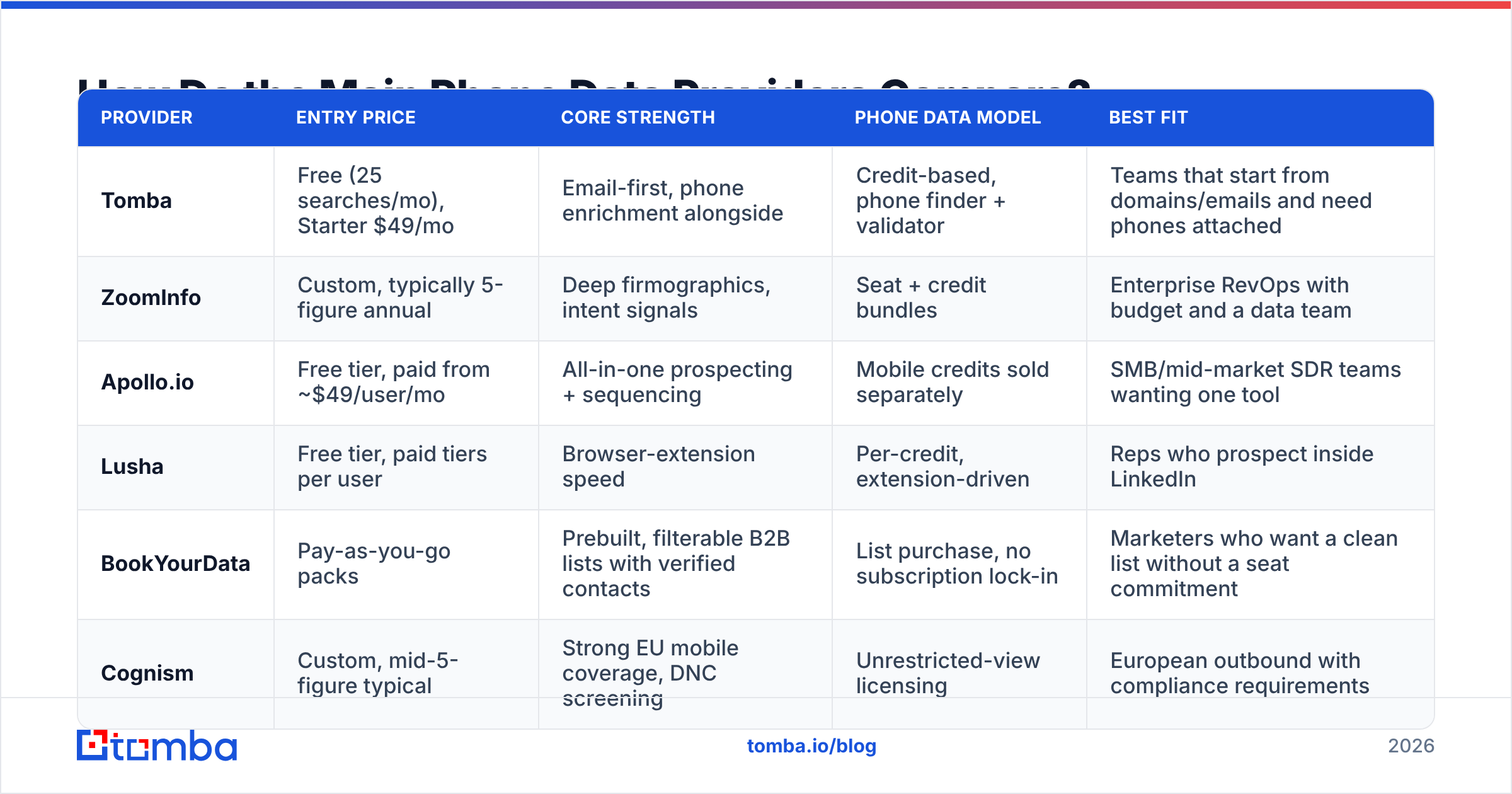
Pricing and positioning shift constantly, so treat this as a shape-of-the-market snapshot rather than a live quote sheet. Always run your own sample test on 200-500 records from your actual ICP before committing to an annual contract.
| Provider | Entry price | Core strength | Phone data model | Best fit |
|---|---|---|---|---|
| Tomba | Free (25 searches/mo), Starter $49/mo | Email-first, phone enrichment alongside | Credit-based, phone finder + validator | Teams that start from domains/emails and need phones attached |
| ZoomInfo | Custom, typically 5-figure annual | Deep firmographics, intent signals | Seat + credit bundles | Enterprise RevOps with budget and a data team |
| Apollo.io | Free tier, paid from ~$49/user/mo | All-in-one prospecting + sequencing | Mobile credits sold separately | SMB/mid-market SDR teams wanting one tool |
| Lusha | Free tier, paid tiers per user | Browser-extension speed | Per-credit, extension-driven | Reps who prospect inside LinkedIn |
| BookYourData | Pay-as-you-go packs | Prebuilt, filterable B2B lists with verified contacts | List purchase, no subscription lock-in | Marketers who want a clean list without a seat commitment |
| Cognism | Custom, mid-5-figure typical | Strong EU mobile coverage, DNC screening | Unrestricted-view licensing | European outbound with compliance requirements |
Two structural points from that table. First, pricing models split into subscription with credits versus pay-as-you-go list purchase — if your outbound is seasonal or campaign-based, the pay-as-you-go model (BookYourData's approach) avoids paying for months you don't prospect. Second, "unrestricted view" versus credit-metered access changes your effective cost per contact by an order of magnitude at high volume.
Check current Tomba pricing and cross-reference vendor claims against G2 reviews, where users tend to report real match rates rather than marketing numbers.
How Do You Find a Phone Number From an Email Address?#
This is the highest-leverage workflow because most teams already have emails.
The sequence:
- Step 1 — Establish the email. Use domain search to pull every known address at the company, or a targeted lookup by first name, last name, and domain.
- Step 2 — Reverse the identity. A reverse email lookup resolves the address to a person record — full name, title, company, social profiles. You need this identity anchor before a phone match is trustworthy.
- Step 3 — Enrich to a phone. Run the resolved record through a phone finder. Match rate here depends heavily on seniority and region: VP-and-above at US companies matches far better than an individual contributor at a 12-person agency in Portugal.
- Step 4 — Validate the line. A phone validator confirms the number is live, tells you line type (mobile vs landline vs VoIP), and returns carrier and region. Line type matters — dialing a VoIP number you assumed was a mobile explains a lot of unexplained voicemail.
- Step 5 — Screen against do-not-call. In the US, scrub against the National DNC Registry. B2B has carve-outs but they're narrower than most reps assume, especially for mobiles and especially in states with their own statutes.
Do steps 4 and 5 before the number enters your dialer, not after. Reversing the order is how teams end up with 40% voicemail rates and a compliance incident.
What Free Methods Actually Work?#
Free methods won't build a 5,000-record list, but they're genuinely effective for named accounts.
Company website deep pages. Skip the contact page. Look at /team, /leadership, /press, /investors, and regional office pages. Press releases in particular almost always end with a media contact block including a direct line.
Regulatory and legal filings. US public companies file investor relations contacts with direct dials in 8-K and proxy materials. UK Companies House, trademark applications, and court filings all expose contact details. A search operator like site:sec.gov "companyname" "direct" gets you further than you'd expect.
Job postings and recruiter pages. Hiring managers list themselves. So do internal recruiters, who are then a warm route into the org chart.
Support and vendor portals. Partner directories, reseller pages, and integration marketplace listings often publish a named account manager with a direct line.
Google search operators. Combine the person's name with a phone-shaped pattern: "Firstname Lastname" "company.com" "+1" OR "direct" OR "mobile". Also try their name plus a conference name — speaker bios are a goldmine.
The switchboard itself. Call the main line, ask for the department by name (not the person), and when transferred, ask the person who picks up for the target's direct extension. It works far more often than reps expect because you're asking an internal-sounding question.
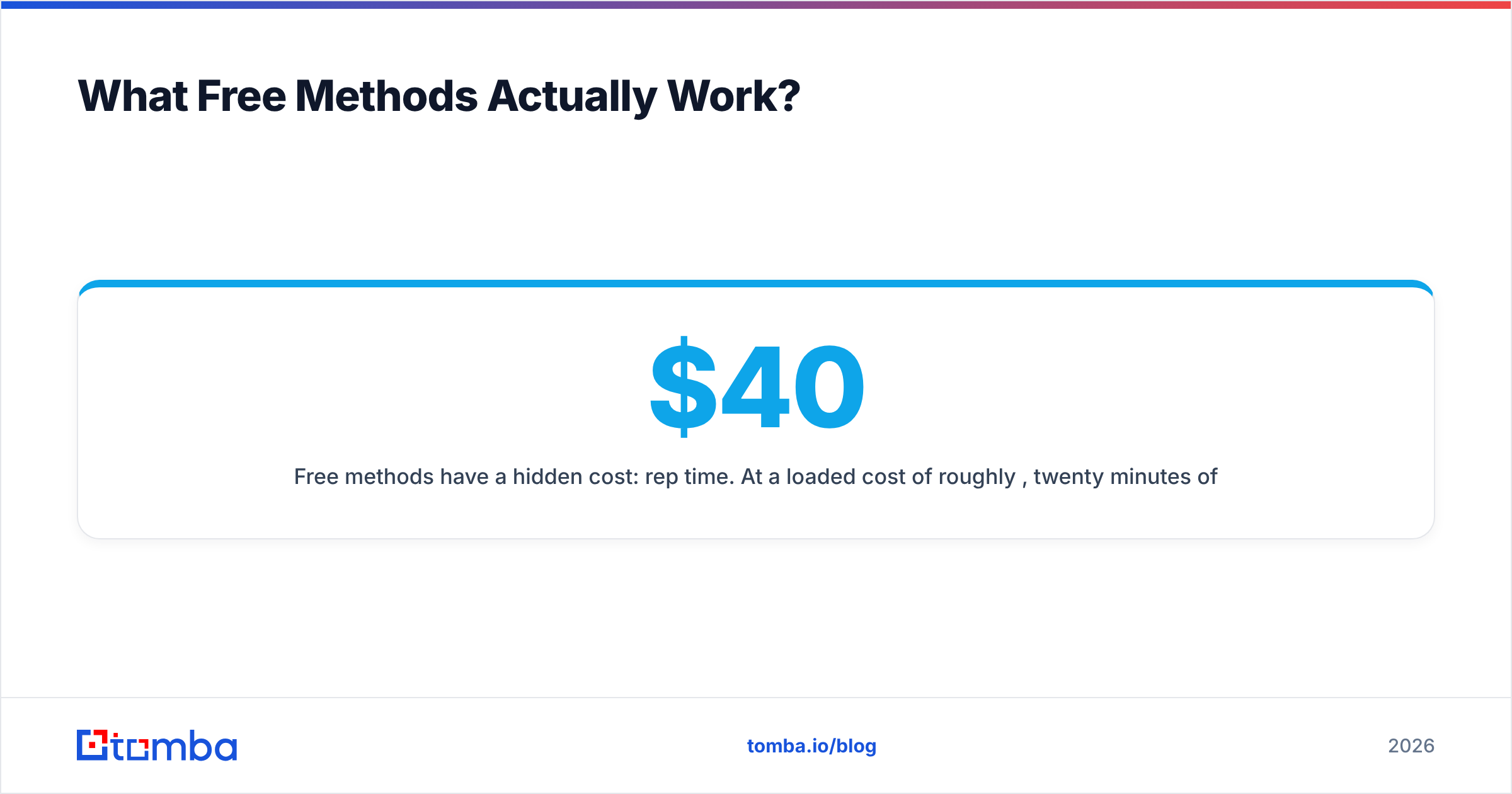
Free methods have a hidden cost: rep time. At a loaded cost of roughly $40/hour, twenty minutes of manual digging is about $13 per contact. A paid provider at $0.30-$1.50 per phone record is cheaper unless the account is genuinely strategic.
Is Buying Phone Data Legal?#
Short answer: yes in most jurisdictions, with real constraints on how you use it.
United States. The TCPA governs automated dialing and prerecorded messages to mobiles. Manual dialing of business contacts for B2B purposes has more latitude, but the safe harbor is narrower than the folklore suggests — courts have been inconsistent about whether a cell used for business is a "business line." The FTC's National Do Not Call Registry applies to telemarketing to consumers; B2B calls are largely exempt from the TSR, but state law varies and mobiles blur the boundary.
European Union. GDPR requires a lawful basis. Legitimate interest can cover B2B outbound, but you owe a documented balancing test, a clear privacy notice, and an easy opt-out. Some member states (Germany, notably) layer stricter rules on unsolicited business calls. Personal mobile numbers are personal data regardless of business use.
Practical hygiene regardless of jurisdiction. Keep provenance records for every number — which vendor, which date, which source category. Honor opt-outs across channels, not just the one where the request came in. Suppress a number the moment someone says stop, and make that suppression global.
Ask any vendor directly: where does this come from, how often is it refreshed, and what's your process when someone requests deletion? A provider that can't answer crisply is a liability. Tomba publishes its data sources for exactly this reason.

How Do You Measure Whether Your Phone Data Is Any Good?#
Run a controlled test rather than trusting a coverage percentage.
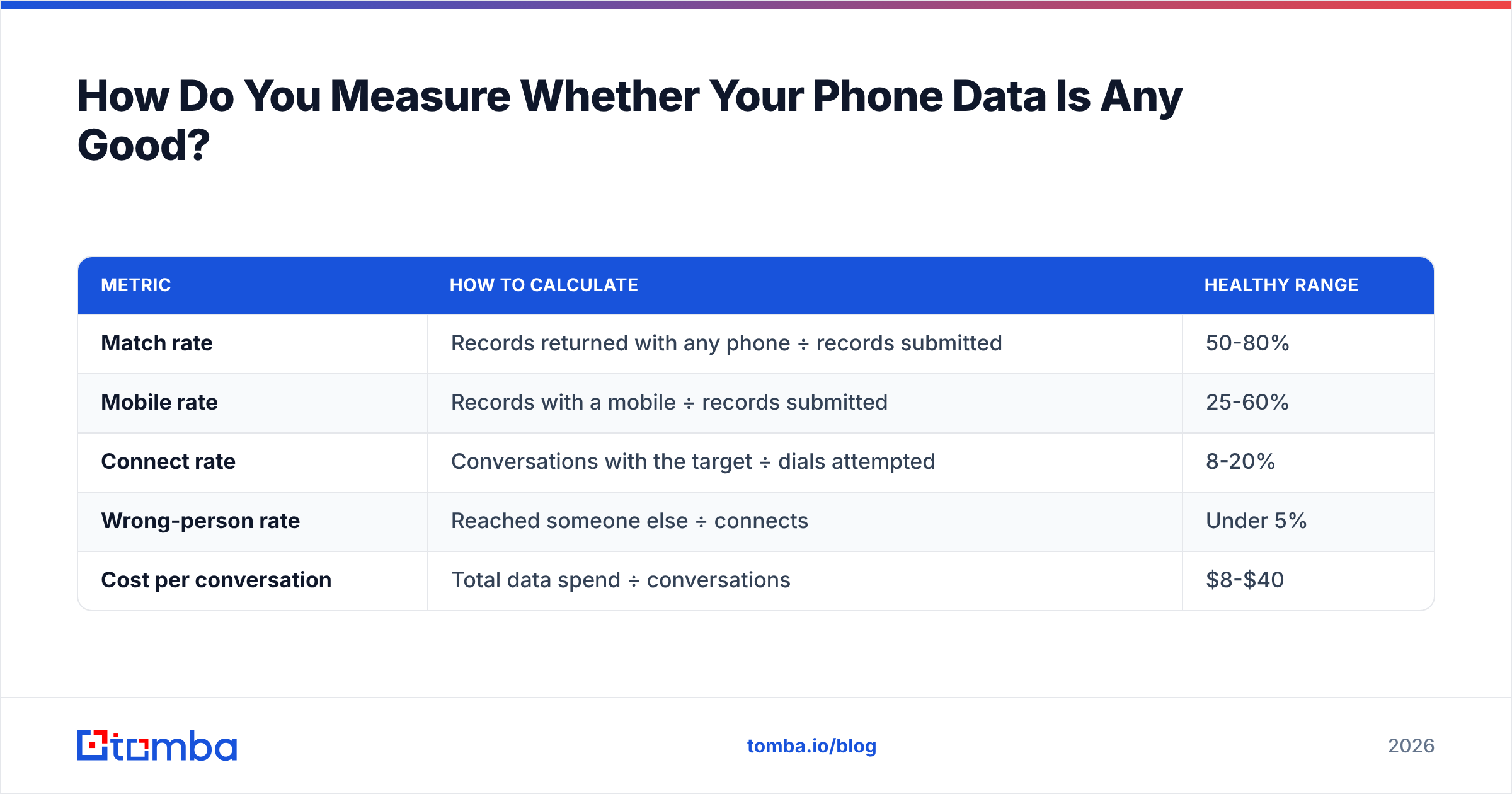
Take 300 records from your real ICP — not a vendor-supplied sample, which will always be their best data. Push them through the provider. Then measure:
| Metric | How to calculate | Healthy range |
|---|---|---|
| Match rate | Records returned with any phone ÷ records submitted | 50-80% |
| Mobile rate | Records with a mobile ÷ records submitted | 25-60% |
| Connect rate | Conversations with the target ÷ dials attempted | 8-20% |
| Wrong-person rate | Reached someone else ÷ connects | Under 5% |
| Cost per conversation | Total data spend ÷ conversations | $8-$40 |
Cost per conversation is the only number that survives contact with your CFO. A provider with a 40% match rate and a 20% connect rate beats one with an 80% match rate and a 6% connect rate — because half the second provider's records are switchboards.
Track wrong-person rate seriously. It's the leading indicator of stale data, and it's the metric vendors never publish. A rate above 10% means the provider is selling you numbers from people's previous jobs.
Also segment by geography and seniority before you conclude anything. Most providers are strong on US mid-market VPs and weak on APAC individual contributors. If your ICP sits in the weak zone, the aggregate match rate told you nothing useful.
How Do You Build a Repeatable Phone-Sourcing Workflow?#
The stack that holds up at volume:
1. Source the account list. Firmographic filters in a B2B database, a scrape of a niche directory, or an intent signal from your website via visitor identification.
2. Resolve people to emails. Bulk-process through a bulk email finder so you have a verified identity anchor for every record before you spend a phone credit.
3. Verify emails first. Run an email verifier pass. Sounds unrelated, but an invalid email is a strong signal the person left the company — and their old direct dial is dead too. Filtering here saves phone credits.
4. Enrich phones on the survivors only. Never enrich the raw list. Enrich the verified subset. On a 5,000-record list where 22% of emails fail verification, that's over a thousand phone credits you didn't waste.
5. Validate and route by line type. Mobiles to your SDRs for manual dial. Landlines into a lower-priority queue. VoIP flagged for review.
6. Sync to CRM with provenance. Push into HubSpot or Salesforce with custom fields for source, acquisition date, and validation status. Use the HubSpot integration or Salesforce integration so the lineage travels with the record. When a compliance question comes six months later, you'll have the answer in the record instead of in someone's memory.
7. Feed outcomes back. Log wrong-number and disconnected outcomes as structured dispositions, then suppress those records and report the pattern back to your vendor. Providers with real feedback loops improve; the ones that ignore your reports are reselling static files.
For engineering teams, the whole chain runs headlessly through the Tomba API — one call to resolve the person, one to enrich, one to validate, with results written straight to your warehouse. HubSpot's own sales prospecting guidance is worth reading alongside this if you're designing the process end to end.
What Mistakes Cost Teams the Most?#
Buying on coverage claims. Coverage is a marketing number. Connect rate on your ICP is the real one. Test before you sign.
Skipping validation to save a step. Validation costs a fraction of a cent. A dead number costs a dialer slot, a rep's attention, and a distorted campaign metric.
Treating all numbers as equal in the dialer. Mobiles and landlines should not share a queue or a call window. A landline at 8am local is reasonable; a mobile at 8am reads as intrusive.
Ignoring provenance. If you can't say where a number came from, you can't defend it, refresh it, or suppress it properly.
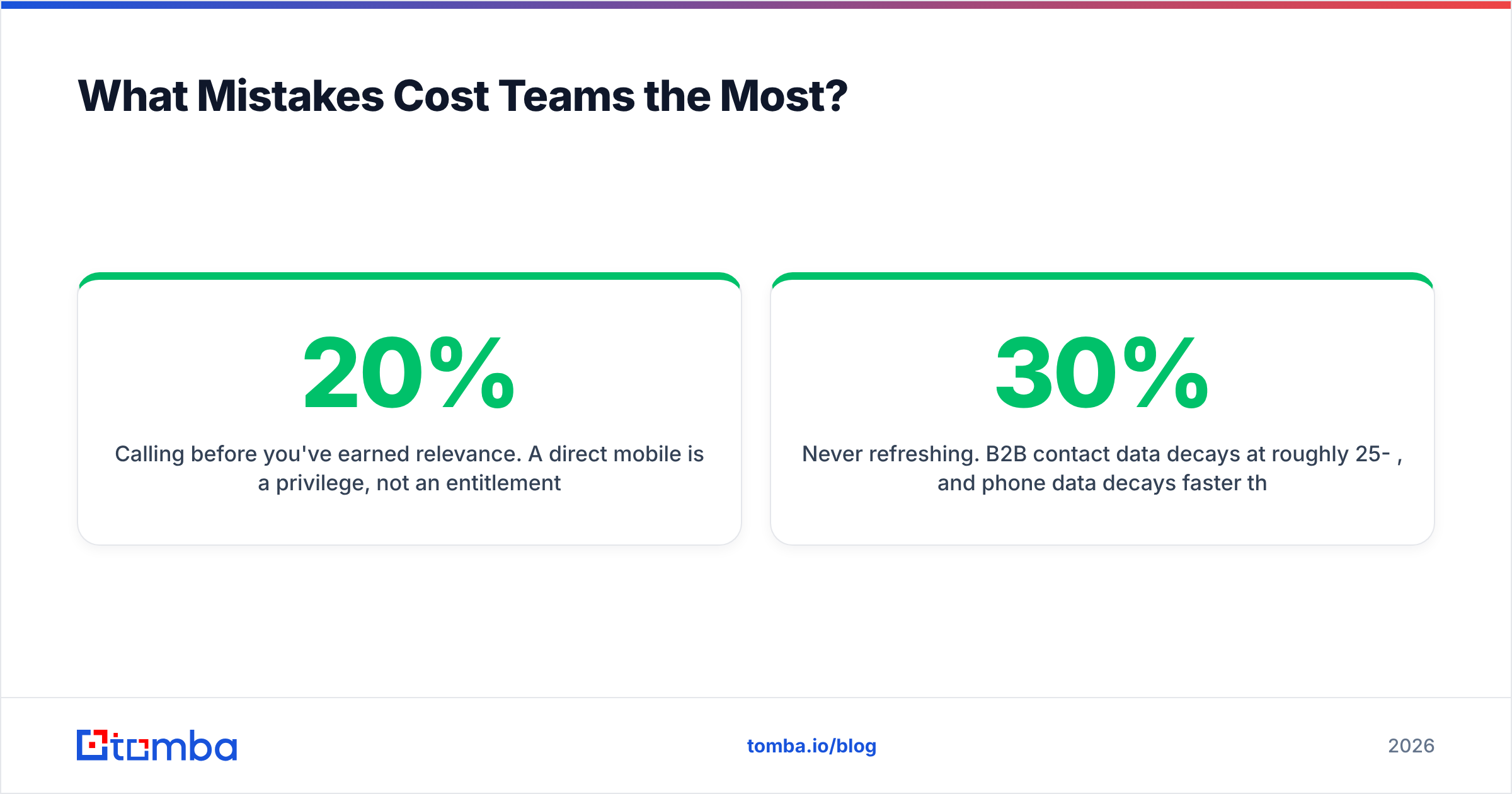
Calling before you've earned relevance. A direct mobile is a privilege, not an entitlement. Reps who open a cold mobile call with a generic pitch burn the channel for everyone. Have a specific, researched reason for the call — that's what separates a 20% connect rate that converts from a 20% connect rate that gets you blocked.
Never refreshing. B2B contact data decays at roughly 25-30% per year, and phone data decays faster than email because job changes take the mobile with them but leave the desk line dead. Re-validate quarterly.
Where Should You Start?#
Start with the emails you already have. Most teams are sitting on thousands of verified contacts and have never tried attaching phone numbers to them — which is the cheapest phone data you will ever acquire, because the identity resolution work is already done.
Run a batch through Tomba's Email Finder to lock down the contact identities across your target accounts, verify them, then enrich the survivors with phone numbers and validate line type before anything touches a dialer. The free tier gives you 25 searches a month to sanity-check match rates on your own ICP before spending anything, and Starter at $49/mo covers a typical SDR's monthly sourcing volume. Test it against your actual account list — not a vendor demo list — and let cost per conversation decide.
Related guides#
// get started
Find, verify and enrich your first contacts today
Start on the free plan with 25 searches a month, then scale when your team is ready.
Free plan · No credit card required · GDPR & CCPA
Get the Tomba newsletter
Product and data updates
// about the author