How To Find Out Business Owners: 9 Methods That Actually Work
Registry filings tell you who owns a business. They don't tell you how to reach that person. Here's the full stack — free public records, LinkedIn cross-checks, and email tools — for identifying and contacting owners in 2026.
TL;DR
- Public registries (Companies House, state Secretary of State, SEC EDGAR) tell you the legal owner or officer of record. They rarely give you a working email or phone number.
- The fastest reliable sequence is: registry or website check to get the name, LinkedIn to confirm the current role, then an email finder to get a reachable address.
- Owner names go stale fast. A registration filed in 2021 can name someone who sold the business in 2023 — always cross-check against a live source.
- For small local businesses with no filings and no LinkedIn, the domain WHOIS, the website footer, and review-site profiles are your best free leads.
- Guessing
info@orfirstname@domain.comwithout verification is how you burn a sending domain. Verify before you send.
What Does "Finding a Business Owner" Actually Mean?#
Most people asking how to find out business owners are actually asking three different questions at once, and mixing them up is why the search takes an hour instead of four minutes.
Separate the job into layers before you start:
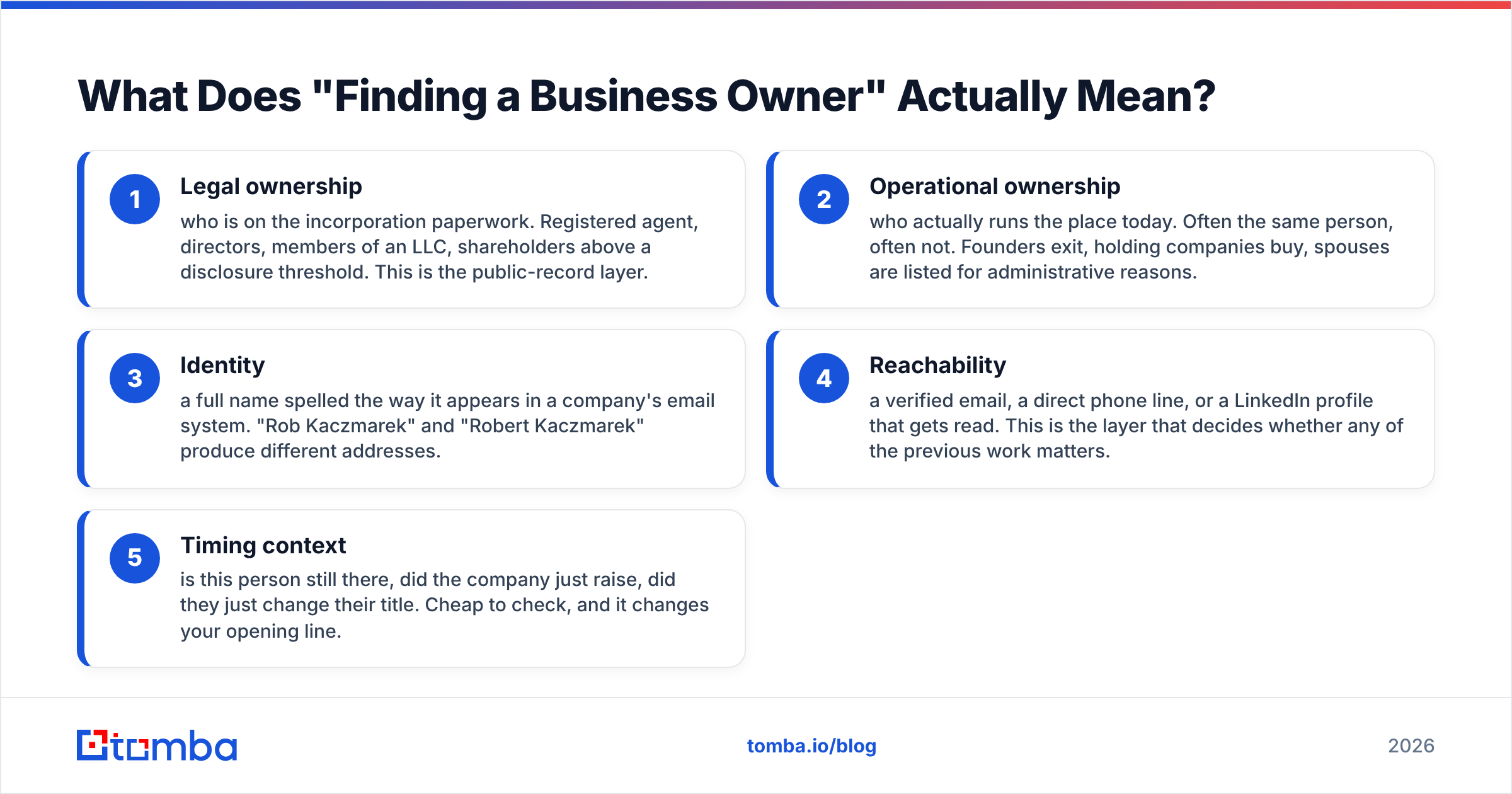
- Legal ownership — who is on the incorporation paperwork. Registered agent, directors, members of an LLC, shareholders above a disclosure threshold. This is the public-record layer.
- Operational ownership — who actually runs the place today. Often the same person, often not. Founders exit, holding companies buy, spouses are listed for administrative reasons.
- Identity — a full name spelled the way it appears in a company's email system. "Rob Kaczmarek" and "Robert Kaczmarek" produce different addresses.
- Reachability — a verified email, a direct phone line, or a LinkedIn profile that gets read. This is the layer that decides whether any of the previous work matters.
- Timing context — is this person still there, did the company just raise, did they just change their title. Cheap to check, and it changes your opening line.
If you only need layer 1 for compliance or due diligence, public registries finish the job for free. If you're prospecting, layers 3 and 4 are the real work, and no registry will do them for you.
Where Are Business Owners Publicly Registered?#
Start with the jurisdiction. Ownership disclosure is a national — sometimes state-level — game, and the quality varies wildly.
United States. There is no federal company register. Filings live with each state's Secretary of State. Delaware, where a huge share of US companies are incorporated, deliberately does not publish member or shareholder names for LLCs — you get the registered agent and nothing else. States like Florida and Texas are far more generous and list managers and officers by name. For public companies and anyone filing with the regulator, SEC EDGAR is the highest-quality free source in the country: full-text searchable, and Forms 3/4/5 name insiders directly.
United Kingdom. Companies House is the gold standard. Free, complete, API-accessible, and it publishes Persons with Significant Control — the actual beneficial owners, with month and year of birth for disambiguation. If your target is a UK limited company, you can answer "who owns this" in about ninety seconds.
Everywhere else. OpenCorporates aggregates over 200 million company records across roughly 140 jurisdictions. Coverage is uneven and some records lag the source registry by months, but as a first sweep across unfamiliar countries it saves a lot of tab-hunting.
One caveat that trips people up constantly: the registered agent is not the owner. Companies like CT Corporation and Registered Agents Inc. appear on hundreds of thousands of filings. If your "owner" turns out to have 40,000 companies, you found a service provider.
How Do You Find a Business Owner for Free?#
Free methods get you a name most of the time and a contact detail some of the time. Run them in this order:
1. The website itself. About pages, team pages, press pages, and the privacy policy. The privacy policy and terms of service are underrated — they frequently name the legal entity and a data-protection contact who is often a founder at a small company.
2. The domain registration. WHOIS privacy hides most registrant details now, but the registration date, registrar, and occasionally an organisation field still leak. Historical WHOIS snapshots from before privacy services became default can name the original owner.
3. LinkedIn. Search the company page, then filter people by "Owner", "Founder", "Managing Director", or "Proprietor". This is your best source for current operational ownership, because people update their own profiles when registries don't. Watch for the reverse failure: someone still listing a company they exited.
4. Review and listing sites. Google Business Profile, Yelp, BBB, Chamber of Commerce directories. Owner responses to reviews are signed surprisingly often. For local service businesses this beats every registry.
5. Local news and trade press. "acquired", "founded by", "opened by" plus the business name in quotes. Small-town papers publish ownership changes that never make it into any database.
6. The physical world. Licence plates on vans, contractor licence boards, liquor licences, food-service permits. Regulated industries publish licensee names, and the licensee is usually an owner.
Free gets you far. Where it collapses is at scale — this sequence takes ten to twenty minutes per business and does not survive a list of 400.
Which Method Should You Use for Each Situation?#
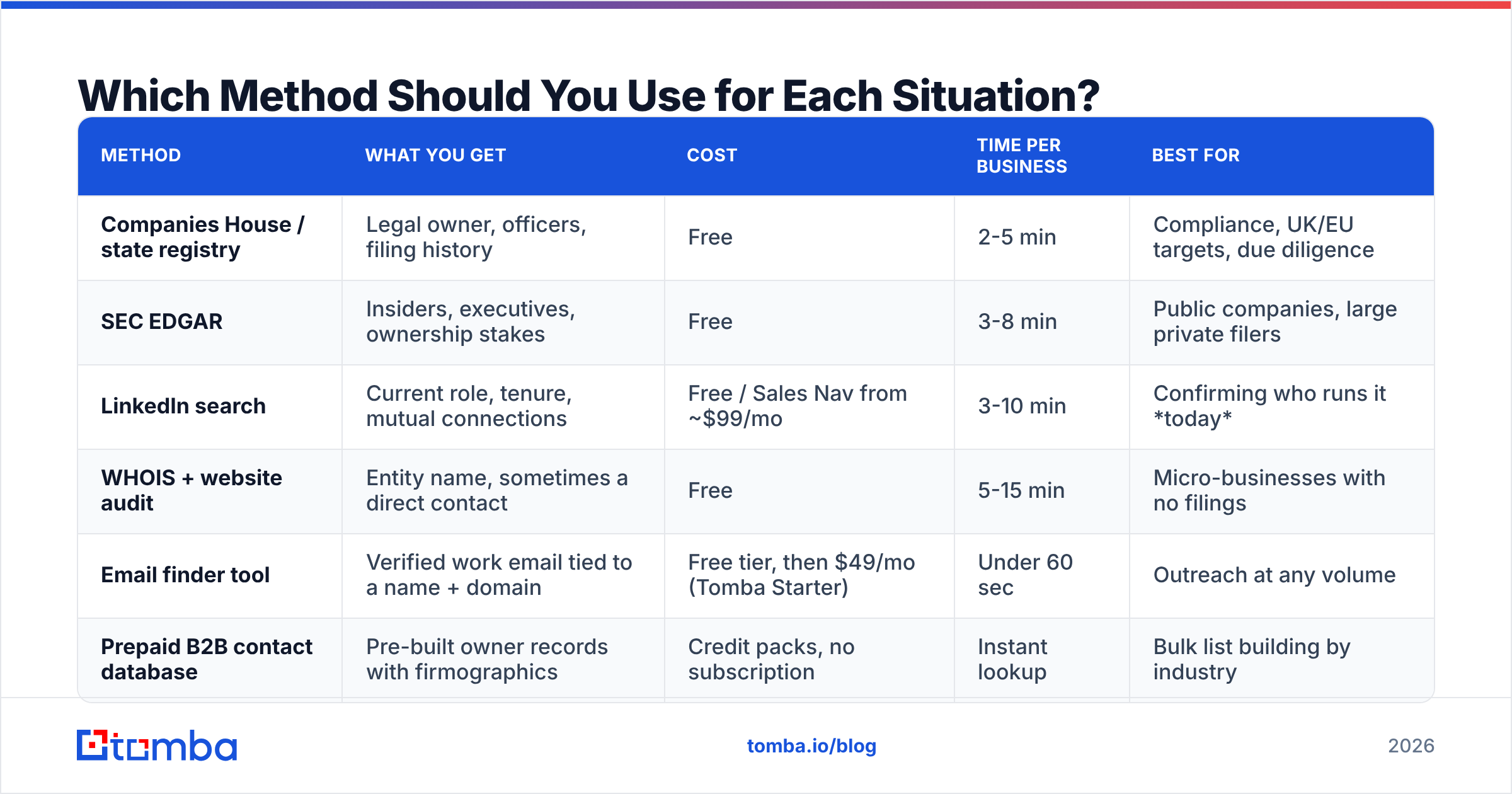
| Method | What you get | Cost | Time per business | Best for |
|---|---|---|---|---|
| Companies House / state registry | Legal owner, officers, filing history | Free | 2-5 min | Compliance, UK/EU targets, due diligence |
| SEC EDGAR | Insiders, executives, ownership stakes | Free | 3-8 min | Public companies, large private filers |
| LinkedIn search | Current role, tenure, mutual connections | Free / Sales Nav from ~$99/mo | 3-10 min | Confirming who runs it today |
| WHOIS + website audit | Entity name, sometimes a direct contact | Free | 5-15 min | Micro-businesses with no filings |
| Email finder tool | Verified work email tied to a name + domain | Free tier, then $49/mo (Tomba Starter) | Under 60 sec | Outreach at any volume |
| Prepaid B2B contact database | Pre-built owner records with firmographics | Credit packs, no subscription | Instant lookup | Bulk list building by industry |
The honest read: no single row wins. Registries are authoritative but stale and contactless. LinkedIn is current but gives you no email. Finders and databases give you reachable contacts but depend on the name you feed them being correct.
How Do You Turn an Owner's Name Into a Working Email?#
This is where most "how to find out business owners" guides stop, and it's the only step that produces revenue.
Once you have a first name, last name, and company domain, an email finder resolves the address against known patterns and live validation rather than guessing. The difference matters: pattern-guessing tools output jsmith@acme.com with no evidence behind it, while a finder that checks the pattern against confirmed addresses on that domain and then validates the mailbox gives you a confidence score you can act on.
Three approaches, in rough order of reliability:
- Name + domain lookup. You know the person. You know where they work. This is the highest-accuracy path and the one to default to.
- Domain search. You know the company but not the person. Pull every discoverable address on the domain, look at the pattern, and look at the job titles attached. Owner-level titles surface fast at companies under 50 people.
- Reverse email lookup. You have an address from a form fill or a WHOIS record and need to know whose it is. Useful for qualifying inbound and for de-anonymising an old contact record.
Then verify. An email verifier checks syntax, domain MX records, and mailbox existence before you send anything. Catch-all domains — which accept everything at the SMTP layer and bounce silently later — are the specific trap here, and they're common at small owner-operated businesses using Microsoft 365 defaults.

What Happens If You Skip Verification?#
Nothing, for about two weeks. Then everything at once.
Mailbox providers score you on how many of your sends hit dead addresses. Push bounce rates past roughly 2-3% and your sender reputation starts degrading; past 5% and Google and Microsoft begin routing your legitimate mail to spam — including mail to prospects whose addresses were perfectly fine. Recovering a burned domain takes weeks of reduced volume and warmup, and some teams just buy a new one instead.
The math is unglamorous but decisive. If you find 500 owner emails by guessing patterns, expect a meaningful chunk to be wrong: wrong pattern, departed employee, decommissioned mailbox. Verification costs a fraction of a cent per record. A damaged domain costs you a quarter.
There's a second, quieter cost. Reply rates on lists sent to unverified addresses look artificially terrible, which leads teams to blame their copy and rewrite messaging that was never the problem. Clean your data before you draw conclusions about your response rate.
How Do You Confirm You Found the Right Person?#
Two independent sources agreeing is the working standard. One source is a hypothesis.
Run this checklist before you write:
- Name match across two systems. Registry filing and LinkedIn, or website team page and a press mention. Spelling must match, not just sound alike.
- Title plausibility. A 12-person company with a "Chief Revenue Officer" listed in a 2019 filing and nobody by that name on LinkedIn today is a stale record.
- Recency. When was the filing? When was the LinkedIn profile last updated? Prefer the source that moves.
- Domain match. The person's email domain should match the company you're targeting, not a parent, a previous employer, or a personal consulting shell.
- Entity match. Common business names produce collisions. "Summit Consulting" exists in every state. Confirm the address or the registration number, not just the name.
For businesses with common surnames or franchise structures, add the address as a disambiguator. Franchisees are separate legal owners from the franchisor, and pitching a franchisee on an enterprise contract they can't sign wastes both of your afternoons.
Is It Legal to Look Up Business Owners?#
Yes, with real limits worth understanding.
Company registration data is published deliberately — transparency is the point of a company register, and using it is exactly what it exists for. Aggregating publicly available business contact information is likewise legal in most jurisdictions.
Where it tightens:
- GDPR (EU/UK). Business contact data about an identifiable person is still personal data. You need a lawful basis — legitimate interest is the usual one for B2B outreach — plus a clear opt-out and a privacy notice you can point to. UK PECR additionally distinguishes between limited companies and sole traders, and sole traders get consumer-grade protection.
- CAN-SPAM (US). Cold B2B email is permitted, but you must include a real physical address, no deceptive subject lines or headers, and a working unsubscribe honoured promptly.
- CASL (Canada). Considerably stricter — closer to a consent regime than a notice regime. Get advice before running Canadian lists at volume.
- Do-not-call registries. Relevant the moment you move from email to phone. Business lines are treated differently from personal mobiles in many jurisdictions, and the difference is not always obvious from the number.
None of this makes owner research off-limits. It makes documentation and opt-out handling non-negotiable. Keep a record of where each contact came from.
How Do You Do This For 500 Businesses Instead of One?#
Manual research doesn't scale past roughly 20-30 businesses before the returns stop justifying the hours. At list scale, the workflow changes shape:
Step 1 — build the domain list. Industry directories, association member lists, conference exhibitor lists, review-site categories, or a filtered B2B database query. You want domains, not names, at this stage.
Step 2 — resolve names in bulk. Run the domains through a bulk process that returns discoverable contacts per domain with titles attached. Filter for owner-level titles: Owner, Founder, Co-Founder, President, Managing Partner, Principal, Proprietor, Managing Director.
Step 3 — enrich and dedupe. Add headcount, location, and tech signals so you can segment. Remove duplicates — the same owner across three registered entities is one person, not three prospects.
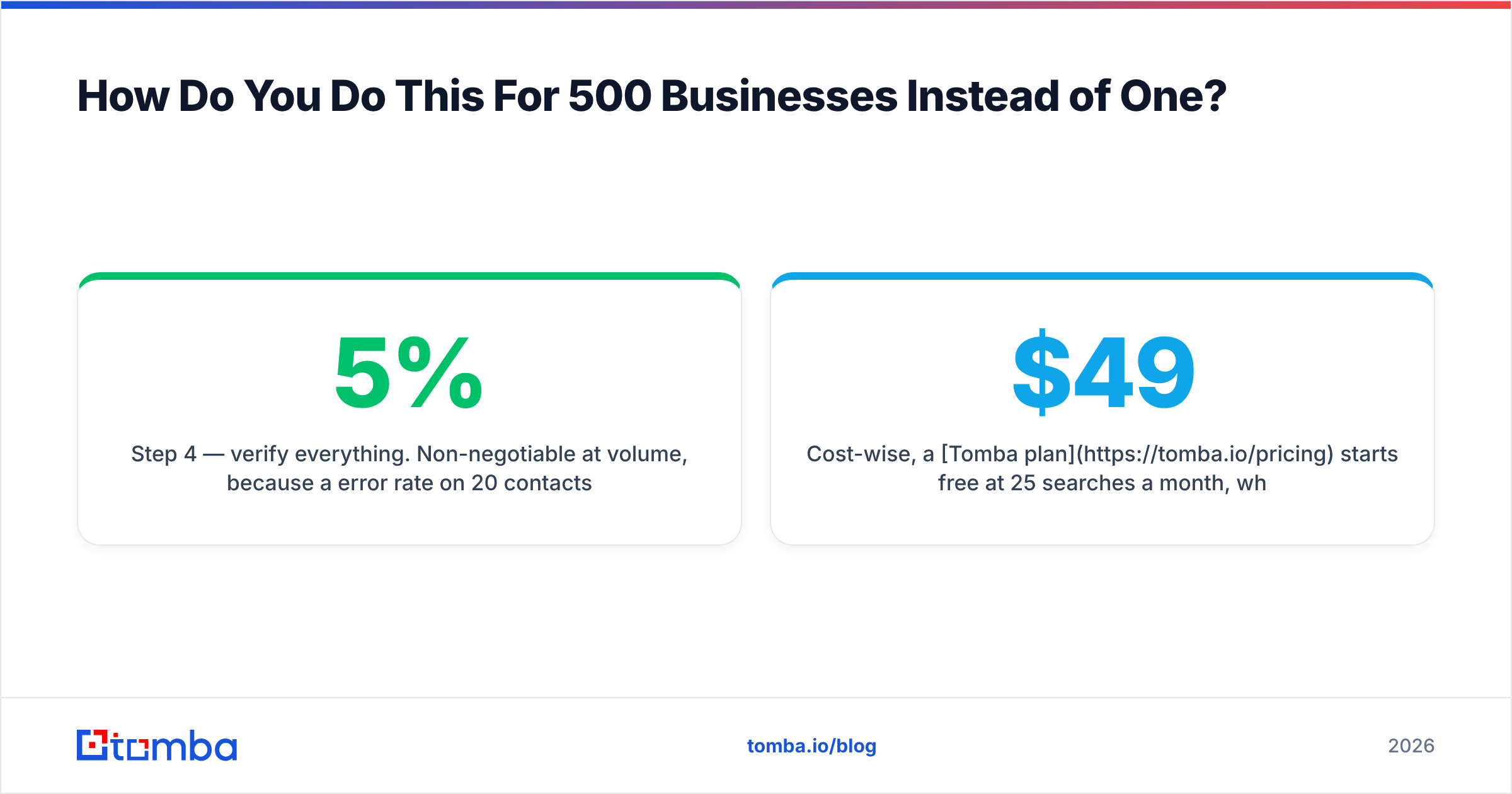
Step 4 — verify everything. Non-negotiable at volume, because a 5% error rate on 20 contacts is one bad send and on 2,000 contacts it's a deliverability incident.
Step 5 — spot-check by hand. Pull 20 random records and verify them manually against LinkedIn. If more than two are wrong, your title filter or your source list is broken, and no amount of sending volume will fix it.
Cost-wise, a Tomba plan starts free at 25 searches a month, which is enough to test the workflow on a sample before committing. Starter runs $49/mo and Growth $99/mo; prepaid credit providers like BookYourData are a reasonable alternative if your work is bursty and you'd rather not carry a subscription between campaigns. Match the billing model to how you actually work — teams that prospect two weeks a quarter overpay on annual seats every single time.
Which Owner Titles Actually Signal Decision Authority?#
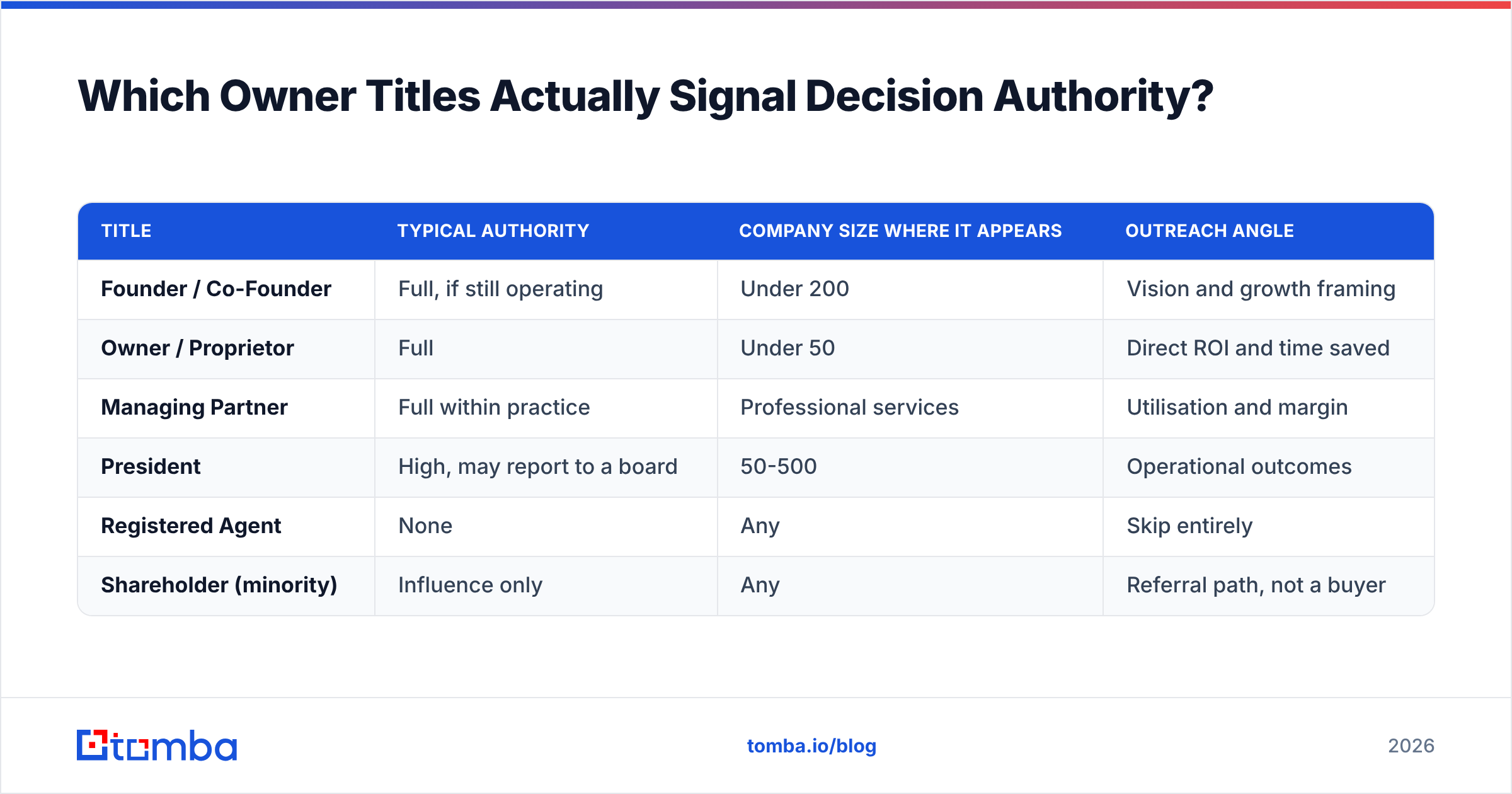
Not every "owner" can sign a contract. Rank your list:
| Title | Typical authority | Company size where it appears | Outreach angle |
|---|---|---|---|
| Founder / Co-Founder | Full, if still operating | Under 200 | Vision and growth framing |
| Owner / Proprietor | Full | Under 50 | Direct ROI and time saved |
| Managing Partner | Full within practice | Professional services | Utilisation and margin |
| President | High, may report to a board | 50-500 | Operational outcomes |
| Registered Agent | None | Any | Skip entirely |
| Shareholder (minority) | Influence only | Any | Referral path, not a buyer |
At companies under 20 people, the owner is usually your buyer, your champion, and your implementer. At 100-plus, the owner is a referral route to a functional lead, and pitching them directly on a tactical tool often stalls.
Start With the Name, Finish With a Verified Inbox#
Finding out who owns a business is a two-part problem, and most people only solve the first half. Registries and LinkedIn give you a name. They don't give you a way in.
Close the loop with the Tomba Email Finder: feed it the owner's name and the company domain, and get back a verified, pattern-confirmed work email with a confidence score — in under a second, at any volume from one lookup to a few thousand. The free tier covers 25 searches a month, which is enough to run the whole workflow described above on a real list before you spend anything. Do the research once, verify it properly, and send to inboxes that actually exist.
Related guides#
// get started
Find, verify and enrich your first contacts today
Start on the free plan with 25 searches a month, then scale when your team is ready.
Free plan · No credit card required · GDPR & CCPA
// about the author