How to Find Out Who Owns a Business Name (2026 Guide)
State registries, trademark databases, WHOIS records, and enrichment tools each reveal a different slice of business ownership. Here is the exact order to search them — and what to do when the registry only lists a registered agent.
Knowing how to find out who owns a business name takes about ten minutes. It also takes four separate sources. This guide runs them in order, from the free state registry to a paid contact lookup. It also covers the most common dead end: a registered agent standing in for a real person.
TL;DR
- Ownership records live in four places: state business registries, trademark databases, domain WHOIS, and corporate filings. No single one gives the full picture.
- Start with the free state Secretary of State search. It takes 90 seconds. It returns the legal entity, filing date, status, and registered agent.
- The most common dead end is a registered agent (CT Corporation, Registered Agents Inc., Northwest) instead of a human. That is a service address, not an owner.
- When filings are thin, read the leadership off LinkedIn first. Then confirm the person with a contact-data lookup.
- Expect lag. Registries update on annual-report cycles, so a 2023 filing may name an officer who left in 2024.
Why is finding a business name owner harder than it looks?#
Because "owner" means at least five different things. Each one is recorded by a different authority.
Think of it like a car. The DMV knows the registered keeper. The insurer knows who drives it. The finance company holds the title. The person washing it on Sunday may be none of them. Ask "who owns this car?" and you have to say which record you mean.
For a business name, the layers are:
- The legal entity holder — the LLC or corporation that filed the name with a state. Recorded by the Secretary of State.
- The trademark owner — whoever registered the name as a mark for a class of goods or services. Recorded by the USPTO or a national IP office.
- The DBA / fictitious name filer — usually a county record. Often the only place a sole proprietor appears.
- The domain registrant — who controls the website. Recorded in WHOIS, though GDPR now redacts most of it.
- The beneficial owner — the human who actually profits. In the US this touches FinCEN's Beneficial Ownership Information reporting, but public access is restricted.
A business can have five different answers across those five layers, all of them legitimate. A franchise operator, a holding company, and the agency running the domain can each be "the owner" in some real sense.
How to find out who owns a business name: 6 fast free methods#
Work these in order. Each step narrows what the next one has to do.
Start with the three official records:
- State Secretary of State business search — free, authoritative, instant. Every US state runs one. Search the exact name plus variants. You get entity type, status, formation date, principal address, registered agent, and often the officers.
- County fictitious business name (DBA) index — where sole proprietors and small partnerships surface. If the state registry returns nothing, the business probably trades under a DBA. The county clerk holds that filing.
- USPTO TESS / trademark search — searches the USPTO trademark database for the name as a registered mark. The owner of record is a real legal entity. Correspondence addresses often name an attorney you can trace.
If those give you an entity but no person, add these three:
- Domain WHOIS + historical WHOIS — current records are mostly redacted after GDPR. Registrar, creation date, and nameservers still leak signal. Archived snapshots from before 2018 often show a named registrant.
- Business credit and directory databases — D&B, OpenCorporates, and state UCC filing indexes link entity names to parent companies and lien holders.
- LinkedIn + leadership pages — for private firms with thin filings, the founder or managing member is usually easy to spot.
Which record tells you what?#
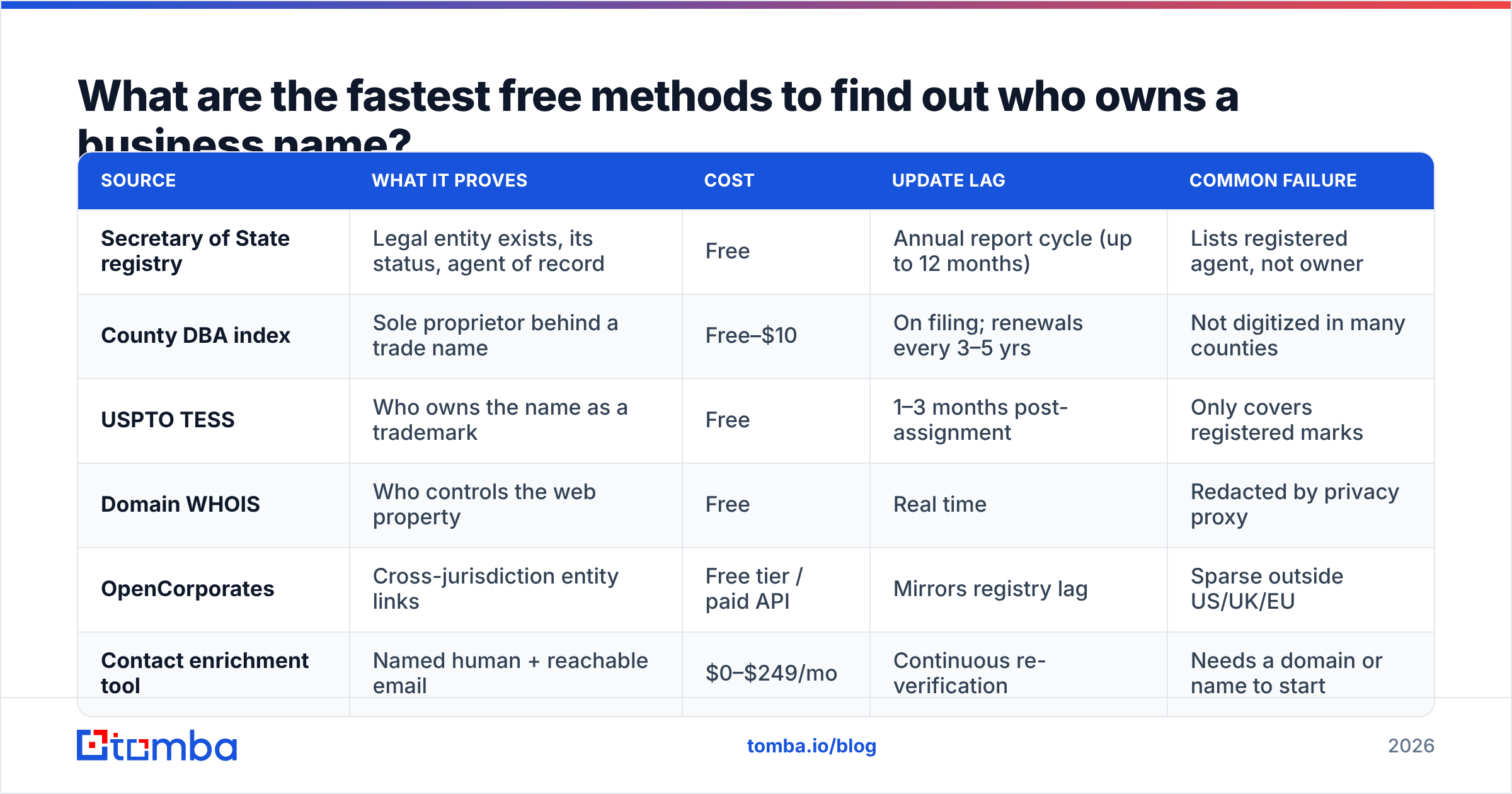
| Source | What it proves | Cost | Update lag | Common failure |
|---|---|---|---|---|
| Secretary of State registry | Legal entity exists, its status, agent of record | Free | Annual report cycle (up to 12 months) | Lists registered agent, not owner |
| County DBA index | Sole proprietor behind a trade name | Free–$10 | On filing; renewals every 3–5 yrs | Not digitized in many counties |
| USPTO TESS | Who owns the name as a trademark | Free | 1–3 months post-assignment | Only covers registered marks |
| Domain WHOIS | Who controls the web property | Free | Real time | Redacted by privacy proxy |
| OpenCorporates | Cross-jurisdiction entity links | Free tier / paid API | Mirrors registry lag | Sparse outside US/UK/EU |
| Contact enrichment tool | Named human + reachable email | $0–$249/mo | Continuous re-verification | Needs a domain or name to start |
The pattern in that table is simple. Free public sources confirm an entity well and surface a person badly. The paid layer flips it. Most real research runs both.
How do you use a state business registry properly?#
Three rules turn a registry search from frustrating to fast.
Search fragments, not full names. Registries match literal strings far more often than fuzzy ones. "Acme Widget Holdings LLC" returns nothing if the filing reads "ACME WIDGET HLDGS, L.L.C." Search "acme widget" and read the list.
Check status, not just existence. An entity marked administratively dissolved or forfeited has stopped filing annual reports. That is a strong signal for due diligence. It also means the officer data you are reading is frozen at the last filing date.
Read the filing history, not the summary page. The summary shows the current registered agent. The document list shows the original articles of organization. In states like Florida, Texas, and Colorado, those articles name the actual organizers. That first filing is usually the closest thing to a founder name you get for free.
Delaware is the exception, and the reason so many searches dead-end. Delaware does not publish member or manager names for LLCs. You get the entity, the file number, the formation date, and the registered agent. Nothing else. If your target is a Delaware LLC, skip to the trademark, domain, and people-based methods below.
What do you do when the registry only shows a registered agent?#
You pivot to signals the agent cannot mask.
A registered agent is a mailbox with legal standing. CT Corporation, CSC, Registered Agents Inc., and Northwest front tens of thousands of entities between them. Seeing one tells you the company used a formation service. That is normal, not suspicious, and it says nothing about ownership.
Four workarounds that actually produce a name:
- Trademark assignment records. If the business ever registered a mark, the USPTO assignment database shows transfers between entities. Those chains often expose a parent company or an individual.
- UCC filings. When a business borrows against assets, the lender files a UCC-1 with the state. Debtor name and address are public. Small-business filings often list the owner personally as a guarantor.
- Court and litigation dockets. PACER and state court indexes name officers in any suit involving the entity.
- The website itself. Terms of service, privacy policy, and refund pages are drafted by lawyers who name the real legal entity. This is the most underrated trick. A company can hide behind an agent in the registry, then name itself precisely in its own ToS.
Once you have a probable name and a company domain, a reverse email lookup or a domain search closes the loop. Both map names to verified work addresses at that domain.
Can you find the owner of a business name outside the US?#
Yes. In several countries it is easier than in the US.
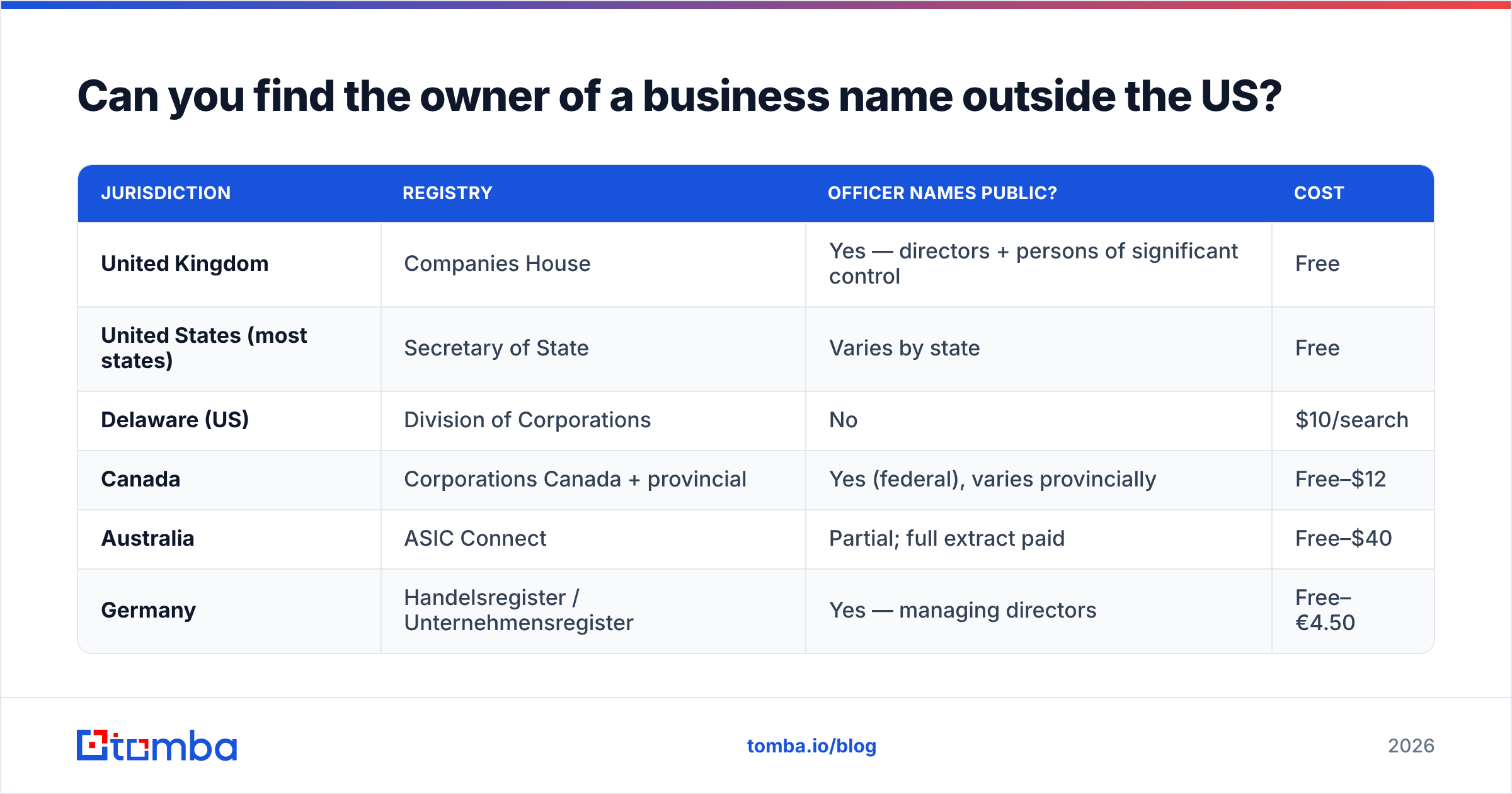
| Jurisdiction | Registry | Officer names public? | Cost |
|---|---|---|---|
| United Kingdom | Companies House | Yes — directors + persons of significant control | Free |
| United States (most states) | Secretary of State | Varies by state | Free |
| Delaware (US) | Division of Corporations | No | $10/search |
| Canada | Corporations Canada + provincial | Yes (federal), varies provincially | Free–$12 |
| Australia | ASIC Connect | Partial; full extract paid | Free–$40 |
| Germany | Handelsregister / Unternehmensregister | Yes — managing directors | Free–€4.50 |
The UK's Companies House is the gold standard. It publishes directors, their month and year of birth, and a "persons with significant control" register. That register names anyone holding more than 25% of shares. If your target has a UK entity, start there. Multinationals often disclose more in the UK filing than anywhere else.
When should you skip public records and use a data tool instead?#
When your goal is contact, not proof.
Public records exist to establish legal facts. If you need to reach the owner, you need a name, a title, and a working email. That applies to partnership pitches, acquisition inquiries, supplier talks, and outbound sales. Registries give you the first, sometimes the second, and never the third.
The practical workflow for a reachable owner:
- Confirm the entity in the state registry. Note the exact legal name and the principal address.
- Confirm the domain matches that entity. Check the ToS page, the footer, and the WHOIS registrar org field.
- Pull the people at that domain. A domain search returns the contacts at a company domain with roles and confidence scores. That lets you spot the founder or owner-operator without guessing.
- Verify before you send. Ownership data ages fast. A name from a 2023 annual report may be at a different company now. Run the address through an email verifier so a bounced guess does not cost you sender reputation.
- Enrich for context. Contact enrichment adds title, LinkedIn profile, and company size. Your first message can then reference something real.
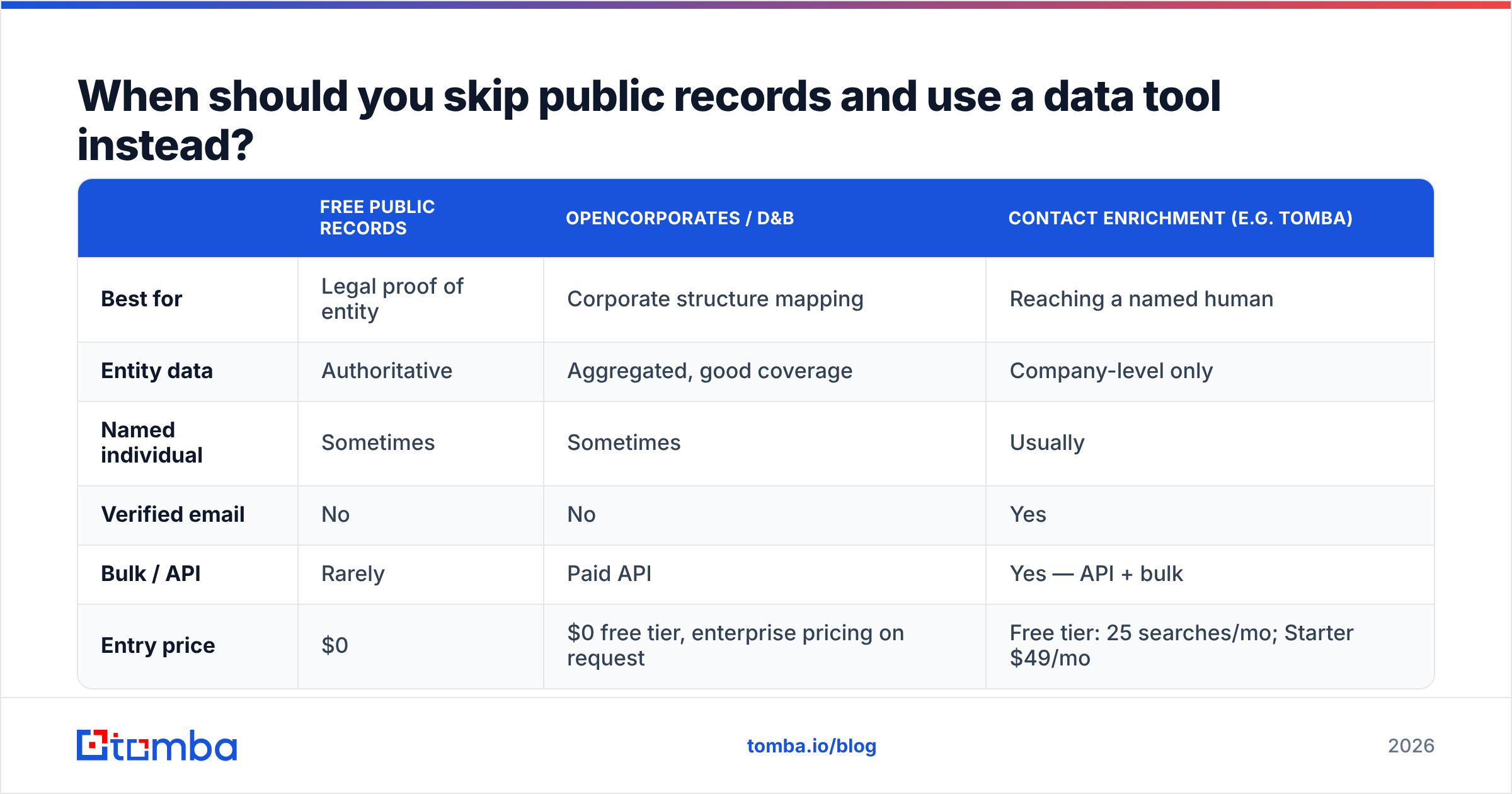
How the tool tiers compare for owner lookups#
| Free public records | OpenCorporates / D&B | Contact enrichment (e.g. Tomba) | |
|---|---|---|---|
| Best for | Legal proof of entity | Corporate structure mapping | Reaching a named human |
| Entity data | Authoritative | Aggregated, good coverage | Company-level only |
| Named individual | Sometimes | Sometimes | Usually |
| Verified email | No | No | Yes |
| Bulk / API | Rarely | Paid API | Yes — API + bulk |
| Entry price | $0 | $0 free tier, enterprise pricing on request | Free tier: 25 searches/mo; Starter $49/mo |
None of these replaces the others. Public records are the only defensible source for legal due diligence. Aggregators map a corporate tree fastest. Enrichment tools are the only realistic path to a verified inbox. Use them in that order and each one costs you less work than starting from scratch.
How do you verify the owner information you find is current?#
Cross-check against three independent timestamps.
Filing recency. Every registry entry shows a last-report date. If it is more than 18 months old, treat officer names as historical. Some states let entities run two full years before administrative dissolution.
Domain activity. A domain that renewed last month with active MX records belongs to a working business. A parked domain with expired certs suggests a shell or a dormant entity, whatever the registry status says.
People signals. If the person the registry names now lists a different employer on LinkedIn, the registry is stale. Professional profiles update in days. Registries update in years.
One rule from B2B data work applies here. A single source you cannot corroborate is a hypothesis. Two sources agreeing is a working assumption. Three is a fact you can act on. G2's reviews of business-data platforms show that decay rate, not raw record count, separates usable databases from bloated ones. The same holds for ownership records you pull by hand.
What are the legal and ethical limits here?#
Everything described above uses public records or commercially available business data. That is the line.
Entity filings, trademark registrations, court dockets, and UCC filings are public by design. They exist so third parties can see who they are dealing with. Using them is unremarkable.
What sits outside the line: pretexting, reaching paywalled records through shared credentials, scraping against a site's terms, and treating business contact data like consumer data. In the EU and UK, business contact data still falls under GDPR. You need a lawful basis, usually legitimate interest, plus a clear opt-out in any outreach. Read the ICO's guidance on direct marketing before you build a list.
Practical rule: if you would be comfortable telling the owner exactly how you found them, you are fine.
A 10-minute checklist for how to find out who owns a business name#
- Minute 0-2: Secretary of State search in the state you believe they operate. Note entity name, status, agent, and filing history link.
- Minute 2-4: Open the earliest filing document. Look for organizer or incorporator names.
- Minute 4-6: Search USPTO for the name as a mark. Check the owner of record and any assignments.
- Minute 6-7: Load the company website. Read the footer, ToS, and privacy policy for the legal entity name. It is almost always there.
- Minute 7-8: WHOIS the domain. Note registrar, creation date, and any unredacted org field.
- Minute 8-10: Search LinkedIn for "founder/owner/managing member" at that company. Cross-check the name against the filings, then run it through a contact lookup for a verified email.
If all six steps disagree, you are probably looking at a franchise, a holding structure, or a business that recently changed hands. That is a finding, not a failure. It usually means the interesting conversation is with the parent entity.
Find the person behind the business name#
Public registries tell you an entity exists. They rarely tell you who to email.
Knowing how to find out who owns a business name gets you to a legal entity and a domain. Tomba's Email Finder turns that domain and a name into a verified, deliverable work address. It returns a confidence score and source attribution, so you can see why it thinks the address is right. Pair it with the domain search to list every contact at the entity, and the verifier to check the address before you send.
Start on the free tier (25 searches per month, no card). Check Tomba pricing if you need bulk lookups or API access for ongoing due-diligence work. Starter is $49/mo, Growth $99/mo, and Pro $249/mo for teams running owner research at volume.
Related guides#
// get started
Find, verify and enrich your first contacts today
Start on the free plan with 25 searches a month, then scale when your team is ready.
Free plan · No credit card required · GDPR & CCPA
// about the author