How To Follow Up In Sales: A 2026 Cadence Playbook
Most deals die in the gap between the first call and the second touch. Here is a concrete follow-up cadence, timing table, and message framework you can copy this week.
TL;DR
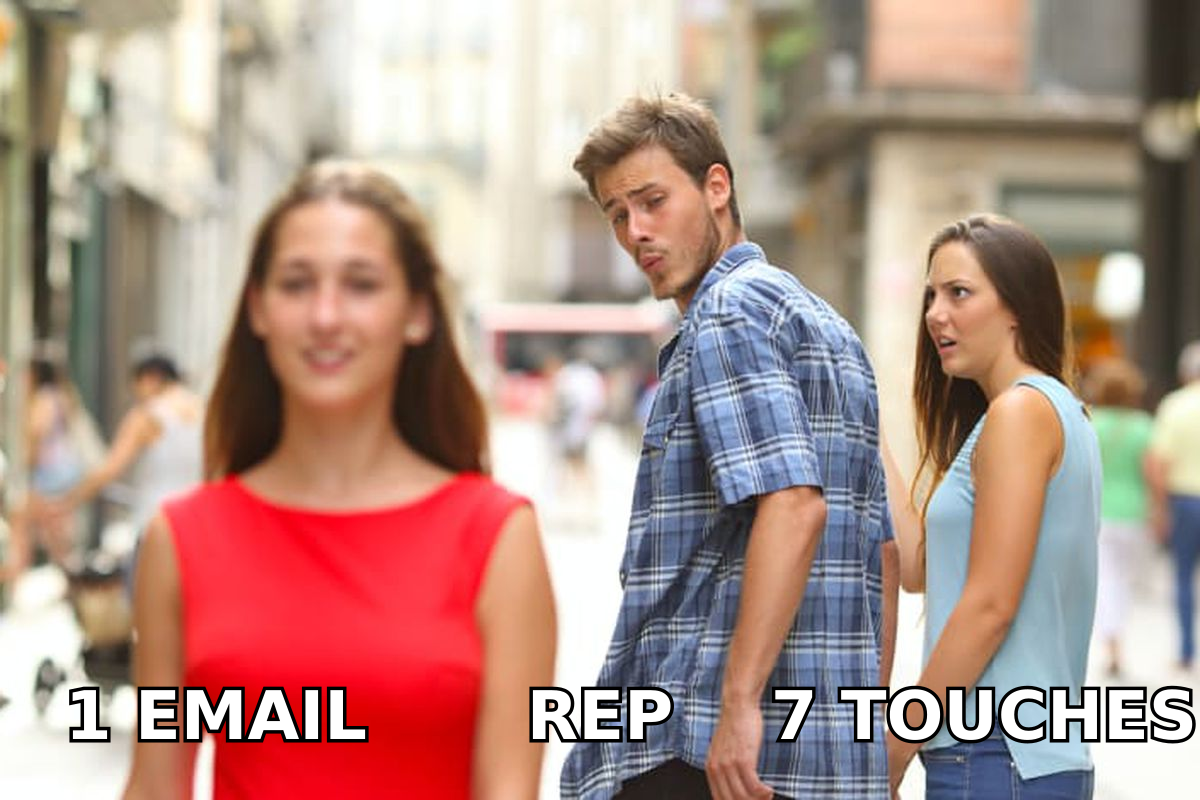
- Most B2B deals need 5 to 8 touches after the first contact, but the average rep stops at two. The gap between those numbers is where your pipeline leaks.
- A working follow-up is a sequence, not a message. Decide the number of touches, the spacing, and the channel mix before you send touch one.
- Never send a follow-up that only says "just checking in." Every touch must carry a new reason to reply: a resource, a data point, a question, or a clean break-up.
- Timing beats cleverness. Day 2, day 4, day 7, day 12, day 20 outperforms five brilliant emails sent whenever you remember.
- Follow-up only works if the contact data is right. A bounced touch three is not a "no reply" — it's a data problem you never saw.
Why do most sales follow-ups fail?#
Because they are reactive. A rep has a good call, says "I'll follow up," writes it on a sticky note, and then sends a one-line email four days later that says "circling back on the below." That email has no job. It asks the buyer to do the work of remembering, re-engaging, and deciding — all at once.
The fix is structural. You decide the cadence in advance, you write each touch to do one specific thing, and you track whether the message actually landed in an inbox. Everything else in this post is detail on those three moves.
Here is what breaks down in practice:
- No defined stop point. Reps either follow up forever (annoying) or stop after two (invisible). Both are decisions made by default.
- Every touch is the same touch. Five variations of "any thoughts?" read as five copies of the same email, because they are.
- Single-channel dependence. Email-only cadences cap out fast. Adding a call and a LinkedIn touch roughly doubles reachable contacts in most teams' data.
- Silent delivery failures. If touch one bounced or landed in spam, touches two through five never had a chance. You logged it as disinterest.
- No internal deadline. Without a next-step date agreed on the call, the follow-up has no anchor and defaults to "checking in."
What does a good follow-up cadence look like?#
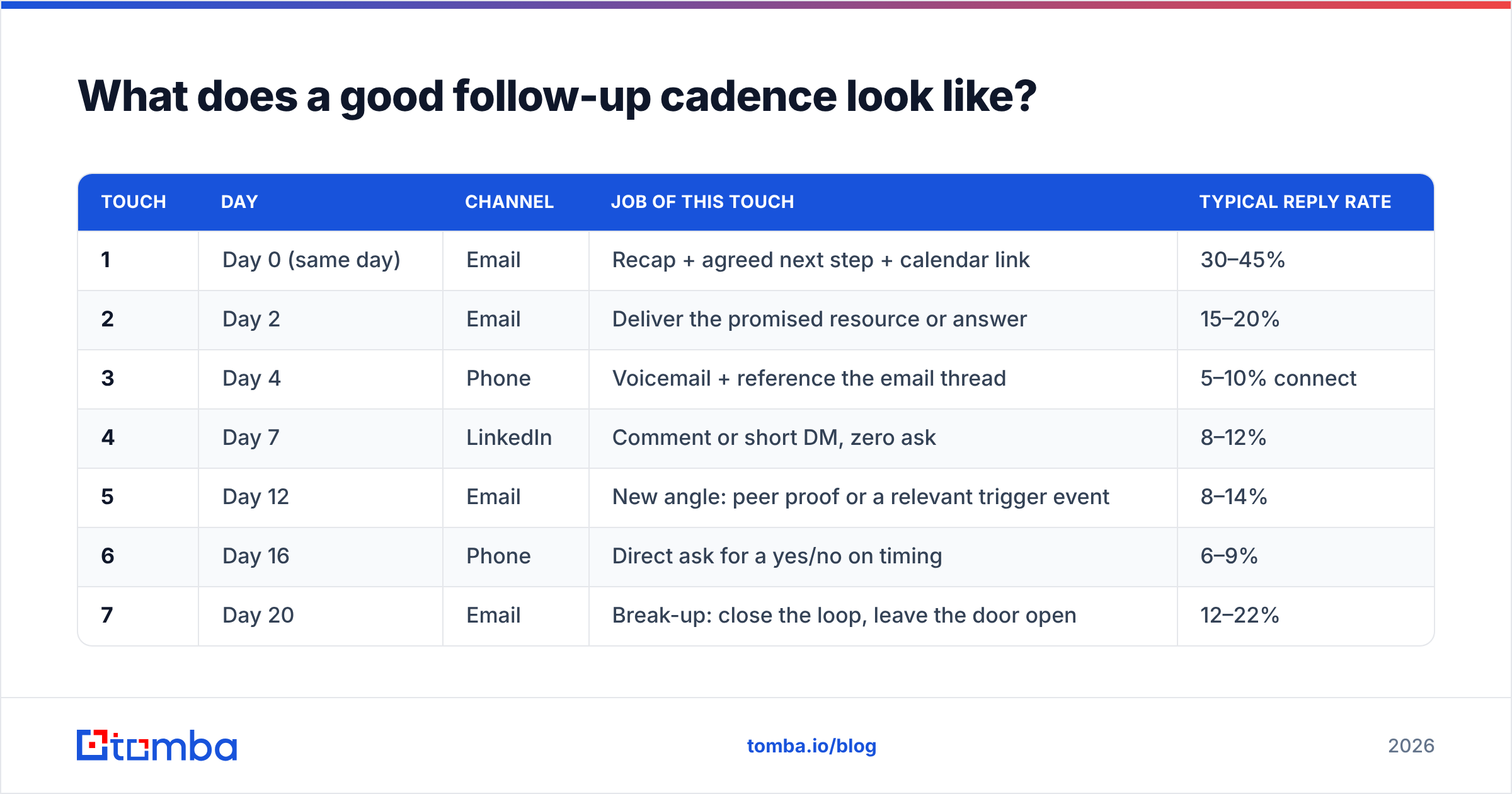
A cadence is a fixed schedule of touches across channels, with a defined start and a defined end. For most B2B deals with a mid-market ACV, seven touches over roughly three weeks is the sweet spot. Below is a cadence that works for a post-discovery follow-up — the highest-value and most-botched moment in the funnel.
| Touch | Day | Channel | Job of this touch | Typical reply rate |
|---|---|---|---|---|
| 1 | Day 0 (same day) | Recap + agreed next step + calendar link | 30–45% | |
| 2 | Day 2 | Deliver the promised resource or answer | 15–20% | |
| 3 | Day 4 | Phone | Voicemail + reference the email thread | 5–10% connect |
| 4 | Day 7 | Comment or short DM, zero ask | 8–12% | |
| 5 | Day 12 | New angle: peer proof or a relevant trigger event | 8–14% | |
| 6 | Day 16 | Phone | Direct ask for a yes/no on timing | 6–9% |
| 7 | Day 20 | Break-up: close the loop, leave the door open | 12–22% |
Two things surprise people about this table. First, touch one has by far the highest reply rate and it is the touch reps most often send late or not at all. Second, the break-up email at touch seven frequently outperforms touches three through six — because it is the only message in the sequence that gives the buyer permission to say no cheaply.
Adjust the spacing to your deal cycle. A $2k self-serve product compresses this into ten days. A $250k enterprise deal stretches it to eight weeks with more stakeholders per touch. The shape stays the same: dense early, spaced out later, with a hard stop.
How soon should you follow up after a sales call?#
Same day, before you go home. There is no debate on this one.
The recap email sent within four hours of a discovery call does three jobs that no later message can do as well:
- It locks the next step in writing. "As agreed, we'll reconvene Thursday the 14th at 10am — invite attached."
- It documents their words, not yours. Quote the problem back in the buyer's language. This is what gets forwarded to the people who weren't on the call.
- It creates the reference thread. Every later touch replies to this email, so the buyer never has to reconstruct context.
Reply-time research across sales orgs consistently shows response probability decaying sharply with delay — HubSpot's sales data has covered this repeatedly, and the pattern holds regardless of industry. Waiting two days to send a recap costs you more than anything you could write in it.
For cold outbound rather than post-call, the first follow-up should land on day 2 or 3. Same-day cold follow-ups read as automated. Anything past day 5 and the buyer has no memory of touch one.
What should each follow-up message actually say?#
Every touch needs a reason to exist that is not "I want a reply." Here are the six reasons that work, with the shape of each message.
1. The recap (touch 1). Three lines: what you heard, what you agreed, when you're meeting. No pitch. No attachments unless promised. Under 100 words.
2. The delivery (touch 2). You promised a case study, a pricing breakdown, a technical doc. Send it. Add one sentence on the specific part relevant to their situation. This is the easiest reply you'll ever earn because you're giving, not asking.
3. The new-information touch (touch 5). A competitor of theirs just did something. A regulation changed. You published something relevant. The subject line carries the news, not your name. This is where most reps go generic and lose the thread.
4. The direct question. One question, answerable in under ten words. "Is this still a priority for Q1, or should I check back in March?" Binary questions get replies that open-ended ones don't.
5. The internal-champion assist. "I put together a one-pager your CFO can skim — happy to send if that's the blocker." You're solving their internal selling problem, which is usually the real blocker.
6. The break-up (final touch). "I'll stop reaching out — if timing changes, my line is open." No guilt, no passive aggression, no "I guess this isn't a priority." The clean version gets replies. The snarky version gets you blocked.
What to delete from your templates permanently: "just checking in," "bumping this to the top of your inbox," "did you see my last email," "following up on my previous email," and any subject line that is only the word "Follow-up."
Which channels should you combine?#
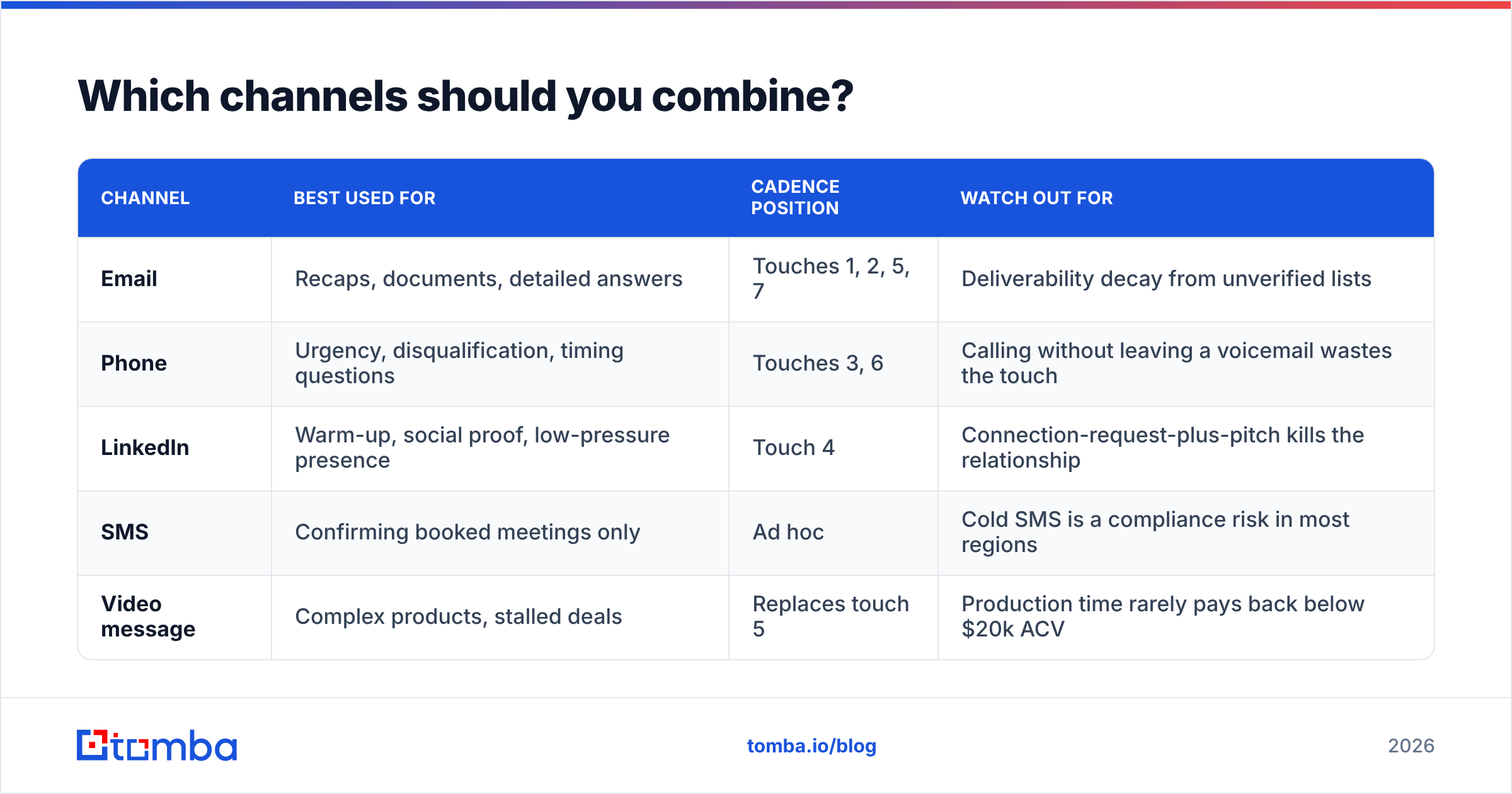
Email alone will cap your reachable rate somewhere around 40 to 60% of a list, depending on data quality and industry. Multi-channel cadences reliably outperform, but only when the channels reference each other.
| Channel | Best used for | Cadence position | Watch out for |
|---|---|---|---|
| Recaps, documents, detailed answers | Touches 1, 2, 5, 7 | Deliverability decay from unverified lists | |
| Phone | Urgency, disqualification, timing questions | Touches 3, 6 | Calling without leaving a voicemail wastes the touch |
| Warm-up, social proof, low-pressure presence | Touch 4 | Connection-request-plus-pitch kills the relationship | |
| SMS | Confirming booked meetings only | Ad hoc | Cold SMS is a compliance risk in most regions |
| Video message | Complex products, stalled deals | Replaces touch 5 | Production time rarely pays back below $20k ACV |
The reference rule matters: your voicemail should say "I sent a note Tuesday with the security doc." Your LinkedIn message should say "sent something over on email — no rush." Cross-channel references make you a person following up rather than three separate bots.
If you're building a phone leg into the cadence, you need real direct dials, not switchboard numbers. A phone finder that returns verified direct lines is the difference between touch three connecting and touch three reaching a receptionist who has never heard of your contact.
How do you know if the problem is your message or your data?#
This is the question almost nobody asks, and it invalidates a lot of follow-up "optimization."
If your touch-one email hard-bounced, every subsequent touch in that sequence went nowhere. If it soft-bounced or hit a catch-all domain that silently discards mail, you got zero signal at all — no bounce notification, no reply, just silence that looks identical to disinterest. Reps then rewrite their templates to fix a problem that lives in the CRM, not in the copy.
Run this diagnostic before you touch a single template:
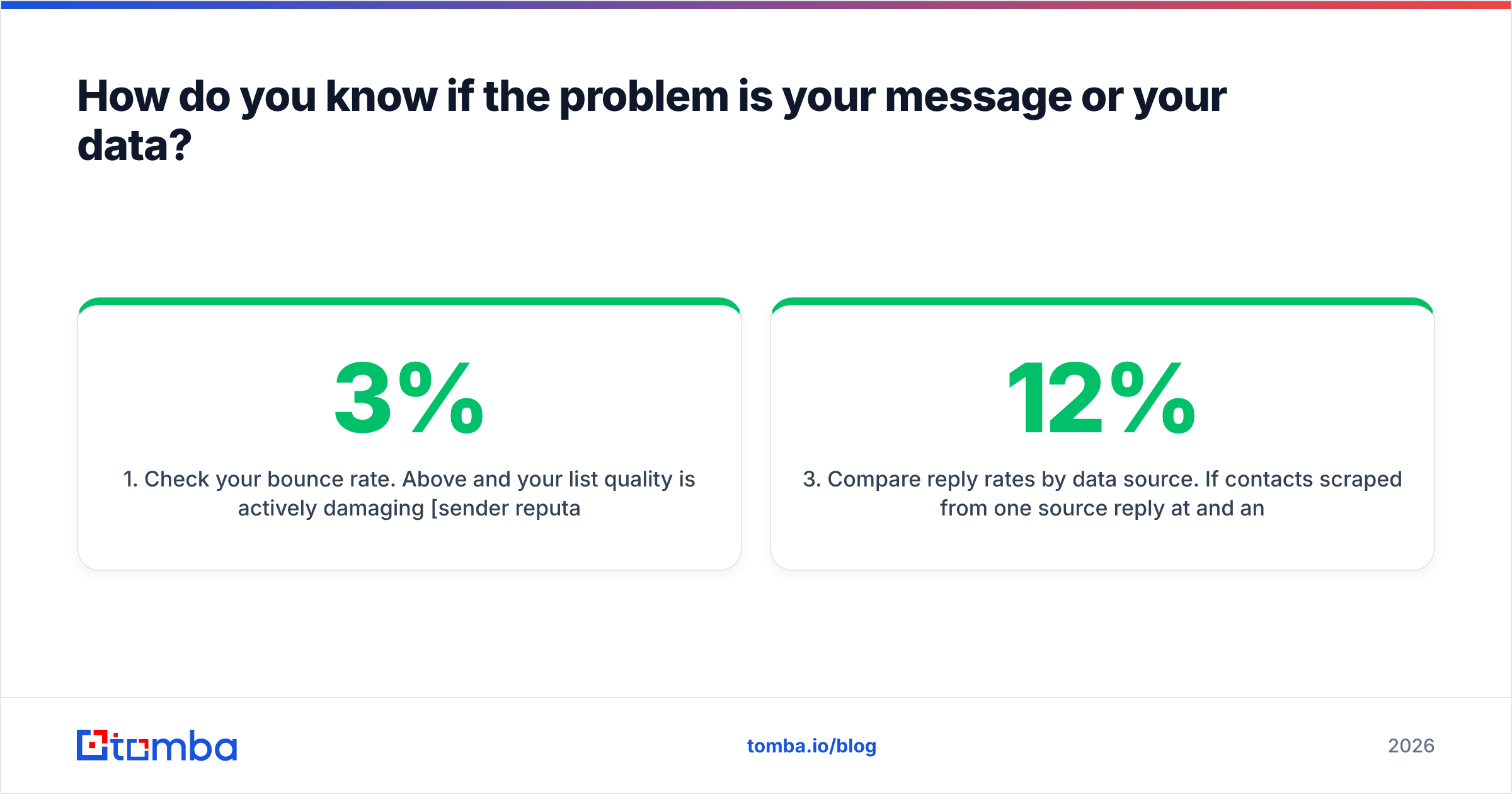
- Check your bounce rate. Above 3% and your list quality is actively damaging sender reputation, which suppresses delivery of everything else you send.
- Segment catch-all domains. These accept all mail then discard unknown addresses. They need a catch-all verifier pass before they enter a cadence, or you'll never know whether the contact exists.
- Compare reply rates by data source. If contacts scraped from one source reply at 12% and another at 1%, your problem is sourcing.
- Look at open-to-reply ratio. High opens with no replies is a message problem. Low opens across the board is usually a deliverability or data problem.
- Audit dead accounts. People change jobs roughly every two to three years. A contact list that hasn't been re-enriched in eighteen months is meaningfully decayed.
Running your list through an email verifier before the cadence starts costs a fraction of a cent per contact and removes the largest confounding variable in your follow-up data. Do it first, then optimize copy.
How many follow-ups is too many?#
The honest answer: it depends on whether each touch adds value, not on the raw count.
Seven value-carrying touches over three weeks is not aggressive. Three "just checking in" emails in five days is. Buyers don't count your emails — they count how many were worth opening.
That said, some hard rules:
- Stop at the break-up. If touch seven gets no reply, move the contact to a nurture list and stop the direct cadence. Re-entry in 90 days with a genuine trigger is fine. Re-entry next week is not.
- Honor explicit no's immediately. "Not interested" ends the sequence. Full stop. Anything else damages your brand and your deliverability.
- Cap concurrent sequences per contact. If marketing is running a nurture track and you're running an outbound cadence, that person is getting double. Coordinate this in your CRM or you'll burn good accounts.
- Watch spam complaints, not just unsubscribes. A complaint rate above 0.1% is a signal to slow down regardless of what your reply rate says. Google and Yahoo's bulk sender rules make this non-negotiable.
For a deeper read on where the line sits, G2's buyer behavior research is a useful neutral source — buyers consistently report tolerance for persistence when the content is relevant and near-zero tolerance when it isn't.
What tools support a follow-up process?#
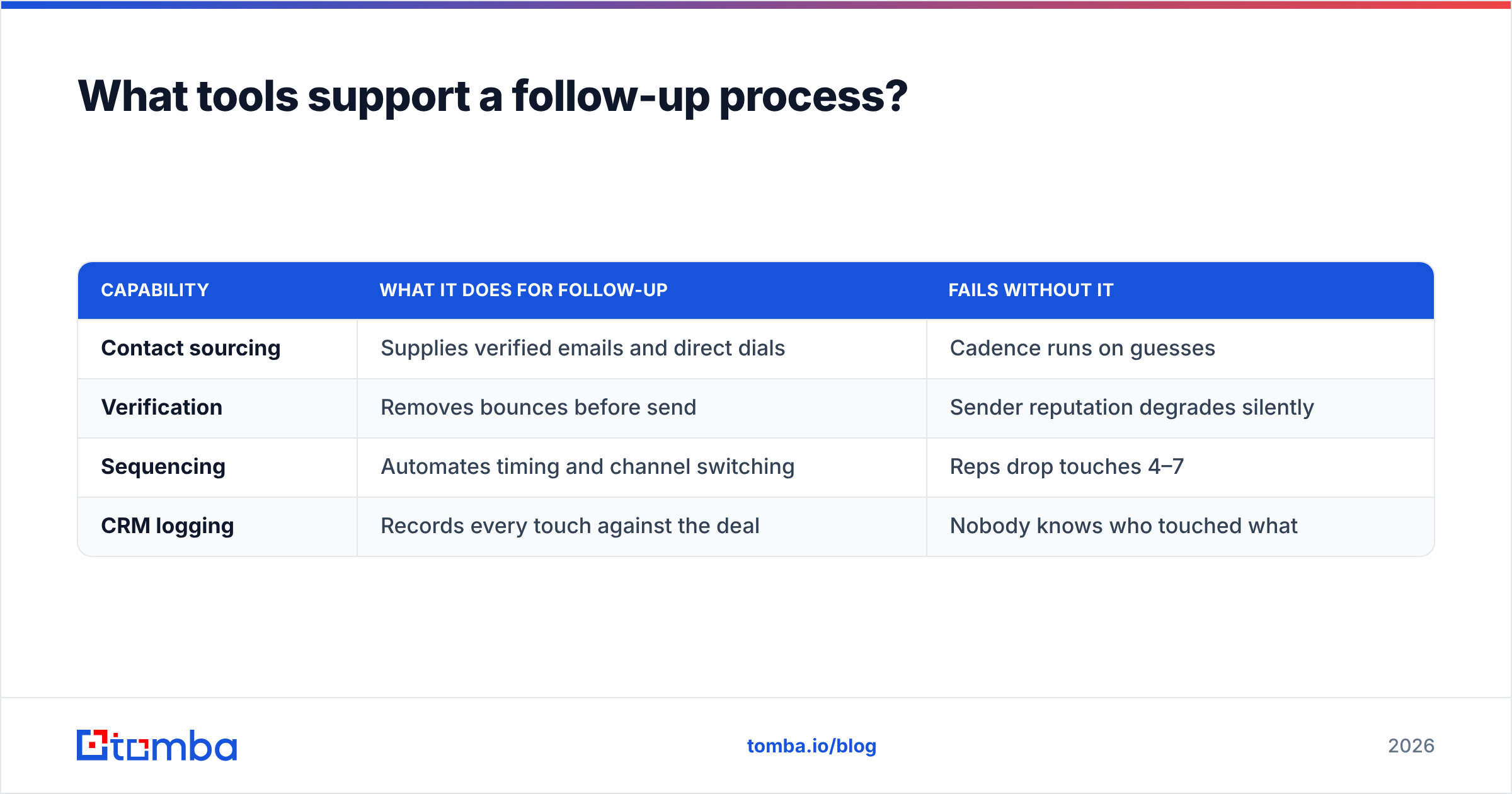
You need four capabilities. They can come from one platform or four.
| Capability | What it does for follow-up | Fails without it |
|---|---|---|
| Contact sourcing | Supplies verified emails and direct dials | Cadence runs on guesses |
| Verification | Removes bounces before send | Sender reputation degrades silently |
| Sequencing | Automates timing and channel switching | Reps drop touches 4–7 |
| CRM logging | Records every touch against the deal | Nobody knows who touched what |
The sequencing layer is crowded — Outreach, Salesloft, Instantly, Reply.io, and Saleshandy all do it competently, and providers like BookYourData serve teams that want ready-built lists to feed those sequences. The layer people underinvest in is the first two: sourcing and verification. A perfect cadence executed against a 20%-invalid list is a 20% loss before you write a word.
If you're building lists yourself, a domain search pass on target accounts gives you the full contact map — including the second and third stakeholders you'll need when your champion goes quiet at touch four. Multi-threading is itself a follow-up tactic: when the primary contact stops replying, the right next touch is often a different person at the same company, not a sixth email to the same inbox.
For teams running cadences at volume, wiring sourcing directly into the sequencer through the Tomba API removes the CSV shuffle entirely — contacts get found, verified, and enrolled without a human step in between.
What does a follow-up process look like at team scale?#
Individual discipline doesn't scale. Process does. Three things make follow-up a team capability rather than a rep habit:
A cadence library, not freestyle. Two or three approved cadences (post-demo, cold outbound, stalled deal) that every rep runs. Variation happens inside the message, not in the schedule.
A single next-step field in the CRM. Every open opportunity has a date and an action. No date means the deal is not real. Managers review that field, not activity counts.
Weekly no-reply review. Fifteen minutes on deals that went silent. Half the time the answer is "wrong contact" or "champion left" — both fixable with better data, neither fixable with a better subject line.
Track response rate by touch number, not just in aggregate. When you can see that touch five is dead across the whole team, you rewrite touch five. Aggregate reply rate tells you nothing actionable.
Start with the data layer#
The cadence in this post works. But it only works when the contact on the other end is real, current, and reachable. Follow-up discipline built on stale data is a very organized way to email nobody.
Start by cleaning what you have and filling the gaps. The Tomba Email Finder returns verified professional emails by name and domain, so touch one lands in an inbox instead of a bounce log — and the free tier gives you 25 searches a month to test it against your own accounts before committing. Paid plans start at $49/month on Starter and scale through Growth at $99/month; the full breakdown lives on the Tomba pricing page.
Fix the data, run the seven touches, and stop losing deals to silence you never diagnosed.
Related guides#
// get started
Find, verify and enrich your first contacts today
Start on the free plan with 25 searches a month, then scale when your team is ready.
Free plan · No credit card required · GDPR & CCPA
// about the author